Pleśniak

  • I first tasted pleśniak on my recent trip to Gdańsk.
  • I had never heard of it before although some of my cakes are similar.
  • It does not appear in any of my older Polish cookery books.
  • Having done a little more research I found it was in some people’s list of their top 10 favourite Polish cakes.
  • *
  • The name is intriguing in that the word means  – mildew or mouldy!
  • It consists of 3 or 4 layers, usually baked in a square or rectangle:
  • Shortcrust/chocolate shortcrust 
  • Sour fruits
  • Meringue
  • *
  • Maybe the mildew reference is to the look of the meringue layer?
  • *
  • The sour fruits are usually sour cherries, blackcurrants or gooseberries.
  • Jam or a mixture of jam and fresh or frozen fruits can be used.
  • The fruit layer should be on the sour side – so if you jam is sweet – heat it up with the addition of the juice of a lemon or two.
  • Sometimes rhubarb, cooked first, is used.
  • My placek with rhubarb & meringue could be adapted with the addition of cocoa to the pastry or the fruit.
  • *
  • I tried this out in a 26 x 21 rectangular tin.
  • I have seen several versions – sometimes with the egg whites/meringue under a layer of pastry – I think the meringue on top is easier.

Shortcrust layers

  • Start to make a rich buttery shortcrust using 250g of plain flour.
  • Do not add any sugar to the pastry.
  • Divide the crumbs part into two.
  • Use the first half to make pastry with 2 egg yolks.
  • To the second half add 3 tablespoons of cocoa powder and continue with 2 egg yolks as normal.
  • Wrap each dough separately. 
  • Leave to chill for around 30 minutes.
  • Egg whites will be used in the meringue.
  • Pre-heat the oven to GM6 – 200°C.
  • Grease and line the baking tin with one long piece of baking paper.
  • Roll out the plain shortcrust to fit into the tin.
  • Roll out the chocolate shortcrust and place this on top.
  • Prick with a fork all over.
  • Bake for around 20 – 25 minutes.
  • Leave to cool completely.

Sour Fruit Layer

  • Spread jam (sour cherry, blackcurrant or gooseberry) over the pastry.
  • If you jam is sweet – heat it up with the addition of the juice of a lemon or two first.
  • Leave to cool.
  • Add some fresh or frozen fruits if you have them.

Meringue Layer

  • Pre-heat oven to GM3 – 160°C.
  • Use 3-4 egg whites & 50g icing sugar per white.
  • Place the whites into a grease free bowl.
  • Whisk till stiff.
  • Add icing sugar and whisk again till stiff.
  • *
  • Spread meringue over the top of the fruits.
  • Bake for 30 – 35  minutes.
  • Can be longer or shorter depending on if you want the meringue crisp or soft.
  • *
  • Leave to cool.
  • Cut into squares when serving.

Royal Standard – Lyndale tea plate.
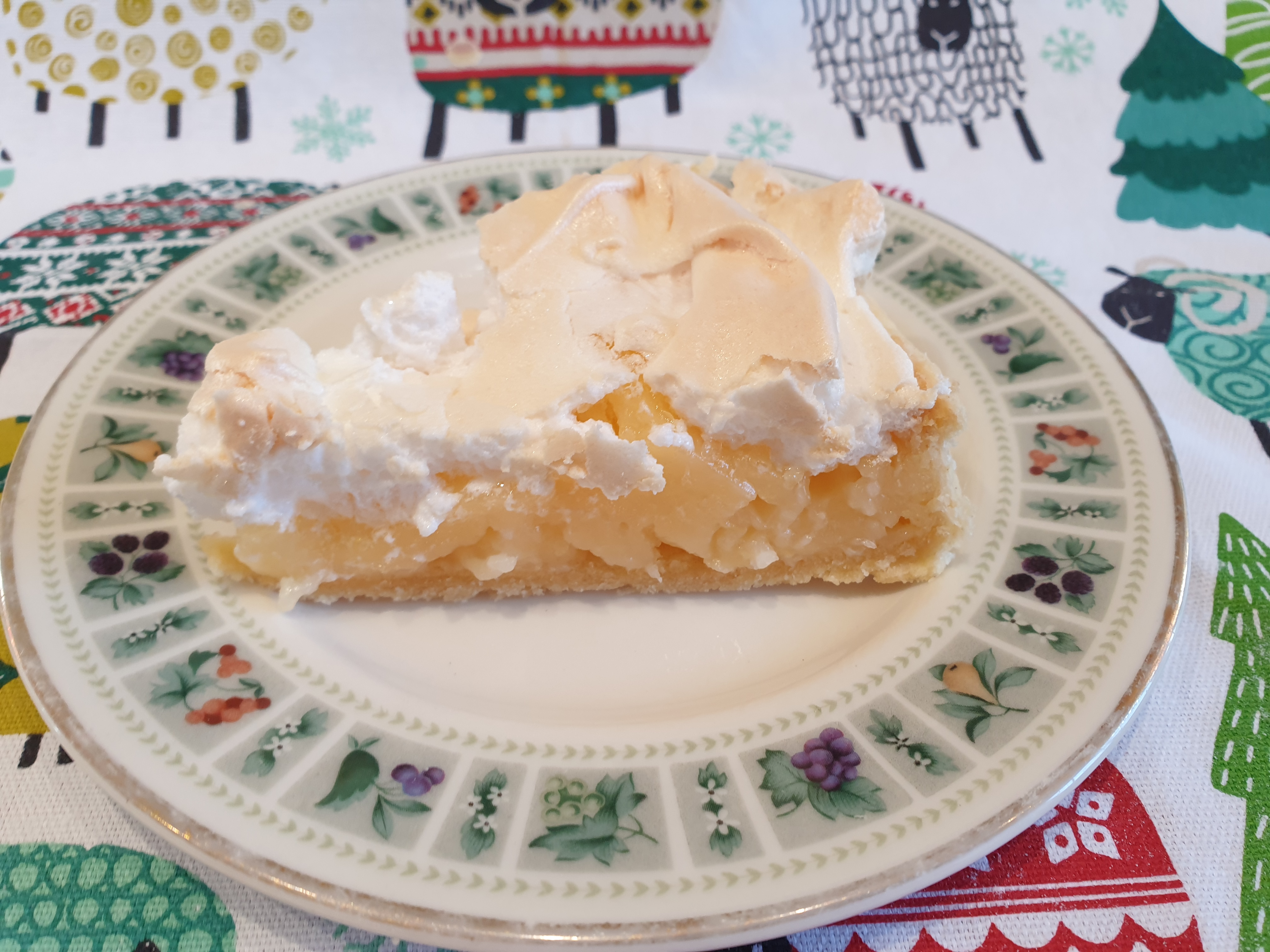
Lemon Meringue Pie

  • I am sure this would be a popular dessert in Poland and would be a bezowa (meringue) tarta (tart)
  • This is said to have originated in the United States of America.
  • Custard pies of various kinds using egg yolks had been made in Britain and then America for years but the first mention of Lemon Meringue Pie is in a cookery book of 1869.

  • Mrs Elizabeth Goodfellow, who ran a pastry shop in Philadelphia, decided to use the leftover egg whites as a topping over a lemon custard.

  • Mrs Elizabeth Goodfellow also started America’s first cookery school.


    INGREDIENTS

    Shortcrust pastry

    *

    40g cornflour

    25g butter

    300ml water

    2 lemons rind & juice

    2 egg yolks

    50g caster sugar

    *

    2 egg whites

    50g & 50g caster sugar

    METHOD

    It is best to use a metal dish especially one with a loose base.

    Any diameter from 18cm to 22cm.

    Grease the dish well.

    Roll out the shortcrust pastry and line the dish.

    Place a circle of baking paper over the base and add “baking beans”.

    Bake blind at GM 7 – 220°C for around 15 minutes.

    Remove the beans and paper and bake for another 5 minutes.

    Leave to cool.

    *

    In a saucepan blend a little of the water with the cornflour.

    Add the rest of the water and the butter.

    Bring to the boil and then lower the heat

    Stir and cook for 3 minutes.

    Remove from the heat.

    Add the lemon rind and juice.

    Add the yolks and 50g of caster sugar.

    Mix well and leave to cool.

    *

    Pre-heat the oven to GM3 – 160°C.

    *

    Fill the pastry with the lemon mixture.

    *

    Whisk the egg whites till stiff.

    Whisk in 50g of caster sugar till stiff.

    Fold in 50g of caster sugar.

    Cover the pie with the egg white mixture.

    Make random peaks over the surface.

    Bake for 25 minutes.

    *

    Leave to cool before serving.

    OPTION

    If you have an extra egg white, say from making the pastry, use this with extra sugar for the topping.

  • Served here on Royal Doulton Tapestry.

Grape Meringue Placek

This cake is a cross between my grape meringue cake and placek(flat cake) with rhubarb and meringue. 

There are two parts to this cake

  • Short pastry base – baked and cooled
  • Grapes* & Meringue topping.

Short pastry base

The base of this is made made from the recipe for  Ciasto kruche 1 – using raw egg yolks found in a previous post  – Pastry – ciasto kruche & półkruche.  

However as the topping is sweet, I used less sugar in the pastry – you might be able to omit all the sugar – I have not tried this.

Ingredients – Base

  • 300g plain flour
  • 200g butter – chilled
  • 50g icing sugar
  • 4 egg yolks
  • pinch of salt

Method – Base

  • Add a pinch of salt to the flour.
  • Use a knife to cut the chilled butter into small pieces into the flour and then use your fingers to make the mixture like breadcrumbs.
  • Add the icing sugar and mix this together.
  • Add the yolks and gently mix them in
  • Bring it all together into a dough – try and handle the pastry as little as possible.
  • Form the dough into a rough rectangle.
  • Wrap the dough in grease proof paper and chill it in the fridge for about 30 minutes.
  • Preheat the oven to GM 6 – 200°C.
  • Grease and line a 33 x 23 cm baking tin – use one long piece for sides and base – helps to take it out. 
  • Use a rolling pin to flatten the dough a little
  • Press the dough into the tin – filling it up all the sides.
  • Prick the surface with a fork.
  • Bake for 20 – 25 minutes till golden.
  • Leave to cool.

Ingredients – Meringue

  • 4 egg whites
  • 200g granulated sugar
  • 2 sponge fingers  – crushed
  • *
  • 300g seedless green grapes

Method – Meringue

  • Preheat the oven to GM 2 -150°C.
  • Place the whites into a grease free bowl.
  • Whisk till stiff.
  • Add granulated sugar and whisk again till stiff.
  • Fold in the crushed sponge fingers.
  • *
  • Place 1/3 of the meringue over the cake base.
  • Place the grapes over the meringue.
  • Cover the grapes with the rest of the meringue
  • Put into the oven for 50 – 60 minutes.
  • Leave to cool completely in the tin.
  • Cut the cake into squares when cool to serve.

Served here on  Royal Doulton – Sonnet  1971-1998

* Note – I tried this with red grapes and found that the skins were too thick and the cake did not come out well – you need thin skinned small seedless green grapes

Placek with Rhubarb & Meringue

This cake was inspired by my placek(flat cake) with sour cherries and meringue

There are three parts to this cake:

  • Short pastry base – baked and cooled.
  • Rhubarb filling – cooked and left to go cold.
  • Meringue topping.

Three stages all take a bit of time but well worth the effort. It is delicious with a lovely balance of  sweetness against the tart rhubarb.

Short pastry base

The base of is made with a smaller amount of the recipe for  Ciasto kruche 1 – using raw egg yolks found in a previous post  – Pastry – ciasto kruche & półkruche. 

I could see out of my kitchen window that the rhubarb was beginning to grow.  As I still had one batch left frozen from last summer I to decided to use that up before the new crop and in time for you to try it.

Ingredients – base

  • 200g plain flour
  • 100g butter – chilled
  • 70g icing sugar
  • 2 egg yokes
  • pinch of salt

Method – base

  • Add a pinch of salt to the flour.
  • Use a knife to cut the chilled butter into small pieces into the flour and then use your fingers to make the mixture like breadcrumbs.
  • Add the icing sugar and mix this together.
  • Add the yolks and gently mix this in, then and bring it all together into a dough – try and handle the pastry as little as possible.
  • Form the dough into a rough rectangle.
  • Wrap the dough in greaseproof paper and chill it in the fridge for about 30 minutes.
  • Preheat the oven to GM 6 – 200°C.
  • Grease and line a 23 x 26 cm baking tin.
  • Use a rolling pin to flatten the dough a little
  • Press the dough into the tin – filling it up all the sides.
  • Prick the surface with a fork.
  • Bake for 20 – 25 minutes till golden.
  • Leave to cool.

Ingredients – Rhubarb filling

  • 400g (approx) of rhubarb
  • 150g of granulated sugar (more may be needed)
  • 25g of butter
  • 3 egg yolks
  • 2-3 tablespoons of potato or corn flour

Method – rhubarb filling

  • This needs to be made ahead of time as it must be cold.
  • Pre-heat the oven to GM2
  • Chop the rhubarb into small pieces and place in a baking dish
  • Add sugar.
  • Bake in the oven for around 1 hour – till soft.
  • Check for sweetness and add more sugar if necessary – but not too sweet.
  • Leave to cool a little.
  • *
  • I used cooked rhubarb that I had frozen from last year. 
  • *
  • Wizz the rhubarb up with a blender or chopper to get a purée.
  • Place this in a saucepan.
  • Heat slowly.
  • Mix the yolks with the potato or cornflour and add this to the rhubarb and heat till it thickens.
  • Add the butter and mix in.
  • Leave to go cold before use.

A few thoughts on the origin & history of meringues:

  • Meringue – a French word.
  • Swiss village of Meiringen.
  • Improved by Italian chef Gasparini.
  • From Polish word – marzynka – a day dream?
  • Made by the chef for the exiled king of Poland, Stanisław Leszczyński (1677 – 1766), Duke of Lorraine (1737 -1766).
  • His daughter, Maria, was married to Louis XV of France and she introduced them to the court.
  • In Polish – beza(sing)) bezy(pl) – link to – buzi kiss?
  • French meringue – whisk eggs till stiff – add sugar and whisk again.
  • Italian meringue – uses sugar syrup.
  • Swiss meringue – sugar and whites heated over a water bath.
  • Addition of cornflour – strengthens the egg white.

Meringue

  • I used 4 egg whites & 200g icing sugar.
  • Place the whites into a grease free bowl.
  • Whisk till stiff.
  • Add icing sugar and whisk again till stiff.

  • Preheat the oven to GM 1 -140°C.
  • Cover the base with the rhubarb filling and level it out.
  • Cover the rhubarb with the meringue and level it out
  • Put back into the oven for 45 to 60 minutes.
  • Cut the cake into squares when cool to serve.

Served here on  Royal Doulton – Counterpoint tea plates 1973 – 1987.