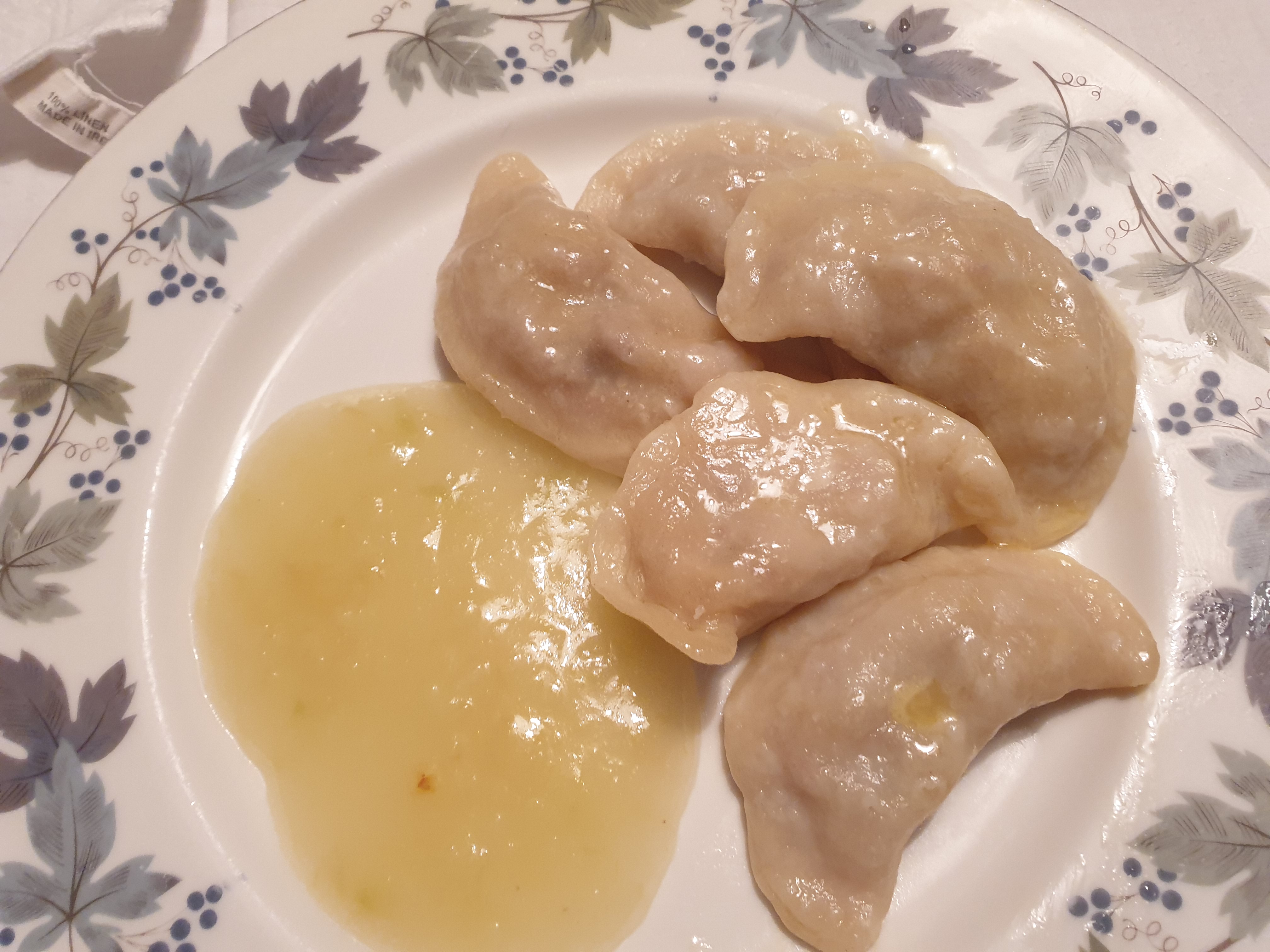
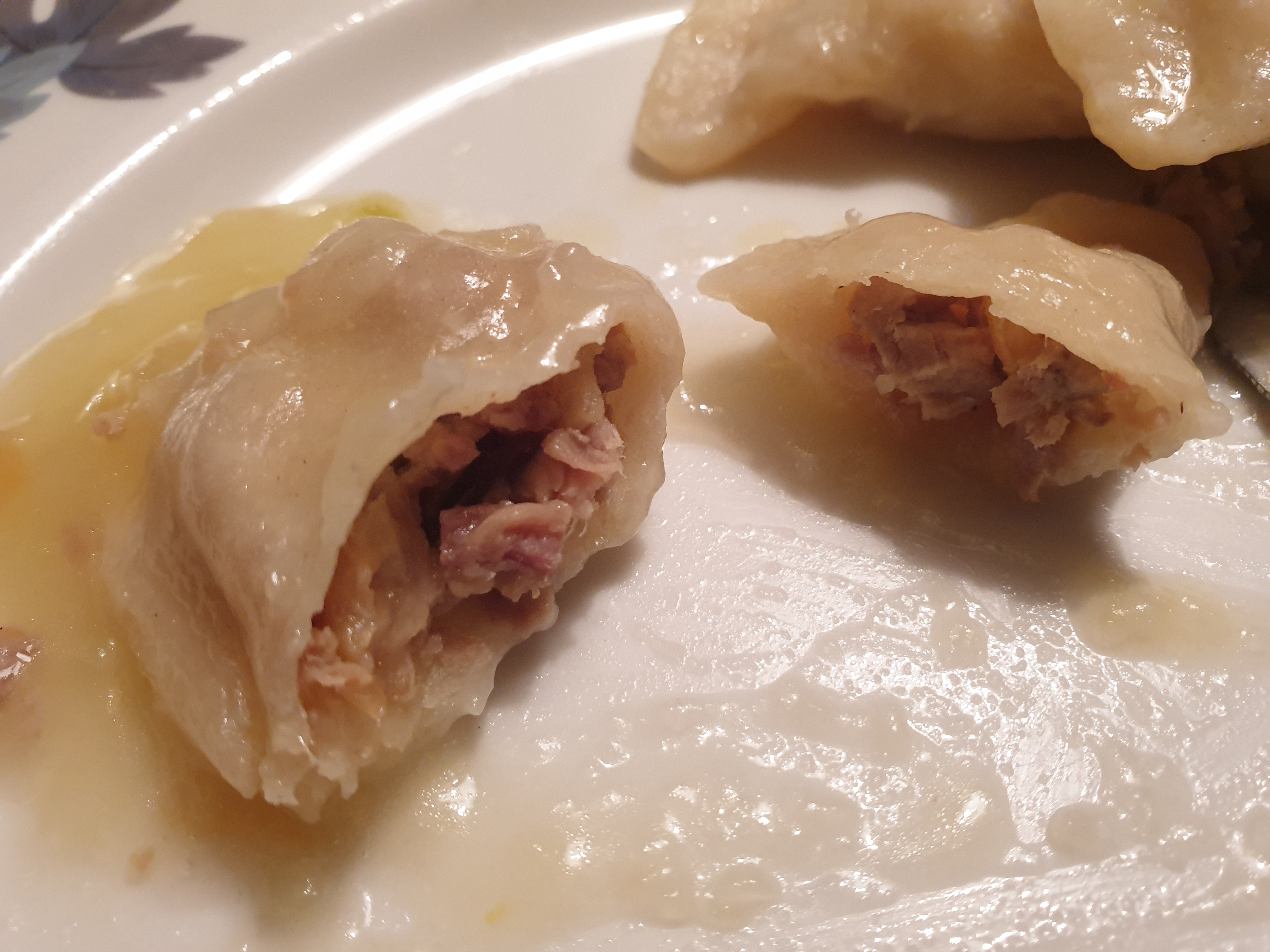
Pierogiwith meat filling is one of the most usual ways my Mama made pierogi.
The meat was usually cooked pork, which had been left from a roast or gulasz the day before.
Below are instructions for cooking the pork from scratch in case you do not have any cooked pork.
At Christmas time the meat could have been chicken, should any have been left.
Ingredients
300g shoulder or spare rib pork
1 onion
1 egg yolk
1 tablespoon of dried breadcrumbs
Approx 250 ml of chicken stock – can be from stock cubes
Butter & oil to fry the onion
Salt & ground black pepper to taste
Method
Pre heat the oven to GM 3 – 1600C
Put the pork into a small casserole dish and cover it with the stock and put on the lid.
Put the dish in the oven for at least 1 hour, depending on the meat you might need longer.
Cook the meat until it is tender and can be broken up with a fork and most of the liquid has been absorbed.
Allow the meat to cool.
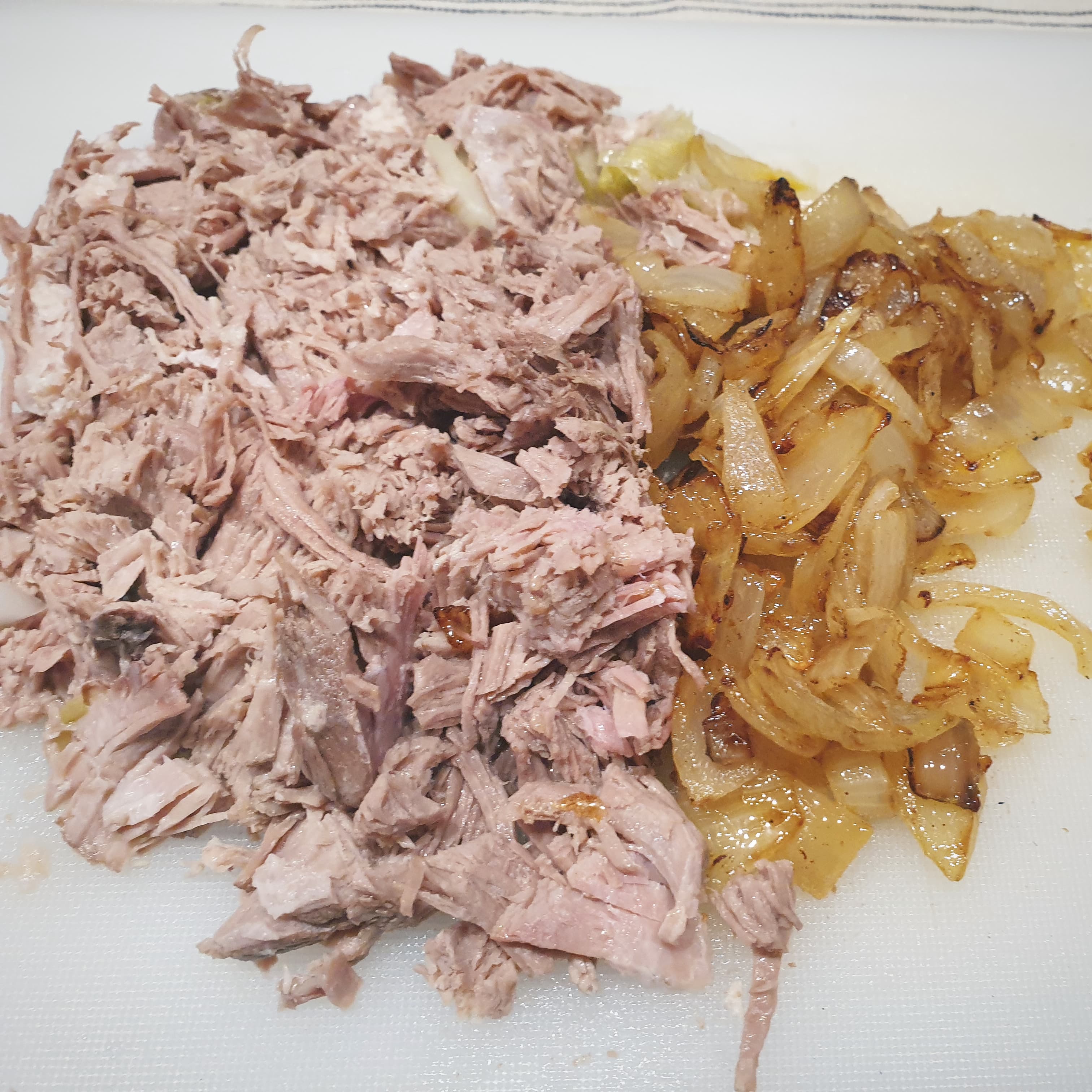
You can mince the meat but I find that if you cook it long enough you do not need to, you can just chop it with a sharp knife .
Chop the onion finely and fry it till it is soft and golden, allow it to cool.
Mix thoroughly together: the meat, onion, yolk and breadcrumbs and then add salt and pepper to taste.
*
Serve with melted butter or
Onions fried in butter or
Fried bacon bits – skwarki.
Make the pierogi in the usual way – instructions are given below.
Ingredients – Dough
500g pasta flour or strong flour or plain flour & 2 tablespoons of fine semolina
300ml water
1 – 2 tablespoons oil – sunflower or light olive
½ teaspoon salt
2 egg yolks
*
Melted butter for serving or chopped onions cooked in butter.
Method – Dough
In a jug or bowl mix together the water, oil and the yolks.
Put the flour and salt into a large bowl and make a well in the centre.
Pour in the liquid from the jug and initially use a knife to mix this into the flour and then use your hands to mix the liquid and flour to get a ball of dough.
Turn this out onto a floured board and knead the dough for a few minutes until you have a smooth ball.
Cut the dough into quarters.
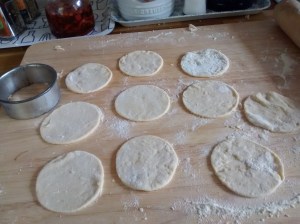
On a floured board roll out a quarter at a time until you have a sheet of thinly rolled dough.
Now prepare a large tray and cover it with a clean tea towel and sprinkle this with flour.
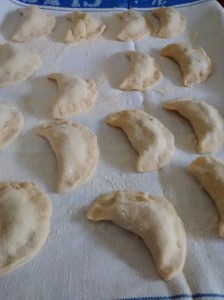
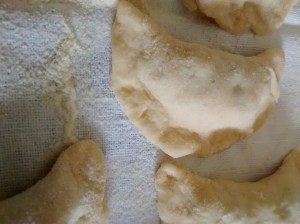
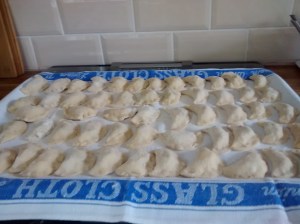
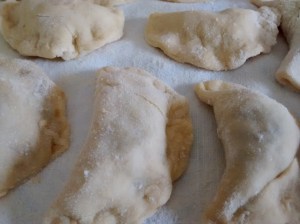
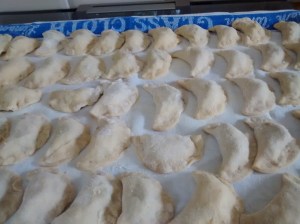
Have a large surface such as a tray covered with a cotton or linen cloth which has been lightly floured ready and place the sealed pierogi on this until they are all made, do not let then touch each other.
I cut them out using a 7 cm diameter cutter.
I have noticed some people make them larger – I will try this out soon.
The excess dough can be re-mixed and rolled out again.
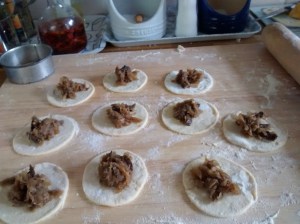
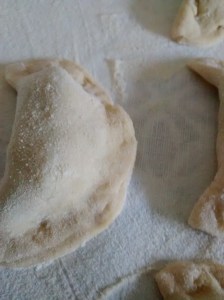
Around a half tablespoon of filling is put on each circle and then they are folded over and the edges pinched together to make a good seal.
You learn from experience how much filling to put in as too much will make it hard to seal them and if not properly sealed they will burst on boiling.
Do not worry if you have a few mishaps – it still happens to me even with experience – it is hard to salvage one that has gone wrong – just accept that there will be a few that you do not cook.
*
To cook the pierogi, use a large pan of boiling water to which you have added some salt and a drizzle of oil.
Drop the pierogi in one by one and allow them to boil. I usually do about 6 to 8 at a time (I only do 6 at a time if using frozen ones).
As they cook they will float to the surface, let them boil for 2 to 3 minutes, (a bitmore if they were frozen*), and
Then remove them with a slotted or perforated spoon and put into a colander above a pan for a few seconds to drain and serve.
Continue boiling batches in the same water.
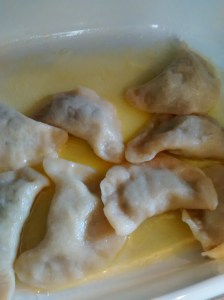
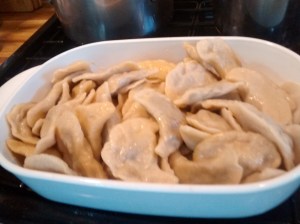
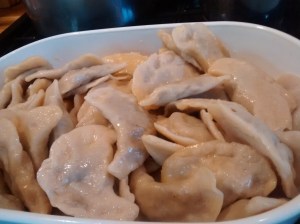
If you want to make all the pierogi to serve together then you need to get a large shallow dish.*
I started to write up a new filling for pierogi and realised that many of my different fillings were in one general pierogi – Polish filled pasta post.
This was one of my earlier posts before I realised that shorter posts were better.
So I am going back and posting shorter versions of this original post.
Each with just 1 filling.
Sauerkraut & Mushrooms is a very popular filling.
Some people make these for Wigilia – Christmas Eve.
Ingredients – Filling
1 jar of sauerkraut
25 – 30g of dried mushrooms
1 or 2 onions – chopped fine
1 -2 bay leaves
Ground pepper to taste
Method – Filling
The filling must be allowed to cooled before using – you can make it in advance – even the day before.
At the end the filling must be as dry as possible to make the assembly of the pierogi easier.
Put the mushrooms in a small bowl and cover them with boiling water.
Leave them overnight.
Strain the mushrooms – but keep the liquid.
Chop the mushrooms into small pieces.
*
Strain the sauerkraut, keep the liquid, and chop into small pieces.
Put the sauerkraut into a pan, add the liquid from the sauerkraut and some from the mushroom liquid.
Cover with boiling water if need be.
Add the bay leaves.
Cover the pan with a lid.
Simmer gently for around 30 minutes.
Checking it does not dry out.
Remove the lid.
Then boil off as much liquid as possible without burning the sauerkraut.
*
Allow the sauerkraut to cool and remove the bay leaves.
Strain the sauerkraut using a sieve to get it as dry as possible.
You can put this into a clean dry cotton or linen cloth and twist the ends together –
Squeeze to get it really dry.
*
Whilst the sauerkraut is cooking heat the chopped mushrooms gently in a small pan with the rest of the liquor, stirring to prevent it burning but reducing as much of the possible.
*
Chop the onions finely and fry them till they are soft and golden.
Add them to the mushroom mixture and mix well together.
Mix the sauerkraut, mushrooms and onions together.
Add some ground black pepper to taste; salt should not be necessary.
OPTION
Add fresh mushrooms fried in butter and chopped fine to the filling.
Ingredients – Dough
250g pasta flour or strong flour or plain flour & 2 tablespoons of fine semolina
150ml water
1 tablespoon oil – sunflower or light olive
½ teaspoon salt
1 egg yolk
*
Melted butter for serving or chopped onions cooked in butter.
Method – Dough
In a jug or bowl mix together the water, oil and the yolk.
Put the flour and salt into a large bowl and make a well in the centre.
Pour in the liquid from the jug and initially use a knife to mix this into the flour and then use your hands to mix the liquid and flour to get a ball of dough.
Turn this out onto a floured board and knead the dough for a few minutes until you have a smooth ball.
Cut the dough into quarters.
On a floured board roll out a quarter at a time until you have a sheet of thinly rolled dough.
Now prepare a large tray and cover it with a clean tea towel and sprinkle this with flour.
Have a large surface such as a tray covered with a cotton or linen cloth which has been lightly floured ready and place the sealed pierogi on this until they are all made, do not let then touch each other.
I cut them out using a 7 cm diameter cutter.
I have noticed some people make them larger – I will try this out soon.
The excess dough can be re-mixed and rolled out again.
Around a half tablespoon of filling is put on each circle and then they are folded over and the edges pinched together to make a good seal.
You learn from experience how much filling to put in as too much will make it hard to seal them and if not properly sealed they will burst on boiling.
Do not worry if you have a few mishaps – it still happens to me even with experience – it is hard to salvage one that has gone wrong – just accept that there will be a few that you do not cook.
*
To cook the pierogi, use a large pan of boiling water to which you have added some salt and a drizzle of oil.
Drop the pierogi in one by one and allow them to boil. I usually do about 6 to 8 at a time (I only do 6 at a time if using frozen ones).
As they cook they will float to the surface, let them boil for 2 to 3 minutes, (a bitmore if they were frozen*), and
Then remove them with a slotted or perforated spoon and put into a colander above a pan for a few seconds to drain and serve.
Continue boiling batches in the same water.
If you want to make all the pierogi to serve together then you need to get a large shallow dish.*
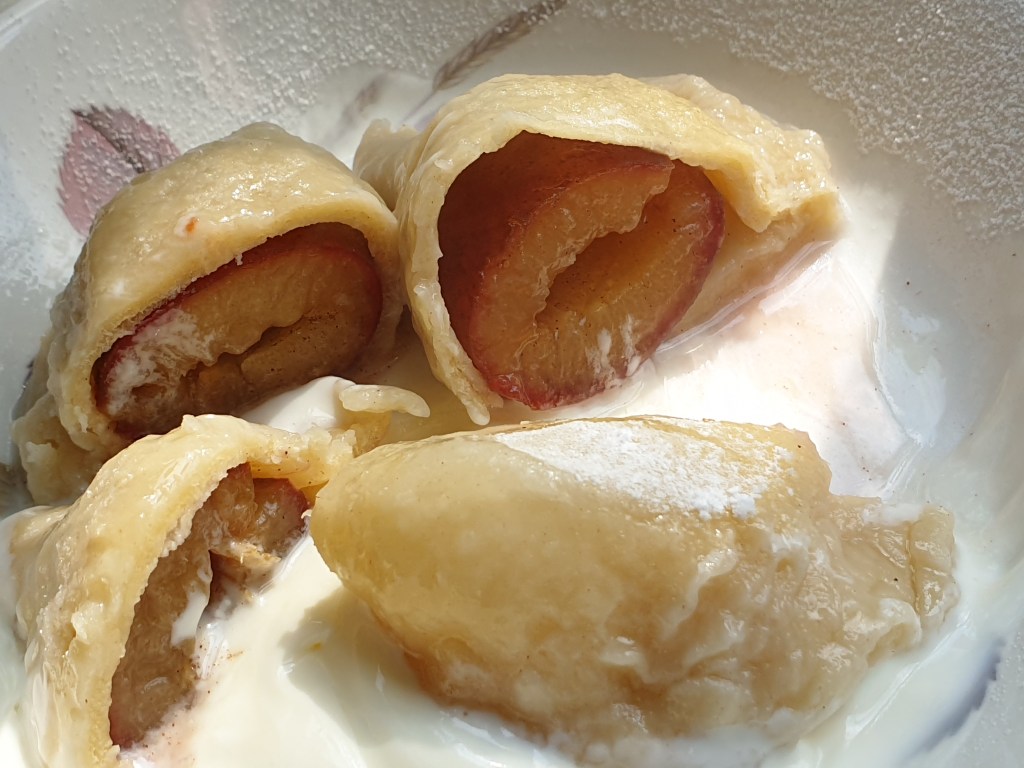
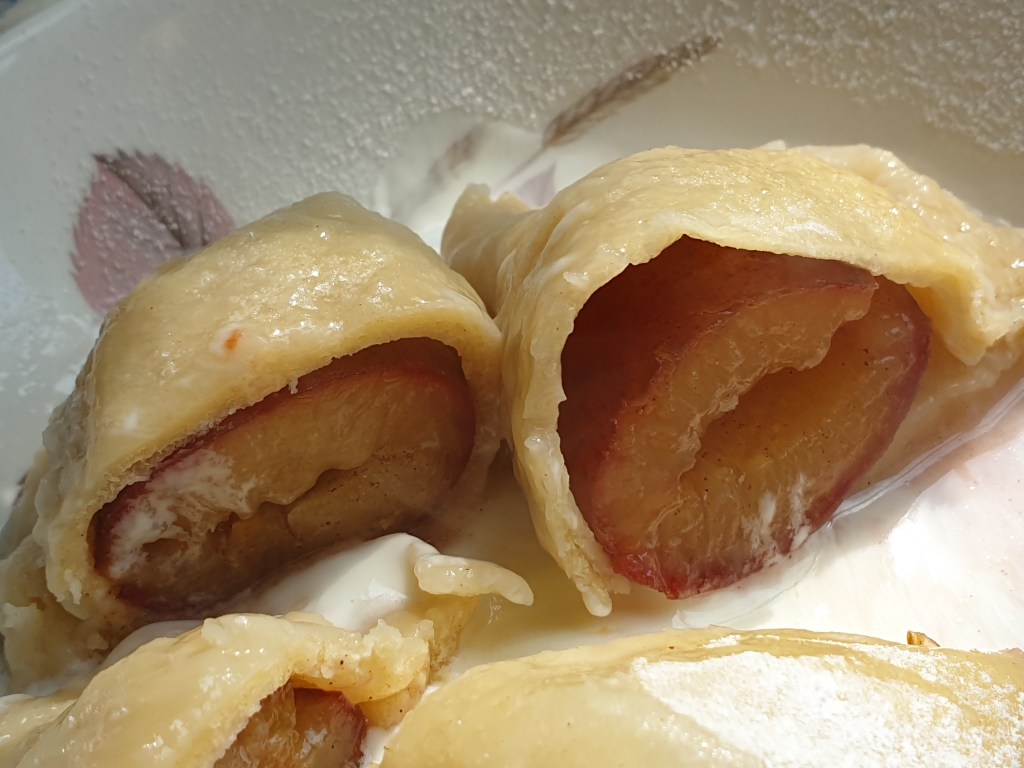
For me these are sweet pierogi– but I have been assured by my aunties in Poland – who made them for me on my last visit – that because of their shape – round balls – these are always called knedle. (This if from the German word knödel – for dumplings).
The dough is just the same as for pierogi and they are also boiled in the same way but will take a bit longer to cook depending on the size of the plums.
In Poland small dark plums called węgierki (Hungarian plums) are used.
I think that in America these are called Italian plums.
Serve them warm, dusted with icing sugar and soured cream.
Pierogi Dough
Use the standard recipe for pierogi, just using 250g of flour (see below)
Best not to make too many as they should be served warm and do not freeze well.
Plum Filling
500g fresh plums – small ones are best for the round shape.
Mix around 3 tablespoons of granulated sugar with 1 teaspoon of ground cinnamon.
Wash and dry the plums and remove the stalks.
Remove the stone but do not cut through completely.
Put ½ to 1 teaspoon of the sugar mixture in the cavity.
Roll out the dough – slightly thicker than for pierogi.
Cut strips of dough more than twice the size of the plum.
Place the filled plum on one side of the dough.
Fold over the other part of the dough and seal the edges well with your fingers – take care as the added sugar produces liquid – use excess dough to give a good seal then cut away this excess dough to give a more rounded shape.
Drop them into boiling water.
Simmer for around 10 minutes.
Remove with a slotted spoon into a colander.
Dust with icing sugar and serve with soured cream.
Ingredients – Dough
250g pasta flour or plain flour & 2 tablespoons of fine semolina
150ml water
1 tablespoon oil – sunflower or light olive
½ teaspoon salt
1 egg yolk
Method – Dough
In a jug or bowl mix together the water, oil and the yolk.
Put the flour and salt into a large bowl and make a well in the centre.
Pour in the liquid from the jug and initially use a knife to mix this into the flour and then use your hands to mix the liquid and flour to get a ball of dough.
Turn this out onto a floured board and knead the dough for a few minutes until you have a smooth ball.
Cover and leave to rest for about ½ an hour.
Roll the dough out – slightly thicker than you would do for pierogi..



 Journey From A Polish Kitchen