White Chocolate Sernik

  • Updated 14 February 2025.
  • This is a baked sernik (cheesecake) that I discovered recently.
  • It is based on one in a Christmas book by Mary Berry.
  • I tried it out with the ingredients adjusted several times.
  • This is my final version, which is slightly different to the one in Mary Berry’s book. 
  • It is very rich and creamy – in many ways like a set sernik.
  • The sernik tends to crack on top – do not worry it does not affect the taste!
  • I used Lindt white chocolate, which is super.
  • (I have read that Milky Bar does not melt as well.)
  • There is no sugar in the cake – the sweetness is from the chocolate – and the biscuits in the base.
  • I found it best to loosen the cake slightly in the tin and then leave it in the tin to cool.
  • I think this sernik is best served chilled.

INGREDIENTS – base

  • 150g of plain chocolate digestive biscuits
  • 40g of butter – plus a little to grease the tin.

METHOD – base

  • Melt the butter gently in a small saucepan.
  • Grease a 20cm round loose bottomed tin with some of the melted butter.
  • Crush the biscuits with a rolling pin.
  • Mix in the crushed biscuits with the melted butter.
  • Put the mixture in the bottom of the tin and flatten out to all the sides.
  • Leave to cool.

INGREDIENTS – sernik

  • 400g of full fat cream cheese or yoghurt cheese.
  • 2 eggs & 1 egg yolk (or 3 eggs)
  • 150 ml of soured cream
  • 300g of white chocolate
  • 2 – 3 drops of vanilla essence 
  • A little cocoa powder for dusting the edges.

METHOD – sernik

  • Pre-heat the oven to GM3 – 160°C.
  • Whisk together the cheese, eggs and yolk and vanilla essence until smooth.
  • Mix in the soured cream and again whisk until smooth.
  • Break the chocolate into a bowl and place over a pan of water.
  • Slowly heat the water and mix the melted chocolate well with a wooden spoon,
  • Take care not to overheat and keep mixing so it is smooth.
  • Allow to cool (this is the hardest part to gauge when to use the chocolate).
  • Slowly stir the cooled, melted chocolate into the cheese mixture and mixture until uniform.
  • Pour the mixture over the dark chocolate base.
  • Flatten the top.
  • Bake for around 50 minutes.
  • When the centre is set – turn off the oven and leave for another 15 minutes with the door slightly open,
  • Using a spatula loosen the sides from the tin.
  • Leave to go cold in the tin before removing.
  • Best kept in the fridge before serving.
  • Dust the edges with cocoa powder using a fine sieve.
  • *
  • NOTE 
  • This is quite rich so maybe do not give huge slices!
  •  

Babka with Three Chocolates!

I was inspired by the use of 3 sorts of chocolate in a recipe I saw from Lidl to decorate a babka.

Babka is the name of a Polish cake – the word means grandmother and refers to the round dumpy shape reminiscent of an older lady wearing a long full skirt as is traditional in many Polish folk costumes.

Wooden Dolls in Polish Costumes

This marbled babka was made using a creamed sponge mixtureusing my mother’s friend’s basic recipe for a creamed sponge.

Ingredients – Cake

  • In this recipe you weigh the eggs in their shells and then use the same weights of butter, caster sugar and self raising flour.
  • Use 4 or 5 eggs
  • 2 drops of vanilla essence
  • 2 tablespoons of cocoa
  • 2 tablespoons of water

Method

  • Pre-heat the oven to GM4 – 180°C
  • Grease the babka tin with melted butter using a pastry brush.
  • For this babka, 4 eggs were used. (I could have used 5 eggs for this tin).
  • Cream the butter and sugar.
  • Beat the eggs with the vanilla essence and add them gradually – mixing in thoroughly.
  • Fold in the flour.
  • Use half of the mixture and place spoonfuls in the bottom of the tin.
  • Mix the cocoa and water together.
  • Mix the cocoa mixture into the second half of the cake mixture.
  • Placed this on top of the plain mixture and flatten it off.
  • With a metal knife lightly mix the two to give a marbling effect.
  • Bake the cake for 40 to 45 minutes.
  • Leave the cake to cool in the tin before turning out.

Ingredients – Icing

  • 100g of dark chocolate and 60g of butter
  • 50g of milk chocolate and 30g of butter
  • Shavings of white chocolate.

Method

  • Put the dark chocolate and butter into a glass bowl.
  • Heat the bowl over hot water, stirring till it all melts together.
  • Drizzle this over the babka and leave to cool.
  • Put the milk chocolate and butter into a glass bowl.
  • Heat the bowl over hot water, stirring till it all melts together.
  • Drizzle this over the dark chocolate.
  • Scatter the white chocolate shaving over the milk chocolate icing.


Portmeirion plate – The Holly & The Ivy – the pattern inspired by the 17th Century English Carol – launched in 1997.

Served on tea plates by Duchess – Poppies – from the 1980s.

How Did My Sponge Become Sandy?

In Polish the word for a fat free sponge cake which is made with just eggs, sugar and flour is  biszkopt.

A sponge cake which uses butter or margarine which is creamed with the sugar is described as piaskowy – this adjective means sandy – hence the title of this post!

I have not managed to find an explanation as to why it is so described  but have found this term in all my Polish cookery books.

Pani Stasia’s Sponge Cake

This is a recipe which I learnt from my mother’s friend who we knew as pani Stasia*.

Pani Stasia made wonderful cakes but unfortunately I did not write many of them down – however I did for this one and it is the basis for many of my other cakes and buns.

This recipe is equivalent to the British cake –  Victoria Sponge – named after Queen Victoria in whose reign this became popular & who is said to have liked this cake very much.

Having been looking at recipes in my Polish cookery cooks I realise that pani Stasia adapted this recipe for England as self raising flour and caster sugar are not found in Polish shops.

(*Pani  translates as Madam, Lady or Mrs and is a polite form of address – it is like donna in Italian or for example  saying Miss Mary in the Southern States of America.

Stasia is the shortened form of the Polish name Stanisława. (The feminine form of Stanisław)

St Stanisław is the patron saint  of Kraków & Poland, he was a martyr, murdered by the Polish king Bolesław II the Bold in 1079 – a story which has much in common with St Thomas à Beckett and the English king Henry II  in 1170).

Ingredients

Eggs

Butter or Block Baking Margarine

Caster Sugar

Self Raising Flour

I usually use 3 or 4 eggs for this recipe – in the photographs below I have used 4 eggs to make 2 cakes which were then sandwiched together with jam and white chocolate butter cream.

IMG_20150805_064443123

Method

Grease and line the base of 2 x 21.5cm  sandwich tins. – I find anodised aluminium tins are the best. (my old tins say 8 1/2 inch on the base – 21cm or 22cm would be OK)

Pre-heat the oven to GM 4 – 180°c

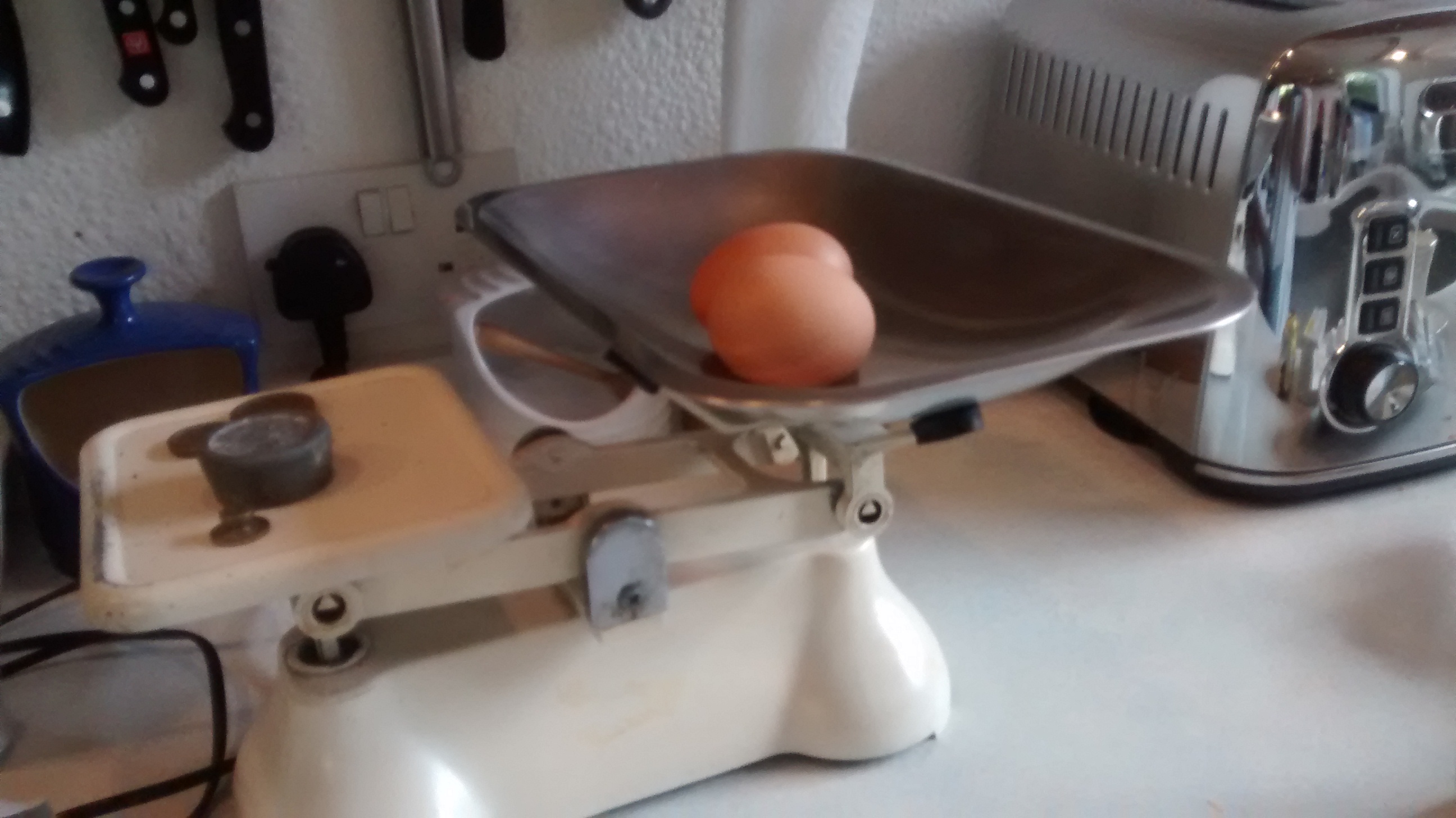
The first thing you have to do is weigh your eggs – complete with their shells.

Weighing Eggs

You then weigh out the same amount of  butter or block margarine, caster sugar and self raising flour.

At first I thought this was very strange but now find that it gives a very good way of getting the right proportions no matter what size the eggs are.

I heard the late Marguerite Patten in an earlier recorded programme on the radio a few weeks ago saying that Victorian cooks often  used this method. 

Cream together the butter and sugar until it is light and fluffy.

Add the eggs, one by one whisking again until the the mixture is light and fluffy again.

Fold in the flour with a metal spoon taking not to over mix the mixture and knock out all the air.

Divide the mixture evenly between the 2 prepared tins.

Bake in the centre of the oven for around 25 to 30 minutes  – the cake should  be golden brown and be clean when a cake tester is used.

IMG_20150804_180730655
Cakes cooling awaiting being sandwiched together

This cake is very versatile and here I have sandwiched it together with blackcurrant jam (given to me by my friend who had made it with fruit from her allotment) and white chocolate butter cream.

Sweet whipped cream is not found in Polish cookery – butter creams and similar are the standard fillings for layer cakes.

On the bottom cake first spread on the jam and then top this with the butter cream.

IMG_20150804_202127960

This butter cream is sweet and needs the contrast of a tart jam, damson jam would be another alternative.

White Chocolate Butter Cream

Ingredients

60g White chocolate

40g Butter – unsalted is best

80g Sieved  icing sugar

 Method

Melt the white chocolate in a glass bowl over a pan of hot water and allow to cool.

Cream the  butter and the icing sugar.

Beat in the cooled, melted chocolate.

Note

Take care  –  if the melted chocolate  is too hot then you will end up having to add more icing sugar and the  butter cream will be very sweet.

Dust the finished cake with icing sugar.

IMG_20150804_202910179

IMG_20150804_202121082

IMG_20150804_202846103
Plates are Burleigh Ware – Burges & Leigh Ltd —– Blue Mist around 1930s


IMG_20150805_064428554


IMG_20150805_065802235

IMG_20150805_065810762