I came across this recipe recently which uses Gouda cheese with soured cream to thicken the sauce – it works really well and I will be trying this in other recipes.
Ingredients
400g – 500g braising steak – cubed
200g – 250g of mushrooms (chestnut type are good) – sliced
2 large onions – chopped
300ml of chicken stock (can be from a cube or concentrate)
3 tablespoons of caraway seeds
1 -2 tablespoons of plain flour
50g of Gouda cheese – chopped into small cubes.
3 tablespoons of soured cream
Sunflower oil for frying
Salt & pepper to taste.
Flat-leafed parsley to garnish – chopped
Method
Pre heat the oven to Gas Mark 3 – 1600C
On a large plate mix together the flour, salt and pepper.
Coat the meat cubes lightly in the flour mixture and brown these in the oil in a hot frying pan.
Place the beef into a casserole dish.
Lightly fry the onions and mushrooms in the frying pan and then add them to the beef.
Caraway Seeds
Add the stock and caraway seeds to the pan.
Put on the lid and cook in the oven for around 3 hours until the beef is tender.
Before serving stir in the cubes of cheese and the soured cream and mix well into the sauce.
Garnish with flat-leafed parsley.
Served here with mashed potatoes on Royal Doulton – Carnation – 1982 – 1998.
Having made kotlety mielone (minced meat burgers ) with first fresh and then cooked cabbage, I started to think of a variation which in a way is more Polish!
I decided to use sauerkraut and also some fresh mushrooms – though dried ones might even be more Polish.
* I often freeze the other half of the jar in a plastic tub for another time.
Method
Drain the sauerkraut and rinse with cold water.
Place the sauerkraut in a pan of water and simmer gently for 5-10 minutes.
Drain the sauerkraut and leave to cool then dry it with a tea towel.
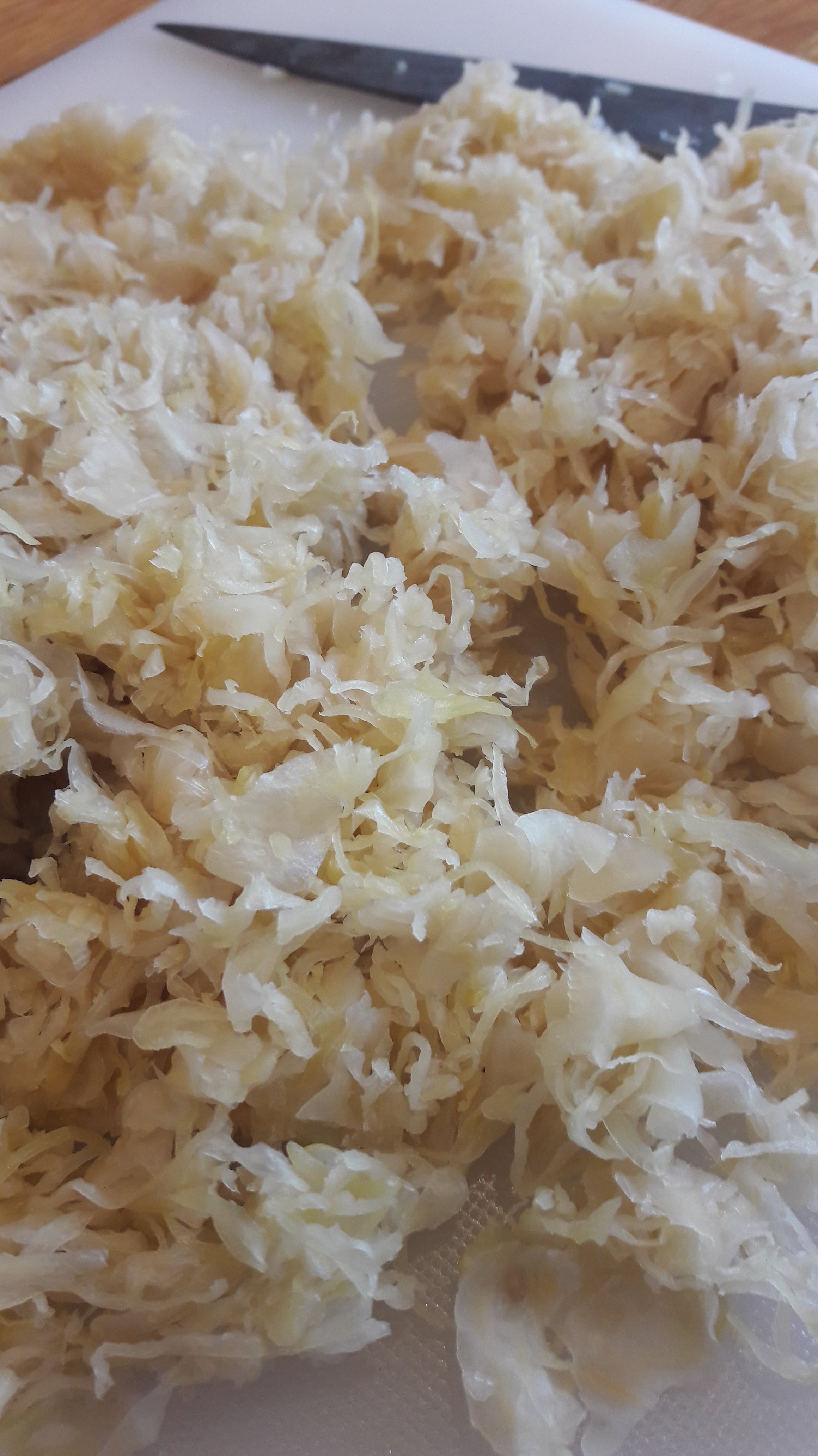
Chop the sauerkraut into small pieces using a sharp knife.
Fry the chopped onion in a little hot oil and butter.
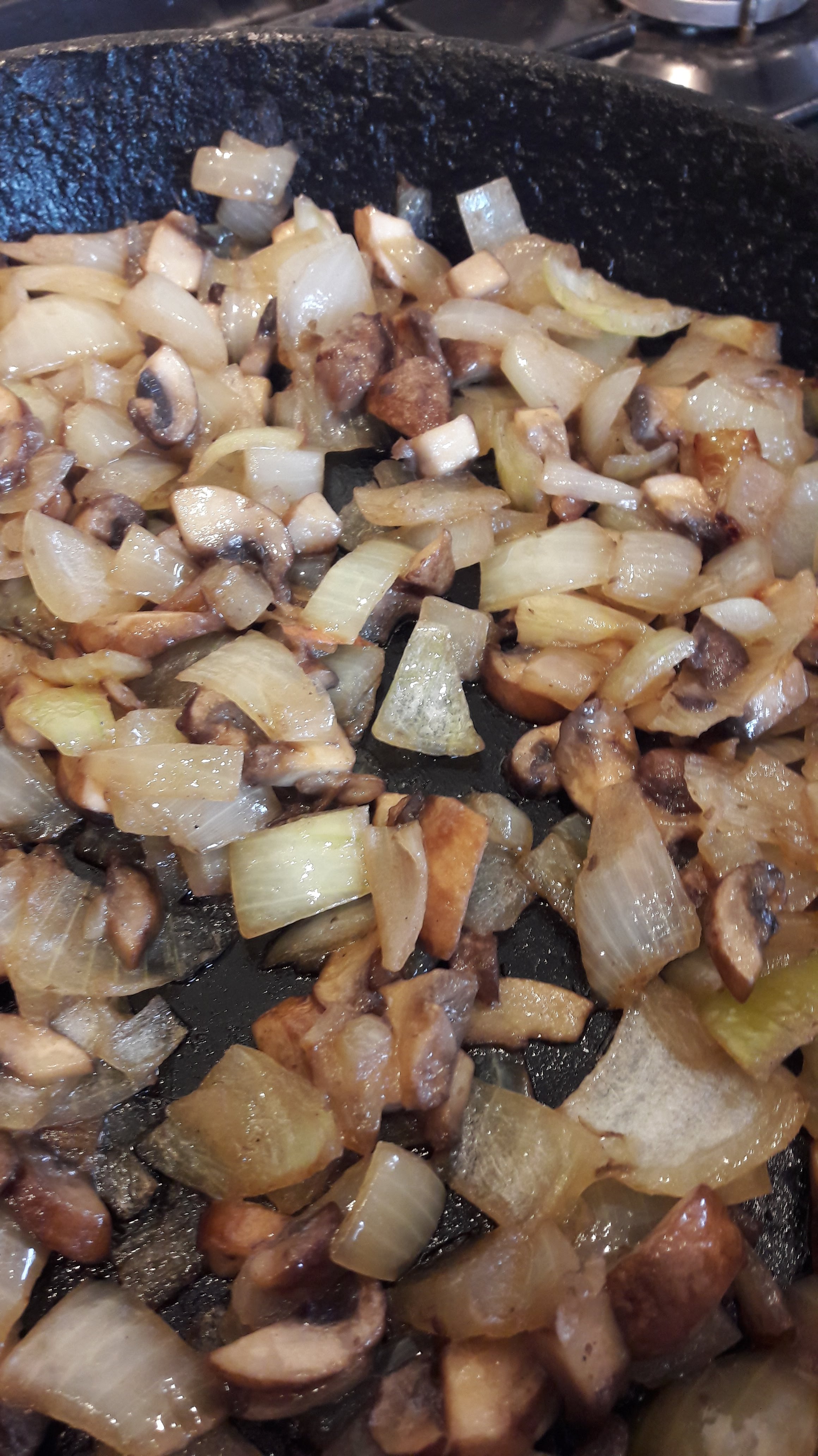
Chop the mushrooms into small pieces and add them to the onions and continue frying until the onions are lightly browned – leave the mixture to cool.
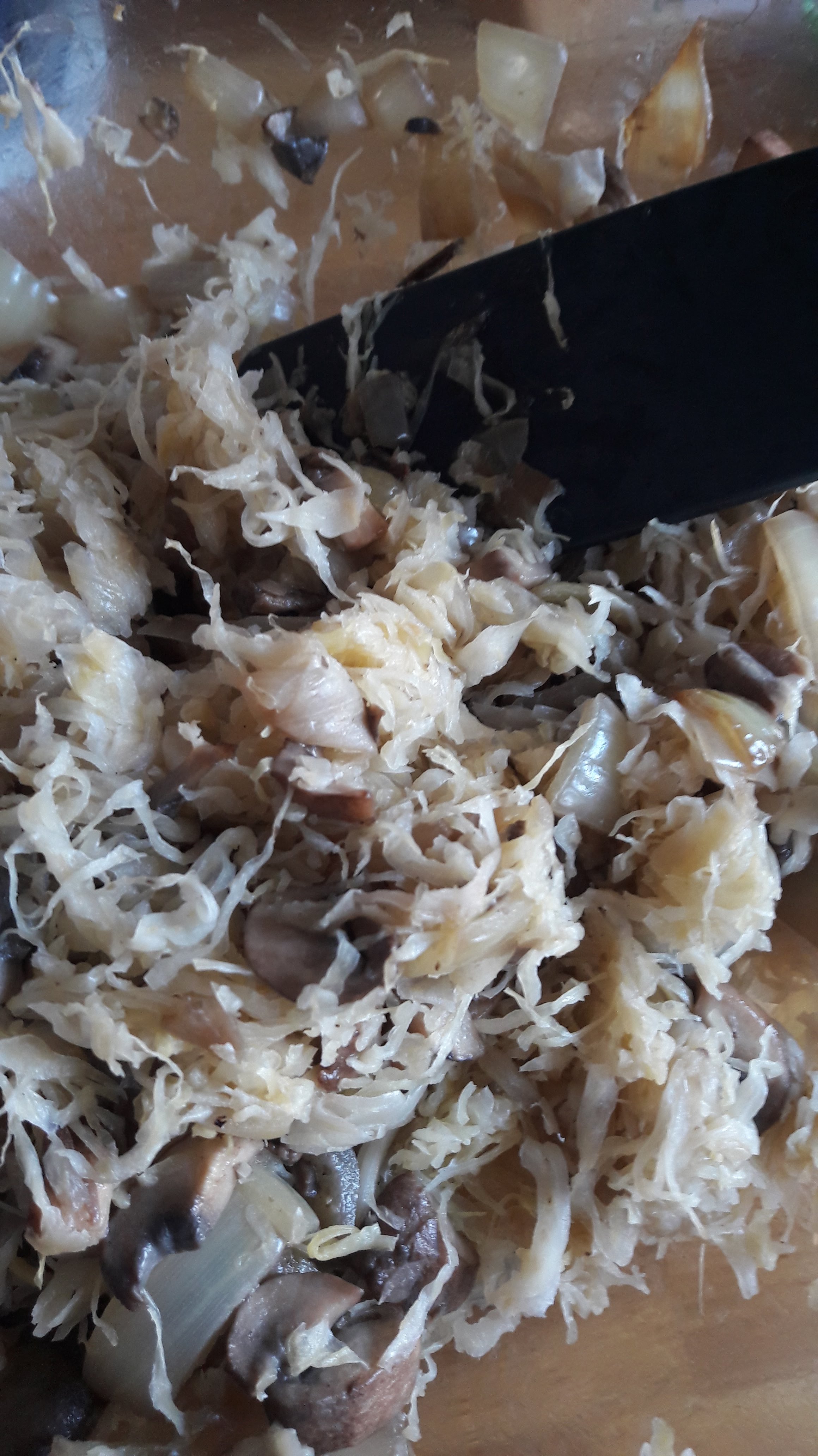
In a large bowl mix the minced meat, the sauerkraut and onion and mushroom mixture until they are evenly mix.
Add the eggs and mix.
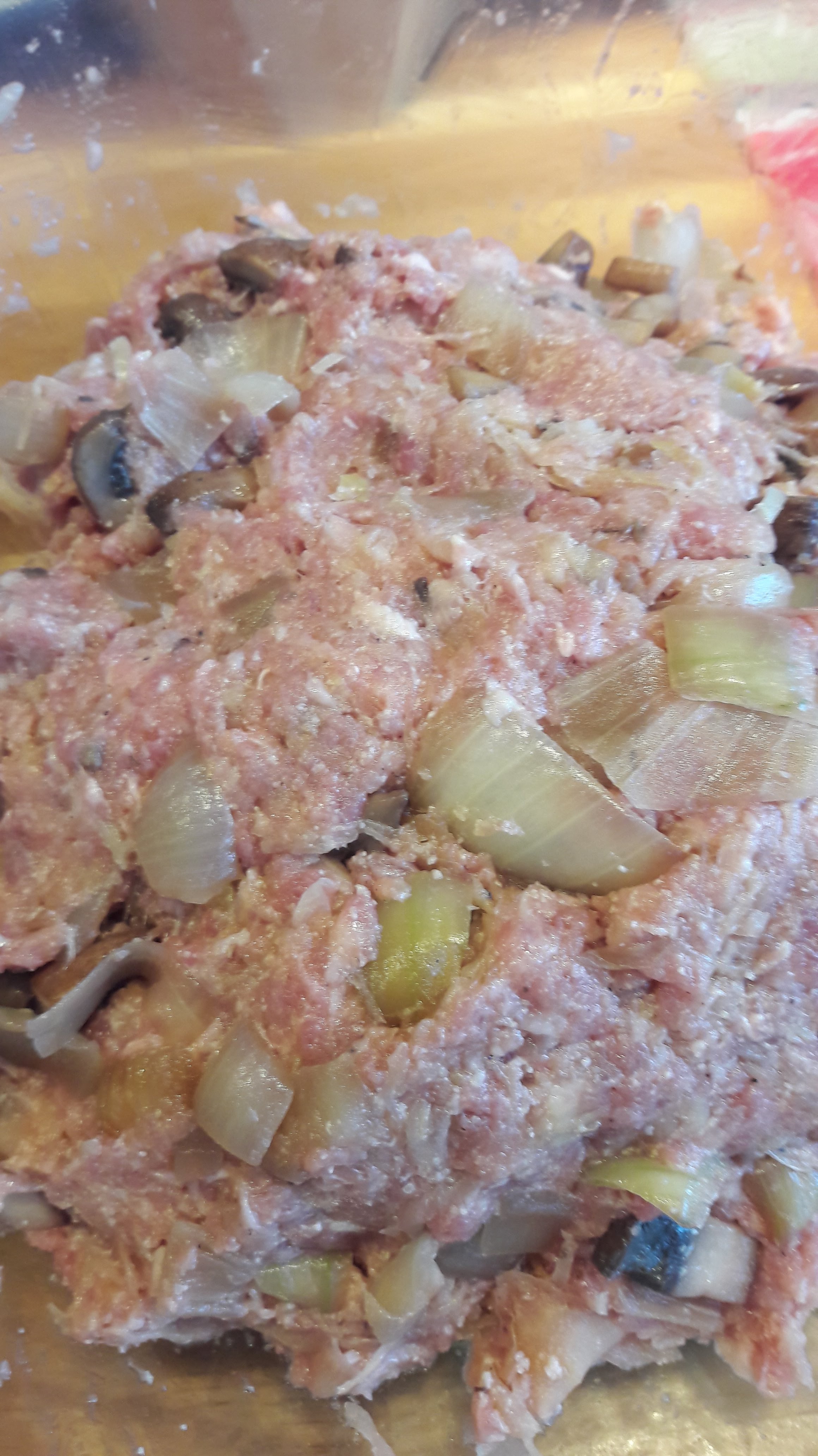
Add the semolina, salt and pepper and mix until you get a uniform mixture.
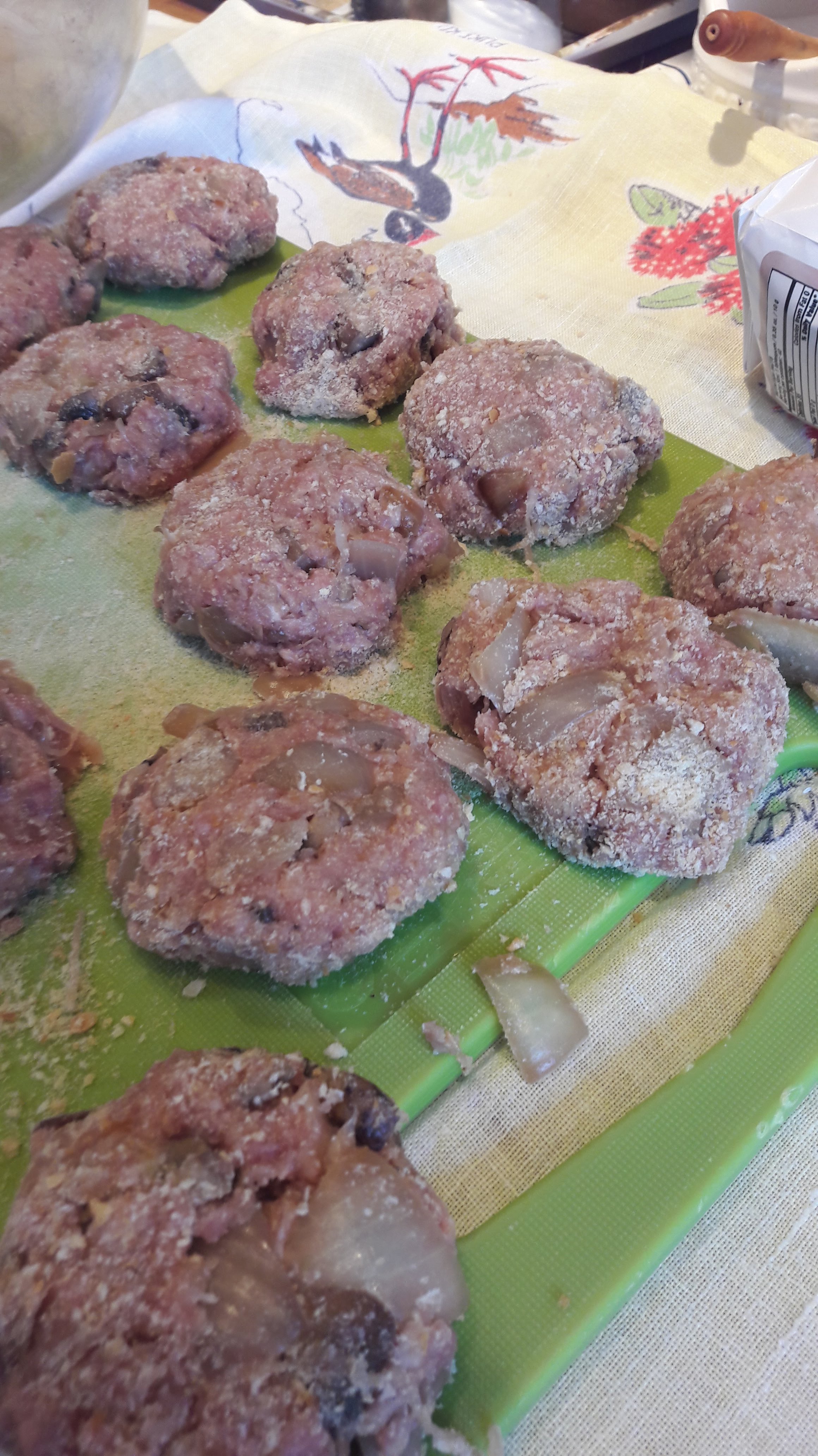
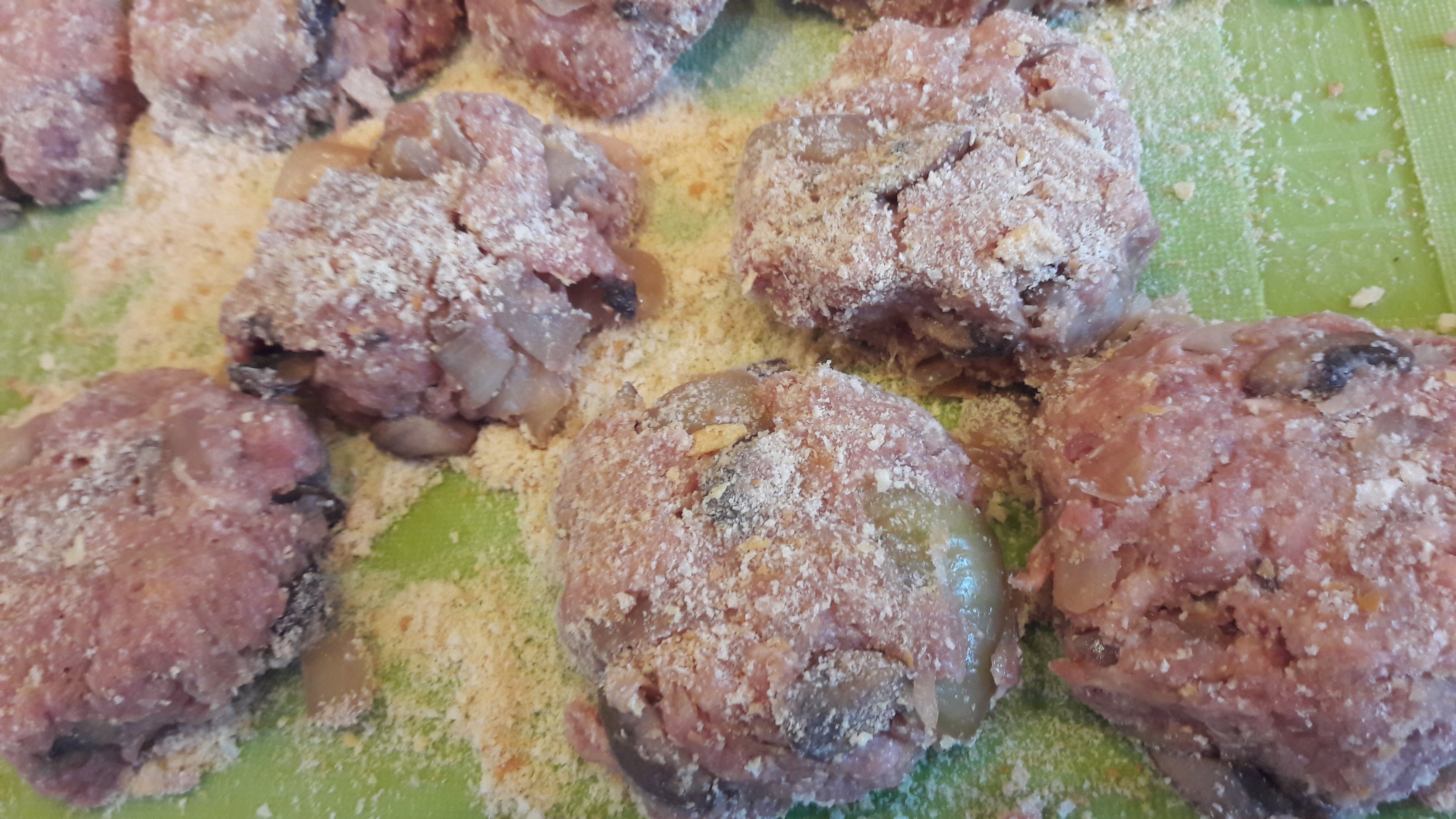
Try to make each one the same size, take a handful of the mixture and press it between your hands to make a flattened circle and then place this in the dried breadcrumbs and turn it over to cover both sides and edges.
Once coated place them on a tray dusted with breadcrumbs until you have used all the mixture up.
Pre-heat the oven to GM3 – 160°C
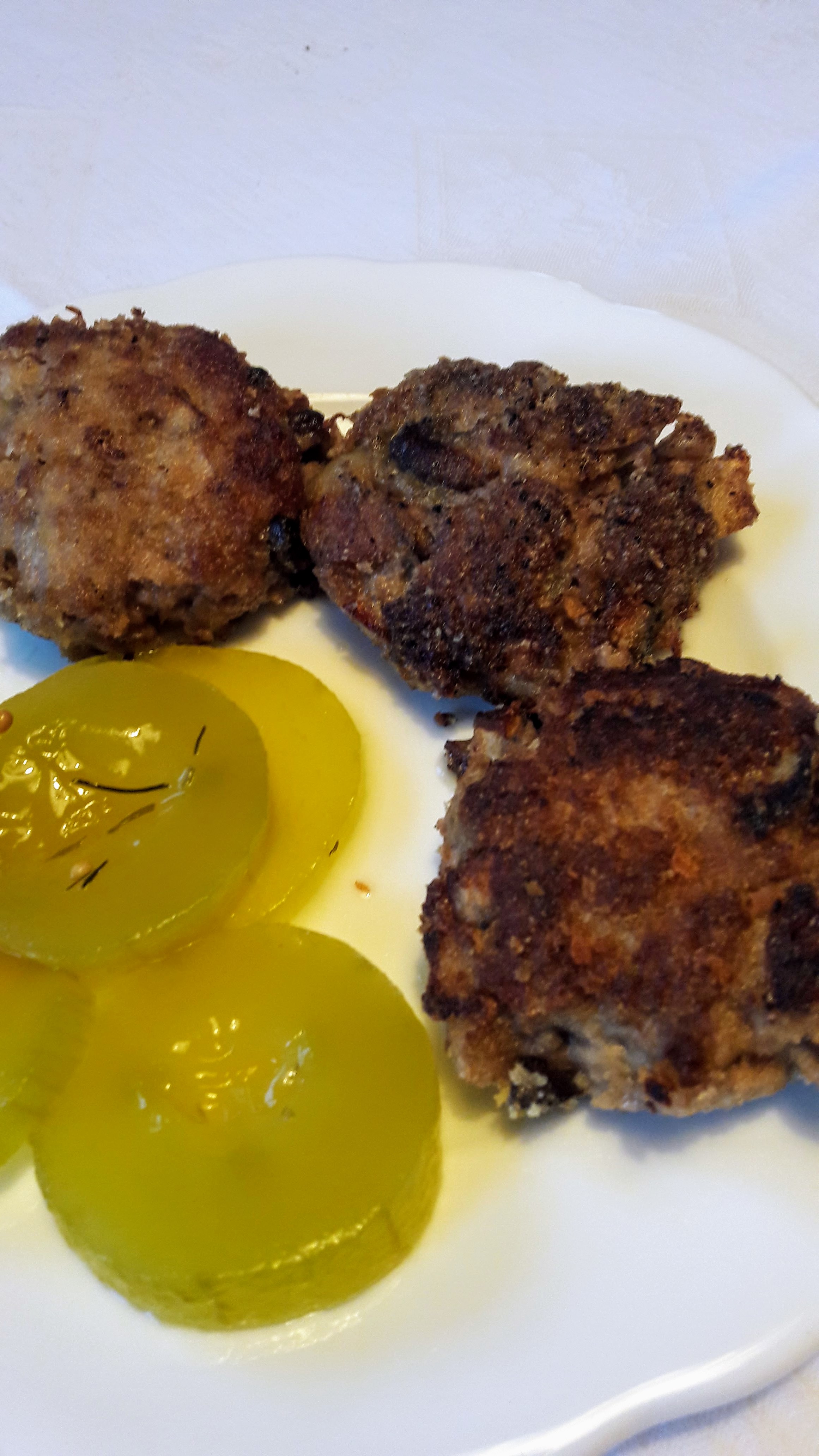
Shallow fry the kotlety in hot oil, depending on the frying pan size, you can do 4 to 5 at a time, turning them over so that both sides are done.
Place them on a metal tray and put in the oven and keep adding to these as you keep frying the batches.
* I used semolina instead of my usual white bread soaked in milk – I was pleased with this as an alternative.
Sunflower oil for frying
Method
Chop the onion fine and fry in a little hot oil till lightly browned then leave till cold.
Cut the cabbage into fine shreds and then across so you have small squarish pieces.
In a large bowl mix the minced meat and cabbage till they are evenly mix.
Add the fried onions and mix again.
Add the eggs and mix.
Add the semolina, salt and pepper and mix until you get a uniform mixture.
Try to make each one the same size, take a handful of the mixture and press it between your hands to make a flattened circle and then place this in the dried breadcrumbs and turn it over to cover both sides and edges.
Once coated place them on a tray dusted with breadcrumbs until you have used all the mixture up.
Shallow fry the kotlety in hot oil, depending on the frying pan size, you can do 3 to 4 at a time, turning them over so that both sides are done. Place them on kitchen roll on a plate or metal tray till they are all cooked – you can keep them warm in a low oven.
I had found I like these more when they have been in the oven for a while after frying – evenly cooked through.
These can be served in many ways, with boiled or mashed potatoes or rice and a variety of salads.
These zrazy are like the ones made with braising beef in that the minced meat mixture surrounds various stuffings.
The minced meat mixture is similar to kotlety mielone & pulpety – but zrazy are cooked differently.
You take a large handful of minced meat mixture , place the stuffing on it and then close up the mixture so you have an oval shape with the stuffing on the inside.
Ingredients
500g minced beef
1 beaten egg
4 tablespoons of semolina
1 onion chopped and fried
Salt & pepper
plain flour for coating
Sunflower oil for frying
Stock
500ml of chicken stock
1 -2 bay leaves
3-4 Peppercorns
2-3 Allspice berries
Stuffing
Two stuffings often used are –
Pieces of bottled peppers
Sticks of Gouda cheese or similar
Method
Pre-heat the oven to GM 3 – 160°C
Mix the beef, fried onion, egg and semolina together.
Season with salt & pepper.
Divide the mixture into around 6 pieces
Flatten out each piece and place the stuffing in the centre.
Close up the mixture around the stuffing to make an oval shaped ball.
Dust the ball with plain flour.
Lightly seal these by browning then in hot oil.
Place the zrazy into an oven proof dish – one that has a lid – so they are not touching.
Pour in the stock – enough to have some at the bottom but do not cover the zrazy.
Put the lid on and cook in the oven for 1 -2 hours.
Sauce
You can thicken the stock that the zrazy are cooked in with cornflour or you can add other ingredients such as fried mushrooms and soured cream when you come to serve them.
Two shown here – cut through – one with cheese & one with peppers, served with a mushroom and soured cream sauce.
Zrazy (this word is plural) is a meat dish popular in Eastern Poland & Lithuania and can be traced back to the 16th & 17th century in the times of the Polish-Lithuanian Commonwealth (1569 – 1795).
(I have seen zrazy translated as Meat Roll-ups, Meat Olives or Collops)
Classic zrazy have a rolled shape and are made of thin slices of beef, beaten with a mallet, which are stuffed with a variety of ingredients including mushrooms.
You need to use beef which is good for braising and slow cooking – I used a thin cut of topside and this worked very well.
The stuffed meat is rolled and secured with thread or thin string, then lightly fried and placed in a casserole dish with stock and slow cooked at a low temperature.
Stock
For the stock, I use chicken or vegetable stock (this can be from a stock cube or powder) and add bay leaves, whole peppercorns and sometimes whole allspice.
Prior to serving, the threads are removed.
Zrazy are eaten with the sauce in which they were cooked, though extra ingredients can be added to this such as soured cream, mushrooms or tomato.
You can add some cornflour to thicken the sauce.
Po nelsońsku – in Lord Nelson’s style – is when mushrooms and soured cream are added to the sauce. (I have not been able to discover why this name is used.)
Here served on Royal Doulton – Carnation – 1982 – 1998
The original recipe is Belgian – if fact a recipe from Flandres or Flanders in English.
It is a recipe I adapted from a book I bought in Belgium many years ago.
The recipe is called Carbonnade flamandeand uses pain d’ épices to thicken and flavour a beef casserole.
Belgian beer is used in the original recipe – I use Polish beer (piwo) – which is also a light coloured lager beer.
(When I went to my local Polish shop – they did not have the beers I normally use such as Żywiec or Tyskie, so I used the EB which was there & it was very good).
I use piernik – a Polish honey spice cake instead of the pain d’ épices.
Note
I often slice up part of a piernik I have made and freeze this so I have some ready for this recipe.
Ingredients
500g of braising steak – cubed
2 onions chopped
2 – 3 slices of piernik (depends on the size)
500ml Polish lager
300ml vegetable or chicken stock (NOT BEEF) – can be from cubes or powder
1 bay leaf
Dried Italian herbs
2-3 grains of pepper
Sprinkling of salt
Oil for frying
Method
Pre-heat the oven to GM4 – 180°C
You need an oven proof casserole dish with a tight fitting lid – I use an enamelled dish.
Fry the beef lightly and then put this into the casserole dish.
Add the chopped onions, herbs, bay leaf, peppercorns and salt.
Chop the piernik into cubes and add this to the dish
Pour the beer over to cover the ingredients – add some of the stock if necessary.
The rest of the stock is used to top up the dish as it is cooking (this is better than putting it all in at the start).
Cook at GM4 – 180°C, for 1 hour then turn the oven down to GM3 – 160°C and cook for another 2 hours.
More time many be needed or you can take it out and re-heat it at GM4 – 180°C for at least 1 hour the next day.
Serve here with steamed new potatoes.
To compliment the sweetness of this dish serve with something tangy such as
If served on top of a large, breakfast plate sized potato pancake this is known as a
węgierski placek – Hungarian pancake.
Tip
Make this a day ahead of when you need it, cook the dish for at least 3 hours and leave it to cool.
The next day cook it again for at least 1 hour, you might have to add a little water or stock but not too much, the sauce should be thick not watery.
Using a slow cooker
Nowadays I often make gulasz using a slow cooker instead of the oven.
I made a gulasz using pork shoulder and cooked it in the slow cooker for 8 hours.
Pork gulasz served in a dish by J & G Meakin Studio Pottery
Unknown Design Name
Luxury Style Gulasz
All houses in Poland have cellars and even people living in block of flats have a cellar area of their own; if you ever get the chance to look in these you will find that they are filled with: jams, preserves, bottled fruit and vegetables, sauerkraut and salted gherkins.
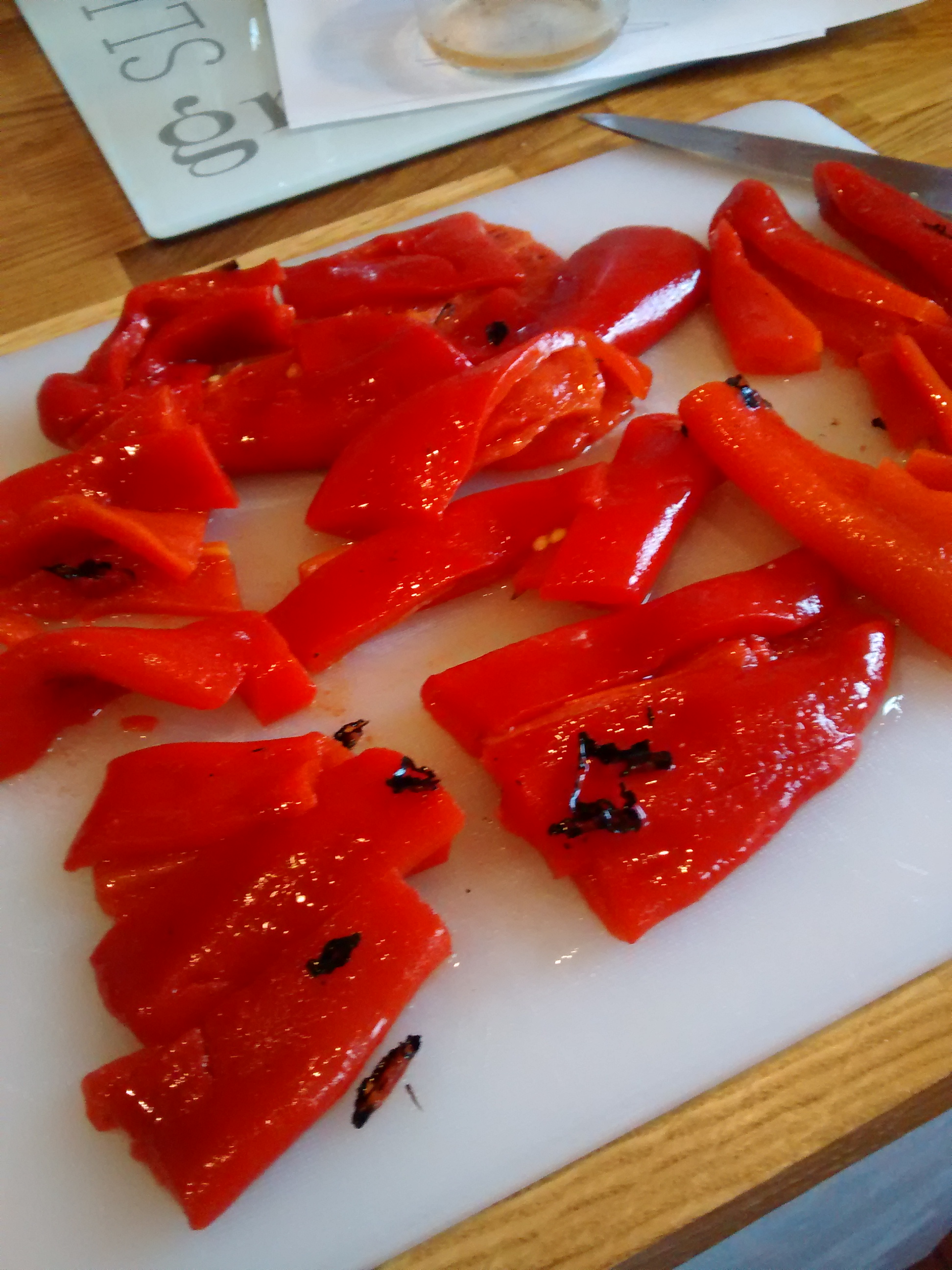
Bottled sweet red peppers in brine are often found amongst these jars. The addition of the peppers from one of these jars to the gulasz makes it even better.
Of course if like me you do not have the home-made variety you can buy these from most delicatessens or supermarkets now.
One Of My Two Cellars
You can use fresh red peppers and I use these when they are plentiful, either will make a delicious gulasz but I think I like ones with the bottled peppers best.
The recipe is a variation on the classic gulasz but you have to use less stock or you will end up with it being too watery due the water content of the peppers – especially the fresh ones.
Ingredients
500g stewing beef or shoulder or spare rib pork
2 onions
2 cloves of garlic
3 tablespoons of tomato purée
150ml chicken stock – can be made from stock cubes
2 teaspoons of (sweet) paprika (not smoked)
1 bay leaf
Jar of bottled red peppers or 3 to 4 fresh red peppers
2 -3 tablespoons of soured cream
2 tablespoons of plain flour
Salt & ground black pepper
Oil for frying
Paprika to dust on the top
Method
Pre heat the oven to Gas Mark 3 – 1600C
Roughly chop the onions and crush the garlic
Mix the tomato purée and the paprika in the stock
If using the bottled peppers cut them into long strips and then cut these into halves
If using the fresh peppers, cut them into long strips, de-seed them and cut these into halves
Cut the meat into cubes and coat the pieces in a mixture of flour, salt and ground pepper
In a frying pan heat the oil until it is hot and fry the meat until all the sides are sealed
Place the meat into a casserole dish
Fry the garlic and onions in the frying pan, adding some oil if necessary but trying not to use too much or the dish will be greasy
Add the onions to the meat then add the bay leaf and some more ground pepper
Add the peppers to the dish and mix the contents together
Pour the stock mixture into the casserole dish and put on the lid
Cook in the oven until the meat is tender, this could be about 3 ½ to 4 hours but often I find it needs longer.
When you are ready to serve the gulasz, mix in one to two tablespoons of soured cream and then put the other tablespoon of soured cream on top in the centre and dust some extra paprika on this.
Serve as for the classic style gulasz.
Here served in a dish by J & G Meakin – Topic from 1967
The Polish word pulpety comes from the Italian word polpette & that word come from polpa meaning pulp.
The word polpette has been used in Italy since the 15th century – though of course meatballs in many forms are to been found in most cultures & countries and are a way of using every last piece of carcass.
Pulpety in Poland are made from meat or fish – I am just going to cover meat in this post.
Meat pulpety can be made from fresh meat or from cooked meat. I prefer the fresh meat ones and if I have any roast meat leftovers I am more likely to use them up in other ways such as in Pierogi – Polish Filled Pasta fillings.
The difference being that pulpety are very small and they are boiled/simmered not fried.
They are often used as an accompaniment for soup – with around 4 to 6 being added to a serving of soup. (There will be much more on the topic of soup in the future.)
Pulpety can be simmered in water or stock – I always uses stock – either chicken or vegetable.
Meat pulpety
Ingredients
400g of minced beef or pork or a mixture of the two
1 onion
1 slice of white bread or bread roll, left for half an hour in a bowl with a little milk – do not use the excess milk just the wet slightly squeezed bread.
Stock / bullion – chicken or vegetable – can be from a stock cube.
Method
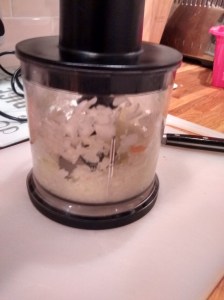
Grate the onion on a fine grated or use an electric mini-chopper.
In a large bowl mix all the ingredients together except for the dried breadcrumbs, it is best to do this using both hands, making sure that all the ingredients are thoroughly combined.
Add enough dried breadcrumbs so that it is a firm mixture.
Put some flour in a dish for your hands to make it easier to shape the pulpety.
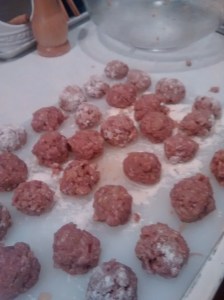
Pinch off small bits of the meat mixture and roll the piece between your hands to make small round balls and place these onto a floured board or tray whilst you make them all.
You can leave these to chill in a cool place or in the fridge if you have time.
In a large pan heat up some stock and drop the pulpety into the boiling liquid and then let them simmer for around 5 minutes.
Remove them from the liquid with a slotted spoon.
Polish style would be to have around 5 pulpety in a bowl of soup – but often I do these for a light lunch and have a large bowl of soup with lots of pulpety per serving.
In the photograph below, they were served in a tomato soup.
Served In A Sauce
The varieties here are endless – make one of your favourite sauces for example mushroom or tomato and drop the cooked pulpety into the sauce and let them simmer.
You can then serve them with potatoes, pasta, rice or to be very Polish – buckwheat.
There is a little bit of linguistic confusion with this dish – I have noticed it in most translations for this recipe.
Kotlety is the Polish word for cutlets or chops as discussed in my last post.
Mielone means minced – so kotlety mielone are what in the USA are called meat patties or now in England as burgers.
My mother called both dishes kotlety – I would realise from the ingredients as to which dish was being prepared in the kitchen.
We had kotlety mielone once a week at home, any left would be heated up in a sauce, often mushroom, the next day.
In Poland they would have been made with minced pork but previously this was hard to get and my mother found it hard work to use a hand mincer, so she made hers with minced beef using the beef that the butcher would mince for her.
In her original recipe she would use an onion which was grated finely; this was the job that was often delegated to me! Later on she changed her recipe and would chop up the raw onion finely and fry this up lightly and let it go cold before adding it to the mince mixture. I now like this second version better, but both are good and you can even do half and half.
Nowadays I use an electric mini chopper to “grate” the onion.
I used beef in this recipe for years and then tried pork, and also half and half; I like the ones half and half the best, however I always make sure it is lean pork mince.
Ingredients
500g minced beef or pork, or 250g of each
1 beaten egg
1 slice of white bread or bread roll, left for half an hour in a bowl with a little milk – do not use the excess milk just the wet slightly squeezed bread
1 onion finely grated, or chopped and fried till golden brown and left to cool. (or half and half)
In a large bowl mix all the ingredients together except for the dried breadcrumbs, it is best to do this using both hands, making sure that all the ingredients are thoroughly combined.
If the mixture seems too wet then add a tablespoon full of dried breadcrumbs and mix this in.
Pour some dried breadcrumbs onto a large plate or board.
Try to make each one the same size, take a handful of the mixture and press it between your hands to make a flattened circle and then place this in the dried breadcrumbs and turn it over to cover both sides and edges.
Once coated place them on a tray dusted with breadcrumbs until you have used all the mixture up.
Shallow fry the kotlety in hot oil, depending on the frying pan size, you can do 3 to 4 at a time, turning them over so that both sides are done. Place them on kitchen roll on a plate or metal tray till they are all cooked – you can keep them warm in a low oven.
I usually serve them with creamy mashed potatoes or lightly buttered boiled rice.
Sometimes I add some finely chopped peppers or chillies to the mixture and serve them with boiled rice.
You can make the kotlety with minced chicken or turkey.
In Poland many people think that ones made with minced veal are the best.
Jasia’s Variations
My cousin Janina (Jasia is the diminutive) in her farm house in the Mazurian lakes in North East Poland made some kotlety mielone which had an addition to the usual recipe. Each one had a small piece of stuffing inside. The meat recipe was the same as was the method of cooking but when she was making them, she placed a little extra at the centre and this added an extra dimension to an old favourite.
The stuffing she used was one of the following:
A cube of cheese – the type which will melt like Gouda or cheddar
A chunk of pickled gherkin.
A thick slice of fried mushroom.
The Next Day
You can eat any kotlety you have left, cold with mustard and any salad.
However if I have any kotlety left, I often re-heated them in a sauce in the oven, my favourite is mushroom sauce.
I often just make a very quick sauce by frying up some sliced mushrooms in a little butter, adding some stock (mushroom or chicken – made from a stock cube). Add the kotlety into the pan and heat them through in the oven for around 1 hour.
Add some soured cream mixed with a tablespoon of corn flour and out this back in the oven for a while or continue heating it on a top burner.
Super served with creamy mashed potatoes – sprinkle chopped dill or parsley over them before serving.
Served on Carnation (1982 – 1998) by Royal Doulton.
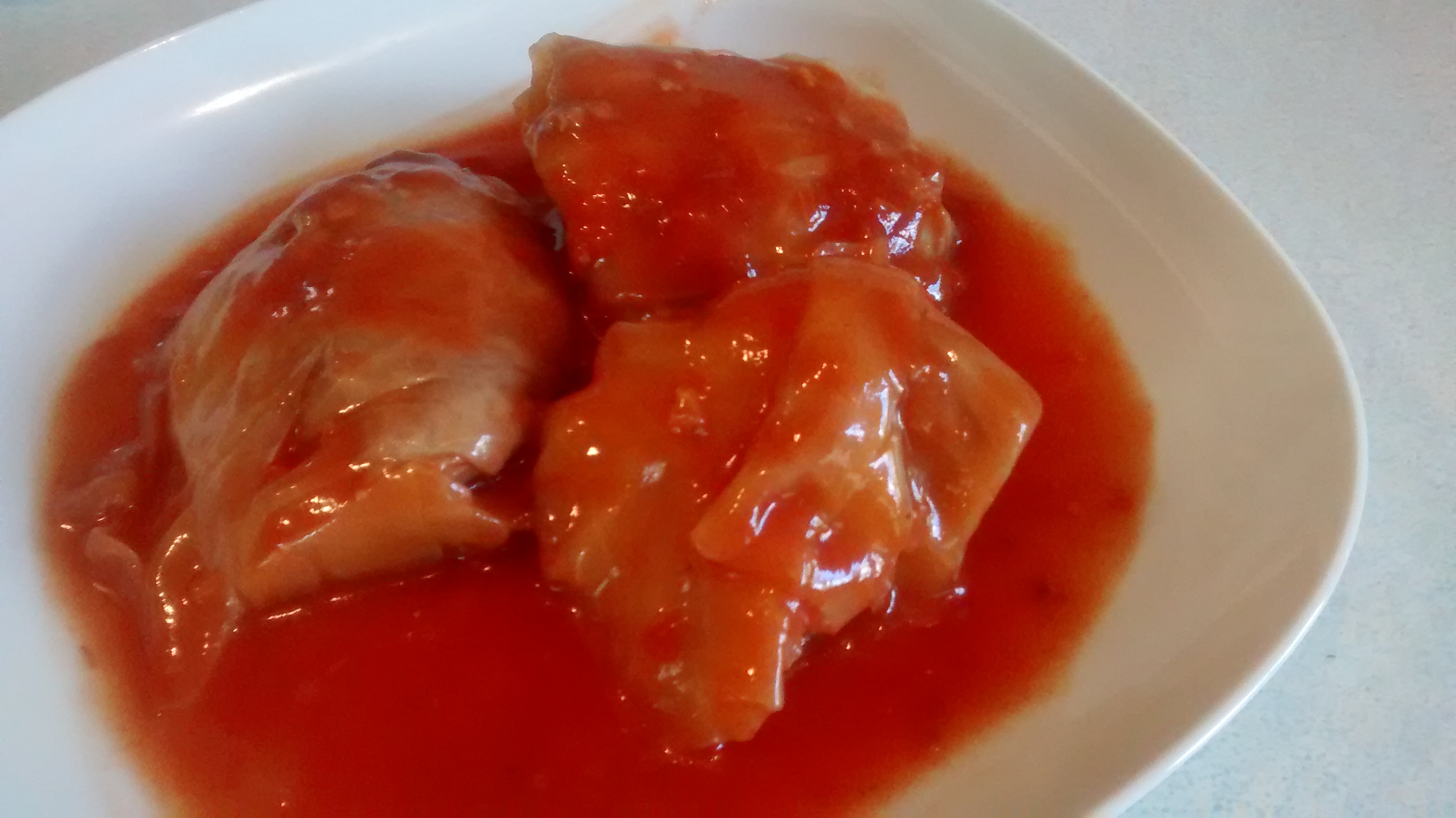
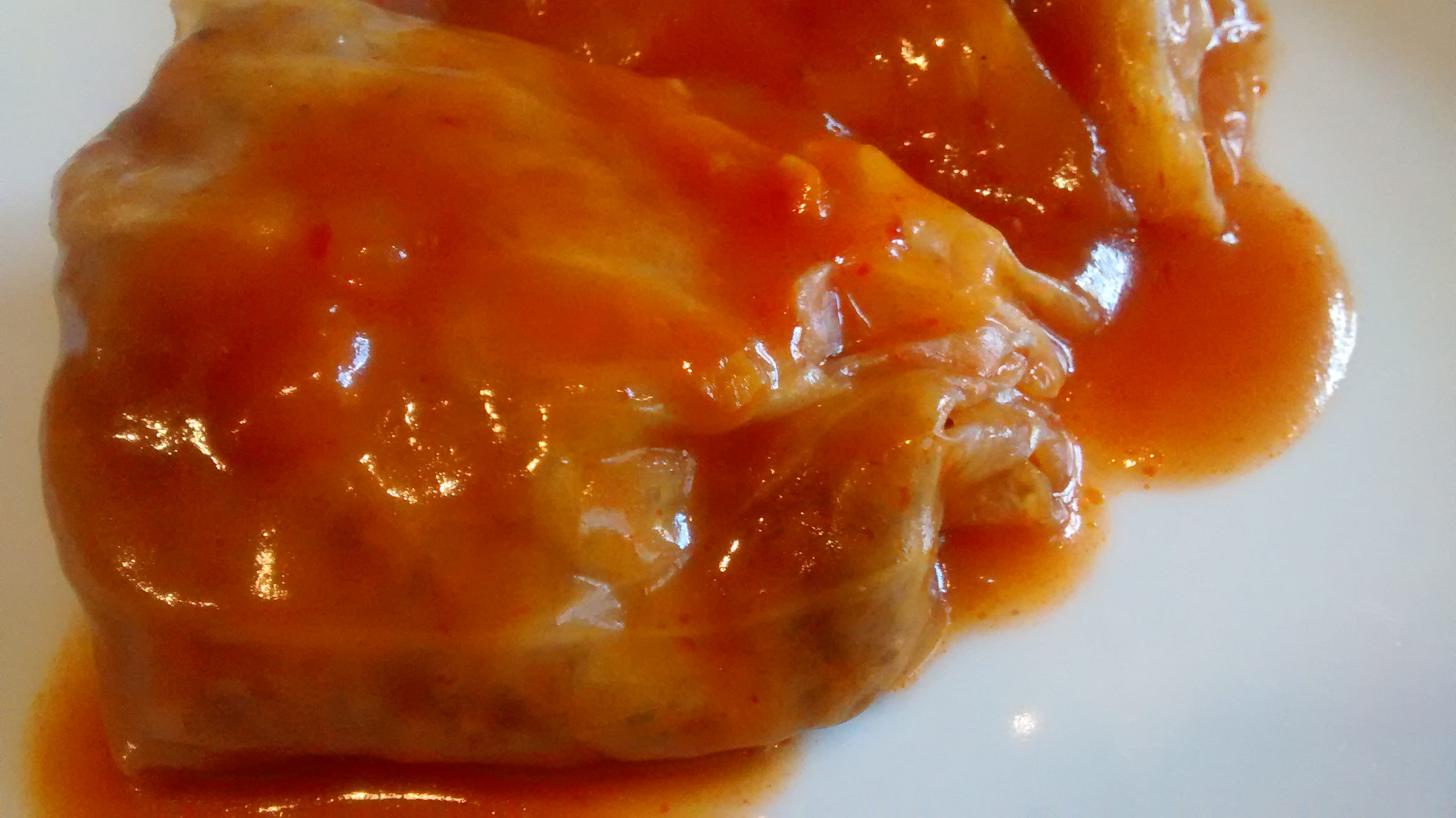
Gołąbki are made using fresh cabbage and the name means little pigeon or dove. This name comes about from its size and shape and also from to the idea of this being a little delicacy.
The cabbage leaves are used to make a little parcel with a meat and rice filling and these are then cooked in a liquid stock or sauce.
I have read that this is a very old dish which originally came from the Byzantine Empire and was made with vine leaves, as it came north; cabbage leaves replaced the vine leaves.
The main 3 ingredients are: cabbage, rice and minced meat, and you also need a liquid to cook them in, which in my mother’s case was always a stock with tomatoes.
You can use white or Savoy cabbage. White cabbage has softer more pliable leaves and I think make the best gołąbki . Savoy cabbage has firmer leaves that are easier to work with but take longer to cook; these can be easier for a novice to use.
You need a large head of cabbage to get large leaves.
You can use any type of rice but the stickier types are the best.
The traditional Polish version uses pork. My mother used beef as this was more readily available in England. Now that minced pork is more available and you do not have to hand mince it, I use either or even mix the two.
There are many variations using, fresh or dried mushrooms, buckwheat instead of rice, and a stock without tomatoes. In fact buckwheat is a more older version as it grows in Poland and rice would have to be imported.
This recipe is my mother’s and for me this is just right!
Mama’s Classic Recipe
Ingredients
1 large head of white cabbage or Savoy cabbage
400g rice
500g of minced beef or pork
chicken stock – a cube or concentrate will do
1 tube of tomato purée
salt & pepper
2 bay leaves
3 or 4 peppercorns or allspice or both
Although the gołąbki take a while to put together, you then leave them to cook in a slow oven for hours which is easy.
You can reheat them on the next day and in fact I think they taste better the longer they have been steeped in the cooking liquid and I always make them a day in advance.
They also freeze very well, so I pack any left in portions of 2 or 4 for a later date. Because of this I like to make as big a batch as I can in one go.
I use a very large enamelled oval dish with a lid which is ideal for this.
As you need whole largish cabbage leaves I sometimes use 2 cabbages to get the bigger leaves.
You need to parboil the rice in salted water so that it is about half way to being cooked and then strain the rice and let it go cold, but if you have some plain boiled rice left from another day you could use this as this is not critical.
In a large bowl mix the rice and minced meat and add salt and pepper. The exact amounts do not matter. I like it to look about 50/50 white and pink but these can be made with much more rice to eke out the meat available.
Next comes the hardest part and patience is called for here to avoid getting scalded fingers. You have to heat or steam the cabbage to make the leaves pliable so you can remove them one by one and use them to encase the filling.
You need the largest pan you have into which you place the cabbage head. I boil some water in a kettle and pour this over the cabbage in the pan with some heat under the pan I let the cabbage cook a little. The temptation is to boil to quickly so making some of the leave too soft and runs the risk of getting scalded as you try to remove the leaves. Another method is to place the cabbage into a metal colander and set this over the pan of water so that it is steamed rather than boiled.
As the leaves become soft, you have to cut them off from the stalk and stack them up for to use later, you can cut out the thickest part of the stalk from the first few larger leaves.
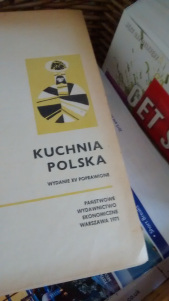
Instructions from my Polish cookbook “bible”
Pre heat the oven to GM2 – 150oC
Place a small handful of the rice & meat mixture onto a cabbage leaf and roll up from the stalk end, tuck in the sides and secure with the outer edge of the leaf to make a small parcel.
Place the rolls into a large casserole dish, packing as many rolls as possible in rows in the dish. Depending on the depth of the dish repeat this for another layer.
A tip I got from my late cousin, Krystyna, is to use extra cabbage leaves on the base of the dish and then to put extra leaves on the top of the rolls.
The rolls sometimes have a habit of getting slightly burnt on the top as they come out of the liquid and sometimes at the base if they have been in the oven a long time, these extra layers protect the rolls and can be discarded at the end.
Make a large amount of liquid stock with hot water and tomato purée and add bay leaves, peppercorns and allspice.
Cover the rolls with this liquid. It is a good idea to have extra which you can use to top up as they are cooking.
Cover with the lid and place in the oven and cook for several hours. Check them occasionally and keep them covered with liquid as much as possible.
As mentioned earlier I make these a day beforehand and then put them back in the oven for an hour or so before serving.
They are a complete meal in themselves but you can give serve them with some bread to mop up all the liquid sauce.





















 Journey From A Polish Kitchen