I have very fond memories of the first time I tasted this cake, it was a very warm, late summer’s day in the land of a thousand lakes in North East Poland – the Mazurian Lakes.
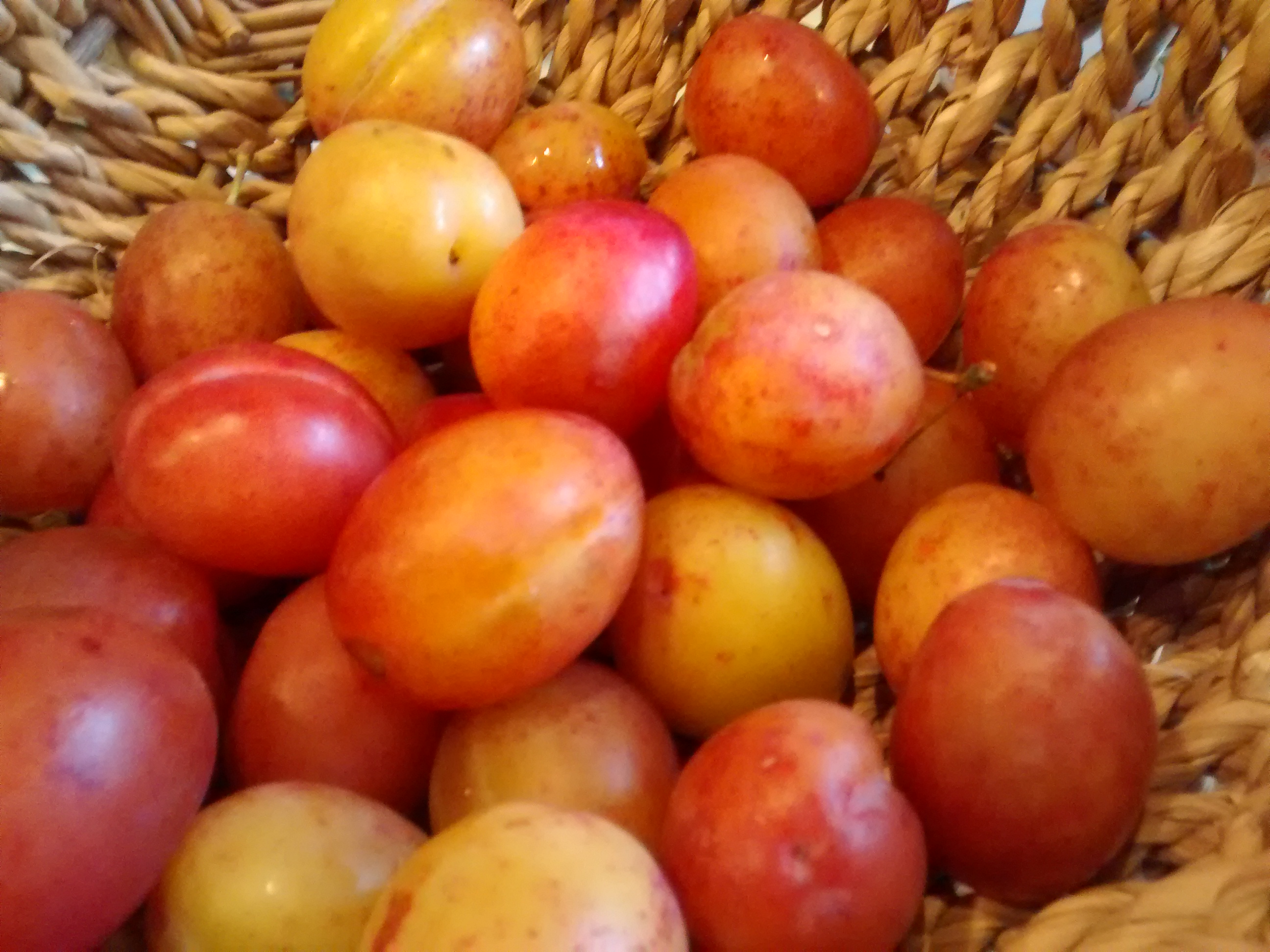
My cousin Krystyna went outside and came back in with one basket of eggs she had collected and another of ripe plums from one of the trees outside. We set to and made this cake to her recipe, calling in the other cousins to eat it as soon as it was cool enough!
The contrasts between the texture of the cake and cooked plums and also the sweetness of the cake and the slight tartness of the plums make this a cake to remember.
The use of oil means this is a relevantly modern recipe & it is so easy to make.
The original recipe was made using metric cups but I have converted it to weights as I am happier using these.
I make this using Victoria Plums.
Ingredients
350 – 400g of plums – small plums are best
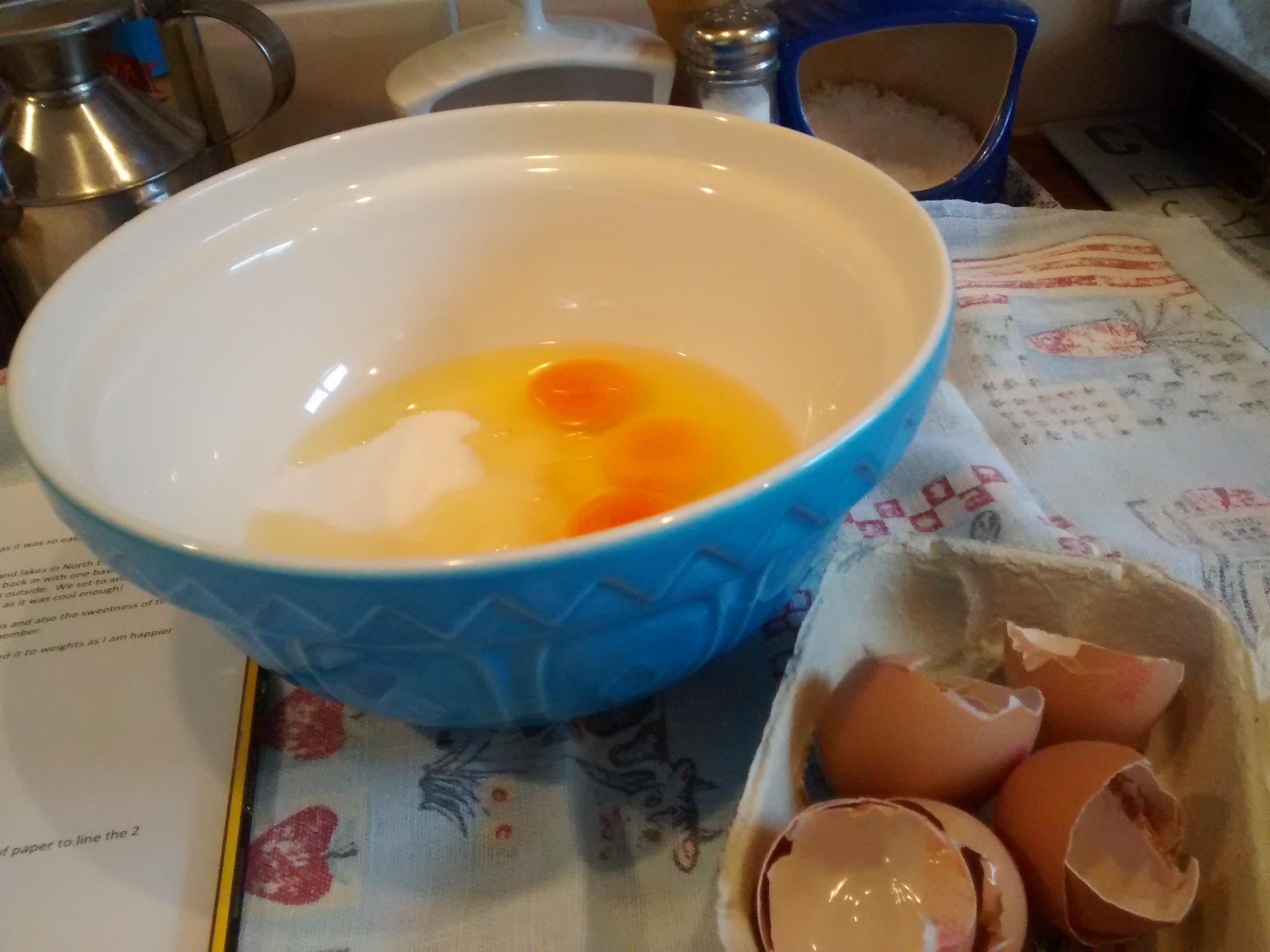
4 eggs
170g granulated sugar
200g self raising flour
60ml sunflower oil
Icing sugar – to dust
Method
Pre heat the oven to Gas mark 4 – 1800C
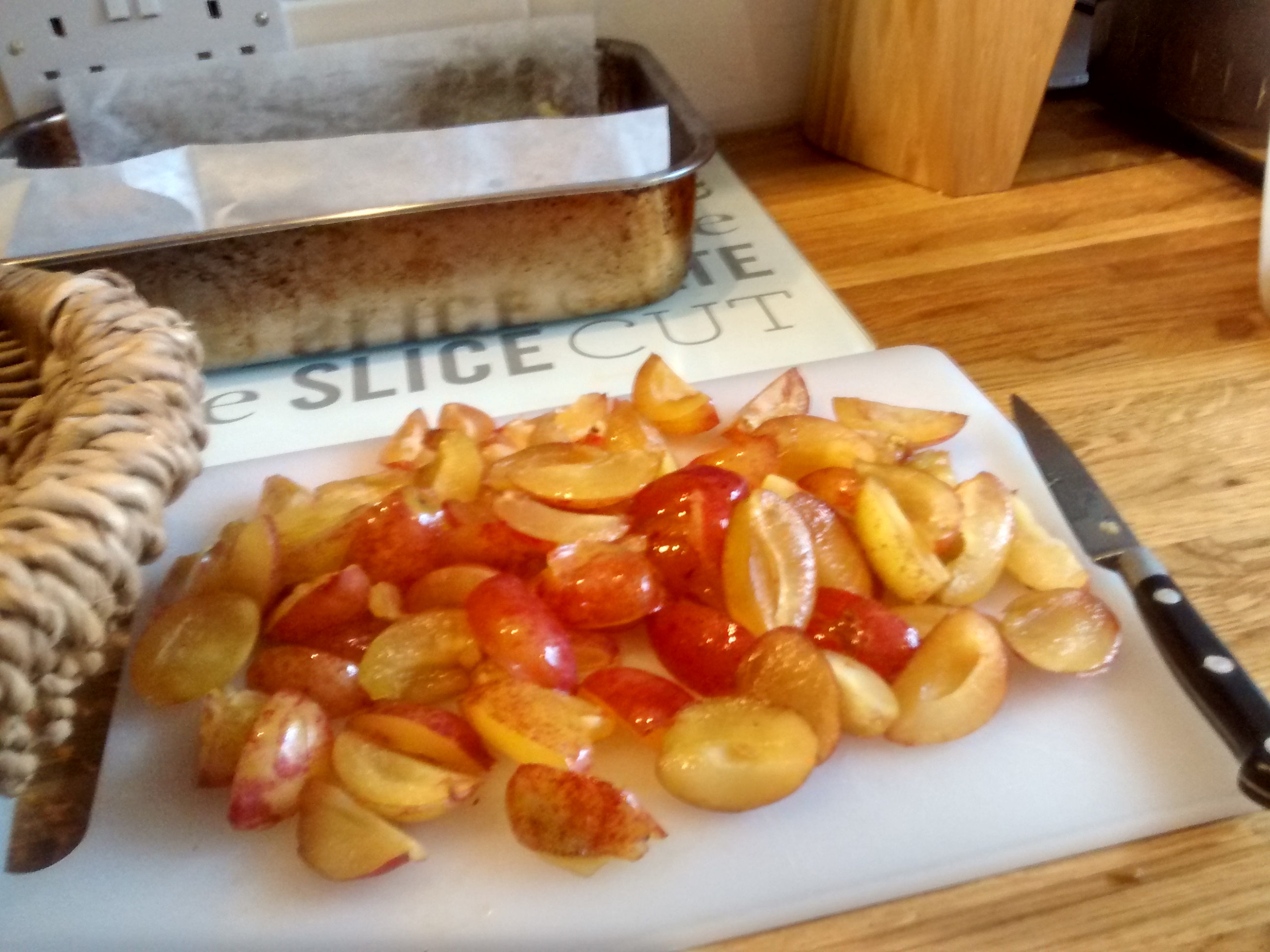
Take a roasting tin around 22cm by 31 cm and use one piece of greaseproof paper to line the 2 long sides and the base.
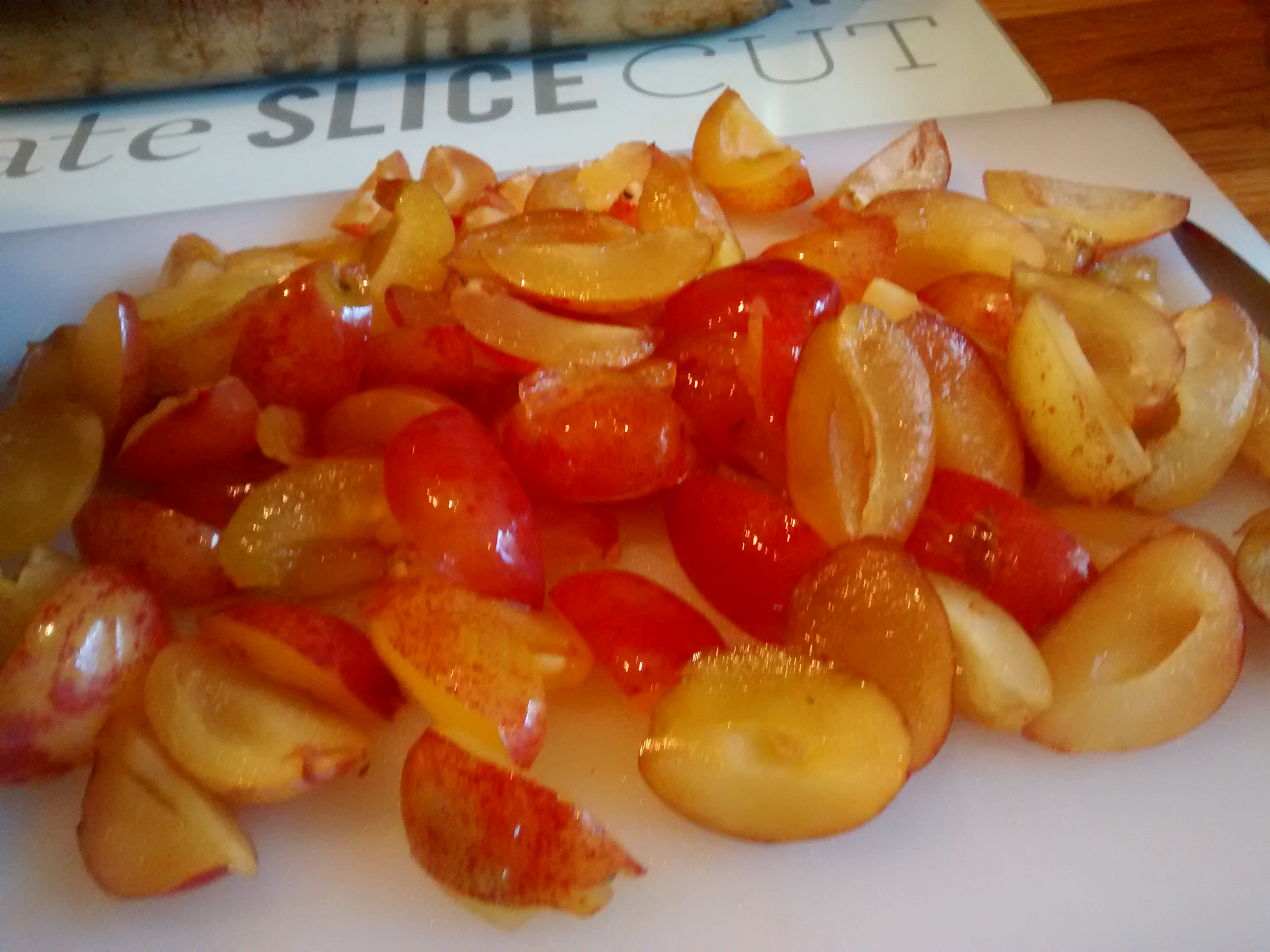
Cut the plums into quarters and take out the stones.
Whisk the eggs and sugar until the mixture is thick and creamy.
Add the oil and the flour and lightly beat everything together to make a thick batter.
Pour the batter into the roasting tin.
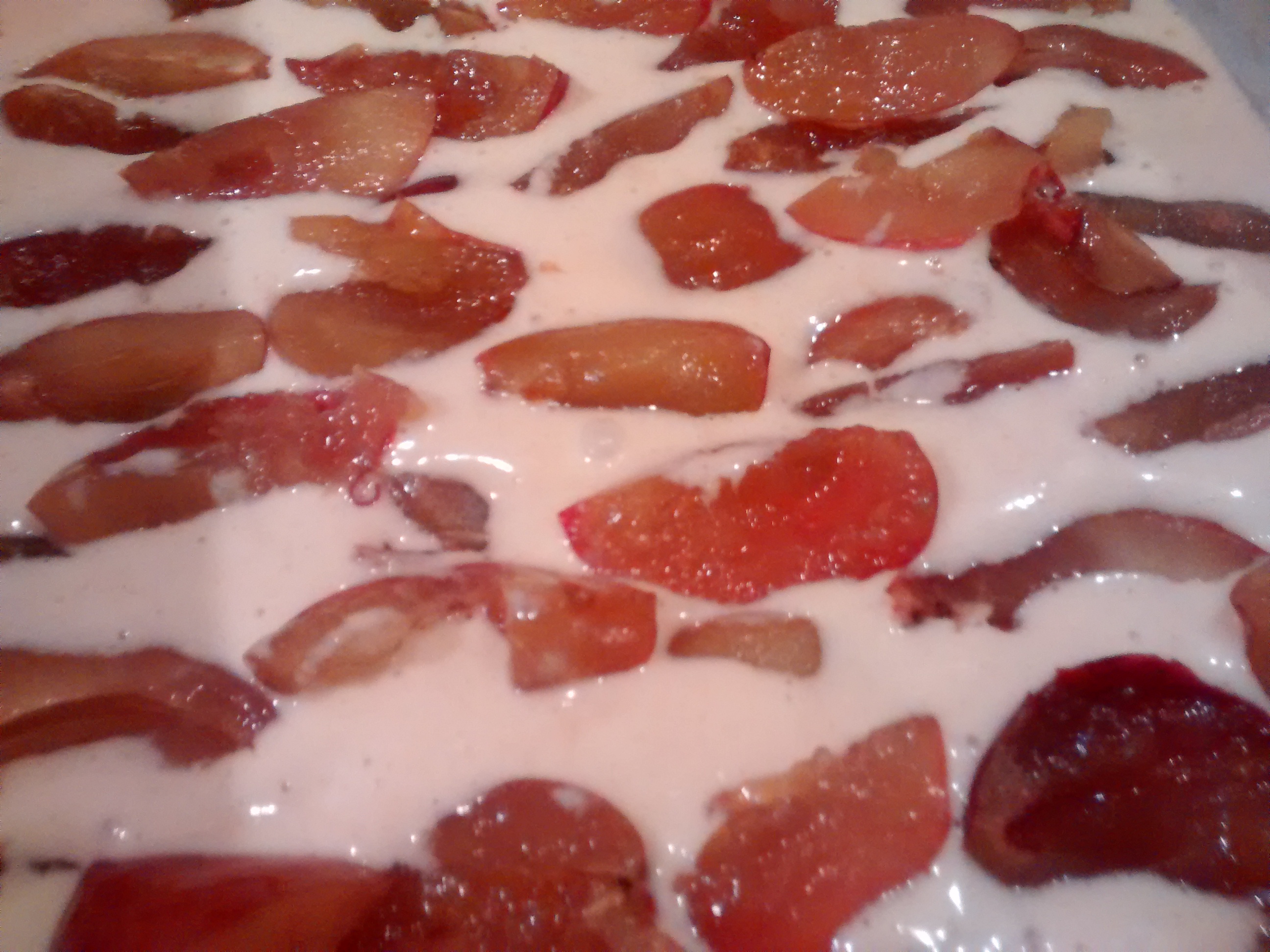
Place the cut plums, skin side down in rows on the batter until the top is full – they will start to sink – do not worry.
Bake for 30 to 35 minutes.
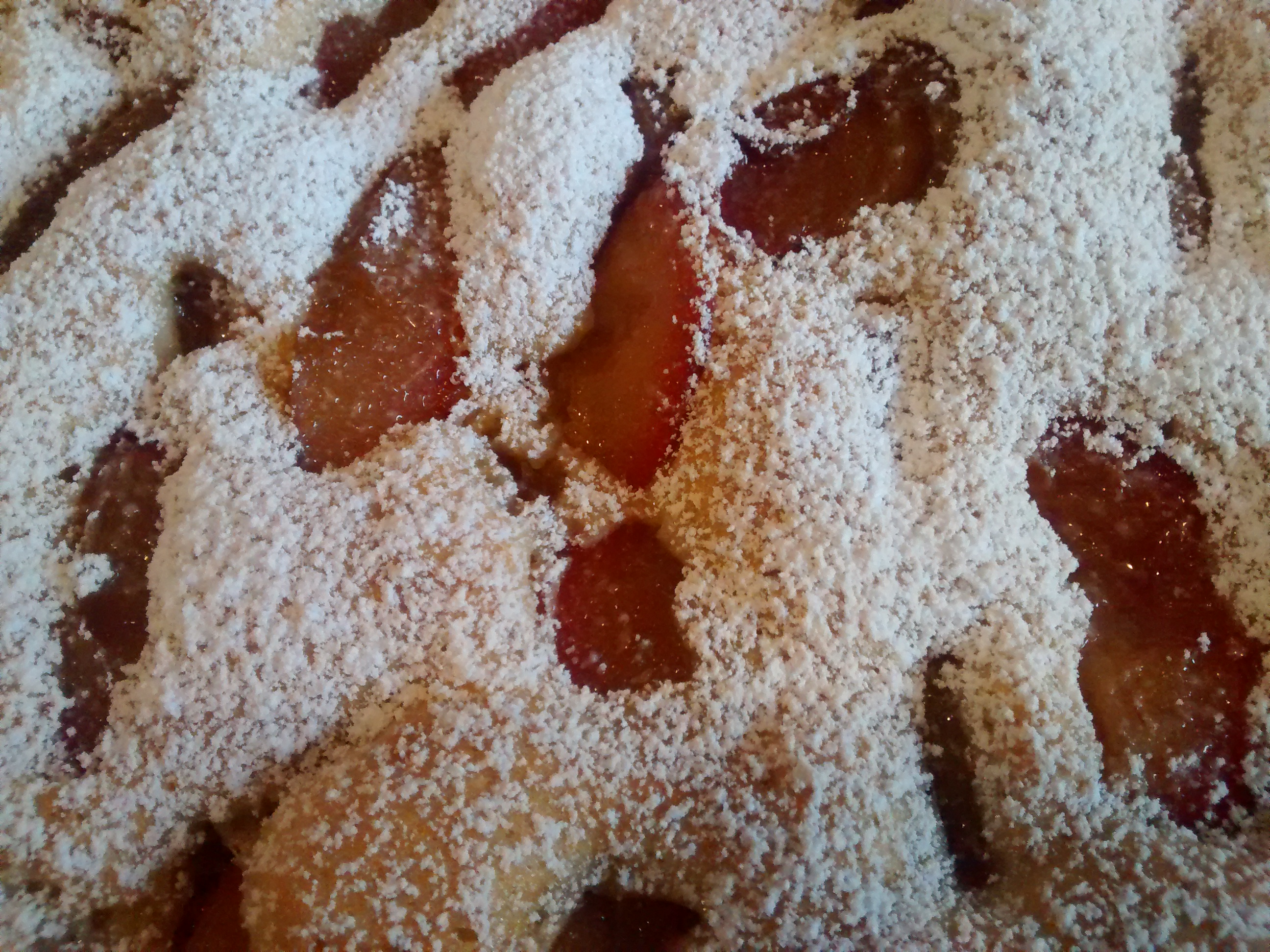
Dust with icing sugar when it has cooled slightly.
Cut into squares to serve.
Tea plates are Counterpoint (1973 – 1987) by Royal Doulton.
Note
If you have any cake left, it is better not to cover it with too airtight a cover as it will go soggy.
Rheum rhabarbarum is the Latin name for rhubarb – in Polish it is rabarbar.
It is a plant that has its origins in China, Mongolia & Siberia – its roots survive the cold!
Rhubarb roots have been used in Chinese medicine for thousands of years.
The plant arrived in Europe via Venice in the 14th century having been brought from China along the Silk Road.
The leaves are poisonous to humans as they contain large quantities of oxalic acid and other toxins.
The stems however can be eaten safely, although they do contain a little oxalic acid but their tartness is due mainly to malic acid which is also found in sour green apples.
Rhubarb stems were first eaten in England in the 17th century.
In 1820 the rhubarb plant was taken over to the USA.
I live in West Yorkshire – just outside what is called the Rhubarb Triangle of Wakefield, Leeds & Morley – where rhubarb is grown in forcing sheds (in darkness) on a commercial scale.
I have rhubarb growing in my garden.
I have used the rhubarb to make rhubarb crumble but over the last few years I have been trying to find recipes for a rhubarb cake and have tried many from English, American & Polish recipe books and magazines.
Some recipes just used 1 or 2 stalks of rhubarb – as I have lots of rhubarb – I wanted a recipe that used more.
Some recipes used the raw stalks in a cake – I found that none of these were to my liking.
I tried using my best Polish apple cake recipe with stewed rhubarb instead of apple but found that it just did not come out very well. The cake was too soggy and raw in places because of the amount of liquid in the stewed rhubarb.
Finally after more trial and error – I came up with a recipe which I am happy to make for people and to share.
Preparing The Rhubarb
This I have found to be the most important part to making a successful rhubarb cake.
You need to prepare the rhubarb the day before you want to make cake.
I tend to make a large amount and if I do not use it all I freeze the rest.
You need around 8 large stalks if not more.
Trim the ends of the rhubarb stalks and then chop the stalk into pieces around 7cm in length.
Put the pieces into an oven proof dish and add granulated sugar – try not to use large amounts – it is better slightly tart.
Put the covered dish into a low oven – GM 2 for around an hour or so – you want it soft but not totally disintegrated.
Allow this to cool.
Now comes the part I found to be the most important – I strain the cooked rhubarb from the juice & syrup.
Put the rhubarb into a colander over a bowl and leave this for several hours or even overnight.
The juice and sugar syrup can be used to flavour yoghurt, diluted with water to make a drink or even added to pork in a slow cook recipe.
Now by just using this strained rhubarb I have found that a cake adapted from my apple cake comes out very well.
I have used half the quantity from my apple cake recipe as the base and then used a drier crumble type mixture – called kruszonka in Polish – for the top.
Cake Ingredients
Base
150g self raising flour
100g butter
40g caster sugar
1 egg yolk and 1 or 2 tablespoons of lemon juice or water.
Topping
120g plain flour
90g butter
60g icing sugar.
Method
You have to use a loose bottom or spring-form tin or you will not be able to get the cake out.
I use a loose bottomed anodised aluminium cake tin which is 22cm in diameter and 8cm deep.
Grease the tin well.
First make the cake base by rubbing the butter into the flour to make crumbs then stir in the sugar.
Add the yolk and lemon juice and bring the ingredients together to form a soft dough – do not handle the dough too much. Leave the dough in a cool place for about half an hour so it is easier to handle.
Pre heat the oven to GM 4 – 180ºC.
Make the topping by rubbing the butter into the flour to make crumbs and then stir in the sugar.
Press the dough into the base of the tin.
Cover the base with the strained rhubarb.
Evenly sprinkle all the topping over the rhubarb.
Bake in the oven for around 1 hour to 1 hour & 10 minutes.
Leave to cool in the tin.
Use a long metal spatula to ease the cake from the side of the tin then place the cake on to the top of a tin can and slide the side down.
If you find the cake is not sweet enough – you can sprinkle the pieces with icing sugar – I rarely due – I like the fruit to be tart.
Tea plates are Counterpoint by Royal Doulton 1973 – 1987
Do not put the cake into an airtight plastic box as it will get soggy – better to cover it with a mesh cover.
In Polish the word for a fat free sponge cake which is made with just eggs, sugar and flour is biszkopt.
A sponge cake which uses butter or margarine which is creamed with the sugar is described as piaskowy – this adjective means sandy – hence the title of this post!
I have not managed to find an explanation as to why it is so described but have found this term in all my Polish cookery books.
Pani Stasia’s Sponge Cake
This is a recipe which I learnt from my mother’s friend who we knew as pani Stasia*.
Pani Stasia made wonderful cakes but unfortunately I did not write many of them down – however I did for this one and it is the basis for many of my other cakes and buns.
This recipe is equivalent to the British cake – Victoria Sponge – named after Queen Victoria in whose reign this became popular & who is said to have liked this cake very much.
Having been looking at recipes in my Polish cookery cooks I realise that pani Stasia adapted this recipe for England as self raising flour and caster sugar are not found in Polish shops.
(*Pani translates as Madam, Lady or Mrs and is a polite form of address – it is like donna in Italian or for example saying Miss Mary in the Southern States of America.
Stasia is the shortened form of the Polish name Stanisława. (The feminine form of Stanisław)
St Stanisław is the patron saint of Kraków & Poland, he was a martyr, murdered by the Polish king Bolesław II the Bold in 1079 – a story which has much in common with St Thomas à Beckett and the English king Henry II in 1170).
Ingredients
Eggs
Butter or Block Baking Margarine
Caster Sugar
Self Raising Flour
I usually use 3 or 4 eggs for this recipe – in the photographs below I have used 4 eggs to make 2 cakes which were then sandwiched together with jam and white chocolate butter cream.
Method
Grease and line the base of 2 x 21.5cm sandwich tins. – I find anodised aluminium tins are the best. (my old tins say 8 1/2 inch on the base – 21cm or 22cm would be OK)
Pre-heat the oven to GM 4 – 180°c
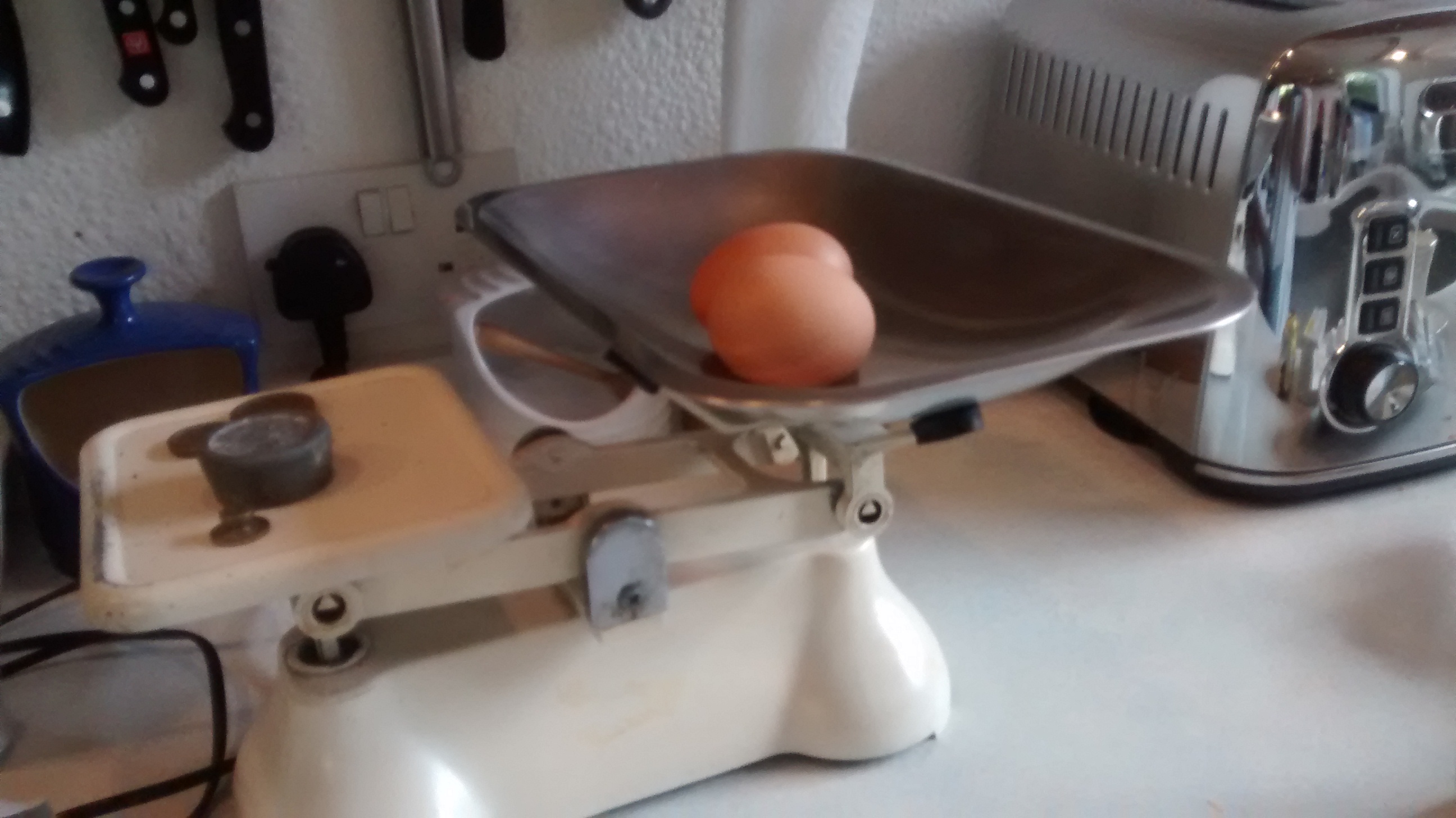
The first thing you have to do is weigh your eggs – complete with their shells.
Weighing Eggs
You then weigh out the same amount of butter or block margarine, caster sugar and self raising flour.
At first I thought this was very strange but now find that it gives a very good way of getting the right proportions no matter what size the eggs are.
I heard the late Marguerite Patten in an earlier recorded programme on the radio a few weeks ago saying that Victorian cooks often used this method.
Cream together the butter and sugar until it is light and fluffy.
Add the eggs, one by one whisking again until the the mixture is light and fluffy again.
Fold in the flour with a metal spoon taking not to over mix the mixture and knock out all the air.
Divide the mixture evenly between the 2 prepared tins.
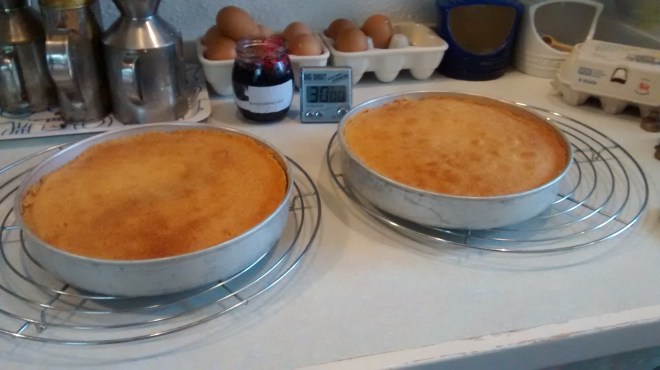
Bake in the centre of the oven for around 25 to 30 minutes – the cake should be golden brown and be clean when a cake tester is used.
Cakes cooling awaiting being sandwiched together
This cake is very versatile and here I have sandwiched it together with blackcurrantjam (given to me by my friend who had made it with fruit from her allotment) and white chocolate butter cream.
Sweet whipped cream is not found in Polish cookery – butter creams and similar are the standard fillings for layer cakes.
On the bottom cake first spread on the jam and then top this with the butter cream.
This butter cream is sweet and needs the contrast of a tart jam, damson jam would be another alternative.
White Chocolate Butter Cream
Ingredients
60g White chocolate
40g Butter – unsalted is best
80g Sieved icing sugar
Method
Melt the white chocolate in a glass bowl over a pan of hot water and allow to cool.
Cream the butter and the icing sugar.
Beat in the cooled, melted chocolate.
Note
Take care – if the melted chocolate is too hot then you will end up having to add more icing sugar and the butter cream will be very sweet.
Dust the finished cake with icing sugar.
Plates are Burleigh Ware – Burges & Leigh Ltd —– Blue Mist around 1930s
The following is a general description and of course times will vary with people and circumstances.
The Polish day seems to start a lot earlier than in England with many people starting work at 7.30am and finishing by 3pm.
Schools often start at 8am and are finished by 2pm.
There are four meals in a Polish day.
1 śniadanie – breakfast
This is a hearty meal from about 5.30amto 7am to set you up for the day.
This will consist of: cured meats, Polish sausage, cheese, hard boiled or scrambled eggs, gherkins, cucumber and tomatoes with bread and rolls, all served with lots of tea. (Tea is quite weak served with slices of lemon or fruit syrup such as raspberry). There may also be some cake.
2 drugie śniadanie – second breakfast
This will be eaten at about 11am. It is a lighter meal than the first breakfast, though often with the same types of food – sometimes it will be just a sandwich – especially if eaten at work or school.
3 obiad – dinner – the main meal of the day
This is eaten between 1pm and 5pm with around 3pm being a very popular time.
This will consist of 2 or 3 courses:
Soup
Main
Dessert of fruit or cake – optional course
Soup is very popular in Poland from hot or cold soups, light consommé types to thick and hearty featuring throughout the year.
I heard a saying on one of my visits to Poland –
Polak bez zupy robi się smutny
This translates as –
A Pole without soup becomes sad.
I think this is very true.
4 kolacja – supper
This is the lightest meal of the day eaten between 7pm to 9pm. It can often be just a slice of cake.
Getting Ready For Dinner
Oak SideboardOak SideboardSection of TableclothsSome of my Many TableclothsSetting the Table for DinnerReady for Soup!










 Journey From A Polish Kitchen