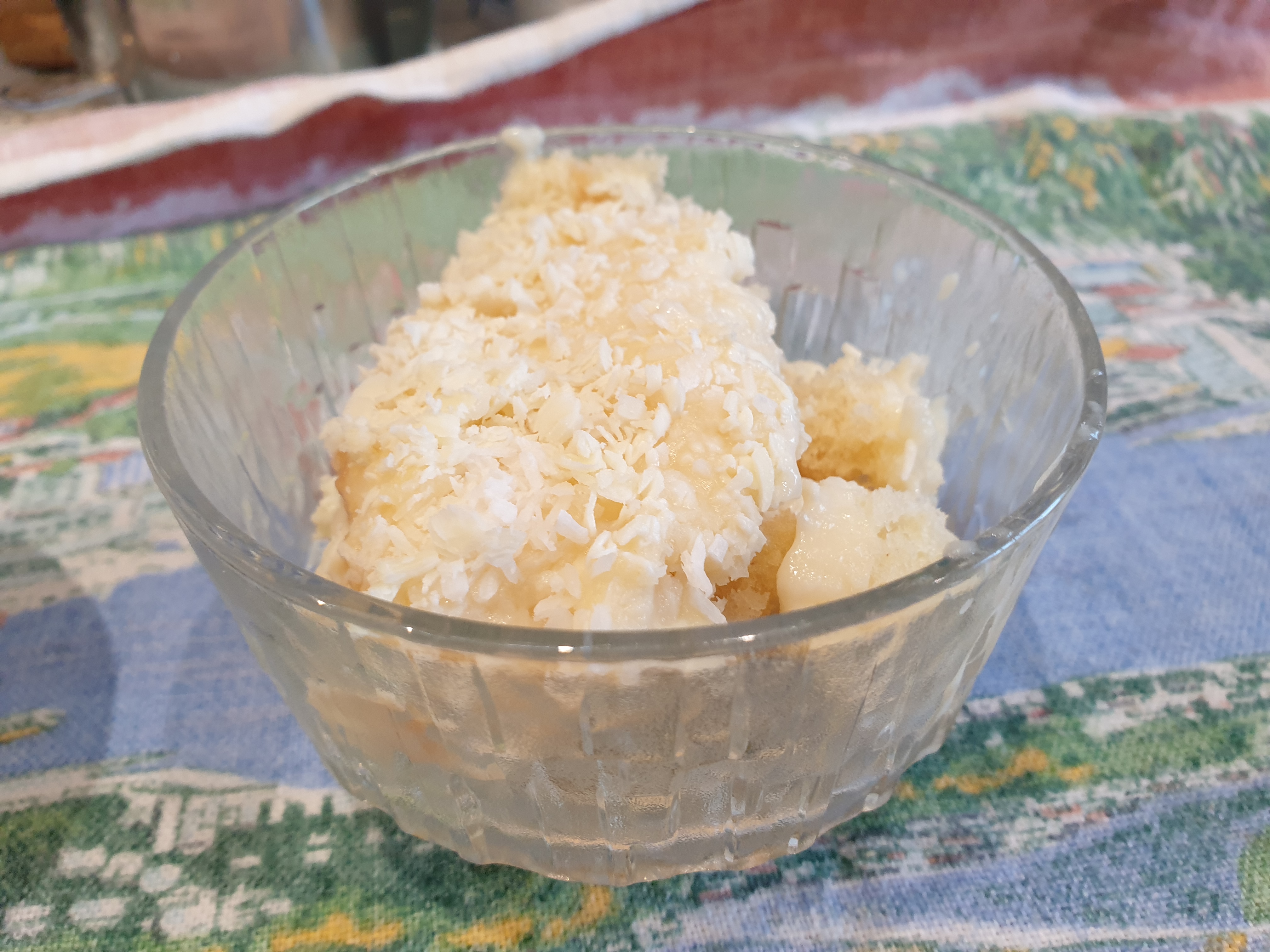
Rafaelo Dessert

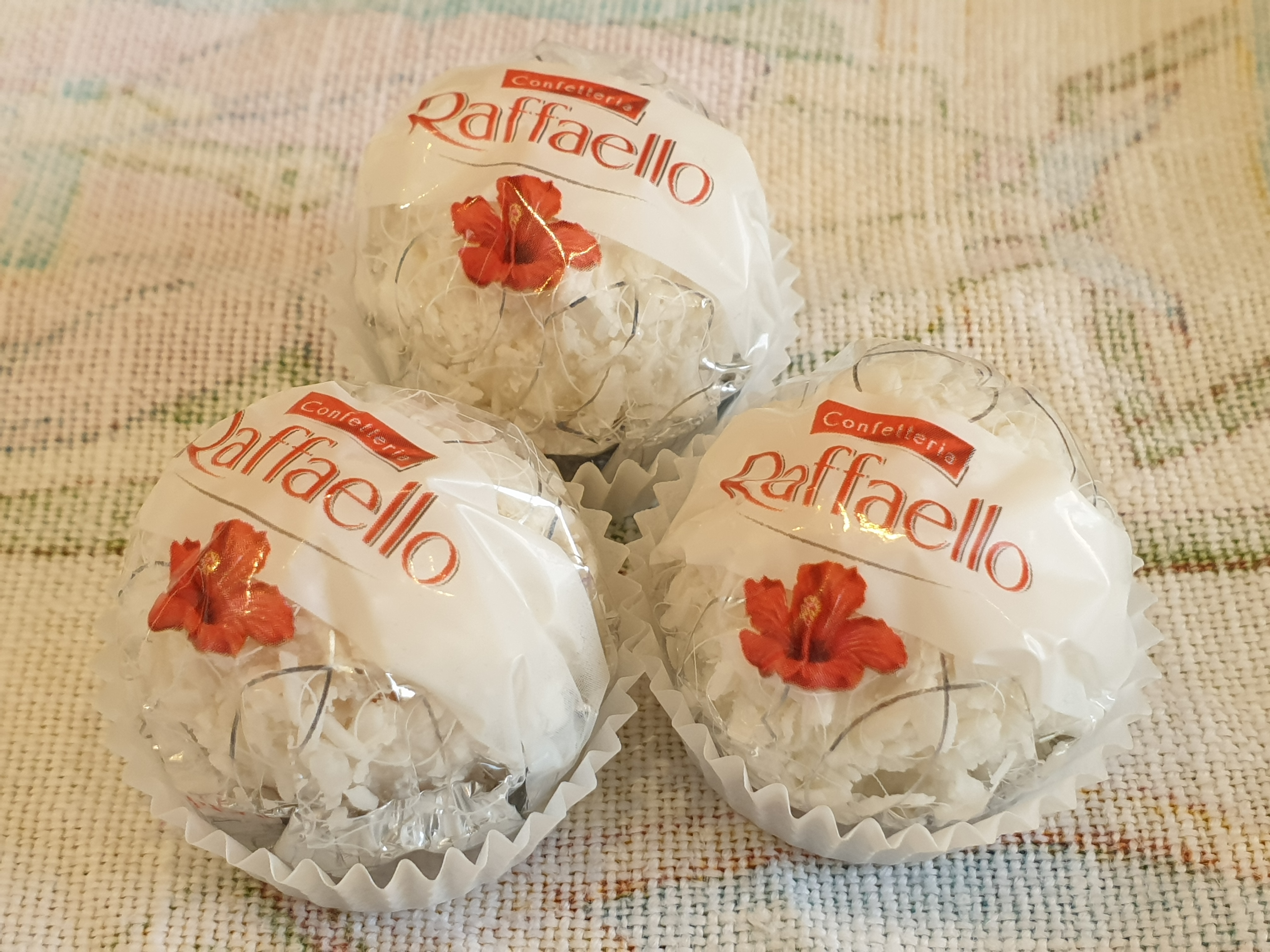
  • Raffaello chocolates were first made in 1990 by the Italian firm Ferrero. 
  • I have noticed that they are very popular in Poland and nearly always on sale in Polish shops in England.
  • They contain: almonds, wafer, white chocolate and coconut.
  • I have been looking for a definitive recipe for a Raffeallo or Rafealo tort based on this confectionary.
  • There are just so many different ideas on how to make this.
  • I have found a vast number of variations including no-bake versions using biscuits or sponge fingers.
  • I then looked at the more baked ones.
  • The cake most used is a fat free sponge – sometimes this includes ground almonds.
  • The filling is a creamy budyń (Polish custard) with large amounts of added butter,
  • Some versions use white chocolate in their ingredients.
  • The tort is topped with desiccated coconut.
  • The tort is often baked in a square or rectangular tin and each served piece is usually square.
  • However a circular one might be easier if using homemade biszkopt – sponge cake.
  • *
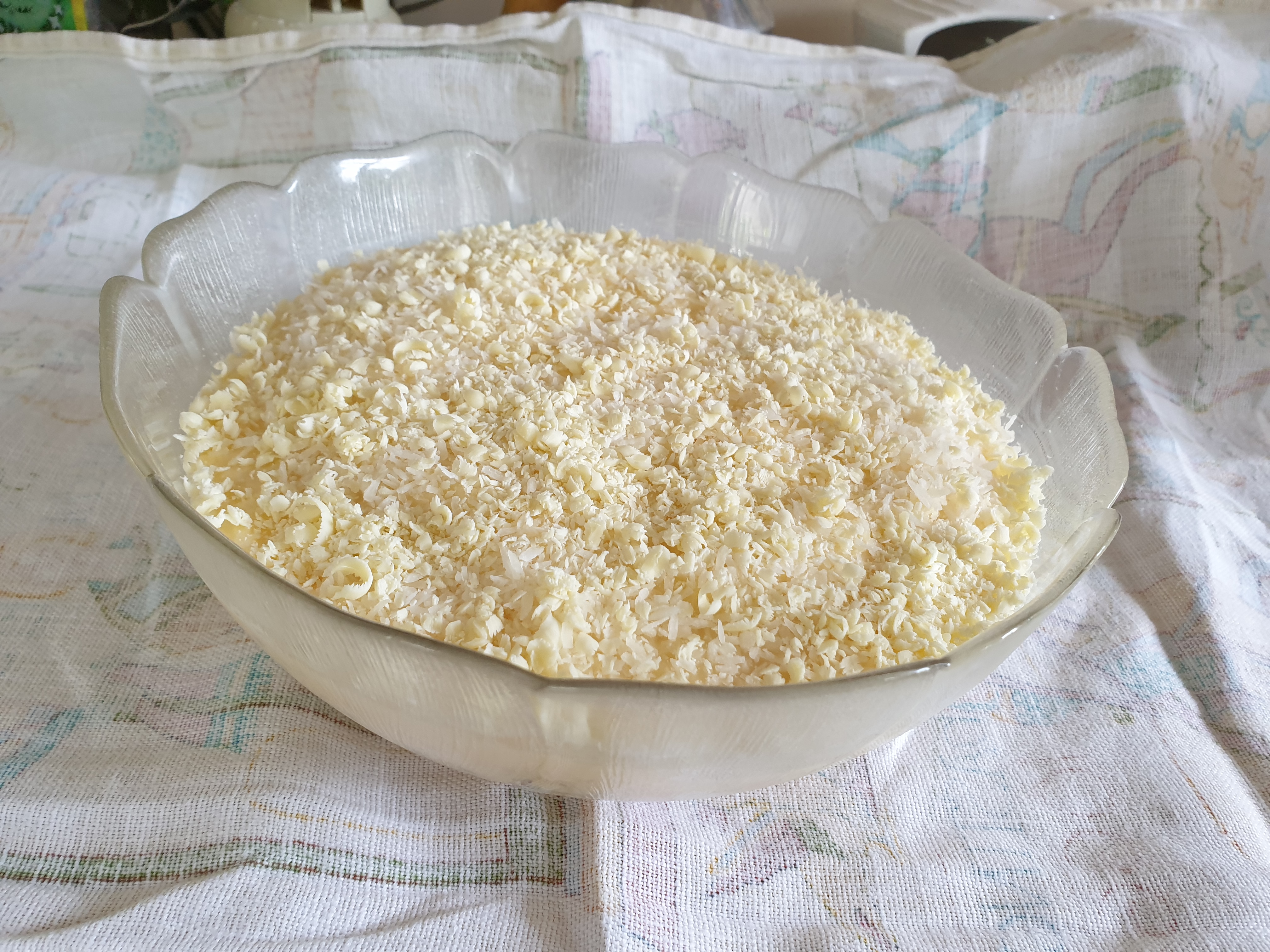
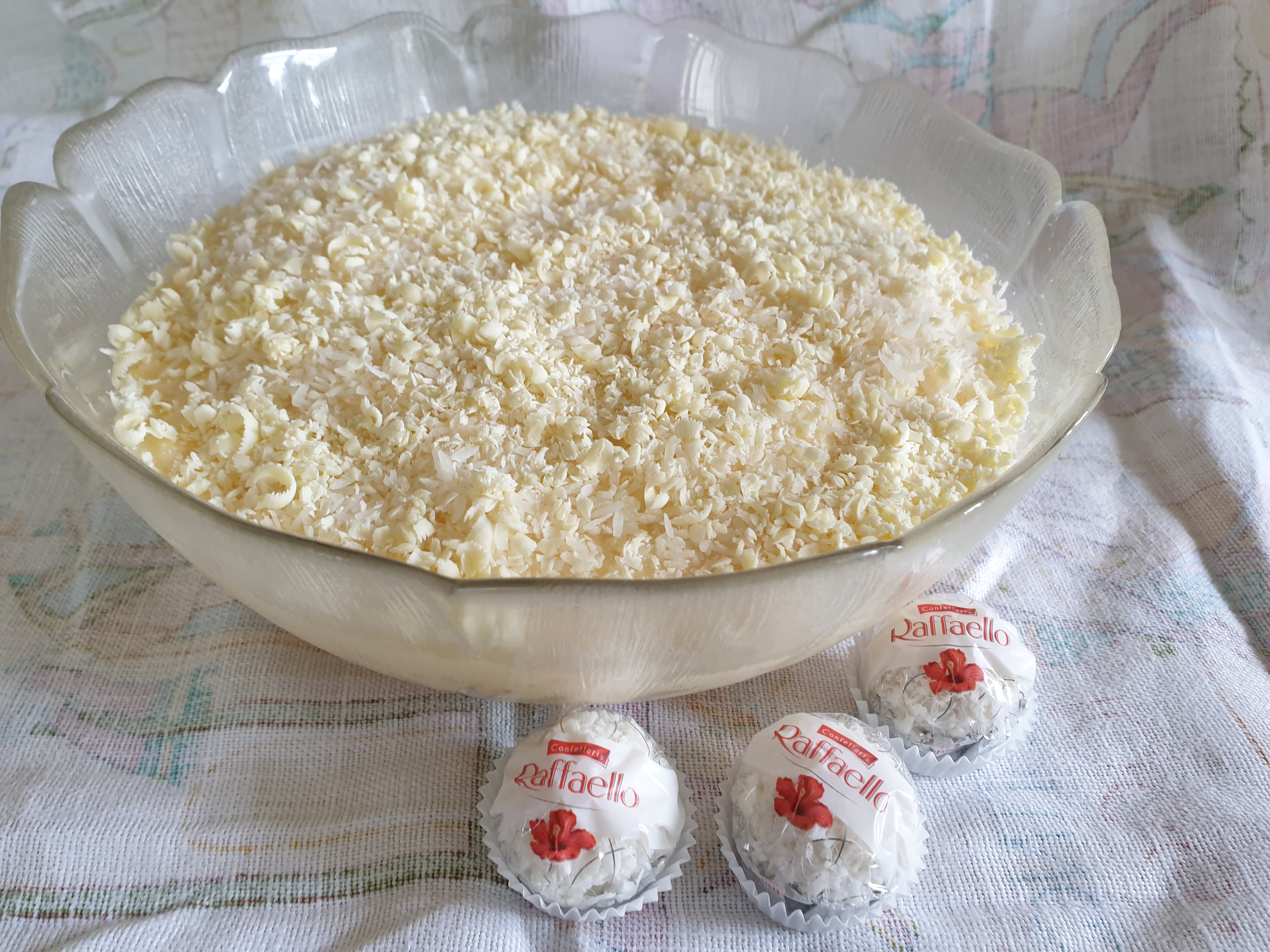
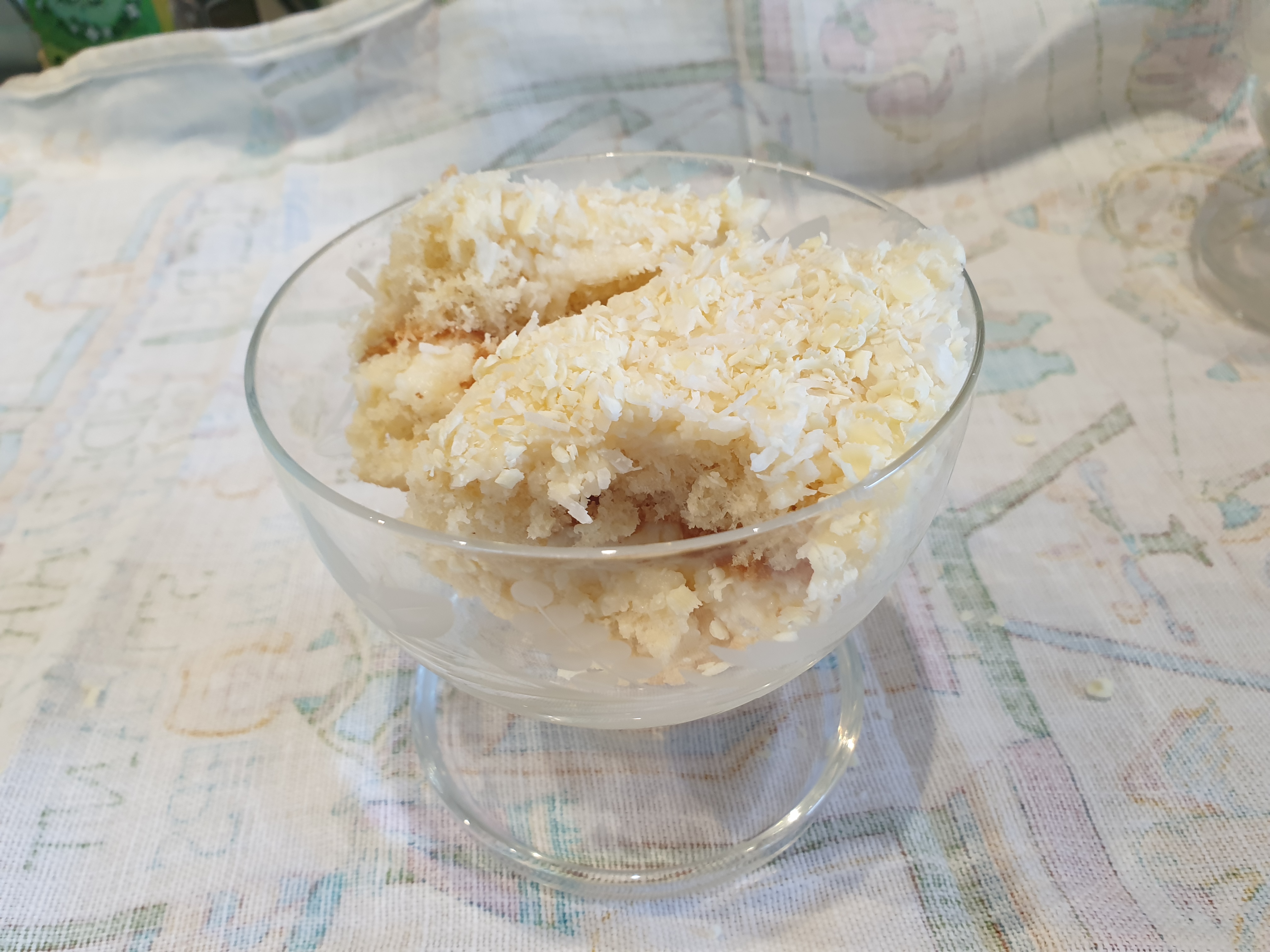
  • I decided to make a lighter dessert, instead with a coconut budyń and sponge cake and a lot less butter.
  • I used a 18cm fat free sponge made with two eggs – cut into two layers.
  • My first attempt was getting the budyń right.

    INGREDIENTS for budyń

  • 500ml milk
  • 1 tablespoon of butter
  • 2-3 tablespoons of granulated sugar
  • 3 egg yolks
  • 3 tablespoons of potato flour (or cornflour)
  • 50 – 80g desiccated coconut & 2 tablespoons
  • 50g white chocolate – coarse grated

Method for budyń

    • Put 300ml of the milk, the butter and sugar into a saucepan.
    • Heat gently till the butter has melted and the sugar dissolved, stirring all the time.
    • Bring this to the boil for a few seconds and then take off the heat.
    • Blend the potato flour with the rest of the milk (200ml) and with the egg yolks.
    • Add some of the boiled mixture to this and stir well.
    • Add this mixture to the rest of  the boiled mixture and stir well.
    • Put the pan back on the heat and bring back to boiling point, stirring gently.
    • Keep at boiling for 1 minute, stirring all the time.
    • Add in the 80g of coconut.
    • Leave to cool.
    • *
    • Use a glass dish and layer up cake, budyń, cake and budyń for the top.
    • Sprinkle the 2 tablespoons of coconut and grated chocolate on the top.
    • Chill in the fridge before serving
OPTION
  • Make the budyń with 750ml of milk and 4 egg yolks.
  • Layer up with some budyń first, then cake, budyń, cake, budyń as before.

Thoughts

  • I liked the version with more budyń. (750ml milk)
  • This was more like a dessert.
  • The version using 500ml of milk was more like a cake with filling.
  • However – they were both voted delicious.

Coconut Cake

  • This is a simple recipe inspired by a large cake recipe in ‘All About Cookery New Edition’, by Mrs Beeton published in 1911.
  • Mrs Beeton writes “ … dessicated cocoanut is now sold at a moderate price, and its use saves much trouble and labour.”

  • Coconuts are the edible fruit of Cocos nucifera, – kokos in Polish, and probably originated in the area of Indonesia and Malaya and then spread to India.

  • Marco Polo came across coconuts and they were then called Pharaoh’s nuts as they were found in Egypt.
  • Venetians were trading in coconuts by the 13th Century.
  • William Dampier (1651-1715), a buccaneer and explorer brought coconuts to England though they did not become popular until the early 19th century.
  • *
  • My father was not keen on coconut so this was not a recipe my mother made.
  • I originally made this cake in a round tin but have now also also tried it out in a rectangular tin, which makes it easier to slice and portion out.

INGREDIENTS

150g butter

150g caster sugar

200g plain flour

1½ teaspoons baking powder

75g dessicated coconut

2 eggs

4 to 5 tablespoons of milk

*

2 tablespoons of apricot or strawberry jam

3 tablespoons of dessicated coconut

METHOD

Pre-heat the over to GM4 – 180°C.

Grease and line or use a cake liner in a 20cm high sided cake tin.

Cream the butter and sugar till fluffy.

Add the eggs one at a time and beat again.

Mix the flour, baking powder and coconut together.

Fold this into the mixture.

Add enough milk to make a soft mixture.

Put into the cake tin – flatten the top.

Bake for 40 – 45 minutes.

*

Leave the cake to cool completely on a wire rack.

Take the cake out of the tin.

Mix the jam with ½ a tablespoon of water and heat gently.

Brush the top of the cake with the jam.

Sprinkle the coconut on top of the jam.

*

Alternative size

26 x 20 cm rectangular cake tin.

Line 3 sides with one piece of greaseproof paper.

Bake for 35-40 minutes.

Colclough Stardust & Duchess Bramble Rose tea plates

Pineapple & Coconut Cake

  • I came across this recipe ages ago but have only just had a chance to make it.
  • The original recipe used a small tin of pineapples, which I have not seen for a while.
  • I used part of a larger tin, which meant I had pineapples left to just eat or use in another dish.
  • The original recipe was baked in a loaf tin, which would have made it a keks.
  • However I think it is best in a flat rectangular tin – so maybe this is a placek!

Ingredients

  • 150g plain flour
  • 1½ teaspoons of baking powder
  • 110g butter
  • 75g granulated sugar
  • 50g & 1 tablespoon of desiccated coconut
  • 2 eggs – beaten
  • 120g tinned pineapples – drained and chopped 
  • 75g sultanas or raisins
  • *
  • 2 tablespoons of granulated sugar
  • 5 tablespoons of pineapple juice

Method

  • Pre-heat the oven to GM5 – 190°C.
  • Drain the pineapples, reserve the juice.
  • Weigh out the 120g of pineapples and chop these up into small pieces.
  • Grease and line a 26 x 16cm baking tin.
  • Mix together the flour and the baking powder.
  • Rub in the butter till the mixture is like breadcrumbs.
  • Stir in the sugar and the 50g of coconut.
  • Mix in the eggs.
  • Mix in the pineapples.
  • Mix in the sultanas.
  • Put the cake mixture into the tin and smooth the top.
  • Scatter the tablespoon of coconut over the top.
  • Bake for 25-30minutes.
  • *
  • Mix the 2 tablespoons of sugar and pineapple juice together.
  • *
  • Spoon the juice mixture evenly over the top of the cake as soon as you get it out of the oven.
  • Leave to cool on a wire rack.
Royal Doulton Carnation tea plate

Coconut Meringue Cake

  • As I  said in my coconut macaroons recipe, my mother did not use coconut in her baking.
  • This is an English recipe that I have made for years.
  • Egg yolks are used in the cake base and whites in the topping.
  • The egg whites are whisked till stiff but then the sugar and coconut are just folded in.

Ingredients

  • BASE
  • 75g butter
  • 100g caster sugar
  • 175g plain flour
  • 1½ teaspoons baking powder
  • Pinch of salt
  • 2 egg yolks
  • 3 tablespoons milk
  • 2-3 drops vanilla essence
  • TOPPING
  • 2 egg whites
  • 100g caster sugar
  • 50g desiccated coconut

Method

  • Grease and line a 26 x 20cm baking tin.
  • Preheat the oven to GM3 – 160°C.
  • Cream the butter and sugar till light and fluffy
  • Beat in the egg yolks, vanilla essence and milk.
  • Mix the flour, baking powder and salt together.
  • Fold the flour mixture to the creamed mixture.
  • Spread this over the base of the tin.
  • *
  • Whisk the egg whites stiffly.
  • Fold in the sugar and coconut.
  • Spread this mixture over the cake base.
  • Bake for 30-35 minutes.
  • Leave to cool in the tin.
  • Cut into slices when cool.
Stardust by Colclough Tea Plate

Coconut Macaroons

  • I think coconut is a relatively new ingredient in Polish cookery.
  • I am sure my mother did not use it.
  • Most Polish recipes that I that I have seen are for cakes that are similar to sweets called  Raffaello  – introduced by Ferrero in 1990.
  • This recipe is the same  as Makaroniki  –  Almond Macaroons with coconut instead of almonds.
  • They are so easy to make and a good use for spare egg whites.
  • Did you know that botanically coconuts are not a nut but a drupe (stone fruit) similar to a plum or a peach?

INGREDIENTS

  • 2 egg whites
  • 170g caster sugar
  • 170g desiccated coconut

METHOD

  • Pre-heat the oven to GM 3 – 160°C
  • Line 2 baking sheets with baking paper
  • Mix the sugar and coconut together.
  • Whisk the egg white till they form stiff peaks.
  • Fold in the coconut mixture carefully until well mixed.
  • Place tablespoons of the mixture on the baking sheets.
  • Flatten them down with the back of a spoon.
  • Bake for 20- 25 minutes.
  • Leave to cool slightly before removing them onto a wire rack.

Vintage Glass Dish

Placek – Derbyshire Inspired

A few months ago I went on a craft week in Derbyshire (home of the Bakewell Tart) and as always I was looking out for new recipes and ideas.

I came across a recipe for a cake using yoghurt.  Now in the past, every cake I have made with yoghurt in the ingredients was not a success with it either being straight to bird table or straight to bin!

Anyway, I tried this one out and was really pleased with the results.

I used Greek style full fat yoghurt and I am sure low or no fat yoghurt would not do! – If using my own yoghurt I would strain it a little so it becomes thicker.

I have made a few alterations to the original recipe.

It is similar to a Polish placek (flat cake) and baked in a rectangular tray.

Ingredients

250g butter or block margarine

225g caster sugar

150ml of Greek style yoghurt (full fat)

4 eggs

1 teaspoon of vanilla essence or the fine grated rind of 1 lemon

280g self raising flour

1/2 teaspoon of baking powder

Blackcurrant jam or sour cherry jam or other slightly tart jam

50g of dessicated coconut

Method

Grease and line 22 x 32 baking tin – use 1 piece of greaseproof to do the 2 long sides and base.

Pre-heat the oven to GM4 – 180 C

Mix together the yoghurt, eggs and vanilla essence or lemon rind.

Mix together the flour and the baking powder.

Beat together the butter and sugar .

Add the yoghurt and egg mixture and beat well.

Add the flour mixture and beat till you have a unified smooth mixture.

Using a big spoon and spatula put the mixture into the prepared tin.

Bake in the oven for 10 minutes.

Carefully take the cake out of the oven and place large teaspoon ‘blobs’ of jam on the top – I did 12 teaspoons at even intervals.

Drench the top with the coconut and quickly put it back in the oven.

Bake for around another 25 minutes.


Place on a cooking rack and leave until it is cold to take out of the tin.

Cut into squares or rectangles to serve.


As a nod to Derbyshire, I used my Royal Crown Derby – Derby Posies – teaplates to serve.

They are marked  XXV which indicates 1972.

Variations

I think that the basic batter of this cake lends itself to quite a few variations – I intend to try some of these out in the coming months.