Pleśniak with Rhubarb

  • I was wondering what to make with some rhubarb I had growing.
  • There was not a great deal so thought about my recipe for pleśniak but using rhubarb and my recipe for placek with rhubarb & meringue.
  • I used a plain layer of shortcrust type pastry –
  • Followed by one with cocoa powder –
  • Then a layer of cooked rhubarb –
  • Then a layer of meringue.
  • The 2 pastry layers are baked first –
  • Then the rhubarb layer and meringue layer put on top and baked.

INGREDIENTS

  • 350g plain flour
  • 175g butter
  • 2 tablespoons of icing sugar
  • Some cold water as needed.
  • *
  • 3 tablespoons of cocoa
  • 2 + 2 egg yolks
  •  
  • 4 whites x 200g icing sugar
  • *
  • Around 8 stalks of rhubarb
  • 2 tablespoons of granulated sugar

METHOD

  • Pre-heat the oven to GM2 – 150°C.
  • Chop the rhubarb into small pieces.
  • Mix with the sugar and place in a roasting tin.
  • Cook in the oven until the rhubarb is soft.
  • Leave to cool – this has to be cold before making the cake.
  • *
  • You can make this the evening before.
  • *****
  • Rub the butter into the flour until like breadcrumbs.
  • Add 2 tablespoons of icing sugar and mix.
  • Divide the mixture into two.
  • *
  • Mix the first half with 2 egg yolks and a little cold water to bring the dough together.
  • Do this gently – do not over mix.
  • Flatten this out into into a rough rectangle.
  • Place into a plastic bag and leave to chill in the fridge for 30 minutes.
  • *
  • To the second half add the cocoa and mix.
  • Add 2 egg yolks and a little cold water to bring the dough together.
  • Do this gently – do not over mix.
  • Flatten this out into into a rough rectangle.
  • Place into a plastic bag and leave to chill in the fridge for 30 minutes.
  • *
  • Pre-heat the oven to GM6- 200°C.
  • Grease and line 3 sides of  a 28 x 21 baking tine using one piece of baking paper.
  • Roll out the plain layer of pastry so it fits the base of the tin.
  • Place the dough into the tin – push out any pieces needed to fill the base.
  • Roll out the cocoa layer and place this on top.
  • Prick the top of the dough.
  • Bake for 30 – 35 minutes.
  • *
  • Leave to go cold.
  • Lower the oven to GM2 – 150°C.
  • *
  • Whisk the egg whites until stiff.
  • Add the icing sugar and whisk again till stiff.
  • *
  • Place the rhubarb over the cooked pastry.
  • Spread it out to near the edges.
  • *
  • Spread the meringue over the top of the rhubarb.
  • Take it to the edges to cover the cake.
  • Bake for around 1 hour.
  • *
  • Leave to cool in the tin.
  • Cut into squares to serve.

Duchess Bramble Rose tea plate.

Pleśniak

  • I first tasted pleśniak on my recent trip to Gdańsk.
  • I had never heard of it before although some of my cakes are similar.
  • It does not appear in any of my older Polish cookery books.
  • Having done a little more research I found it was in some people’s list of their top 10 favourite Polish cakes.
  • *
  • The name is intriguing in that the word means  – mildew or mouldy!
  • It consists of 3 or 4 layers, usually baked in a square or rectangle:
  • Shortcrust/chocolate shortcrust 
  • Sour fruits
  • Meringue
  • *
  • Maybe the mildew reference is to the look of the meringue layer?
  • *
  • The sour fruits are usually sour cherries, blackcurrants or gooseberries.
  • Jam or a mixture of jam and fresh or frozen fruits can be used.
  • The fruit layer should be on the sour side – so if you jam is sweet – heat it up with the addition of the juice of a lemon or two.
  • Sometimes rhubarb, cooked first, is used.
  • My placek with rhubarb & meringue could be adapted with the addition of cocoa to the pastry or the fruit.
  • *
  • I tried this out in a 26 x 21 rectangular tin.
  • I have seen several versions – sometimes with the egg whites/meringue under a layer of pastry – I think the meringue on top is easier.

Shortcrust layers

  • Start to make a rich buttery shortcrust using 250g of plain flour.
  • Do not add any sugar to the pastry.
  • Divide the crumbs part into two.
  • Use the first half to make pastry with 2 egg yolks.
  • To the second half add 3 tablespoons of cocoa powder and continue with 2 egg yolks as normal.
  • Wrap each dough separately. 
  • Leave to chill for around 30 minutes.
  • Egg whites will be used in the meringue.
  • Pre-heat the oven to GM6 – 200°C.
  • Grease and line the baking tin with one long piece of baking paper.
  • Roll out the plain shortcrust to fit into the tin.
  • Roll out the chocolate shortcrust and place this on top.
  • Prick with a fork all over.
  • Bake for around 20 – 25 minutes.
  • Leave to cool completely.

Sour Fruit Layer

  • Spread jam (sour cherry, blackcurrant or gooseberry) over the pastry.
  • If you jam is sweet – heat it up with the addition of the juice of a lemon or two first.
  • Leave to cool.
  • Add some fresh or frozen fruits if you have them.

Meringue Layer

  • Pre-heat oven to GM3 – 160°C.
  • Use 3-4 egg whites & 50g icing sugar per white.
  • Place the whites into a grease free bowl.
  • Whisk till stiff.
  • Add icing sugar and whisk again till stiff.
  • *
  • Spread meringue over the top of the fruits.
  • Bake for 30 – 35  minutes.
  • Can be longer or shorter depending on if you want the meringue crisp or soft.
  • *
  • Leave to cool.
  • Cut into squares when serving.

Royal Standard – Lyndale tea plate.

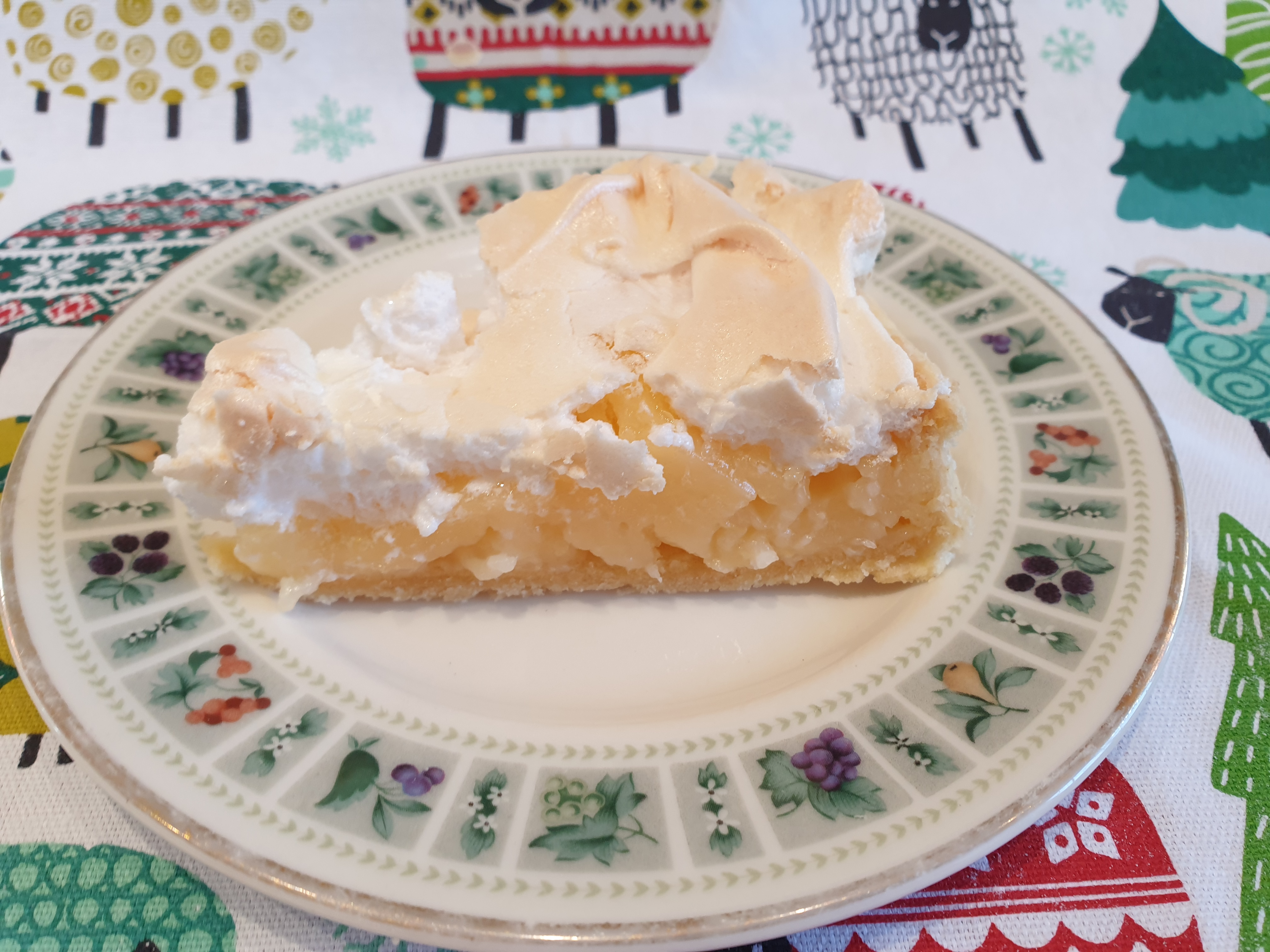
Lemon Meringue Pie

  • I am sure this would be a popular dessert in Poland and would be a bezowa (meringue) tarta (tart)
  • This is said to have originated in the United States of America.
  • Custard pies of various kinds using egg yolks had been made in Britain and then America for years but the first mention of Lemon Meringue Pie is in a cookery book of 1869.

  • Mrs Elizabeth Goodfellow, who ran a pastry shop in Philadelphia, decided to use the leftover egg whites as a topping over a lemon custard.

  • Mrs Elizabeth Goodfellow also started America’s first cookery school.


    INGREDIENTS

    Shortcrust pastry

    *

    40g cornflour

    25g butter

    300ml water

    2 lemons rind & juice

    2 egg yolks

    50g caster sugar

    *

    2 egg whites

    50g & 50g caster sugar

    METHOD

    It is best to use a metal dish especially one with a loose base.

    Any diameter from 18cm to 22cm.

    Grease the dish well.

    Roll out the shortcrust pastry and line the dish.

    Place a circle of baking paper over the base and add “baking beans”.

    Bake blind at GM 7 – 220°C for around 15 minutes.

    Remove the beans and paper and bake for another 5 minutes.

    Leave to cool.

    *

    In a saucepan blend a little of the water with the cornflour.

    Add the rest of the water and the butter.

    Bring to the boil and then lower the heat

    Stir and cook for 3 minutes.

    Remove from the heat.

    Add the lemon rind and juice.

    Add the yolks and 50g of caster sugar.

    Mix well and leave to cool.

    *

    Pre-heat the oven to GM3 – 160°C.

    *

    Fill the pastry with the lemon mixture.

    *

    Whisk the egg whites till stiff.

    Whisk in 50g of caster sugar till stiff.

    Fold in 50g of caster sugar.

    Cover the pie with the egg white mixture.

    Make random peaks over the surface.

    Bake for 25 minutes.

    *

    Leave to cool before serving.

    OPTION

    If you have an extra egg white, say from making the pastry, use this with extra sugar for the topping.

  • Served here on Royal Doulton Tapestry.

Chocolate Meringues

  • The original recipe made a circle/nest of the meringue.
  • I find individuals ones easier and more useful.
  • The sugar in the original was all icing sugar – I found this very hard to whisk up so if you can find caster sugar it is much easier to use.

INGREDIENTS

  • 2 egg whites
  • 90g caster sugar
  • *
  • 15g icing sugar
  • 2 teaspoons of cocoa powder

METHOD

  • Pre-heat the oven to GM2 – 150°C
  • Line a baking tray with baking paper
  • *
  • In a small dish mix the 15g of icing sugar and the cocoa powder.
  • *
  • Whisk the egg white until they are stiff.
  • Add the caster sugar and whisk until stiff again.
  • With a metal spoon fold in the icing sugar and cocoa mixture.
  • Place spoonfuls of the mixture onto the baking sheet.
  • You should get 6 or 8 meringues.
  • Place them in the oven for around 1hour 25 minutes.
  • Turn off the oven – you can keep them in there for an extra 15 minutes if required.
  • Leave the baking tray on a wire rack to cool completely.

Using the Meringues

  • These chocolate meringues are very useful for a variety of desserts.
  • They go well with sweetened yoghurt or yoghurt cheese.
  • They can be used with flavoured butter creams using rum or coffee or even more chocolate.
  • In England whipped double cream can be used.
  • In the glass dish above greek yoghurt was mixed with some sour cherry jam as the base and a dollop of the yoghurt was put on top of the meringue.
  • Try with chocolate budyń –– Polish custard.
  • They should be great with vanilla ice cream.

Coconut Meringue Cake

  • As I  said in my coconut macaroons recipe, my mother did not use coconut in her baking.
  • This is an English recipe that I have made for years.
  • Egg yolks are used in the cake base and whites in the topping.
  • The egg whites are whisked till stiff but then the sugar and coconut are just folded in.

Ingredients

  • BASE
  • 75g butter
  • 100g caster sugar
  • 175g plain flour
  • 1½ teaspoons baking powder
  • Pinch of salt
  • 2 egg yolks
  • 3 tablespoons milk
  • 2-3 drops vanilla essence
  • TOPPING
  • 2 egg whites
  • 100g caster sugar
  • 50g desiccated coconut

Method

  • Grease and line a 26 x 20cm baking tin.
  • Preheat the oven to GM3 – 160°C.
  • Cream the butter and sugar till light and fluffy
  • Beat in the egg yolks, vanilla essence and milk.
  • Mix the flour, baking powder and salt together.
  • Fold the flour mixture to the creamed mixture.
  • Spread this over the base of the tin.
  • *
  • Whisk the egg whites stiffly.
  • Fold in the sugar and coconut.
  • Spread this mixture over the cake base.
  • Bake for 30-35 minutes.
  • Leave to cool in the tin.
  • Cut into slices when cool.
Stardust by Colclough Tea Plate

Tort Melba – Meringue

  • A Polish lady that I had not seen for many years came to visit me.
  • We sat in the garden chatting over coffee and cake.
  • She mentioned a cake she had not had for many years – Tort Melba.
  • She told me it was based around Pêche Melba – Peach Melba.
  • However she could not remember the recipe.
  • I said I would look the recipe up and make it for her.
  • *
  • Recipes used peaches, raspberry sauce and instead of vanilla ice cream a vanilla flavoured yoghurt cheese or cream cheese.
  • *
  • I found there are 3 types:
  • *
  • A meringue version –  tort bezowyrecipe below.
  • *
  • Several versions used two rounds of meringue sandwiched together.
  • It is easier to make a nest (Pavlova style) and place the fillings in that.
  • *
  • A sponge cake version –  2 will be posted soon.
  • A layered jelly version – I tried several versions but was not happy with any of the results.

Ingredients – Meringue

  • 4 egg whites
  • 200g caster sugar
  • 1 teaspoon of potato flour or cornflour
  • 1 teaspoon of white wine vinegar
  • 2-3 drops of vanilla essence

Method

  • Use the loose base of a baking tin 24cm in diameter.
  • Lightly grease the circle.
  • Cut a 24cm circle of greaseproof and stick it on the metal circle.
  • Place the circle on a large baking tray – one without sides is best.
  • Pre-heat the oven to GM1 – 140°C.
  • Whisk the egg whites until stiff.
  • Add the sugar and whisk again till stiff.
  • Fold in the potato or corn flour, the vinegar and vanilla essence.
  • Using up to ½ of the mixture cover the circle on the tin.
  • Using the rest of the meringue put spoonfuls around the edge.
  • Bake for 80 minutes.
  • Turn off the oven and leave the meringue inside for 20 minutes.
  • Take out and leave to cool completely before filling.
  • *
  • Place the yoghurt cheese filling in the centre of the meringue nest.
  • Add the chopped peaches.
  • Drizzle the raspberry sauce over the top. 

Ingredient – Filling

  • 200g yoghurt cheese, curd cheese or cream cheese
  • 2 – 3 tablespoons of icing sugar
  • 2-3 drops of vanilla essence
  • *
  • 1 tin of peaches, drained and chopped
  • *
  • Raspberry sauce made with 4 tablespoons of raspberry jam and 1 tablespoon of water – heated together for a few minutes and cooled.

Royal Doulton – Counterpoint tea plates – 1973 – 1987

Almond Meringue Cake

My mother used to buy little cakes called Japs from the English bakers where we lived in Lancashire.

We both loved them.

I now know that the name is shortened from Japonais  – which is French for Japanese style.  How they came by this name seems to be a mystery.

Traditionally they were two circles of almond meringue sandwiched together with a butter cream (often coffee flavour), covered with more butter cream and nibbled nuts.

When I came across this recipe for an almond meringue cake, lots of memories came flooding back.

The proportions for the meringue are:

50g of caster sugar & 25g of ground almonds per egg white.

I used 4 egg whites in this version.

Ingredients

  • 4 egg whites
  • 200g caster sugar
  • 100g ground almonds

Method

  • Use the loose bases of two baking tin – 20cm in diameter.
  • Lightly grease the circles.
  • Cut a 2 x 20cm circles of grease-proof paper and stick them onto the metal circles.
  • Place each circle on a large baking tray.
  • Pre-heat the oven to GM1 – 140°C.
  • Whisk the egg whites until stiff.
  • Add the sugar and whisk again till stiff.
  • Fold in the ground almonds.
  • Spoon and smooth half the mixture onto each circle.
  • Bake for 50 minutes (swap shelves half way through).
  • Turn off the oven and leave the meringues inside for 20 minutes.
  • Take out and leave to cool completely before using.
  • *
  • Place one circle onto your cake stand.
  • Cover this with coffee or rum butter cream**.
  • Place the second circle on top.
  • Optional – add a few blobs of butter cream on top to decorate.
  • *
  • ** You can use a lighter cream filling of your choice.


Coffee set by Royal Doulton  – Pastorale – 1970 – 1990

Jug by Buchan Pottery, Portobello near Edinburgh –  from the early 1960s.


Hazelnut Meringue & Apricot Cream

Although I  have been using this recipe for many years I just cannot remember where I got it from.

I make the meringue in a nest shape and fill it with apricot cream when I have many people to eat it in one sitting.

Otherwise I make little meringues with 1 tablespoon of mixture on baking sheets.  These can be stored for ages and served with the apricot cream in individual dishes when required.

Ingredients

  • 4 Egg whites
  • 200g caster sugar
  • 75-100g chopped roasted hazelnuts
  • *
  • 1 tin of apricots in syrup
  • Around 200g of yoghurt cheese
  • Around 2-3 tablespoons of icing sugar

Method

  • Use the loose base of a baking tin 25cm in diameter.
  • Lightly grease the circle.
  • Cut a 25cm circle of greaseproof and stick it on the metal circle.
  • Place the circle on a large baking tray – one without sides is best.
  • Pre-heat the oven to GM1 – 140°C.
  • Whisk the egg whites until stiff.
  • Add the sugar and whisk again till stiff.
  • Fold in the chopped roasted hazelnuts.
  • Using up to ½ of the mixture cover the circle on the tin.
  • Using the rest of the meringue put spoonfuls around the edge.
  • Bake for 50 minutes.
  • Turn off the oven and leave the meringue inside for 20 minutes.
  • Take out and leave to cool completely before filling.
  • *
  • Drain the apricots from the syrup
  • Purée the apricots – a stick blender is good for this.
  • Mix the apricot purée with the yoghurt cheese and some of the icing sugar.
  • Adjust the sweetness with icing sugar – you do not want it too sweet.
  • *
  • Put the meringue nest onto a serving plate or stand.
  • Pile the apricot cream into the centre of the nest.


Coffee set – Elizabethan – Lace – 1966 – 1982


Meringue Cake with Rhubarb

Tort Bezowy is a meringue cake.

Meringues are popular in Poland and often made because lots of other dishes contain many egg yolks so there are egg whites needed to be used rather than wasted.

A little tip – freeze two egg whites at a time in a little container – then you have them ready for use later – bring them back to room temperature first.

The meringue that is used here has the addition of potato or cornflour and a little vinegar which gives a soft marshmallow centre to the meringue.

This style of meringue dish was named in honour of the Russian ballerina Anna Pawlowa (Pavlova) after her tour of Australia in 1926.

It is made up of 3 parts

  • 1 Pavlova style meringue
  • 2 Budyń (Custard)
  • 3 Rhubarb compote

Pavlova style meringue

Ingredients

  • 4 egg whites
  • 225g caster sugar
  • 1 teaspoon of potato flour or cornflour
  • 1 teaspoon of white wine vinegar
  • 2-3 drops of vanilla essence

Method

  • Use the loose base of a baking tin 25cm in diameter.
  • Lightly grease the circle.
  • Cut a 25cm circle of greaseproof and stick it on the metal circle.
  • Place the circle on a large baking tray – one without sides is best.
  • Pre-heat the oven to GM1 – 140°C.
  • Whisk the egg whites until stiff.
  • Add the sugar and whisk again till stiff.
  • Fold in the potato or corn flour, the vinegar and vanilla essence.
  • Using up to ½ of the mixture cover the circle on the tin.
  • Using the rest of the meringue put spoonfuls around the edge.
  • Bake for 50 minutes.
  • Turn off the oven and leave the meringue inside for 20 minutes.
  • Take out and leave to cool completely before filling.

Budyń  (Custard) 

Ingredients

  • 4 egg yolks
  • 400ml of milk
  • 1 tablespoon of butter
  • 2 tablespoons of granulated sugar
  • 2½ tablespoons of potato flour or cornflour
  • 2-3 drops of vanilla essence

Method

  • Put 250ml of the milk, the butter, sugar and vanilla essence into a saucepan.
  • Heat gently until the butter has melted and the sugar dissolved, stirring all the time.
  • Bring to the boil and then take off the heat.
  • Blend together the rest of the milk (150ml), the egg yolks and the potato or corn starch.
  • Add some of the boiled mixture and stir well.
  • Add this to the rest of the boiled mixture and stir well.
  • Put the pan back on the heat and gently bring back to boiling point and keep stirring.
  • Keep on the heat  – stirring for 1 minute.
  • Pour into a glass or china dish and cover with a circle of grease-proof paper.
  • Leave to go completely cold before using.

Rhubarb Compote

Ingredients

  • 250g fresh rhubarb*
  • 75g granulated sugar

Method

  • Pre-heat the oven to GM3 160°C
  • Cut the rhubarb into 4cm chunks.
  • Put the cut rhubarb into a small roasting dish.
  • Sprinkle the sugar over the top.
  • Cover with a piece of foil.
  • Place in the oven for around 30 minutes.
  • Leave to go cold before using.

*You might want to roast more rhubarb for other uses and just use some for this dish.

Assembling the Pavlova

All three parts must be cold.

  • Place the meringue nest on a large serving plate or stand.
  • Using a tablespoon – pile the budyń (custard) into the centre.
  • Arrange the rhubarb chunks and some of the syrup over the custard.

Lead Crystal cake stand  – Tortenplatte – Venus  by Nachtmann(Germany).

Plates – Lavender by Jet for Ter Steege in The Netherlands.

Grape Meringue Placek

This cake is a cross between my grape meringue cake and placek(flat cake) with rhubarb and meringue. 

There are two parts to this cake

  • Short pastry base – baked and cooled
  • Grapes* & Meringue topping.

Short pastry base

The base of this is made made from the recipe for  Ciasto kruche 1 – using raw egg yolks found in a previous post  – Pastry – ciasto kruche & półkruche.  

However as the topping is sweet, I used less sugar in the pastry – you might be able to omit all the sugar – I have not tried this.

Ingredients – Base

  • 300g plain flour
  • 200g butter – chilled
  • 50g icing sugar
  • 4 egg yolks
  • pinch of salt

Method – Base

  • Add a pinch of salt to the flour.
  • Use a knife to cut the chilled butter into small pieces into the flour and then use your fingers to make the mixture like breadcrumbs.
  • Add the icing sugar and mix this together.
  • Add the yolks and gently mix them in
  • Bring it all together into a dough – try and handle the pastry as little as possible.
  • Form the dough into a rough rectangle.
  • Wrap the dough in grease proof paper and chill it in the fridge for about 30 minutes.
  • Preheat the oven to GM 6 – 200°C.
  • Grease and line a 33 x 23 cm baking tin – use one long piece for sides and base – helps to take it out. 
  • Use a rolling pin to flatten the dough a little
  • Press the dough into the tin – filling it up all the sides.
  • Prick the surface with a fork.
  • Bake for 20 – 25 minutes till golden.
  • Leave to cool.

Ingredients – Meringue

  • 4 egg whites
  • 200g granulated sugar
  • 2 sponge fingers  – crushed
  • *
  • 300g seedless green grapes

Method – Meringue

  • Preheat the oven to GM 2 -150°C.
  • Place the whites into a grease free bowl.
  • Whisk till stiff.
  • Add granulated sugar and whisk again till stiff.
  • Fold in the crushed sponge fingers.
  • *
  • Place 1/3 of the meringue over the cake base.
  • Place the grapes over the meringue.
  • Cover the grapes with the rest of the meringue
  • Put into the oven for 50 – 60 minutes.
  • Leave to cool completely in the tin.
  • Cut the cake into squares when cool to serve.

Served here on  Royal Doulton – Sonnet  1971-1998

* Note – I tried this with red grapes and found that the skins were too thick and the cake did not come out well – you need thin skinned small seedless green grapes