Traditional Polish Recipes Made Easy & New Variations
Author: jadwiga49hjk
I love cooking and baking. I love trying out new recipes and currently am trying out many old favourites from my Polish cookbooks and family recipes. I am trying out many variations, often to make them easier but still delicious.
I collect glass cake stands and china tableware, mainly tea plates, jugs and serving dishes, many of which I use on a daily basis. They are an eclectic mixture from the 20th & 21st century.
Sałatka is the Polish word my parents used for salad.
However when I visited Poland for the first time I realised that there is another word for salad and that is – Surówka.
Surówka – this come from a Polish word meaning raw.
There is a distinction between the two in that a sałatka is a dish served cold of mainly cooked vegetables and a surówka is a dish served cold of mainly raw, pickled or fermented vegetables.
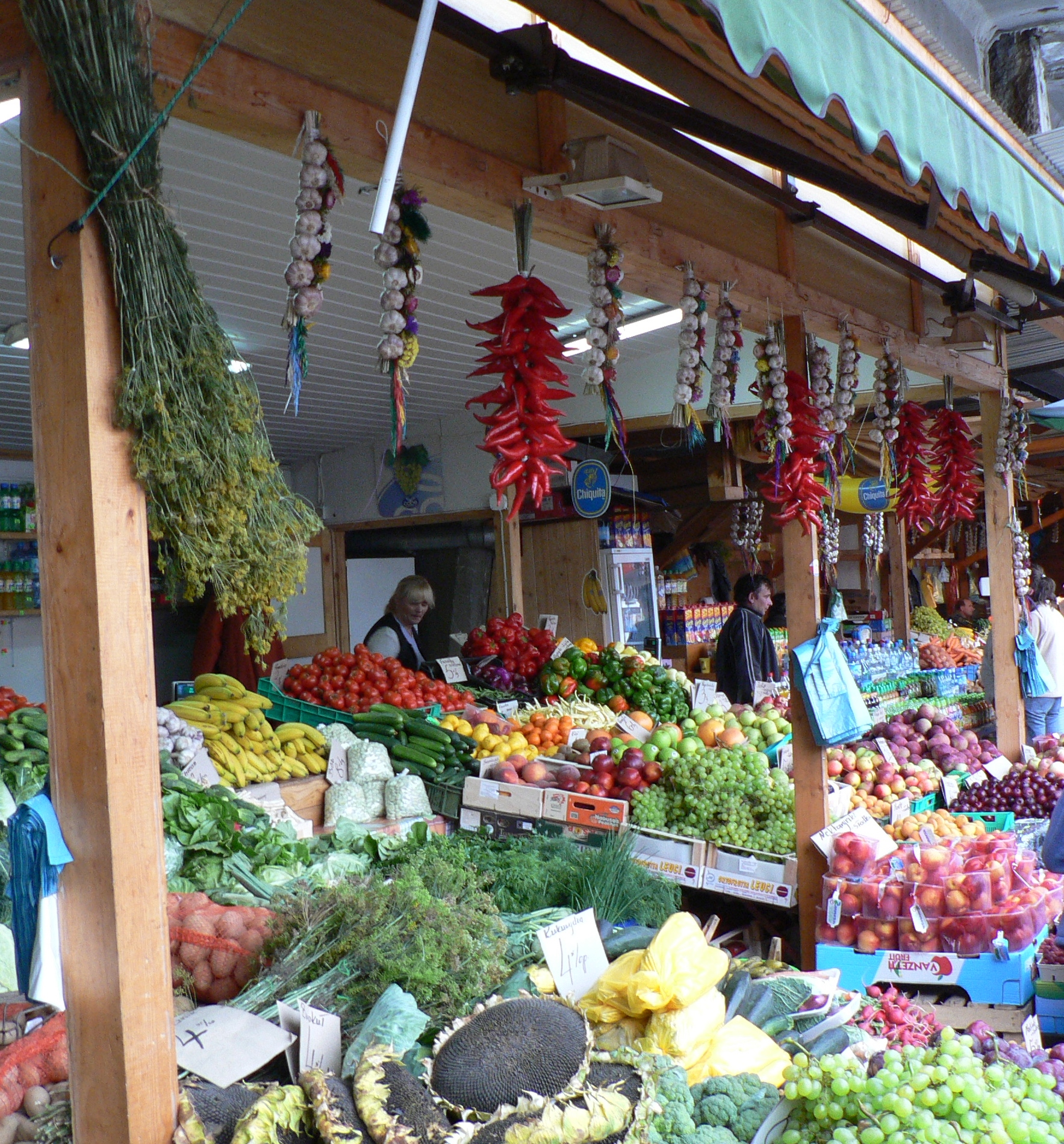
Some ingredients for salads for sale
As it is hard in English to differentiate between the two – I will be writing about many classic cold Polish vegetable dishes and will be calling them all salads.
Fruit, cold meats, fish, either cooked or pickled, and hard boiled eggs also feature in these salads.
A salad accompaniment with a meal is often more usual than hot cooked vegetables and a tomato or gherkin salad is normal fare for breakfast.
Vegetables that have been pickled, fermented, bottled or canned will feature throughout the year at least once a day in Polish meals. Before widespread refrigeration this is how people preserved food for use throughout the winter.
Old Polish houses always had cellars, the Polish word is piwnica, from the word piwo which means beer so it means the place where beer is kept. The ones I have seen in Poland were filled with bottled fruit and vegetables as well as jams, ready to make meals and salads throughout the year. In blocks of flats there is still in the basement level, cellar space for each flat.
My aunties said they could not imagine life without a cellar. Their cellars were filled with many jars of bottled paprika that they had prepared – what in England we call peppers or capsicums, various mixed vegetables, cranberries and lingonberries.
Paprika – Capsicum – Pepper
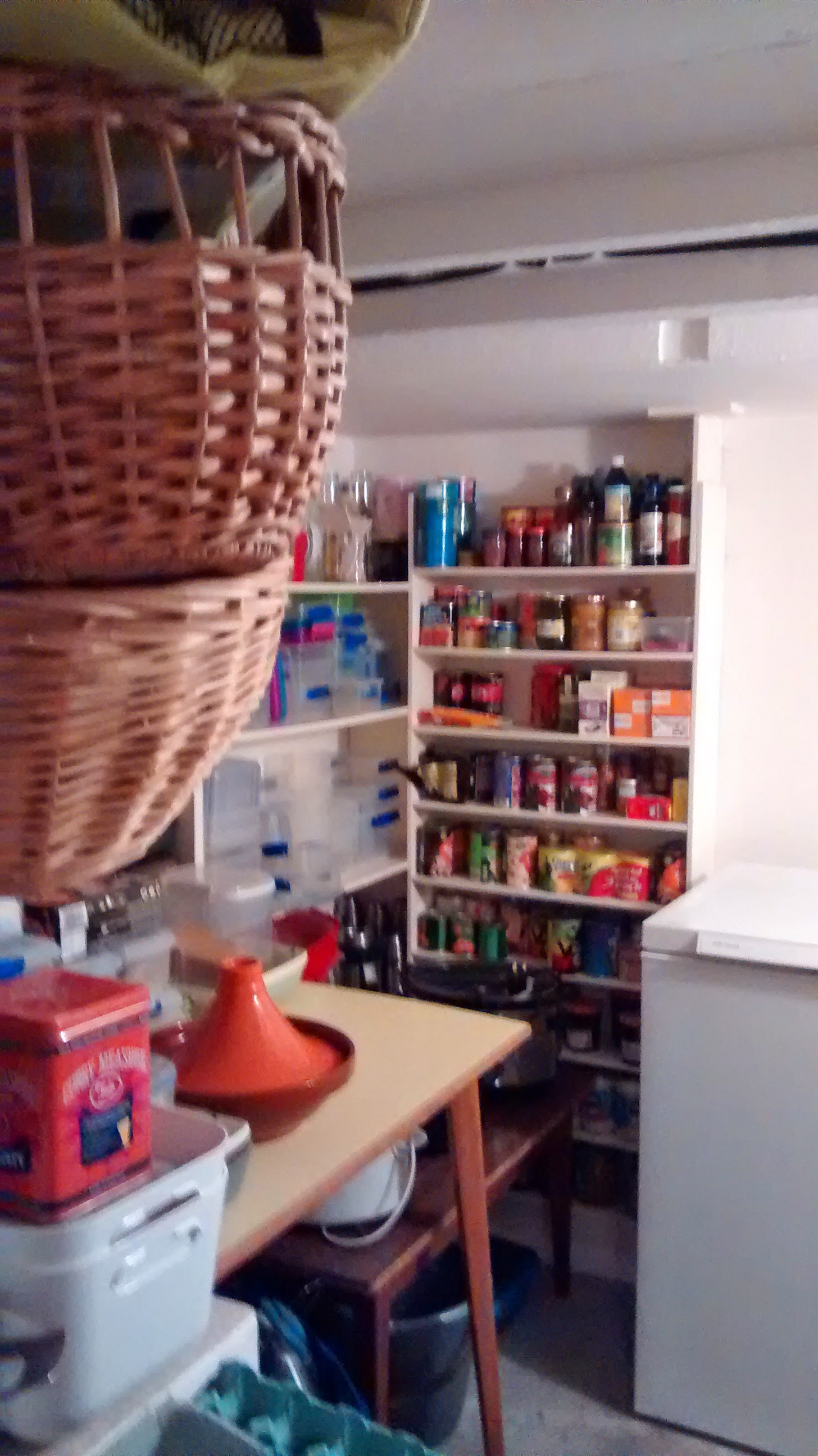
I am very lucky in having two cellars in my house and spent a week in spring this year organising them – including an area for tinned and bought bottled vegetables ready for making salads amongst other things.
Cellar – Mainly for Food
Cellar – Mainly for Drinks
Salad dressings
Three of the most popular salad dressings used are:
Lemon Juice
One of my cousins came to visit me a couple of weeks ago and brought me this lovely, large, glass lemon squeezer.
If lemons are scarce or expensive or for convenience in Poland you can buy packets of citric acid which you can mix up with water.
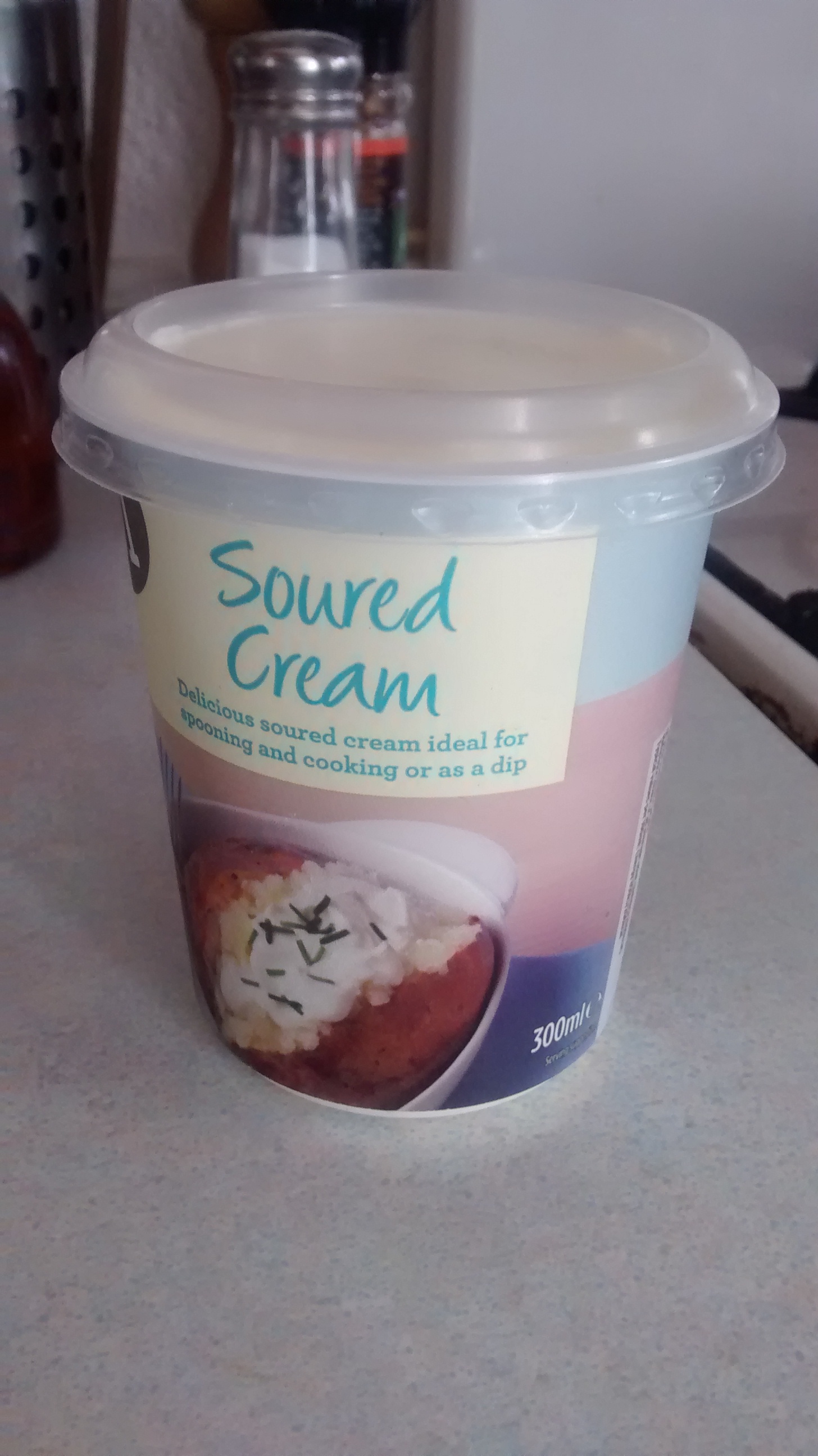
Smetana – Soured Cream
Nowadays you can find soured cream in many English stores but if there is none then lemon juice added to fresh single cream will give nearly the same result.
Mayonnaise
Although I have made mayonnaise, I tend to buy it now and my favourite is Hellmann’s – original or light (the very low fat version I think is horrid as it has a strange taste and texture). Sometimes if making the salad ahead of time I think the original is a bit better as it does not get as watery from the vegetables but mostly I use the light version.
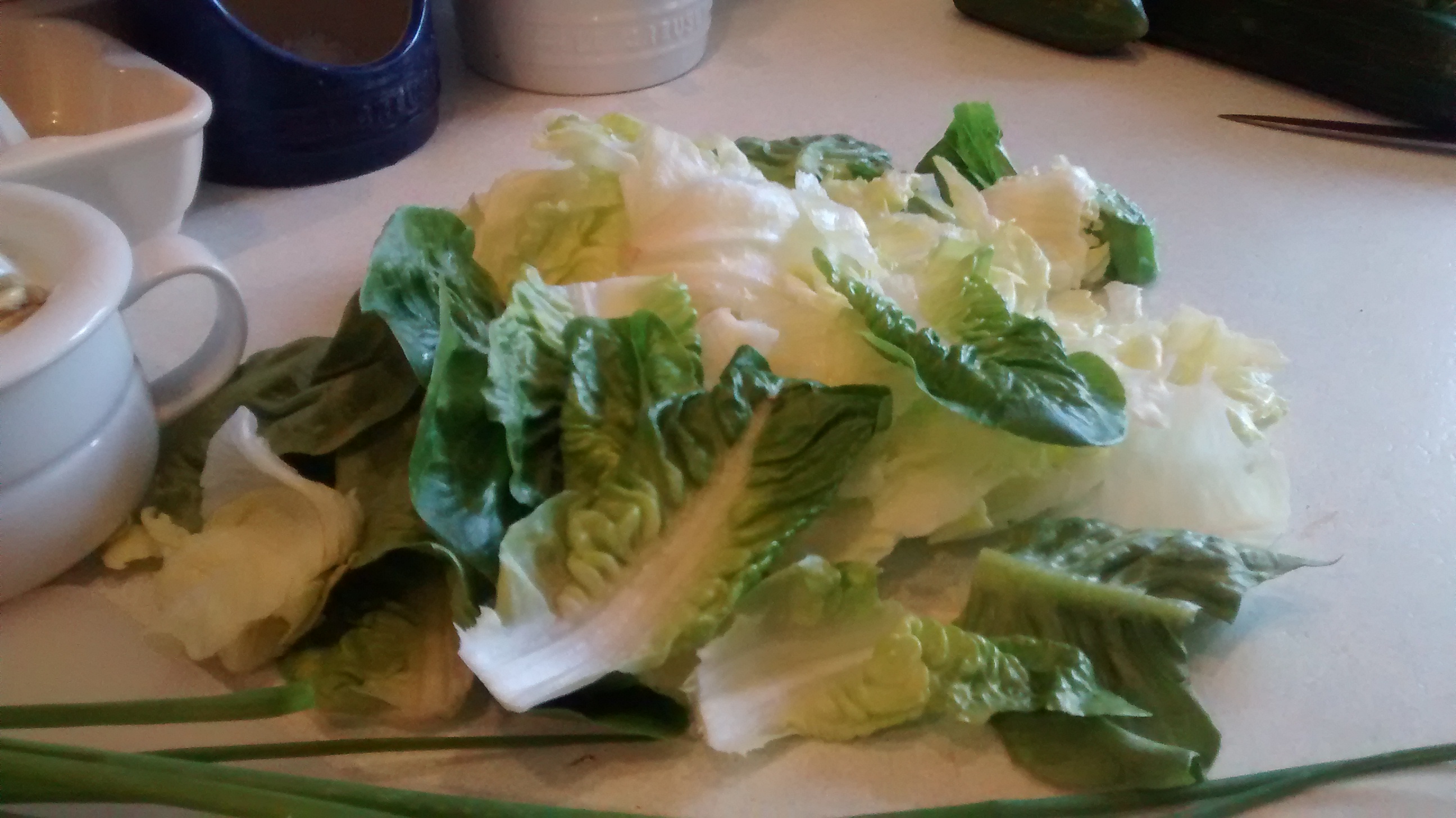
Vegetables waiting to be made into salads
Salad Garnishes
Garnishes are chopped fine and sprinkled on the top of the dish of salad, these are often: flat leafed parsley, dill, chives, the green part of spring onions and hard boiled eggs. If none of these are available ground paprika might sometimes be sprinkled on the salad.
Soured Milk – is the fermented milk product that is found in Northern Europe, especially in Poland. It forms naturally from bacteria in fresh milk and these bacteria live happily in colder climates.
When we used to have farm milk at home my mother made soured milk all the time and then also made twaróg – Polish curd cheese from this. However you cannot make soured milk from pasteurised milk (of course you can in a dairy where they will have the starters).
My mother had this on the go all the time, mainly to make the curd cheese which is used in lots of Polish recipes – savoury and sweet.
Yoghurt – is the fermented milk product that is found in Southern Europe and the Middle East. It forms naturally from bacteria in fresh milk and these bacteria live happily in warmer climates.
You could say that yoghurt is soured milk’s cousin.
It is a relatively new dairy product for sale in Poland but is now very popular.
You can make yoghurt at home because you can use some bought yoghurt as a starter and then continue using your yoghurt as a starter and so on.
I go through phases of making yoghurt – it is easy to do – you just need a little bit of time and a supply of milk and some bought yoghurt as a starter.
Two Very Good Books
The Yoghurt Book – Food of the Gods by Arto der Haroutunian – first published in 1983.
Mine is an old copy. I think it might be out of print but there are second hand copies available for sale eg on Amazon.
Eat Well The YoChee Way by Nikki & David Goldbeck – 2001
This book is American & YoChee is the authors name for yoghurt cheese.
My Method For Making Yoghurt
I use a wide-necked vacuum flask, it holds about 750 ml (it must be wide necked or you will have difficulties cleaning it). I fill it with boiling water to sterilise it and heat it up. I leave this with the water in whilst the milk is cooling down – then I pour out the water and add the yoghurt mix. I often make this at night and it is ready in the morning. You can make it in the morning and it should be ready in the evening.
Now that milk is pasteurised you need a yoghurt starter, Greek yoghurt is good, once you have made some of your own, you can then use that to start the next batch.
You need milk – you can use whole milk or semi skimmed – you can use skimmed milk but I prefer the others.
I have a tall milk pan which is very useful as there is height for the milk to rise without spilling all over the cooker top.
Bring the milk to the boil and then let it cool to 37 to 40 degrees o C, if you dip in a finger tip it must feel just lukewarm, no hotter than body temperature, and you should be able to keep your finger there for a count of 10 without it being too hot or you can use a cook’s thermometer. This is important, too hot will kill the bacteria, too cold may not be warm enough for the bacteria to grow.
Mix a large tablespoon of yoghurt into the milk, about 1 tablespoon to 500ml of milk.
You then have to leave the mixture in a warm place to grow.
You can put the mixture in a clean, sterilized with boiling water, bowl and cover this with a cloth and leave it overnight or about 12 hours. This is the easiest method in the summer or if you have a warm but not too hot spot in the house.
I empty the hot water from my vacuum flask and pour in the milk & yoghurt mixture, put on the stopper and the lid and leave for around 10 hours.
I have used a thermostatically controlled yoghurt maker in the past and you put the mixture into little pots and left them. I found this did not make much yoghurt in one go and there was a lot to clean out and sterilise. I started to use the vacuum flask method and have stayed with that but some of the new electric makers now have just one large pot and I think they may be easier to use.
Once it is made, pour it into a bowl or tub and refrigerate the yoghurt, it tastes so much better and fresher that any bought ones. I bought some plastic food storage tubs with lids specially for this.
At this point you can start again and when you have loads you will start to think “maybe I will make some yoghurt cheese from this” and on it goes!
With the yoghurt, sometimes I eat it plain, or use it instead of milk with muesli or other cereals, dried fruits and nuts. Mostly though I add fruit to it, chopped fresh fruit sprinkled with a bit of icing sugar, stewed fruit or tinned fruit. I love it with stewed prunes! It is super with just a spoonful of runny honey. Sometimes I use it as a salad dressing on its own or mixed with mayonnaise.
Making Yoghurt Cheese
Also known as YoChee and in the Middle East as labna or labneh.
Traditional Method
The yoghurt cheese is made by putting yoghurt into a muslin cloth and tying it up and letting the whey drain off from the curds. This will take many hours and is best done in a cool place.
Modern Straining Method
I bought a little device from Lakeland Plastics which is a modern version of the hanging muslin cloth. It is a plastic tub with a stainless steel fine mesh sieve which hangs in the box. You then put on a plastic lid and then put the tub in the fridge.
I leave this to strain for at least 24 hours – often up to 48 hours.
Sometimes I buy a 1kg tub of Greek yoghurt to make the cheese if I do not have any of my own – this is more than enough for the tub.
Yoghurt Cheese as it comes out of the pot.
It is a soft, fresh tasting cheese.
I eat it uncooked either plain or with chopped onions, chives or garlic, with chopped dates and banana or jam and so on, the list is endless.
I use yoghurt cheese in Polish recipes instead of twaróg – Polish curd cheese to make baked cheesecake or Polish style ravioli with either sweet curd cheese or savoury with potatoes, onions and curd cheese and much, much more.
I would use this home made cheese within a week as it does not of course have the shelf life of commercially, often vacuum packed, cheeses.
This morning for breakfast I had some freshly made yoghurt cheese on toast with some morello cherry jam which my friend had made a couple of weeks ago from cherries growing on her allotment.
It was delicious!
The cheese is wonderful with other slightly tart jams such as blackcurrant or damson.
By the Way – Whey is a useful by-product
Tub of whey you can keep in the fridge.
The liquid whey that is in the bottom of the tub can be saved and used instead of water, milk or buttermilk in making scones and soda bread etc or you can add it to soups.
Naleśniki are thin pancakes like the French crêpes. Their name comes from the Polish verb to pour.
In Poland pancakes are eaten all year round, with either savoury or sweet fillings, and not just before Lent. (In fact pancakes are not amongst the special foods eaten before this time of fasting).
We used to have then about once a week but I never seemed to have been involved much in their making except for spreading the fillings on, so when I started to make them myself I had lots of disasters!
My pancakes were always a bit hit and miss. Often the constancy was not constant nor the thickness and nearly always the first one of the batch would stick to the pan and have to be thrown away.
Then I looked up the recipe in my old Polish cookbook, made a few telephone calls to various relatives and also followed Delia Smith’s advice and bought a special frying pan which I use only for pancakes.
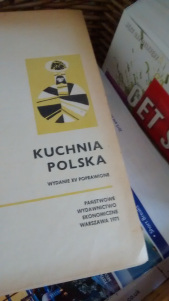
Kuchnia Polska – 15th Edition 1971
So I now I think I know the secrets of making perfect pancakes and these I will now pass on.
Sift the flour
You must use a mixture of milk and water – 50/50 is the best – this ensures that the pancakes do not burn as easily and also enables you to make then very thin and elastic so they are easy to work with. (This is the most important tip).
Beat the eggs and add then them first to the sifted flour.
Add the milk mixture to the egg and flour mix until you have a batter the consistency of pouring cream.
Leave the batter to stand for at least 1 hour in which time it will thicken, then add a little more liquid.
Use a special thin pan which you use just for pancakes, mine has a base diameter of 20 cm and is made of steel, once seasoned, just wipe it clean between uses with kitchen roll – never scour it or use detergent.
Work out how much batter you need for a pancake and find a measure which will then give you a consistent amount – I use a small ladle which holds 45ml.
Have a dish of melted butter or margarine and sunflower oil for frying so you can add just enough and tip some back if needed.
Ingredients
200g plain flour
2 eggs
200 ml milk (full or semi-skimmed)
200 ml water
pinch of salt
This amount makes around 8 pancakes.
I remember this recipe as it is all the 2’s for ease, but it will depend on the flour and the size of the eggs, you might not use all the milk & water mixture or you might just need a little more.
Heat the pan – you want a high heat but not too much to burn the pancakes – you will find you have to keep adjusting the heat. (As I cook using gas this is easy to do).
Pancake Batter & Ladle
Using the ladle pour the mixture into the pan.
Tilt the pan so that the mixture covers the surface completely and evenly.
Cook the pancakes on one side and turn then over (or toss them English style), you can make them up one by one or stack then up with a piece of greaseproof paper in between them. You can do this and leave then for later use
There are many recipes for pancake fillings both savoury and sweet.
I think the 2 most popular sweet fillings in Poland are sweet curd cheese (see a previous post) and stewed apples with cinnamon.
Pancakes with sweet fillings are normally folded into triangles – fan -shaped by folding the pancake into half and half again.
Pancakes with savoury fillings are normally rolled up and often then put in a dish, topped with a sauce or grated yellow cheese and put in the oven for a time.
In these instructions I have used photographs of pancakes being made with the sweet curd cheese filling.
Frying the PancakeSweet Curd Cheese FillingSpread with FillingFolded in HalfAnd Half AgainDusted with Icing Sugar
I find two are enough for me!
You can make the filled pancakes in advance prior to dusting them with icing sugar and then heat them up on both sides – using the pancake pan again – maybe with the addition of a little butter. Then dust them with icing sugar.
This sweet fresh curd cheese mixture is one that is used as a filling for pancakes in Poland.
You can make this mixture with twaróg – curd cheese, cream cheese or yoghurt cheese.
Use 1 packet of cheese, usually 200g – 300g , to this add 2 to 3 tablespoons of soured cream and 2 to 3 tablespoons of icing sugar and mix this together till you get a smooth mixture. You can add 2 to 3 drops of vanilla essence. Do not add too much sugar – you want the contrast of sweetness & sour.
Sweet Curd Cheese MixturePancake Spread With Sweet Curd Cheese MixturePancakes Folded Polish Style with Sweet Curd Mixture Dusted with Icing Sugar
Twaróg – Polish Curd Cheese is used extensively in cooking and finds its way in many guises onto the Polish menu, especially at home, both in sweet and savoury dishes.
The following are what I consider to be popular classic savoury fresh cheese mixtures and are often served for breakfast with bread and salad.
Here in England I think they could be served at lunchtime. As well as with bread and rolls they can be served with crisp-breads, oatcakes or crackers.
3 Classic Curd Cheese Mixtures
You can make these with Twaróg – Curd Cheese or with Cream Cheese.
You can also use yoghurt cheese – (Look out for a post on how to make this later).
The amounts used are just approximate, using one packet of cheese, which is normally around 200g – 300g, for each mixture and can be varied to taste.
If using curd cheese, add a pinch or two of salt and a couple of spoonfuls of soured cream, mix together until smooth.
If using cream cheese just take it out of the packet and mix it in a bowl – you can add a spoonful or two of soured cream to make it a softer consistency if you wish.
Mixture 1
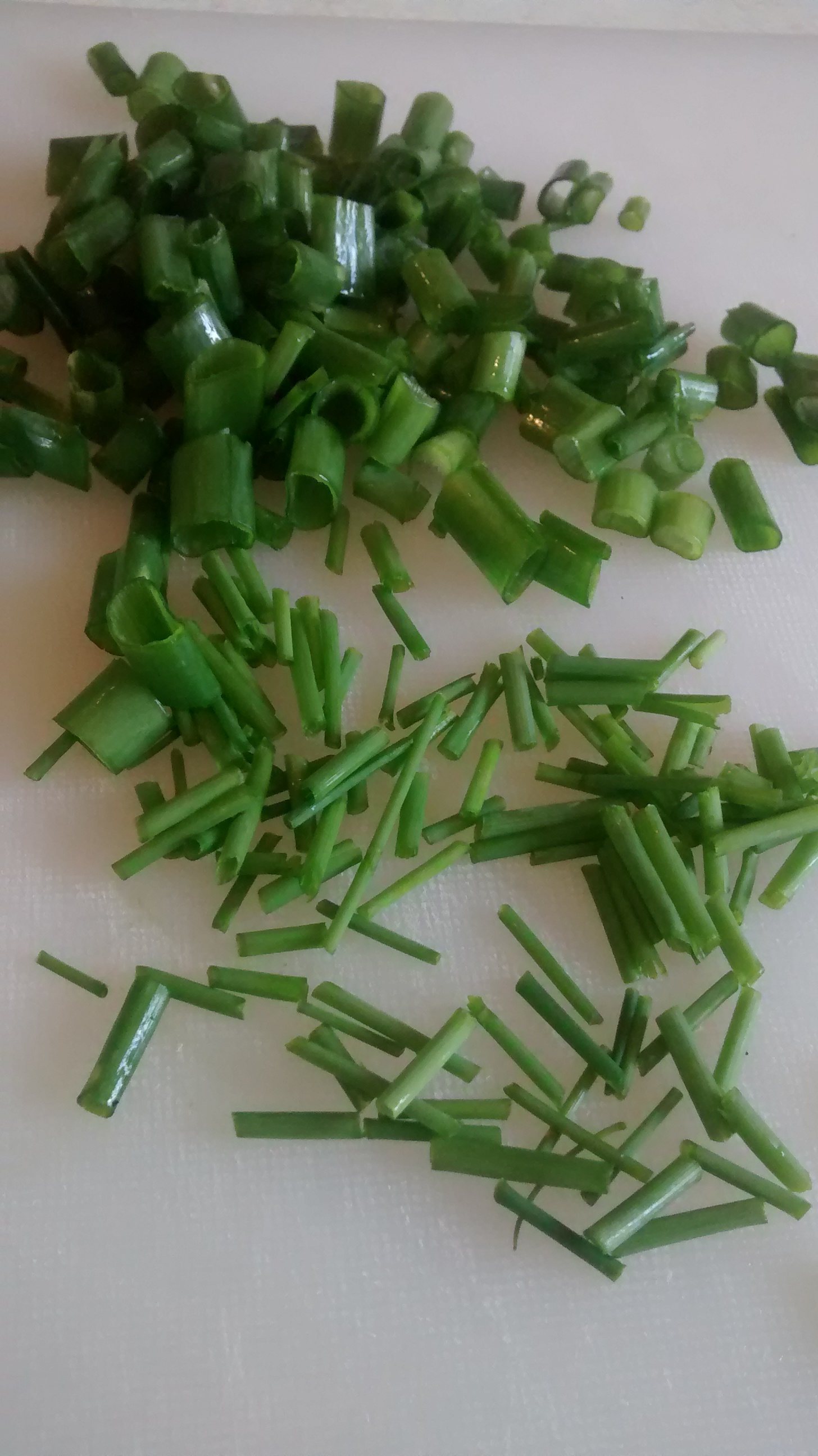
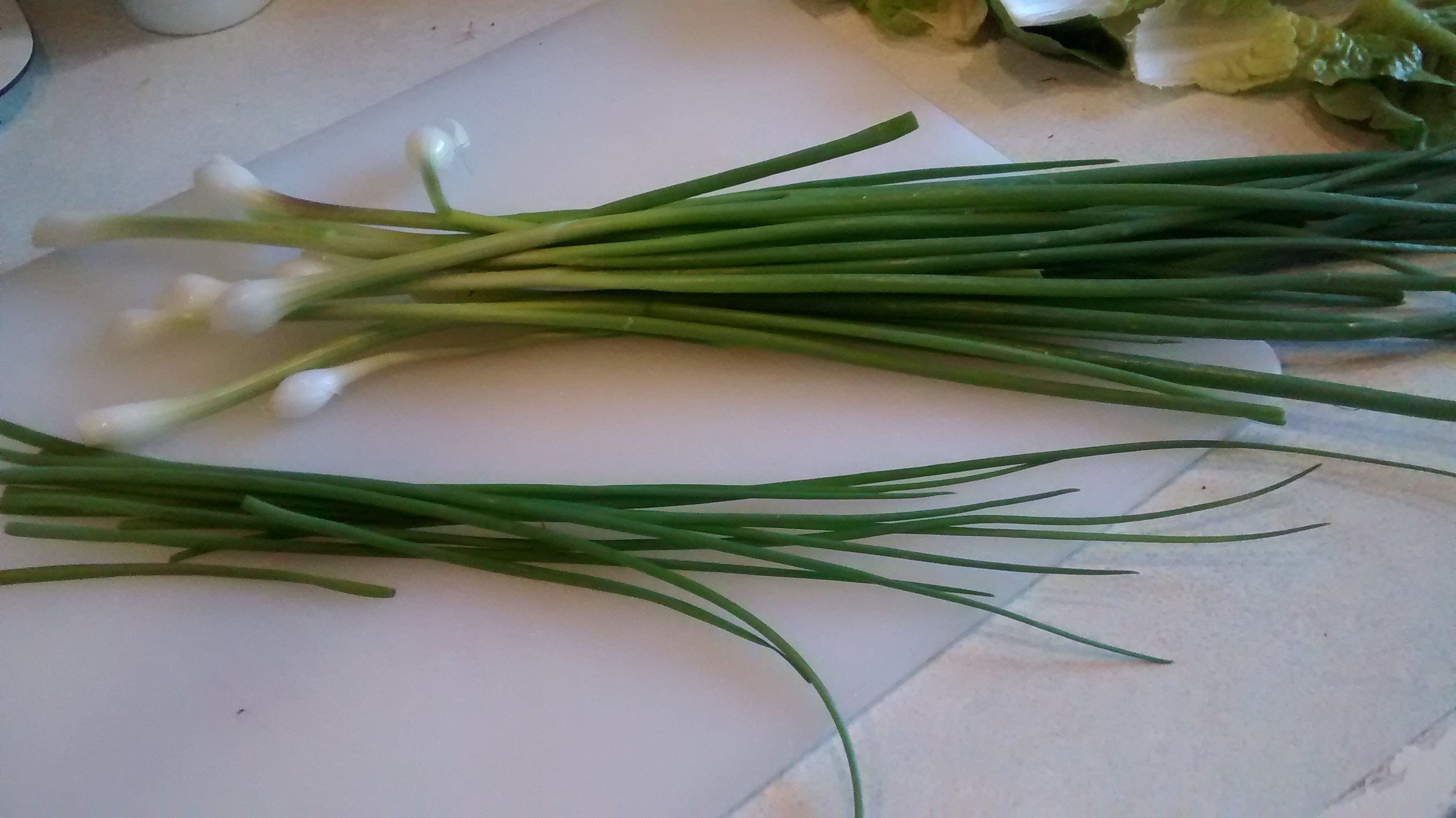
To the cheese add a few tablespoons of finely chopped chives or the green parts of spring onions.
In Poland szczypiorek (which in dictionaries is given as chives) would be used – however I think it is slightly different and is much larger than the chives I grow here in England.
Chives Growing in a Pot
Spring Onions and ChivesCurd Cheese and Chives
Mixture 2
To the cheese add a couple of teaspoons of caraway seeds
Curd Cheese and Caraway Seeds
Mixture 3
To the cheese add some chopped gherkins
I find these are the best gherkins to use as they are not vinegary.
Chopped GherkinsCurd Cheese and Gherkins
Typical Polish Breakfast Fare
These cheese mixtures can also be served with bliny -little buckwheat pancakes. (Look out for a a post on how to make these later).
Baked cheesecakes have a very long history with the Ancient Greeks baking them with cheese and then the Romans adding eggs to the recipes.
Varieties of cheesecakes were made in the Middle East and mentioned in the Old Testament. Maybe a land flowing with milk and honey is so good as these are ingredients needed to make a cheesecake!
The traditional cheesecake in Poland is a baked cheesecake and it is found in Christian and Jewish Traditions.
One story is that King Jan III Sobieski brought the recipe back with him after his victory against the Turks at the Battle of Vienna (1683).
This could tie up with the fact that one version of the cheesecake in Poland is called Viennese – Style.
When immigrants to the United States of America from Poland, Russia and Germany took their recipes with them in the 19 Century we eventually got the New York Cheesecake.
As ser is the Polish word for cheese – we get sernik as the Polish word for cheesecake.
Cheesecakes are made from twaróg – curd cheese, eggs and sugar and how they turn out depends not only on the proportions of each but also the cheese that is used. Butter and soured cream may also be used.
My mother used to make her own curd cheese from fresh farm milk that was allowed to sour and then the solid curds were separated from the whey by pouring the soured milk into a muslin cloth and leaving this to drain.
Unfortunately you cannot make soured milk from pasteurised milk.
Recently I have been making my own yoghurt and yoghurt cheese. You have to use a live yoghurt starter with pasteurised milk. This is very similar to twaróg, not identical but very near. The result tastes wonderful but it takes a lot of time and effort to get enough cheese at home and so the following recipes use bought cheese.
You can find twaróg now in Polish shops and some supermarkets and sometimes under its German name qwark.
Twaróg – Curd Cheese
Previously as the curd cheese was not available my recipes have been adapted to use a Philadelphia ™ style cream cheese.
Philadelphia ™ is a cream cheese invented in 1872 in New York State.
Full fat makes the best cheesecake. You can use a mixture of full fat and medium fat but never use low fat cheese.
You cannot make a good baked cheesecake from low fat cheese.
Curd cheese is slightlygrainyand to get the best results you either need to put it through a mincer or use a blender.
A traditional baked cheesecake has 2 layers – a cake base and then the curd cheese layer on top.
In my mother’s original cake the cheese mixture was poured over a baked cake base but for ease I often use a crushed biscuit base.
Mama’s Cheesecake
Biscuit Base Ingredients
75g melted butter
150g digestive, rich tea or morning coffee biscuits
You need a round tin with a loose base or a spring form tin or you will not be able to get the cake out. I always use an anodised aluminium tin, 23cm in diameter and 7 cm deep, which does not rust.
Selection of my anodised cake tins
Grease the tin well with butter.
Crush the biscuits to make fine crumbs and use some of these to coat the sides of the greased tin.
Crushed biscuits
Add the melted butter to the rest of the biscuits and mix together. Put this mixture onto the base of the tin pressing it down firmly.
Biscuit crumb mix – pressed into the tin
Leave the tin in a cold place whilst you make the cheese mixture.
Cheese Mixture Ingredients
700g of curd cheese or cream cheese (at room temperature)
6 egg yolks
2 egg whites
4 tablespoons of caster sugar
50 to 75g of melted butter
3 drops of vanilla essence
1 to 2 tablespoons of semolina (optional)
Pre heat the oven to GM4 – 180oC.
In a large bowl beat the yolks and sugar until they are thick and creamy – the mixture should be lighter in colour than the original yolks and be creamy. (This may take around 5 minutes). Then add the cooled melted butter, cheese and vanilla essence.
If using the semolina, add this now – it makes the cake a bit denser. (I rarely add this with cream cheese, more often with curd cheese).
Beat the whites with a whisk until you have soft peaks and fold these into the mixture.
Pour the mixture on top of the biscuit base and bake for 1 to 1 ¼ hours. Check after an hour, if the top starts to get too brown before the cake is cooked place a piece of foil over the top.
Once the cake is cooked switch off the oven, you can leave the door open slightly and let it cool down in the oven, this prevents it sagging and cracking too much as it cools. (It will sag and often does crack – this is not unusual).
Once the cake is cool you can take it out of the tin. I use a tin can and put the cake tin on this and slide the side of the cake tin down.
Dust the top of the cake with icing sugar before serving.
This cake tastes best if allowed to get cold, so make it the day before it is needed.
Variations
You can make endless variations on this basic recipe by adding raisins, mixed peel, fresh raspberries and so on or adding a drizzle of melted dark chocolate on the top when it has cooled.
In Poland one type of cheesecake is described as Vienneseand another as fromKraków. The Viennese one has sultanas or raisins and orange peel in the cheese mixture and sometimes some chocolate on top, whilst the one from Kraków is traditionally baked in a square or rectangular shape and has a lattice of pastry over the top and will also have sultanas or raisins in the cheese mixture.
Cheesecake Version 2
I cannot quite remember the origin of this version, I think my mother got it either from one of her friends or from the Polish newspaper. It has soured cream as one of the ingredients but no butter. It uses all the egg whites which are stiffly beaten causing this cake to have a lighter texture and it rises more but does sink down again as it cools.
The instructions are the same as the one above for the biscuit base. It is the cheese mixture which is different
Cheese Mixture Ingredients
600g curd cheese or cream cheese (at room temperature)
100g caster sugar
6 eggs separated
120 mls soured cream
grated rind of 2 lemons or 3 drops of vanilla essence
Pre heat the oven to GM4 – 180oC.
In a large bowl beat the yolks and sugar until they are thick and creamy, add the lemon rind (or vanilla essence), soured cream and cheese.
In another large bowl whisk the whites till they are stiff and fold these into the cheese mixture using a metal spoon.
Pour the mixture on top of the biscuit base and bake for 50 minutes to 1 hour. Check after 50 minutes if the top starts to get too brown before the cake is cooked place a piece of foil over the top.
Once the cake is cooked switch of the oven, you can leave the door open slightly and let it cool down in the oven, this prevents it sagging and cracking too much as it cools.
Once the cake is cool you can take it out of the tin. I use a tin can and put the cake tin on this and slide the side of the cake tin down.
Dust the top of the cake with icing sugar before serving.
This cake tastes best if allowed to get cold, so make it the day before it is needed.
The origins of cheese pre-dates recorded history but one of the earliest archaeological evidence of cheese production in 5,500 BC is from Kujawy in Poland.
Seris the Polish word for cheese.
Unlike in France, Poland does not have dozens of varieties of cheese.
There are basically three types of cheese in Poland – white, yellow and smoked.
White cheese is made from curd cheese.
Twaróg is the name for curd cheese and is the most important cheese for cooking in Poland both for savoury and sweet dishes.
It is often known as ser wiejski – village cheese.
This is the cheese that both sets of my grandparents would make on a very regular basis.
Twaróg
Twaróg is made from soured milk and can be classified as a fresh acid-set cheese or as a fermented milk product. The soured milk is poured into muslin clothes and then hung up to separate the solid curds from the whey. This results in the traditional wedge shape.
Rennet is not used in its production.
In German it is called Qwark, in Dutch it is called Kwark and is similar to the French Fromage frais.
It is similar to yoghurt cheese which is made from strained yoghurt.
Science note
Soured milk and yoghurt are both produced by the action of bacteria in milk.
However it is mesophile (moderate temperature loving) bacteria which produce soured milk and thermophile(higher temperature loving) bacteria which produce yoghurt. What that means is that soured milk is naturally prevalent in cooler climates than yoghurt.
Historical note
There is evidence of soured milk production in 10,000BC and yoghurt production in 6,000BC.
Twaróg is used extensively in Polish cookery both savoury & sweet.
Recipes using Twaróg will feature in many of my future posts.
Yellow cheese is hard cheese and although there are several varieties they are very much like the Dutch cheeses such as Edam and Gouda.
Smoked cheese – the most famous is from the Tatra Mountains and it is made from sheep’s milk – it is called Oscypek.
This cheese has been made from the 15th Century.
The curds are pressed into wooden decorative shapes.
It has a protected trade name under the EU’s Protected Designation of Origin.
Some scenes of the Tatra Mountains
Zakopane is a much visited town in the Tatra mountains. Its name means dug in and it is in at the bottom of a valley surrounded by mountains.
Wooden houses typical of Zakopane
Oscypek – smoked cheese – from the Tatra Mountains – is often served grilled with cranberry or lingonberry jam.
Oscypek for sale in the streets of Zakopane
Lady selling Smoked CheeseSmoked Cheese made with Sheep’s MilkSome cheeses are made with Goat’s Milk
Górale – Highlanders – Shepherds from the Tatra Mountains
Folk DancingFolk Dancing
World Cheese Production
Some Very surprising Statistics
If anyone had asked me about world cheese production before I started this post, I would have guessed that the biggest producer in Europe was France or maybe The Netherlands. I would have been very wrong!
Looking at the figures for 2011 & 2013 for World Cheese Production in metric tonnes I found that –
The top 6 in both these years are as follows:
United States of America
Germany
France
Italy
Netherlands
Poland.
Also the United Kingdom does not feature in the top 10 at all.
Thinking about this, I of course realised that here in The United Kingdom many of the cheeses for sale are imported many from France and The Netherlands.
In recent years Polish cheeses are appearing not only in the many Polish shops in the United Kingdom but also in some of the regular supermarkets.
I have tried this out as a just vegetable variation.
In my Polish cookbooks there are many variations without meat and they use mushrooms or other vegetables and grains, but these tend to use just dried mushrooms and often rather than rice use buckwheat or pearl barley. Whilst these grains are maybe more traditionally Polish in style I wanted to do a recipe which would initially be more appealing to the English taste. Also I wanted to use mainly fresh mushrooms.
Ingredients for the filling
150 to 200g of rice
400g of mushroom caps – white and/or chestnut
Some butter to fry the mushrooms
5g of dried mushrooms (more if you desire)
A few tablespoons of boiling water
Salt & pepper to taste
Method
In a small bowl add the boiling water to the dried mushrooms , just enough to cover them, and leave overnight.
Stepped Dried Mushrooms and Chopped Fresh Mushrooms
Parboil the rice and leave to go cold. (You can use any already cooked rice you might have cooked already – it is not that critical – it will just have a softer texture).
Finely Slice up the mushroom caps (You can chop them into smaller pieces) and fry them in the butter until they are soft.
Making a Pulp of Dried Mushrooms
Using a knife make a pulp of the dried mushrooms or chop them into small pieces if they have not softened enough.
Add the mushroom pulp and the liquor in which they were steeped to the frying mushrooms and continue cooking the mixture evaporating of most of the liquid or about 10 minutes.
Leave the mushrooms to cool.
In a large bowl mix the parboiled rice and mushroom mix, add salt and pepper to taste.
Mushroom & Rice Mixture
Prepare the cabbage leaves
You need a large white cabbage or a savoy cabbage or I have now started using sweetheart cabbage – you might need 2 of these as they are not usually so large.
Patience is called for here to avoid getting scalded fingers. You have to heat or steam the cabbage to make the leaves pliable so you can remove them one by one and use them to encase the filling.
You need the largest pan you have into which you place the cabbage head.
I boil some water in a kettle and pour this over the cabbage in the pan. With some heat under the pan I let the cabbage cook a little. The temptation is to boil too quickly so making some of the leave too soft and runs the risk of getting scalded as you try to remove the leaves.
Another method is to place the cabbage into a metal colander and set this over the pan of water so that it is steamed rather than boiled – I think this method is the one I like best.
As the leaves become soft, you have to cut them off from the stalk and stack them up for to use later, you can cut out the thickest part of the stalk from the first few larger leaves. Pre heat the oven to GM3 – 160oC
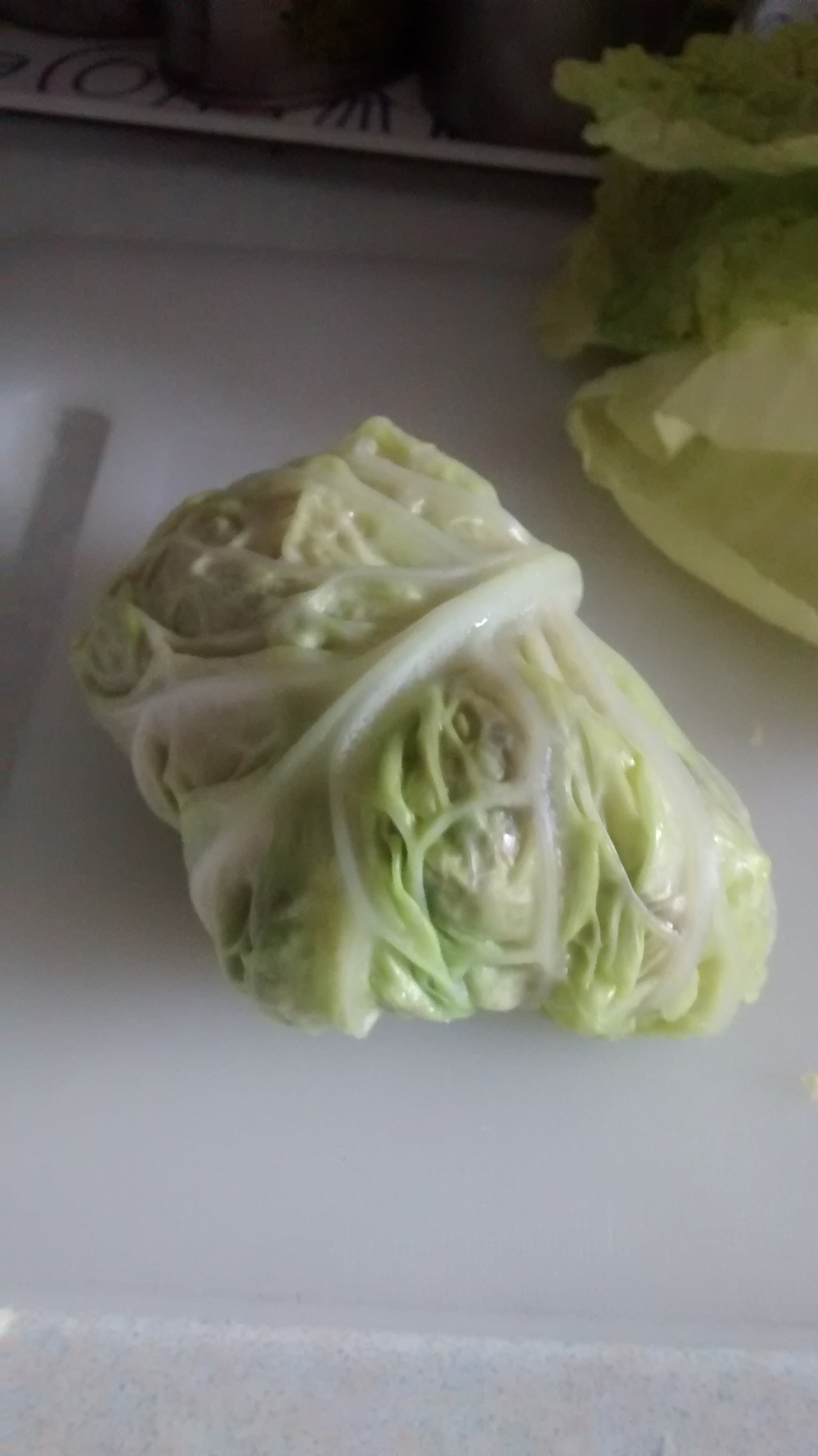
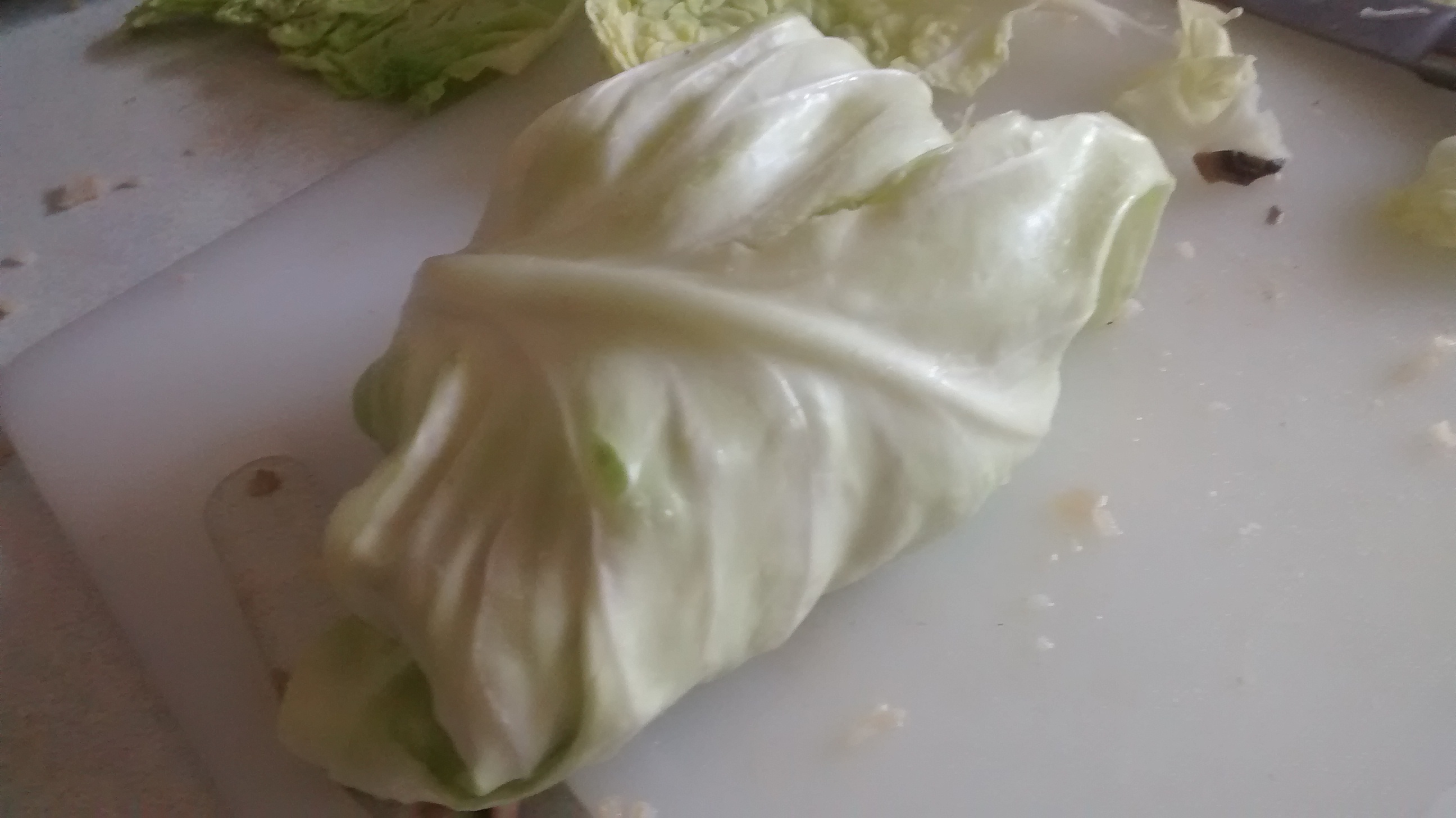
Fill the leaves with the rice & mushroom mix and roll them up from the stalk end, tuck in the sides and secure with the outer edge of the leaf to make a small parcel.
Place the rolls into a large casserole dish, packing as many rolls as possible in rows in the dish. Depending on the depth of the dish repeat this for another layer.
If you have any extra cabbage leaves place these on the base of the dish and then to put extra leaves on the top of the rolls.
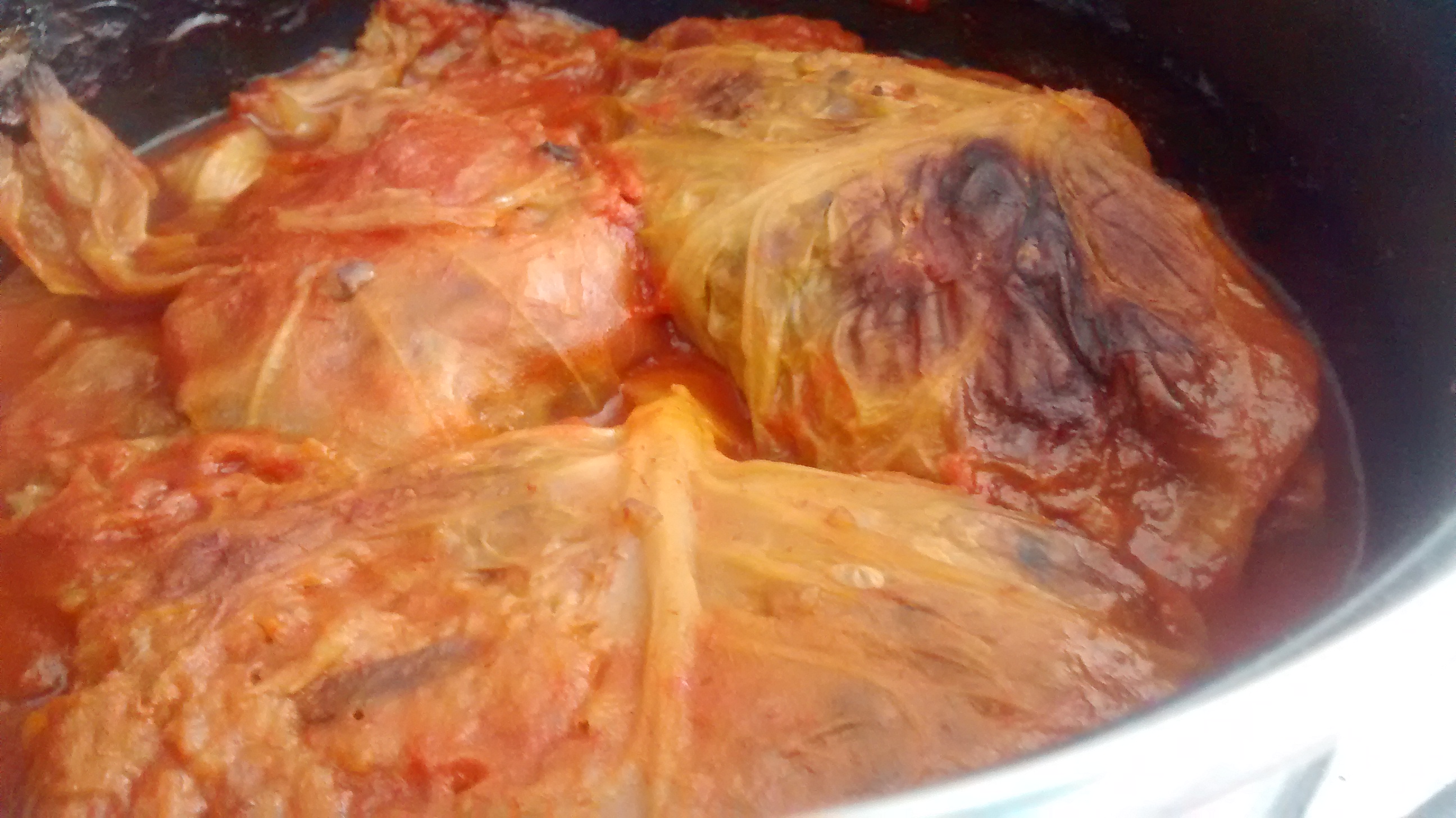
The rolls sometimes have a habit of getting slightly burnt on the top as they come out of the liquid and sometimes at the base if they have been in the oven a long time, these extra layers protect the rolls and can be discarded at the end.
Make a vegetable stock and pour this over the cabbage rolls.
Ingredients for Vegetable Stock
Vegetable stock – I like to use the Swiss Marigold Bouillon vegetable stock powder which is in a tub mixed with boiling water
1 tube of tomato purée
2 bay leaves
3 or 4 peppercorns or allspice or both.
salt & pepper ( note there might be enough salt in the stock cube)
Mix up the stock powder in a jug with boiling water, add the tomato purée and then the rest of the ingredients. You need a large amount to cover the cabbage rolls.
Pre heat the oven to GM3 – 160oC
Cover the rolls with this liquid. It is a good idea to have extra which you can use to top up as they are cooking.
Cover with a lid and place in the oven and cook for several hours. Check them occasionally and keep them covered with liquid as much as possible.
As mentioned earlier I make these a day beforehand and then put them back in the oven for an hour or so before serving.
They are a complete meal in themselves but you can give serve them with some bread to mop up all the liquid sauce.
Note
Wigilia – Christmas Eve
I will be writing a post all about the special meal on this day later when all the dishes are meatless.
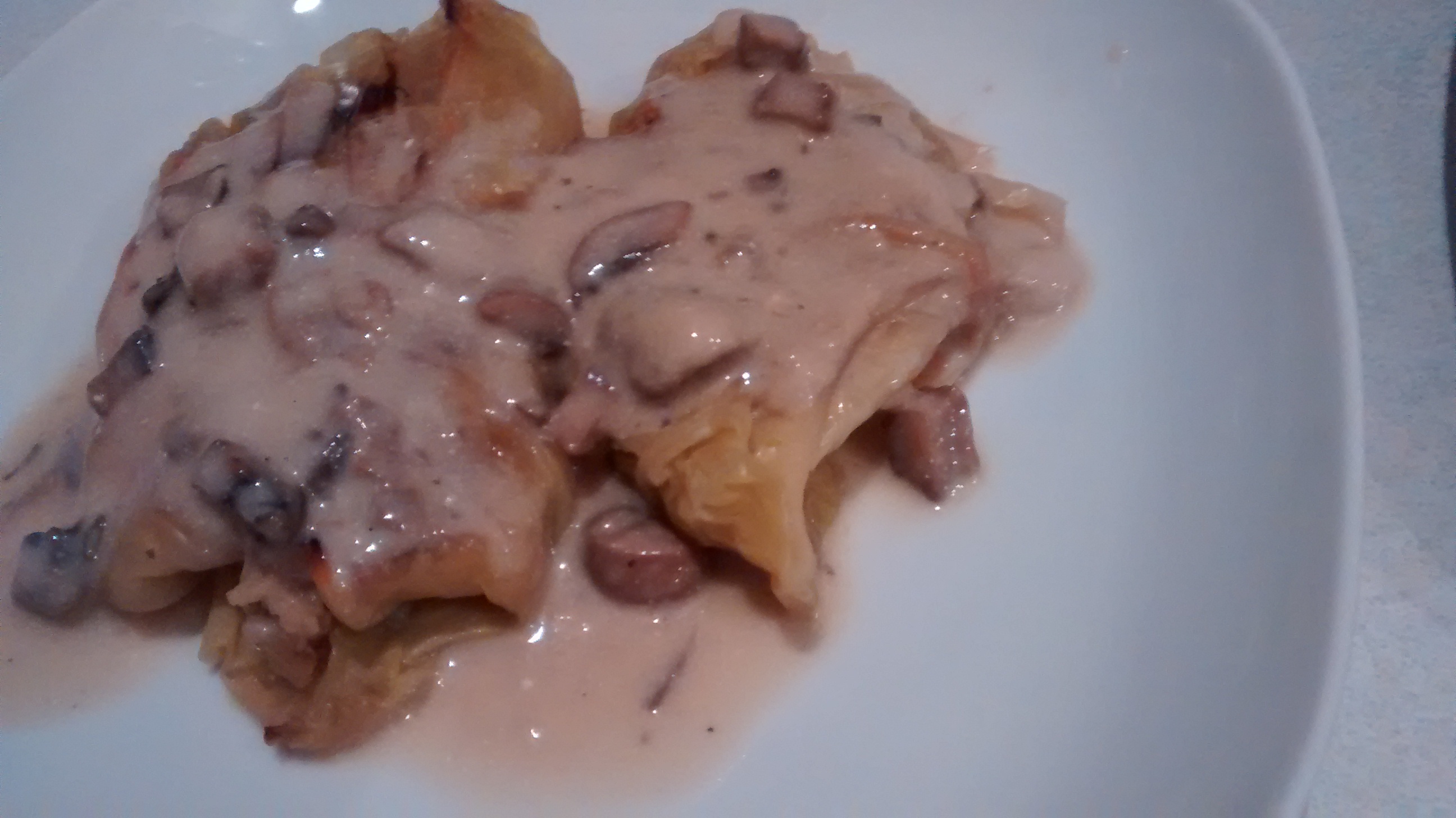
Cabbage Rolls in the style of Dom Polonii in Kraków.
KrakówKrakówKrakówKrakówKraków
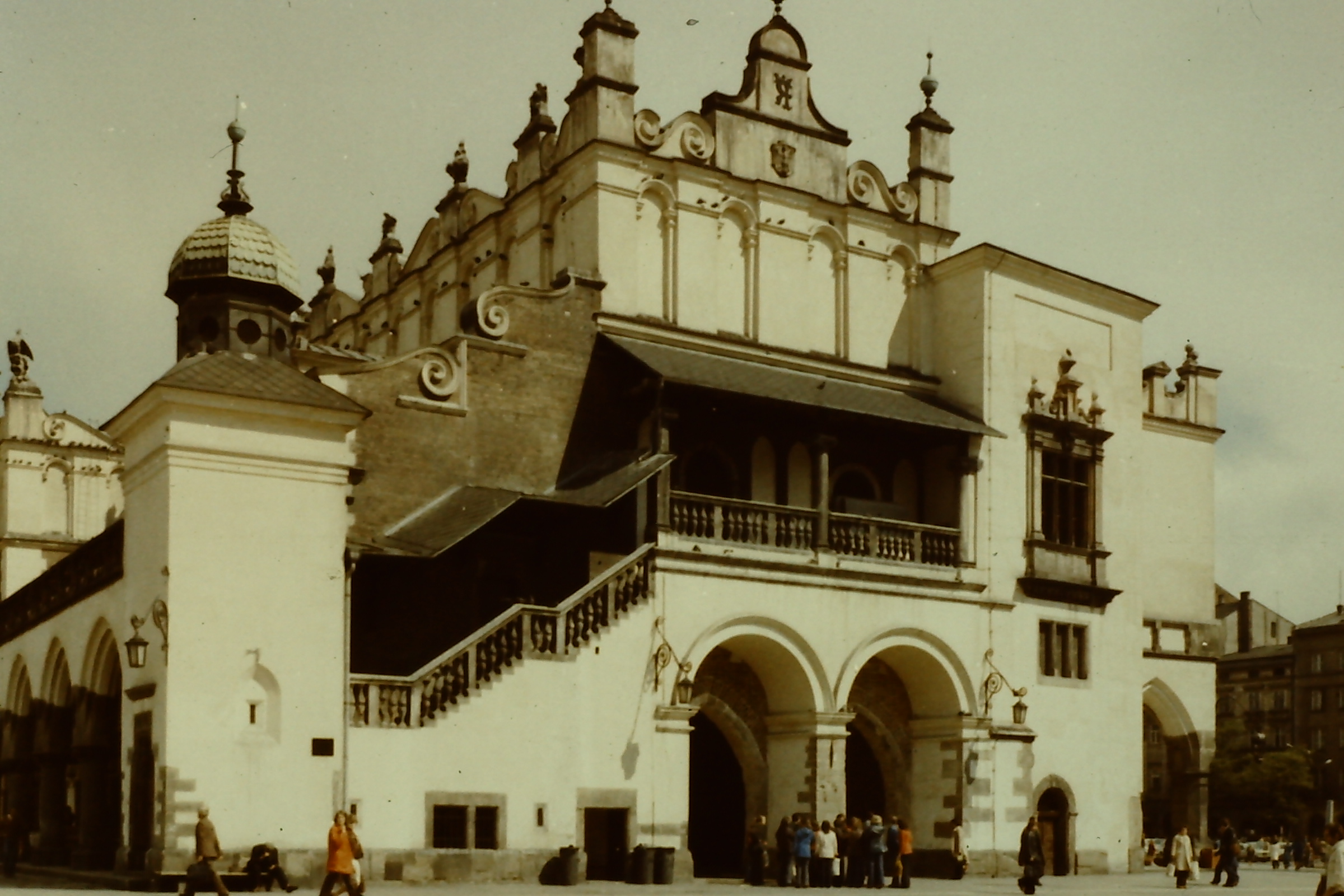
In Kraków, just off the main square (Rynek Główny), there is a building called Dom Polonii (The House of the Poles). It is a medieval tenement building and hosts Chopin concerts in a lovely room with a grand piano on the first floor. I have enjoyed listening to many concerts there. On the ground floor there is a small restaurant. On my trips to Kraków I have found that I eat there the most as it is very reasonably priced and the food is very much like home cooking.
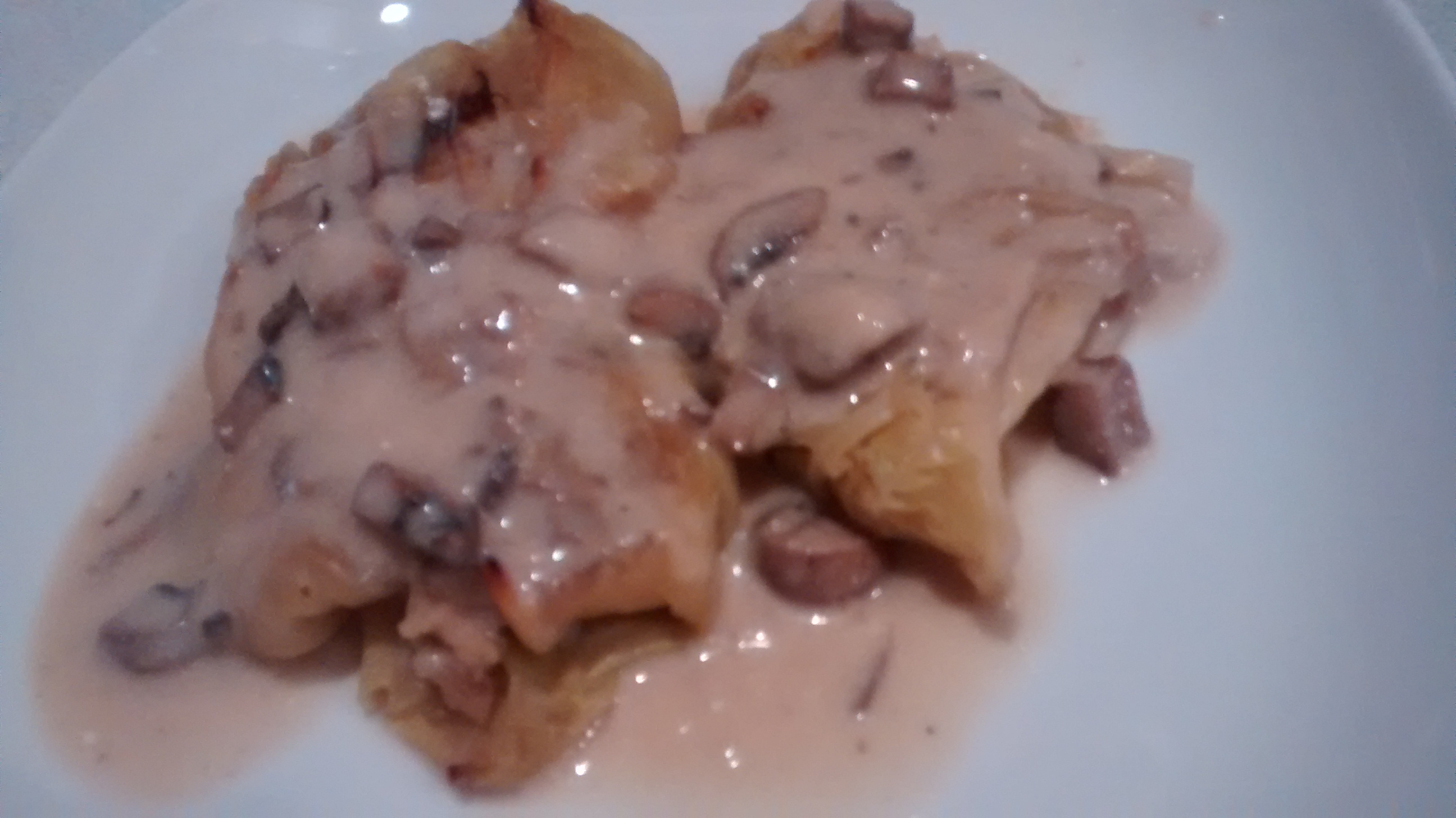
They serve gołąbki there which are cooked without tomatoes and then served with a creamy mushroom sauce.
The following is my recreation of this recipe.
First I made the gołąbki as in my previous post but without tomato purée in the cooking stock but adding some lemon juice as this prevents the leaves from falling apart too quickly.
I will give a quick re-cap of this recipe at the end of this post.
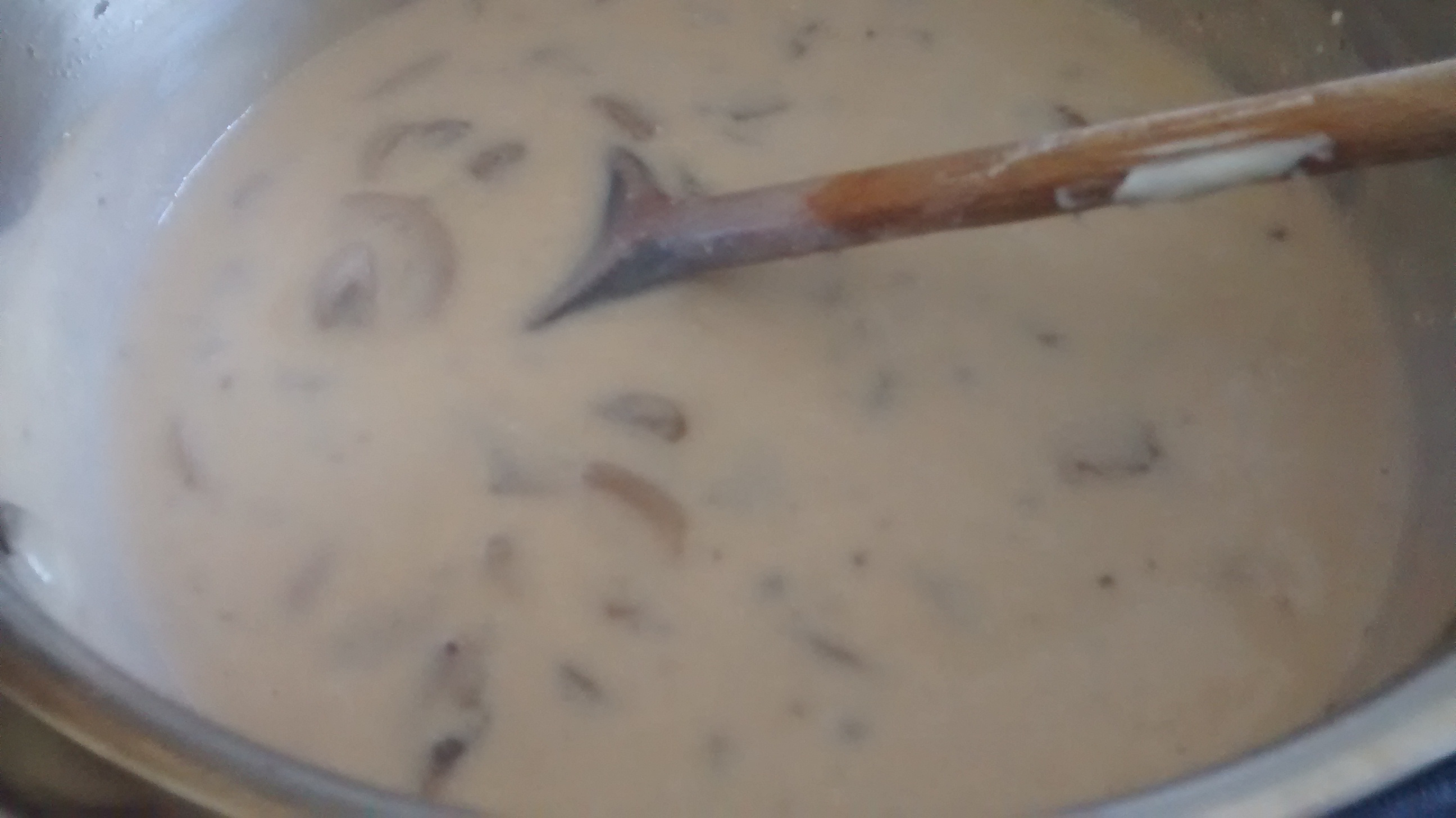
Then I made a mushroom sauce and served the gołąbki with this poured on the top.
Mushroom Sauce
I looked through my Polish cookbooks and many of the mushroom sauces are made with just dried mushrooms. These are delicious and have a strong flavour however it works out very expensive and are not available everywhere.
I am going to give instructions for a sauce using fresh mushroom and just a small amount of dried mushroom.
I will give 2 versions of this mushroom sauce, the first using dried mushrooms, the second a mushroom stock cube.
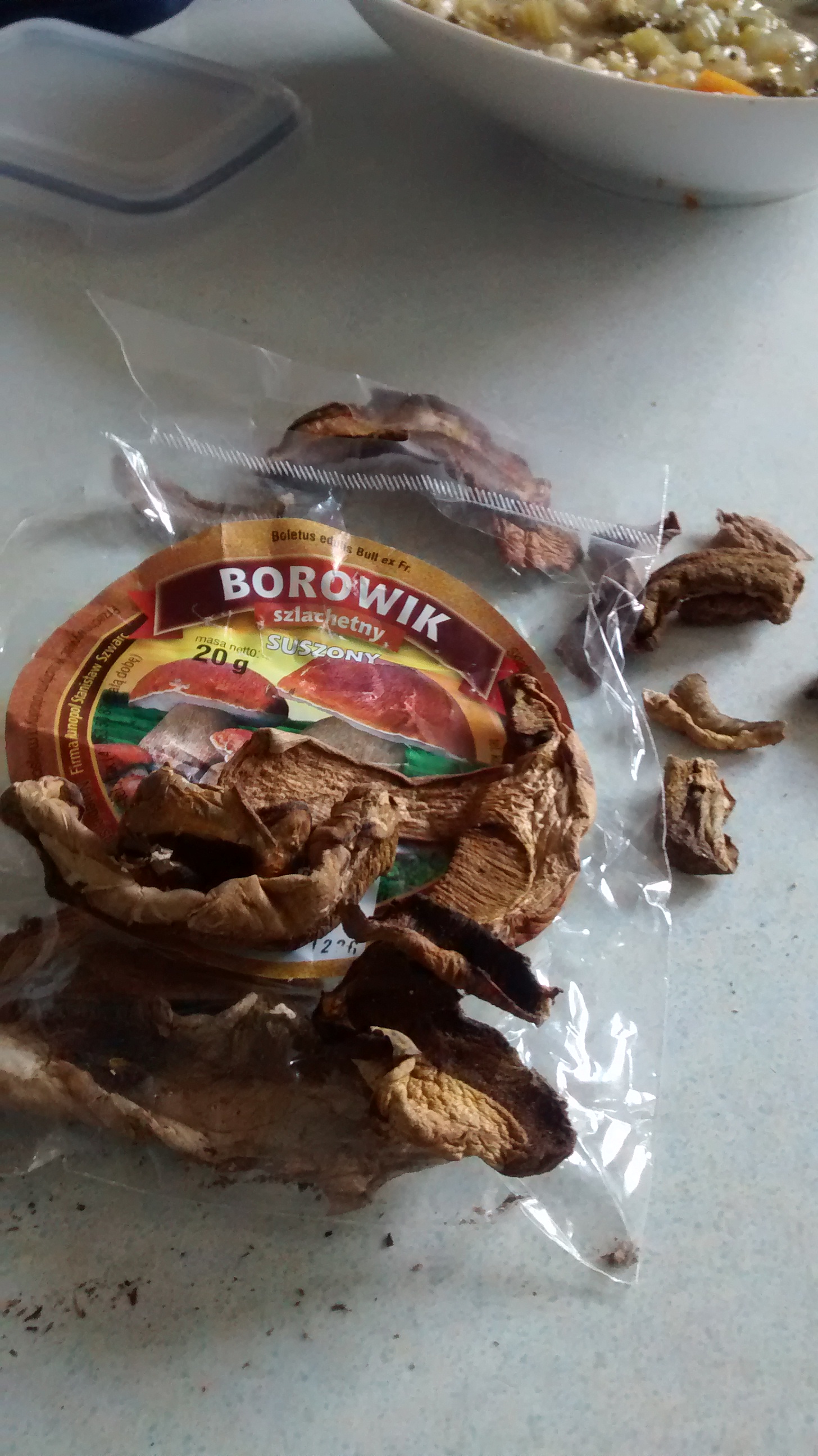
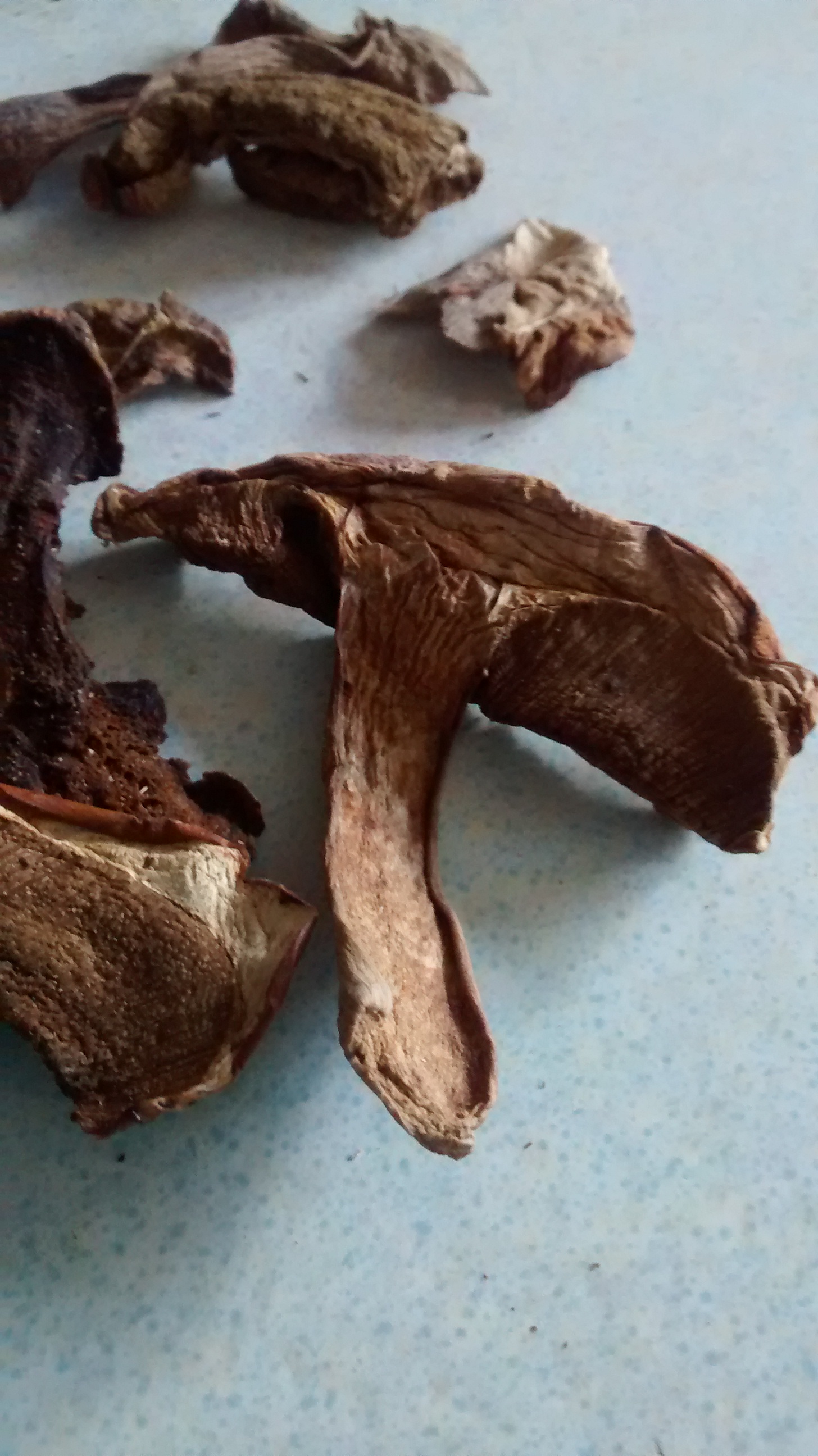
The best dried mushrooms are Boletus edulis, in Poland they are called borowik or prawdzik, in Italy porcini.
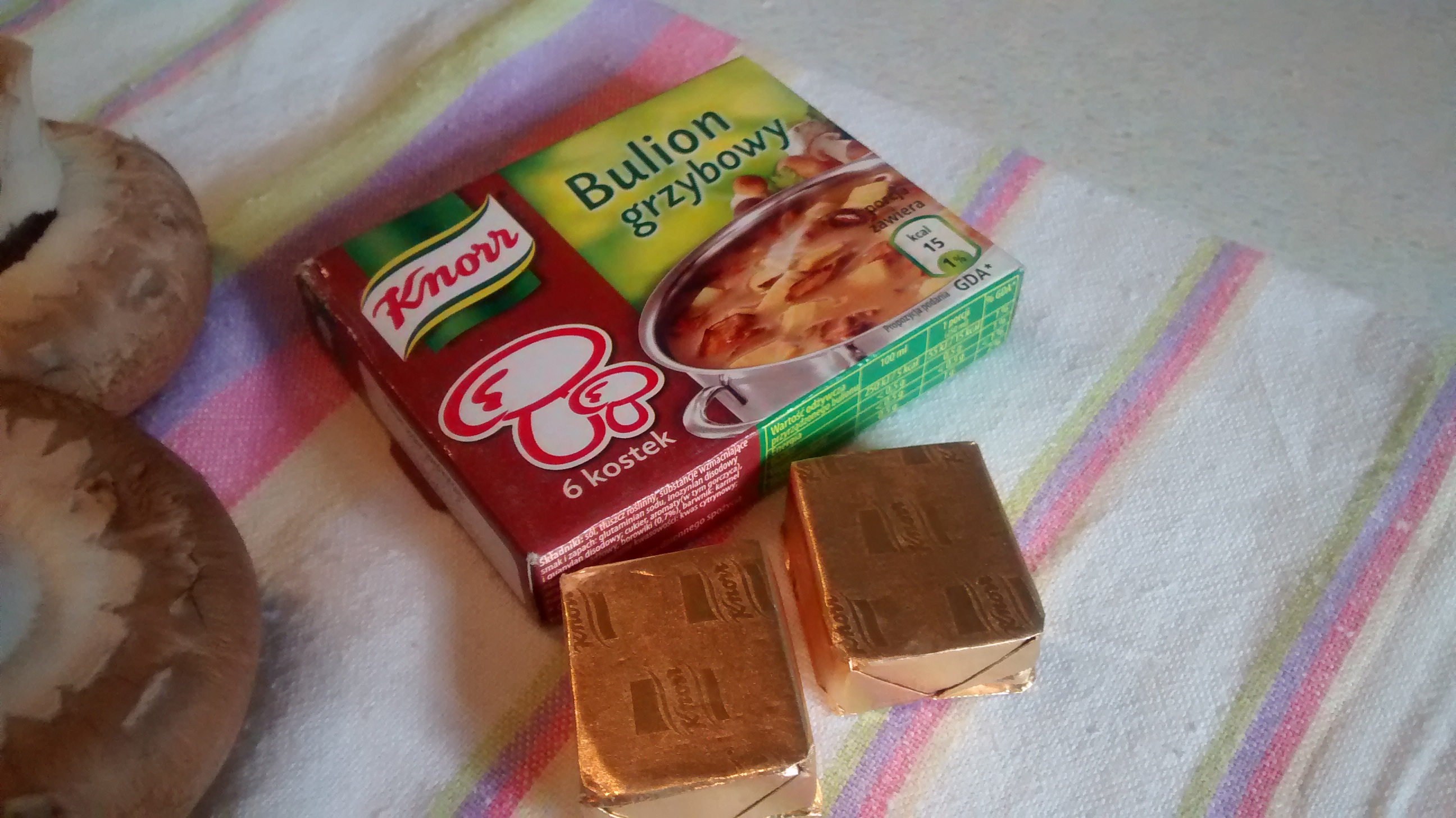
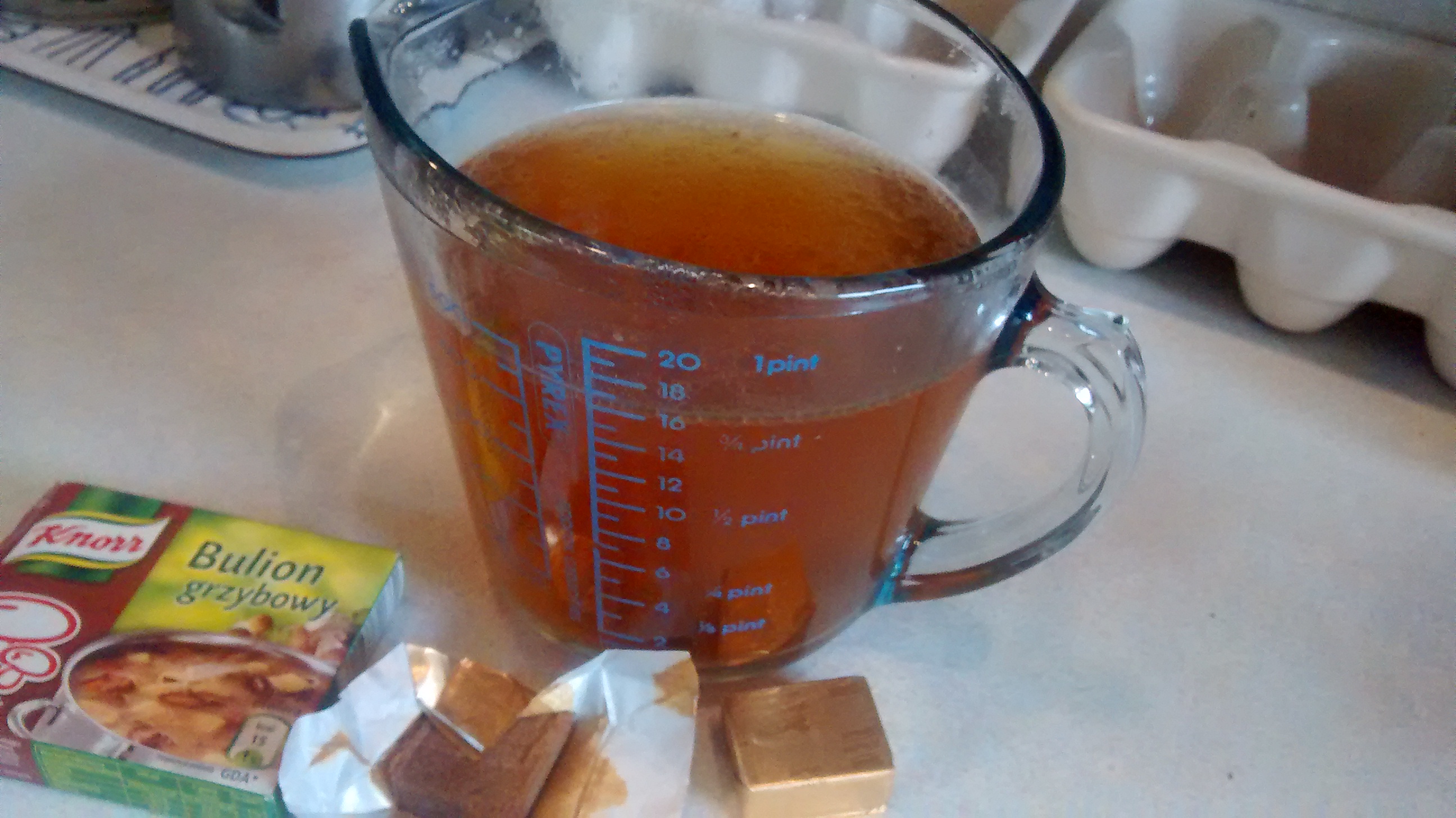
Knorr – mushroom stock cubes
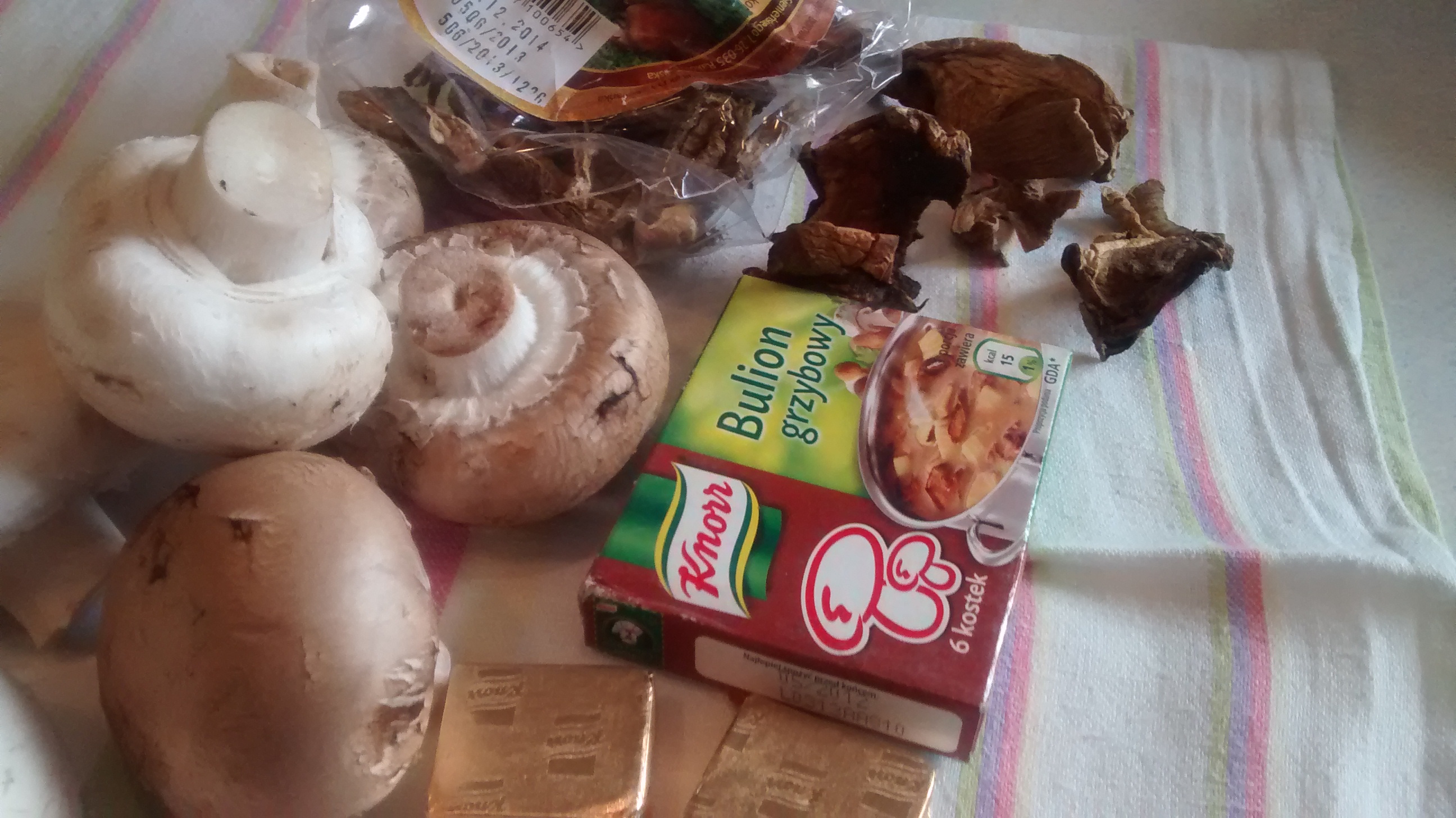
In Poland there are now mushroom stock cubes which are very useful especially for making sauces. Years ago I brought loads back to England, now you can find these in the many Polish food shops. The ones I use are made by Knorr and are shown on the photographs in this post. These stock cubes contain a small amount of dried mushroom extract.
The 2 sauces have the same starting points it is the addition of reconstituted mushrooms or stock cubes for the extra taste which is the difference.
Mushroom sauce 1 – using dried mushrooms
Ingredients
150g fresh button mushroom caps – white and/or chestnut
5g of dried mushroom (around 3 slices)
500ml hot boiling water
1 heaped tablespoon of cornflour
3 tablespoons of milk
2 large tablespoons of soured cream.
butter to cook the mushrooms in
salt & pepper to taste
Method
You have to start this sauce the night before or in the morning for use in the evening.
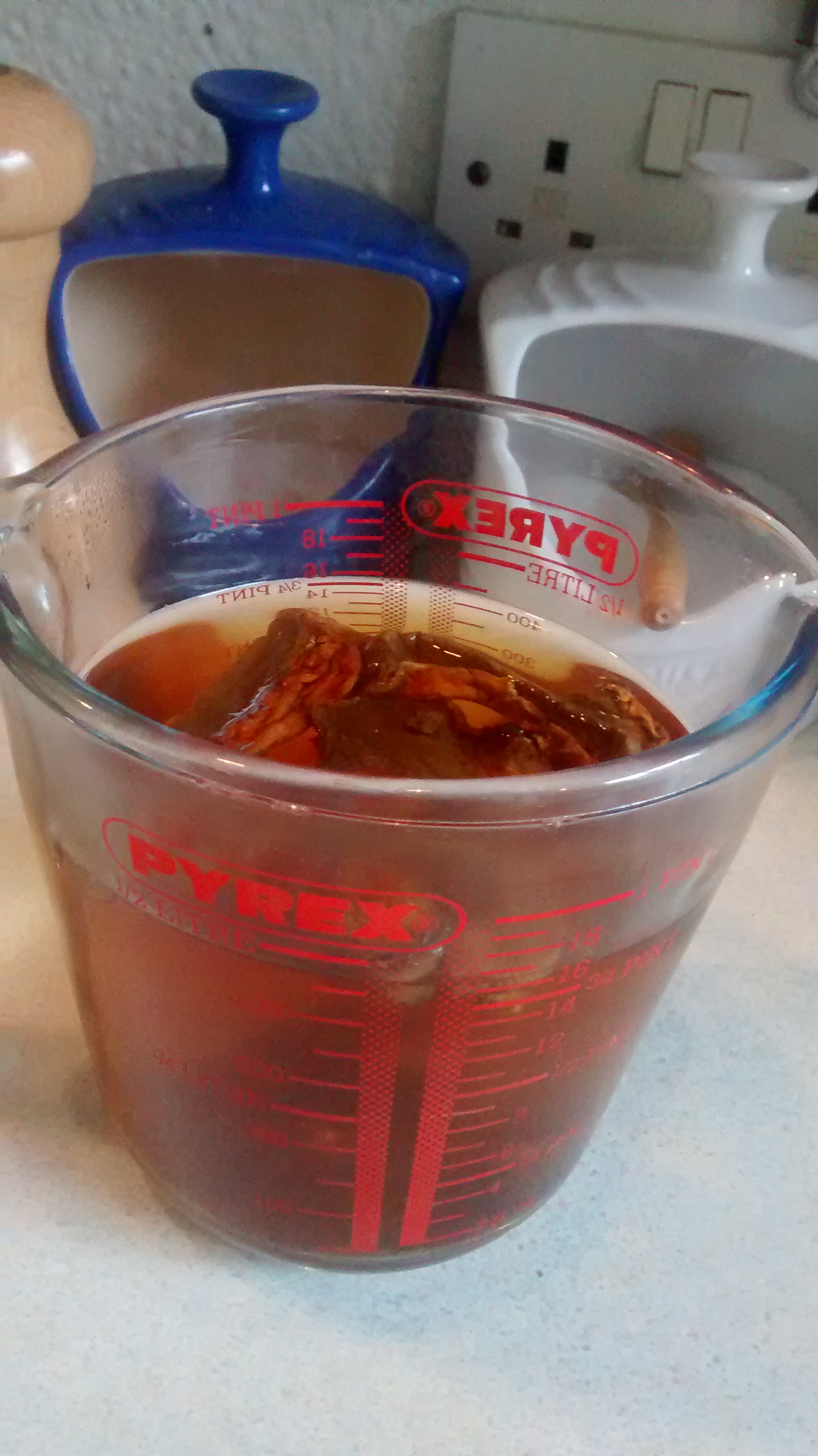
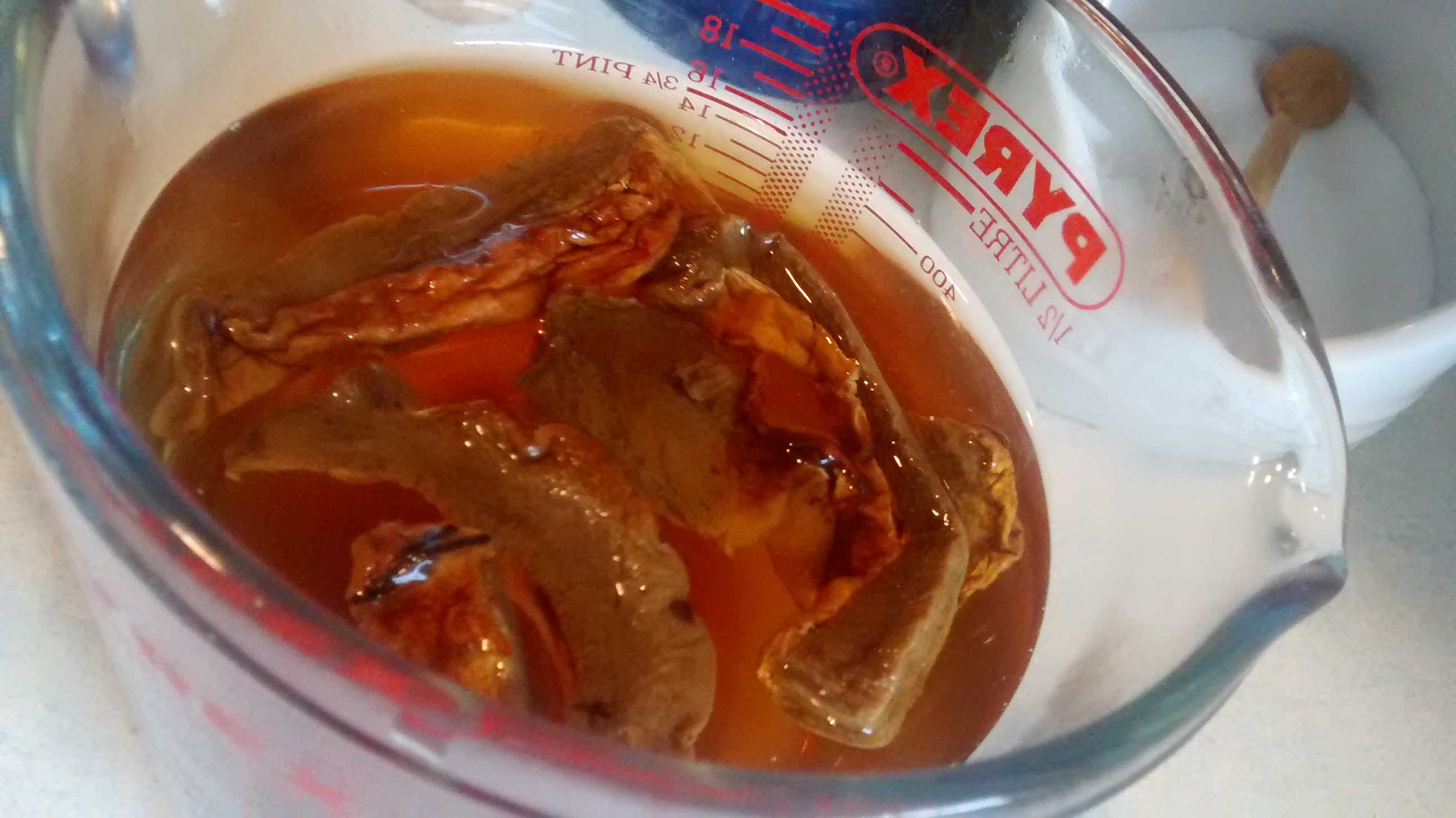
Cover the dried mushrooms with 500ml of boiling water and leave to soak.
Preparing Dried MushroomsDried Mushroom in Hot Water
The following day take out the reconstituted mushrooms and using a knife you can chop then up into tiny pieces or if the are soft enough you can spread out the pulp on a chopping board.
Reconstituted MushroomsMaking a Pulp of Mushrooms
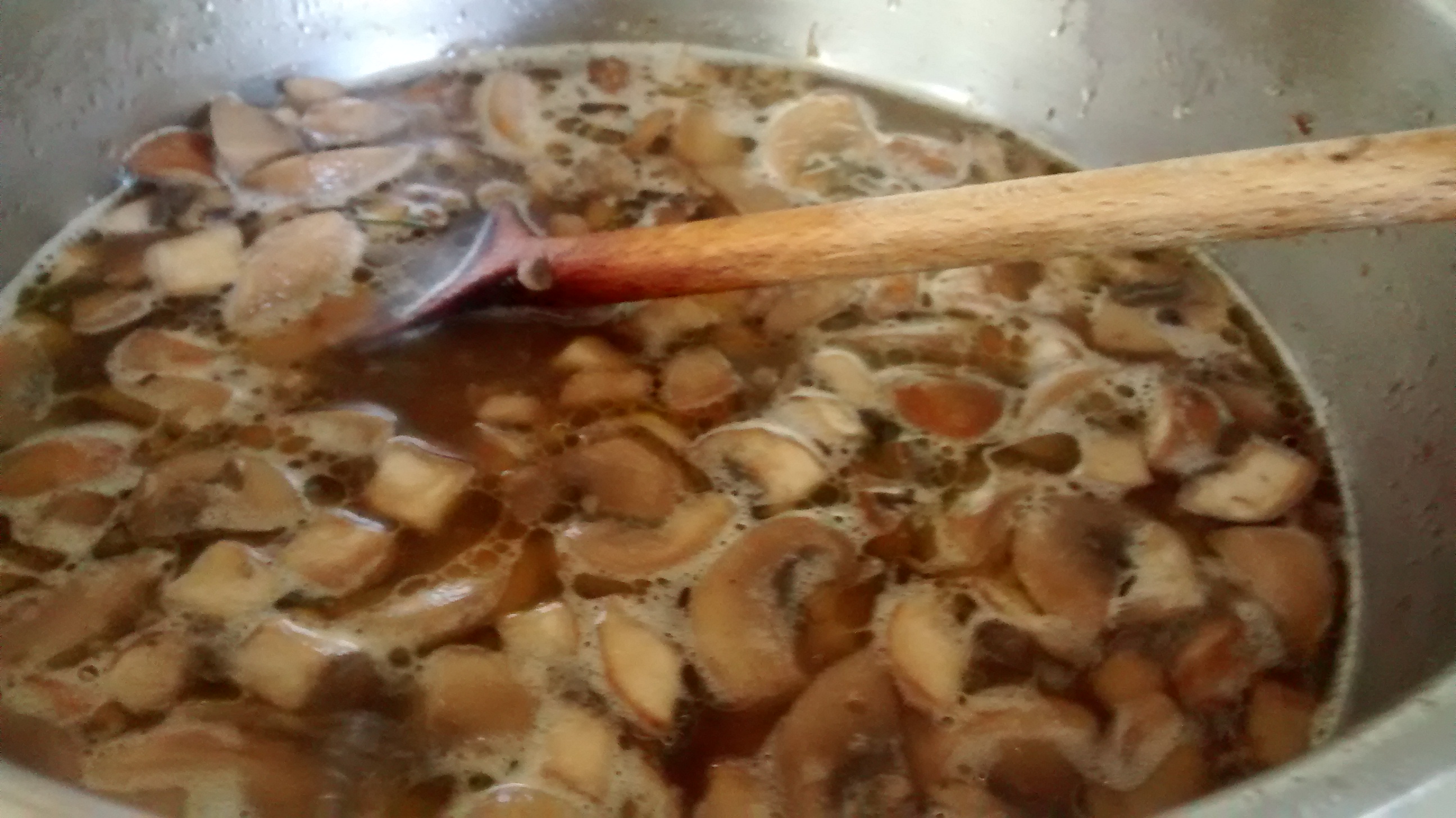
Slice the mushroom caps into fine slices and fry them gently in some butter till they are soft.
Add the dried mushroom pulp and the liquor in which they were seeped.
Simmer gently for about 5 to 10 minutes.
In a little dish mix the cornflour with the milk.
Add the cornflour mixture to the cooked mushrooms and stir gently over the heat until the sauce thickens.
Add salt & pepper to taste.
Remove from the heat and add the 2 large spoonfuls of soured cream and mix well in.
Note
None of these amounts are exact – they are a rough guide depending on what you have – you can use more water, milk or soured cream and so on.
Mushroom sauce 2 – using a mushroom stock cube
Ingredients
150g fresh button mushroom caps – white and/or chestnut
500ml hot boiling water
1 heaped tablespoon of cornflour
3 tablespoons of milk
2 large tablespoons of soured cream.
butter to cook the mushrooms in.
note
I rarely have to add any more salt or pepper as the stock cube has enough seasoning in it.
Method
Dissolve the stock cube in the hot water.
Preparing a Mushroom Stock Cube
Slice the mushroom caps into fine slices and fry them gently in some butter till they are soft.
Simmer gently for about 5 to 10 minutes.
In a little dish mix the cornflour with the milk.
Add the cornflour mixture to the cooked mushrooms and stir gently over the heat until the sauce thickens.
Remove from the heat and add the 2 large spoonfuls of soured cream and mix well in.
If you can get the stock cubes then version 2 is the quickest.
Basic gołąbki recipe without tomatoes
Ingredients
1 large head of white cabbage or Savoy cabbage*
400g rice
500g of minced beef or pork
Chicken stock – a cube or concentrate will do
salt & pepper
2 bay leaves
3 or 4 peppercorns or allspice or both
juice of 1 or 2 lemons.
*As you need whole largish cabbage leaves I sometimes use 2 cabbages to get the bigger leaves. Recently I have started to use Sweetheart cabbage which has large leaves on the outside but you will most likely need 2 of these.
Instructions from my Polish cookbook “bible”
You need to parboil the rice in salted water so that it is about half way to being cooked and then strain the rice and let it go cold, but if you have some plain boiled rice left from another day you could use this, as this is not critical.
In a large bowl mix the rice and minced meat and add salt and pepper. The exact amounts do not matter. I like it to look about 50/50 white and pink but these can be made with much more rice to eke out the meat available.
Next comes the hardest part and patience is called for here to avoid getting scalded fingers. You have to heat or steam the cabbage to make the leaves pliable so you can remove them one by one and use them to encase the filling.
You need the largest pan you have into which you place the cabbage head. I boil some water in a kettle and pour this over the cabbage in the pan with some heat under the pan I let the cabbage cook a little. The temptation is to boil to quickly so making some of the leave too soft and runs the risk of getting scalded as you try to remove the leaves.
Another method is to place the cabbage into a metal colander and set this over the pan of water so that it is steamed rather than boiled.
As the leaves become soft, you have to cut them off from the stalk and stack them up for to use later, you can cut out the thickest part of the stalk from the first few larger leaves.
Pre heat the oven to GM3 – 160oC
Place a small handful of the rice & meat mixture onto a cabbage leaf and roll up from the stalk end, tuck in the sides and secure with the outer edge of the leaf to make a small parcel.
Place the rolls into a large casserole dish, packing as many rolls as possible in rows in the dish. Depending on the depth of the dish repeat this for another layer.
A tip I got from my late cousin, Krystyna, is to use extra cabbage leaves on the base of the dish and then to put extra leaves on the top of the rolls.
The rolls sometimes have a habit of getting slightly burnt on the top as they come out of the liquid and sometimes at the base if they have been in the oven a long time, these extra layers protect the rolls and can be discarded at the end.
Make a large amount of stock with hot water and lemon juice and add bay leaves, peppercorns and allspice.
Cover the rolls with this liquid. It is a good idea to have extra which you can use to top up as they are cooking.
Cover with the lid and place in the oven and cook for several hours. Check them occasionally and keep them covered with liquid as much as possible.
I always think these taste better when made a day before hand and left for the liquid to seep in more and then reheated in the oven as required.
In the style of Dom Polonii
Sprinkling some chopped dill or flat leaf parsley on the top will be even better (Sadly I did not have any on the day of this photograph).
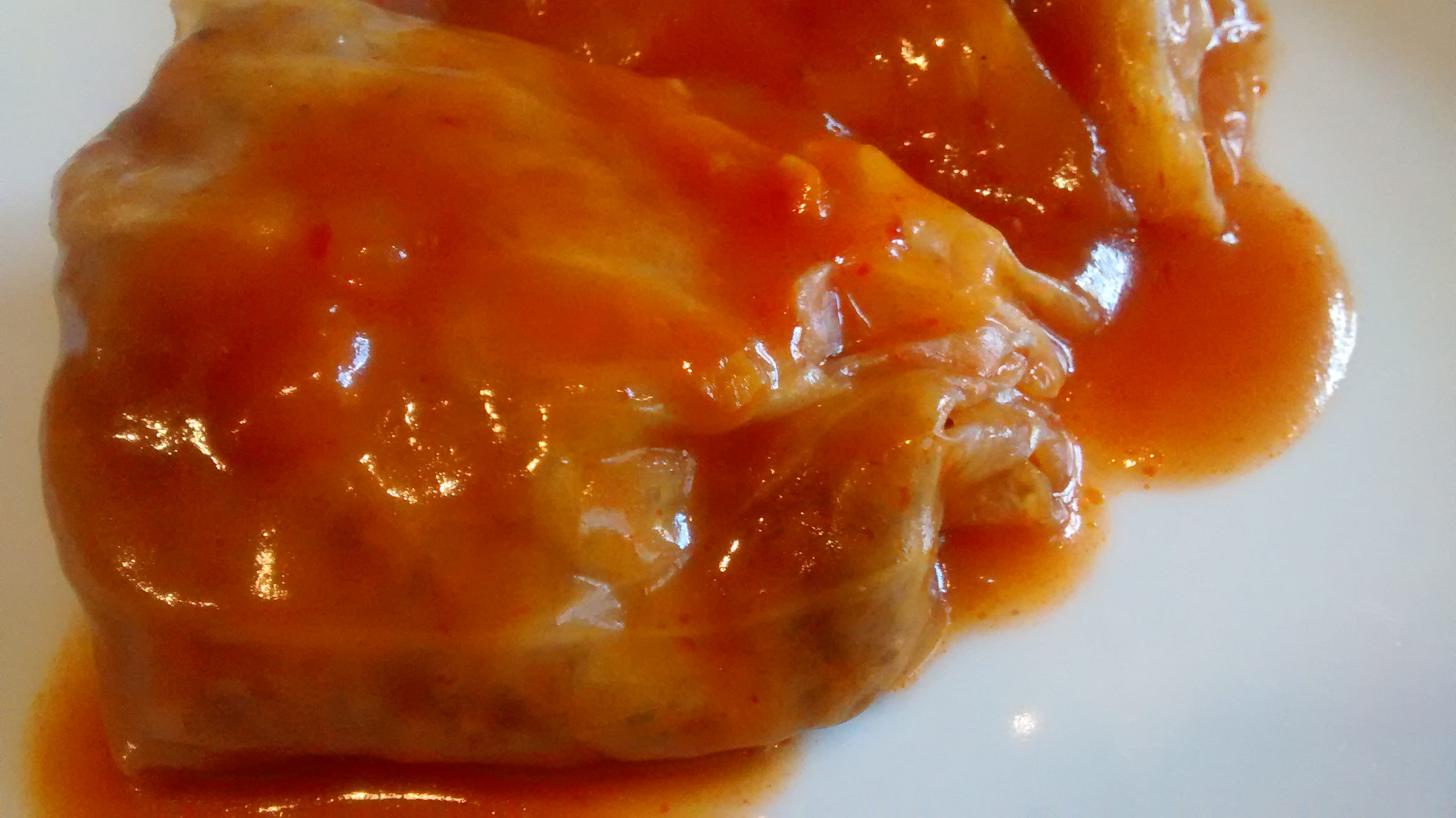
Gołąbki are made using fresh cabbage and the name means little pigeon or dove. This name comes about from its size and shape and also from to the idea of this being a little delicacy.
The cabbage leaves are used to make a little parcel with a meat and rice filling and these are then cooked in a liquid stock or sauce.
I have read that this is a very old dish which originally came from the Byzantine Empire and was made with vine leaves, as it came north; cabbage leaves replaced the vine leaves.
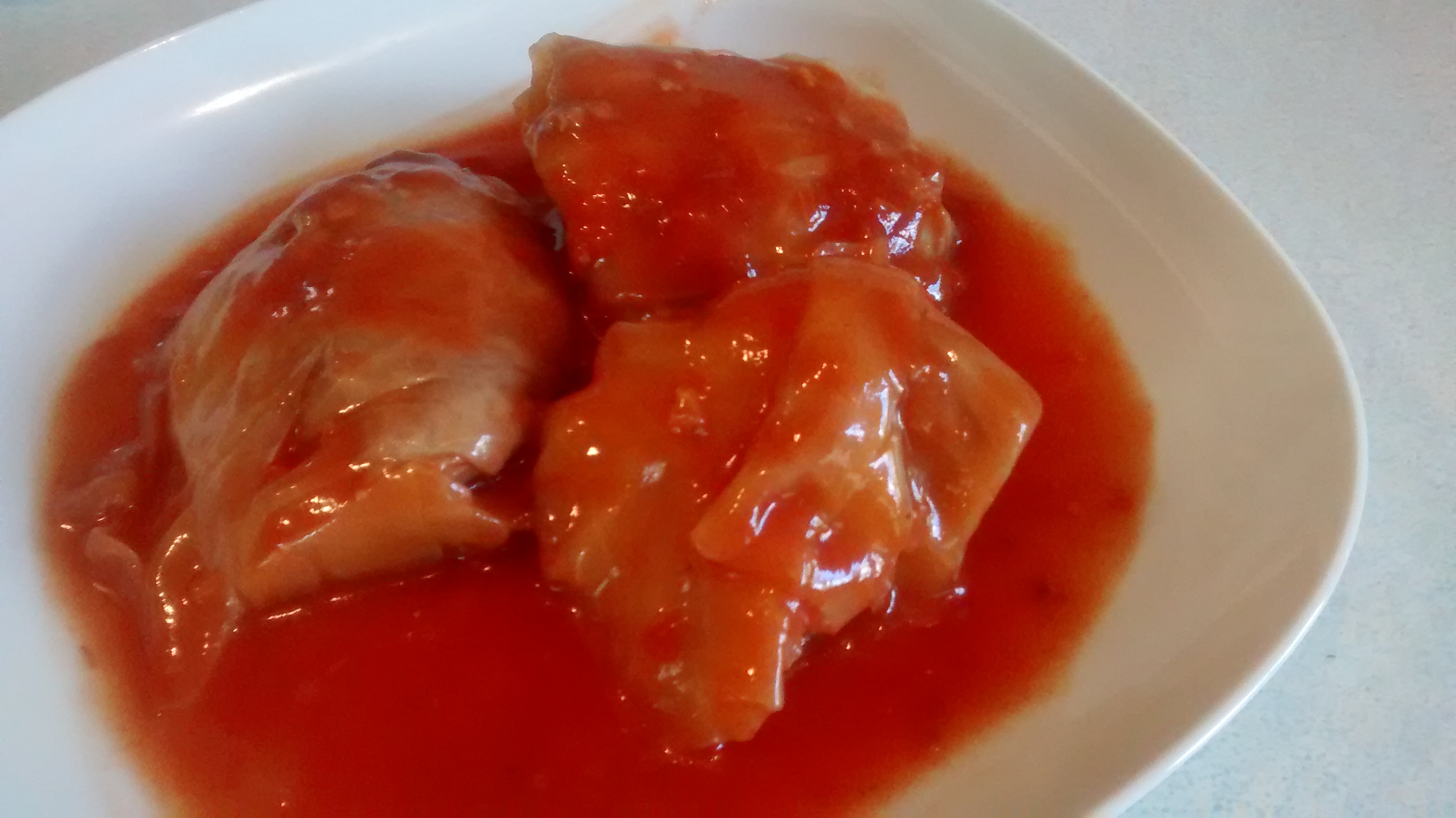
The main 3 ingredients are: cabbage, rice and minced meat, and you also need a liquid to cook them in, which in my mother’s case was always a stock with tomatoes.
You can use white or Savoy cabbage. White cabbage has softer more pliable leaves and I think make the best gołąbki . Savoy cabbage has firmer leaves that are easier to work with but take longer to cook; these can be easier for a novice to use.
You need a large head of cabbage to get large leaves.
You can use any type of rice but the stickier types are the best.
The traditional Polish version uses pork. My mother used beef as this was more readily available in England. Now that minced pork is more available and you do not have to hand mince it, I use either or even mix the two.
There are many variations using, fresh or dried mushrooms, buckwheat instead of rice, and a stock without tomatoes. In fact buckwheat is a more older version as it grows in Poland and rice would have to be imported.
This recipe is my mother’s and for me this is just right!
Mama’s Classic Recipe
Ingredients
1 large head of white cabbage or Savoy cabbage
400g rice
500g of minced beef or pork
chicken stock – a cube or concentrate will do
1 tube of tomato purée
salt & pepper
2 bay leaves
3 or 4 peppercorns or allspice or both
Although the gołąbki take a while to put together, you then leave them to cook in a slow oven for hours which is easy.
You can reheat them on the next day and in fact I think they taste better the longer they have been steeped in the cooking liquid and I always make them a day in advance.
They also freeze very well, so I pack any left in portions of 2 or 4 for a later date. Because of this I like to make as big a batch as I can in one go.
I use a very large enamelled oval dish with a lid which is ideal for this.
As you need whole largish cabbage leaves I sometimes use 2 cabbages to get the bigger leaves.
You need to parboil the rice in salted water so that it is about half way to being cooked and then strain the rice and let it go cold, but if you have some plain boiled rice left from another day you could use this as this is not critical.
In a large bowl mix the rice and minced meat and add salt and pepper. The exact amounts do not matter. I like it to look about 50/50 white and pink but these can be made with much more rice to eke out the meat available.
Next comes the hardest part and patience is called for here to avoid getting scalded fingers. You have to heat or steam the cabbage to make the leaves pliable so you can remove them one by one and use them to encase the filling.
You need the largest pan you have into which you place the cabbage head. I boil some water in a kettle and pour this over the cabbage in the pan with some heat under the pan I let the cabbage cook a little. The temptation is to boil to quickly so making some of the leave too soft and runs the risk of getting scalded as you try to remove the leaves. Another method is to place the cabbage into a metal colander and set this over the pan of water so that it is steamed rather than boiled.
As the leaves become soft, you have to cut them off from the stalk and stack them up for to use later, you can cut out the thickest part of the stalk from the first few larger leaves.
Instructions from my Polish cookbook “bible”
Pre heat the oven to GM2 – 150oC
Place a small handful of the rice & meat mixture onto a cabbage leaf and roll up from the stalk end, tuck in the sides and secure with the outer edge of the leaf to make a small parcel.
Place the rolls into a large casserole dish, packing as many rolls as possible in rows in the dish. Depending on the depth of the dish repeat this for another layer.
A tip I got from my late cousin, Krystyna, is to use extra cabbage leaves on the base of the dish and then to put extra leaves on the top of the rolls.
The rolls sometimes have a habit of getting slightly burnt on the top as they come out of the liquid and sometimes at the base if they have been in the oven a long time, these extra layers protect the rolls and can be discarded at the end.
Make a large amount of liquid stock with hot water and tomato purée and add bay leaves, peppercorns and allspice.
Cover the rolls with this liquid. It is a good idea to have extra which you can use to top up as they are cooking.
Cover with the lid and place in the oven and cook for several hours. Check them occasionally and keep them covered with liquid as much as possible.
As mentioned earlier I make these a day beforehand and then put them back in the oven for an hour or so before serving.
They are a complete meal in themselves but you can give serve them with some bread to mop up all the liquid sauce.


























 Journey From A Polish Kitchen