Pisanki – Polish Easter Eggs

Easter is celebrated on the first Sunday, after the first full moon, after the spring equinox, which is the 21st of March. So the earliest date for Easter is the 22nd of March and the latest date is the 25th of April.

In English the word Easter comes from the name of the pagan goddess of dawn or spring – Eastre or Eostre and her festival was in spring time and hence this old word has stuck.

In Polish the name is Wielkanoc – which translates as Great Night – as it is the night of The Resurrection.

Eggs at Easter were originally a pagan tradition as symbols of fertility, rebirth and the revival of nature and heralded in the start of spring.

The tradition was absorbed by Christianity and the egg is now the symbol of the tomb and as the chick hatches from the egg with life so it symbolises the Resurrection of Jesus Christ.

Pisanki are the decorated eggs you find in Poland. The word comes from the Polish verb pisać which nowadays means to write,  however in old Polish it also meant to paint.

There are many different ways of decorating eggs and each of these has its own specific name  –  one method uses beeswax and dyes are used to give wax resist patterns – another scratches away the dye to revel the original shell colour.

In Kraków there is the Museum of Ethnography, founded in 1902, which has  superb displays of intricate and beautiful pisanki through the ages – well worth a visit.

Below are photographs of an egg which was decorated using the beeswax and dye method – onion skins in this case.  It belongs to the Director of  the Leeds Polish Saturday School and was one of many made two years ago with instructions from a visiting tutor at a workshop session for the teachers and pupils at the school.


I make very simple coloured eggs by hard boiling eggs with onion skins.

Boiling eggs with brown onion skins dyes the egg shells a rich brown colour.


Boiling eggs with red onion skins dyes the egg shells a dark red-brown colour.


You can buy sheets of coloured paper dyes which give a range of colours   – safe edible dyes of course – I have tried these in the past but now just use onions as they are always in my vegetable basket.

Tip

When hard boiling eggs use eggs that are at least three days old as very fresh eggs are hard to peel.

These hard boiled eggs form part of the basket of food which is taken to church on the Saturday before Easter to be blessed see Palm Sunday & Holy Saturday.

The blessed eggs are peeled and cut into quarters to be shared at the Easter Breakfast with all the people present.


Other non- blessed hard boiled eggs are used in a game of tapping  eggs together to see which one cracks first.

A wooden imitation of these lovely decorated eggs is now a very popular item for sale throughout the year in Poland.  It is a something that many tourists buy to take home.


Picture45

Pisanki for sale in Kraków

Picture48


My Wooden Pisanki


Wooden Eggs belonging to my friend in Leeds


In these the wooden eggs have been painted and carved to expose the pale wood imitating the method of scratching with a fine tool the paint or dye and exposing the egg shell colour of real eggs

Easter Greetings

The photographs are taken from recent Easter cards from Poland.

Wesołych Świąt

IMG_20160307_122736836


Happy Holy (Holiday) Day


IMG_20160307_122818233

Wesołych Świąt Wielkanocnych

Happy Holy (Holiday) Day at Easter

Wesołego Alleluja

Happy Alleluia


Because of the egg theme you may also hear

Smacznego jajka 

May the eggs be delicious.


IMG_20160307_122641469

PS

After posting the above I received an Easter card from Poland with the following stamp.

IMG_20160331_155207810


Palm Sunday & Holy Saturday

Palm Sunday is the Sunday before Easter and marks the beginning of Holy Week.

Palms are blessed in church on this day to commemorate Christ’s entry into Jerusalem.

Of course palm trees do not grow in Poland and so other plants are substituted. Often pussy willow  is used as the catkins are usually out around this time. My mother always called pussy willow – palma – the Polish for palm.


Picture12


Twigs For Sale in the Old Square in Kraków


Picture11

Palms are also made from  dried grasses and corn which are often dyed to make them colourful or from coloured paper which is rolled and the edges cut to make a fringe.

IMG_20160317_084252377_HDR


IMG_20160317_085832182


IMG_20160317_084304081

In many villages the farmers would make huge palms for the procession completing with each other to see who had the biggest and best.

The Main Square in  Kraków – Decorated with Large Palms


It is still Lent in Holy Week so the food eaten is simple and often meat, butter and egg free. Most baking and cooking done now is to make food to eat at Easter.

As well as going to church services it is a time for houses to undergo a massive clean-up especially inside.

Holy Saturday is the last day of Lent – the day before Easter.

This is the only day in the Catholic year on which Mass is not celebrated.

In Poland there is the tradition on this day to have the food for Easter blessed.

This has its roots in the early medieval church in the 12th Century and the food would have originally  been just bread and eggs.

In times past in villages the priest would have gone around to people’s houses and blessed the food there. Nowadays people bring a basket of food to the church and the food is blessed with Holy Water and is then taken home and not eaten till the Easter Sunday Breakfast.

Once blessed this basket is called święconka meaning  that which has been blessed

The basket is lined with a cloth – often white linen and sometimes embroidered.  A white linen cloth is used to cover the basket. These cloths represent the white shroud in which Jesus was wrapped.

What goes into the basket depends on several factors but hard boiled eggs and bread are usually present. Everything in the basket has a symbolic meaning.

Eggs –  Christ’s Resurrection – a symbol of life.

Bread – Christ as the Bread of Heaven.

Salt –  Preservation & Purification & Zest for Life

Horseradish – The Harsh & Bitter sacrifice of Christ.

Cooked Meat & Sausage – Joy & Abundance of God’s mercy.

Babka – The risen  dough  – this represents the Risen Christ.

Shaped Lamb (butter/cake/bread) – Christ – The Lamb of God -(see Lamb Bread)

Cheese – Moderation.

Butter – End of Lent.

Getting a basket ready to take to Church

IMG_20160317_091427426 IMG_20160317_091412273

IMG_20160314_121021117

IMG_20160314_121012463


IMG_20160209_170105296

IMG_20160302_063114078


IMG_20160314_121030337


IMG_20160301_080227533


Picture33 Picture23


See Babka


IMG_20160314_121136387


IMG_20160314_121150500


People coming & going to church in Kraków with baskets of food.


Food for sale for Easter in Kraków.

Picture17

Picture22

The special meal at Easter in Poland is the Easter Breakfast –  although it is a lot later than a normal breakfast being usually around 11am

This meal is a cold buffet and includes the food that was blessed in church on Easter Saturday.

The hard boiled eggs are cut up into quarters or eighths and they are shared between everyone present  at the start of the meal.

POSTSCRIPT

Since posting I received the following photographs from my friend in Leeds who is The Director of the Polish Saturday School.

Sugar Lambs to go in the basket for blessing.


Salt Dough Lambs – made for the Easter Fair


Poles Love to Eat Cabbage

Cabbage is a vegetable that plays a very large part in Polish cookery.  It can be eaten raw  in a variety of salads or cooked in many different ways.

Cabbages grow well in Poland and they can be stored for part of the winter so giving a supply for most of the year.

Veg Market - Copy

Cabbages For Sale in a Polish Market

Cabbages can also be preserved by allowing them to ferment using brine. This fermented cabbage is called sauerkraut in German which means sour cabbage.

My parents used to tell me about how their parents made barrels and barrels of fermented cabbage, shredding the cabbage finely, adding salt and packing it firmly into the barrels. This was standard work after harvesting cabbages and would provide a basic ingredient for many dishes throughout the coming year.

One of my aunties in Poland who lives in a block of flats makes her own sauerkraut in a bucket which stands on her balcony. She is not alone in this.

Street market in Krakow – Sauerkraut and Sausage
Sauerkraut and Sausage

On a recent trip to Poland I bought a little book on cabbage cookery.  The title, translates as “Falling in Love with Cabbage”; I think most Poles do this at a very early age as cabbage features, fresh or sour, in so many meals.

Falling In Love With Cabbage

Falling In Love With Cabbage

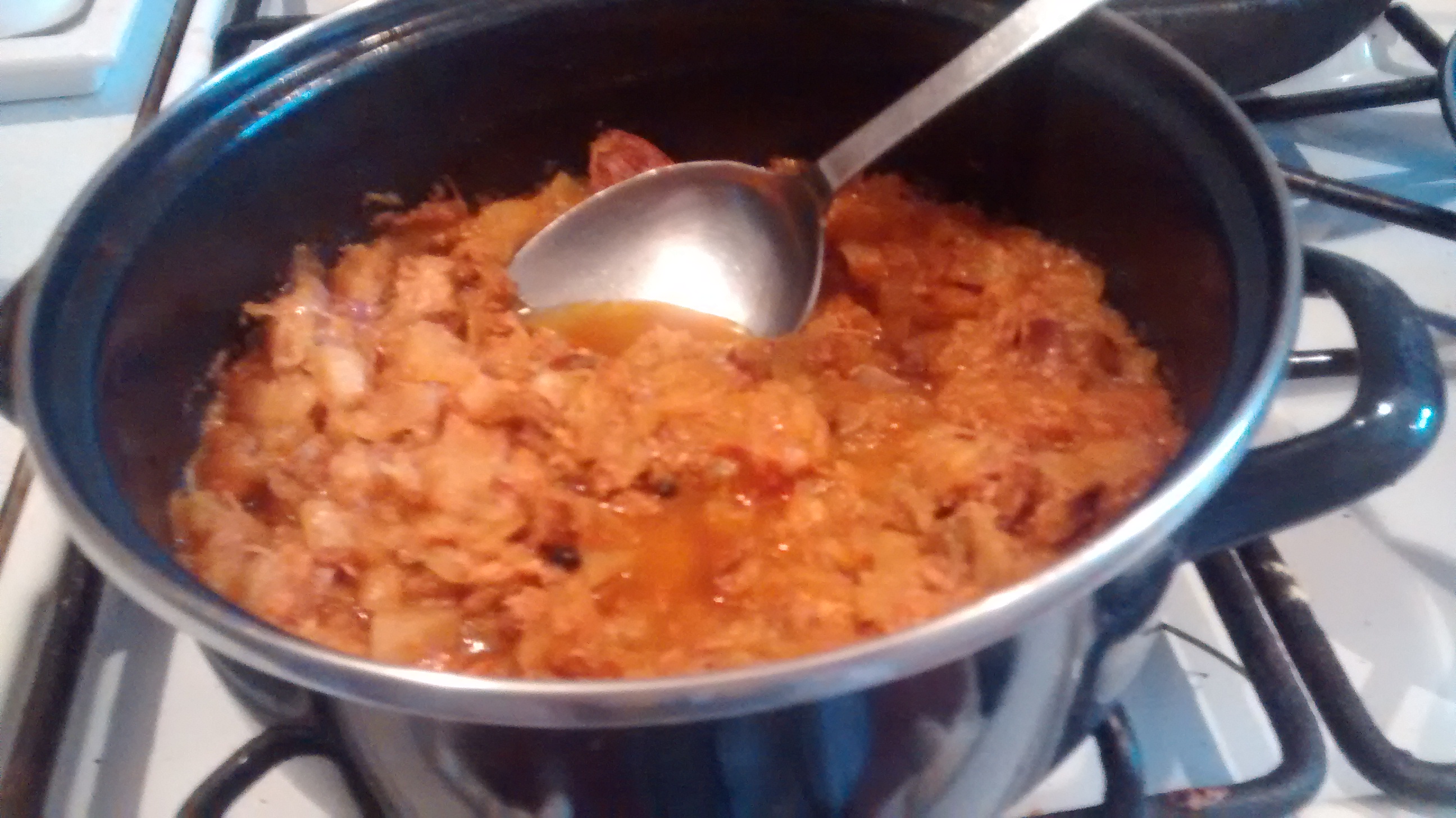
In my next posts I am going to cover some classic Polish recipes for cabbage including bigos and gołąbki (cabbage rolls)- as seen on the book cover.

Bigos

Bigos


Polish Meals

Polish Meals

The following is a general description and of course times  will vary with people and circumstances.

The Polish day seems to start a lot earlier than in England with many people starting work at 7.30am and finishing by 3pm.

Schools often start at 8am and are finished by 2pm.

There are four meals in a Polish day.

1 śniadanie – breakfast

This is a hearty meal from about 5.30amto 7am to set you up for the day.

This will consist of: cured meats, Polish sausage, cheese, hard boiled or scrambled eggs, gherkins, cucumber and tomatoes with bread and rolls, all served with lots of tea. (Tea is quite weak served with slices of lemon or fruit syrup such as raspberry). There may also be some cake.

2 drugie śniadanie – second breakfast

This will be eaten at about 11am. It is a lighter meal than the first breakfast, though often with the same types of food – sometimes it will be just a sandwich – especially if eaten at work or school.

3 obiad – dinner – the main meal of the day

This is eaten between 1pm and 5pm with around 3pm being a very popular time.

This will consist of 2 or 3 courses:

  • Soup
  • Main
  • Dessert of fruit or cake – optional course

Soup is very popular in Poland from hot or cold soups, light consommé types to thick and hearty featuring throughout the year.

I heard a saying on one of my visits to Poland –

Polak bez zupy robi się smutny

This translates as –

A Pole without soup becomes sad.

I think this is very true.

4 kolacja – supper

This is the lightest meal of the day eaten between 7pm to 9pm. It can often be just a slice of cake.

Getting Ready For Dinner

Oak Sideboard
Oak Sideboard
Oak Sideboard
Oak Sideboard
Section of Tablecloths
Some of my Many Tablecloths
Setting the Table for Dinner
Ready for Soup!
Ready for Soup!


My Polish Background

My parents met in England after the Second World War. They had come from different parts of North East Poland through many countries and many hard times; they met in Hereford and married there.

I was born in Penley (Polish Hospital) in the then County of Flint in North Wales.

I grew up in Lancashire with a large Polish community around us and my mother cooked very traditional Polish food.

I now live in West Yorkshire  and continue to cook traditional Polish food although often with a modern twist.

The winters are long and hard in Poland and the traditional dishes use ingredients which will survive through these winter months: smoked meats, picked herrings, potatoes, cabbage, pickled cabbage and gherkins, dried mushrooms, buckwheat, rye, dried fruits, poppy and caraway seeds and honey.

The summers are usually warm and there are lots of red berries, apples, fresh dill, flat leaved parsley, tomatoes, carrots and spring onions. Soured milk, soured cream and curd cheese feature in many dishes as this was the way to extend the life of dairy products before refrigeration. Much of the summer produce that was not eaten would be preserved for the winter by drying, bottling, pickling or made into jams.

Both my parents had grown up in the country side on small farms and their families had grown crops, kept animals and knew how to cure meats and preserve fruit and vegetables.

My father’s family’s land had some woodland and bordered onto a small river, and he used to say that with this they were very rich as they could hunt for small animals and birds, catch fish and find mushrooms, nuts and berries.

The Poles are very hospitable and passionate about good food, no guest invited or unexpected is ever sent away hungry. My childhood memories are filled with every occasion possible celebrated with tables filled with delicious food and people of all ages together.

The Polish kitchen seems to rely on one cook who spends a great deal of time preparing food for the extended family and “fast food” is not a description one would use of many of the dishes. However although many take a while to prepare they can then be left to cook slowly and are ideal to be reheated so there is no last minute panic and what is made can serve for several meals.

I would help my mother in the kitchen and when we went to visit my father’s family in London I would always be interested in what was the same and what was different and looked for new ideas.

I visited Poland for the first time in 1979; a time of shortages and queues however I have never tasted food with so much flavour as then. I tried old favourites and found new ideas. When I visited family and friends in the United States of America a few years later I once again tried lots of my old favourites to eat.

I have now visited Poland many times, sometimes to aunts and cousins on both my mother’s and father’s side and also to places in which I do not have family and have then eaten in hotels, restaurants, cafes and found teashops with such a variety of cakes that I have never been able to sample everything in the time I was there.

I am always pleased to have such wonderful food and take the opportunity to have my favourite dishes but in the last few trips I have been doing some research into regional variations and new versions of older recipes.

In my blog I will feature a selection of my favourite recipes from family and friends and some new discoveries, as well as some dishes that have evolved from older recipes.

So as you follow my blog and try the recipes may I wish you, as they do in Poland before eating, smacznego! (may it taste delicious).