Keks

Keks is the word for a light fruit cake which is baked in a loaf tin or even more so a long narrow rectangular tin.

I am not sure how or when the word keks came into the Polish language but I am certain it comes from the English word “cakes” –  however the word keks is singular in Polish and means cake, and the plural is  keksy which is cakes.

It is thought that the keks originated from recipes for cakes from ancient Rome with the cakes being baked with pomegranate seeds, pine nuts and dried grapes and  using barley flour and then later in the middle ages honey was used and other fruits.

Keks is mentioned in a Polish cookery compendium from 1682 by Stanisław Czerniecki.

Nowadays keks is made using wheat flour and bakalie.

Bakalie is usually translated as dried fruits – however it has more varied fruits than the English version of dried grapes (raisins, sultanas, currants) & mixed peel.

Bakalie can be a mixture of the following:

  • Apricots
  • Currants
  • Dates
  • Figs
  • Mixed peel
  • Prunes
  • Raisins
  • Sultanas
  • Nuts – almonds, hazel & walnuts

Of course you can vary the mixture every time you make it.

The use of  sweet dried fruits came into use in Poland through the influence of Turkish cooking where most of these fruit and nuts grow.

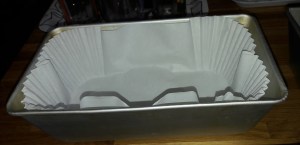
Traditional keks is baked in a long narrow rectangular tin, however I also use the English style 2lb loaf tins especially as you can get greaseproof cake tin liners which make life a lot easier.

NOTE

I have tried these out several times and have found two things that you must do to make turn out well:

  1. Toss the fruit in flour so it does not all clump together.
  2. Bake the cake at a low temperature so it cooks through.

Keks

Ingredients -1

Amounts for a long narrow tin

300g butter or block baking margarine

300g granulated  sugar

6 eggs

2-3 drops vanilla essence

300g plain flour

80g potato flour

2 teaspoons  baking powder

1 teaspoon of ground cinnamon

400g  bakalie (dried fruit  & nuts – see above) & 1 tablespoon plain flour

butter & dried breadcrumbs to prepare the tin or greaseproof paper

Ingredients -2

Amounts scaled down amounts for a 2lb loaf tin

200g butter or block baking margarine

200g granulated  sugar

4 eggs

2-3 drops vanilla essence

200g plain flour

60g potato flour

1.5 teaspoons  baking powder

1 teaspoon of ground cinnamon

300g  bakalie (dried fruit  & nuts – see above) & 1 tablespoon plain flour

Butter & dried breadcrumbs to prepare the tin or greaseproof paper or liner

Method

Prepare the baking tin by either coating with butter & dried bread crumbs or cut a sheet of  greaseproof paper to line the long side and base of the loaf tin or use a liner where appropriate.

Pre heat the oven to GM 3 – 160º C

Prepare the bakalie (dried fruit & nuts) by chopping the larger fruits into smaller pieces.

Place them in a bowl with 1 tablespoon of plain flour and mix thoroughly so all the fruit is coated.

20170212_055711

Tip the coated fruit into a large sieve and shake well to remove excess flour.

20170212_060009

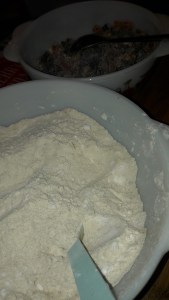
Mix the baking powder and cinnamon with the flours
20170216_072648

In a large bowl cream the butter and sugar together until they are light and fluffy

Add the vanilla essence

Add the eggs one by one, each with a tablespoon of flour

Fold in the rest of the flour

20170216_074357

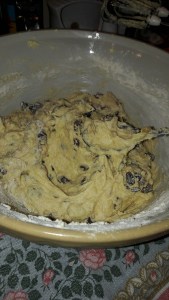
Carefully mix in the bakalie

20170215_065831

Spoon the mixture into the prepared tin and put in the oven

20170215_070044

Bake for around 1 hour 30 minutes for the long tin & 1 hour 20 minutes for the smaller loaf tin

Check at around 1 hour & cover the top with greaseproof paper if it starts to brown on top too quickly

Test the cake with a cake tester or wooden skewer near the end of the cooking time to check that it is baked throughout

Leave the cake to cool in the tin before turning it out.

Aynsley, Las Palmas from the 1960s

Colclough 4212, Art Deco 1930s, Blue Violets/Pansies

Keks – using fruit mincemeat

At Christmas time I make English fruit mincemeat using the recipe from Delia Smith but without the chopped nuts.

20170215_042413

If I have any mincemeat over after the Christmas period  when I make mince pies,  I make a fruit loaf which which is very much a keks.

I bake this in a 2lb loaf tin.

Note

You can also use 2 small 1lb loaf tins or even a round 22cm tin – adjusting the baking time.

Ingredients

  • 150 butter
  • 100g soft brown sugar
  • 75g sultanas or currants  and mixed peel
  • 225g self raising flour
  • 450g jar of mincemeat (exact amount is not critical)
  • 3 eggs
  • Optional 25g flaked almond to sprinkle on top

Method

Pre-heat the oven to GM2- 150ºC

Prepare the loaf tin by greasing it, lining the long sides or using a greaseproof liner.

20170207_112805

Lightly cream the butter and sugar

Beat in the eggs, one by one

Stir in the mincemeat and the  extra dried fruit until it is an even consistency – a wooden spoon is good for this

Stir in the flour.

If the mixture seems a bit dry add a tablespoon of rum or similar

Spoon the mixture into the tin and smooth the top

Sprinkle nuts on top if using

Bake for around 1 hour 15 minutes

Leave to cool in the tin before turning it out.

More Pork & Prunes

This recipe is in an old Polish style  –  po staropolsku  with its use of prunes and honey. I love the flavour of the meat with this sweetness added to it.

See also Pork & Prunes recipe 2

Pork & Prunes 3

This is a dish could be served on special occasions such as Christmas Day.

This recipe needs a large piece of pork loin which will have some of the prunes placed in cuts on the top.

I usually use prunes with the stones still in however in January 2017 there were no prunes with stones on the market in Leeds. The lady on the stall said this was because of a very poor harvest – so I have used these stoned prunes to try out the recipe for the photographs & this post.

Ingredients

1.5kg – 2kg boneless pork loin in one piece – skinless if possible (I used a joint with skin on this time – I think skinless is defiantly  better)


200g prunes

100ml of  sherry or vermouth

350ml of chicken stock – can be made from stock cubes

bouquet garni made from flat leaf parsley, bay leaf and thyme

1 tablespoon of plain flour

2 tablespoons of butter

1 tablespoon of olive oil

salt & ground black pepper

2 tablespoons of honey

Method

You will need a roasting tin with a lid.

Pour the stock into a pan and bring it to the boil and then add the prunes and cover these with a lid.  Let them simmer gently for 20 minutes stirring occasionally.

20170129_124753


Allow the prunes to cool so you can handle them and take out the stones.

Take 8-10 of the prunes and put them in a dish and pour the sherry over them and leave them for at least 30 minutes.

Pre heat the oven to Gas Mark 3 – 1600C.

Take the pork and in what will be the top make 8 to 10 deep cuts with a sharp knife.  Into each pocket place one of the prunes that has been soaked in the wine.

(If your joint has the skin on it then cut under the skin and put the prunes between the skin and the meat).

20170129_132241


Keep the sherry liquid as you will need it later.

Coat the joint with the flour, salt and pepper.

In a frying pan, melt the butter, add the oil and on a high heat, brown all the sides of the joint or if the joint is too large for the pan use the roasting pan on top of the stove to fry it in.

Put the meat and the frying juices into the roasting tin.

Add 6 tablespoons of the stock and cover the dish with the lid and put the dish in the oven for 40 – 50 minutes.

Take the dish out of the oven , add the rest of the prunes and the stock, put the lid back on and cook in the oven for another 40-50 minutes until the meat is tender.

Take out the meat and put it on a warm serving dish cover it with foil and a tea towel and leave it to rest in a warm place whilst you finish the sauce.

20170129_152828


Take the bouquet garni out of the dish and add the sherry liquid and honey  to the prunes and bring this to the boil.  Then simmer it gently and use a balloon whisk to blend the sauce together and break up any large pieces of prunes.

Pour the sauce into a gravy boat or jug and serve with the meat.

Slice up the meat.


Served here on Carnation by Royal Doulton, 1982 – 1998

Prune Sauce

I had some of the prune sauce left over  and I had decided to cook some duck breasts.

I thought why not heat up the prune sauce and serve it with the duck, which is what I did – it was delicious  together.

So I thought  “Why not try to create a prune sauce which can be cooked separately for serving with roast or pan fried meats such as pork, duck or game“.

So I did and here is the recipe.

Ingredients

150g prunes – pitted are easiest for this

250ml hot boiling water

250ml chicken stock – can be from cube or concentrate

1 tablespoon of butter

1 tablespoon of flour

3 tablespoon of honey

50 ml sherry or vermouth

1 bay leaf

Ground black pepper

Method

Place the prunes in a small bowl and pour the hot water over them and leave them to soak for at least an hour.

If using prunes with stones remove these now.

In a saucepan melt the butter and add the flour and heat gently stirring with a wooden spoon to make a roux.

Slowly add the stock and bring this to the boil, stirring constantly so that you do not get any lumps.

20170209_163831


Add the prunes and the liquid they were soaked in, the  bay leaf and ground black pepper.

20170209_164005


Simmer gently until the prunes are soft.

Add the sherry and the honey and simmer for another 3 to 4 minutes.

Remove the bay leaf.

Use a balloon whisk to blend the sauce together and break up any large pieces of prunes.


Pour the sauce into a gravy boat or jug and serve hot with your meat.

Note

If possible, depending on how you have cooked the meat , add any meat juices to the sauce, stirring well.


Pork & Prunes

This recipe is in an old Polish style  –  po staropolsku  with its use of prunes and caraway seeds.

I  prefer to use prunes with the stones in and  I usually buy then from a Nut & Dried Fruit stall in Leeds Kirkgate Market. However in January 2017 there were no prunes with stones on the market. The lady on the stall said this was because of a very poor harvest – so I  used stoned prunes to try out this recipe for the photographs for this post.

This recipe uses a method of cooking which is called duszone – that translates from Polish as suffocated but also when used in cooking as braised  however I think suffocated is much more evocative.

You will need a roasting tin with a lid.

A joint of pork  is first sealed by browning it on all sides and then it is placed in a roasting dish with a little liquid and then a lid is placed over the contents and the dish is cooked in an oven.  Meat cooked this way is very succulent.

Ingredients

800g boneless pork loin joint

Note  You can always scale up this recipe for a larger piece of pork.

100g prunes

2 onions – finely chopped

1 tablespoon of plain flour

2 tablespoons of butter

1 tablespoon of olive oil

salt & ground black pepper

1 teaspoon caraway seeds

Method

At least an hour before you want to cook the pork, put the prunes in a small bowl and pour boiling water over the prunes to cover them.

Leave them to plump up and then remove the stones from the prunes. (I left mine for 4 hours).

Retain the liquid from the soaking as this will be needed.

Pre heat the oven to Gas Mark 3 – 1600C

Coat the joint with the flour, salt and pepper.

In a frying pan, melt the butter, add the oil and on a high heat, brown all the sides of the joint.

Put the meat and the frying juices into the roasting tin.

Put the prunes and onions around the pork and add the liquid from the soaking of the prunes, put on the lid and place the dish into the oven.

About 1 ¼ hours should be enough for this weight.

20170121_174651


Take out the pork and place it on a warm serving dish, cover with foil,  and leave in a warm place whilst you finish the prunes.

Stir the caraway seeds into the onion and prune mixture and heat this up on the top of the stove to thicken for 2 to 3 minutes.


Cut the pork into thick slices and place them on a platter or serving dish and put the prune & onion mixture around them.

Serve with boiled potatoes.


Here served on a bone china platter, Josephine Yellow

by Wedgwood, 1941 – 1964


Po staropolsku – in an Old Polish Style

In many recipe books and often on menus in restaurants you can see dishes described as po staropolsku which means in an Old Polish Style.

What exactly does that mean?

I have found this a hard question to answer as there two sides to its meaning, one is about hospitality and the other is the ingredients.

Hospitality

When restaurants use  po staropolsku they are trying to evoke connections to noblemen & democracy with the chivalry & hospitality that was found in the manor houses in Poland, particularly from the 16th to the 18th century.  They are trying to make you think of the quality of the food and the surroundings.

The Poles are thought to be a very hospitable nation and a very famous saying in Poland is  – “Gość w dom, Bóg w dom”  which means  when you have a guest in your house, you have God in your house, meaning treat your guests to the very best.

The chef & writer, the late Maciej Kuroń (1960 – 2008) in his book Kuchnia Polska (Polish Cookery)has a new saying –

“Lepiej gościa zabić, niż nie nakarmić “which means – it is better to kill a guest rather than not feed them well.

I noted this quote many months ago – today when I tried to find the reference in the book, which is a large tome of over 900 pages, I could not find it – when I do in the future I will come back and add  it here.

Some of my reference cookery books.

Ingredients

Many old recipes can be classed as po staropolsku – especially if they contain:

  • Honey
  • Cloves
  • Cinnamon
  • Caraway
  • Herbs such as marjoram, thyme & juniper
  • Dried fruits – especially prunes
  • Dried mushrooms
  • Grains such as buckwheat
  • Game & birds

Dishes included various soups & especially Sour Soups (I will write about these in the future), honey cakes, pierogi, gołąbki, bigos and dishes with meat & dried fruits.

Pork and Prunes

Some of my favourite dishes in the old Polish style combine pork with prunes, often with honey.  I love the flavour of the meat with all this sweetness added to it.

I am going to write up 3 different recipes  – the first in this post – the others to follow shortly.

The best pork to use is a boneless joint of pork loin which has also had the skin removed, but if you cannot get this then leg of pork is good as well.

When roasting pork allow 50 minutes per kilo, plus 25 minutes at Gas mark 5 – 1900C.

Note  You can always scale up this recipe for a larger piece of pork.

I have found that the best prunes are lovely plump ones from Agen in France but the ones that are more dried are also good, you just have to soak them for longer before you can take out the stones.

You can of course use ready stoned prunes – I just prefer the ones with stones in  – though they are increasingly harder to find – I can get them from a Nut & Dried Fruit stall in Leeds Kirkgate Market.

However in January 2017 there were no prunes with stones on the market. The lady on the stall said this was because of a very poor harvest – so I have had to use stoned prunes to try out the recipes for the photographs & this post.

Pork and Prunes 1

Ingredients

800g boneless pork loin joint

100g prunes

1 tablespoon of honey

Coarse salt

At least an hour before you want to roast the pork, put the prunes in a small bowl and pour boiling water over the prunes to cover them.

Leave them to plump up and then remove the stones from the prunes.

Retain the liquid from the soaking as this will be needed.

Pre heat the oven to Gas Mark 5 – 1900C.

Place the pork in a roasting tin and rub some coarse salt onto the fat on the top.

Put the prunes under and around the pork with the water from the soaking & extra to cover the bottom of the roasting tin and place in the oven.

Roast the pork – about 1 ¼ hours should be enough for this weight, baste the meat with the liquid from the prunes and juices a couple of times, adding extra water if needed.

When the meat is ready, take out of the oven, cover with foil and then a tea towel and leave it to rest.

Add the honey to the prunes and juices, stir these together over some heat in the roasting pan, you may need to add some more water.

Slice the pork and place on a serving dish and place the prune mixture around the pork to serve.

Here served on a Royal Doulton Plate – Carnation 1982-1998.