Here is a salad made with one of Poland’s favourite vegetables – cabbage – and is one I have been making for many, many years since it was given to me by one of my cousins (British born like me) who lives in Wembley.
However it is not a classic Polish salad because it contains oranges which would have been a luxury item in times gone by and certainly in communist times when nothing was imported that was not strictly necessary.
There are just 3 main ingredients & a couple of options for the dressing.
The amounts here are just a guide – for example – I just usually add a handfull of raisins – this time I weighed them.
Ingredients
Around half a small white cabbage
2 Oranges
80g Raisins
Dressing – mayonnaise or yoghurt or a mixture of the two
A pinch of salt & pepper to taste.
Method
Peel the oranges, cut them into slices, separate the segments and then chop these into small pieces.
Finely shred the cabbage
Mix the oranges, raisins & cabbage together.
Add the dressing (see below) and mix well together.
You can add salt and pepper here if desired – I find just a tiny amount is needed.
Served here in Royal Doulton, Carnation, 1982 – 1998
Dressing
Mayonnaise – I use Hellmann’s – original or light
Greek yoghurt
Mayonnaise & Greek Yoghurt
Any of the above with some extra orange juice.
I tend to make this salad a while before it is needed as with the magic of osmosis – raisins become plumped up with the juice from the oranges & the dressing becomes sweet from the sugars in the raisins.
This salad goes well with roast dinners, cold smoked meats and Polish style sausages.
I was looking for some salad recipes for red cabbage and came across these three in my Polish recipe books.
Two different methods are used to prepare the cabbage and I was intrigued to see how they would turn out. They were both a success and I will be using them again.
Red Cabbage Salad 1
This method is in between using raw and cooked cabbage.
Ingredients
½ head of red cabbage
1 large Bramley Apple
Juice of 2 lemons
1 small onion
2 tablespoons of olive oil
Salt & pepper to taste
1- 2 teaspoon of sugar
Method
Using a sharp knife shred the cabbage into fine slices.
Put the shredded cabbage into a pan and just cover with water, bring this to the boil and then let it simmer for 1 to 2 minutes – no more.
Strain the cabbage from the water, pour the juice of a lemon over the cabbage and mix it in, as well as taste, this will give the cabbage a lovely colour, and leave it to cool.
Chop the cabbage into small pieces.
Note – next time I will chop into much smaller pieces.
Peel and coarse grate the apple and add this to the cabbage.
Chop the onion into fine pieces and add this to the cabbage.
Mix in the juice of another lemon and 2 tablespoons of olive oil.
Add salt & pepper and sugar to taste.
This salad goes well with roast pork, goose or duck.
Red Cabbage Salad 2 & 3
For these the cabbage is grated on a coarse grater – this was quite hard to do but well worth it.
It is the dressing which makes these two salad different – both are delicious.
Red Cabbage Salad 2
Ingredients
½ head of red cabbage
1 Bramley apple
Juice of a lemon
Dressing
3 tablespoons of mayonnaise
3 tablespoons of soured cream
1 tablespoon of made-up mustard Polish, French or German style
Juice of half a lemon
Salt & pepper & sugar to taste
Method
Grated the cabbaged using a coarse grater
Peel and grate the apple using a coarse grater
Mix the grated cabbage and apple together.
Mix up all the ingredients for the dressing.
Add the dressing to the salad and thoroughly mix it all together.
Red Cabbage Salad 3
Ingredients
½ head of red cabbage
1 Bramley apple
50g of chopped walnuts
Dressing
3 to 4 tablespoons of olive oil
Juice of a lemon
1 tablespoon of runny honey
Salt & pepper to taste.
Method
Grated the cabbaged using a coarse grater
Peel and grate the apple using a coarse grater
Mix the grated cabbage and apple together.
Mix the ingredients for the dressing and pour this over the salad and mix it in.
Chop the walnuts into small pieces and mix them in before serving.
A Little Note About Walnuts
Walnuts (Juglans regia) are native to south-east Europe and south-west China. They are the oldest tree food known dating back to 7,000 BC.
There are accounts of their cultivation in Babylon (now Iraq) in 2,000BC.
Juglans regia means means Jupiter’s royal nut.
They are the seed of a drupe (stone fruit) – not a true Botanical nut.
In Polish walnuts are orzechy włoskie – nuts Italian – so named it is thought as they were brought to Poland by traders from Imperial Rome.
Black walnuts (Juglans nigra) are native to North America.
Today, 4 July 2016, is the first Anniversary of my blog!
What an interesting year it has been for me with all the reading & research, cooking & photographing and the writing.
I do hope you are all enjoying reading my posts & God willing this is the start of another interesting year.
This will be my 58th post & I am going to write about a very popular vegetable in Poland.
Seler – Celeriac – Celery
The word seler in Polish is used for both celeriac and celery and in fact celeriac is a just a variety of celery (Apium graveolens).
Celeriac is mentioned in Homer’s Odyssey where it is called selinon.
Now for a little plant biology – in English the stems of the plant are known as celery and they are long with leaves at the top.
Whereas in the variety known as celeriac – it is the hypocotyl – the swollen enlarged stem above the root and below the leaves – which is eaten. The leaves come off the top of this swollen stem. (Celeriac is often classed as a root vegetable but it is not the root.)
Celeriac has not been around in the shops in England for that long and last week I bought one in Marks & Spencer’s and it had a label on it saying “NEW“.
Years ago when I looked at my Polish cookery book and it talked about grating seler – celery I used to think “oh, how very odd – I wonder how that comes out“ – I now realise that they were referring to grating celeriac.
In Poland you are much more likely to be served celeriac than celery and it is a very popular vegetable which can be eaten both raw and cooked and is used in a variety of salads.
I have been trying out some salads both with raw & cooked celeriac including some old favourites. Celeriac has a delicate flavour and easily picks up the flavours of the other ingredients.
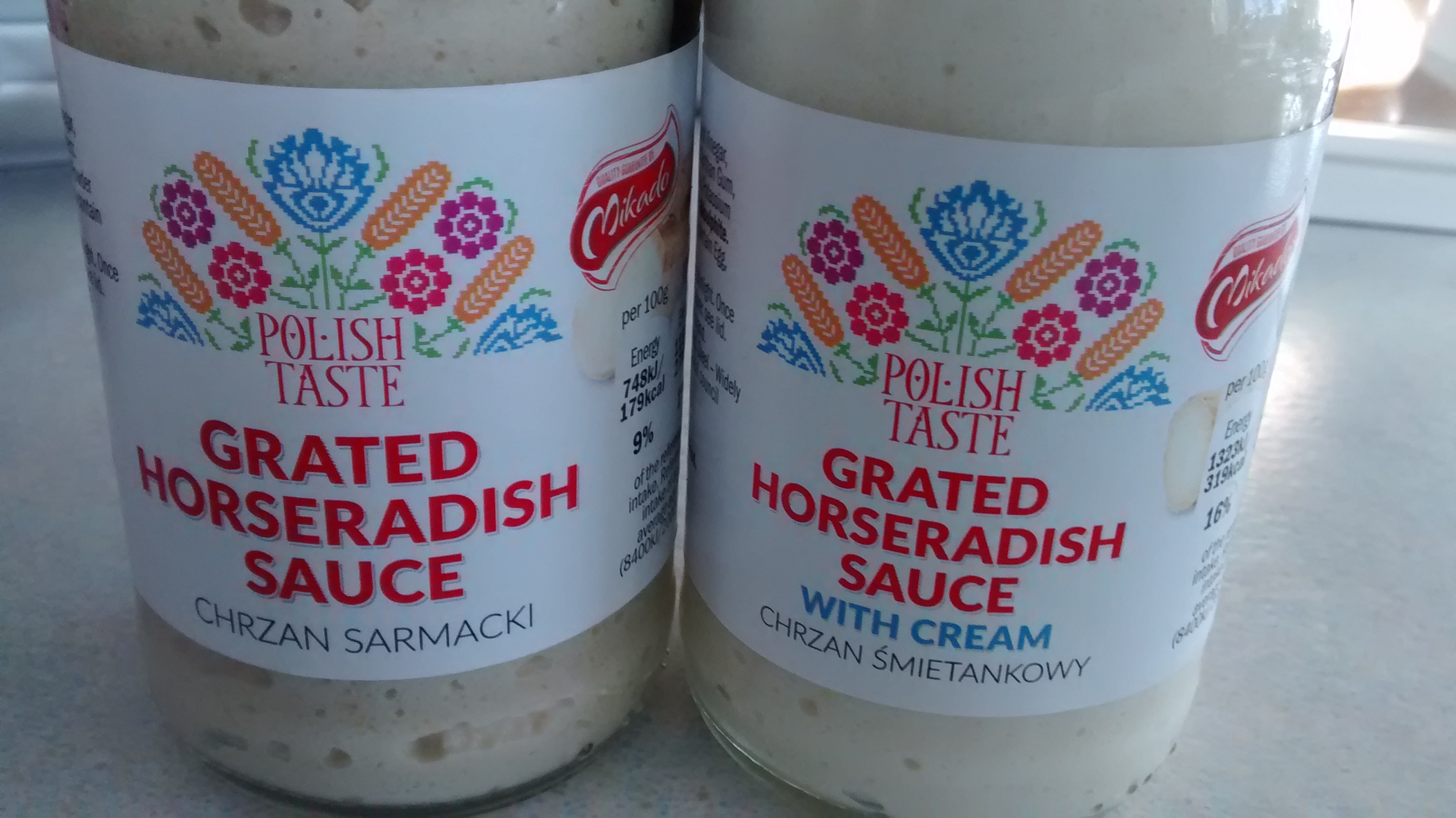
Dressings for the salads include mayonnaise, soured cream, natural thick yoghurt & my favourite grated horseradish (I use a bought sauce.)
I have given details of the dressing I have used in the following recipes but they are easily interchangeable.
Salads Using Raw Celeriac
For the following recipes you will need to peel the celeriac – use a peeler if you can as using a knife can take too much off. You then need to grate the celeriac.
Lemon juice is needed to prevent the grated celeriac discolouring.
Simple Celeriac Salad
Ingredients
Grated celeriac – around half of one
Juice of 1 lemon
2 small tart apples such as Granny Smith – grated
Mayonnaise
Soured cream
Method
Make the dressing by mixing mayonnaise and soured cream together, I tend to use equal amounts.
Mix the grated celeriac & grated apple together.
Pour the lemon juice over them.
Add the dressing bit by bit – you want to coat the ingredients but not have lots of excess dressing.
Celeriac with Raisins & Walnuts Salad
Grated celeriac – around half of one
Juice of 1 lemon
2 small tart apples such as Granny Smith – grated
Raisins – approx 1/2 a cup
Chopped walnuts – approx 1/2 a cup
Mayonnaise
Soured cream
Horseradish sauce
Method
Make the dressing by mixing mayonnaise and soured cream together – equal amounts – and then add 1 to 2 large tablespoonfuls of horseradish sauce.
Mix the grated celeriac & grated apple together.
Pour the lemon juice over them.
Add the raisins & the chopped walnuts
Add the dressing bit by bit – you want to coat the ingredients but not have lots of excess dressing.
Celeriac & Orange Salad
Ingredients
Grated celeriac – around half of one
Juice of 1 lemon
2 small tart apples such as Granny Smith – grated
Raisins – approx 1/3 of a cup
2 oranges
Thick yoghurt
Soured cream
Horseradish sauce
Method
Squeeze the juice from 1 orange & pour this over the raisins.
Leave this for a couple of hours so that the raisins plump up.
Make the dressing by mixing equal amounts of yoghurt and soured cream together and then add 1 or 2 large tablespoons of horseradish sauce.
Mix the grated celeriac & grated apple together.
Pour the lemon juice over them.
Peel & then chop the other orange and mix this with the soaked raisins.
Add the dressing bit by bit – you want to coat the ingredients but not have lots of excess dressing.
Salads Using Cooked Celeriac
You can cook the celeriac by boiling it in water but I have found that it is much easier to steam it.
If there is still any soil on the celeriac then wash this away with water first.
If your celeriac is large you might want to cut it in half and just use half & use the other half for something else.
Steam the celeriac – it will need at least 20 minutes.
You can use a cake tester to see if it is cooked.
Leave it to cool – I leave mine in the steaming pan with the lid on.
When it is cold peel away the outer “skin”
Chop the celeriac into rough cubes or chunks.
These cooked cubes are then the basis of many different salads.
You can use the cooked celeriac in many salads instead of boiled potatoes as in the classic Polish Potato Salad with peas & carrots in mayonnaise.
The potatoes in the above salad can be replaced with celeriac.
Celeriac & Gherkin Salad
Ingredients
Chopped cooked celeriac – around half of one
1 tart apple such as Granny Smith – grated
Lemon juice
1 chopped gherkin
1 chopped onion – red looks good.
Mayonnaise
Method
Mix the chopped cooked celeriac and the grated apple together and some lemon juice.
Add the chopped gherkin and onion.
Add a couple of large tablespoons of mayonnaise and mix it all together.
Celeriac Salad with Hard Boiled Eggs
Ingredients
Chopped cooked celeriac – around half of one
1 tart apple such as Granny Smith – grated
Lemon juice
2 or 3 hard-boiled eggs chopped
Large handful of raisins or sultanas
1 chopped onion – red looks good
Thick yoghurt
Horseradish sauce.
Method
Mix the chopped cooked celeriac and the grated apple together and some lemon juice.
Add the chopped onion.
Add the raisins (or sultanas)
Add the chopped hard boiled eggs.
Mix a dressing using 2 to 3 tablespoons of thick plain yoghurt and 1 or 2 tablespoons of horseradish sauces and mix the other ingredients.
Leave this for around half and hour so that the flavours can mingle.
NOTE
If you hard boil very fresh eggs they are very difficult to peel -it is easier to use older eggs.
Celery, Peanut & Sultana Salad
This recipe is one I got for one of my sisters many years ago and although this is not a traditional Polish salad it has become one of my trusty recipes as it is so easy and as it is best to make it sometime ahead there is no last minute stress when making it.
Ingredients
4 long celery stalks
Around 1/3 cup of salted peanuts
Around 1/3 cup of sultanas
Mayonnaise
Method
Chop the celery into fine slices.
Mix with the peanut and sultanas.
Add 2 or 3 tablespoons of mayonnaise.
Leave for at least half an hour before serving – I usually make this several hours beforehand.
Now for a little science to explain why the dressing taste so sweet and is more runny than when it started.
Osmosis is the movement of water across a semi-permeable membrane from an area of high water concentration to an area of low water concentration to try to equalise the concentrations on both sides.
Cells in the plant ingredients have semi-permeable membrane.
The salt on the peanuts causes water to leave the celery and go into the mayonnaise, this water then enters the sultanas causing them to plump up.
The above is true when you mix many salads but especially here with the salt on the peanuts and the dried fruit.
Beetroot is a very popular vegetable in Poland and is served both hot and cold and is the main ingredients of barszcz (The classic Polish beetroot soup).
Now this may just my imagination but the beetroot in Poland just tastes so much better than the ones I have had in England, maybe it is the variety that is grown there or the soil. I think you have to use home-grown or organic beetroot to get as good a taste.
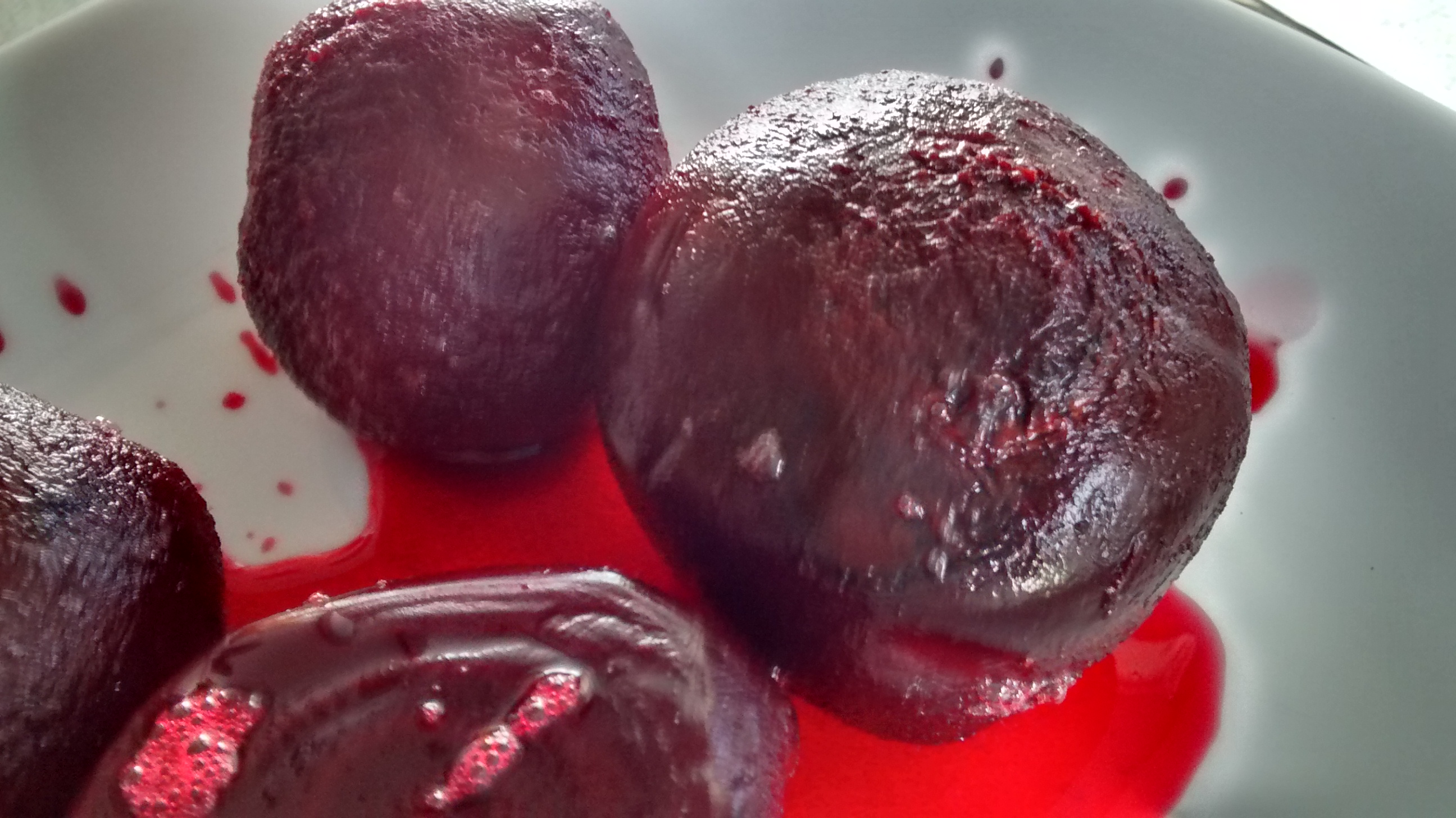
In the following recipes I have used vacuum packed boiled beetroots – boiling or roasting raw beetroot should give a better flavour but when you only want to make a small amount or you have little time this will work as well especially if you adjust the flavour with lemon juice or a little sugar.
A popular variant is something called botwinka – this is very young beetroot – sold in bunches (rather like radishes) and consists of the small “bulb” and the young green leaves, which are all used. As I have not seen this for sale in England I will not be including any recipes – but if you are ever in a position to try this (often in the form of a soup) you will taste something very delicious.
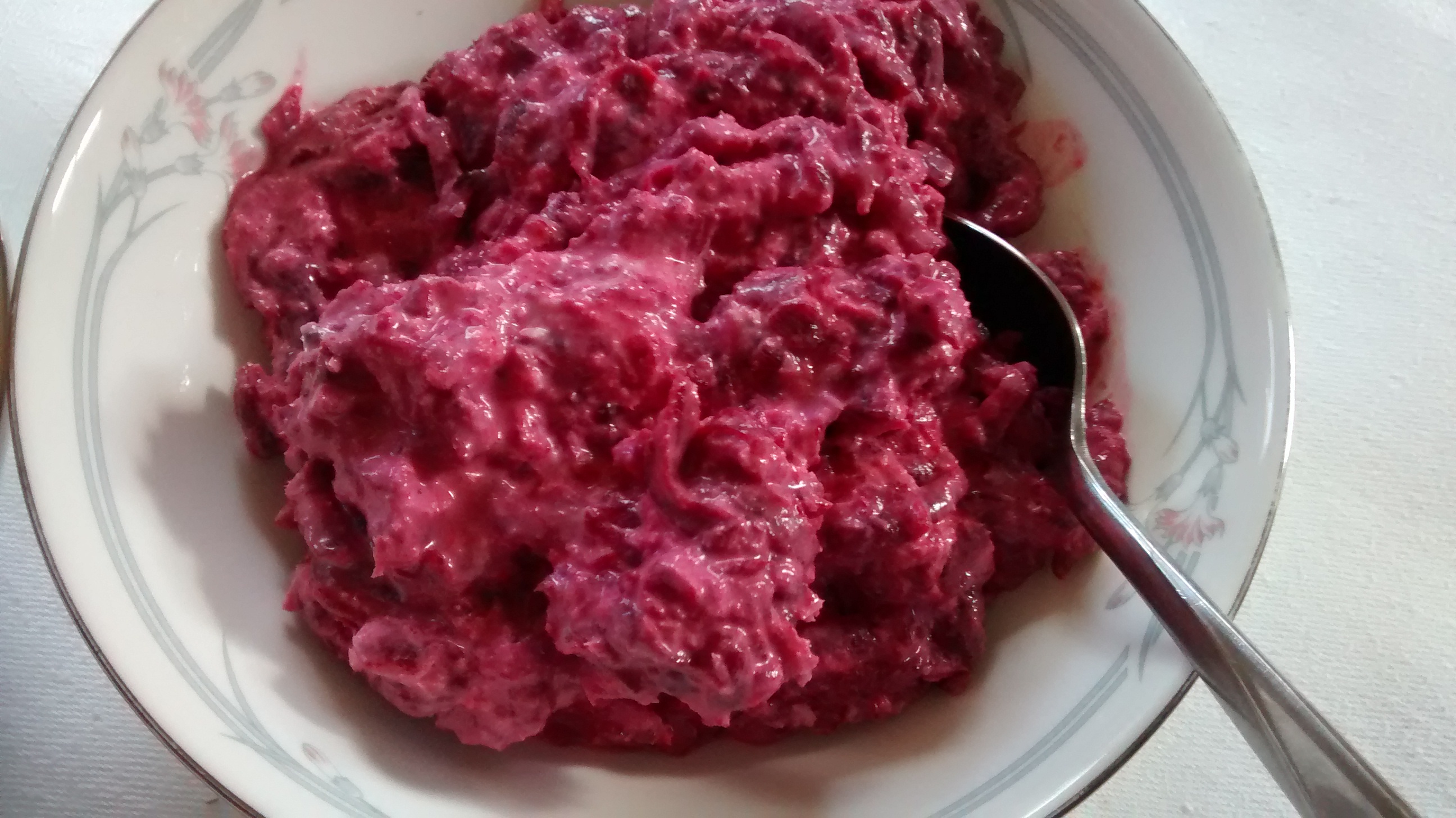
Ćwikła is the most typical Polish accompaniment to roasted and smoked meats and sausage. This salad or relish is made from grated cooked beetroot which is mixed with grated horseradish – chrzan.
The first recorded recipe for ćwikła comes from the writings of Mikołaj Rej (1505 – 1569) who is known as the “Father of Polish Literature”. He was the first person to write exclusively in Polish.
He was born 59 years before Shakespeare (1564 – 1616).
Ćwikła
Ingredients
2 or 3 boiled beetroots
Horseradish sauce
Soured Cream
Extra lemon juice – optional
Method
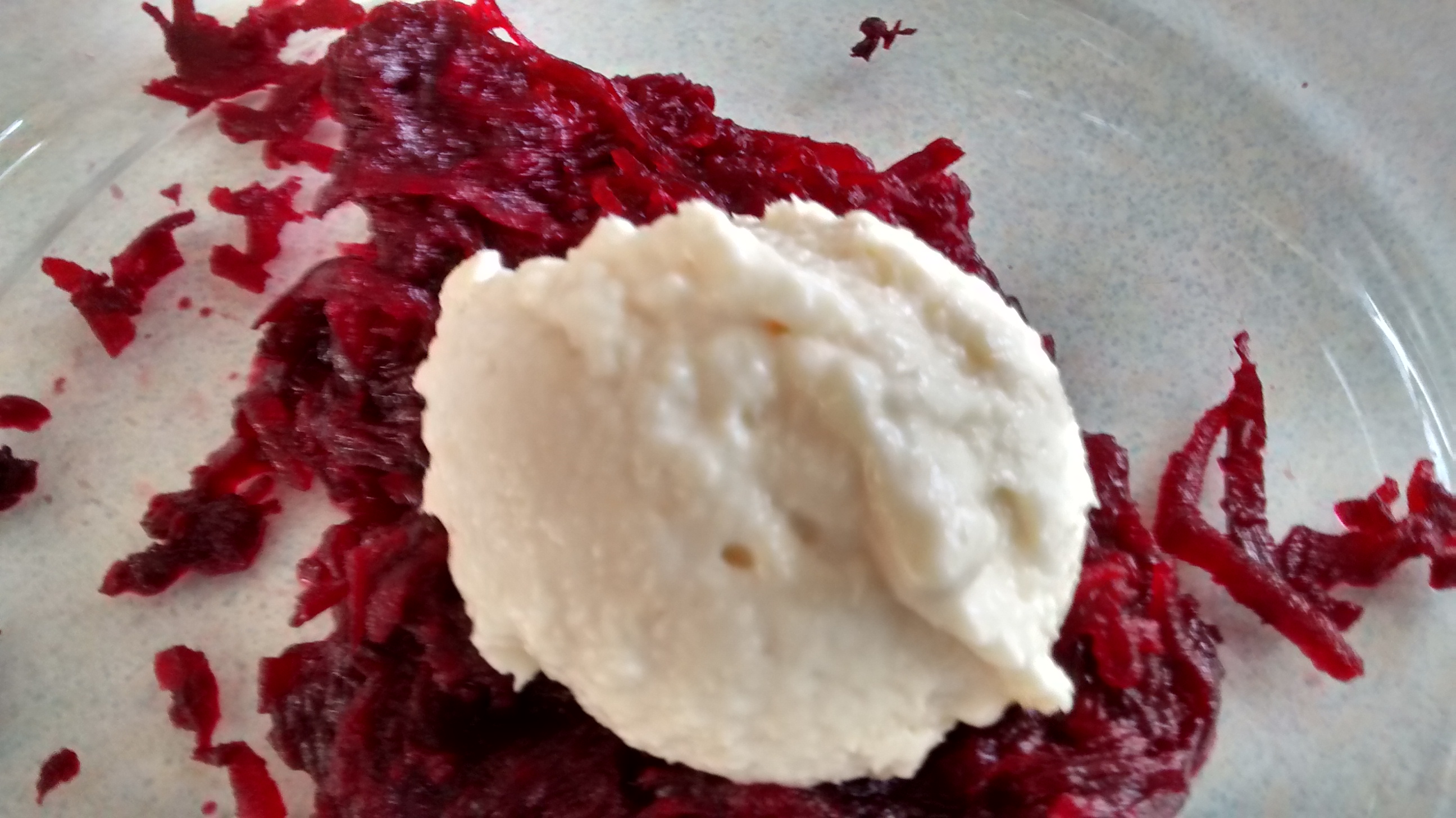
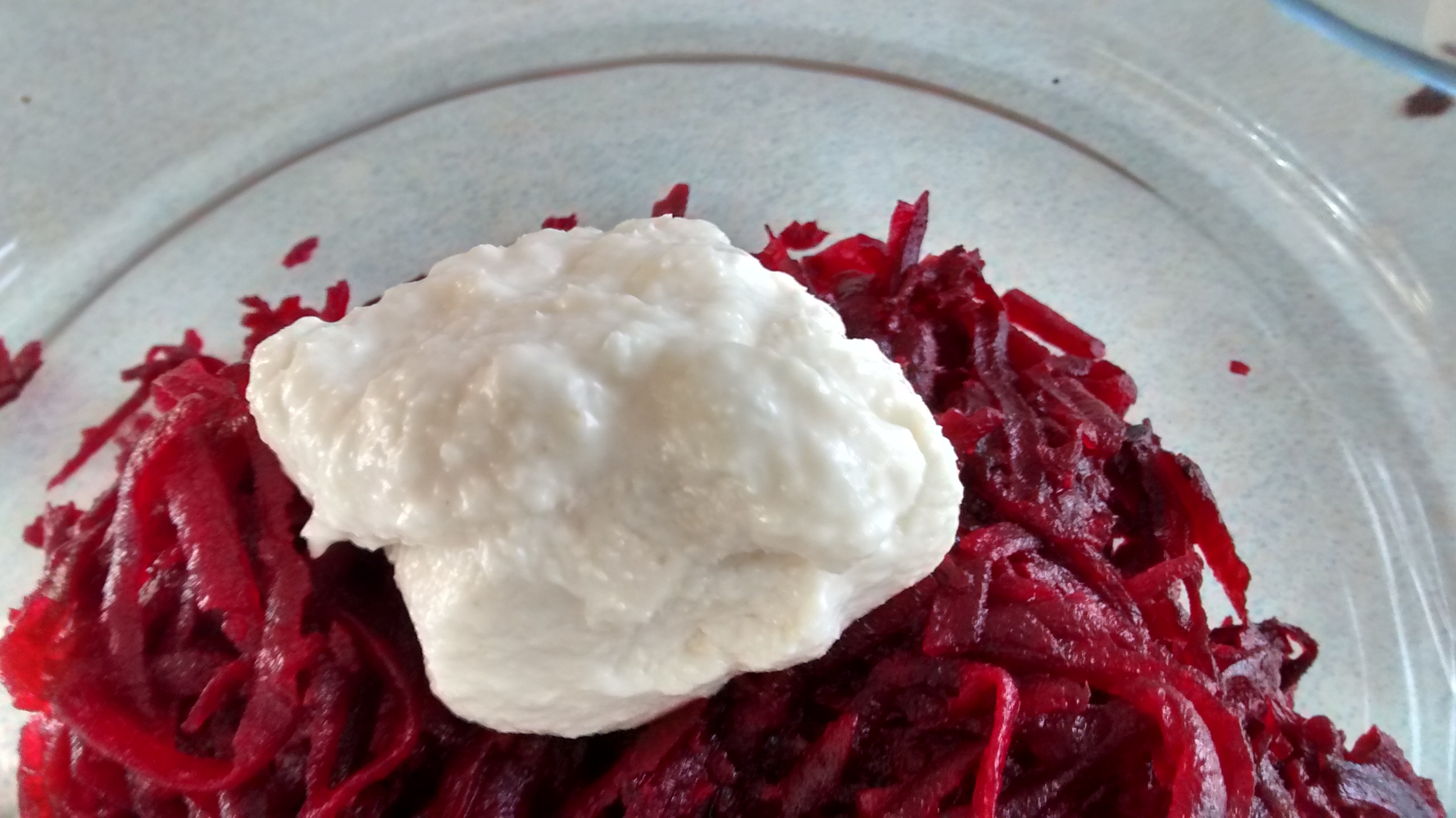
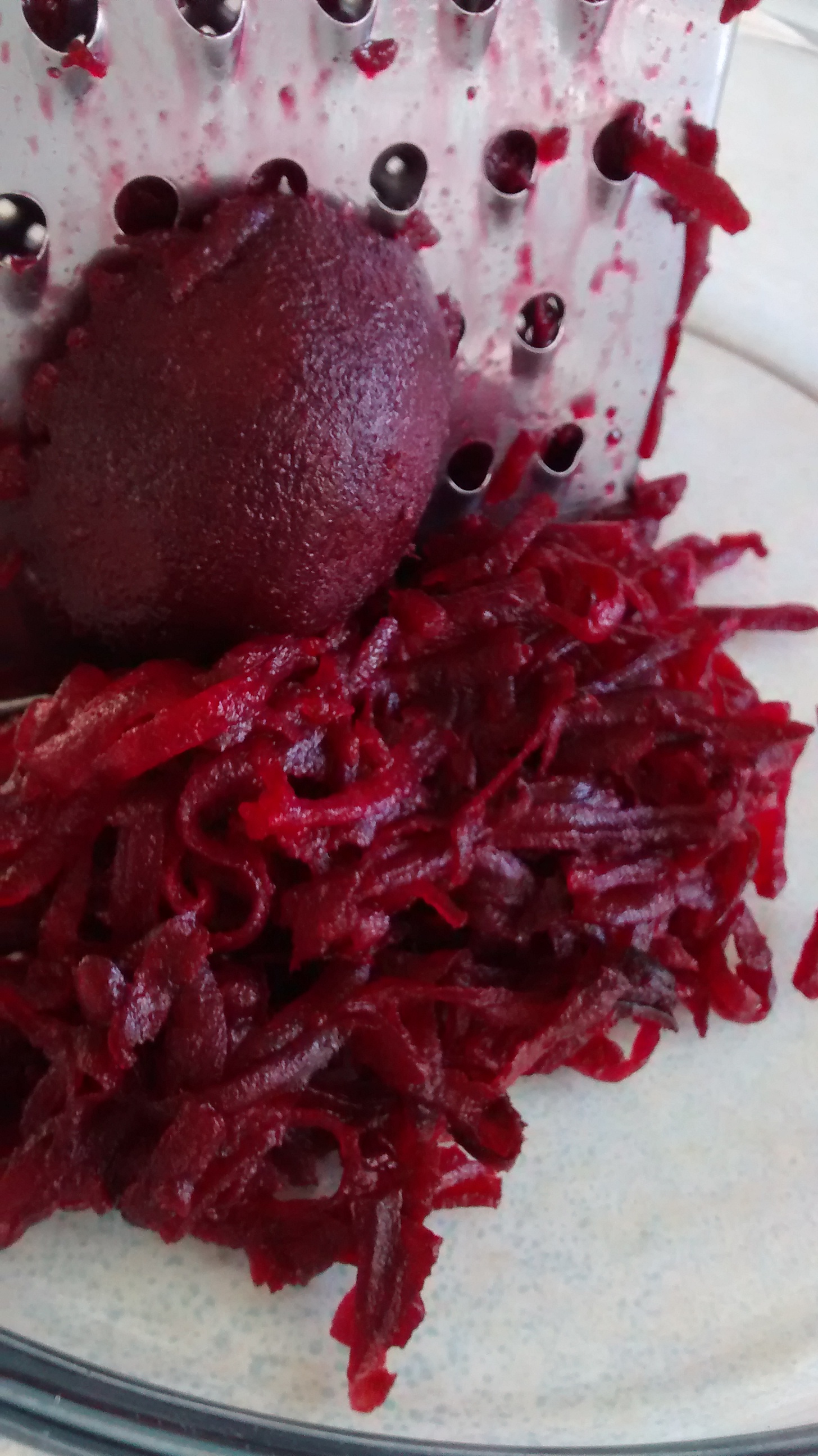
Grate the beetroots using a fine or medium grater and put this into a bowl.
In the past I always used a fine grater but now I prefer to use my medium grater.
Medium Grated
Fine Grated
Add a large dollop or two of horseradish sauce.
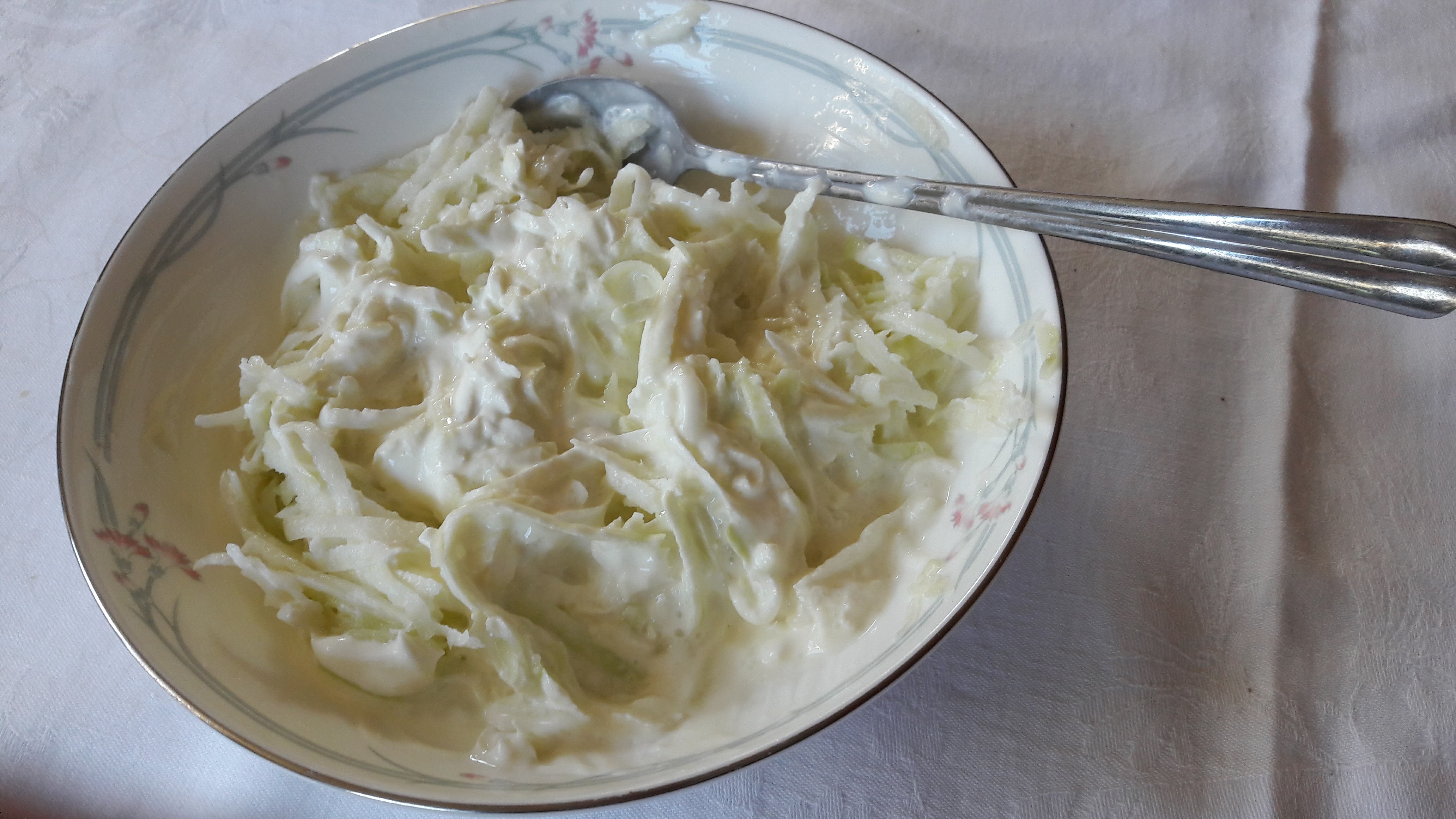
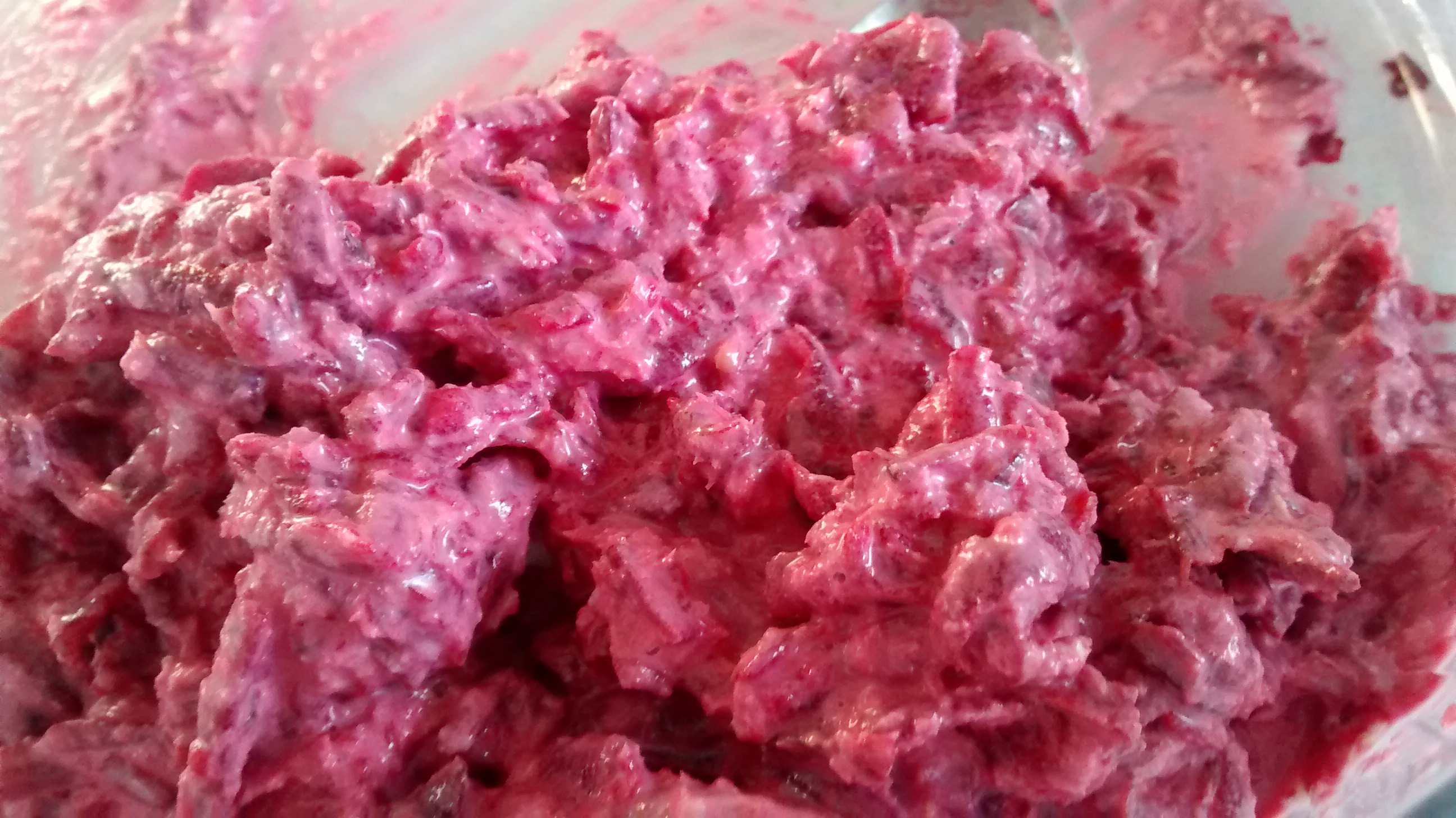
Below are two kinds, one with soured cream and one without.
I like the one with soured cream more.
A few years ago I thought it would be a good idea to grow my own horseradish – that was a mistake! It starts to take over with the roots spreading underground. However the dark leaves are very attractive and the air does smell of horseradish when you walk up to it. You just need to be able to contain it.
Mix the grated beetroot and horseradish sauce together.
Add soured cream – if using the sauce with this in already you might not need as much.
You can add lemon juice as well.
Carnation Serving Dish by Royal Doulton
Beetroot & Apple Salad
Ingredients
2 or 3 boiled beetroots
1 eating apple with a good flavour such as Jazz, Braeburn or Pink Lady.
Juice of half or a whole lemon
Sugar – optional
Method
Grate the beetroots using a medium grater.
Peel and core the apple and grate this using a medium grater.
Mix the two together.
Add lemon juice to taste.
You can add some extra sugar to taste.
NOTE
This tastes much better if it is left so all the ingredients mingle together for a few hours.
I make this in the morning if I want it for the evening or I make it the night before for lunch time the next day.
Creamed Beetroot
This is a delicious way of serving beetroot warm with a roast dinner.
Ingredients
3 or 4 boiled beetroots
Large tablespoon of butter
1 or 2 tablespoons of flour
Juice of a lemon & some extra water
3- 4 tablespoons of soured cream
Salt & pepper to taste
A little sugar to taste – optional
Method
Grate the beetroots using a medium grater and put them into a saucepan with the lemon juice and a little water.
Put a lid on the saucepan and gently simmer the beetroot – taking care not to let it dry out or burn.
Melt the butter in a small frying pan and add the flour – let it colour slightly.
Add 2 tablespoons of soured cream and a little water and combine this well.
Add this mixture to the simmering beetroots, once again combining well.
Let this simmer for 5 to 10 minutes – keep checking, and stirring and adding more soured cream, lemon juice or water if it looks like it is going to dry out.
Add salt & pepper and a little sugar to taste.
Serving dish is Topic designed by Alan Rogers in 1967 for J & G Meakin.
When cooking was much more seasonal this salad was extremely popular in winter when many other vegetables were unavailable.
Using bottled sauerkraut you can make this salad all year around. You can also buy vacuum packed sauerkraut in many Polish shops.
Preparing the sauerkraut
There are two ways of preparing the sauerkraut. It all depends on the actual sauerkraut which varies with the home-made or vacuum packed being milder usually than the bottled & how sour you like it to be.
Sour is indeed a well loved taste in Poland and sour is a description you can apply to many Polish dishes. There will be more posts on this on the future.
These salads could be considered sweet & sour.
For all the following salads I have used roughly 200g of sauerkraut which is easily enough as a side-dish for two people.
I think all the following salads benefit from being made a few hours ahead and left to allow the flavours to interact and mellow.
Preparation Method 1
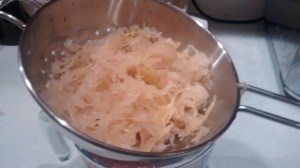
Just take some of the sauerkraut and sieve of some of the liquor.
Sieve off some of the liquor
Preparation Method 2
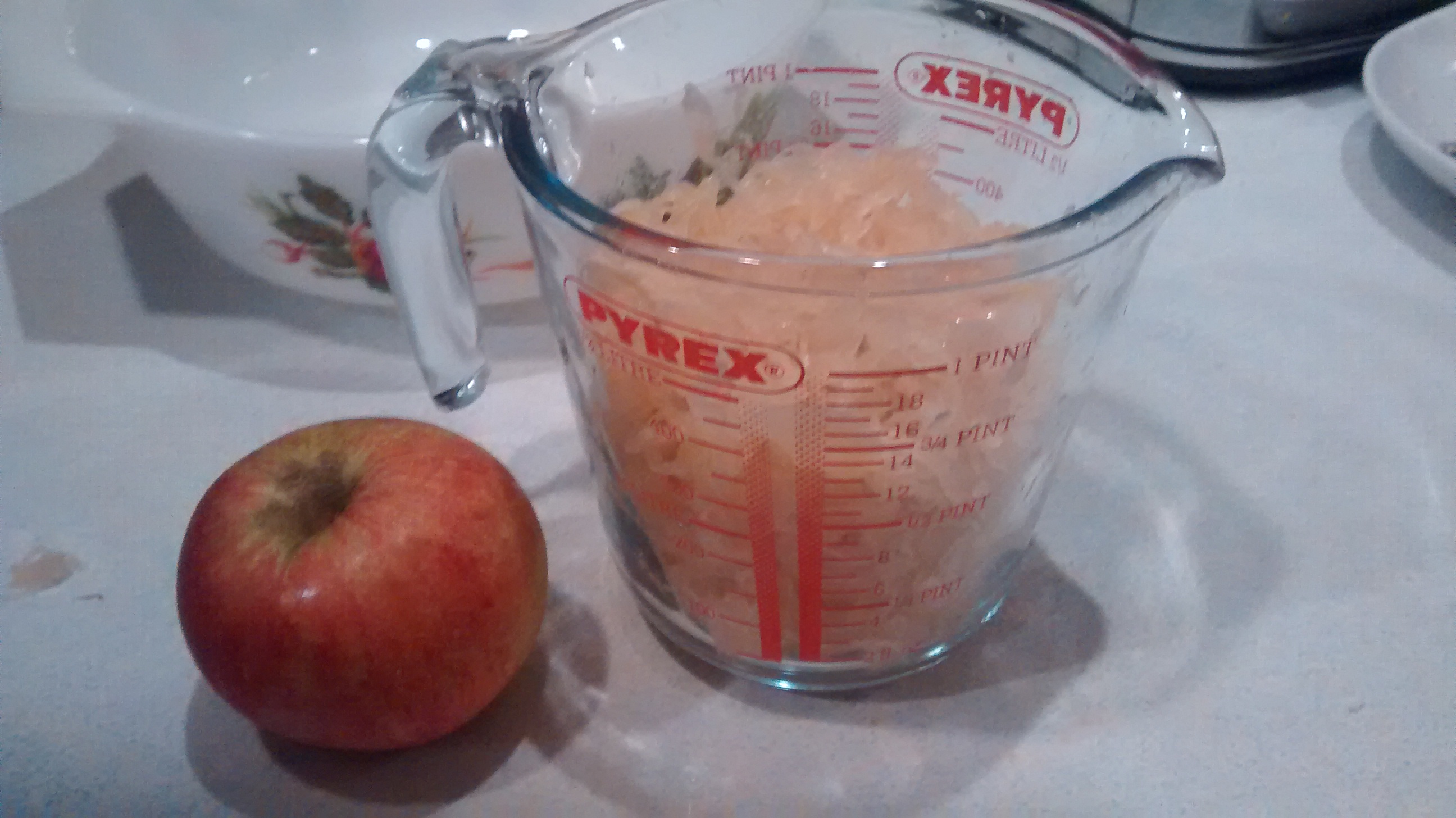
Put the sauerkraut into a jug or bowl and add some water to rinse off the liquor.
Use Water to Rinse the Sauerkraut
Rinse off the Water
My personal preference is to use method 1 with the sauerkraut just drained and not rinsed.
Sauerkraut & Apple Salad
Ingredients
Around 200g of Sauerkraut
1 tasty eating apple such as Jazz or Braeburn
2 to 3 tablespoons of sunflower oil
1 to 2 tablespoons of granulated sugar.
Method
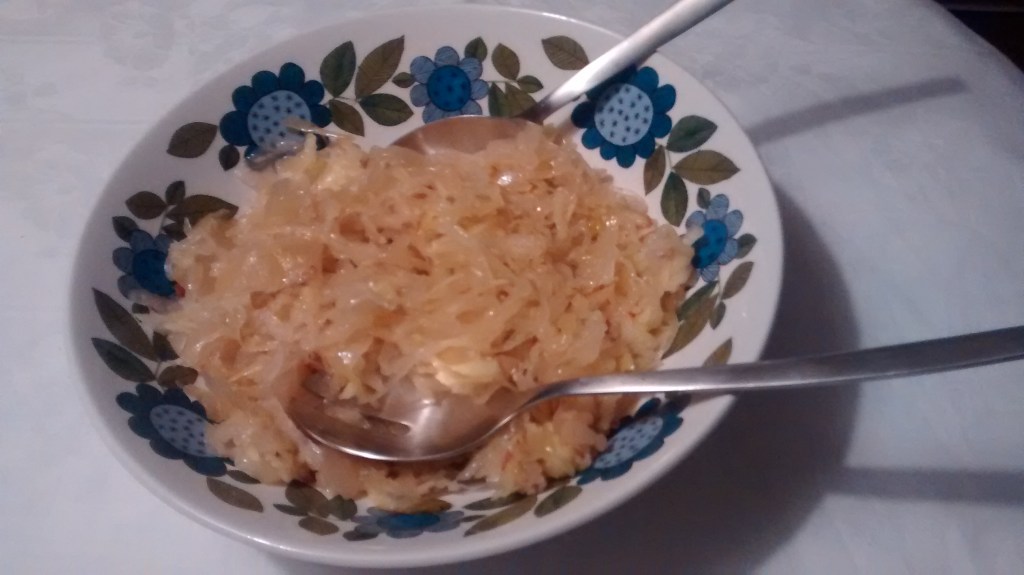
Prepare the sauerkraut and put it in a dish.
Grate the apple, skin and flesh using a coarse grater and add this to the sauerkraut. Mix the two together.
Add the sunflower oil and sugar and mix well.
Leave in a cool place for a couple of hours before serving.
Serving Dish by J & G Meakin – Topic – designed by Alan Rogers in 1967
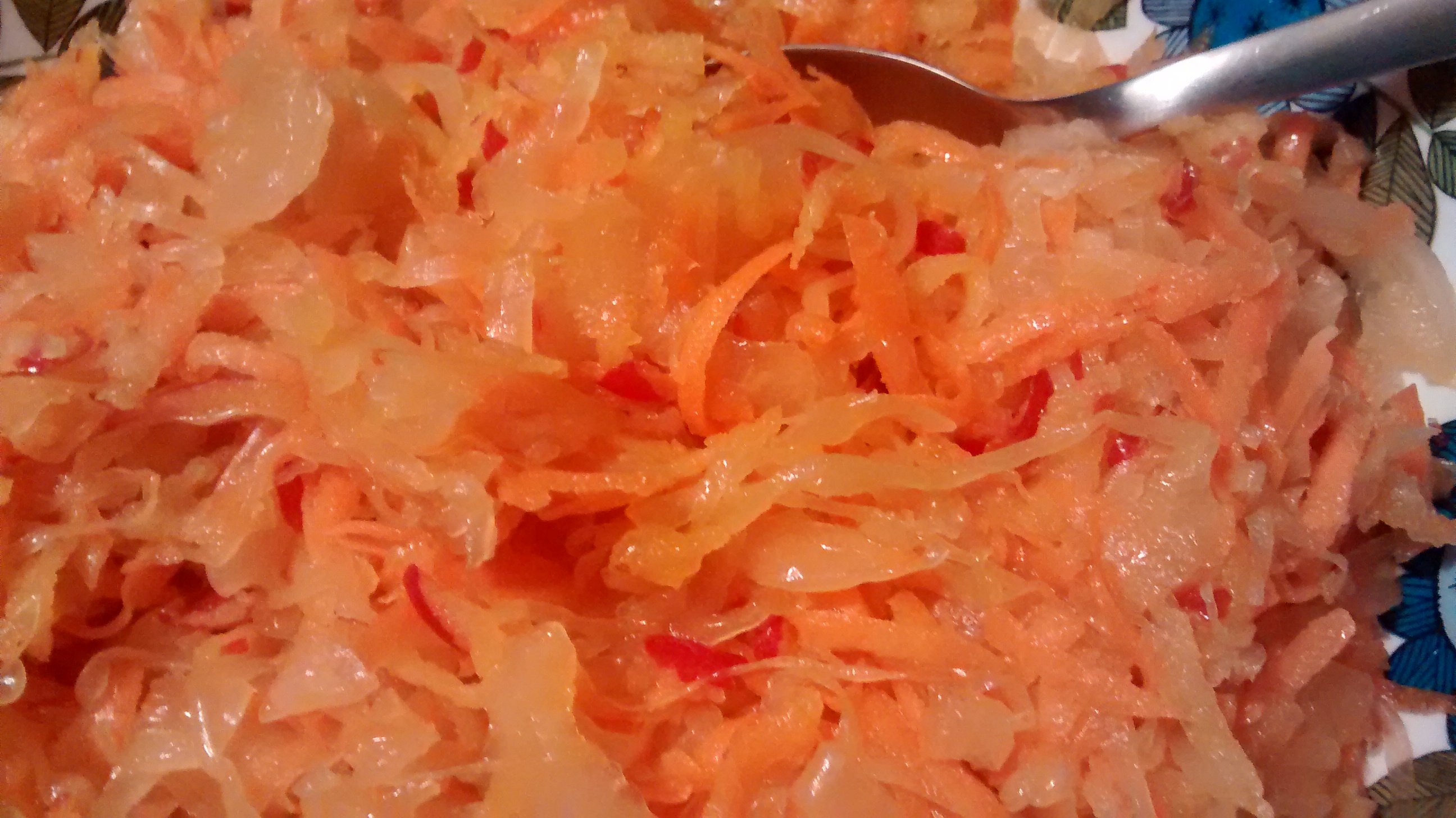
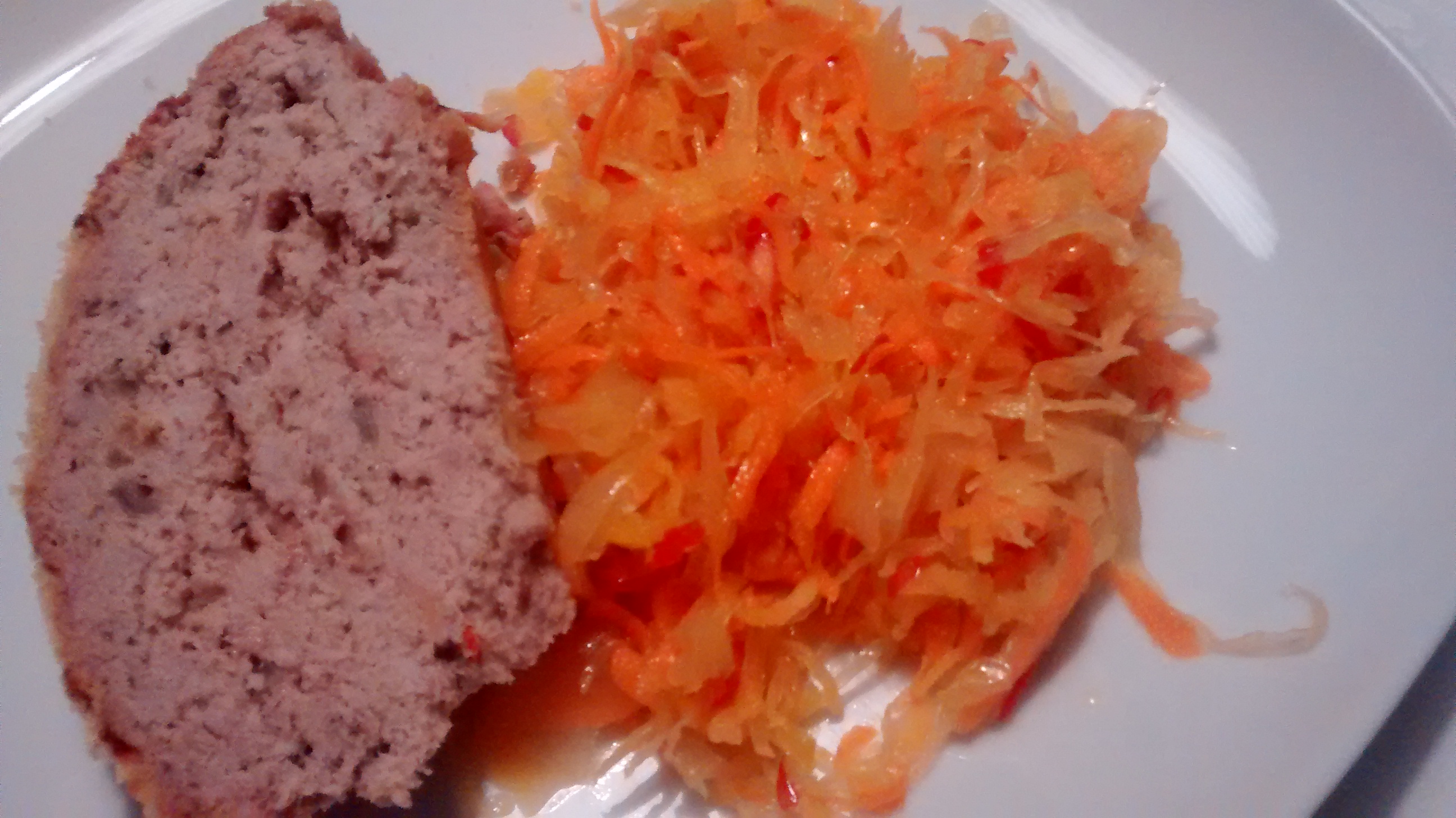
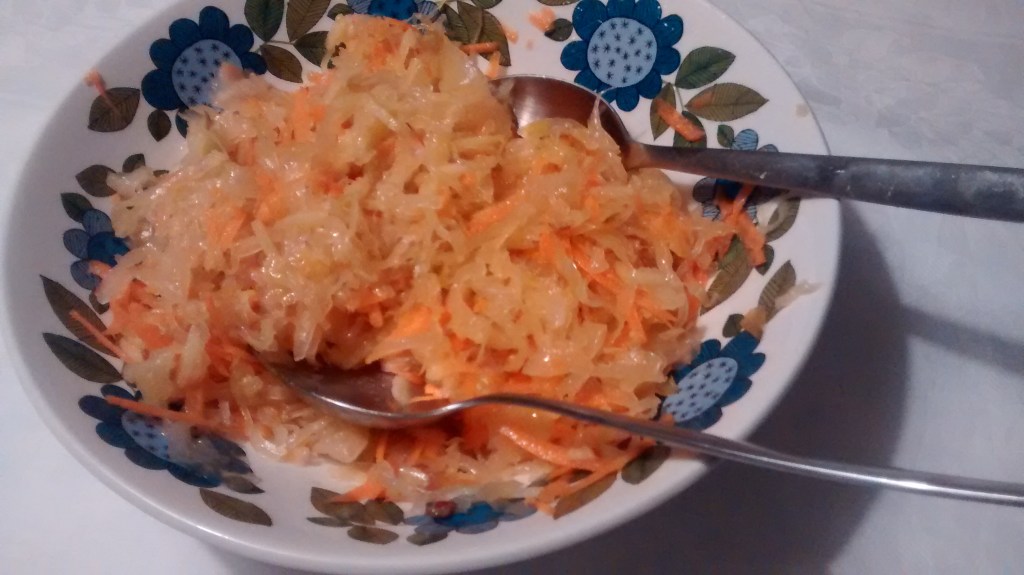
In the restaurant in the Polish Centre in Leeds they serve a wonderful sauerkraut and carrot salad – secret recipe of course! – the following is the nearest I can get to it.
Sauerkraut & Carrot Salad 1
Ingredients
Around 200g of Sauerkraut
1 carrot
1 tasty eating apple such as Jazz or Braeburn
2 to 3 tablespoons of sunflower oil
1 to 2 tablespoons of granulated sugar.
Method
Prepare the sauerkraut and put it in a dish.
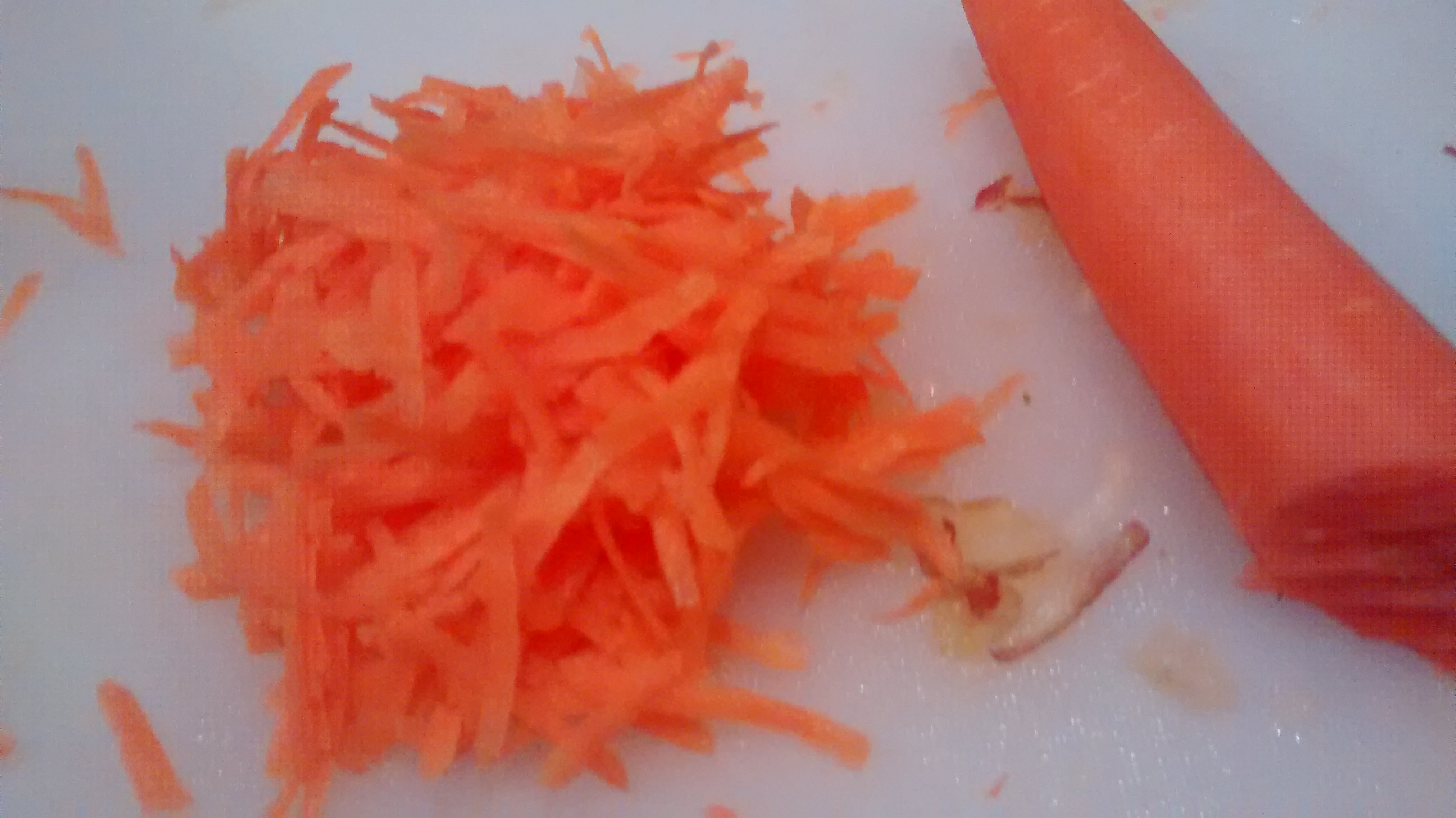
Peel and grate the carrot using a coarse grater.
Grate the apple, skin and flesh, using a coarse grate.
Add the grated carrot and the apple to the sauerkraut.
Mix them all together.
Add the sunflower oil and sugar and mix well.
Leave in a cool place for a couple of hours before serving.
Mid 20th Century Pyrex Dish
Serving Dish is Carnation by Royal Doulton 1982 to 1998
Meat Loaf and Sauerkraut & Carrot Salad
Sauerkraut & Carrot Salad 2
Ingredients (as salad 1 but less carrot)
Around 200g of Sauerkraut
Half a carrot
1 tasty eating apple such as Jazz or Braeburn
2 to 3 tablespoons of sunflower oil
1 to 2 tablespoons of granulated sugar.
Method
Prepare the sauerkraut and put it in a dish.
Peel and grate the carrot using a coarse grater.
Grate the apple, skin and flesh, using a coarse grate.
Add the grated carrot and the apple to the sauerkraut.
Mix them all together.
Add the sunflower oil and sugar and mix well.
Leave in a cool place for a couple of hours before serving.
Tip
Once you have opened a jar of sauerkraut if you are not going to make something else with it in the next day or so you can portion it up and freeze it for later use.
A few years ago on one of my visits to The Netherlands to stay with my Dutch friend, we had a super meal which included a delicious dish of red cabbage that had been cooked with apples.
I thought then that I did not remember my mother ever cooking red cabbage. When I came home I found recipes in both my Polish and English cookery books and tried out many of these.
The following recipe has been refined and altered and this one with lots of apples and spices is the one I now use all the time.
As it takes a long time to cook in a low oven or in a slow cooker, I tend to make a lot at once. It freezes and reheats well, so once made I divide it into small portions to freeze.
I think it goes well with roast pork loin and I usually make some before Christmas and serve it with roast pork loin during the holiday period.
Tip 1
Have a lemon ready after handling the chopped red cabbage as you will find your hands become stained blue/purple. Lemon juice will clear the stains away. Another reason to make this dish in advance.
Tip 2 – Also Excellent as a Salad
I have discovered that this dish is also delicious when it is cold! I now also serve this with cold meats and Polish style sausage.
Ingredients
1 head of red cabbage
3 or 4 large cooking apples
1 onion – chopped fine
1 or 2 garlic cloves – chopped fine (optional)
6 tablespoons of soft brown sugar
1 level teaspoon of ground cinnamon
¼ level teaspoon of ground cloves
Salt & ground black pepper
3 tablespoons of cider or wine vinegar
3 tablespoons of water
Method
Pre heat the oven to GM 2 or get your slow cooker ready..
You need a large oven-proof dish with a lid to make this. I either use a very large oval enamel dish or I have now started to use a slow cooker.
I mix the ingredients in a large bowl first and then put them in the cooking dish.
Mix together the sugar, spices, salt and pepper, vinegar and water.
Remove the core from the cabbage head and cut the cabbage into fine shreds and add these to the spice mixture.
Peel, core and then coarse grate the apples and then add these to the cabbage mixture. Mix the ingredients with a wooden spoon.
Put the mixture into the cooking dish (or slow cooker) and put in the oven (or switch on the slow cooker).
It should take about 3-4 hours – it may take longer in the slow cooker.
When cooking was more seasonal, this was a very popular salad in the late summer and autumn after the apple harvest.
Nowadays with better storage methods, this is a salad you can make all year round.
Serving Dish is Royal Doulton, Carnation 1982 – 1998
The following will make enough for 2 people as a side dish – use the ratio of 2 to 3 carrots to 1 small or medium eating apple if you want to make more.
Organic carrots may have the edge here for taste but regular ones will still be good.
Use sweet and tasty eating apples such as: Jazz, Pink Lady or Cox’s orange pippins.
Ingredients
2 carrots
1 eating apple
1 tablespoon of granulated sugar
Juice of half a lemon
Method
Peel the carrots and grate them using a coarse grater into a bowl.
Cut the apple into quarters and remove the seed case.
Hold the apple by the skin and grate the flesh,
also using the coarse grater, into the bowl.
Discard the apple skin.
Sprinkle the mixture with the sugar and add the lemon juice.
Mix everything together, place into a serving dish and serve.
Note
If you do not have any apples then just carrots with the sugar and lemon juice are also good.
Before the days of shops that sell fresh and frozen produce all year round from all over the world, this salad could be made in the autumn and winter using bottled or tinned vegetables.
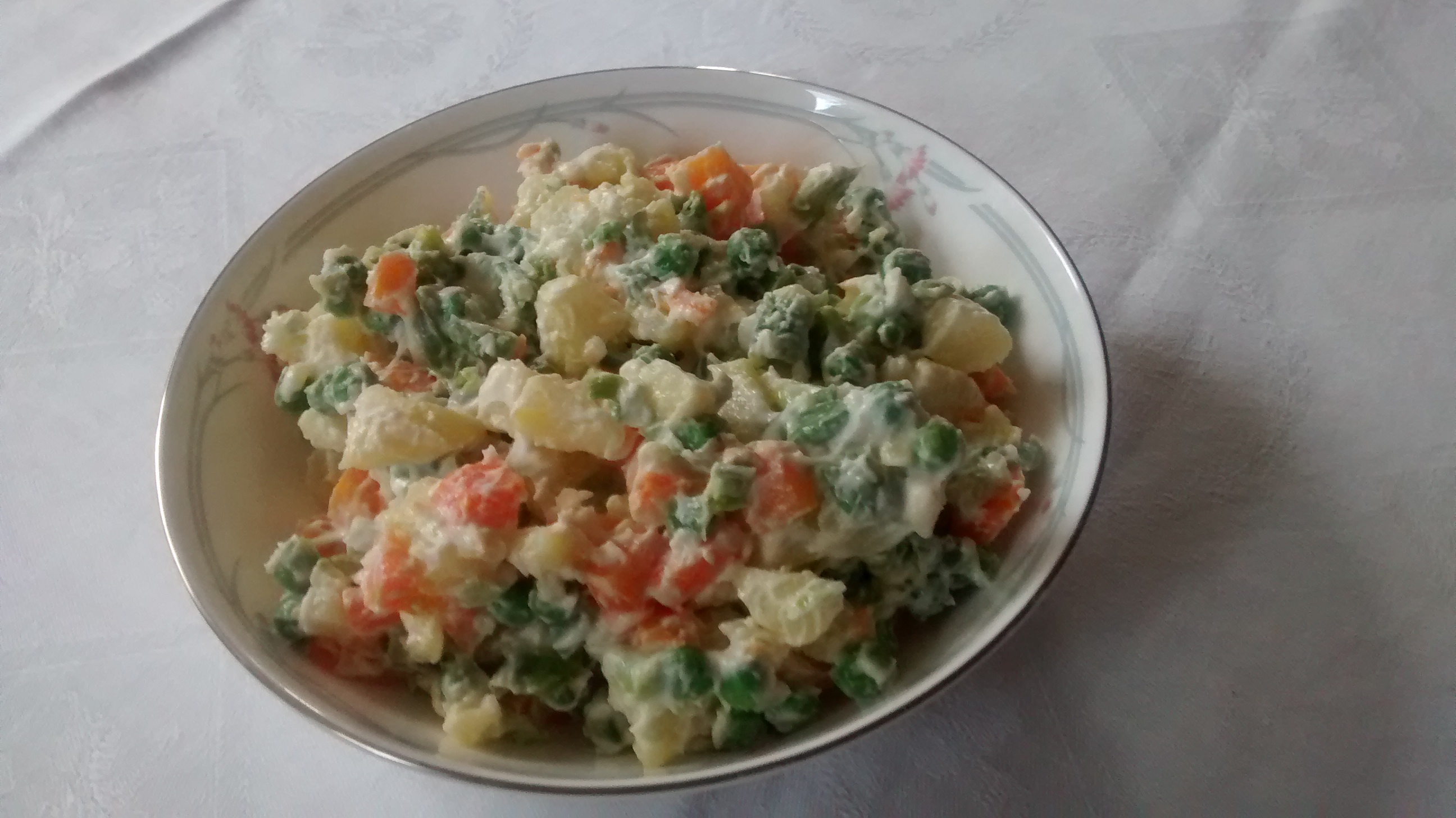
This salad is made using mainly cooked chopped vegetables and the aim is to make it colourful and to balance the colours and size of the ingredients.
The main three colours are white, green and orange.
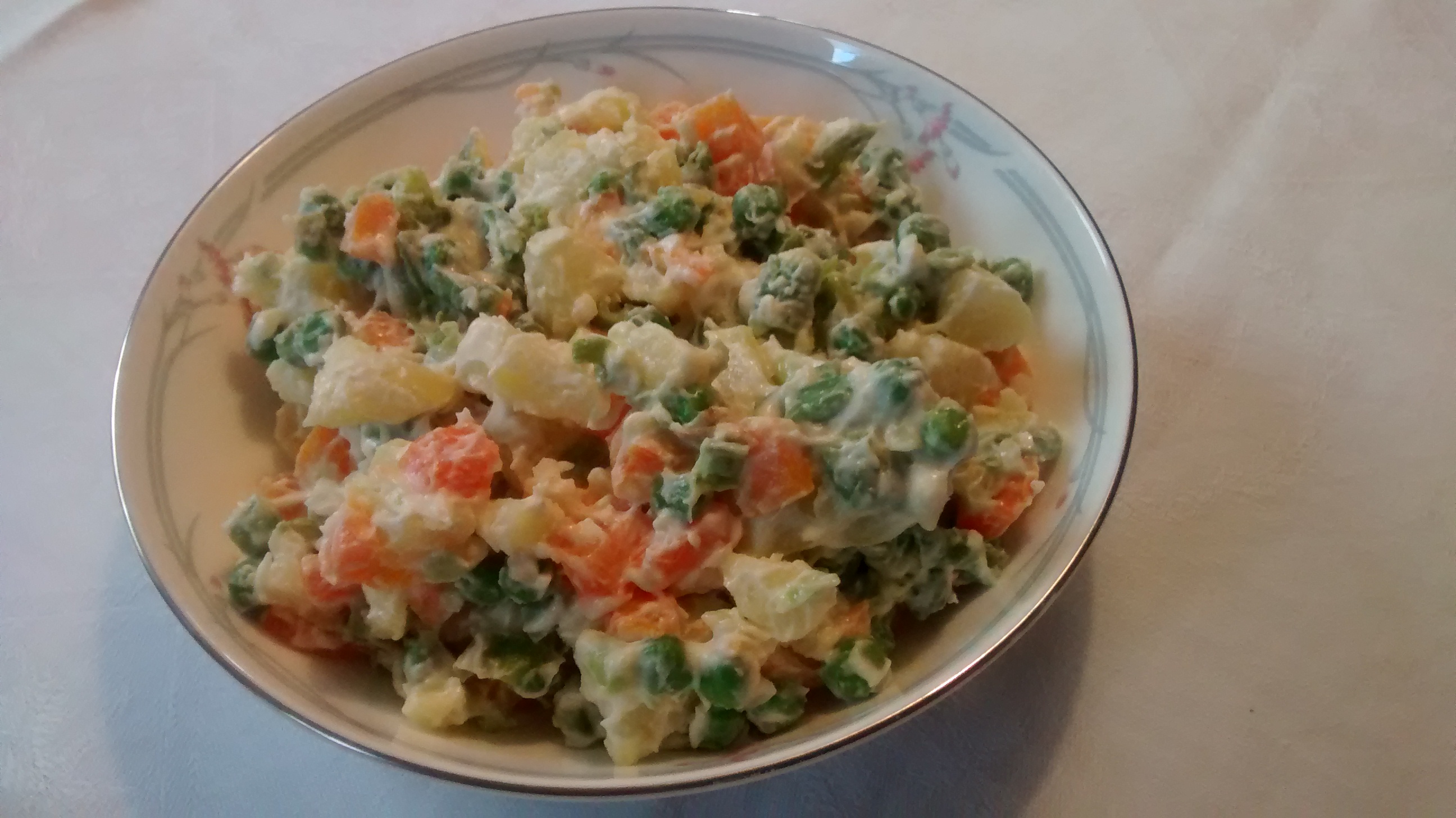
Salad in a Royal Doulton Dish – Carnation – 1982 to 1998
White
The white is achieved from: potatoes, celeriac or white beans such as haricot or cannellini or even tinned baked beans with the sauce rinsed off.
Green
The green is achieved from peas , whole green beans or gherkins. I use frozen peas or whole green beans.
Orange
The orange is achieved from carrots or bottled paprika.
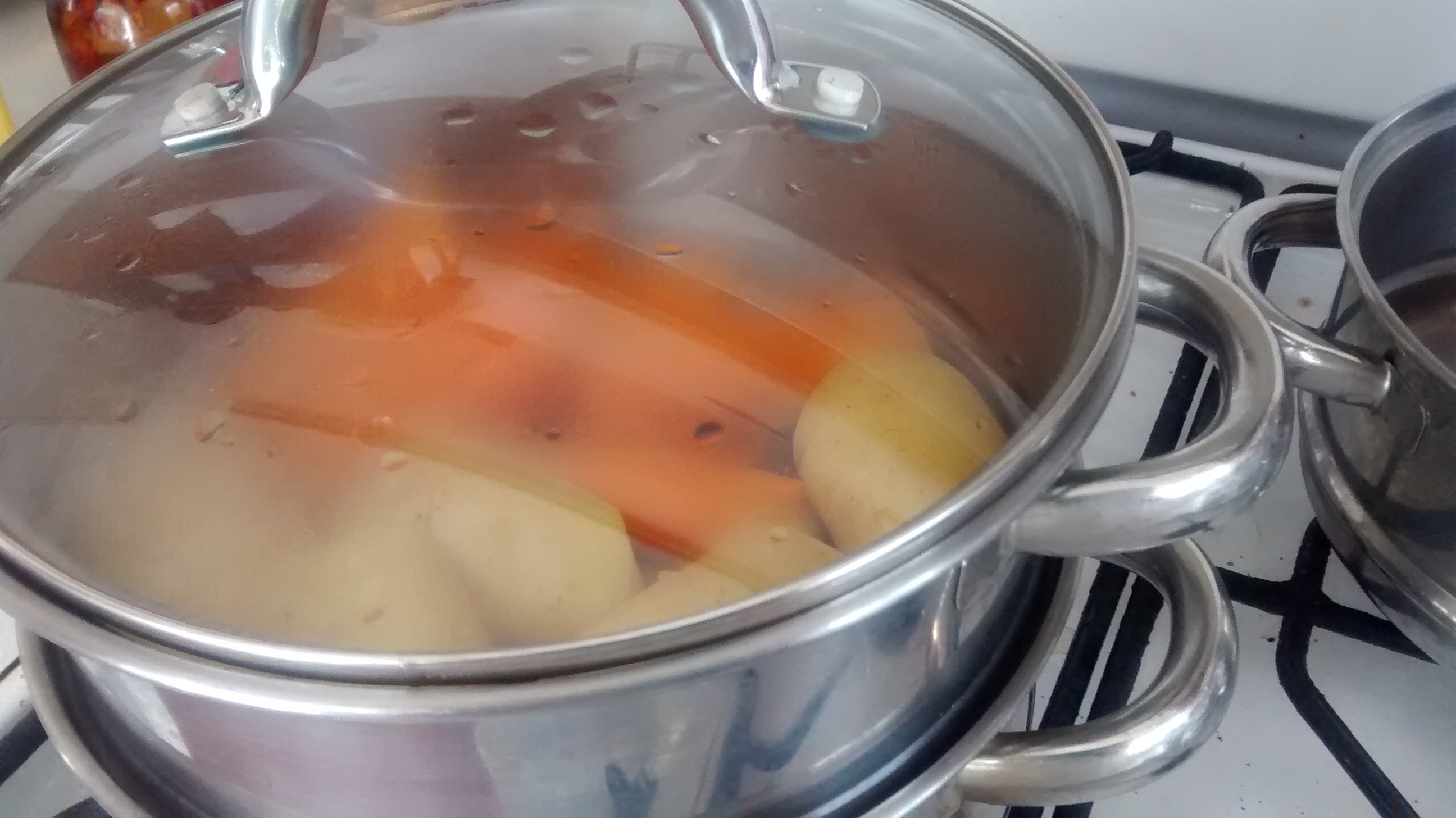
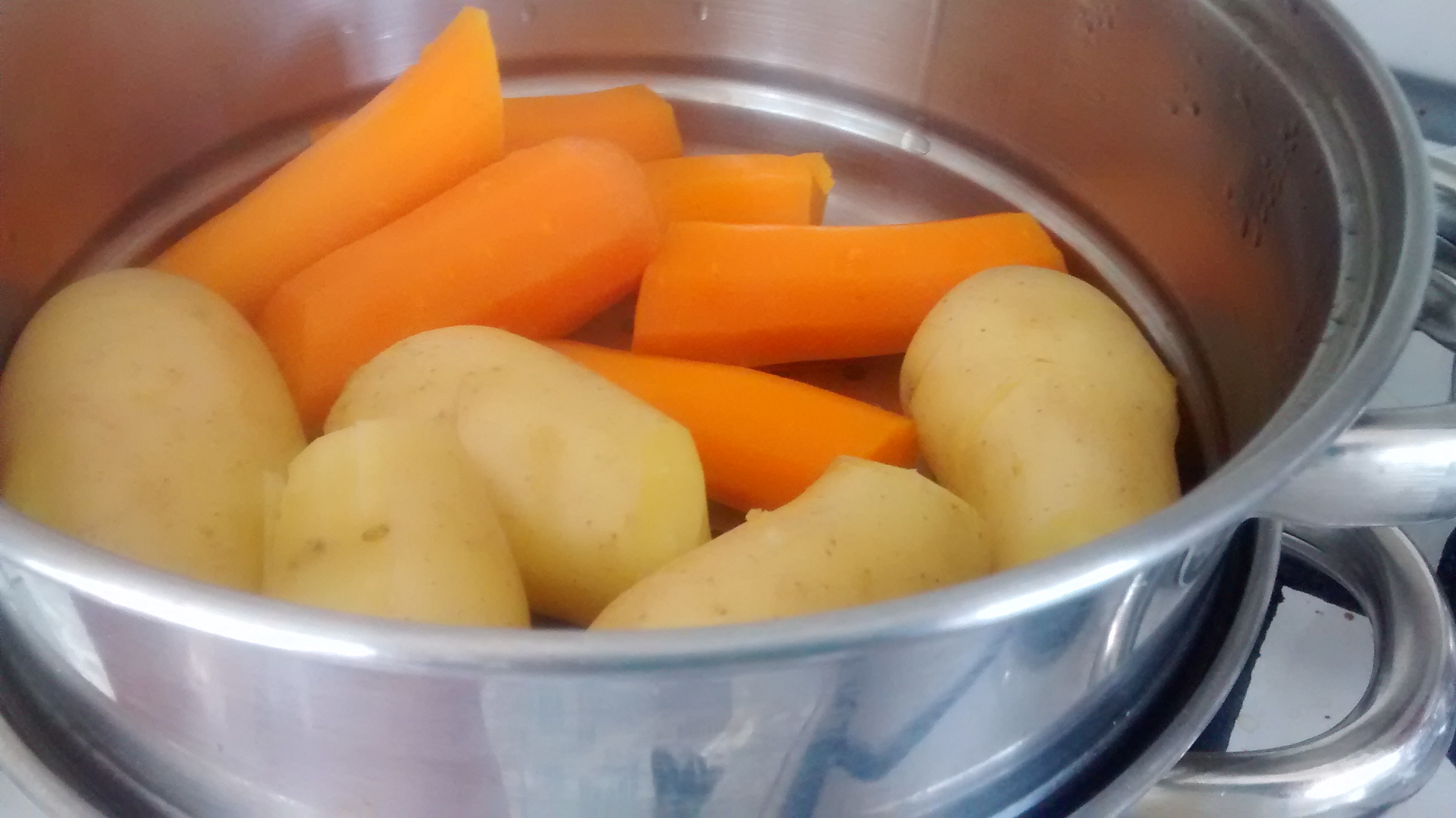
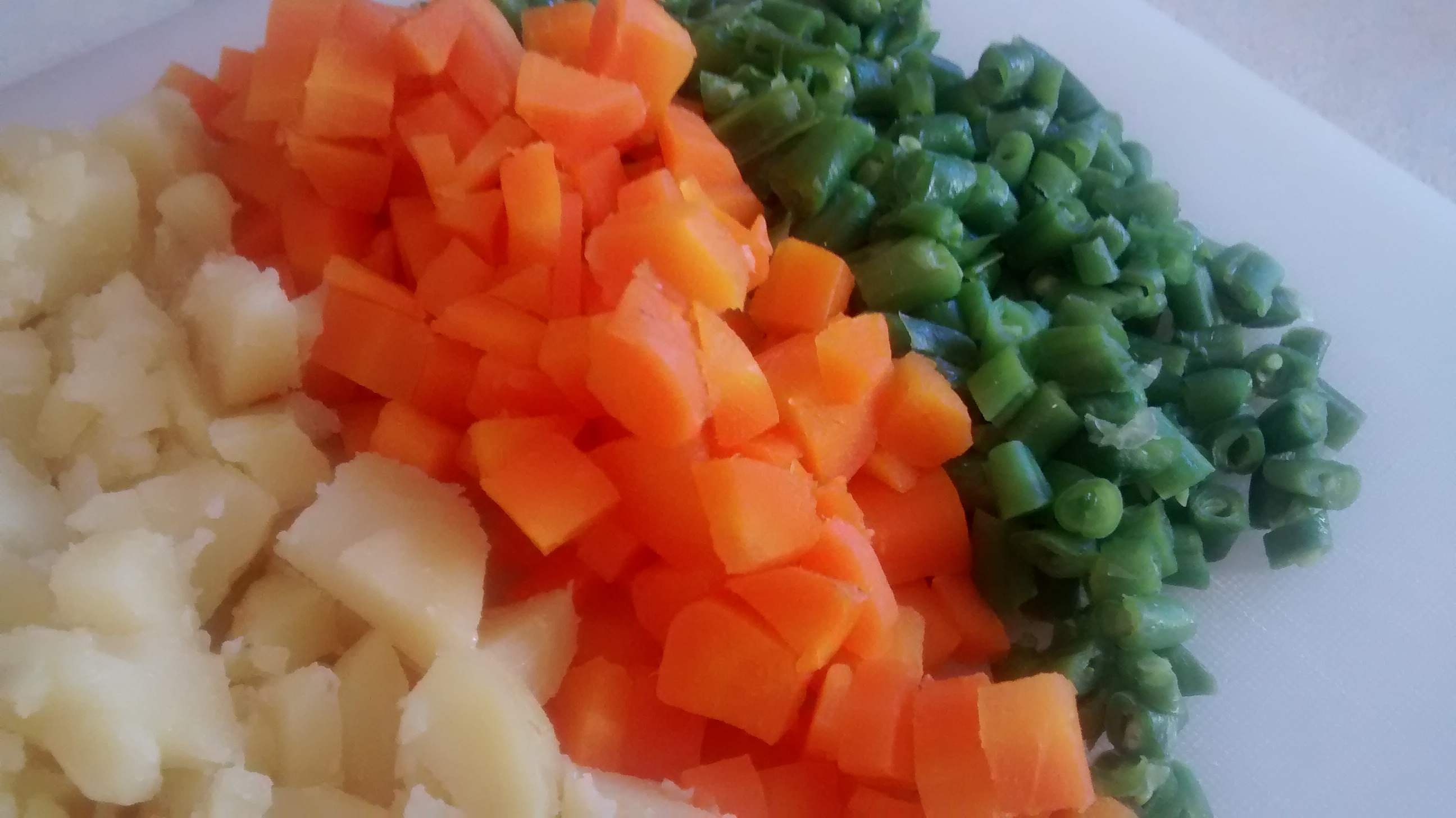
The following salad was made from potatoes, carrots and whole green beans which were cooked before assembling.
Steam the Potatoes and Carrots
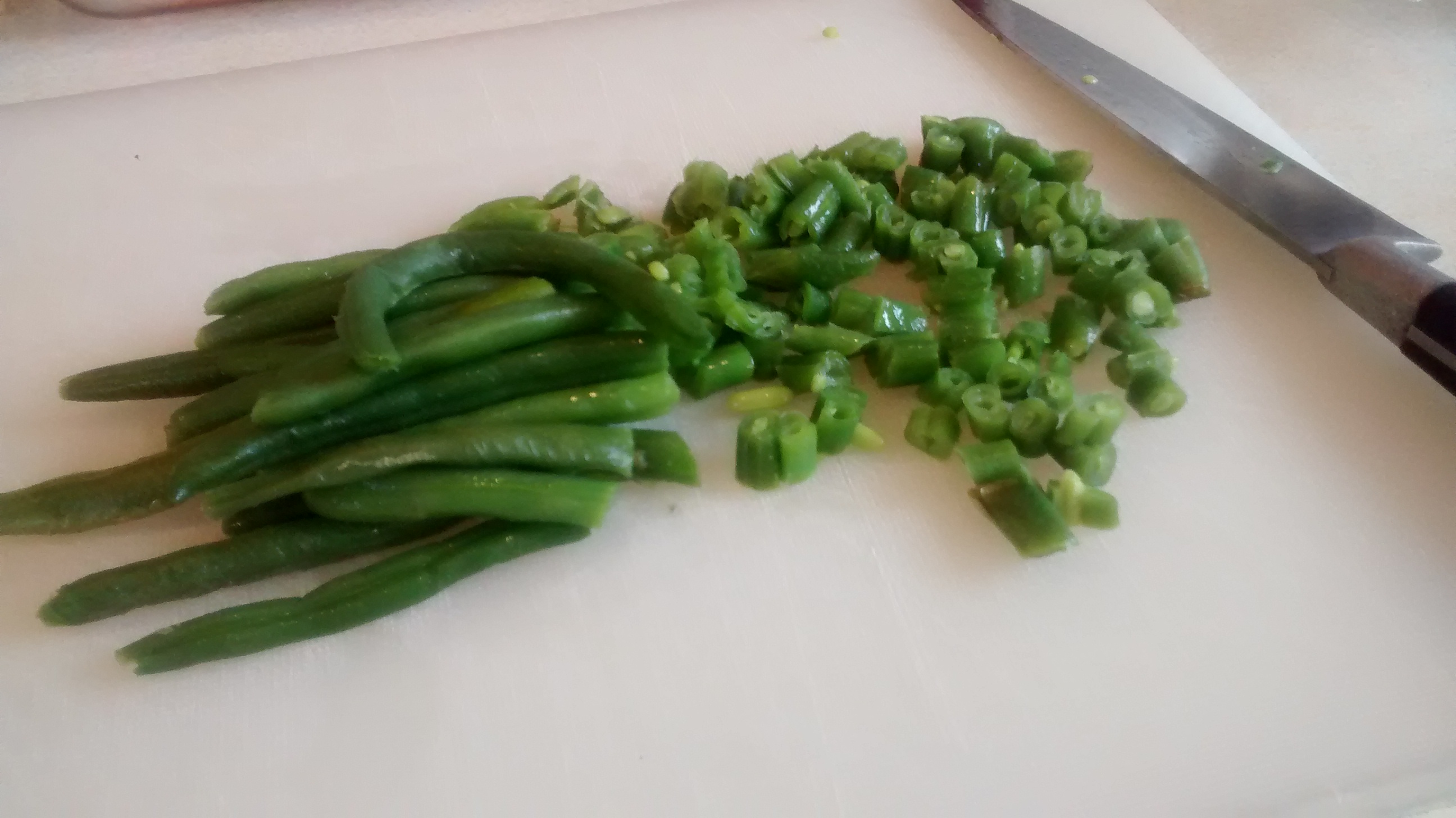
Boil or steam the whole green beans.
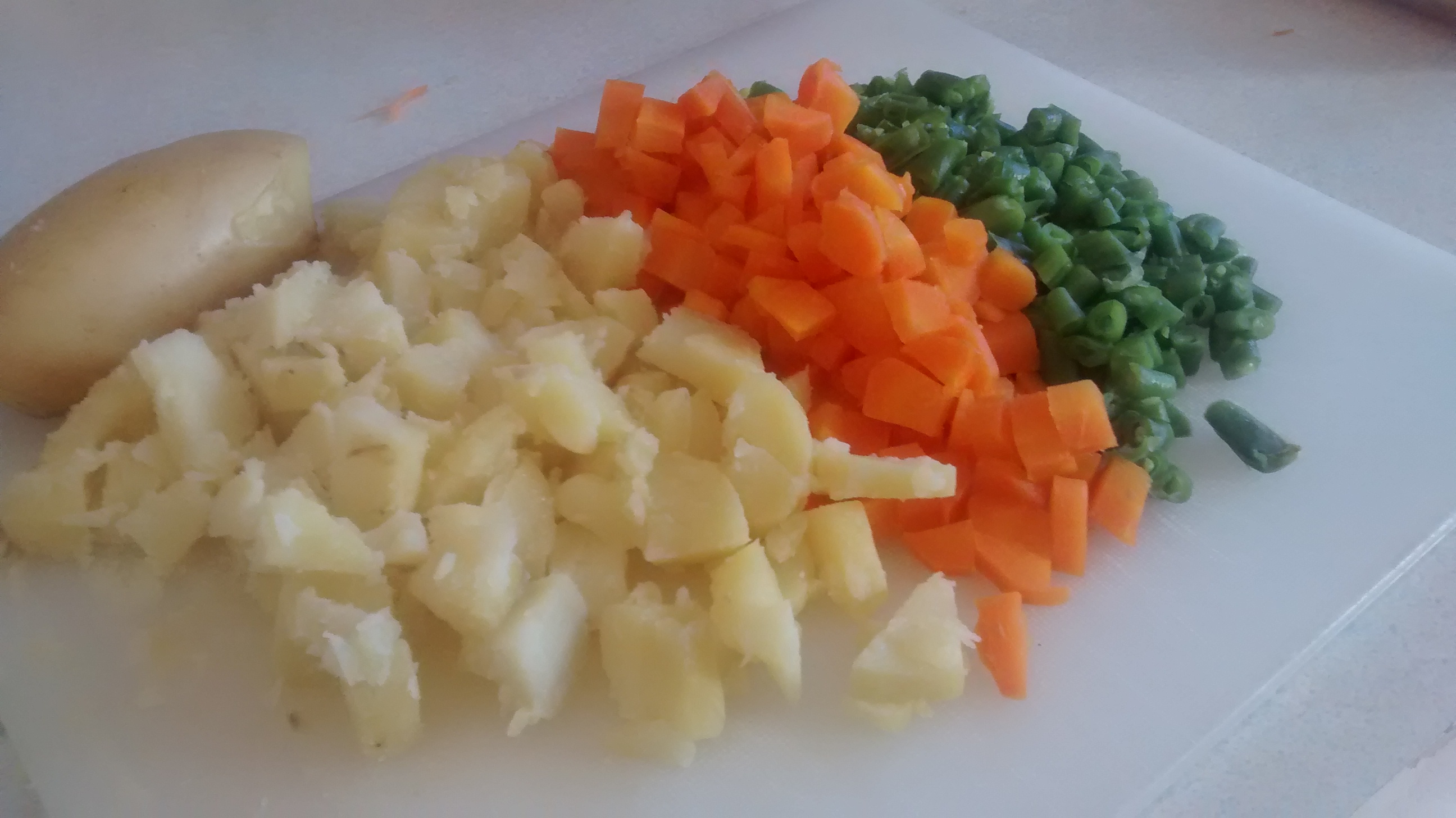
Once the vegetables have cooled then chop them into small pieces.
Mix the vegetables together with several tablespoonfuls of mayonnaise – original or light – just enough to lightly coat the vegetables.
Add salt and pepper to taste.
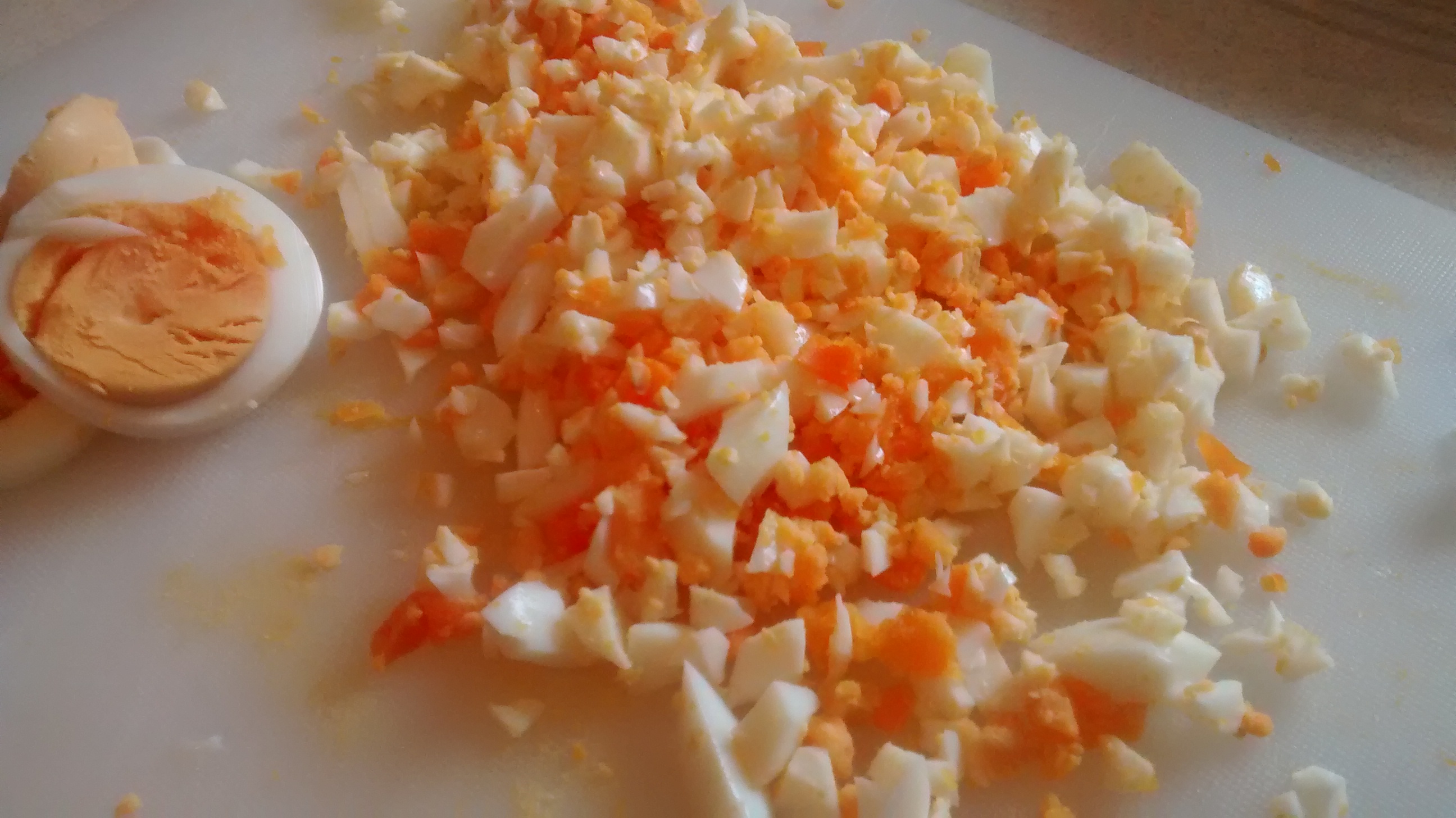
Variation 1
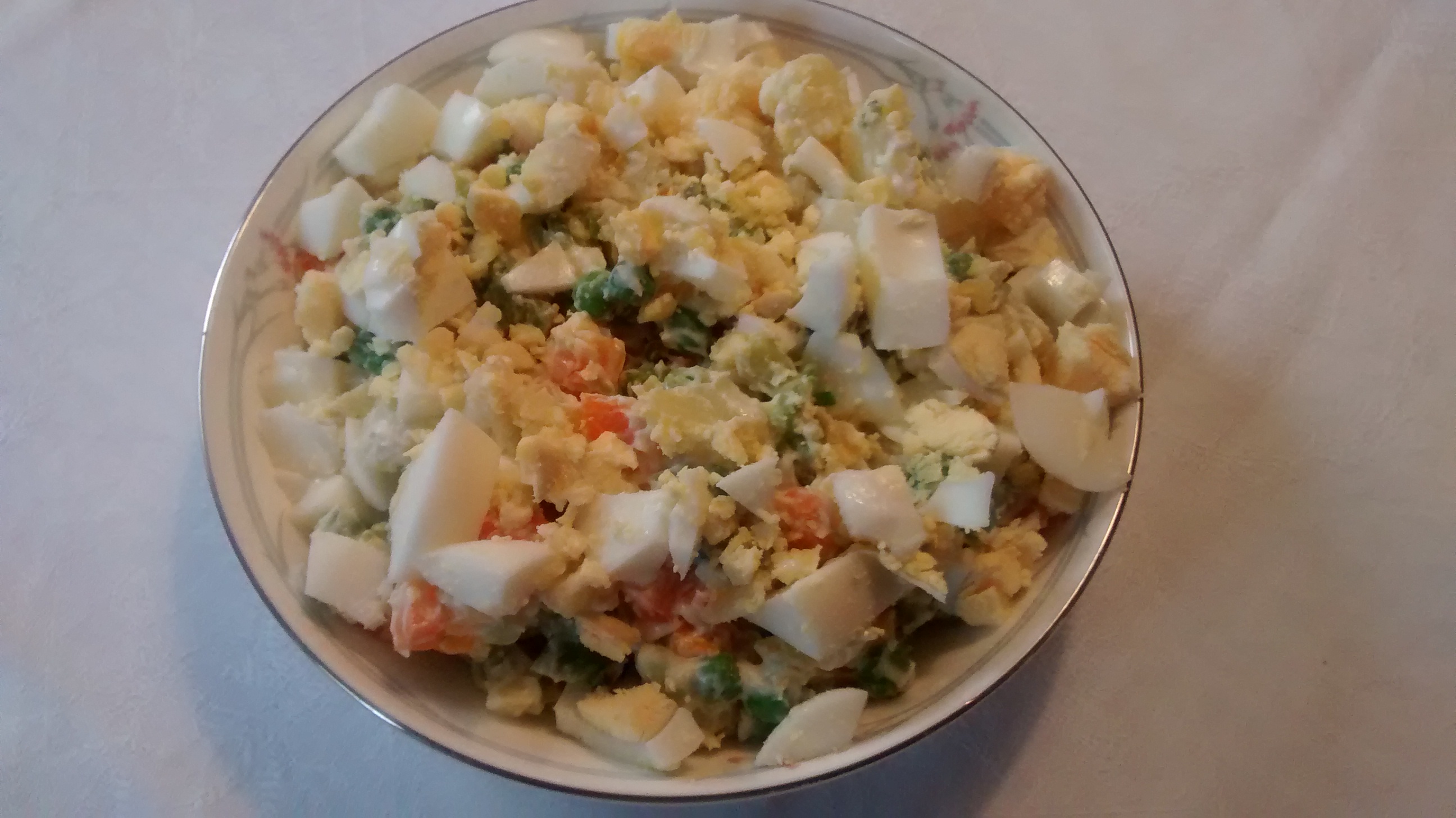
Add 2 hard boiled eggs which have been chopped to the salad.
Mixed Vegetable Salad with Hard Boiled Eggs
Variation 2
Use Celeriac instead of potato.
Peel the celeriac then cut it up into large pieces and steam these – chop the cooked celeriac into smaller pieces when it has cooked and cooled.
Potato salad is very popular in Poland especially as it can be made nearly all year round.
This can be served with cold meats and Polish style sausages as well as with hot dishes such as roast pork or chicken.
I like to make potato salad using starchy potatoes as I love the soft fluffy texture.
My favourite starchy potatoes are King Edward and MarisPiper.
The King Edward variety was introduced in the United Kingdom in 1902 and was named after King Edward VII as this was his coronation year.
The Maris Piper variety was released in 1966 and was named after Maris Lane in Trumpington on the outskirts of Cambridge which at that time was the home of the Plant Breeding Institute.
Classic Potato Salad
Ingredients
Starchy Potatoes – from 3 large potatoes upwards
1/2 – 1 onion – chopped fine
Mayonnaise – I like to use Hellmans – original or light
Salt and pepper to taste.
Method
Peel the potatoes and cut any large potatoes into quarters and then boil or steam them to cook them.
Strain the cooked potatoes in a colander and leave them to cool slightly.
Rough chop the cooked potatoes using a knife or a spoon – you do not want the pieces to be too uniform in size.
Add the chopped onion to the potatoes and then several tablespoonfuls of mayonnaise and mix together.
I like to use potatoes that are still slightly warm as I find the mayonnaise coats them better.
However you can use cold potatoes – maybe some you have left from another meal – the salad will still be good.
Add salt and pepper to taste.
Leave to cool completely before serving.
Simple Classic Potato Salad
Variations on the Classic Salad
Potato Saladwith Gherkins
Chop 2 or 3 gherkins and add these to the Potato Salad.
Chopped Gherkins
Potato Salad with Gherkins
Potato Saladwith Gherkins and Boiled Eggs
Chop 1 or 2 hard boiled eggs and add these to the potato salad with the gherkins.
Chopped Hard Boiled Eggs
Potato Salad with Gherkins and Hard Boiled Eggs
Potato Saladwith Peas
Cook some frozen peas and add these to the classic potato salad
Gherkins are cucumbers that have been fermented in brine or pickled with vinegar.
Botanically cucumbers are fruit although they are a vegetables from the culinary point of view.
In Polish the word ogórki means cucumbers.
Kiszoneogórki means fermented cucumbers – either in brine or vinegar.
Letnieogórki means summer cucumbers – which are fresh salad cucumbers.
The Latin name for the cucumber is Cucumis sativus and it is a member of the gourd family and so related to pumpkins and melons.
It is thought the plant originated in India and then was taken to Greece and from there to northern Europe.
I have read that the making of pickles by fermenting in brine is over 4,000 years old. This would preserve vegetables throughout the winter – well before the days of frozen food and supermarkets!
A quick look at the journey of the word –Gherkin – according to several dictionary sources.
This is a word that started in Greece and travelled to England & America via Poland, Germany and The Netherlands.
Angourion – Medieval Greek for cucumber.
Ogórek – Polish for cucumber
Gurke – German for cucumber
Augurk – Dutch for a brined or pickled cucumber
Gherkin – English for a brined or pickled cucumber
In Poland, July & August are the main months for making gherkins at home and once when I was there at that time in my relatives’ houses every container seemed to have been put into use for a stage in their production.
Everyone has their own special recipe using brine and sometimes vinegar with the addition of garlic and herbs and spices – the most often used is the flower head of the dill plant – hence we get dill pickles. Some methods are very quick taking just a few days others take longer.
The type of cucumber used is a different variety than the salad cumber it is shorter, fatter, often knobbier and has a lower water content.
I cannot at the moment give you a good recipe for making gherkins as I have rarely seen the right variety of cucumbers for sale in England – maybe now with more Polish shops I might see some next year and try out some recipes.
The bought gherkins I like are the Polish Krakus ones.
Another type I like are ones you can buy in Lidl – these are made with sugar and vinegar and are sliced lengthways – they have only a slight vinegar taste and are sweet – I do not like the very vinegary kind.
There are many uses of gherkins in Polish cookery – the most famous must be gherkin soup – which I just love – but that recipe I will cover later once I start to write about soups.
Of course gherkins – form part of many salads.
Gherkins Sliced Lengthways – a very simple salad
Gherkin and Tomato Salad
Ingredients
3 or 4 Gherkins – cut into discs
4 or 5 Tomatoes- cut into half & then thinly sliced
1 small onion – finely chopped
Flat-leaved parsley – finely chopped – to garnish
Salt and pepper to taste.
Method
In a bowl mix together the gherkins, tomatoes and onions.
Sprinkle with a little salt and add 1 or 2 tablespoons of the liquid from the gherkin jar (if none is available then use some lemon juice) and mix again.
Place into a serving dish and sprinkle with chopped flat leaved parsley and freshly ground black pepper.