Kawa – Coffee

Kawa is the Polish for coffee & the word comes from the Turkish kahveh and earlier the Arabic qahwah.

The Coffea plant grows as a bush with fragrant white flowers and the fruits are red berries (related to cherries and plums) – the botanical name for these are drupes  – fruits contain a single seed known often as a stone – so they are not beans in the botanical sense at all.

Short History of Coffee

Legend has it that in the 9th century a goat-herder  noticed that his goats were more lively after eating the leaves and berries of the Coffea bush

Coffee was known in Ethiopia in the 11th century and then it was the leaves that were boiled and drunk  and they were thought to have medicinal powers.

Coffee is recorded in the Yemen in the mid -14th century.

By 1555 coffee is known in Istanbul and it is now the beans which are roasted and ground and heated with water – hence Turkish coffee.

Coffee came to Europe first through Venice with the first recorded coffee shop being in 1645.

In 1683 after the victory by the Polish King Jan Sobieski III(1629 – 1696) against the Turks in Vienna, many sacks of coffee were left behind. One of his Polish officers,  Jerzy Franciszek Kulczycki,  received these sacks of coffee beans.   He opened one of the first coffee houses in Vienna serving small cups of Turkish coffee.

Coffee arrived in America not long after this in the late 17th century.

Coffee became popular in Poland in the 18th Century.  The first coffee café (kawiarnia) was opened in Warsaw in 1724.

Coffee in Poland

Coffee in Poland is served as strong black coffee – coffee without milk or cream.

It is known as Kawa parzona  which means coffee scalded!

The tradition way is to make coffee in a tall glass with a large tablespoon of ground coffee put in the bottom of the glass and hot boiled water poured onto this and this is left for about 3-4 minutes and then the top is stirred.

When you drink the coffee you do not drink down to the bottom, the sediment – the grounds or  the lees  & in Polish – fusy – are left.

I often make myself a coffee this way – it is quick and you only need 1 tablespoonful.

Note

I collect the used coffee ground from this and other methods and use them as top dressing around my strawberry plants & Hostas- many think this is a deterrent to snails.


I have an uncle in Białystok who loves coffee and when I was there he showed me various different ways of making coffee; as he used to work in the Middle East we made Turkish coffee several times.

There are many methods of making coffee often with electrical equipment.

The method I use the most is with a  Cafetière or French Press. I think it is the nearest to the old Polish method but the grounds are separated from the coffee in an easy way.

Note

Both the French & the Italians lay claim to inventing the Cafetière.  A method of making coffee using a plunger was known in France from the 1850s but a patent was issued in the 1920s to an Italian from Milan.


Coffee making equipment

Including: a coffee grinder (a present from my friend in The Netherlands), a Hornsea pottery coffee container, an old and a new  cezve or ibrik (Turkish coffee maker) and a pyroflam coffee maker jug from The Netherlands.


Assorted Coffee makers including stove top espresso makers

Coffee Pots

An assortment of coffee pots including:

  • Royal Doulton  – Regalia – 1988 – 1997
  • Royal Tuscan – Samoa – 1960 – 1967
  • Myott – China Lyke – Majorca
  • Studio Meakin – Topic – 1967
  • Empire Porcelain Minou
  • Rörstrand (Sweden) – Amanda by Christina Campbell 1968 – 1977

and some coffee cups – Royal Adderley – Masquerade – 1960s  & Portmeirion – Tivoli designed by Susan Williams Ellis

Coffee Cups & Saucers

Elizabethan – Greensleeves  &

Royal Doulton –  Sonnet – 1971 – 1998


Greenway Hostess – Design by John Russell – 1960 – 1979  &

Elizabethan – Lace – 1960 – 1979


Wedgwood – Susie Cooper design – 1950s – Flower motif series B  &

Elizabethan – Carnaby 1970s


Save

Save

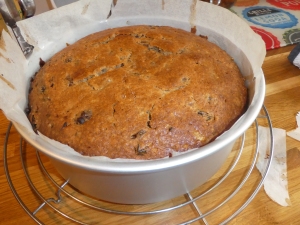
Tea Soaked Fruit Cake

This cake recipe is one I came across recently and I like it because it uses tea – a drink well loved in Poland.

It is similar to a keks which is usually made in a loaf tin but I like to make this one in a round tin.

The recipe uses 8 tea bags and I think Earl Grey,  Lady Grey & Empress Grey tea bags are really good. (If you do not have tea bags then use 8 teaspoons of loose tea, but have it in a muslin bag as you do not want the tea leaves in the cake.)

I have used dried fruits consisting just of currants, raisins, sultanas & peel.

You could make it more Polish by using a bakalie mixture which also has chopped dates, figs & prunes, however I would not add nuts – or if you want to use them – add them after the overnight soaking.

Ingredients

500g mixed dried fruit

8 tea bags (Earl Grey, Lady Grey or Empress Grey)

300ml boiling water

500g self-raising flour

325g butter or block margarine

1 teaspoon mixed spice

pinch of salt

5 eggs

Method

Place the teabags in a large bowl and add the boiling water and stir to make a very strong tea.

Add the dried fruit and stir well.

Leave the fruit to soak overnight.


Pre-heat your oven to GM 3 ,  150°C.

Grease and line a 23cm loose bottom or a spring-form tin.

Place the flour and butter or margarine into a large bowl and use your finger tips to rub in the fat until the mixture looks like breadcrumbs.

In a bowl mix the sugar, salt & mixed spice thoroughly.

Add the sugar mixture to the flour & butter mixture and stir well.

Add the eggs and the soaked fruit and all the remaining liquid and stir well.


Pour the mixture into the baking tin and level the top.

Bake in the  oven for 1 hour 40 minutes.

Check after an hour and place a piece of foil or greaseproof  paper on the top if it is beginning to burn.

Check to see if the cake is done with a cake tester or skewer.

NoteThis cake is large and you run the risk of having it underdone in the middle – make sure it is cooked in the middle when testing.

Leave to cool in the tin.

P1030671


Served on tea plates – Greenway  Hostess – design by John Russell, 1960 – 1979.

Smaller Sized Cake

This cake is large so I thought I would have a go at making a smaller version.

There are 5 eggs in the original recipe so I  decided to do a 3 egg version.

To make it more Polish, I used a bakalie mixture which had chopped dates, figs, peel & prunes as well as the currants, raisins & sultanas.

Ingredients

300g bakalie or dried mixed fruit

5 tea bags (Earl Grey, Lady Grey or Empress Grey)

200ml boiling water

300g self-raising flour

200g butter or block margarine

1 teaspoon mixed spice

pinch of salt

3 eggs


Method

As above – using a 20cm tin.

Bake for around 1 hour 20 minutes – checking after 50 minutes and covering if necessary with a piece of greaseproof paper to stop the top burning.

Note

Maybe because of the different dried fruits I thought it came out drier than the large one & I served it sliced with some butter.

However I have found that if you wrap the cake in aluminium foil for a day or two – it improves – becoming  more moist.


Served on tea plates – La prune – by Jet for Ter Steege in The Netherlands.

Placek

Placek is a low flat cake and can be  round or rectangular in shape.

I made two using  each of the recipes in  ciasto półkruche  – a type of shortcrust pastry – with jam fillings and both turned out well.

Placek with jam

Grease and line a 32 x 22 tin

Pre-heat the oven  GM5 – 190°C

Use half the dough and roll it out to fit the tin.

Spread the dough with jam – you will need around a jar.

Cover the top with the rest of the dough rolled out.

Bake for around 30 minutes.

Dust with icing sugar as soon as you take it out of the oven and leave to cool.

Placek with Blackcurrant Jam


Served on – Colclough – Enchantment-  1950 – 1960s

Placek with Sour Cherry Jam


Served on – Duchess – Bramble Rose – 1960s


Sponge with Sour Cherry Jam

Wiśnie  is the Polish for sour cherries  which I have described in More Duck.

Having made sponge with sweet orange jam I thought I would try this with sour cherry jam – the one I used is from Lidl and is very good with a sharp sour taste. The taste goes really well with the  dark chocolate.


I made an English style sponge for ease.

Ingredients

2 eggs

75g caster sugar

75g self raising flour

Method

Pre-heat the oven to GM4 – 180°C

Grease and line the base of  a round 18cm diameter  baking tin.

In a bowl whisk the eggs and caster sugar until they are pale and creamy.

Gently fold in the flour.

Pour the mixture into the tin and bake for 20 – 25 minutes until golden.


You will need around 3 to 4 tablespoons of jam.

Warm the jam slightly to make it easier to spread.

Sandwich the cake halves together with the jam.


Make a dark chocolate glaze as in mazurek  using yeast dough  and again in mazurek with oranges.


Here served on Royal Doulton – Counterpoint  1973 – 1987.


Sponge with Sweet Orange Jam

This cake was inspired firstly by mazurek with oranges and also by the very British Jaffa cakes.

Jaffa cakes were first made in 1927 by McVitie & Price (Established in Edinburgh in 1830)  – little sponges with orange jelly and a chocolate topping – named after the port (now called Tel Aviv) from where the Victorians and Edwardians imported oranges).

A fat-free sponge cake is cut in half and sandwiched together with a sweet orange jam and then covered  with a chocolate glaze or icing.

I have tried out several versions – and made a fat-free sponge using  the recipe with  potato flour   this time using a round 19cm baking tin which has been greased and lined with a circle of greaseproof paper on the base and baked for 20 – 25 minutes at GM4 – 180°C


A quicker version is to use a more English sponge recipe ( this has slightly less volume so a smaller baking tin is used).

Ingredients

  • 2 eggs
  • 75g caster sugar
  • 75g self raising flour

Method

  • Pre-heat the oven to GM4 – 180°C
  • Grease and line the base of  a round 18cm diameter  baking tin.
  • In a bowl whisk the eggs and caster sugar until they are pale and creamy.
  • Gently fold in the flour.
  • Pour the mixture into the tin and bake for 20 – 25 minutes until golden.


  • Leave to cool and cut the sponge in half


20170804_090748
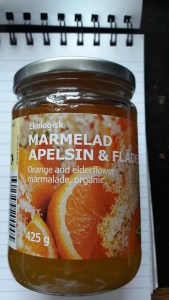
Orange & Elderflower Jam from IKEA
  • Warm the jam slightly to make it easier to spread.
  • Sandwich the cake halves together with the jam.

Chocolate glaze – using the one from Mazurek – with Yeast Dough


Served on Bramble Rose by Duchess from the 1960s


The more milk chocolate icing below is the one from chocolate babka.


Served here on tea plates by Spencer Stevenson Co Ltd 1948 – 1960, design name not known.


Sernik Base with Peanut Butter

My mother often used this base when she made her sernik (baked cheesecake)  – it is a recipe she used in later years as the use of peanut butter is not at all traditionally Polish!

Ingredients

110g butter or block margarine

90g caster sugar

175g plain flour

1 egg yolk

1 tablespoon of peanut butter (I prefer to use crunchy)

Grated rind of 1 lemon

Method

In a large mixing bowl, cream together the butter and sugar.

Add the lemon rind, egg yolk  and peanut butter and cream again.

Mix in the flour with a wooden spoon and then using your hand bring this all together to form a soft dough.

Place the dough in a fridge for several hours.


Pre-heat the over to GM5 – 190°C

Use a loose bottom tin (or spring-form tin)  22cm or 20 cm in diameter.

Grease the base and sides of the tin.

Press the dough onto the base of the tin.

Prick the surface of the dough with a fork.

Bake for around 15 – 20 minutes until the top is golden.

Let the base cool completely before using it.


Using The Base

The base must be thoroughly cooled before use.

The base can be stored on the tin base for later use if needed – wrapped in foil or in an airtight container.

Sernik

Make your sernik (cheesecake) mixture and pour this onto the base and bake as per your recipe.

I used around 450 – 500g of yoghurt cheese with the addition of  mixed peel as in my another cheesecake recipe.


Great cake lifter from Lakeland Plastics.


Cake is on a Lead Crystal cake stand

Cake forks are Crazy Daisy by Portmeirion designed by Sophie Conran in 2009.

Tea plates are Enchantment by Colclough from the mid 1950s – 1960s.


Hazelnut – Tort

Corylus avellana is the hazelnut, also known as  cobnut or filbert nut.  In Polish it is orzech laskowy  – which translates as nut of the forest and as its name implies hazel trees or bushes grow abundantly in Poland.

Turkey is the largest commercial producer of hazelnuts followed by Italy.

Ferrero SpA  – makers of Ferrero Rocher and Nutella use 25% of the global supply of hazelnuts per annum.

Tort is a layer cake (in England the French word gateaux is used) – the layers of cake being sandwiched together with a butter cream (Sweet whipped cream was hardly known in Poland – with soured cream being the norm).

The word tort is originally from the Latin torta – flat cake or round loaf of bread.

A tort can be round or in a block shape – it often has very decorative piping  – my decorations tend to be more simple!

A tort is often made for celebrations and is often very large – I have recipes which call for a dozen or more eggs!

The following recipe only uses 6 eggs!

This tort recipe uses hazelnuts which have been roasted and then ground.

I often buy my hazelnuts from a  dried fruit & nut stall in Leeds Kirkgate Market.  This the largest covered market in Europe and was founded in 1875 and has around 100,000 visitors per week.

On this stall you can buy : whole hazel nuts, roasted hazel nuts and ground roasted hazel nuts.

I use either roasted hazel nuts and grind them myself or roast the hazel nuts myself and then grind them.

Roasting Hazel Nuts

To roast hazelnuts put the shelled nuts on a baking tray and put them in an oven at GM 5 – 190°C for around 10 to 15 minutes – keep checking as it is easy to burn them.

Once they are done, leave them to cool and then rub off the papery skins between your fingers and discard them.


I use an electric grinder which is very useful.


Ingredients

  • 6 eggs
  • 225g  caster sugar
  • 225g roasted & ground hazelnuts
  • 2 sponge fingers – crushed
  • Method

Pre-heat the oven to GM5 – 190°C

Grease and line a 23cm x 32cm baking tray.


Mix together the ground hazelnuts and crushed sponge fingers.


Whisk together the eggs and caster sugar until they are pale and fluffy.


Fold in the nut mixture.

Pour the mixture onto the baking tray and bake for  around 20 minutes until it is golden on top.


Take out and leave it to cool on a cooling tray.

Measure the length of the cake and cut it into 3 equal pieces.


A poncz (sweet punch for moistening the cake) is used on each layer.

I used one made from 150ml of weak black tea, 45 ml of rum and 2 tablespoons of granulated sugar.

Rum Butter Cream

Ingredients

  • 120g butter
  • 2 egg yolks
  • 2 tablespoons of rum
  • 300g icing sugar ( approximate amount)
  • Method

Cream together the butter and egg yolks.

Add the rum and cream again.

Mix in the icing sugar till you have a smooth butter cream


Using a spatulas layer up the cake first with poncz on each layer and then the butter cream.

Cover the top and sides with the butter cream.

Make fancy patterns with spatulas (or you can do fancy piping if you wish).


Little spatulas for decorating with icing.


Tea plates are Silver Rose by Duchess from the 1950s & 1960s.

The cake slice is Water Garden by Portmeirion.

Round Tort

The same quantities and method as above can be used for two 18m diameter cake tins.

Here the poncz was made from 150ml weak black tea and 2 tablespoons of granulated sugar & coffee butter cream was used.

Coffee Butter Cream

Ingredients

90g butter

1 egg yolk

3 tablespoons of very strong coffee

250g of icing sugar (approximate amount)


Method

Cream the butter and egg yolk.

Add the coffee and cream again.

Mix in the icing sugar until you have a thick butter cream.


Use the poncz to moisten the cake & layer up and coat with the icing.

20170730_182946


Very useful cake lifter – from Lakeland Plastics – for moving the cake

20170604_065017


Another cake lifter


Tea set is by Spencer Stevenson Co Ltd, who manufactured in England  between 1948 and 1960.  The design name is not known.

Green Teapot is Café Culture by Maxwell Williams.

Other Cake Sizes

3 eggs with 110g of roasted hazel nuts & 110g of caster sugar for 1 – 18cm diameter cake tin.

4 eggs with 150g of roasted hazelnuts & 150g of caster sugar for 1  – 22cm diameter cake tin.


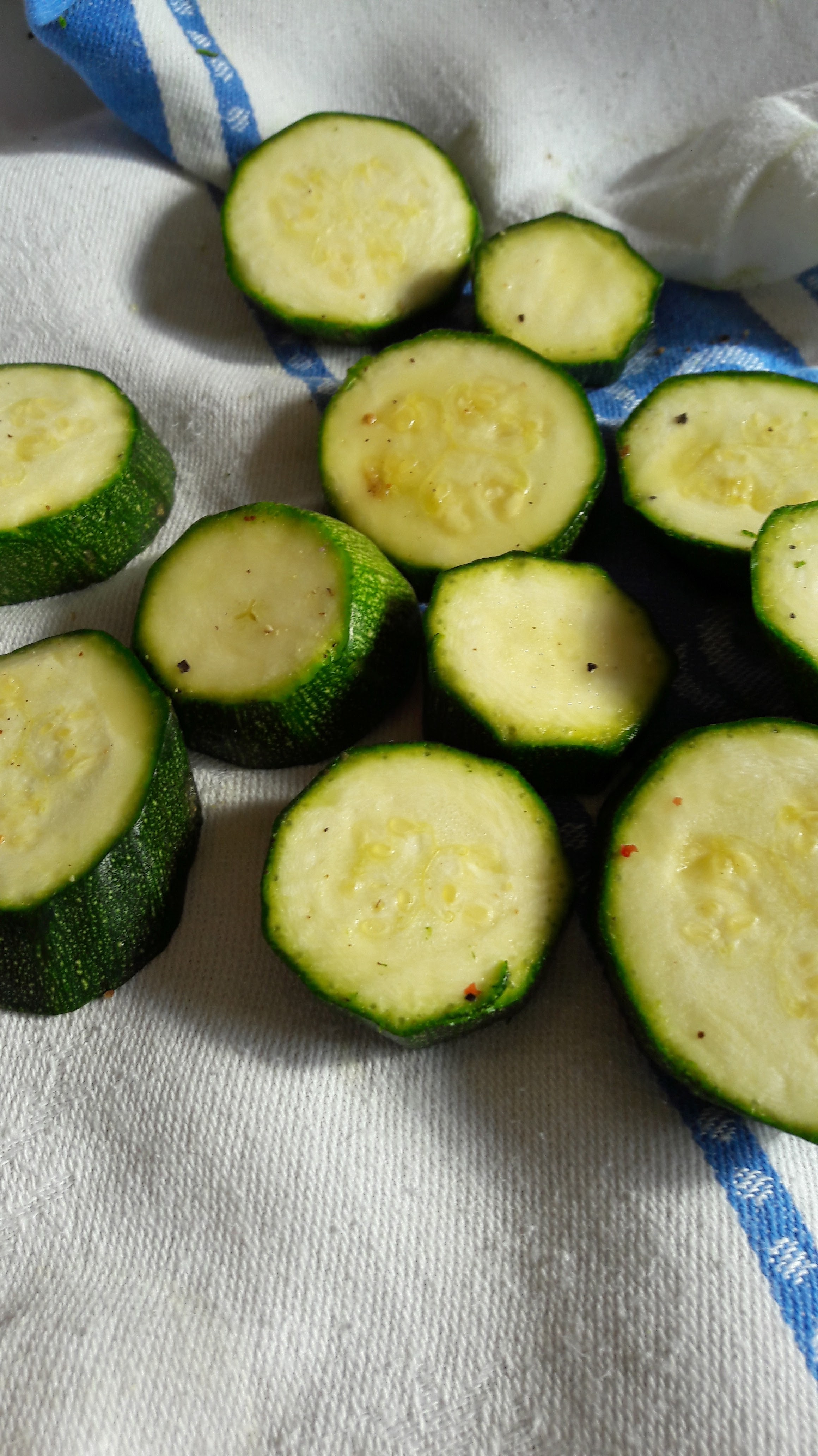
Courgettes – 3 Ways

Courgettes in Polish are cukini – so here is another vegetable that owes its name in Polish to Italian  – zucchini.

Courgettes belong to the cucurbitaceae family as do cucumbers which are very well loved in Poland

I have read that courgettes did not become popular in Poland until the 1970s although the larger marrow and pumpkins were often cooked and many recipes for these can be adapted for courgettes.


Here are 3 ways of cooking courgettes  – they all go well with grilled or roast meats such as pork or chicken.

Floured Courgettes

This is a very simple Polish way of cooking courgettes.

Ingredients

2 courgettes – sliced

2 to 3 tablespoons of plain flour

Salt & Pepper

Sunflower oil & Butter for frying

Method

Slice the courgettes and sprinkle them with salt and pepper.

Put the plain flour in a dish and toss the slices of courgettes in the flour.


Fry them gently  on both sides in a mixture of sunflower oil and butter.

Place the cooked ones on some kitchen roll in a warm oven whilst you do the next batch.


Breaded Courgettes

Sliced rounds of courgette are coated with dried breadcrumbs – this recipe reminds me of vegetables served à la Polonaise.

Ingredients

2 Courgettes

2 beaten eggs

Plain flour

Dried Breadcrumbs

Salt & Pepper

Sunflower oil for frying

Method

Slice the courgettes and place them in a colander and sprinkle them with salt and pepper and leave them for 15 minutes.


Dry the courgettes with a clean tea towel or kitchen roll.


Toss the courgettes in flour.

Dip them into the beaten egg.

Coat them with dried breadcrumbs.


Fry the slices, on both sides,  in hot sunflower oil.


Note

If you have any left, they are good with dips such as mayonnaise or salsa.

Buttery & Lemony Courgettes

I cannot remember where I got this recipe from but it is a method I have used for years.

Ingredients

2 courgettes – sliced

1 lemon – fine grated rind & juice

2- 3 tablespoons of butter

Salt & Pepper to taste

Method

Use a small saucepan or high sided frying pan

Put the lemon rind and juice into the pan.

Sprinkle salt & pepper on the courgette slices.

Add the courgette slices and heat gently for a few minutes and use the lid to keep in the liquid.

Add the butter and continue cooking gently.


Continue cooking until the slices are tender throughout and the lemon juice and butter have reduced to a buttery lemon coating.


Served in a dish by Alfred Meakin – Jayne – from the 1950s.

Mazurek – Using Yeast Dough

I came across this recipe for  a yeast dough mazurek in this little recipe book and was very intrigued by the method which is quite different from the usual yeast doughs and thought I would give it a go!

It turned out very well.

20170520_214209


Ingredients

450g plain flour

100g granulated sugar

200g butter or block margarine

50g fresh yeast or 25g of dried yeast

190 ml of milk

3 eggs

200g of bakalie (dried fruits including currants, raisins, peel, figs, dates, prunes etc)

Method

Warm the milk to hand heat and mix in the yeast.

Melt the butter on a gently heat.

In a bowl whisk the eggs with the sugar until they are light and fluffy.

Add the melted butter.

Add the milk and yeast mixture and mix thoroughly.

Leave in a warm place for 8 hours!

Grease and line a large baking tray 33cm x 24cm

Pre-heat the oven to GM5 – 190°C

Mix the bakalie(dried fruits) with the flour.

Mix the flour and fruits with the yeast mixture.


Place the dough into the tin – spreading it out evenly.

Place the dough onto the tray and put in the oven.

Bake for around 25 – 30 minutes.

Prick the surface of the cake with a fork in several places.

Leave it to cool in the tin for a while and then remove from the tin and place on a wire rack to cool.

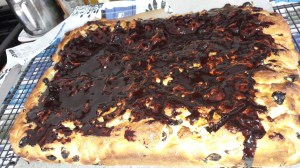
Pour the hot chocolate topping over the top.

20170524_153320


Topping Ingredients

50g butter

30g of granulated sugar

2 tablespoons of cocoa

2 – 3 tablespoons of water

Note

You could double this amount if you want to it to cover all over and be a bit thicker.

Method

In a small saucepan gently melt the butter and sugar .

Add the cocoa and water and mix it till it is all blended together.


Note

You can decorate the top with dried fruit and nuts – you would really need to do double the topping ingredients for this,


Served on Royal Doulton – Counterpoint  – 1973 – 1987

Mazurek

Most people know that a mazurek (mazurka in English)  is a Polish folk dance. It is also the word for someone or something from Mazur (the region known as Mazowsze in Polish) in North Central Poland.

A tasty meaning of mazurek, is a flat Polish cake made with different bases and toppings. The varieties are seemingly endless and vary from region to region and family to family. They can be made with yeast doughs, crumbly shortbread-like doughs  (ciasto kruche) or flaky, puff-pastry-like doughs.

The mazurek is usually baked in a rectangular or square shape.

The topping varieties include: almond paste, dried fruits, fresh fruits, nuts, meringues, kajmak, jam or poppy seed paste.

There is often an icing of some sort poured over the topping.

A mazurek is  rarely over 2.5 cm (1 inch) in height.

It is thought  that  the mazurek, was inspired by sweet Turkish desserts that came to Poland via the spice trade routes from Turkey in the early 17th century .

Mazurek  is traditionally served at Easter when it is considered an Easter treat after 40 days of fasting for Lent and this is maybe why this cake is so sweet.

Another reason is that Holy Week, the period from Palm Sunday to Easter Sunday, is a busy one in a Polish household as the interior and exterior of the house is cleaned from top to bottom so any baking  that could be prepared well in advance of Easter Sunday without getting stale was good and the mazurek, often made with an over-abundance of dried fruits to keep it moist  is well suited to this.

When the top of an Easter mazurek is  iced , it typically is emblazoned with the words “Alleluja” or “Wesołego Alleluja (Happy  Alleluja or Happy Easter).


Mazurek made with jam topping

I used ciasto kruche for these, using the versions in pastry-ciasto kruche

I liked the one using hard boiled eggs the best.

Method

Pre-heat the oven to GM 5 – 190°C

I used a Mermaid shallow tin, 31cm x 21cm, which I greased and lined – to make it easier to get the mazurek out of the tin.

Using around 1/2 to 2/3rds of the pastry dough, roll out a rectangle for the bottom of the tin – if it is too crumbly you might have to piece and press this in.

Using the rest of the dough make stripes about a finger thickness and place these around the edge of the tin.

Use a sharp knife to make a cut pattern in these strips.


Bake for 25 -30 minutes until the pastry is golden.

Leave to cool completely.

Fill the mazurek hollow with jam.

You will need around a whole jar of jar and you can heat the jam slightly to make it easier to spread.

Make some icing with beaten egg white, lemon juice and icing sugar and drizzle this over the jam.

Mazurek with blackcurrant jam


Served here on a bamboo board and  Las Palmas tea plates by Aynsley from the 1960s

Mazurek with raspberry jam


Served here on a bamboo board and tea plates with a violet design by Colclough from the 1930s.