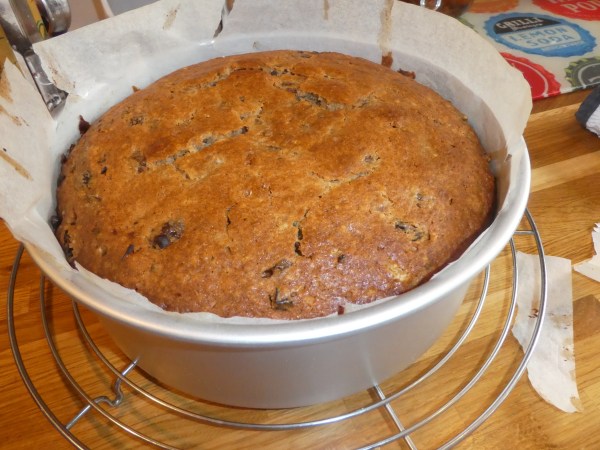
Apricot Keks

  • I made a lovely apricot and prune keks – fruit cake – several months ago.
  • I still had a lot of dried apricots so decided to make this just with apricots.
  • This time I made it in a 21 centimetre square tin
  • It too was delicious.
  • You have to start this cake the night before.

    Ingredients

    • 385g dried apricots
    • 100ml hot Earl Grey tea
    • 100ml sherry
    • *
    • 115g currants
    • 115g sultanas
    • 115g raisins
    • 50g mixed peel
    • *
    • 150g soft brown sugar
    • 150g butter
    • 2 eggs
    • *
    • 185g plain flour
    • 2 teaspoons of mixed spice

    Method

    • Chop the apricots into small pieces.
    • Place them into a bowl and pour the hot tea over them.
    • Leave until this is cold.
    • Add the sherry, cover and leave overnight.
    • *
    • Add the other dried fruits to the soaked apricots and mix well.
    • *
    • Grease and line all sides of a 21 cm square tin
    • Pre-heat the oven to GM 1- 140°C
    • Mix the flour with the mixed spices.
    • Cream the sugar and butter till well blended.
    • Add the eggs and mix well together.
    • Fold in the flour mixture.
    • Add the dried fruits and mix well together.
    • Spoon the mixture into the prepared tin and smooth down the top.
    • Bake for  3 – 3¼ hours.
    • Leave to cool in the tin.

Note

You can use a 24cm tin – and bake for 2 – 2¼ hours.

Plum Bread

This is an old English recipe which could easily be a keks recipe in Poland.

  • It can be called a tea bread as the dried fruits are soaked in tea.
  • Why is it called plum bread when there are no plums?
  • In England in the past, plum referred to all the different dried fruits.
  • The usage of the word plum to mean dried fruits has dropped out of usage.

Ingredients

  • 450g mix of currants, sultanas and raisins
  • 200ml of hot, strong Earl Grey tea
  • 170g soft brown sugar
  • 25g melted butter
  • 250g plain flour
  • 2 teaspoons of baking powder

Method

  • Put the dried fruit and sugar into a bowl.
  • Pour the tea over them and stir.
  • Leave overnight.
  • *
  • Pre-heat the oven to GM4 – 180°C.
  • Line a large loaf tin or use a cake liner.
  • Mix the flour with the baking powder.
  • Mix the flour mixture into the dried fruit mixture.
  • Stir in the melted butter.
  • Spoon into the tin and smooth the top.
  • Bake for 60 minutes – check after 50 minutes and cover with greaseproof  paper if necessary to prevent burning.
  • Leave to cool in the tin on a wire cake rack.

Served on Queen Anne, bone china tea plates

Apricot & Prune Fruit Cake

I have been going through my recipe cuttings and came across this one, which I have been meaning to make for ages as I wanted to try a fruit cake made with either dried apricots or prunes and this has both!

This could easily be described as a keks in Polish.

It is a delicious and moist cake, which can be eaten straight away – so could be a very late bake for Christmas!

The recipe was for a very large round cake but I thought a square would be better for cutting up and so I scaled down the ingredients and made it in a 24 centimetre square tin.

You have to start this cake the night before.

Ingredients

  • 120g dried apricots
  • 165g stoned prunes
  • 100ml hot Earl Grey tea
  • 100ml sherry
  • *
  • 115g currants
  • 115g sultanas
  • 115g raisins
  • 50g mixed peel
  • *
  • 150g soft brown sugar
  • 150g butter
  • 2 eggs
  • *
  • 185g plain flour
  • 2 teaspoons of mixed spice

Method

  • Chop the apricots and prunes into small pieces.
  • Place them into a bowl and pour the hot tea over them.
  • Leave until this is cold.
  • Add the sherry, cover and leave overnight.
  • *
  • Add the other dried fruits to the soaked fruits and mix well.
  • *
  • Grease and line all sides of a 24 cm square tin
  • Pre-heat the oven to GM 1- 140°C
  • Mix the flour with the mixed spices.
  • Cream the sugar and butter till well blended.
  • Add the eggs and mix well together.
  • Fold in the flour mixture.
  • Add the dried fruits and mix well together.
  • Spoon the mixture into the prepared tin and smooth down the top.
  • Bake for 2 – 2¼ hours.
  • Leave to cool in the tin.


Tea set by Spencer Stevenson from the mid 20th Century

Note

Yesterday I baked this for the second time in a 21 centimetre square tin – this needed 3 – 3 ¼ hours.

Keks -With Fruit Mincemeat – 2

Keks is the word for a light fruit cake which is baked in a loaf tin or more often in a long narrow rectangular tin.

I am not sure how or when the word keks came into the Polish language but I am certain it comes from the English word “cakes” –  however the word keks is singular in Polish and means cake, and the plural is  keksy which is cakes.

Keks are make with bakalie, which is usually translated as dried fruits – however it has more varied fruits than the English version of dried grapes (raisins, sultanas, currants) and  mixed peel and can include: apricots, dates, figs, prunes and nuts.

Keks – using fruit mincemeat

At Christmas time I make English fruit mincemeat using the recipe from Delia Smith but without the chopped nuts.

If I have any mincemeat left over after the Christmas period I make a fruit loaf which which is very much a keks.

This is my second version of a keks with mincemeat.


Ingredients

  • 150 butter
  • 150g dark brown sugar
  • Grated zest of an orange
  • Grated zest of a lemon
  • 3 eggs
  • 450g jar of mincemeat (exact amount is not critical)
  • 175g  mixture of sultanas, raisins, currants & mixed peel
  • 50g of chopped walnuts
  • 225g  spelt flour
  • 3 level teaspoons of baking powder

Method

  • Preheat the oven to GM3 – 160ºC
  • Prepare the long loaf tin by greasing it and lining the long sides using one piece of greaseproof paper.
  • Lightly cream the butter and sugar.
  • Add the grated zest of the lemon and the orange.
  • Beat in the eggs, one by one.
  • Stir in the mincemeat, the dried fruits and walnuts until it is an even consistency – a wooden spoon is good for this.
  • Mix the spelt flour with the baking powder.
  • Stir in the flour mixture.
  • Spoon the mixture into the tin and smooth the top.
  • Bake for around 60 minutes – check after 50 minutes and cover the top if necessary to prevent burning.
  • Leave to cool in the tin before turning it out.


Served here on hand painted Paragon octagonal tea plates.


Courgette Cake

I have just returned from a trip to The Netherlands where I stay with my  Dutch friend who I have known for nearly all my life!  We were both born in the same year  – lived just a few doors apart in Lancashire and  went to the same school together. Now we live in differerent countries but we visit each other often.

I am always on the look out for recipes as well as old glass & china. We went to a second-hand street market in Roermond and there was a book sale in one of the churches and strangely enough the books were sold by weight!  I  bought a nearly new copy of a cookery book by Yvette van Boven (I now know she appears on television).

This cake is  based on one of her recipes and reminds me of the light fruit cakes called keks in Polish – though the use of the courgette is novel  –  you would never guess it is in the cake!

Ingredients – Cake

  • 150g self-raising flour
  • pinch of salt
  • 1 tablespoon of vanilla sugar
  • 150g of light brown sugar
  • 1 teaspoon of cinnamon
  • 150g of raisins
  • 150g of currants
  • 100g of roasted and roughly chopped hazelnuts
  • 1 medium size courgette coarse grated
  • 2 eggs
  • 125ml of sunflower oil

Ingredients – Lemon Icing

  • Fine grated rind of 1 lemon
  • 2 tablespoons of lemon juice
  • 150g of icing sugar

Method – Cake

  • Pre-heat the oven to GM4 180°C
  • I used a continental style long loaf tin, greased it  and used a single sheet of grease proof paper  to line the long sides and the base.

  • Mix together the flour, salt, sugars and cinnamon, making sure that any lumps in the brown sugar are all pressed out.
  • Mix together the raisin, currants, nuts and the courgette.
  • Lightly whisk the eggs and oil together.
  • Add the flour mixture to the egg mixture and mix thoroughly together with a wooden spoon.
  • Add the courgette mixture and mix well in.
  • Place the cake mixture into the tin and smooth the top.
  • Bake for 50 – 55 minutes – check after 40 minutes and cover the top with greaseproof or foil if browning too much before it is baked through.
  • Leave to cool before icing.

Method – Icing

  • Place the icing sugar in a bowl and add the grated lemon zest.
  • Mix in the lemon juice until you have a thick icing.
  • You might have to adjust the thickness with  more lemon juice (or water) or with icing sugar.
  • Put the icing on the top of the cake and let it drip down the sides.

Served on Woodside by Royal Grafton from 1940 to 1959.

Carrot Variation

  • I  thought that this might be good using grated carrot instead of courgette – I used a medium sized carrot.
  • I used chopped walnuts, which I had, as when I had gone to get the hazelnuts, I got the last packet from my local shop and did not have time to go to anywhere else!

Nuts for sale in the Food Market in Rotterdam

Served on Stardust by Colclough from the 1960s.

Both versions were delicious and enjoyed by many!

Mama’s Never Too Late Christmas Cake

In Medieval times in Britain on Christmas Eve a porridge made with oats, to which was added dried fruits, spices and honey was eaten.  This was the origin of Christmas Pudding.

The spices used were a reminder of the Wise Men – the 3 Kings that came from the East.

By the 16th Century as ovens became more in use, butter and eggs were added and wheat flour replaced the oats and this became the Christmas cake.

We never had this cake at home until sometime in the late 1970s when my mother tried out this recipe from a magazine.

It is a very moist cake and reminiscent of Christmas pudding.

Because it is so moist it will only keep for about 2 months but it is one that can be made really at the last minute and one year I made it just 4 days before Christmas.

However if you want to add marzipan & icing then you should make it about 2- 3 weeks in advance, to give time for this to be done.

Ingredients

900g mixture of currants, raisins & sultanas

175g chopped mixed peel (if you have a 200g tub just use it all)

175g glacé cherries cut in half (if you have a 200g tub just use it all)

Grated rind of 1 lemon & 1 orange

1 large cooking apple, peeled and coarse grated

225g fine grated carrots

1 teaspoon rum

110 ml strong cold tea (I use a scented one like Earl Grey)

**********

350g Butter or block margarine

350 g soft dark brown sugar

4 tablespoons of black treacle

6 large eggs – beaten

*************

400g plain flour – sieved

½ level teaspoon salt

6 level teaspoons mixed spice

½ level teaspoon of cinnamon

½ a grated nutmeg

1 tablespoon cocoa  – yes cocoa! – sieved

1 tablespoon ground almonds (optional)

Method

Put all the fruit, rinds, carrots, rum & tea into large bowl,  mix and leave for 15 minutes.

Pre-heat the oven to Gas Mark 2 – 150oC.

In another  large bowl, cream the margarine and sugar, beat in the treacle and eggs.

Mix all the dry ingredients together & fold them in using a large metal spoon.

Fold in the fruit mix using a large metal spoon.

This amount will make one of the following cake sizes:

25cm square – I find this shape the best to cut up.

25 cm diameter round

20 cm diameter round plus a small loaf.

*

  • Grease and line the cake tin.
  • Put all the cake mixture into the tin to fill the shape and smooth the top.
  • Bake at Gas Mark 2 – 150oC for –
  • 25 cm square  – 1hr 50min – 2hours
  • 10” round  –  2 ½ hours
  • 8” round plus a small loaf  (I have never tried this – will suspect around 1 ½ hours).
  • The above are guides as it does depend on your oven – you need to check earlier.

Leave to cool completely in the tin.

Wrap in several layers of foil to store.

Decorating the cake

It depends on who is coming and whether there are  lots of marzipan & icing lovers on how much I decorate the cake.

Sometimes I just dust the top with icing sugar.

Sometimes I just have marzipan on the top dusted with icing sugar  – but lately I have had marzipan & Royal Icing lovers coming so have decorated the top & used a cake frill around the sides.

Marzipan

Marzipan is a paste made from ground almonds, honey or sugar & egg white.

It is thought that it originated in China and then came to the Middle East and from there it came to some parts of Western Europe through Spain & Portugal and to Eastern Europe from Turkey.

The old name in English is marchpane and the Polish is marcypan and the name appears to come from Italy where it was known as panis martius or marzapane  which means March Bread but why March Bread – I am not sure!

It was certainly being used in the 15th century in Europe.

Preparing the cake for marzipan

Brush the surface of the cake with warmed apricot jam.

I usually make my own marzipan but of course you can buy ready made marzipan.

If you are going to ice the cake as well then allow 1 week for the marzipan to harden so the nut oils do not discolour the icing (If you know it will be eaten quickly this is not really a problem).

Ingredients per egg white

1 egg white

75g ground almonds

40g icing sugar

40g caster sugar

1 -2 drops of almond essence

I usually do a 3 egg white amount of marzipan

Method

In a bowl mix the ground almond, icing sugar and caster sugar.

Lightly beat the egg white & add the almond essence.

Add the egg white mixture to the dry ingredients and mix together with a wooden spoon until you get a unified mass of marzipan.

You want a mixture that you can roll out – you may have to add more icing sugar to achieve this.

You need to dust a board with icing sugar to roll out the marzipan easily.

Royal Icing

This icing uses egg whites and give a firm icing good for doing fancy decorations (which I do not do!).

Using sugar to make icing  was a sign of wealth & power and this became very popular in Victorian times.

It was used on Queen Victoria’s wedding cake in 1840 and so got the name Royal.

You can ice right up to the last minute but it does take around a week for the icing to fully harden.

Ingredients per egg white

1 egg white

300g icing sugar

Juice of 1/2 lemon ( this is optional but I usually use it)

If just doing the top of the cake I would use 2 egg whites.

Note

You can buy powdered Royal icing which is icing sugar & dried egg white and you just add water or water & lemon juice. (I have used it but have used fresh egg whites as well!)

Method

Lightly beat the egg whites and then mix in the lemon juice.

Add the icing sugar a few tablespoons at a time and keep mixing until you have have the icing thick enough to work with.

Spread the icing on top of the marzipan using a small spatula & have a mug of hot water at hand to dip the spatula in.

I do not do any fancy icing – just random peaks – also achieved using a spatula.
Some new Christmas cake decorations bought recently

Save

Save

Tea Soaked Fruit Cake

This cake recipe is one I came across recently and I like it because it uses tea – a drink well loved in Poland.

It is similar to a keks which is usually made in a loaf tin but I like to make this one in a round tin.

The recipe uses 8 tea bags and I think Earl Grey,  Lady Grey & Empress Grey tea bags are really good. (If you do not have tea bags then use 8 teaspoons of loose tea, but have it in a muslin bag as you do not want the tea leaves in the cake.)

I have used dried fruits consisting just of currants, raisins, sultanas & peel.

You could make it more Polish by using a bakalie mixture which also has chopped dates, figs & prunes, however I would not add nuts – or if you want to use them – add them after the overnight soaking.

Ingredients

500g mixed dried fruit

8 tea bags (Earl Grey, Lady Grey or Empress Grey)

300ml boiling water

500g self-raising flour

325g butter or block margarine

1 teaspoon mixed spice

pinch of salt

5 eggs

Method

Place the teabags in a large bowl and add the boiling water and stir to make a very strong tea.

Add the dried fruit and stir well.

Leave the fruit to soak overnight.


Pre-heat your oven to GM 3 ,  150°C.

Grease and line a 23cm loose bottom or a spring-form tin.

Place the flour and butter or margarine into a large bowl and use your finger tips to rub in the fat until the mixture looks like breadcrumbs.

In a bowl mix the sugar, salt & mixed spice thoroughly.

Add the sugar mixture to the flour & butter mixture and stir well.

Add the eggs and the soaked fruit and all the remaining liquid and stir well.


Pour the mixture into the baking tin and level the top.

Bake in the  oven for 1 hour 40 minutes.

Check after an hour and place a piece of foil or greaseproof  paper on the top if it is beginning to burn.

Check to see if the cake is done with a cake tester or skewer.

NoteThis cake is large and you run the risk of having it underdone in the middle – make sure it is cooked in the middle when testing.

Leave to cool in the tin.

P1030671


Served on tea plates – Greenway  Hostess – design by John Russell, 1960 – 1979.

Smaller Sized Cake

This cake is large so I thought I would have a go at making a smaller version.

There are 5 eggs in the original recipe so I  decided to do a 3 egg version.

To make it more Polish, I used a bakalie mixture which had chopped dates, figs, peel & prunes as well as the currants, raisins & sultanas.

Ingredients

300g bakalie or dried mixed fruit

5 tea bags (Earl Grey, Lady Grey or Empress Grey)

200ml boiling water

300g self-raising flour

200g butter or block margarine

1 teaspoon mixed spice

pinch of salt

3 eggs


Method

As above – using a 20cm tin.

Bake for around 1 hour 20 minutes – checking after 50 minutes and covering if necessary with a piece of greaseproof paper to stop the top burning.

Note

Maybe because of the different dried fruits I thought it came out drier than the large one & I served it sliced with some butter.

However I have found that if you wrap the cake in aluminium foil for a day or two – it improves – becoming  more moist.


Served on tea plates – La prune – by Jet for Ter Steege in The Netherlands.

Keks

Keks is the word for a light fruit cake which is baked in a loaf tin or even more so a long narrow rectangular tin.

I am not sure how or when the word keks came into the Polish language but I am certain it comes from the English word “cakes” –  however the word keks is singular in Polish and means cake, and the plural is  keksy which is cakes.

It is thought that the keks originated from recipes for cakes from ancient Rome with the cakes being baked with pomegranate seeds, pine nuts and dried grapes and  using barley flour and then later in the middle ages honey was used and other fruits.

Keks is mentioned in a Polish cookery compendium from 1682 by Stanisław Czerniecki.

Nowadays keks is made using wheat flour and bakalie.

Bakalie is usually translated as dried fruits – however it has more varied fruits than the English version of dried grapes (raisins, sultanas, currants) & mixed peel.

Bakalie can be a mixture of the following:

  • Apricots
  • Currants
  • Dates
  • Figs
  • Mixed peel
  • Prunes
  • Raisins
  • Sultanas
  • Nuts – almonds, hazel & walnuts

Of course you can vary the mixture every time you make it.

The use of  sweet dried fruits came into use in Poland through the influence of Turkish cooking where most of these fruit and nuts grow.

Traditional keks is baked in a long narrow rectangular tin, however I also use the English style 2lb loaf tins especially as you can get greaseproof cake tin liners which make life a lot easier.

NOTE

I have tried these out several times and have found two things that you must do to make turn out well:

  1. Toss the fruit in flour so it does not all clump together.
  2. Bake the cake at a low temperature so it cooks through.

Keks

Ingredients -1

Amounts for a long narrow tin

300g butter or block baking margarine

300g granulated  sugar

6 eggs

2-3 drops vanilla essence

300g plain flour

80g potato flour

2 teaspoons  baking powder

1 teaspoon of ground cinnamon

400g  bakalie (dried fruit  & nuts – see above) & 1 tablespoon plain flour

butter & dried breadcrumbs to prepare the tin or greaseproof paper

Ingredients -2

Amounts scaled down amounts for a 2lb loaf tin

200g butter or block baking margarine

200g granulated  sugar

4 eggs

2-3 drops vanilla essence

200g plain flour

60g potato flour

1.5 teaspoons  baking powder

1 teaspoon of ground cinnamon

300g  bakalie (dried fruit  & nuts – see above) & 1 tablespoon plain flour

Butter & dried breadcrumbs to prepare the tin or greaseproof paper or liner

Method

Prepare the baking tin by either coating with butter & dried bread crumbs or cut a sheet of  greaseproof paper to line the long side and base of the loaf tin or use a liner where appropriate.

Pre heat the oven to GM 3 – 160º C

Prepare the bakalie (dried fruit & nuts) by chopping the larger fruits into smaller pieces.

Place them in a bowl with 1 tablespoon of plain flour and mix thoroughly so all the fruit is coated.

20170212_055711

Tip the coated fruit into a large sieve and shake well to remove excess flour.

20170212_060009

Mix the baking powder and cinnamon with the flours

20170216_072648

In a large bowl cream the butter and sugar together until they are light and fluffy

Add the vanilla essence

Add the eggs one by one, each with a tablespoon of flour

Fold in the rest of the flour

20170216_074357

Carefully mix in the bakalie

20170215_065831

Spoon the mixture into the prepared tin and put in the oven

20170215_070044

Bake for around 1 hour 30 minutes for the long tin & 1 hour 20 minutes for the smaller loaf tin

Check at around 1 hour & cover the top with greaseproof paper if it starts to brown on top too quickly

Test the cake with a cake tester or wooden skewer near the end of the cooking time to check that it is baked throughout

Leave the cake to cool in the tin before turning it out.

Aynsley, Las Palmas from the 1960s

Colclough 4212, Art Deco 1930s, Blue Violets/Pansies

Keks – using fruit mincemeat

At Christmas time I make English fruit mincemeat using the recipe from Delia Smith but without the chopped nuts.

20170215_042413

If I have any mincemeat over after the Christmas period  when I make mince pies,  I make a fruit loaf which which is very much a keks.

I bake this in a 2lb loaf tin.

Note

You can also use 2 small 1lb loaf tins or even a round 22cm tin – adjusting the baking time.

Ingredients

  • 150 butter
  • 100g soft brown sugar
  • 75g sultanas or currants  and mixed peel
  • 225g self raising flour
  • 450g jar of mincemeat (exact amount is not critical)
  • 3 eggs
  • Optional 25g flaked almond to sprinkle on top

Method

Pre-heat the oven to GM2- 150ºC

Prepare the loaf tin by greasing it, lining the long sides or using a greaseproof liner.

20170207_112805

Lightly cream the butter and sugar

Beat in the eggs, one by one

Stir in the mincemeat and the  extra dried fruit until it is an even consistency – a wooden spoon is good for this

Stir in the flour.

If the mixture seems a bit dry add a tablespoon of rum or similar

Spoon the mixture into the tin and smooth the top

Sprinkle nuts on top if using

Bake for around 1 hour 15 minutes

Leave to cool in the tin before turning it out.