Walnut filling for Rogaliki

  • Several recipes mentionned using a walnut filling rather than poppy seed or jam for Polish pastries.
  • It was hard to find a definative recipe so I had to think up the amounts myself.
  • The ingredients were: walnuts, milk, sugar and butter; I experimented to find the right propotions.
  • The amounts given are not set in stone, you need the milk to heat the nuts in but the butter and sugar can be adjusted to taste.
  • This mixture can be used for rogaliki   – 
  • Or for other pastries similar to poppy seed roll.
  • The mixture is usually used with pastry that is not sweet so can be quite sweet – depends on you liking.

INGREDIENTS

  • 150g walnuts – chopped fine or even part ground
  • 250 ml of milk
  • 3 -4 tablespoonfuls of granulated sugar
  • 1 – 2 tablespoonfuls of butter

METHOD

  • Place all the ingredients into a small saucepan.
  • Heat gentley whilst stirring all the time.
  • Heat until all the milk is absorbed.
  • Check the sweetness – add more sugar if needed.
  • Leave to cool completly before using.
  • *
  • This mixture can be frozen for later use.

Pleśniak

  • I first tasted pleśniak on my recent trip to Gdańsk.
  • I had never heard of it before although some of my cakes are similar.
  • It does not appear in any of my older Polish cookery books.
  • Having done a little more research I found it was in some people’s list of their top 10 favourite Polish cakes.
  • *
  • The name is intriguing in that the word means  – mildew or mouldy!
  • It consists of 3 or 4 layers, usually baked in a square or rectangle:
  • Shortcrust/chocolate shortcrust 
  • Sour fruits
  • Meringue
  • *
  • Maybe the mildew reference is to the look of the meringue layer?
  • *
  • The sour fruits are usually sour cherries, blackcurrants or gooseberries.
  • Jam or a mixture of jam and fresh or frozen fruits can be used.
  • The fruit layer should be on the sour side – so if you jam is sweet – heat it up with the addition of the juice of a lemon or two.
  • Sometimes rhubarb, cooked first, is used.
  • My placek with rhubarb & meringue could be adapted with the addition of cocoa to the pastry or the fruit.
  • *
  • I tried this out in a 26 x 21 rectangular tin.
  • I have seen several versions – sometimes with the egg whites/meringue under a layer of pastry – I think the meringue on top is easier.

Shortcrust layers

  • Start to make a rich buttery shortcrust using 250g of plain flour.
  • Do not add any sugar to the pastry.
  • Divide the crumbs part into two.
  • Use the first half to make pastry with 2 egg yolks.
  • To the second half add 3 tablespoons of cocoa powder and continue with 2 egg yolks as normal.
  • Wrap each dough separately. 
  • Leave to chill for around 30 minutes.
  • Egg whites will be used in the meringue.
  • Pre-heat the oven to GM6 – 200°C.
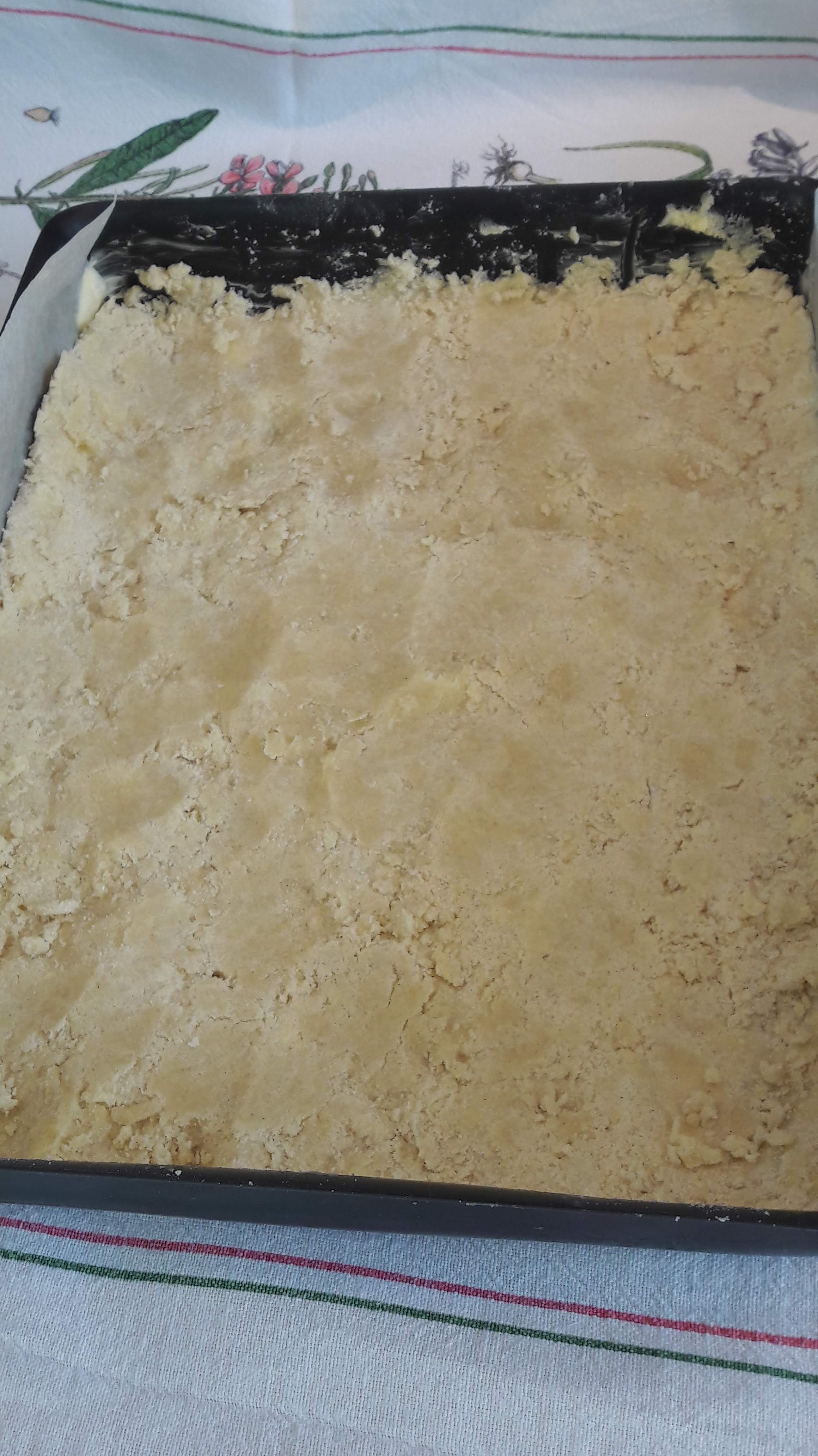
  • Grease and line the baking tin with one long piece of baking paper.
  • Roll out the plain shortcrust to fit into the tin.
  • Roll out the chocolate shortcrust and place this on top.
  • Prick with a fork all over.
  • Bake for around 20 – 25 minutes.
  • Leave to cool completely.

Sour Fruit Layer

  • Spread jam (sour cherry, blackcurrant or gooseberry) over the pastry.
  • If you jam is sweet – heat it up with the addition of the juice of a lemon or two first.
  • Leave to cool.
  • Add some fresh or frozen fruits if you have them.

Meringue Layer

  • Pre-heat oven to GM3 – 160°C.
  • Use 3-4 egg whites & 50g icing sugar per white.
  • Place the whites into a grease free bowl.
  • Whisk till stiff.
  • Add icing sugar and whisk again till stiff.
  • *
  • Spread meringue over the top of the fruits.
  • Bake for 30 – 35  minutes.
  • Can be longer or shorter depending on if you want the meringue crisp or soft.
  • *
  • Leave to cool.
  • Cut into squares when serving.

Royal Standard – Lyndale tea plate.

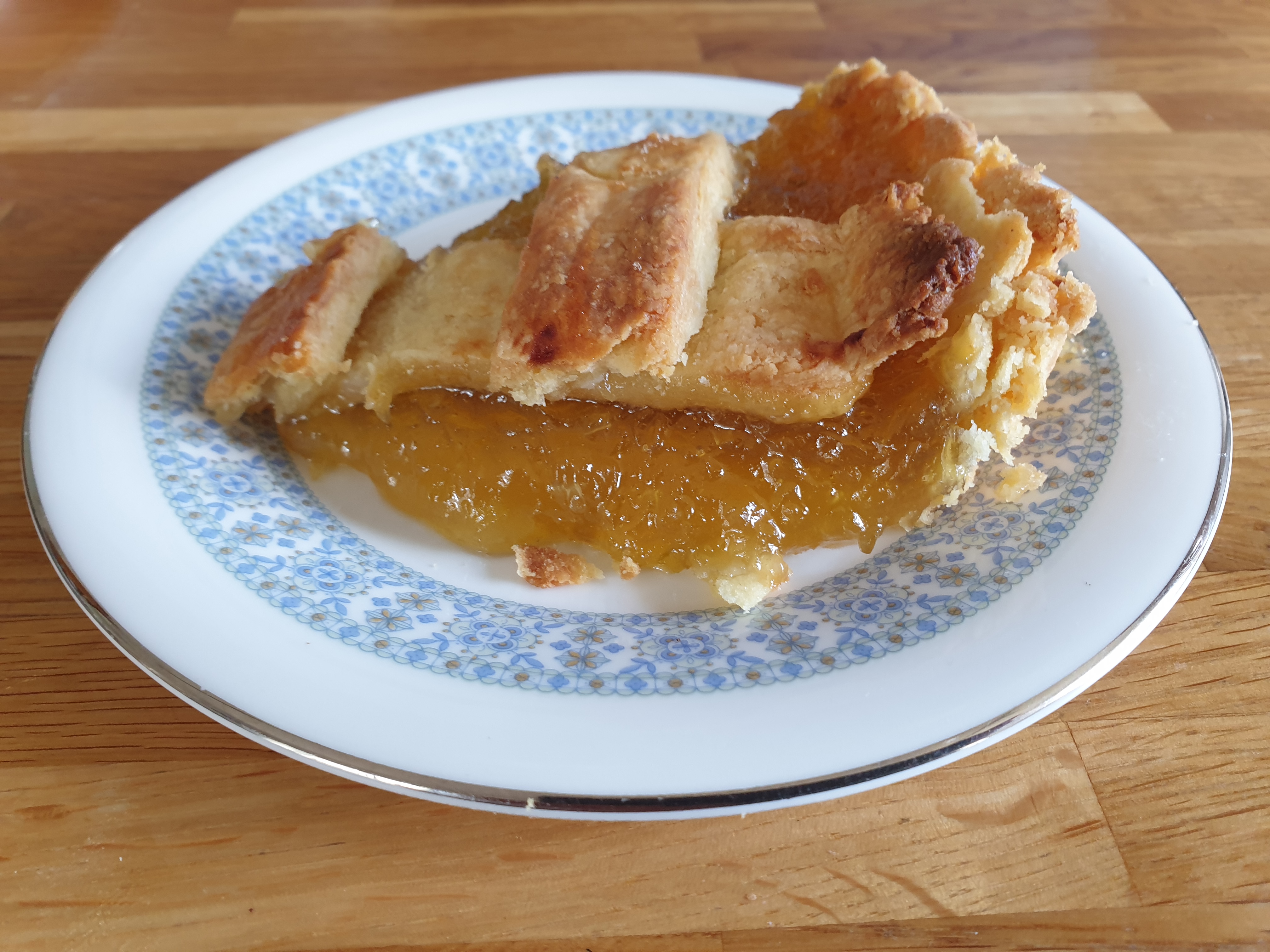
Courgette Tart

  • This delicious recipe originated from an old Yorkshire recipe for marrow  tart.
  • Did you know that marrow and courgettes are varieties of the same species – Cucurbita pepo
  • As courgettes are more abundant in shops now I decided to use these in the tart.
  • The amount of sugar in the original recipe was too much – everyone thought it was too sweet.
  • The ratio of courgettes to sugar has been adjusted and now very well liked.

INGREDIENTS

  • Shortcrust pastry – kruche ciasto
  • *
  • 500g courgettes
  • 2 large lemons
  • 350g sugar
  • 85g butter
  • *
  • Beaten egg white to brush

METHOD

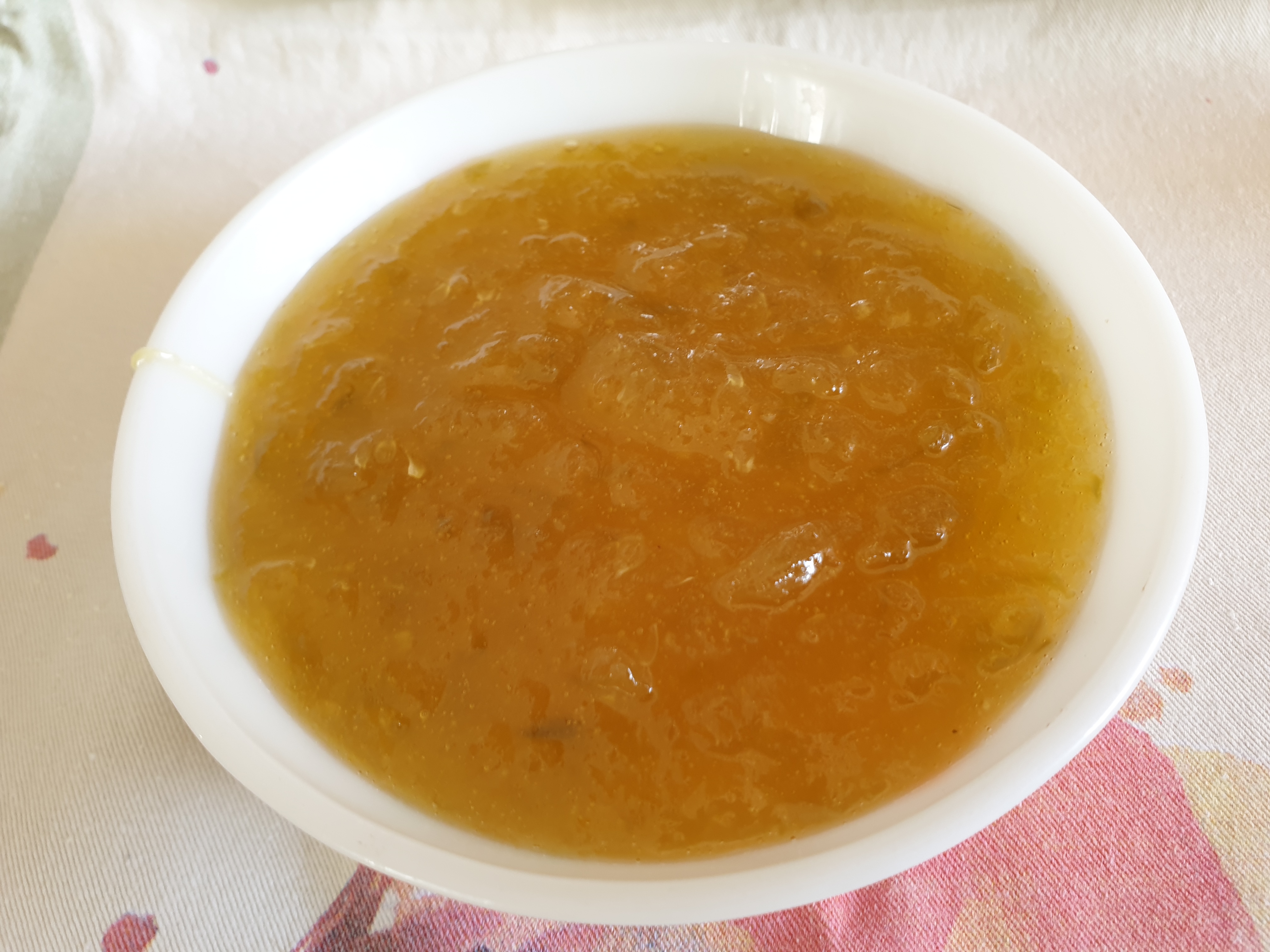
  • First make the filling.
  • Peel the courgettes and cut them into chunks.
  • Steam the courgettes till they are soft.
  • Leave to cool and dry them off.
  • Mash the courgettes using a potato masher.
  • Put the courgettes, lemon rind and juice, sugar and butter into a small saucepan.
  • Heat them up and simmer whilst stirring until the mixture is thick.
  • Leave to cool completely.
  • *
  • Pre-heat the oven to GM6 – 200°C.
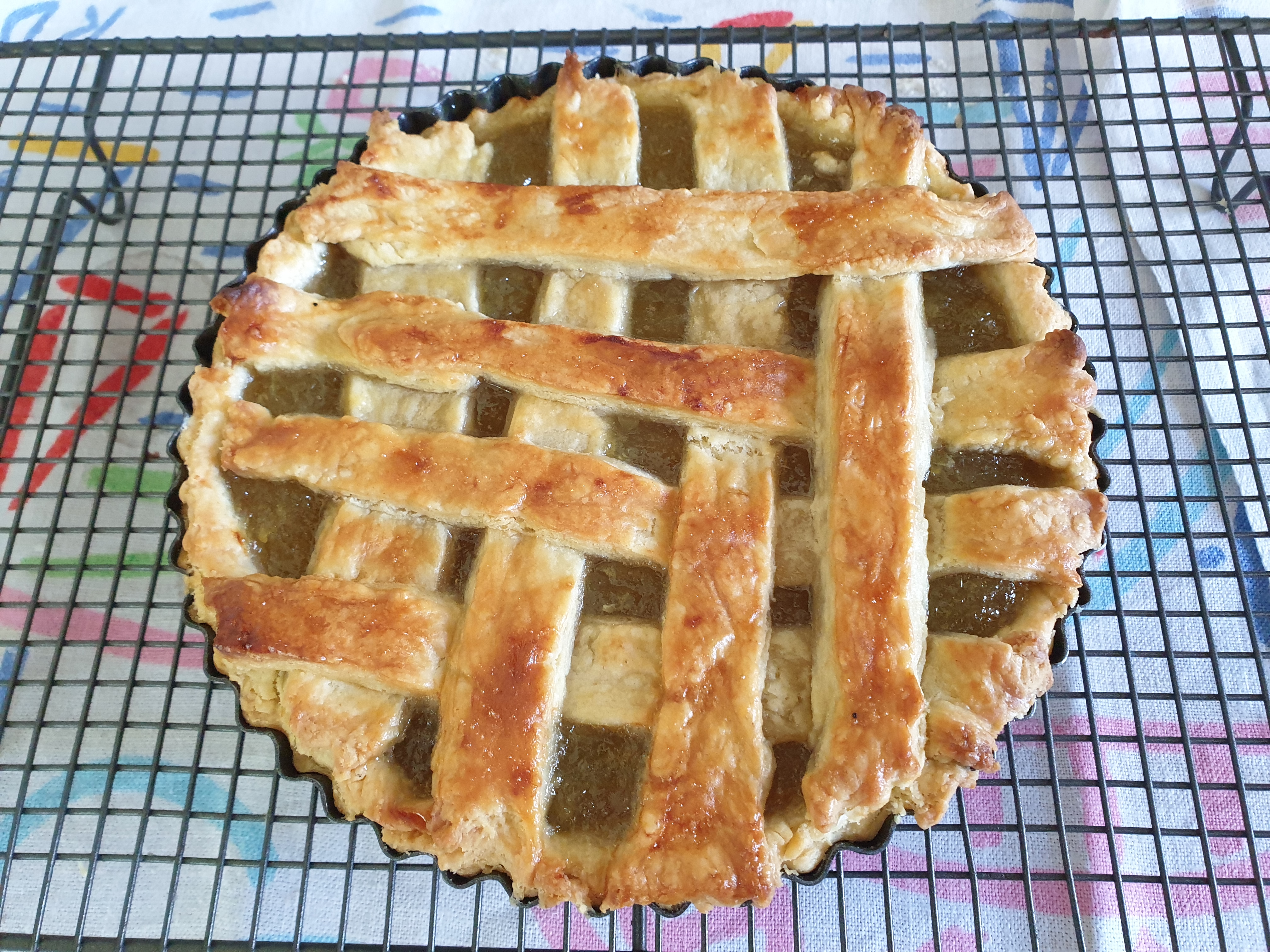
  • Line a tart tin – loose bottomed is best – with the shortcrust pastry.
  • Place on a metal baking sheet.
  • Fill with the filling.
  • Use strips of pastry to partly cover the top.
  • Brush the pastry with the egg white.
  • Bake for 25 to 30 mins.
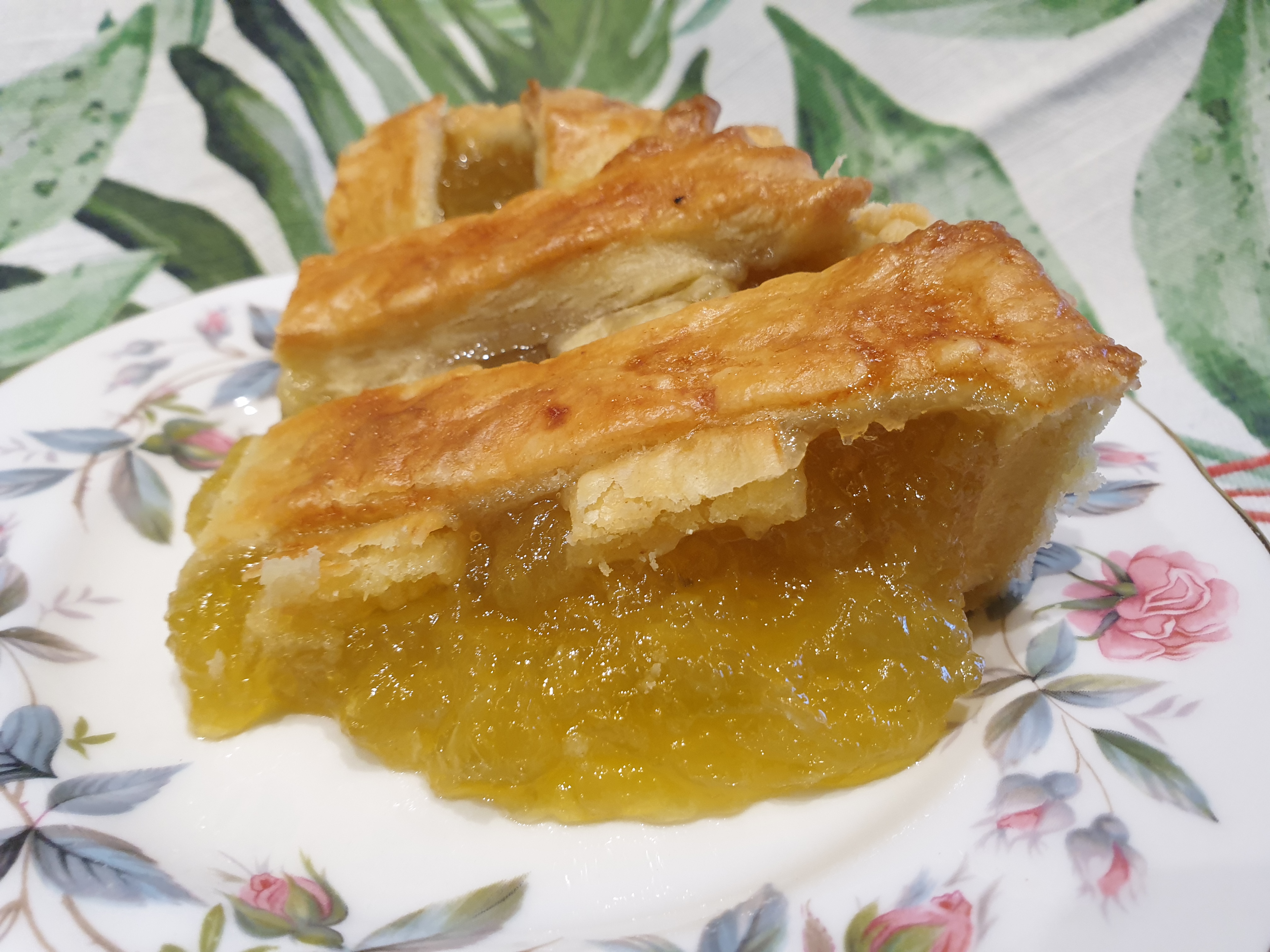
  • Royal Doulton Sonnet &
  • Duchess Silver Rose Tea Plates
  • *
  • I am sure I will be able to think of other other ideas for this filling.

Baking with Cranberry Mincemeat 1 – Easy Little Pies

  • These are the small version of the Easy Apple Cake posted recently.
  • Use the same amount of pastry and divide it into 8 or 6 portions.
  • *
  • Shortcrust pastry made from 200g plain flour, 100g butter, 1 egg yolk, juice of 1 lemon, extra water if necessary – 2 tablespoons of icing sugar optional.
  • *
  • Grease a large baking tray or two.
  • Pre-heat the oven to GM6 – 200°C.
  • Roll out each piece of pastry into a thin rough circle.
  • Brush the centres with some egg yolk.
  • Add a 1-2 tablespoons of the Cranberry mincemeat.
  • Bring up the sides but do not totally cover the filling.
  • Join up the pastry slightly.
  • Brush beaten egg white over the pastry.
  • Sprinkle a little granulated over the sides.
  • Place pies on the baking sheet.
  • Bake for 15 – 20 minutes till golden.
  • Leave to cool still on the baking tray for a few minutes and then transfer onto a wire rack.
  • Serve slightly warm or leave to cool completely.
  • Evesham plate by Royal Worcester. 

Flat Sernik

  • Today is the 7th anniversary of my first post on this blog! 
  • This is my 490th post.
  • I have enjoyed doing this so much.
  • I still have lots of recipes old and new to try out.
  • My friends and relative keep giving me ideas and recipes – long may that continue.
  • This recipe is a cross between old and new.
  • I found this recipe in an old book and adapted it slightly.
  • It is a good recipe for when you do not have a large quantity of  cheese.
  • The sernik – baked cheese cake, is made in a rectangular baking tray.
  • It is really a placek – flat cake.
  • Shortcrust pastry – kruche ciasto – is used as a base.
  • Best to use a rich buttery shortcrust

Ingredients

  • Shortcrust  pastry  made from around 250 -300g flour
  • *
  • 300g -350g yoghurt cheese or cream cheese
  • 4 egg yolks
  • 90g granulated sugar
  • 30g ground almonds
  • Fine grated zest of 1 lemon
  • 50g sultanas
  • 50g mixed chopped peel

Method

  • Make enough pastry for a 18 x 28cm baking tray.
  • Pre-heat oven to GM6 – 200°C
  • Grease the baking tray.
  • Roll out the pastry thinly to cover the base of the tin and raise up the sides.
  • Crimp the sides to form an even pattern.
  • Prick the surface with a fork.
  • Cover the base with foil and baking beans.
  • Bake for 10 – 15 minutes.
  • Remove the beans and foil and bake again for 8-9minutes.
  • Leave to go cold completely.
  • *
  • Pre-heat the oven to GM3 – 160°C.
  • *
  • Mix all cheese, yolks, sugar, almonds and lemon zest together.
  • Stir in the sultanas and peel.
  • Spread the filling over the pastry to fill the “hollow”.
  • Bake for 50 – 55 minutes.
  • Turn off the oven.
  • Leave in the oven for 20 – 25 minutes.
  • *
  • Cut into rectangles to serve.

Served on Crown Staffordshire Tea Plate – Design not known.

Optional but not tried – orange zest rather than lemon zest.

Placek with Prunes – 2

  • I have an earlier post –  prune placek, which is quite different from this one.
  • This placek – flat cake- has a filling of prunes.
  •  The pastry used is a variation on my Polish  kruche ciasto – shortcrust pastry.
  • Prunes often feature in Wigilia – Christmas Eve dishes.
  • A prune filling like this is used in a tart baked in Belgium and eaten on Ash Wednesday. (17 February in 2021)

Ingredients – Pastry

  • 225g plain flour
  • 110g butter
  • 1 tablespoon of granulated sugar
  • 2 egg yolks
  • 5 tablespoons of water
  • *
  • 1 tablespoon of caster sugar to sprinkle

Ingredients – Filling

  • 300g of prunes – stoned
  • 1 small cinnamon stick
  • 2 sprigs of rosemary
  • 1 tablespoon of granulated sugar
  • 1 lemon – grated rind and juice

Method – Filling

This filling needs to be cold – so make this first.

  • Put the prune, cinnamon stick and rosemary in a large bowl.
  • Cover these with boiling water.
  • Leave overnight.
  • *
  • Remove the cinnamon stick and rosemary.
  • Put the prunes and liquid  into a  pan.
  • Add the lemon rind and juice.
  • Heat gently  and stir occasionally until the prunes are soft and the water is adsorbed.
  • Use a stick blender to turn the prunes into a pulp.
  • You might have to heat gently again to make sure the pulp is thick.
  • Leave to go completely cold.

Method – Pastry

  • A rich pastry is made in the traditional rubbed in method with the ingredients listed above.
  • Chill the pastry for around 30 minutes.
  • *
  • Pre-heat the oven to GM 5 – 190°C.
  • Grease and line a shallow tray 21cm x 26cm.
  • Divide the pastry into two.
  • Roll out one piece to line the bottom of the tin.
  • Spread the filling evenly over the pastry – not quite to the edges.
  • Roll the second piece of pastry out and use to cover the filling.
  • Press the edges down to seal.
  • Make some diagonal slashes across the top.
  • Bake for around 30 minutes until golden.
  • Remove from the oven and sprinkle with the caster sugar.
  • Leave to cool in the tin.
  • Cut into squares when cold.

Royal Doulton – Counterpoint tea plates – 1973-1987

Mincemeat – Squares

  • Fruit mincemeat pies I think of these as very British – but we all love them and they have become part of our Christmas Day and New Year celebrations.
  • I use my mother’s recipe for the pastry  –  kruche ciasto – shortcrust pastry.
  • I like the size and proportions of little mince pies, which seem to just jump of the plate into my hand!
  • However they are time consuming to make so I have come up with this easier version, which I make after the holidays.
  • Poles would say the mincemeat is a version of bakalie and this recipe is a placek – flat cake.

Mincemeat

I always make my own mincemeat using the recipe in Delia Smith’s Christmas cookery book but without the chopped almonds (I do not like the crunch of the nuts).


When using the mincemeat I add a little extra brandy or sherry and stir it in.

Ingredients – Pastry

  • 225g plain flour
  • 110g butter
  • 1 tablespoon of granulated sugar
  • 2 egg yolks
  • 5 tablespoons of water
  • *
  • 1 tablespoon of caster sugar to sprinkle

Method – Pastry

  • Rub the butter into the flour to make “breadcrumbs”.
  • Mix in the granulated sugar.
  • First with a knife and then with your fingertips mix in the yolks and  some of the water – until it comes together.
  • You are aiming to get a dough which is not wet.
  • Chill the pastry for around 30 minutes.
  • Pre-heat the oven to GM 5 – 190°C.
  • Grease and line a shallow tray 21cm x 26cm.
  • Divide the pastry into two.
  • Roll out one piece to line the bottom of the tin.
  • Spread the mincemeat evenly over the pastry – not quite to the edges.
  • Roll the second piece of pastry out and use to cover the filling.
  • Press the edges down to seal.
  • Bake for around 30 minutes until golden.
  • Remove from the oven and sprinkle with the caster sugar.
  • Leave to cool in the tin.
  • Cut into squares when cold.

Tea plates by Queen Anne – unknown pattern name


Save

Custard Tart

  • Whilst trying out some old English recipes I made this custard tart.
  • It is made with a shortcrust pastry case, which is filled with an egg custard.
  • Ground nutmeg is a popular spice in England.

I think that this would be liked in Poland as it is similar to Budyń – Polish custard which is also made from milk, egg yolks and sugar.

  • Shortcrust pastry or a richer pastry such as  kruche ciasto is used.
  • The pastry case is baked blind first in a loose bottomed tart tin.
  • This can be made the day before.

Ingredients

  • Shortcrust pastry to line the base and sides of a 20cm diameter loose bottomed tin
  • 300ml of milk
  • 3 tablespoons of sugar
  • 4 eggs – beaten
  • Freshly grated nutmeg

Method

  • Pre-heat the oven to GM6 – 200°C.
  • Roll out the pastry thinly and line the base and sides of the tin.
  • Bake blind for 15 minutes.
  • Take out the “beans” and bake for another 5 minutes.
  • Leave the pastry to become completely cold.
  • Lower the oven to GM4 – 180°C.
  • Put the tart tin on a baking sheet (makes it easier to handle).
  • Have the beaten eggs in a large bowl.
  • In a deep saucepan, add the sugar to the milk and gently bring to the boil, stirring a few times.
  • Pour the hot milk mixture onto the beaten eggs and whisk together quickly.
  • Allow the mixture to cool completely.
  • Pour the egg mixture into the baked pastry case.
  • Grate the nutmeg liberally over the surface of the custard.
  • Bake for 30 – 35 minutes until the custard is nearly set.
  • Turn of the oven and open the door slightly.
  • Leave the custard in the oven for around 15 minutes.
  • Take it out and leave to cool on a wire cake rack.
  • Leave it to cool before taking it out of the tin.
  • Serve at room temperature.


Tea plates:

  • Burleigh Ware – Burges and Leigh Ltd – Blue Mist from the 1930s
  • Aynsley – Las Palmas from the 1960s.


Prune Placek

This recipe was given to me by one of my cousins (British born like me) who lives in Wembley.

Although this is not a traditional Polish recipe it does reminds me of a Polish placek (flat cake) and contains prunes which are very popular and used in many recipes in Poland.

There is a base of  easy to make shortcrust type pastry, a layer of softened prunes and a cake topping which contains oats and sesame seeds.

Muscovado sugar is used – this is definitely not a Polish sugar as it is produced in the process of refining sugar cane whilst in Poland sugar is made from sugar beet.

Note

You can make the filling ahead of when  you need it as it has to be cold.  I often make the base and the filling in the evening and then finish the placek the next day.

Ingredients

Base

175g plain flour

125g butter or margarine

50g caster sugar

Filling

225g no-need-to-soak prunes

1 tablespoon dark muscovado sugar

1 tablespoon of cornflour

Water

Topping

120g butter or margarine

60g caster sugar

1 tabelspoon of honey

125g no-need-to-soak prunes

100g self-raising flour

1/2 teaspoon of bicarbonate of soda

100g rolled oats

50g sesame seeds (keeping  back 2 tablespoons to sprinkle on the top)

Method

Base

Pre-heat the oven to GM 4 – 180°C

Grease and line a rectangular 20 x 27cm tin.

Rub the butter into the flour to made breadcrumbs.

Mix in the caster sugar.

Bring the mixture together to make a dough.

Press the dough into the tin.


Bake the base for around 25 minutes until it is golden on top.

Leave till it is cold.

Filling

Cover the prunes with water in a small pan and add the sugar.

Simmer the prunes, sugar and water  for 10 minutes until you have a soft pulp – take care not to boil the mixture dry – add more water if needed.

Mix the cornflour with some water to form a paste and add this to the mixture and stir until it thickens.

Remove from the heat and leave it till it is cooled completely.

Spread the filling on top of the pastry base.

Topping

In a pan gently melt the butter, sugar and honey.

Leave to cool slighty.

Chop the prunes into small pieces.

Add the prunes to the butter mixture and mix .

In a bowl mix the flour, bi-carbonate of soda, oats and sesame seeds.

Add the butter mixture to the dry ingredients and mix well in.

Spread this mixture over the prune filling.

Sprinkle the reserved sesame seeds over the top.

Bake for 25 – 30 minutes until the top is golden.

Cut into squares or rectangles to serve.

Variations

Other dried fruits can be used for the filling  – such as apricots, dates or figs.


The serving cake plate is a recent purchase from Leeds second hand market.

The design is Field Fare by James Cooper for Washington Pottery, Hanley, Staffordshire from around the 1950s.

The cups and saucers are another very recent purchase from a local car boot sale.

They are bone china by Colclough, pattern number 8266, from I think the 1970s.

The stoneware tea plate is Blue Mist, Burleigh Ware by Burges and Leigh Ltd  from the 1930s.


Mince Pies

I think of these as very British – but we all love them and they have become part of our Christmas Day celebrations. Originally the pies were made with meat and this idea of meat and spices came from the Middle East and it is thought to have been the brought back by the Crusaders.

I make these with the pastry that I learnt from my mother  – a variation on kruche & półkruche,  pastry (a richer shortcrust pastry).  Using the proportion of 2 parts flour to 1 part butter.

Ingredients

Pastry

200g plain flour

100g butter or block margarine

1-2 tablespoons of icing sugar

1 egg yolk

Juice of 1 lemon (and maybe 1 tablespoon of cold water)

Glaze

Lightly beaten egg white

Caster sugar

Mincemeat

I always make my own mincemeat using the recipe in Delia Smith’s Christmas cookery book but without the chopped almonds (I do not like the crunch of the nuts).

When making the pies I add a little extra brandy or sherry to the mincemeat and stir it in.

My tins are anodised aluminium and have a gentle rounded shape, this I think make for the perfect balance between the pastry and the filling.

I put “tops” on my mince pies – but not fully covered ones.

The tops are brushed with beaten egg white and sprinkled with caster sugar.

Method for pastry

Rub the butter into the flour to make “breadcrumbs”.

Mix in the icing sugar.

First with a knife and then with your fingertips mix in the yolk & lemon juice (and  maybe a tablespoon of cold water.)

You are aiming to get a dough which is not wet.

Rest for about 10 minutes.

Pre-heat the oven to GM6 – 200°C

You need to grease the tins well in order to get the pies out successfully.

I often use the pastry in two halves.

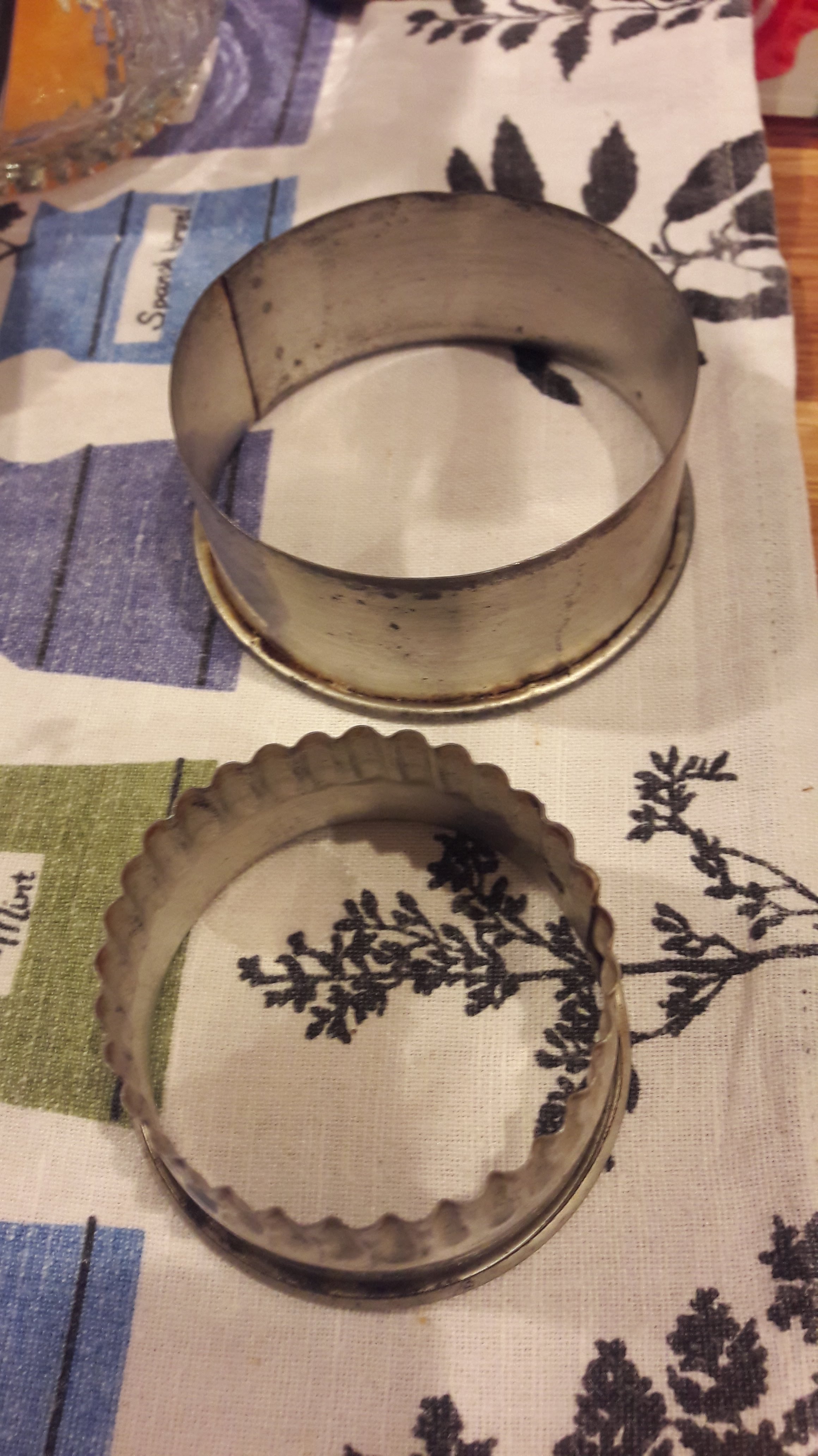
2 sizes of cutters are needed – 1 – 7cm diameter, plain, for the base, 1 – 6cm diameter, crinkle edge for the top.

Cut out the bases and place them in the tins

Place around a tablespoonful of mincemeat on the pastry.

Place the smaller tops on.

Lightly beat the egg white and brush this on the tops

Sprinkle caster sugar over the egg white.

Bake for around 15 minutes – keeping an eye on them – so they do not burn.

Leave to cool slightly in the tins & carefully remove them onto a rack to fully cool.

Tea-plate is Stardust by Colclough from the 1960s.

Mince pies on buffet table

Save