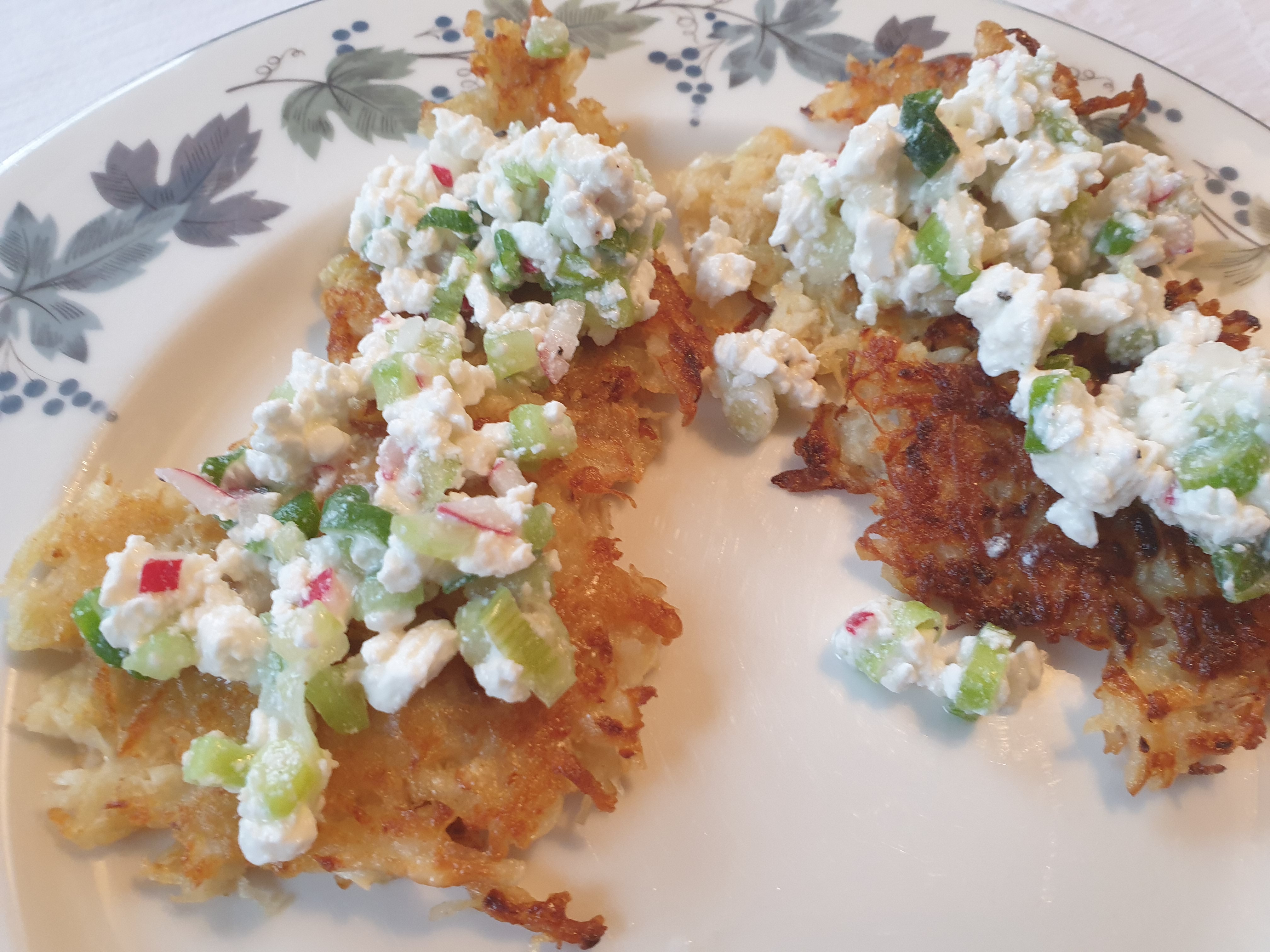
Yoghurt Cheese Salad

INGREDIENTS

  • 250g of full fat twaróg or yoghurt cheese
  • Bunch of radishes – finely sliced
  • 1 large gherkin – chopped into small cubes
  • Bunch of spring onions – finely chopped – white and green parts
  • Salt & Pepper to taste
  • *
  • Some Greek style yoghurt or soured cream – may be needed to loosen up the cheese.
  • OPTIONAL
  • ½ fresh cucumber – peeled, deseeded and chopped into small cubes.

METHOD

  • Mix the twaróg or yoghurt cheese with the radishes, gherkins and spring onions.
  • Add the cucumber if using.
  • Add the yoghurt or soured cream if needed.
  • Season to taste.

Fruit & Sweet Cheese Cake

  • I tried this recipe from one of my recently bought Polish magazines.
  • I have not make a cake dough with twaróg/yoghurt cheese before.
  • I would only make a small alteration to the amounts in the ingredients next time – a little more sugar with the topping of twaróg/yoghurt cheese which is how I have written this up.
  • It was huge success.

INGREDIENTS

  • 250g plain flour
  • 100g granulated sugar
  • 2 teaspoons of baking powder
  • ¼ teaspoon of salt
  • 120g – melted butter – allowed to cool.
  • 3 eggs
  • 125g + 125g twaróg/yoghurt cheese (very well strainned)
  • 1½ – 2 tablespoons of icing sugar
  • 300g of fruit – around 150g of apples – the rest blackberries/raspberries or fruits of the forest (can be frozen – defrosted and dried with kitchen roll).
  • *
  • Sieved icing sugar to serve.

METHOD

  • Grease and line on 3 sides  a 20 x 26cm baking tin.
  • Pre-heat the oven to GM3 – 160ºC.
  • Mix the dry ingredients together in a bowl.
  • In another bowl mix lightly whisk together the eggs and 125g of the twaróg/yoghurt cheese
  • Mix the contents of the 2 bowls together.
  • Add the cooled, melted butter and mix to get a soft dough.
  • Press the dough into the tin.
  • *
  • In a bowl mix the other 125g of the twaróg/yoghurt cheese with the icing sugar.
  • *
  • Peel and core the apples
  • Slice them into very thin slices.
  • *
  • Spread the sweetened twaróg/yoghurt cheese over the dough nearly up to the edges.
  • Sprinkle the apple slices over this.
  • Then sprinkle on the black fruit (I used fresh blackberries).
  • (I should have used more – did not have enough).
  • Bake for 55 to 65 minutes .
  • *
  • Sprinkle with icing sugar to serve.
  •  

Pierogi – Cheese Savoury

  • Mama made these very often – I loved them.

  • She often made them for Friday, when this was a meatless day.
  • In Poland you may see these savoury cheese ones on a menu  as Pierogi ruskie   – that is  Ruthanian pierogifrom the old word for the Ukraine.
  • My mother would  boil extra potatoes on one day and save some to make these fillings the next.
  • They are super fried up later.

Ingredients – Cheese 1

Method

  • Peel and boil the potatoes in salted water, strain and mash, then leave to cool.
  • Chop the onion finely and fry it till it is soft and golden, allow it to cool.
  • Mix together thoroughly, the potatoes, onions, cheese and egg yolk.
  • Add salt and pepper to taste.

Ingredients – Cheese 2

  • When my mother did not have any curd cheese, she used Lancashire cheese, as that was the cheese most readily available to her.
  • Both versions taste good, the secret with this one is to grate the cheese as finely as possible and mix it in well.
  • *
  • 400g floury potatoes
  • 1 onion
  • 200g white crumbly cheese such as Lancashire
  • 1 egg yolk
  • Butter & oil to fry the onion
  • Salt & ground black pepper to taste

Method

  • Peel and boil the potatoes in salted water, strain and mash, then leave to cool.
  • Chop the onion finely and fry it till it is soft and golden, allow it to cool.
  • Grate the cheese as finely as possible.
  • Mix together thoroughly, the potatoes, onions, cheese and egg yolk.
  • Add salt and pepper to taste.

Make the pierogi in the usual way – instructions are given below.

  • Ingredients – Dough

  • 500g pasta flour or strong flour or plain flour & 2 tablespoons of fine semolina
  • 300ml water
  • 1 – 2 tablespoons oil – sunflower or light olive
  • ½ teaspoon salt
  • 2 egg yolks
  • *
  • Melted butter for serving or chopped onions cooked in butter.

Method – Dough

  • In a jug or bowl mix together the water, oil and the yolks.
  • Put the flour and salt into a large bowl and make a well in the centre.
  • Pour in the liquid from the jug and initially use a knife to mix this into the flour and then use your hands to mix the liquid and flour to get a ball of dough.
  • Turn this out onto a floured board and knead the dough for a few minutes until you have a smooth ball.
  • Cut the dough into quarters.
  • On a floured board roll out a quarter at a time until you have a sheet of thinly rolled dough.
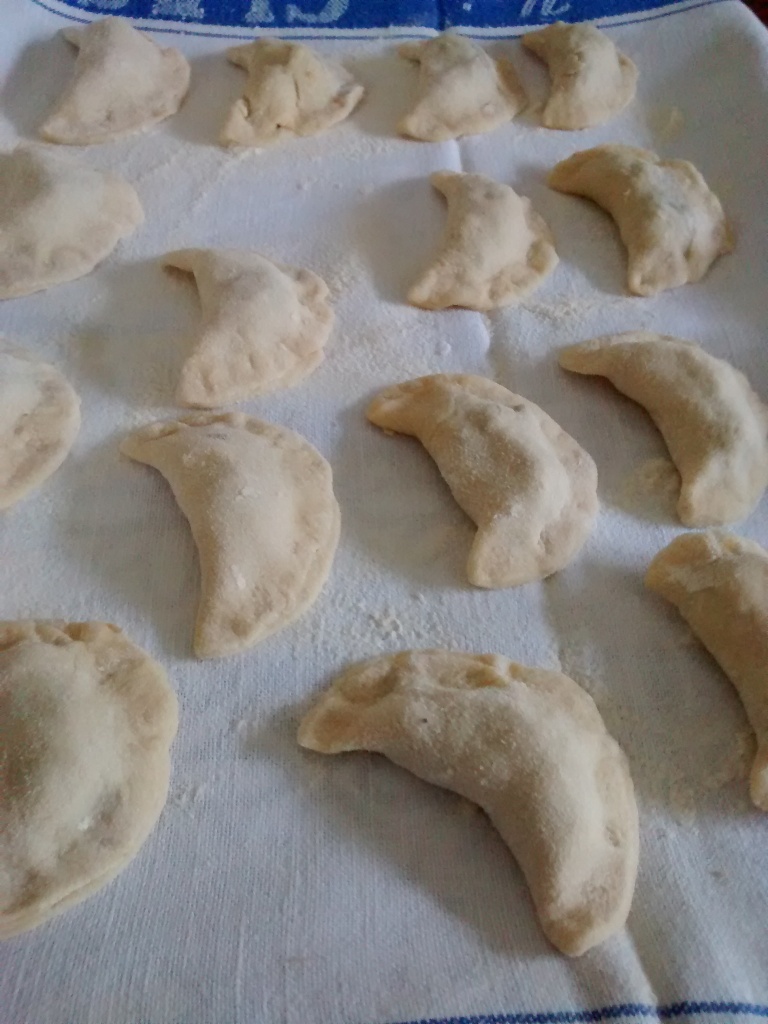
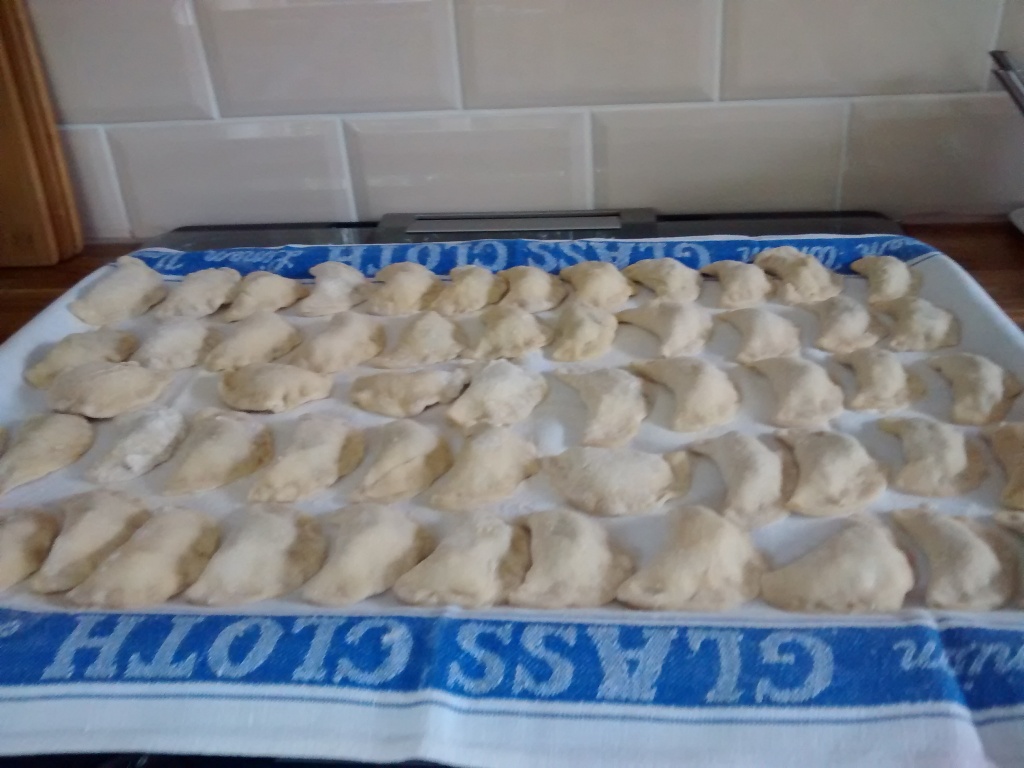
  • Now prepare a large tray and cover it with a clean tea towel and sprinkle this with flour.
  • Have a large surface such as a tray covered with a cotton or linen cloth which has been lightly floured ready  and place the sealed pierogi on this until they are all made, do not let then touch each other.
  • I cut them out using a 7 cm diameter cutter.
  • I have noticed some people make them larger – I will try this out soon.
  • The excess dough can be re-mixed and rolled out again.
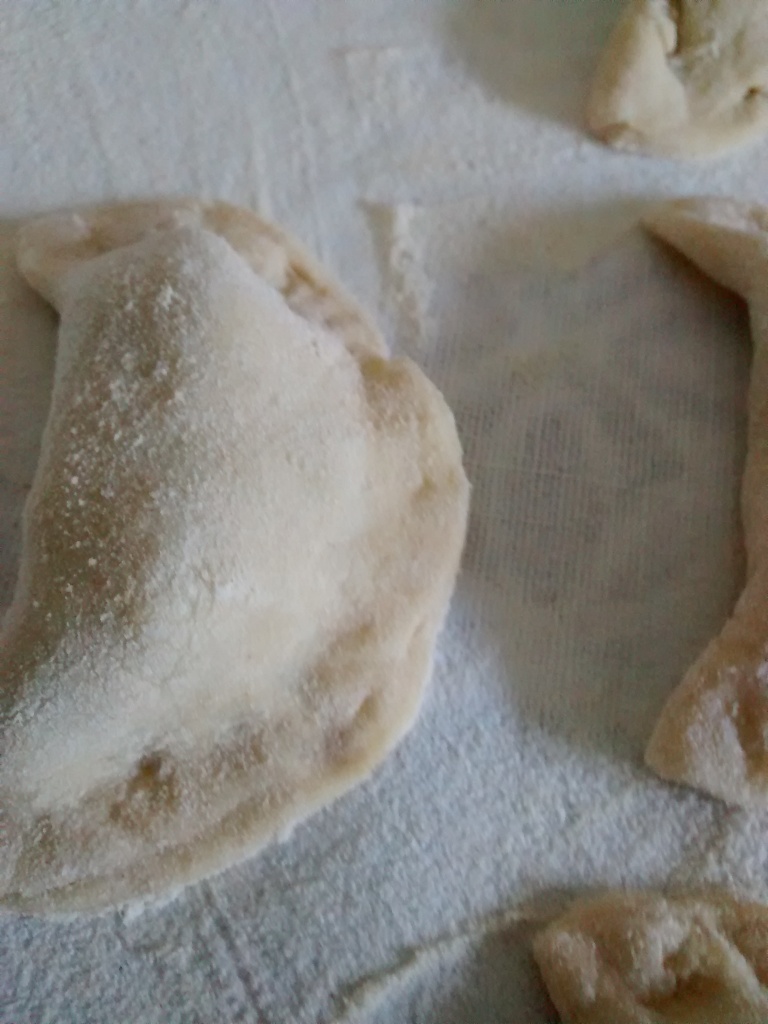
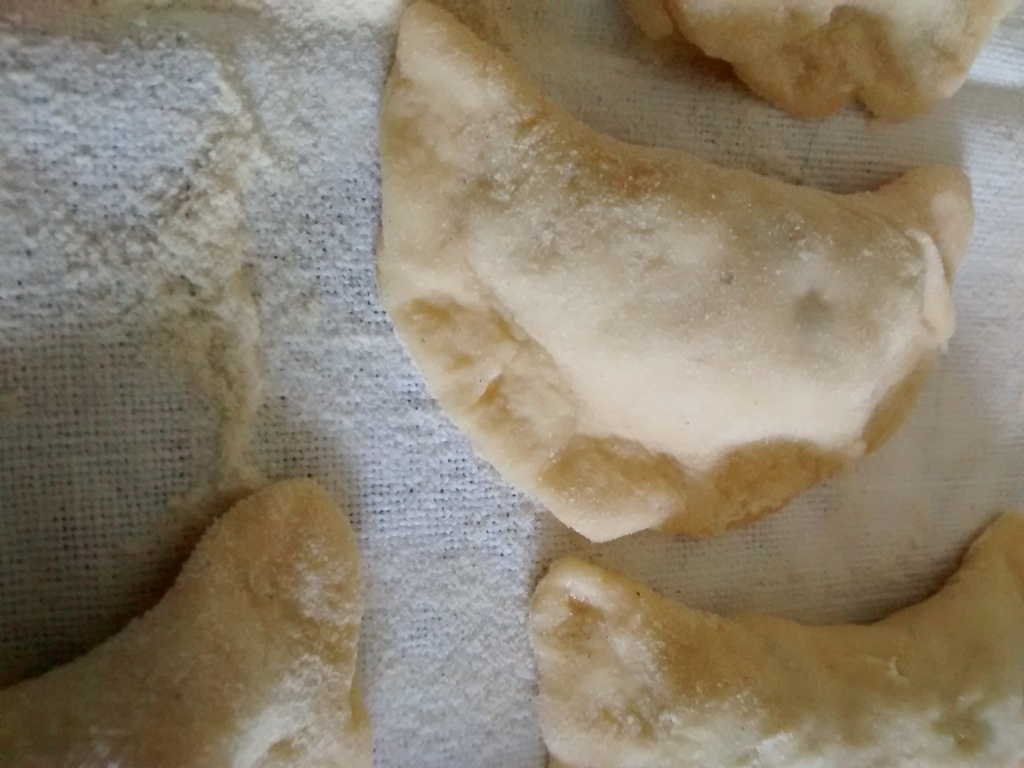
  • Around a half tablespoon of filling is put on  each circle and then they are folded over and the edges pinched together to make a good seal.
  • You learn from experience how much filling to put in as too much will make it hard to seal them and if not properly sealed they will burst on boiling. 
  • Do not worry if you have a few mishaps – it still happens to me even with experience – it is hard to salvage one that has gone wrong – just accept that there will be a few that you do not cook.
  • *
  • To cook the pierogi, use a large pan of boiling water to which you have added some salt and a drizzle of oil.
  • Drop the pierogi in one by one and allow them to boil.  I usually do about 6 to 8 at a time (I only do 6 at a time if using frozen ones).
  • As they cook they will float to the surface, let them boil for 2 to 3 minutes, (a bit more if they were frozen*), and
  • Then remove them with a slotted or perforated spoon and put into a colander above a pan for a few seconds to drain and serve.
  • Continue boiling batches in the same water.
  • If you want to make all the pierogi to serve together then you need to get a large shallow dish.*
  • Put in the pierogi and add melted butter.
  • Keep the dish warm in a low oven.
    • *I often open freeze them for later.

Chocolate Roll

  • This cake would be called a rolada in Polish.
  • The baking of this is simple – the hardest part is adding the filling and rolling it back together.
  • You can make many versions of this with different fillings.
  • Here I have used a sour cherry jam layer and a sweet curd or cream cheese layer on top.

Ingredients – Cake

  • 2 eggs
  • 75g caster sugar
  • 50g Plain flour
  • 1 teaspoon baking powder
  • 25g cocoa powder
  • *
  • extra sugar for rolling

Ingredients – Filling

  • Sour Cherry Jam & a little water
  • *
  • 150-200g  yoghurt cheese or cream cheese
  • 1-2 tablespoons of soured cream
  • Icing sugar to taste

Method – Cake

  • Pre-heat the oven to GM 7 – 220°C.
  • Grease and line a 24 x 34cm baking sheet.
  • *
  • Have ready 2 more sheets of baking paper.
  • Lay one of these flat and sprinkle with caster sugar.
  • *
  • Whisk the eggs and sugar until light, pale and fluffy.
  • Mix the flour, baking powder and cocoa together till uniform.
  • Fold in the flour mixture with a metal spoon.
  • Spread the mixture over the prepared tin with a spatula –
  • Getting to all the edges as nearly as possible.
  • Bake for 7- 8 minutes.
  • DO NOT OVERBAKE or it will crack later.
  • Take out the cake and tip it onto the sugared paper.
  • Peel off the paper which was under the cake.
  • Using a metal spatula can be helpful.
  • Put the third sheet of baking paper on top of the cake.
  • Roll up the cake from the narrow end with the paper inside.
  • Leave the cake to cool completely.

Method – Filling

  • Use a small saucepan to thin down the jam by adding a little water, mixing and heating it gently.
  • Leave to cool completely.
  • *
  • Mix the cheese ingredients to taste.
  • You want a soft spreadable mixture.

Assembling the cake

  • Unroll the cake gently and flatten a little.
  • Spread on the jam over the whole cake.
  • Spread on the sweet cheese mixture over the jam.
  • Roll up the cake again.
  • Leave in a cool place for about an hour before serving.
  • Serve as thick slices
  • *
  • Can taste even better the next day as the jam seeps into the cake.
  • Served on Royal Doulton – Flirtation from the late 1970s.

You can try this with a variety of options with different jams and flavours for the sweet cheese. 

Fruity Twaróg Desserts

  • These desserts are a more fruity version of twaróg desserts 
  • As well as flavoured jellies and twaróg, puréed tinned fruits such as peaches, apricots and pears or runny jams are used.
  • The jelly, fruit and twaróg mixture is left to set in a bowl and scoops are then put into individual serving dishes.
  • The flavours and fruits used here are just examples – use the flavours of jellies that you like as well as the fruit.

Ingredients – Raspberry

  • 1 packet of raspberry jelly
  • 250 – 350g of twaróg , yoghurt cheese or cream cheese
  •  4 tablespoons of raspberry jam

Ingredients – Peach

  • 1 packet of lemon or orange jelly
  • 250 – 350g of twaróg , yoghurt cheese or cream cheese
  • 1 tin of peaches

Ingredients – Apricot

  • 1 packet of lemon or orange jelly
  • 250 – 350g of twaróg , yoghurt cheese or cream cheese
  • 1 tin of peaches

Toppings

  • Fresh fruit chopped
  • Tinned or bottled fruit chopped
  • Thickened syrup made from tinned fruit juices and potato flour
  • Sauce made from runny jam or jam and water (heated and cooled)
  • Grated chocolate or chocolate flake
  • Mint or lemon balm leaves

Method

  • Make up a packet of jelly with 200ml of boiling water.
  • Leave to cool.
  • Drain the fruit from the syrup.
  • Purée the fruit .
  • Or gently heat the jam with some water and then cool.
  • Whisk in the twaróg and fruit or jam into the cooled jelly mixture.
  • Pour into a large bowl.
  • Leave to set in the fridge.
  • Put scoops into individual glasses.
  • Add the toppings.

Note – you can make two flavours and serve scoops of each.

Twaróg Dessert

  • This dessert is one I make when I do not wish or have time to to make a layered torcik
  • The jelly and twaróg mixture is left to set in a bowl and scoops are then put into individual serving dishes.
  • The more twaróg you use the softer will be the mixture.
  • As I do not really like to drink milk using twaróg ensures I get calcium in my diet.
  • The flavours and fruits used here are just an example – use the flavours of jellies that you like as well as the fruit.

Ingredients

  • 1 packet of lemon jelly
  • 250 – 400g of twaróg , yoghurt cheese or cream cheese
  • Juice and rind of 1 lemon
  • *
  • Toppings
  • Bottled blackcurrants – drained
  • Grated chocolate or chocolate flake

Method

  • Make up 500ml of jelly as per the packet instructions.
  • Add the lemon juice and rind.
  • Leave to cool.
  • Whisk in the twaróg and mix till all  is blended in.
  • Pour into a large bowl.
  • Leave to set in the fridge.
  • Put scoops into individual glasses.
  • Add the toppings.

Pulpety – Meat & Cheese

  • I came across this version of pulpety  (Polish meatballs) recently and thought I would give these a try as I always have lots of yoghurt cheese.
  • Both beef and pork are used in this recipe and I often do mix these two meat minces together.
  • Dried breadcrumbs are not used in this recipe.
  • The bread is not moistened with milk.
  • The following amounts made 30 pulpety.

Ingredients

  • 200g minced beef
  • 200g minced pork
  • 200g twaróg(curd cheese) or yoghurt cheese (well drained)
  • 2 small onions diced (I might wiz them up in a mini-chopper next time)
  • 2 teaspoons of Italian herbs
  • Fresh white breadcrumbs from a slice of white bread or a roll.
  • 1 egg
  • Salt & pepper
  • *
  • 500ml of chicken stock – can be from a cube or concentrate
  • *
  • 500ml of a sauce of your choice – I used a simple tomato sauce

Method

  • Mix all the ingredients together to a uniform mixture.
  • Hands are best at the end – the mixture is quite sticky.
  • Pinch off small bits of the meat mixture and roll the piece between your hands to make small round balls and place these onto a floured board or tray whilst you make them all.
  • Leave these to chill in a cool place or in the fridge for an hour or so.
  • Pre-heat the oven to GM4-180°C.
  • Heat the chicken stock in a deep wide frying pan.
  • Add some of the pulpety and simmer with a lid for around 5 minutes.
  • Have a large ovenproof dish ready with your sauce.
  • Remove the pulpety with a slotted spoon and add to the sauce.
  • Repeat with the rest of the pulpety.
  • Put a lid on the dish.
  • Cook in the oven for at least 1 hour.
  • You can lower the heat and cook for longer.

Sauces

The varieties here are endless – make one of your favourite sauces for example mushroom or tomato.

You can then serve them with potatoes, pasta, rice or to be very Polish – buckwheat or pearl barley.


Served in Royal Doulton – Burgundy – 1959-1981


Pierogi with Leeks & Peas

  • Well over a year ago when on a trip to Gdańsk, in one restaurant I saw on the menu pierogi (Polish filled pasta) which had leeks, peas and soured cream as a filling.
  • Although I did not try these, I thought they sounded good and tried out this  mixture as a filling for buckwheat pancakes.
  • At last I have had the time to try this out as a filling for pierogi.
  • I adjusted the filling I had made for the pancakes by using cream cheese (or twaróg or yoghurt cheese) rather than soured cream.

Filling

  • 2 leeks – chopped
  • 50 – 75g frozen peas
  • 2-3 tablespoons of butter
  • 2 -3 tablespoons of cream cheese, twaróg or yoghurt cheese
  • Salt and pepper to taste.

  • Using a deep large frying pan with a lid (a glass one is best), melt the butter and gently cook the leeks to soften them but not brown.
  • Add the frozen peas and cover with the lid and cook for a few minutes.
  • Stir the mixture and continue to heat without the lid to drive off excess liquid.
  • Purée most of the mixture – keeping some of the peas whole.
  • Stir in the cream cheese (twaróg or yoghurt cheese).
  • Season to taste.

Ingredients – Dough

  • 250g pasta flour or plain flour & 2 tablespoons of fine semolina
  • 150ml water
  • 1 tablespoon oil – sunflower or light olive
  • ½ teaspoon salt
  • 1 egg yolk

Method – Dough

  • In a jug or bowl mix together the water, oil and the yolk.
  • Put the flour and salt into a large bowl and make a well in the centre.
  • Pour in the liquid from the jug and initially use a knife to mix this into the flour and then use your hands to mix the liquid and flour to get a ball of dough.


  • Turn this out onto a floured board and knead the dough for a few minutes until you have a smooth ball.
  • Cover and leave to rest for about ½ an hour.
  • *
  • Cut the dough into half.
  • Prepare a large tray and cover it with a clean cotton or linen tea towel and sprinkle this with flour.
  • On a floured board roll out the dough a half at a time until you have a sheet of thinly rolled dough.
  • Cut out circles using a 7 cm diameter cutter.
  • The excess dough can be re-mixed and rolled out again.
  • Around a half tablespoon of filling is put on  each circle and then they are folded over and the edges pinched together to make a good seal.
  • You learn from experience how much filling to put in as too much will make it hard to seal them and if not properly sealed they will burst on boiling.  Do not worry if you have a few mishaps – it still happens – even with experience – it is hard to salvage one that has gone wrong – just accept that there will be a few that you do not cook.
  • Place the sealed pierogi on prepared tray until they are all made, do not let then touch each other.
  • *
  • To cook the pierogi, use a large pan of boiling water to which you have added some salt and a drizzle of oil.
  • Drop the pierogi in one by one and allow them to boil.  I usually do about 6 to 7 at a time.
  • As they cook they will float to the surface, let them boil for 2 minutes and then remove them with a slotted or perforated spoon and put into a colander above a pan for a few seconds to drain and serve with melted butter.
  • Continue boiling batches in the same water.
  • If you want to make all the pierogi to serve together then you need to get a large oven proof dish.
  • Melt lots of butter in the dish.
  • Keep the dish warm in a low oven.
  • As you take out the cooked pierogi add them to the dish and coat them with the melted butter.
  • Keep on adding more as they cook.

Plate- Alfred Meakin – Midwinter – Spanish Garden 1960s

To Serve

  • These are good served just with the melted butter.
  • I also liked the gently refried ones, in the butter, the next day.


Sernik – Simple Version

  • At the end of 2020 I looked at the statistics for my blog.
  • I found that over the five and a half years  – sernikbaked cheesecake is my most looked at post and has been for a few years.
  • As today is The Epiphany – The Three Kings – I thought another version of a Polish Classic would be good.
  • Recently I got this recipe from my cousin in Wembley.
  • This is  a simple version – not very different from my mama’s but does not have any added butter or soured cream.
  • The original recipe was on a packet of bought twaróg.
  • The original recipe used 1 kilogram of  twaróg and as you can imagine it was large!
  • I have cut down the amount of ingredients to make a more manageable sernik.
  • I have adjusted some of the other ingredients as my own yoghourt cheese is always a little “wetter” than the bought twaróg.
  • There is no cake base at all in this recipe – but of course you can add one.
  • Be aware that the cake rises and then collapses on cooling.

Royal Grafton – Woodside – 1940-1959

Ingredients

  • 500g twaróg – yoghurt cheese or cream cheese
  • 4 eggs separated
  • 140g icing sugar & 2 tablespoons & extra for dusting
  • 1 tablespoon of semolina
  • 2 tablespoons of potato flour (cornflour should be okay)
  • 1 teaspoon of vanilla essence or rum

Method

  • Pre-heat the oven to GM3 – 160°C
  • Use a cake liner to line a loose bottomed 20cm or 22cm cake tin.
  • Whisk the egg yolks and sugar together until the mixture is pale and creamy.
  • Add the twaróg or yoghurt cheese and the vanilla essence or rum and whisk all together.
  • Fold in the semolina and the potato flour.
  • In a separate bowl whisk the egg whites till they are stiff.
  • Add the 2 tablespoons of icing sugar and whisk again till stiff.
  • Fold the egg whites into the cheese mixture.
  • Spoon the mixture into the lined cake tin.
  • Bake in the oven for  60 – 70 minutes.
  • Check earlier and cover if it is starting to catch.
  • When the cake is ready switch off the oven and leave it in there for at least 40 minutes.
  • Take out the cake to cool in the tin.
  • Once it is cold – take the cake out of the tin by loosening the outer ring or placing the cake tin with the loose bottom on a tin can and sliding the cake tin down.
    *
  • Dust the cake with icing sugar before serving.
  • *
  • I think this cake is best made the day before you want to serve it – so it is well cooled and set.

Options

  • You can use this basic mix with a number of variations:
  • Chocolate drizzle on top.
  • Mixed peel added to the mixture.
  • Different cake bases.
  • Fruit in thickened syrups served with it.
  • and so on ….

Served on a Vintage glass cake stand and Paragon – hand painted tea plates with a sauce made from thinned down raspberry jam.

Chocolate Limes – Torcik

In England there are some old fashioned sweets called chocolate limes, which I really like. They consist of a crunchy lime coating over a dark chocolate paste centre.

I have been making several chilled cakes – torcik – and thought I would try out a variation based on this chocolate and lime idea.

This torcik is a variation on ones that I made previously with different fruits and bases.

I tried out a few variations on the proportions of the ingredients and decided that just having two layers worked best with a chocolate flake decorations on the top.

  1. Biscuit & chocolate base
  2. Sweet curd cheese with lime jelly

Ingredients

  • 100g of plain biscuits such as petit beurre, morning coffee or rich tea
  • 40g butter
  • 50g dark  chocolate
  • *
  • 300g twaróg or yoghurt cheese (could use full fat cream cheese)
  • 150g icing sugar
  • 80g butter
  • 4 yolks
  • 1 packets of lime jelly
  • *
  •  Cadburys flake or grated dark chocolate to decorate.

Method

  • Use a 22cm diameter loose bottomed or spring-form tin.
  • This is a smaller size than for my previous ones.
  • Lightly rub the base with some butter.
  • *
  • Crush the biscuits into small crumbs.
  • Melt the butter and chocolate gently, stirring to prevent burning.
  • Add the biscuit crumbs and mix well together.
  • Put the mixture into the base of the tin and press it down firmly.
  • Leave till it is cold.
  • *
  • Dissolve the lime jelly in 150ml of boiling water and leave to cool.
  • The tricky bit is having the jelly at the right temperature to use.
  • *
  • Cream together the butter and icing sugar.
  • Add the egg yolks, one by one, alternating with the twaróg.
  • Mix thoroughly.
  • *
  • Gently mix in the cool jelly.
  • Pour the mixture over the base.
  • Level the top.
  • *
  • Leave for around 30 minutes so the jelly is starting to set.
  • Decorate  the top with sprinkled grated chocolate or flakes or both.
  • Leave to set – best in the fridge – for at least 3 hours.
  • Take great care when removing the torcik out of the tin.
  • Use a long thin spatula to ease the edge.
  • Use a tin to place the cake tin on to move it apart from the base.


Tea plates Waterlily by Taylor and Kent