Mazurek

Most people know that a mazurek (mazurka in English)  is a Polish folk dance. It is also the word for someone or something from Mazur (the region known as Mazowsze in Polish) in North Central Poland.

A tasty meaning of mazurek, is a flat Polish cake made with different bases and toppings. The varieties are seemingly endless and vary from region to region and family to family. They can be made with yeast doughs, crumbly shortbread-like doughs  (ciasto kruche) or flaky, puff-pastry-like doughs.

The mazurek is usually baked in a rectangular or square shape.

The topping varieties include: almond paste, dried fruits, fresh fruits, nuts, meringues, kajmak, jam or poppy seed paste.

There is often an icing of some sort poured over the topping.

A mazurek is  rarely over 2.5 cm (1 inch) in height.

It is thought  that  the mazurek, was inspired by sweet Turkish desserts that came to Poland via the spice trade routes from Turkey in the early 17th century .

Mazurek  is traditionally served at Easter when it is considered an Easter treat after 40 days of fasting for Lent and this is maybe why this cake is so sweet.

Another reason is that Holy Week, the period from Palm Sunday to Easter Sunday, is a busy one in a Polish household as the interior and exterior of the house is cleaned from top to bottom so any baking  that could be prepared well in advance of Easter Sunday without getting stale was good and the mazurek, often made with an over-abundance of dried fruits to keep it moist  is well suited to this.

When the top of an Easter mazurek is  iced , it typically is emblazoned with the words “Alleluja” or “Wesołego Alleluja“ (Happy  Alleluja or Happy Easter).


Mazurek made with jam topping

I used ciasto kruche for these, using the versions in pastry-ciasto kruche. 

I liked the one using hard boiled eggs the best.

Method

Pre-heat the oven to GM 5 – 190°C

I used a Mermaid shallow tin, 31cm x 21cm, which I greased and lined – to make it easier to get the mazurek out of the tin.

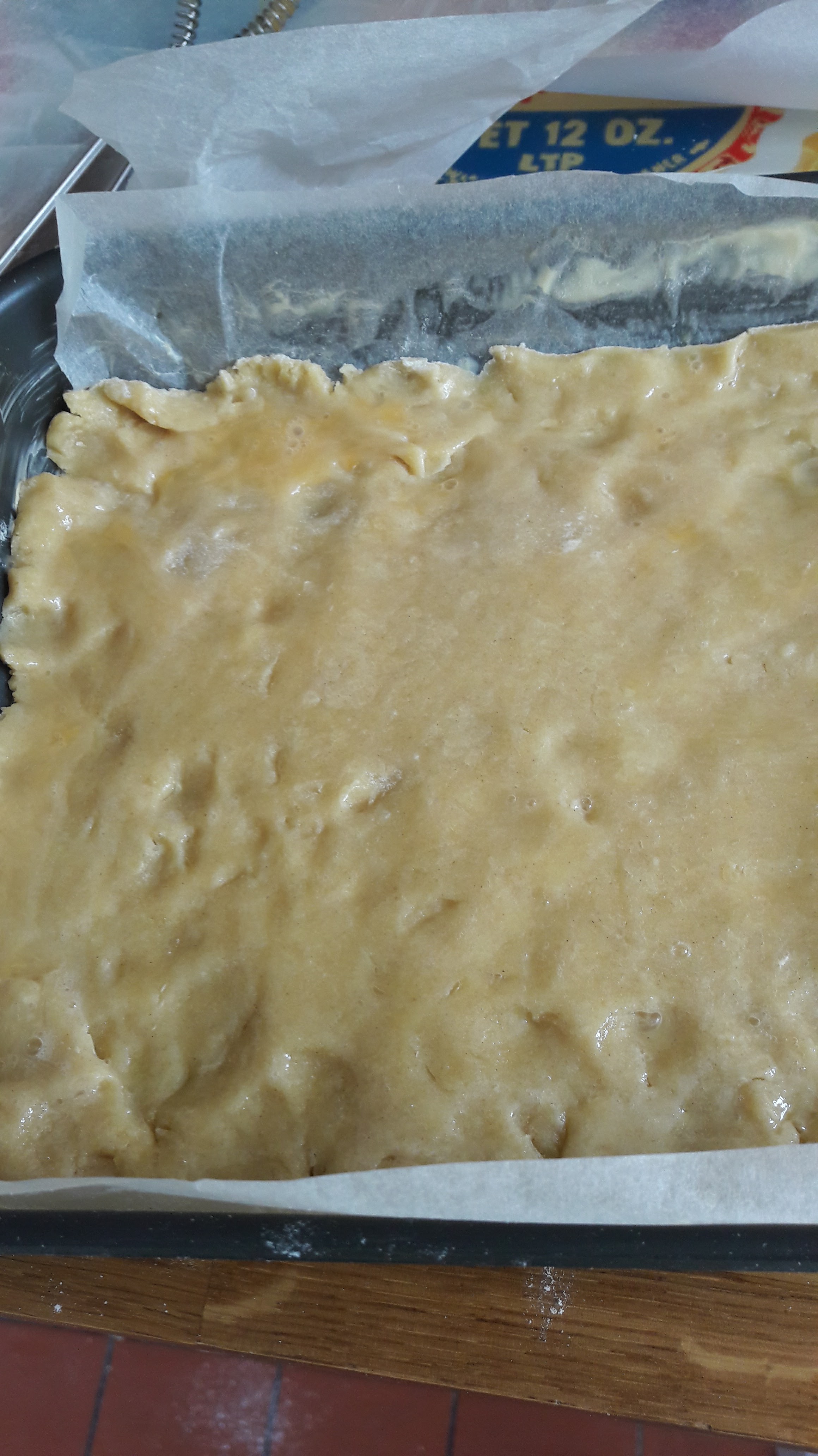
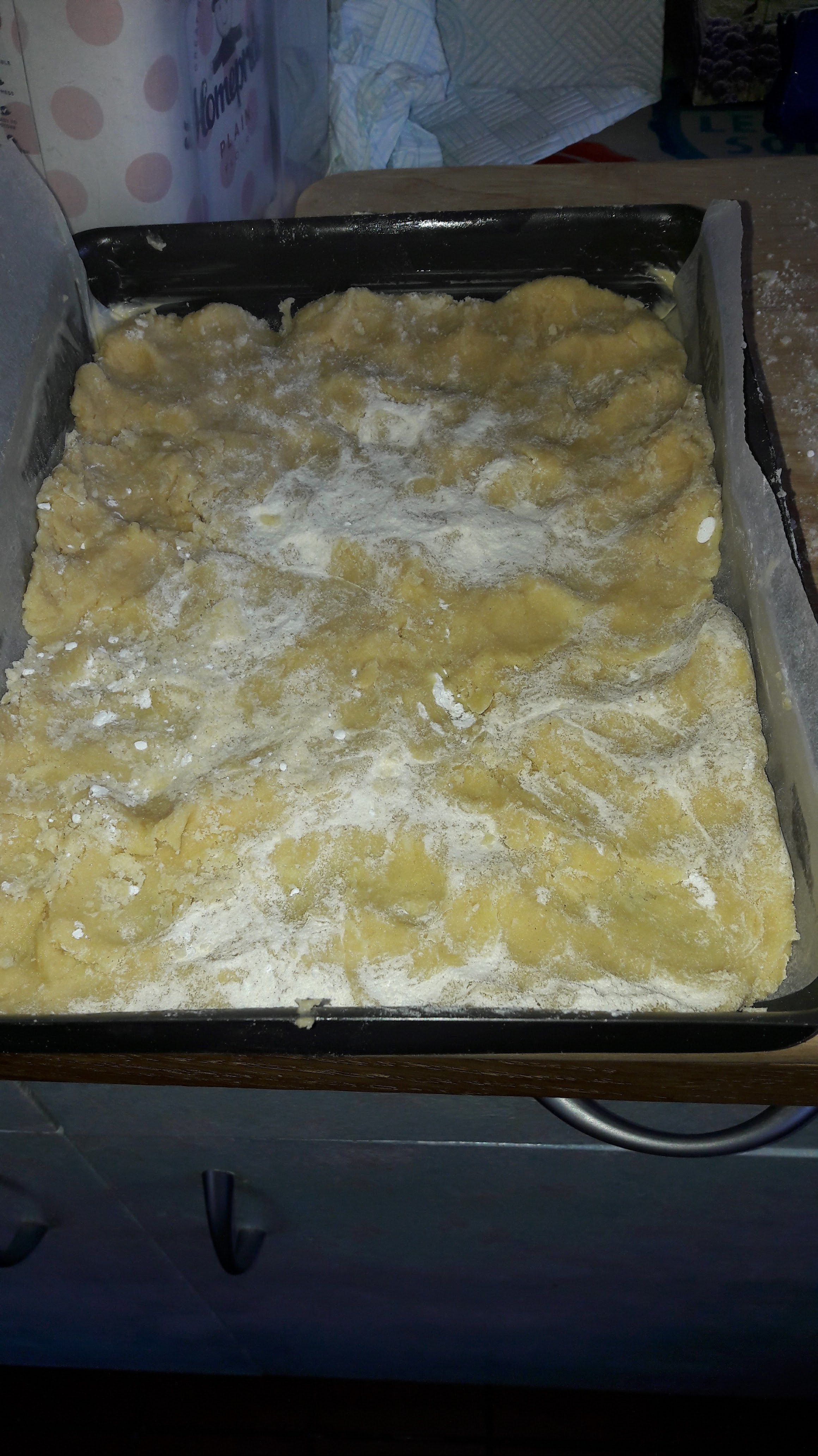
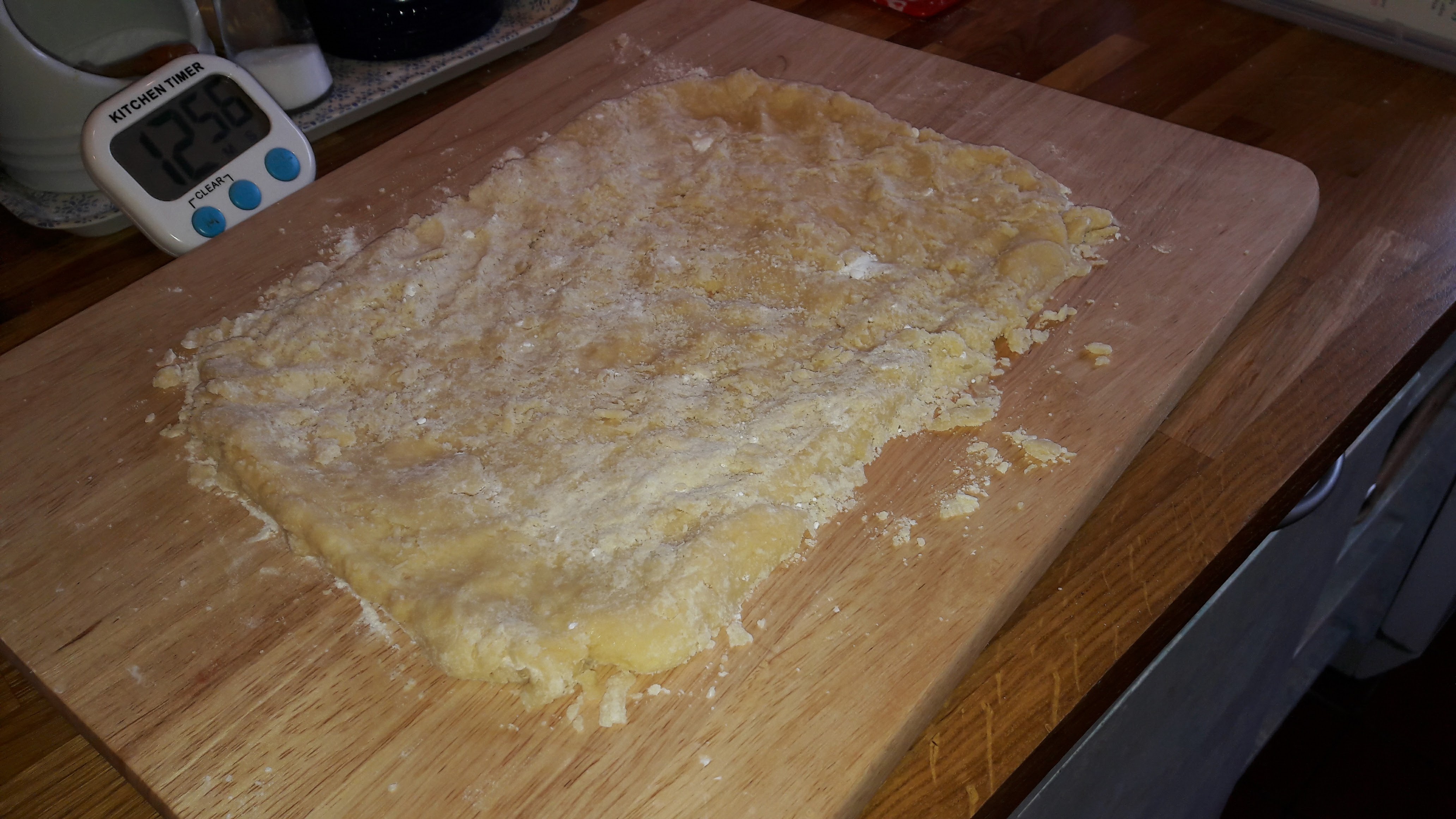
Using around 1/2 to 2/3rds of the pastry dough, roll out a rectangle for the bottom of the tin – if it is too crumbly you might have to piece and press this in.

Using the rest of the dough make stripes about a finger thickness and place these around the edge of the tin.

Use a sharp knife to make a cut pattern in these strips.


Bake for 25 -30 minutes until the pastry is golden.

Leave to cool completely.

Fill the mazurek hollow with jam.

You will need around a whole jar of jar and you can heat the jam slightly to make it easier to spread.

Make some icing with beaten egg white, lemon juice and icing sugar and drizzle this over the jam.

Mazurek with blackcurrant jam


Served here on a bamboo board and  Las Palmas tea plates by Aynsley from the 1960s

Mazurek with raspberry jam


Served here on a bamboo board and tea plates with a violet design by Colclough from the 1930s.


Pastry – ciasto kruche & półkruche

This was originally posted in June 2017 – I updated it in September 2019. 

There are two classic pastries, kruche and półkruche in Poland & the most difficult part is trying to get a good translation of the names.

Ciasto kruche

Ciasto is pastry and the word kruche means brittle, fragile or crumbly and ciasto kruche is often translated as shortcrust pastry – however it is quite different to British shortcrust pastry – in someways it is nearer to shortbread.

Having done a lot more research, I now think it is what is called in French – pâte sucrée.

This pastry is used to make a Polish cake called Mazurek of which there are many versions.

Ciasto półkruche

The pół part of the word półkruche means half or semi – but semi-shortcrust pastry does not really explain much!

This pastry is often used to make a Polish cake called placek  – a flat cake.

Served here on tea plates – Colclough – Enchantment 1950s – 1960s.

Both of these pastries are much richer than shortcrust pastry.

Ciasto kruche

The 4 ingredients are

  • plain flour
  • butter
  • icing sugar and
  • egg yolks (and a pinch or two of salt)

Notes

  • Use a flour which is low in gluten  – a cake flour not  a bread flour.
  • Butter give the best results but block  margarine can be used .
  • The pastry is fragile due to its high fat content.
  • Use just egg yolks (raw or hard boiled ), because the protein in the whites makes pastry tougher.
  • Using cooked egg yolks gives a more  in crumbly pastry.

Ratios for kruche

  • 3 flour:  2 Butter:  1 Icing sugar
  • or
  • 2 flour: 1 butter:  ½ – 1 Icing sugar
  • Usually – 1 yolk per 100g flour
  • A pinch or two of salt.


Ciasto półkruche

Here flour, butter, icing sugar and egg yolks (and a pinch or two of salt) are also used but there can be other additions such as:

  • baking powder
  • egg whites
  • soured cream or milk,
  • granulated sugar  or vanilla sugar
    .

The proportions of the main ingredients are different in that półkruche has a lower fat content than kruche.

Ratios półkruche

  • 2 flour: 1 butter
  • or
  • 3 flour: 1 Butter

Both kruche  and  półkruche are  baked in an oven heated  at GM5 – 190°C or GM6 – 200° C,  for 20 to 25 minutes.

Ciasto kruche 1 – using raw egg yolks

Ingredients

  • 340g plain flour
  • 170g butter – chilled
  • 100g icing sugar
  • 3 egg yolks
  • pinch of salt.

Method

  • Add a pinch of salt to the flour.
  • Use a knife to cut the chilled butter into small pieces into the flour and then use your fingers to make the mixture like breadcrumbs.
  • Add the icing sugar and mix this together.
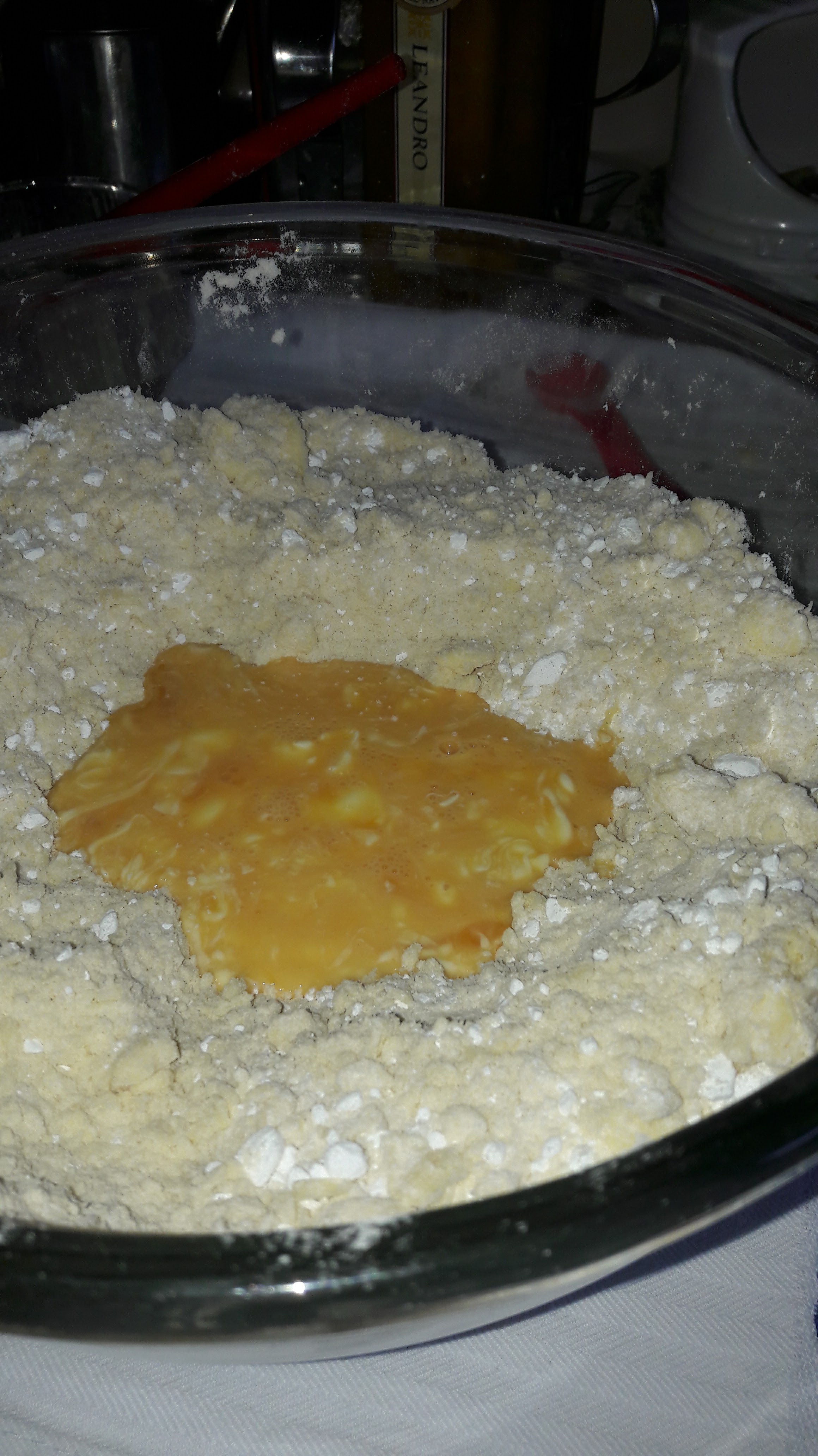
  • Add the yolks and gently mix this in then and bring it all together into a dough – try and handle the pastry as little as possible.
  • Wrap the dough in greaseproof paper and avoid touching the dough with warm hands, as it increases its temperature and this leads to increased use of flour.
  • Once the dough has been kneaded, cool (at least 30 minutes in the centre of the refrigerator and up to 2 hours) and then roll out to the desired shape and size.
  • Roll out the dough and shape it as required.

Note

As this dough is very crumbly – I often find I have to piece and press the dough into the cake tin.

 Ciasto kruche 2 – with cooked egg yolks

I have seen recipes using hard boiled yolks and always thought “Strange! – having tried this out – I found that this is the best pastry ever!  Delicious & crisp.

Ingredients

  • 300g plain flour
  • 200g butter – chilled
  • 100g icing sugar
  • 3 cooked egg yolks
  • pinch or two of salt.

There are 2 ways of cooking the egg yolks:

1 – Hard boil the eggs for 10 minutes, allow to cool and separated the cooked yolks from the whites (this give you cooked egg whites to add to salads or similar). Use a fork to break up the yolks into very small pieces.


2 – Separate the raw yolks from the whites, then place these in a colander and cook over hot water (this gives you raw egg whites to use in other recipes).

Method

  • Add a pinch of salt to the flour.
  • Use a knife to cut the chilled butter into small pieces into the flour and then use your fingers to make the mixture like breadcrumbs.
  • Add the icing sugar and mix this together.
  • Add the broken up yolks and gently mix this in then and bring it all together into a dough – try and handle the pastry as little as possible.
  • Wrap the dough in greaseproof paper and chill it in the fridge for about 30 minutes.

Ciasto półkruche -1

Ingredients

  • 300g plain flour
  • 1/2 teaspoon baking powder
  • 150g butter
  • 100g icing sugar
  • 1 egg & 2 yolks
  • 1 – 2  tablespoons of soured cream
  • pinch of salt

Method

  • Add a pinch of salt and the baking powder to the flour.
  • Use a knife to cut the chilled butter into small pieces into the flour and then use your fingers to make the mixture like breadcrumbs.
  • Add the icing sugar and mix this together.
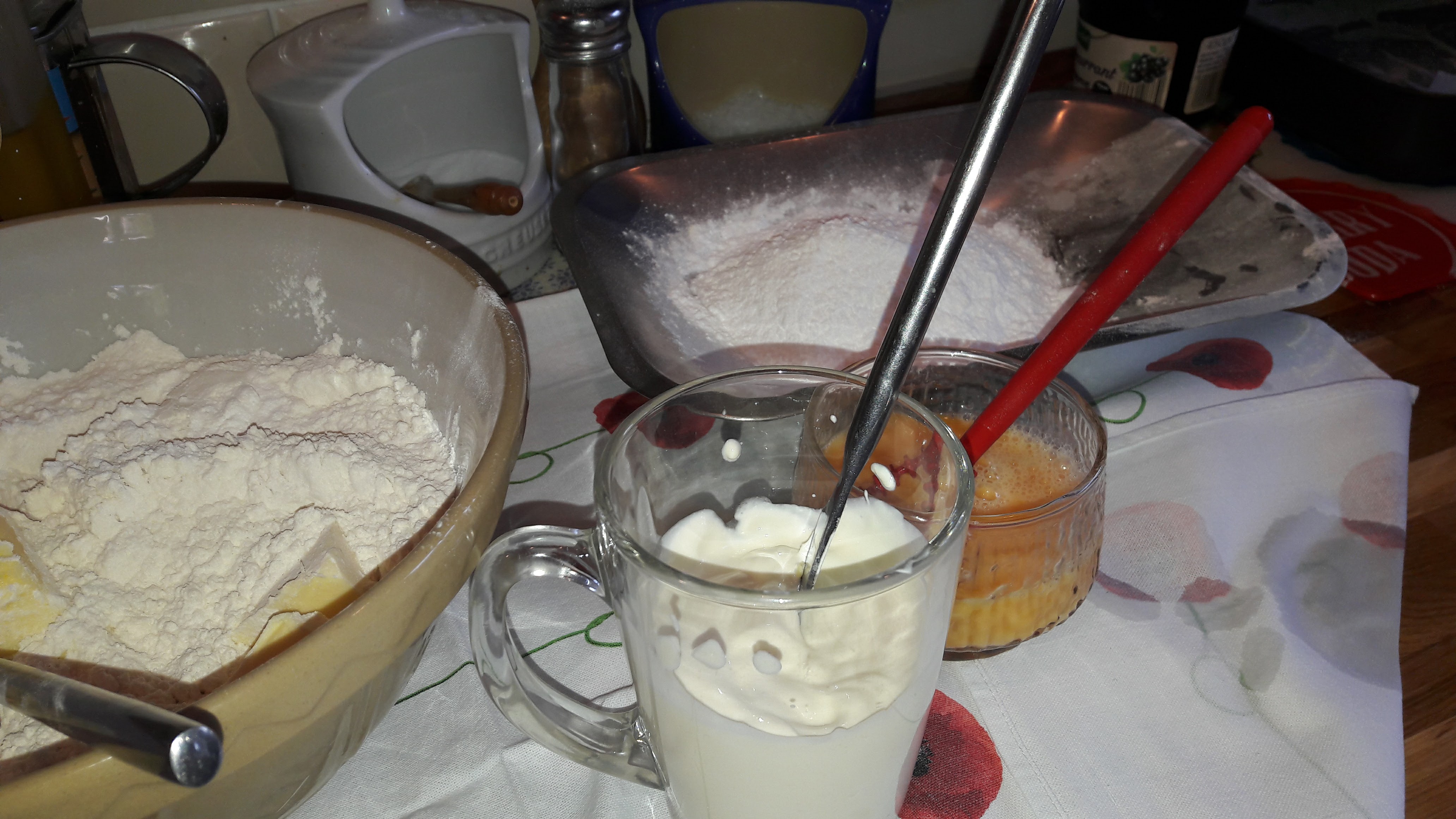
  • Make a well in the centre and add the eggs, yolks and the soured cream and gently mix this in then and bring it all together into a soft dough
  • Try and handle the pastry as little as possible.


  • Because of the use of baking powder this dough is used straight away.
  • I tend to flatten and shape this dough by hand rather than using a rolling pin.


Ciasto półkruche -2

  • 500g plain flour
  • 1 teaspoon baking powder
  • 200g butter
  • 150g icing sugar
  • 2 eggs & 1 yolk
  • 4 -5 tablespoons of soured cream


Method

  • Add a pinch of salt and the baking powder to the flour.
  • Use a knife to cut the chilled butter into small pieces into the flour and then use your fingers to make the mixture like breadcrumbs.
  • Add the icing sugar and mix this together.
  • Make a well in the centre and add the eggs, yolk and the soured cream and gently mix this in then and bring it all together into a soft dough
  • Try and handle the pastry as little as possible.


  • Because of the use of baking powder this dough is used straight away.
  • I tend to flatten and shape this dough by hand rather than using a rolling pin.


Chocolate Babka

It has taken me a while to get to this recipe for a super chocolate babka .

I had bought an unused, still with stickers, Oneida babka tin in a charity shop and wanted to try it out.

20170114_080317 20170114_080302

I looked up several recipes and tried then out.

The first one was like rubber, the second was dry as dust but finally the third one turned out well.

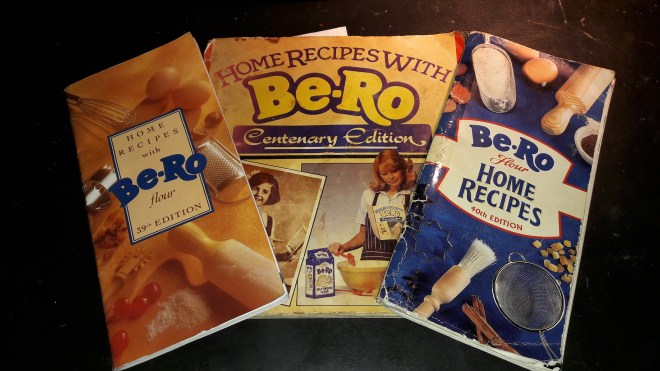
I have adapted this recipe from one that is found in the older Be-Ro(flour) recipes books.

This recipe just uses cocoa powder.

20170204_064412

These books were ones I used as a child , they contain simple basic recipes for traditional British cakes & biscuits and are very easy to follow.

Cake Ingredients

  • 400g self raising flour
  • 450g caster sugar
  • 1 teaspoon salt
  • 50g cocoa powder
  • 200g butter or block margarine
  • 4 eggs
  • 150ml evaporated milk
  • 150ml water
  • 2 drops of vanilla essence

Method

Grease the babka tin.

One tip I have learnt when using these tins is that it is best to brush them well with melted butter and then sprinkle dried breadcrumbs over the surface to prevent sticking  – I think this works better than flour.

  • Pre-heat the oven oven to GM 4  – 180°C
  • You need to use a large bowl for this cake mixture.
  • Rub the butter into the flour so that the mixture is like breadcrumbs.
  • Stir in the salt, sugar and cocoa powder.
  • Lightly beat the eggs and add the evaporated milk, the water and the drops of vanilla essence.
  • Stir the liquid mixture into the dry ingredients mixing thoroughly to give a thick batter.
  • Pour the cake batter into the tin.

20170128_121607

Bake for around 40 to 45 minutes, checking it is baked with a cake tester or wooden skewer.

Leave to cool in the tin and then turn out the cake onto a cooling rack.

Chocolate Icing Ingredients

  • 60g butter
  • 1 tablespoon of cocoa powder
  • 3 tablespoons of hot milk
  • 250g icing sugar
  • 1-2 drops of vanilla essence

Method

  • Heat up some milk in a small pan (I use a bit more than is needed and measure it out after heating).
  • Melt the butter in a pan.
  • Blend in the cocoa powder.
  • Stir in the icing sugar, milk and essence (I add the sugar in stages -aiming  for a slightly runny icing) and beat until it is thick and smooth – adjusting with icing sugar and extra milk as necessary.
  • Try and dribble the icing over the cake first, rather than spread it on with a spatula.  Then use a spatula to even it out over the whole cake.


The cake stand & pastry forks are Crazy Daisy (21st Century design) by Portmeirion

The tea service is Lyndale, by Royal Standard from the 1950s.

The green teapot is Cafe Culture by Maxwell Williams.

If you have any left after serving, then this cake keeps well if kept in an air tight container.

I use a plastic cake saver from Morrisons Supermarket  which is really useful (however a cake stand on a foot is too high – you have to use a lower stand or plate).


The plate is Beechwood by Royal Adderley, 1955  to 1964.

Keks

Keks is the word for a light fruit cake which is baked in a loaf tin or even more so a long narrow rectangular tin.

I am not sure how or when the word keks came into the Polish language but I am certain it comes from the English word “cakes” –  however the word keks is singular in Polish and means cake, and the plural is  keksy which is cakes.

It is thought that the keks originated from recipes for cakes from ancient Rome with the cakes being baked with pomegranate seeds, pine nuts and dried grapes and  using barley flour and then later in the middle ages honey was used and other fruits.

Keks is mentioned in a Polish cookery compendium from 1682 by Stanisław Czerniecki.

Nowadays keks is made using wheat flour and bakalie.

Bakalie is usually translated as dried fruits – however it has more varied fruits than the English version of dried grapes (raisins, sultanas, currants) & mixed peel.

Bakalie can be a mixture of the following:

  • Apricots
  • Currants
  • Dates
  • Figs
  • Mixed peel
  • Prunes
  • Raisins
  • Sultanas
  • Nuts – almonds, hazel & walnuts

Of course you can vary the mixture every time you make it.

The use of  sweet dried fruits came into use in Poland through the influence of Turkish cooking where most of these fruit and nuts grow.

Traditional keks is baked in a long narrow rectangular tin, however I also use the English style 2lb loaf tins especially as you can get greaseproof cake tin liners which make life a lot easier.

NOTE

I have tried these out several times and have found two things that you must do to make turn out well:

  1. Toss the fruit in flour so it does not all clump together.
  2. Bake the cake at a low temperature so it cooks through.

Keks

Ingredients -1

Amounts for a long narrow tin

300g butter or block baking margarine

300g granulated  sugar

6 eggs

2-3 drops vanilla essence

300g plain flour

80g potato flour

2 teaspoons  baking powder

1 teaspoon of ground cinnamon

400g  bakalie (dried fruit  & nuts – see above) & 1 tablespoon plain flour

butter & dried breadcrumbs to prepare the tin or greaseproof paper

Ingredients -2

Amounts scaled down amounts for a 2lb loaf tin

200g butter or block baking margarine

200g granulated  sugar

4 eggs

2-3 drops vanilla essence

200g plain flour

60g potato flour

1.5 teaspoons  baking powder

1 teaspoon of ground cinnamon

300g  bakalie (dried fruit  & nuts – see above) & 1 tablespoon plain flour

Butter & dried breadcrumbs to prepare the tin or greaseproof paper or liner

Method

Prepare the baking tin by either coating with butter & dried bread crumbs or cut a sheet of  greaseproof paper to line the long side and base of the loaf tin or use a liner where appropriate.

Pre heat the oven to GM 3 – 160º C

Prepare the bakalie (dried fruit & nuts) by chopping the larger fruits into smaller pieces.

Place them in a bowl with 1 tablespoon of plain flour and mix thoroughly so all the fruit is coated.

20170212_055711

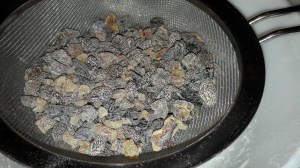
Tip the coated fruit into a large sieve and shake well to remove excess flour.
20170212_060009

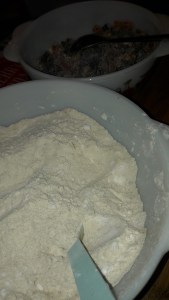
Mix the baking powder and cinnamon with the flours
20170216_072648

In a large bowl cream the butter and sugar together until they are light and fluffy

Add the vanilla essence

Add the eggs one by one, each with a tablespoon of flour

Fold in the rest of the flour

20170216_074357

Carefully mix in the bakalie

20170215_065831

Spoon the mixture into the prepared tin and put in the oven

20170215_070044

Bake for around 1 hour 30 minutes for the long tin & 1 hour 20 minutes for the smaller loaf tin

Check at around 1 hour & cover the top with greaseproof paper if it starts to brown on top too quickly

Test the cake with a cake tester or wooden skewer near the end of the cooking time to check that it is baked throughout

Leave the cake to cool in the tin before turning it out.

Aynsley, Las Palmas from the 1960s

Colclough 4212, Art Deco 1930s, Blue Violets/Pansies

Keks – using fruit mincemeat

At Christmas time I make English fruit mincemeat using the recipe from Delia Smith but without the chopped nuts.

20170215_042413

If I have any mincemeat over after the Christmas period  when I make mince pies,  I make a fruit loaf which which is very much a keks.

I bake this in a 2lb loaf tin.

Note

You can also use 2 small 1lb loaf tins or even a round 22cm tin – adjusting the baking time.

Ingredients

  • 150 butter
  • 100g soft brown sugar
  • 75g sultanas or currants  and mixed peel
  • 225g self raising flour
  • 450g jar of mincemeat (exact amount is not critical)
  • 3 eggs
  • Optional 25g flaked almond to sprinkle on top

Method

Pre-heat the oven to GM2- 150ºC

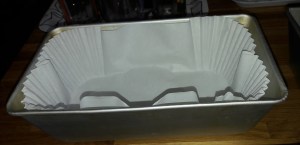
Prepare the loaf tin by greasing it, lining the long sides or using a greaseproof liner.
20170207_112805

Lightly cream the butter and sugar

Beat in the eggs, one by one

Stir in the mincemeat and the  extra dried fruit until it is an even consistency – a wooden spoon is good for this

Stir in the flour.

If the mixture seems a bit dry add a tablespoon of rum or similar

Spoon the mixture into the tin and smooth the top

Sprinkle nuts on top if using

Bake for around 1 hour 15 minutes

Leave to cool in the tin before turning it out.

Beetroot & Chocolate Cake

  • I had a request from the 93 year old mother of one of my friends to make her a cake that included beetroot in the ingredients – maybe a red velvet cake.
  • Now I had never seen one of these cakes and certainly never made one and I did have doubts about it.
  • I did some research and found lots of recipes for red velvet cakes but nearly all of them used just red food colouring.
  • I then found a recipe for a cake using beetroot and tested it out and surprisingly it came out very, very well. The recipe uses sunflower oil and is an easy to make batter cake.
  • This is not a traditional Polish recipe at all but it does contain a favourite Polish vegetable – namely – beetroot.

    Ingredients

  • 250g cooked beetroots (I used ready cooked vacuum packed beetroots  – 1 pack is more than enough)
  • 1/2 teaspoon of vanilla extract
  • 300g caster sugar
  • 250ml sunflower oil
  • 3 eggs
  • 225g plain flour
  • 1 teaspoon of bicarbonate of soda
  • 1/4 teaspoon salt
  • 6 tablespoons cocoa powder

Method

  • Grease and line a  21 x 31 cm baking tin.
  • Preheat the oven to Gas mark 4 – 180ºC
  • Drain the beetroots from the water and place in a sieve for a while to ensure they are dry – you can dry them with some kitchen roll as well.
  • Purée the beetroots – using a food chopper or blender

In a large bowl combine the puréed beetroots, eggs, vanilla essence, oil and sugar.

In a separate bowl mix together the flour, bicarbonate of soda, salt and cocoa.

20170219_113354

Add the dry ingredients to the other bowl and beat well together.

20170219_114510

Pour the batter mixture into the prepared tin.

20170219_115514

Bake for 45 to 50 minutes.

Test if done with a cake tester or wooden skewer.

Leave to cool in the tin.

20170219_125037

The cake is delicious and moist – it has a slightly red tinge to the very dark nearly black colour.

Here I have just served it plain.

Served on Royal Doulton, Counterpoint, 1973 – 1987.

You can dust the top  with icing sugar if desired.

The cake is delicious on its own but many versions have a topping of some description.

I made one using butter, cream cheese ( or yoghurt cheese), icing sugar and lemon.

Ingredients for Topping

  • 50g butter
  • 100g of full fat cream cheese, twaróg or yoghurt cheese
  • Finely grated rind of 1 lemon
  • 1 teaspoon of lemon juice
  • 250 – 300g icing sugar

Method

  • The butter needs to be at room temperature.
  • Cream the butter, lemon rind, lemon juice and the cream cheese and 2 tablespoons of the icing sugar until the mixture is smooth and well combined.
  • Slowly add the icing sugar and mix well in until it is smooth and firm enough to use as a topping.

You can make the topping ahead of time and keep it in a container in the fridge – topping the cake later when needed.

Take care not to get too many brown cake crumbs in the icing when spreading it on the cake.

Served on Colclough, Enchantment, tea plates from the 1960s

with Portmeirion, Crazy Daisy, pastry forks.

The cake was voted delicious!

Biszkopt – Sponge Cake using Potato Flour

Biszkopt is a fat free sponge cake which means it does not have any butter, margarine or oil in it – just eggs, sugar & flour.

This recipe in my Polish cookery book is described as oszczędna which means economical and compared with many of the recipes which use 4 or more eggs it is.

I used this recipe to make  a cake which is very popular in Poland  –  rolada  which is a  roulade or roll.

I was really pleased with this  recipe & think I  will continue to use this the most.

Ingredients

40g potato flour

3 tablespoons of plain flour

1 teaspoon baking powder.

2 eggs separated

65g icing sugar plus 1 tablespoon of icing sugar & extra for dusting.

2 tablespoons of boiling water

Also you need a tin 23 x 32cms & 3 sheets of greaseproof paper

Fillings

Jam

Lemon Curd – This is very English but I am sure it would be loved in Poland –

Marks & Spencer’s Sicilian lemon curd is superb!


Butter Cream filling of your choice – I used coffee & rum here.

Method

Pre-heat oven to GM 4 – 180°C

There are lots of steps in this recipe &  after several trials, I have given the steps in the order I found worked the best.

Grease and line a  23 x 32cms baking tin – you can also grease the paper on the upper side – I have found this does make it easier to remove the cake.

Mix together the potato flour, plain flour and the baking powder.

Whisk the egg whites until they are stiff then add in 1 tablespoon of icing sugar and whisk again.

Whisk the egg yolks until they are pale then add the 2 tablespoons of boiling water and whisk again, add the icing sugar and whisk till the mixture is  pale and creamy.

Gently fold in the flour mixture.

Fold in the stiff whites.

Pour the mixture into the baking pan & bake for around 15 minutes or until golden brown.

Remove from the oven and lightly dust with icing sugar then turn this out onto a sheet of greaseproof paper also dusted with icing sugar.


Place another piece of greaseproof on top of this and roll up the cake (starting with a short side) with the paper.

Leave this to cool.

Unroll the cake and spread with jam, lemon curd or a butter cream filling of your choice & then roll up the cake again.

Dust the cake  with icing sugar.

Rolada with lemon curd


Blue edged plates 1930s Allertons Ltd

Sandwich plate H&K Tunstall

Rolada with jam


Coffee & Rum Butter Cream

Ingredients

2 egg yolks

100g icing sugar

120g of butter

2 tablespoons of strong coffee

2 tablespoons of rum

Method

Make some strong coffee using 20g of ground coffee and boiling water and then strain it and leave to cool.

(You can of course use  instant coffee – my mother used Camp coffee years ago & it is still available)


Beat the egg yolks, butter & icing together

Add the coffee & rum and mix well in.

You can add a little more icing sugar  if you think the mixture is too soft.


Sandwich plate H&K Tunstall

Biszkopt -Sponge Cake

Biszkopt is a fat free sponge cake which means it does not have any butter, margarine or oil in it – just eggs, sugar & flour.

The word originates from the old Italian biscotto & Medieval Latin bis coctus – which  means twice baked – though why I do not understand as this sponge is only baked once!

The English word biscuit also has this origin.

This sponge is used to make tort – layer cake 0r gateaux – however as these are usually such large cakes – I have used it for another popular cake in Poland – rolada – which is a  roulade  – often called a Swiss roll  – though I have not been able to find the reason for this  Swiss connection.

Rolada

Ingredients

4 eggs – separated

4 tablespoons of granulated sugar

4 tablespoons of plain flour

Icing sugar to dust

You will need 3 sheets of greaseproof paper

Fillings

Jam

Butter Cream Icing

Lemon Curd – this is very English – but would be loved in Poland – Marks & Spencer’s Sicilian lemon curd is superb!

Method

Pre-heat the oven to GM 4 – 180°C.

Grease and line a  23 x 32cms baking tin – you can also grease the paper on the upper side – I have found this does make it easier to remove the cake.

Whisk the egg whites until they are stiff.

Whisk together the egg yolks & sugar until they are pale and fluffy.

Fold in the flour.

Fold in the egg whites.

Pour the mixture into the baking pan & bake for around 15 minutes or until golden brown.

Remove from the oven and lightly dust with icing sugar then turn this out onto a sheet of greaseproof paper also dusted with icing sugar.


Place another piece of greaseproof on top of this and roll up the cake (starting with a short side) with the paper.

Leave this to cool.

Unroll the cake and spread with jam, lemon curd or a butter cream filling of your choice & then roll up the cake again.

Dust the cake  with icing sugar.


Krystyna’s Plum Cake

I have very fond memories of the first time I tasted this cake, it was a very warm, late summer’s day in the land of a thousand lakes in North East Poland – the Mazurian Lakes.

My cousin Krystyna went outside and came back in with one basket of eggs she had collected and another of ripe plums from one of the trees outside.  We set to and made this cake to her recipe, calling in the other cousins to eat it as soon as it was cool enough!

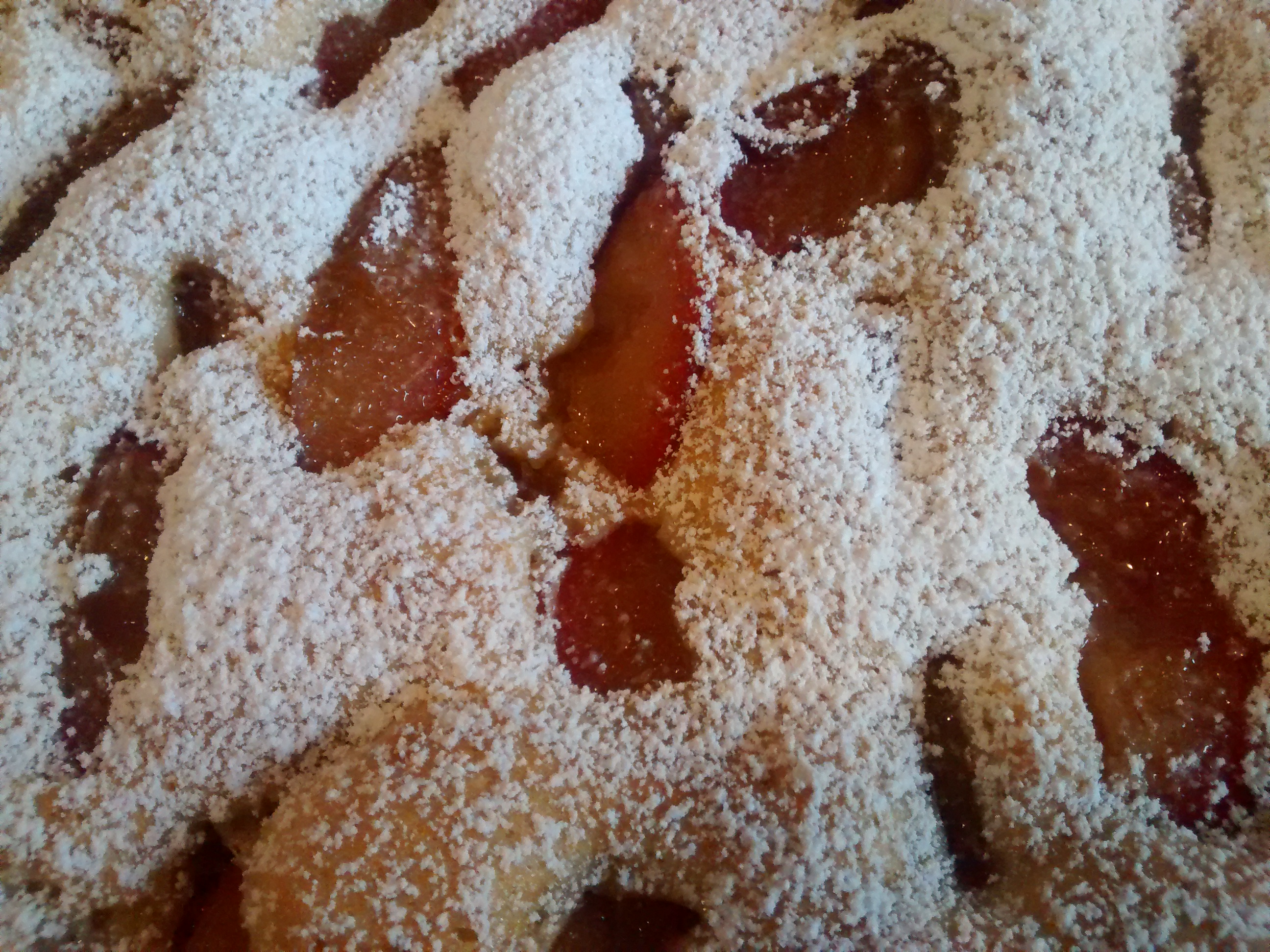
The contrasts between the texture of the cake and cooked plums and also the sweetness of the cake and the slight tartness of the plums make this a cake to remember.

The use of oil means this is a relevantly modern recipe & it is so easy to make.

The original recipe was made using metric cups but I have converted it to weights as I am happier using these.

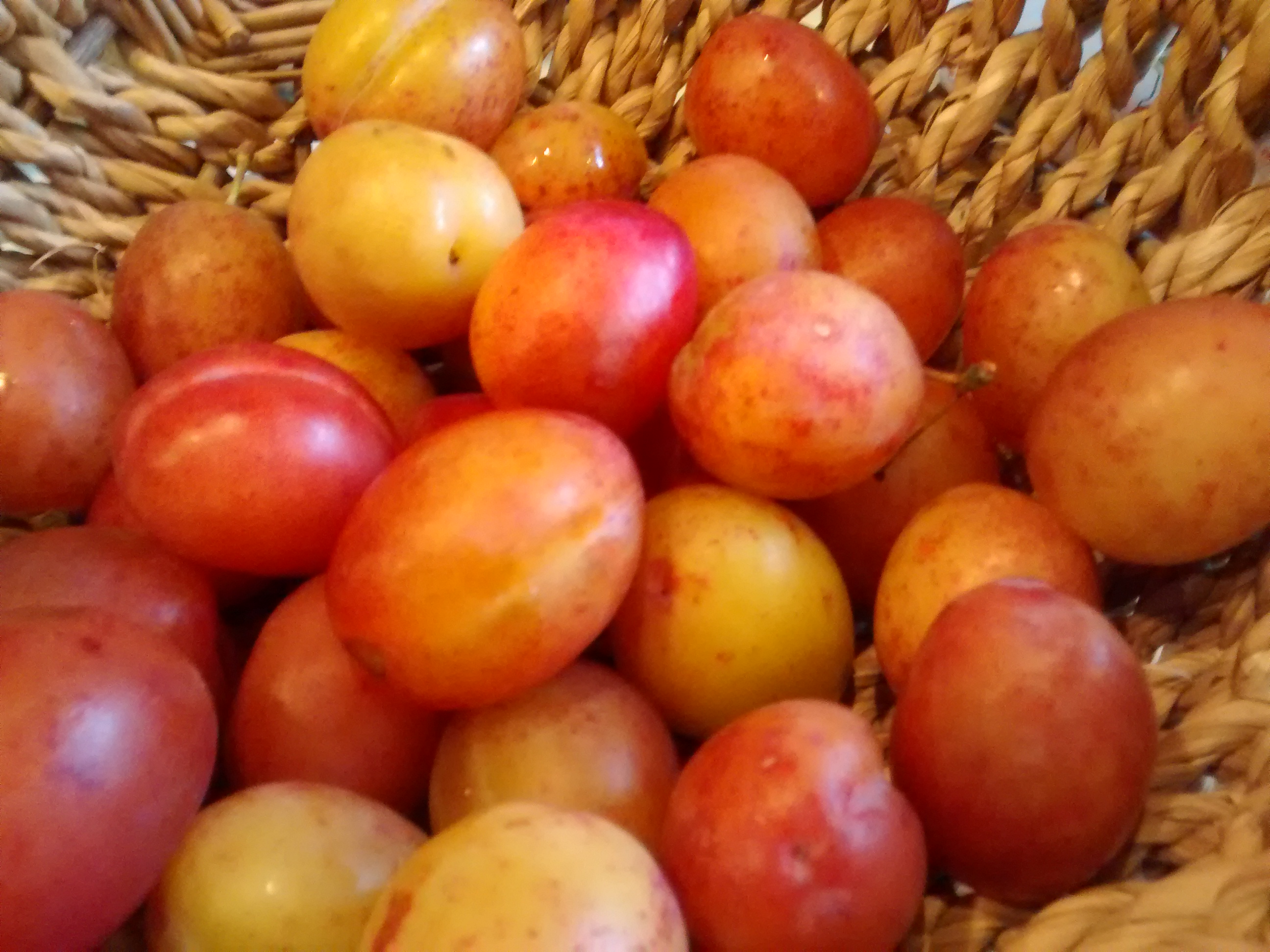
I make this using Victoria Plums.

img_20160910_071802625

Ingredients

350 – 400g of plums  –  small plums are best

4 eggs

170g granulated sugar

200g self raising flour

60ml sunflower oil

Icing sugar – to dust

Method

Pre heat the oven to Gas mark 4 – 1800C

Take a roasting tin around 22cm by 31 cm and use one piece of greaseproof paper to line the 2 long sides and the base.

img_20160910_070010012 img_20160910_070243360

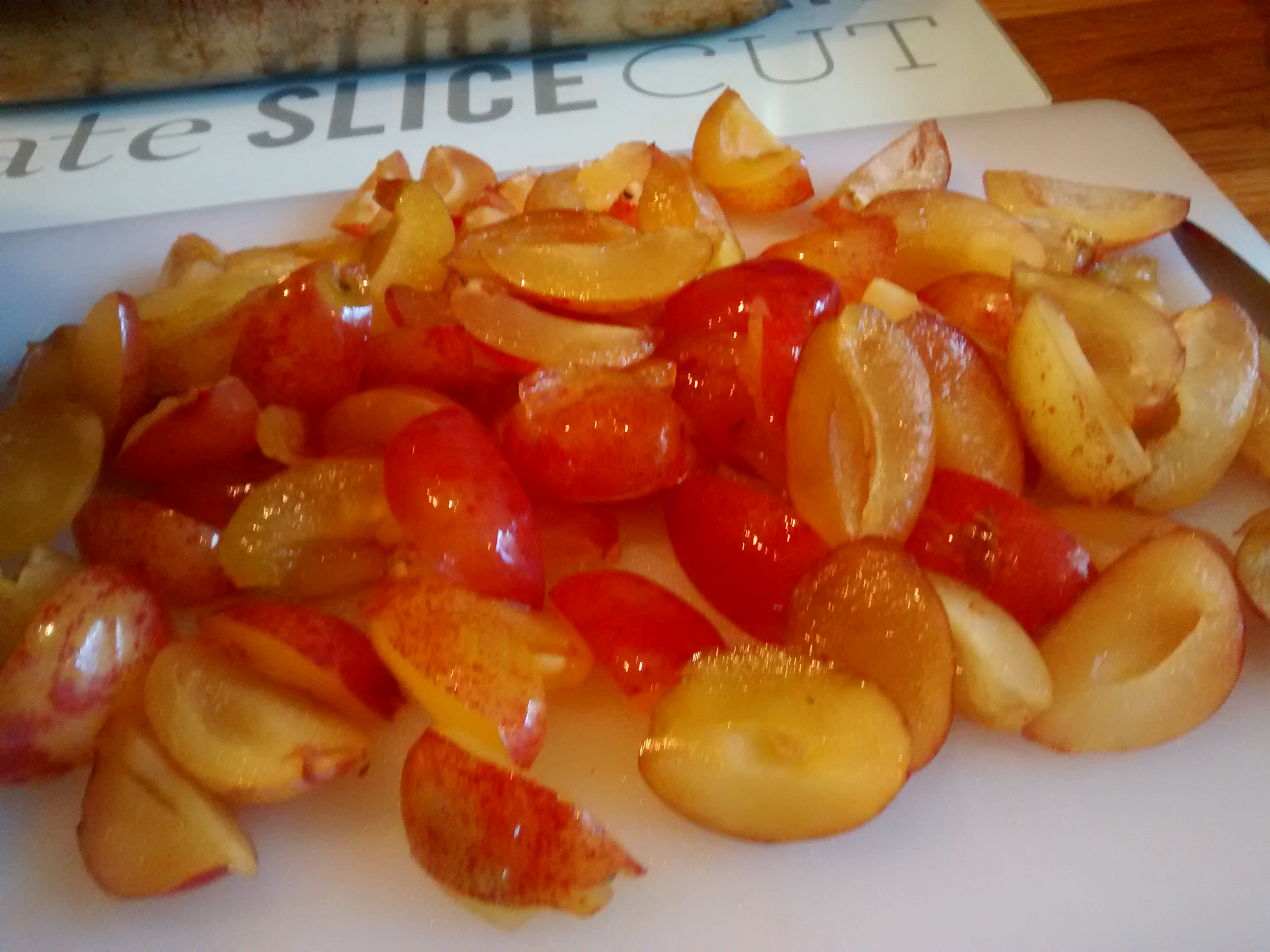
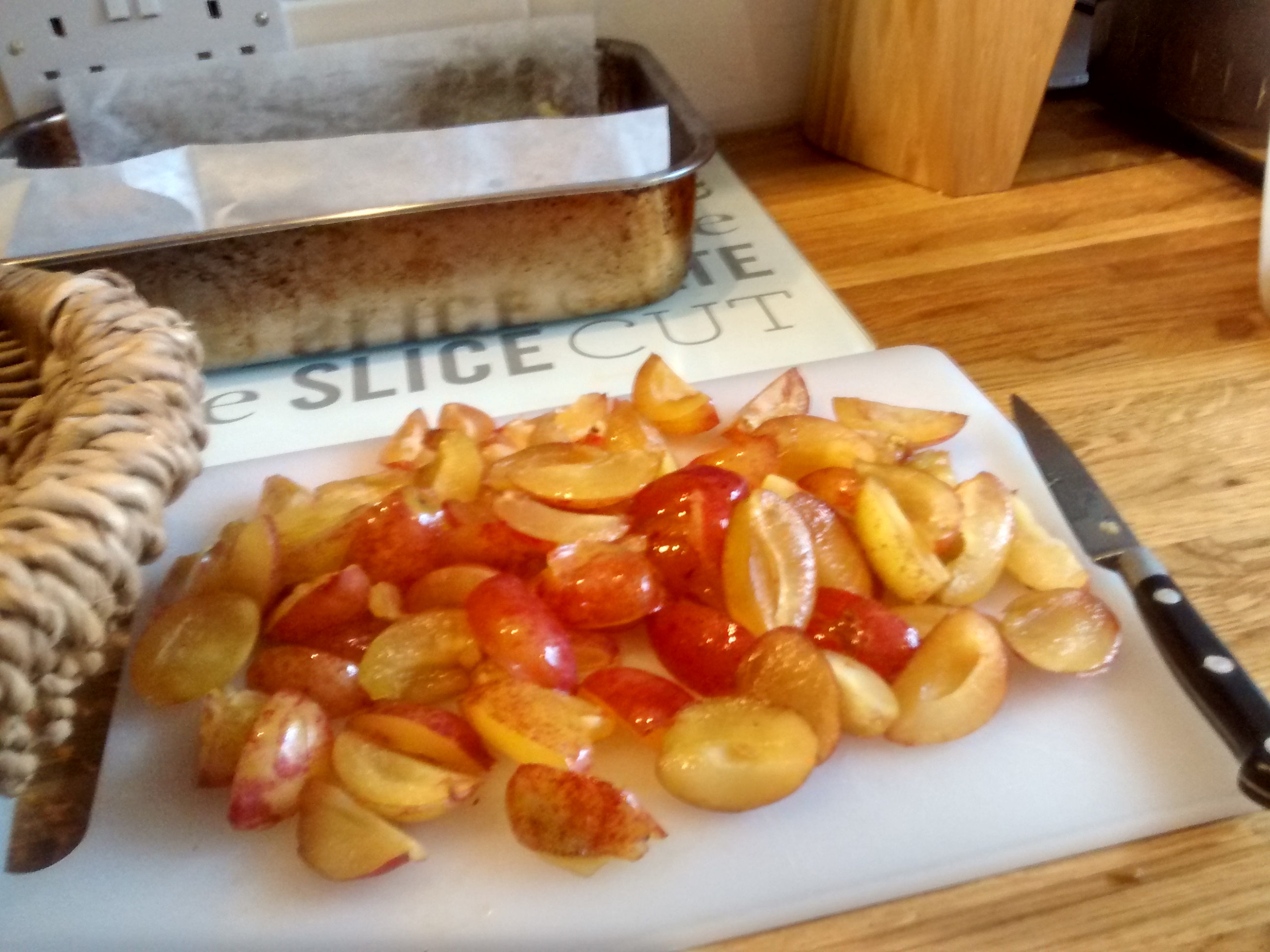
Cut the plums into quarters and take out the stones.

img_20160910_072721575 img_20160910_072740212_hdr

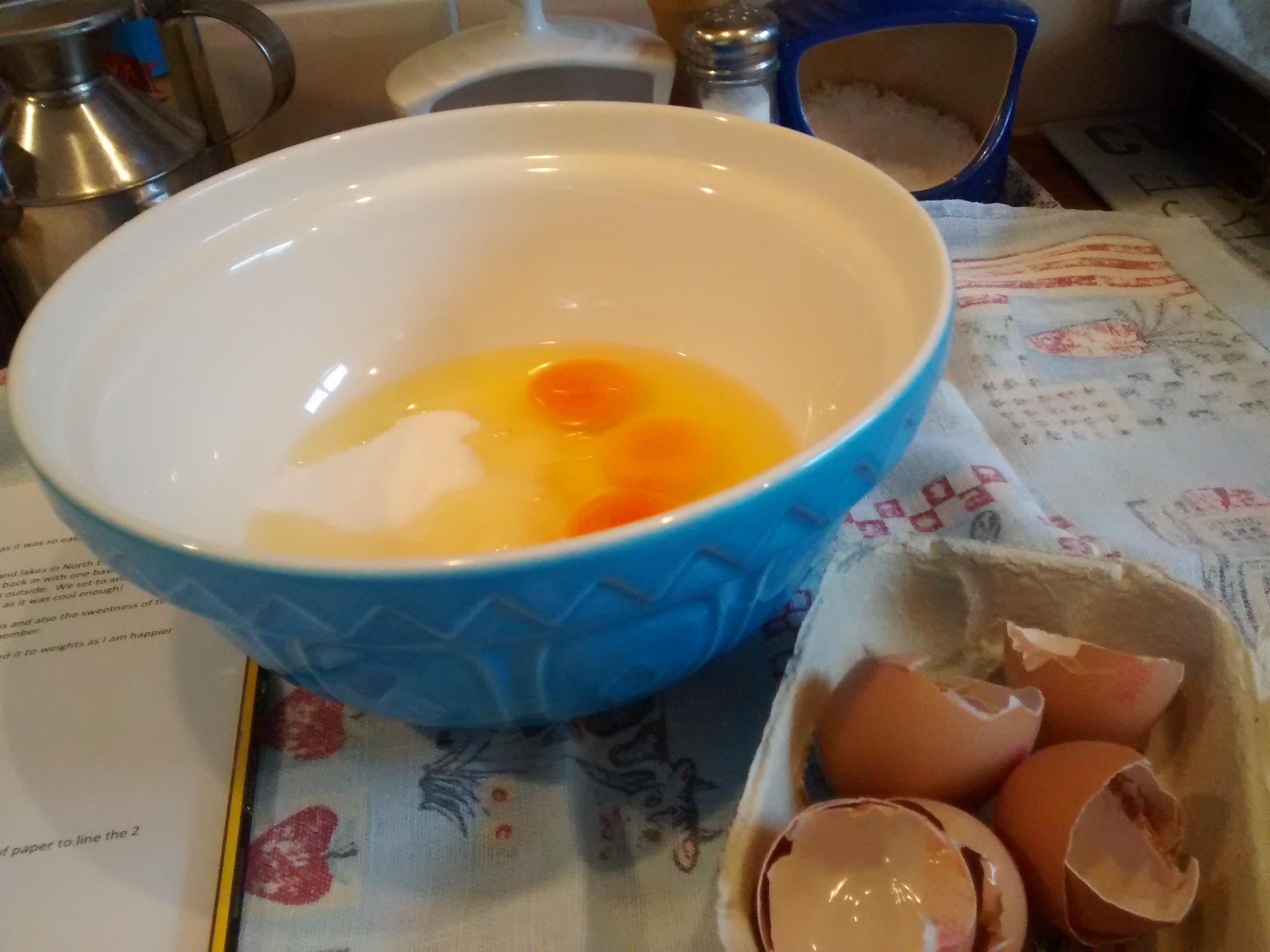
Whisk the eggs and sugar until the mixture is thick and creamy.

img_20160910_072001919

Add the oil and the flour and lightly beat everything together to make a thick batter.

Pour the batter into the roasting tin.

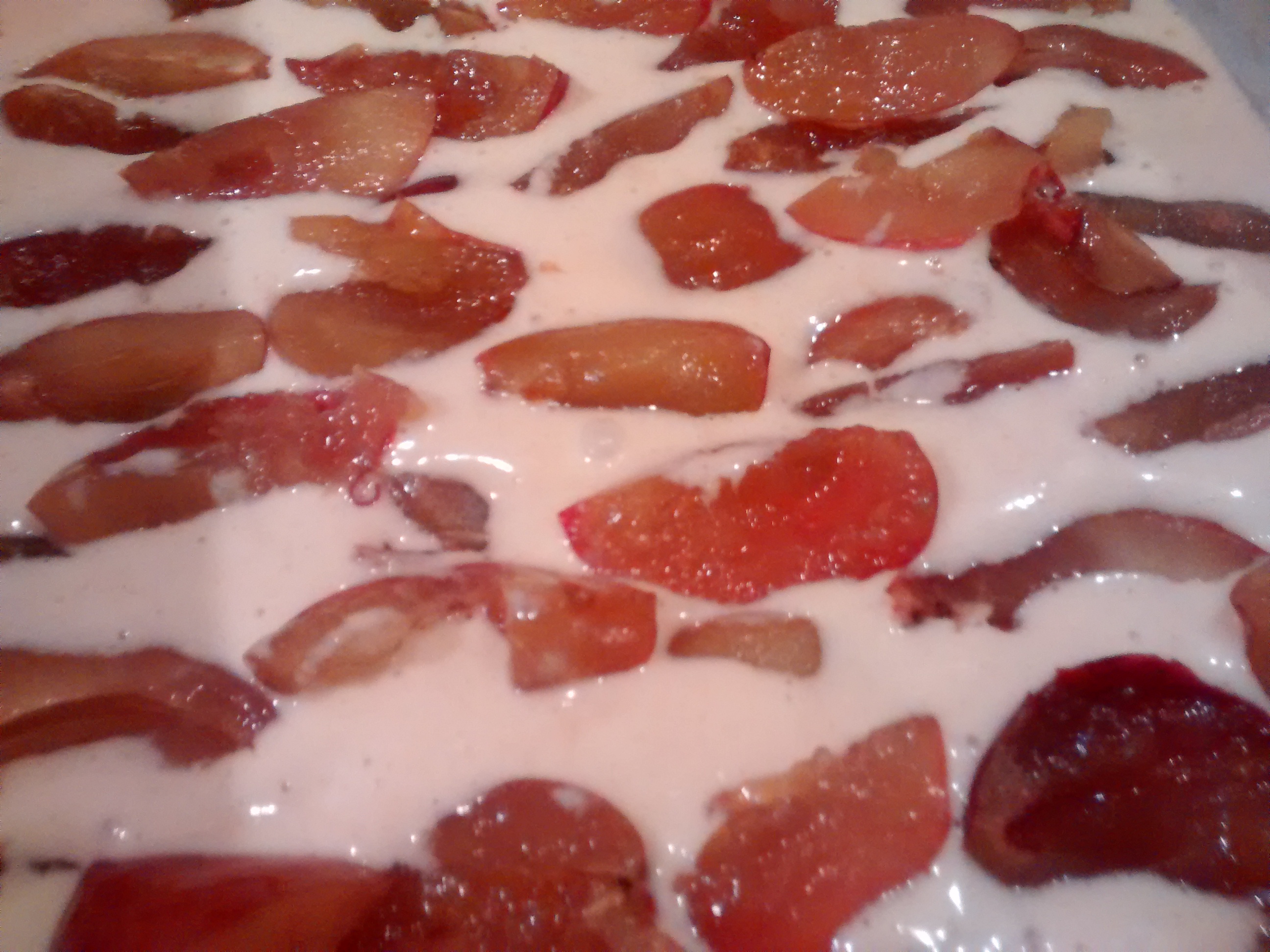
Place the cut plums, skin side down in rows on the batter until the top is full – they will start to sink – do not worry.

img_20160911_054310880 img_20160911_054306922

Bake for 30 to 35 minutes.

Dust with icing sugar when it has cooled slightly.

img_20160911_070743498 img_20160910_085809656

img_20160911_070748705

Cut into squares to serve.

img_20160911_071119804 img_20160910_091721061 img_20160910_091655679

Tea plates are Counterpoint (1973 – 1987) by  Royal Doulton.

Note

If you have any cake left, it is better not to cover it with too airtight a cover as it will go soggy.

Madeleine Cakes

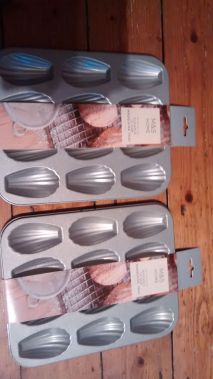
I was in Marks & Spencer’s and saw these lovely tins and thought   “I must try these“.

I bought 2 tins and then the following week I got another and after trying out some recipes I bought a 4th.

IMG-20160319-WA0000


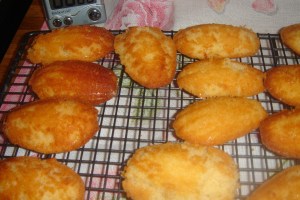
Madeleines are very small sponge cakes baked in tins with shell-shaped depressions.

Of course you can make then in small bun tins if you want to see if you like them before investing in the tins.

IMG_20160321_160447468


They originated from the Lorraine region in France.

When looking for recipes I thought that these did not have a Polish connection but in fact they do!

The exiled king of Poland, Stanisław  Leszczyński (1677 – 1766), was the Duke of Lorraine from 1737 -1766  and his daughter Maria was married to Louis XV of France.

Madeleine Paulmier was the cook for the exiled king and the story goes that these little cakes were named after her.

Marcel Proust  (1871 – 1922) the French author described them as “a little shell of a cake, so generously sensual beneath the piety of its stern pleating…” in his book  À la recherche du temps perdu  – In Search of Lost Time.

I have tried out many different recipes all with varying  quantities – my head was spinning trying to sort them all out.

The following three are I ones I liked best.

They are all based on variations of the Genoise Sponge in which you use melted butter.

For ALL the recipes you must grease the tins well – I have found that using melted butter & a pastry brush is very effective.

DSC03194 DSC03193

Madeleines 1

This mixture made over 30 Madeleines.

Ingredients

65g Butter (plus extra for greasing the pans)

65g Icing sugar

2 eggs

65g Self-raising flour

2-3 drops of vanilla essence

Method

Grease the tins.

Pre-heat the oven to GM4 – 180ºC

In a small pan melt the butter and leave it to cool.

Whisk the icing sugar, eggs and vanilla essence together until the mixture is thick and creamy.

Gently fold in the self-raising flour using a metal spoon.

Gently fold in the melted butter using a metal spoon.

Divide the mixture between the tins.

IMG_20160321_153004258


Bake for around 10minutes till golden.

IMG_20160321_154448312_HDR


Leave them to cool slightly in the tins and then remove them onto a wire rack.

Dredge them liberally with icing sugar.

IMG_20160321_154710042 IMG_20160321_155046064


Madeleines  2 – With Ground Almonds

This mixture made around 30 Madeleines

Ingredients

65g Butter (plus extra for greasing the pans)

65g Icing sugar

2 eggs

65g Self-raising flour

65g Ground almonds

2-3 drops of vanilla or almond essence.

Method

Grease the tins.

Pre-heat the oven to GM4 – 180ºC

In a small pan melt the butter and leave it to cool.

Whisk the icing sugar, eggs and vanilla or almond essence together until the mixture is thick and creamy.

Mix the self-raising flour and ground almonds together.

Gently  fold in the flour and almond mixture using a metal spoon.

Gently fold in the melted butter using a metal spoon.

Divide the mixture between the pans.

Bake for around 10 minutes till golden

Leave them to cool slightly in the tins and then remove them onto a wire rack.

Dredge them liberally with icing sugar.

Madeleines  3 – With Ground Almonds & Honey

This recipe is based on a updated recipe from Mrs Beeton  in  How To Cook – 220 Classic Recipes For The Modern Kitchen – 2011.

DSC03211


This mixture made 36 Madeleines.

Ingredients

120g butter (plus extra for greasing the pans)

50g runny honey

3 eggs

100g caster sugar

100g self raising flour

25g ground almonds.

Method

Place the butter in a small pan to melt over a medium-high heat and allow it to cook until it starts to brown lightly.

Remove then pan from from the heat and add the honey and stir it in well.

Leave the mixture to cool slightly.

Whisk the icing sugar and eggs together until the mixture is thick and creamy.

Mix the self-raising flour and ground almonds together.

Gently  fold in the flour and almond mixture using a metal spoon.


Gently fold in the cooled  butter and honey mixture using a metal spoon until fully incorporated.

DSC03203


Cover and place in the fridge for 30 minutes.

Grease the tins.

Divide the mixture between the tins.

DSC03205


Let them rest for 10 minutes.

Pre-heat the oven to GM3- 160ºC

Bake for around 10 minutes till golden.

Keep an eye on them as the honey in them tends to brown quickly.

DSC03207


Leave them to cool slightly in the tins and then remove them onto a wire rack.

Dredge them liberally with icing sugar.

Rhubarb Cake

  • I managed to accidently remove this from my posts – it was post 55!
  • I have now restored it and am republishing it now (as post 724).
  • Rheum rhabarbarum is the Latin name for rhubarb   –  in Polish  it is rabarbar.
  • It is a plant that has its origins in China, Mongolia & Siberia – its roots survive the cold!
  • Rhubarb roots have been used in Chinese medicine for thousands of years.
  • The plant arrived in Europe via Venice in the 14th century  having been brought  from China  along the Silk Road.
  • The leaves are poisonous  to humans as they contain large quantities of oxalic acid and other toxins.
  • The stems however can be eaten safely, although they do contain a little oxalic acid but their tartness is due mainly  to malic acid which is also found in sour green apples.
  • Rhubarb stems were first eaten in England in the 17th century.
  • In 1820 the rhubarb plant was taken over to the USA.
  • I live in West Yorkshire –  just outside what is called the Rhubarb Triangle  of Wakefield, Leeds & Morley   – where rhubarb is grown in forcing sheds (in darkness) on a commercial scale.
  • I have rhubarb growing in my garden.
  • I have used the rhubarb to make rhubarb crumble but over the last few years I have been trying to find recipes for a rhubarb cake and have tried many from English, American & Polish recipe books and magazines.
  • Some recipes just used 1 or 2 stalks of rhubarb – as I have lots of rhubarb – I wanted a recipe that used more.
  • Some recipes used the raw stalks in a cake – I found that none of these were to my liking.
  • I tried using my best Polish apple cake recipe with stewed rhubarb  instead of apple but found that it just did not come out very well.  The cake was  too soggy and raw in places because of the amount of liquid in the stewed rhubarb.
  • Finally after more trial and error – I came up with a recipe which I am happy to make for people and to share.

Preparing The Rhubarb

This I have found to be the most important part to making a successful rhubarb cake.

You need to prepare the rhubarb the day before you want to make cake.

I tend to make a large amount and if I do not use it all I freeze the rest.

You need around 8 large stalks if not more.

Trim the ends of the rhubarb stalks and then chop the stalk  into pieces around 7cm in length.

Put the pieces into an oven proof dish and add granulated sugar – try not to use large amounts – it is better slightly tart.

Put the covered dish into a low oven –  GM 2 for around an hour or so – you want it soft but not totally disintegrated.

Allow this to cool.

  • Now comes the part I found to be the most important – I strain the cooked rhubarb from the juice & syrup.
  • Put the rhubarb into a colander over a bowl and leave this for several hours or even overnight.
  • The juice and sugar syrup can  be used to flavour yoghurt, diluted with water to make  a drink or even added to pork in a slow cook recipe.

  • Now by just using this strained rhubarb  I have found that a cake adapted from my apple cake comes out very well. 
  • I have used half the quantity from my apple cake recipe as the base and then used a drier crumble type mixture – called kruszonka in Polish – for the top.

Cake Ingredients

Base

150g plain flour

1 & 1/2 teaspoons of baking powder

100g butter

40g caster sugar

1 egg yolk and 1 or 2 tablespoons of lemon juice or water.

Topping

120g plain flour

90g butter

60g icing sugar.

Method

You have to use a loose bottom or spring-form tin or you will not be able to get the cake out.

I use a loose bottomed anodised aluminium cake tin which is 22cm in diameter and 8cm deep.

Grease the tin well.

First make the cake base by rubbing the butter into the flour to make crumbs then stir in the sugar.

Add the yolk and lemon juice and bring the ingredients together to form a soft dough – do not handle the dough too much. Leave the dough in a cool place for about half an hour so it is easier to handle.

Pre heat the oven to GM 4 – 180ºC.

Make the topping by rubbing the butter into the flour to make crumbs and then stir in the sugar.

Press the dough into the base of the tin.

Cover the base with the strained rhubarb.

Evenly sprinkle all the topping over the rhubarb.

Bake in the oven for around 1 hour to 1 hour & 10 minutes.

Leave to cool in the tin.

Use a long metal spatula to ease the cake from the side of the tin then place the cake on to the top of a  tin can and slide the side down.

If you find the cake is not sweet enough – you can sprinkle the pieces  with icing sugar – I rarely due – I like the fruit to be tart.

Tea plates are Counterpoint by Royal Doulton 1973 – 1987

Do not put the cake into an airtight plastic box as it will get soggy – better to cover it with a mesh cover.

IMG_20160518_210609015