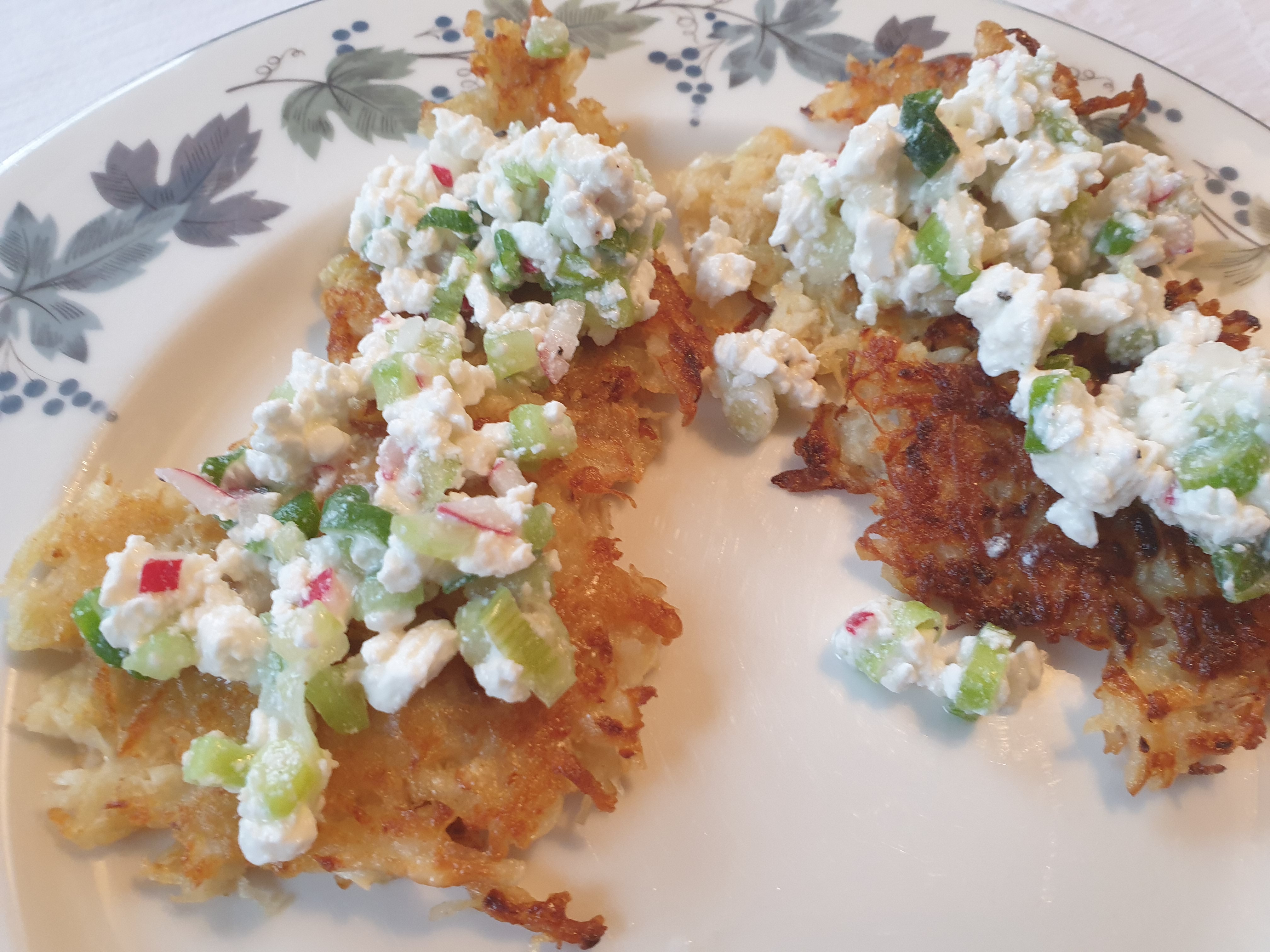
Yoghurt Cheese Salad

INGREDIENTS

  • 250g of full fat twaróg or yoghurt cheese
  • Bunch of radishes – finely sliced
  • 1 large gherkin – chopped into small cubes
  • Bunch of spring onions – finely chopped – white and green parts
  • Salt & Pepper to taste
  • *
  • Some Greek style yoghurt or soured cream – may be needed to loosen up the cheese.
  • OPTIONAL
  • ½ fresh cucumber – peeled, deseeded and chopped into small cubes.

METHOD

  • Mix the twaróg or yoghurt cheese with the radishes, gherkins and spring onions.
  • Add the cucumber if using.
  • Add the yoghurt or soured cream if needed.
  • Season to taste.

Fruit & Sweet Cheese Cake

  • I tried this recipe from one of my recently bought Polish magazines.
  • I have not make a cake dough with twaróg/yoghurt cheese before.
  • I would only make a small alteration to the amounts in the ingredients next time – a little more sugar with the topping of twaróg/yoghurt cheese which is how I have written this up.
  • It was huge success.

INGREDIENTS

  • 250g plain flour
  • 100g granulated sugar
  • 2 teaspoons of baking powder
  • ¼ teaspoon of salt
  • 120g – melted butter – allowed to cool.
  • 3 eggs
  • 125g + 125g twaróg/yoghurt cheese (very well strainned)
  • 1½ – 2 tablespoons of icing sugar
  • 300g of fruit – around 150g of apples – the rest blackberries/raspberries or fruits of the forest (can be frozen – defrosted and dried with kitchen roll).
  • *
  • Sieved icing sugar to serve.

METHOD

  • Grease and line on 3 sides  a 20 x 26cm baking tin.
  • Pre-heat the oven to GM3 – 160ºC.
  • Mix the dry ingredients together in a bowl.
  • In another bowl mix lightly whisk together the eggs and 125g of the twaróg/yoghurt cheese
  • Mix the contents of the 2 bowls together.
  • Add the cooled, melted butter and mix to get a soft dough.
  • Press the dough into the tin.
  • *
  • In a bowl mix the other 125g of the twaróg/yoghurt cheese with the icing sugar.
  • *
  • Peel and core the apples
  • Slice them into very thin slices.
  • *
  • Spread the sweetened twaróg/yoghurt cheese over the dough nearly up to the edges.
  • Sprinkle the apple slices over this.
  • Then sprinkle on the black fruit (I used fresh blackberries).
  • (I should have used more – did not have enough).
  • Bake for 55 to 65 minutes .
  • *
  • Sprinkle with icing sugar to serve.
  •  

Pierogi – Cheese Savoury

  • Mama made these very often – I loved them.

  • She often made them for Friday, when this was a meatless day.
  • In Poland you may see these savoury cheese ones on a menu  as Pierogi ruskie   – that is  Ruthanian pierogifrom the old word for the Ukraine.
  • My mother would  boil extra potatoes on one day and save some to make these fillings the next.
  • They are super fried up later.

Ingredients – Cheese 1

Method

  • Peel and boil the potatoes in salted water, strain and mash, then leave to cool.
  • Chop the onion finely and fry it till it is soft and golden, allow it to cool.
  • Mix together thoroughly, the potatoes, onions, cheese and egg yolk.
  • Add salt and pepper to taste.

Ingredients – Cheese 2

  • When my mother did not have any curd cheese, she used Lancashire cheese, as that was the cheese most readily available to her.
  • Both versions taste good, the secret with this one is to grate the cheese as finely as possible and mix it in well.
  • *
  • 400g floury potatoes
  • 1 onion
  • 200g white crumbly cheese such as Lancashire
  • 1 egg yolk
  • Butter & oil to fry the onion
  • Salt & ground black pepper to taste

Method

  • Peel and boil the potatoes in salted water, strain and mash, then leave to cool.
  • Chop the onion finely and fry it till it is soft and golden, allow it to cool.
  • Grate the cheese as finely as possible.
  • Mix together thoroughly, the potatoes, onions, cheese and egg yolk.
  • Add salt and pepper to taste.

Make the pierogi in the usual way – instructions are given below.

  • Ingredients – Dough

  • 500g pasta flour or strong flour or plain flour & 2 tablespoons of fine semolina
  • 300ml water
  • 1 – 2 tablespoons oil – sunflower or light olive
  • ½ teaspoon salt
  • 2 egg yolks
  • *
  • Melted butter for serving or chopped onions cooked in butter.

Method – Dough

  • In a jug or bowl mix together the water, oil and the yolks.
  • Put the flour and salt into a large bowl and make a well in the centre.
  • Pour in the liquid from the jug and initially use a knife to mix this into the flour and then use your hands to mix the liquid and flour to get a ball of dough.
  • Turn this out onto a floured board and knead the dough for a few minutes until you have a smooth ball.
  • Cut the dough into quarters.
  • On a floured board roll out a quarter at a time until you have a sheet of thinly rolled dough.
  • Now prepare a large tray and cover it with a clean tea towel and sprinkle this with flour.
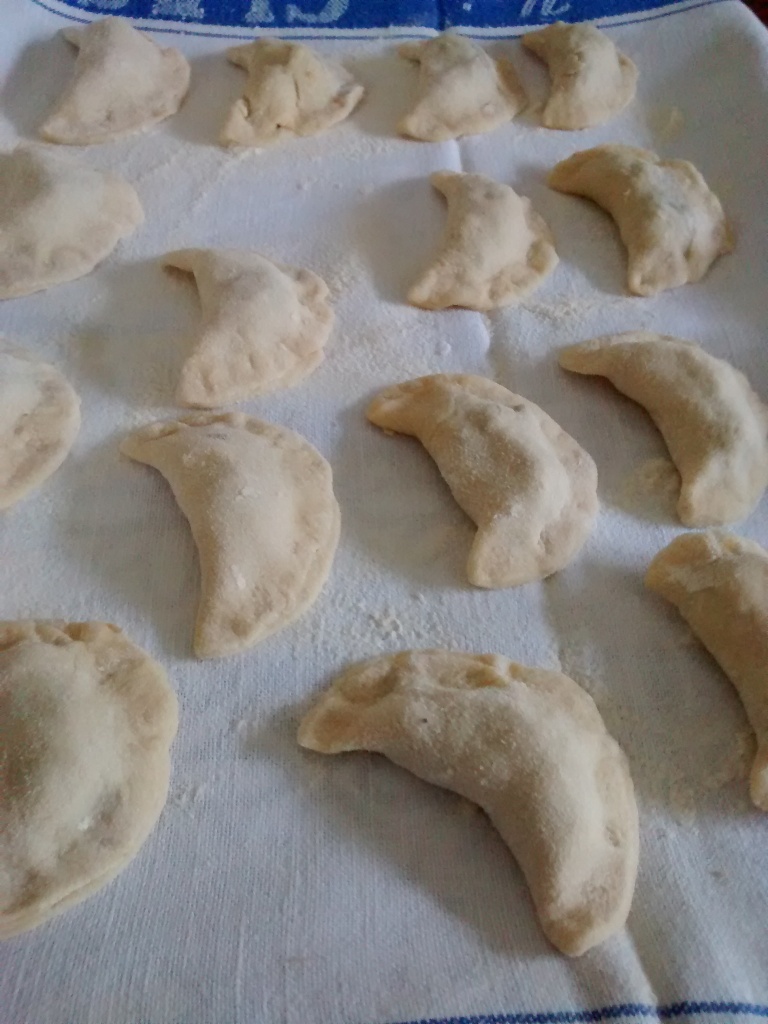
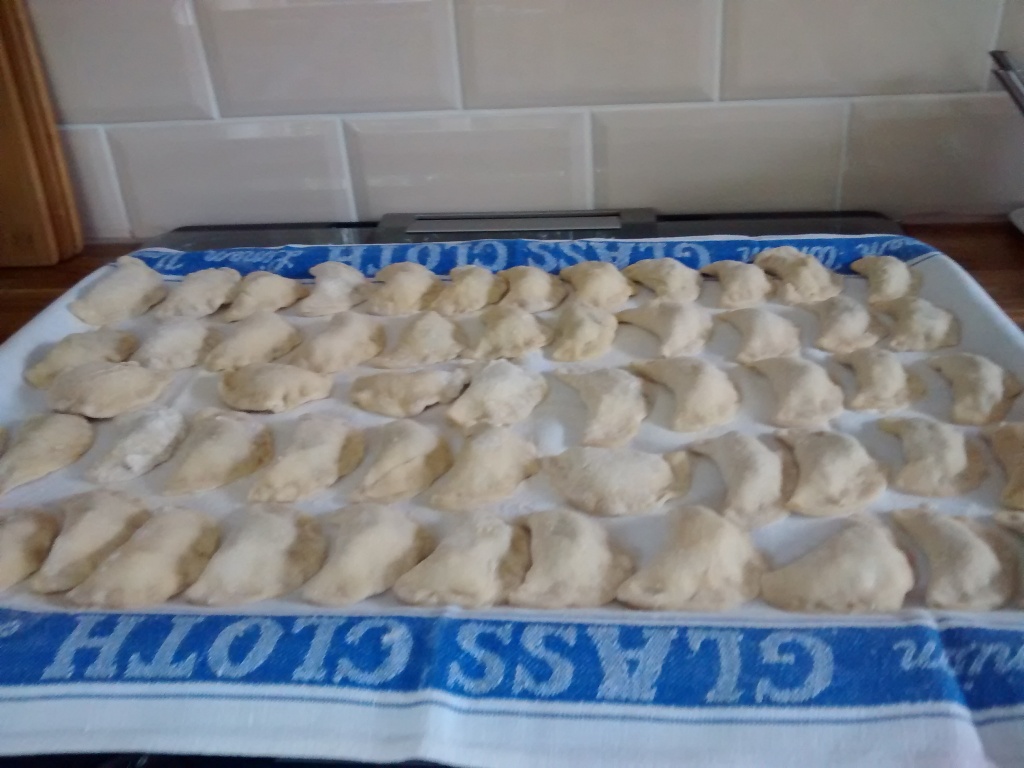
  • Have a large surface such as a tray covered with a cotton or linen cloth which has been lightly floured ready  and place the sealed pierogi on this until they are all made, do not let then touch each other.
  • I cut them out using a 7 cm diameter cutter.
  • I have noticed some people make them larger – I will try this out soon.
  • The excess dough can be re-mixed and rolled out again.
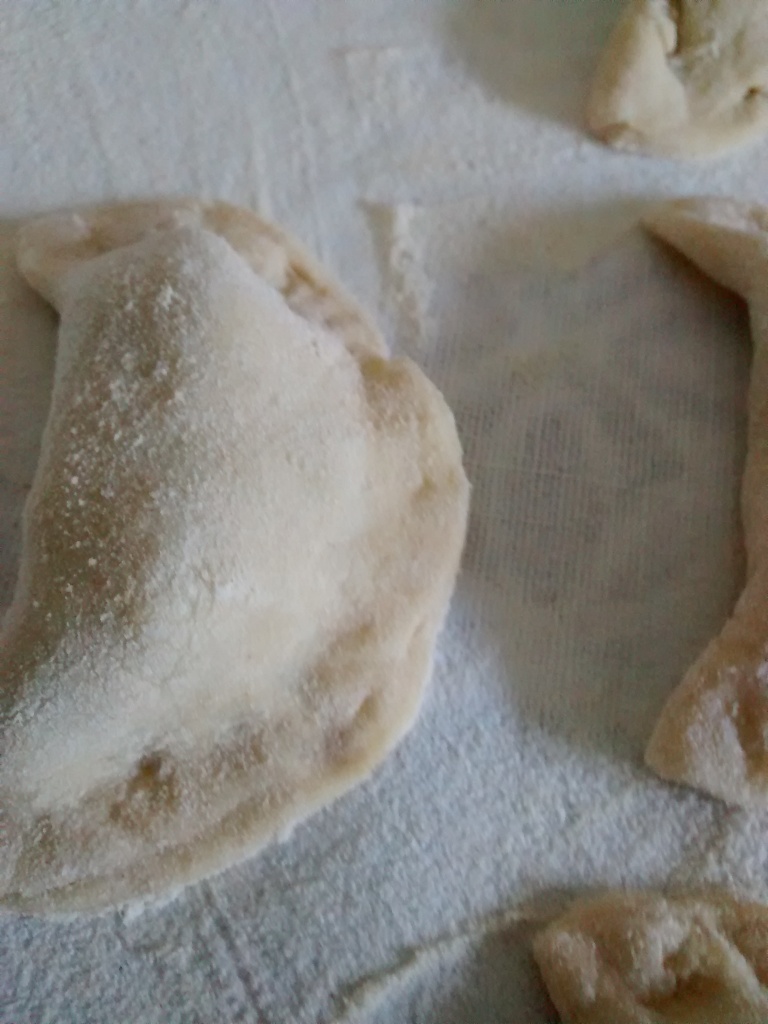
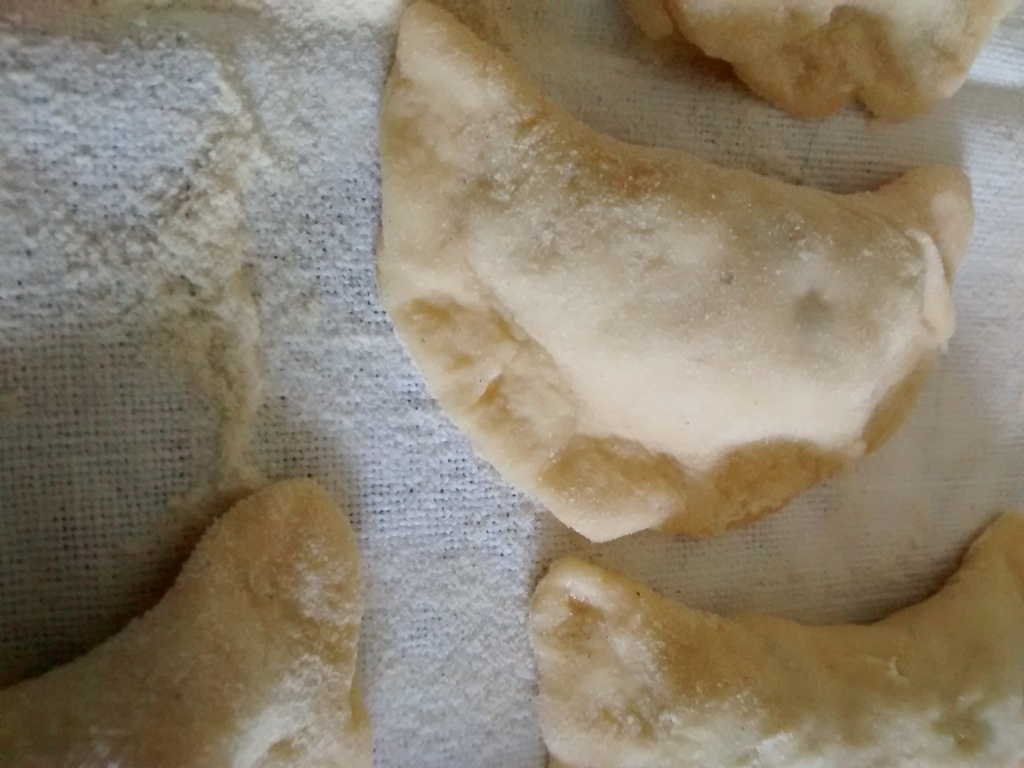
  • Around a half tablespoon of filling is put on  each circle and then they are folded over and the edges pinched together to make a good seal.
  • You learn from experience how much filling to put in as too much will make it hard to seal them and if not properly sealed they will burst on boiling. 
  • Do not worry if you have a few mishaps – it still happens to me even with experience – it is hard to salvage one that has gone wrong – just accept that there will be a few that you do not cook.
  • *
  • To cook the pierogi, use a large pan of boiling water to which you have added some salt and a drizzle of oil.
  • Drop the pierogi in one by one and allow them to boil.  I usually do about 6 to 8 at a time (I only do 6 at a time if using frozen ones).
  • As they cook they will float to the surface, let them boil for 2 to 3 minutes, (a bit more if they were frozen*), and
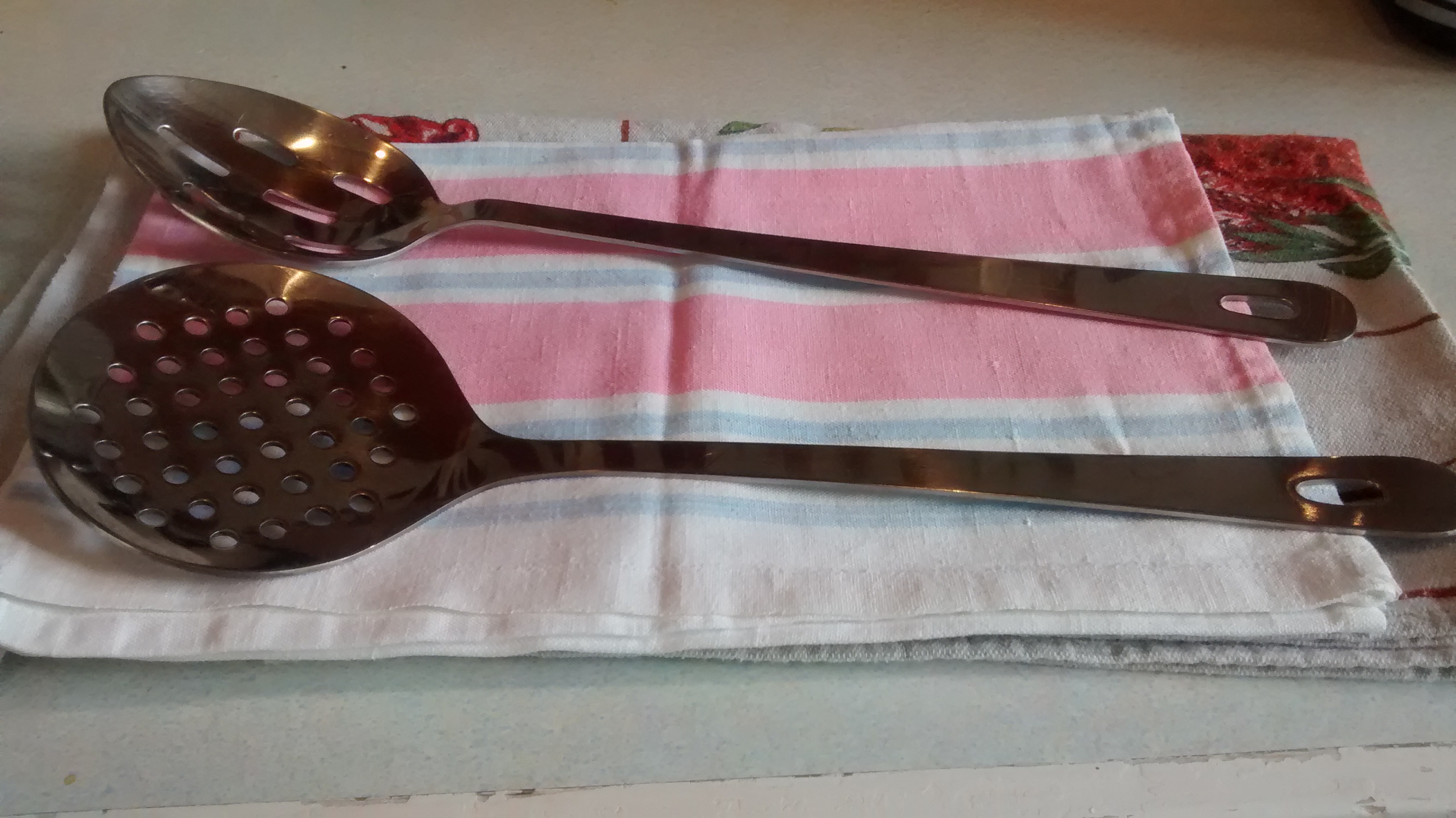
  • Then remove them with a slotted or perforated spoon and put into a colander above a pan for a few seconds to drain and serve.
  • Continue boiling batches in the same water.
  • If you want to make all the pierogi to serve together then you need to get a large shallow dish.*
  • Put in the pierogi and add melted butter.
  • Keep the dish warm in a low oven.
    • *I often open freeze them for later.

Macaroni Cheese

  • Makaron is the general term for pasta in Poland.
  • Pasta and cheese casseroles were recorded in the 14th century in Italian cookbook.
  • This recipe would be described as makaron z serem in Polish.
  • In 1802, Thomas Jefferson, the American President, served “a pie called macaroni” at a state dinner.
  • In 1824, an American cookbook, The Virginia Housewife by Mary Randolph (Jefferson’s daughter) included a dish of macaroni, cheese, and butter, layered together and baked in a hot oven.
  • This was the start of the American classic – Mac & Cheese.
  • Most recipes use a thick cheese sauce with boiled pasta.
  • Here the pasta is boiled in milk and water and a cheese sauce is not used.
  • Cheddar or Gouda cheese has been used rather than Parmesan.

Ingredients

  • 225g macaroni (or other small pasta shapes)
  • 130g butter
  • 230g of Cheddar or Gouda cheese
  • 600ml milk
  • 1 litre of water
  • 50g of fine white breadcrumbs
  • Salt and pepper to taste

Method

  • Grate the cheese.
  • Divide the cheese into 2 portions – 60g and 170g
  • Use a large pan and bring the milk, water and some salt to the boil.
  • Drop in the macaroni and boil till tender stirring occasionally.
  • Watch carefully so the liquid does not froth and boil over.
  • Melt 30g of the butter in a small saucepan.
  • Drain the macaroni and put it back in the warm saucepan.
  • Mix in the 100g of butter and the 170g of cheese with the macaroni.
  • Stir in the pepper.
  • Place in an oven proof dish.
  • Mix the 60g of cheese with the breadcrumbs and sprinkle on top.
  • Pour the melted butter over the breadcrumbs.
  • Brown the top under a hot grill.
  • Serve immediately.

Served on Royal Doulton Carnation 1982 – 1998

Macaroni Cheese

  • Pasta and cheese casseroles were recorded in the 14th century in an Italian cookbook.
  • In 1802, Thomas Jefferson, the American President served “a pie called macaroni” at a state dinner.
  • In 1824, an American cookbook, The Virginia Housewife by Mary Randolph (Jefferson’s daughter) included a dish of macaroni, cheese, and butter, layered together and baked in a hot oven.
  • This was the start of the American classic – Mac & Cheese.
  • This is an old English Victorian recipe.
  • Here the pasta is boiled in milk and water, and a cheese sauce is not used.

Ingredients

  • 225g macaroni
  • 130g butter
  • 230g of Cheddar cheese
  • 600ml milk
  • 1 litre of water
  • 50g of fine white breadcrumbs
  • Salt and pepper to taste

Method

  • Grate the cheese.
  • Divide the cheese into 2 portions – 60g and 170g.
  • Use a large pan and bring the milk, water and some salt to the boil.
  • Drop in the macaroni and boil till tender stirring occasionally.
  • Watch carefully so the liquid does not froth and boil over.
  • Melt 30g of the butter in a small saucepan.
  • Drain the macaroni and put it back in the warm saucepan.
  • Mix in the 100g of butter and the 170g of cheese with the macaroni.
  • Stir in the pepper.
  • Place in an oven proof dish.
  • Mix the 60g of cheese with the breadcrumbs and sprinkle on top.
  • Pour the melted butter over the breadcrumbs.
  • Brown the top under a hot grill.
  • Serve immediately.

Salmon Spread

  • There are many recipes in my Polish cookery books for a variety of spreads using cooked meat or fish.
  • In Polish this would be called pasta – a paste or a spread.
  • This recipe was given to me by my late cousin who lived near Durham.

Ingredients

  • Small tin of pink salmon
  • 200g of cream cheese or yoghurt cheese
  • Juice of half a lemon
  • *
  • A little soured cream- optional
  • Salt and pepper

Method

  • Drain the salmon from the liquid in the tin.
  • Remove the skin and any bones.
  • Mash the salmon up with a fork.
  • Add the cheese and the lemon juice.
  • Mix it all together to a smooth paste.
  • Add some soured cream to make a softer spread.
  • Season to taste.
  • Put into a bowl to serve or into individual little pots.
  • *
  • Serve with bread, toast or crackers and green salad.
  • Or use as a dip with crudities.


Served on an oval plate by Johnson Brothers – Snowhite – 1960-1979

Note

You can use some left over poached fresh salmon instead.


Pulpety – Meat & Cheese

  • I came across this version of pulpety  (Polish meatballs) recently and thought I would give these a try as I always have lots of yoghurt cheese.
  • Both beef and pork are used in this recipe and I often do mix these two meat minces together.
  • Dried breadcrumbs are not used in this recipe.
  • The bread is not moistened with milk.
  • The following amounts made 30 pulpety.

Ingredients

  • 200g minced beef
  • 200g minced pork
  • 200g twaróg(curd cheese) or yoghurt cheese (well drained)
  • 2 small onions diced (I might wiz them up in a mini-chopper next time)
  • 2 teaspoons of Italian herbs
  • Fresh white breadcrumbs from a slice of white bread or a roll.
  • 1 egg
  • Salt & pepper
  • *
  • 500ml of chicken stock – can be from a cube or concentrate
  • *
  • 500ml of a sauce of your choice – I used a simple tomato sauce

Method

  • Mix all the ingredients together to a uniform mixture.
  • Hands are best at the end – the mixture is quite sticky.
  • Pinch off small bits of the meat mixture and roll the piece between your hands to make small round balls and place these onto a floured board or tray whilst you make them all.
  • Leave these to chill in a cool place or in the fridge for an hour or so.
  • Pre-heat the oven to GM4-180°C.
  • Heat the chicken stock in a deep wide frying pan.
  • Add some of the pulpety and simmer with a lid for around 5 minutes.
  • Have a large ovenproof dish ready with your sauce.
  • Remove the pulpety with a slotted spoon and add to the sauce.
  • Repeat with the rest of the pulpety.
  • Put a lid on the dish.
  • Cook in the oven for at least 1 hour.
  • You can lower the heat and cook for longer.

Sauces

The varieties here are endless – make one of your favourite sauces for example mushroom or tomato.

You can then serve them with potatoes, pasta, rice or to be very Polish – buckwheat or pearl barley.


Served in Royal Doulton – Burgundy – 1959-1981


Pierogi leniwe

Pierogi leniwe – means lazy pierogi or  lazy dumplings.

I wrote about kopytka – Polish potato dumplings a good while back and these have the same shape.

Traditional recipes use twaróg – Polish curd cheese – I use my own yoghurt cheese.  I have found that you can use crumbly, white, mild, English cheeses such as: Cheshire, Lancashire or Wensleydale.

They can be served savoury or sweet – with melted butter, à la Polonaise (buttered breadcrumbs) or skwarki (crisp, fried, small squares of bacon) or sweet with a cinnamon sugar mixture.

Ingredients

  • 400g of twaróg (curd cheese), yoghurt cheese or  a white, crumbly cheese.
  • 3 egg yolks
  • 160 – 200g of plain flour
  • ½ teaspoon of salt

Method

  • Mix the yolks with the cheese.
  • Add the salt
  • Weigh out the flour to give an idea of how much is needed – this will depend on the cheese and the size of the eggs.
  • Add the flour and mix first with a wooden spoon and then by hand, you might not need all the flour or you may need more.
  • Mix until you have a soft dough.
  • Divide the dough into quarters and using a floured board shape the dough and roll it with you hands until you have a long sausage about 3cm in diameter.  If the dough sticks to the board then you need to add more flour.
  • Use a sharp knife to cut the dough into pieces, make the first cut at a diagonal and make the thickness about 1 to 1.5cm. You will get a sort of oval shape.

  • Repeat this with the rest of the dough.
  • Fill a large pan with water, add some salt and bring this to the boil.
  • When the water is boiling, add the dumplings one by one, do not over fill the pan or they will stick together. I tend to do around 8 at a time.
  • As they cook they will float to the surface, give them about another minute and then remove them with a slotted  or a perforated spoon and put them in a colander.
  • I have a colander sitting in an empty pan by the side of the large pan in which I am boiling the dumplings.

IMG_20151020_094418143


  • I find that the maximum from putting  them into the water to taking them out will be 3 minutes, if you cook these too long they will start to fall apart.

Here served as suggested above with  melted butter and with skwarki (crisp, fried, small squares of bacon).

Served on –

  • J & G Meakin – Topic – around 1967
  • Wedgwood – Chelsea garden – early 21st century.

Here served  à la Polonaise (buttered breadcrumbs)  in a handled dish by

Rörstrand Sweden Granada Ovenware  from the 1960s


They can be also be served  sweet with a cinnamon sugar mixture.

Kopytka z serem- Cheesy Potato Dumplings

I wrote about kopytka – Polish potato dumplings a good while back.

Since then I have tried another version which uses cheese as well as potatoes.

Traditional recipes use twaróg – Polish curd cheese – I have found that crumbly, white, mild, English cheeses such as: Cheshire, Lancashire or Wensleydale are also good.

Whilst looking at many recipes, I saw that the proportions of boiled potatoes to cheese varied greatly.

I have gone for roughly equal weights of boiled starchy potatoes to cheese.

The exact amounts are not critical but you must use starchy potatoes such as King Edward or Maris Piper.

IMG_20150910_122355675

Serve with either melted butter, à la Polonaise (buttered breadcrumbs) or skwarki (crisp, fried, small squares of bacon) or a hot sauce such as mushroom.

Ingredients

  • 300g of boiled starchy potatoes
  • 300g of twaróg (curd cheese) or white, crumbly cheese such as Lancashire
  • 2 egg yolks
  • 160 – 200g of plain flour
  • Salt
  • Oil to add to water for boiling

Method

Use a large bowl and put the cold boiled potatoes into the bowl.

Crumble the cheese and add it to the potatoes and mash them both together.

Add the yolks to the mixture.

Add a little salt.

Weigh out the flour to give an idea of how much is needed; this will depend on the type of potato and the size of the eggs.  Add the flour and mix first with a wooden spoon and then by hand, you might not need all the flour or you may need more. Mix until you have a soft dough.

Divide the dough into quarters and using a floured board shape the dough and roll it with you hands until you have a long sausage about 3cm in diameter.  If the dough sticks to the board then you need to add more flour.

Use a sharp knife to cut the dough into pieces, make the first cut at a diagonal and make the thickness about 1 to 1.5cm. You will get a sort of oval shape.

Repeat this with the rest of the dough.

Fill a large pan with water, add some salt and bring this to the boil.

When the water is boiling, add the dumplings one by one, do not over fill the pan or they will stick together. I tend to do this in 4 batches.

As they cook they will float to the surface, give them about another minute and then remove them with a slotted  or a perforated spoon and put them in a colander. I have a colander sitting in an empty pan by the side of the large pan in which I am boiling the dumplings.
IMG_20151020_094418143


I find that the maximum from putting  them into the water to taking them out will be 3 minutes, if you cook these too long they will start to fall apart.

Served on –

  • Royal Douton – Carnation – 1982 – 1998
  • J & G Meakin – Topic – around 1967
  • Wedgwood – Chelsea garden – early 21st century.

Here served as suggested above with  melted butter, with skwarki (crisp, fried, small squares of bacon) and a gulasz.

Beef Gulasz with Caraway

I came across this recipe recently which uses Gouda cheese with soured cream to thicken the sauce – it works really well and I will be trying this in other recipes.

Ingredients

400g – 500g braising steak – cubed

200g – 250g of mushrooms (chestnut type are good) – sliced

2 large onions – chopped

300ml of chicken stock (can be from a cube or concentrate)

3 tablespoons of caraway seeds

1 -2 tablespoons of plain flour

50g of Gouda cheese – chopped into small cubes.

3 tablespoons of soured cream

Sunflower oil for frying

Salt & pepper to taste.

Flat-leafed parsley to garnish – chopped

Method

Pre heat the oven to Gas Mark 3 – 1600C

On a large plate mix together the flour, salt and pepper.

Coat the meat cubes lightly in the flour mixture and brown these in the oil in a hot frying pan.

Place the beef into a casserole dish.

Lightly fry the onions and mushrooms in the frying pan and then add them to the beef.


Add the stock and caraway seeds to the pan.

Put on the lid and cook in the oven for around 3 hours until the beef is tender.

Before serving stir in the cubes of cheese and the soured cream and mix well into the sauce.

Garnish with flat-leafed parsley.

Served here with mashed potatoes on Royal Doulton – Carnation – 1982 – 1998.