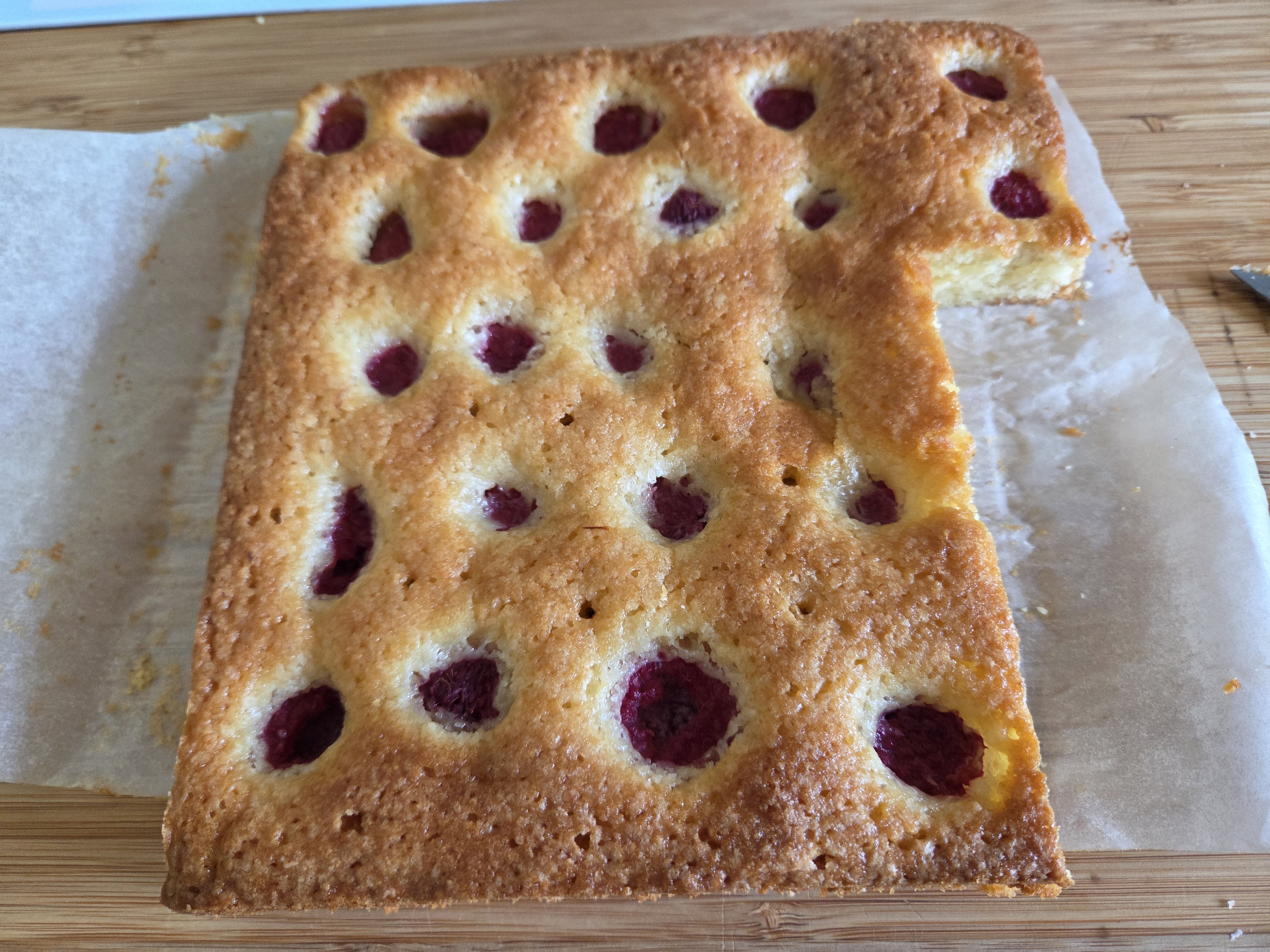
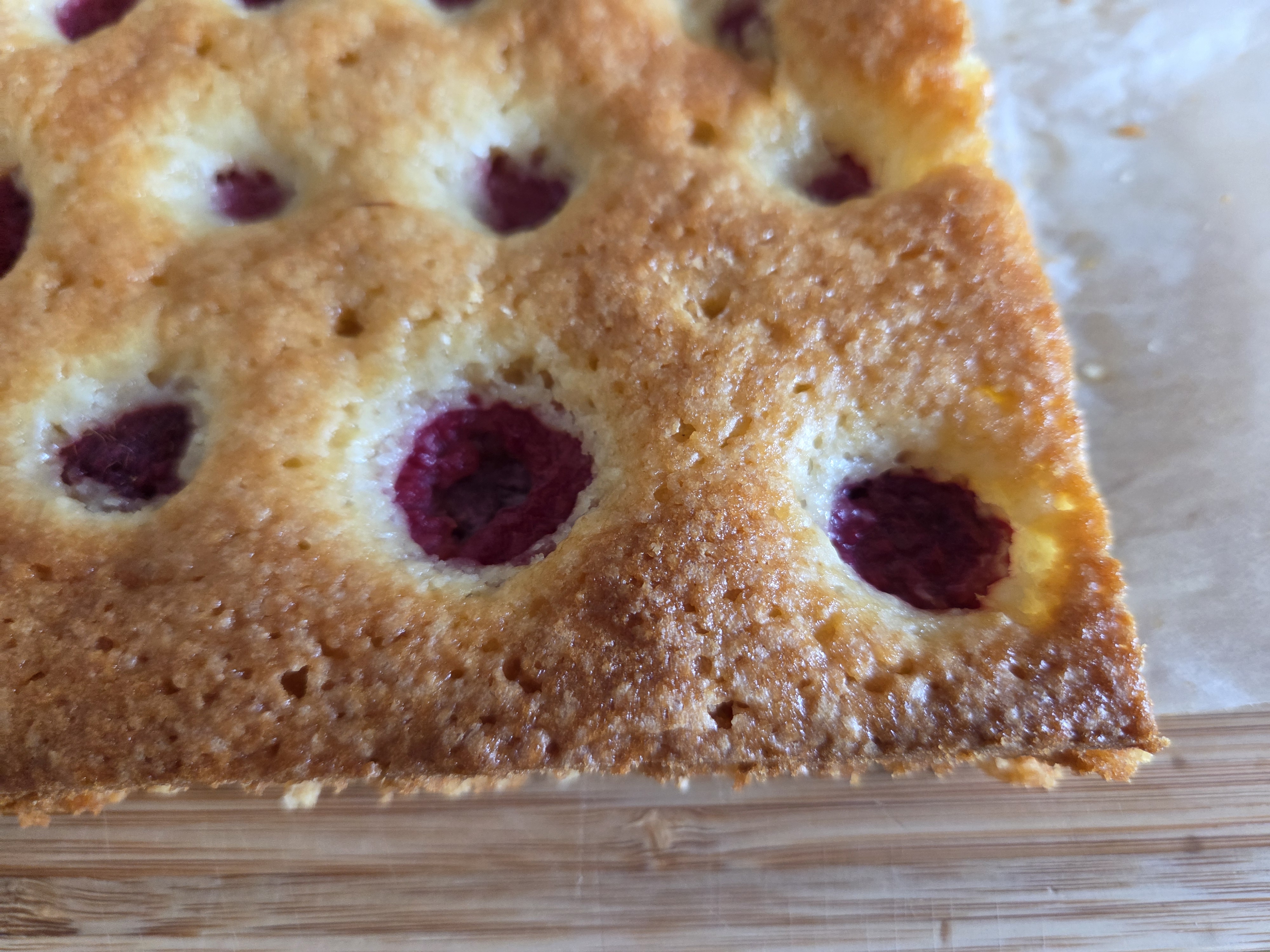
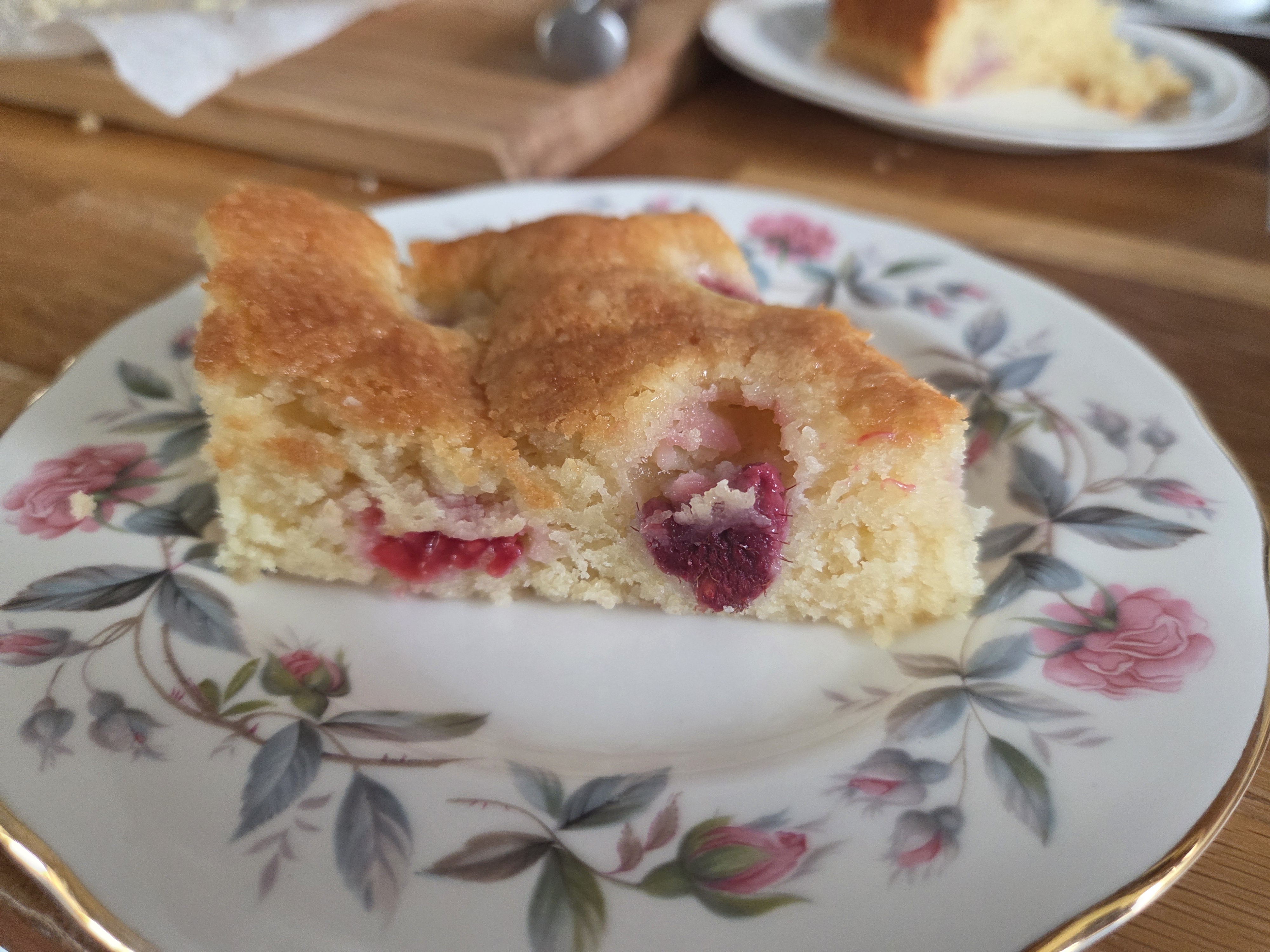
Almond & Raspberry Cake

  • I came across this recipe and thought I would give it a try.
  • The cake is easy to make as it is a batter.
  • I used fresh raspberries but I think defrosted frozen raspberries would also be fine.

INGREDIENTS

  • 125g plain flour
  • 1 teaspoon of baking powder
  • 75g ground almonds
  • 150g butter
  • 200g granulated sugar
  • 3 tablespoons of lemon juice=1 large lemon
  • 2-3 drops of vanilla essence
  • 2 eggs
  • 150 – 200g of fresh raspberries

METHOD

  • Preheat the oven to GM4-180°C.
  • Use a 20cm square tin (one with a loose base is best).
  • Grease and line the base and 3 sides with greaseproof paper.
  • Mix the flour, baking powder and the ground almonds together.
  • *
  • In a saucepan melt the butter, sugar and lemon juice together until well combined.
  • Leave to cool a little.
  • *
  • Add the butter mixture to the dry mixture.
  • *
  • Beat the eggs with the vanilla essence.
  • Add the egg s a little at a time.
  • Mix well until you have a smooth batter.
  • Pour the batter into the tin.
  • Place the raspberries over the top.
  • *
  • Bake for 35 – 40 minutes until the top is golden.
  • Cover the top with greasproof or foil near the end to prevent burning if not cooked through.
  • Leave to cool on  wire cake rack.

Duchess – Bramble Rose – tea plate

Fruit & Sweet Cheese Cake

  • I tried this recipe from one of my recently bought Polish magazines.
  • I have not make a cake dough with twaróg/yoghurt cheese before.
  • I would only make a small alteration to the amounts in the ingredients next time – a little more sugar with the topping of twaróg/yoghurt cheese which is how I have written this up.
  • It was huge success.

INGREDIENTS

  • 250g plain flour
  • 100g granulated sugar
  • 2 teaspoons of baking powder
  • ¼ teaspoon of salt
  • 120g – melted butter – allowed to cool.
  • 3 eggs
  • 125g + 125g twaróg/yoghurt cheese (very well strainned)
  • 1½ – 2 tablespoons of icing sugar
  • 300g of fruit – around 150g of apples – the rest blackberries/raspberries or fruits of the forest (can be frozen – defrosted and dried with kitchen roll).
  • *
  • Sieved icing sugar to serve.

METHOD

  • Grease and line on 3 sides  a 20 x 26cm baking tin.
  • Pre-heat the oven to GM3 – 160ºC.
  • Mix the dry ingredients together in a bowl.
  • In another bowl mix lightly whisk together the eggs and 125g of the twaróg/yoghurt cheese
  • Mix the contents of the 2 bowls together.
  • Add the cooled, melted butter and mix to get a soft dough.
  • Press the dough into the tin.
  • *
  • In a bowl mix the other 125g of the twaróg/yoghurt cheese with the icing sugar.
  • *
  • Peel and core the apples
  • Slice them into very thin slices.
  • *
  • Spread the sweetened twaróg/yoghurt cheese over the dough nearly up to the edges.
  • Sprinkle the apple slices over this.
  • Then sprinkle on the black fruit (I used fresh blackberries).
  • (I should have used more – did not have enough).
  • Bake for 55 to 65 minutes .
  • *
  • Sprinkle with icing sugar to serve.
  •  

Blackberry Sauce

  • In Gvara (yes this spelling) restaurant in Gdańsk, I had wild boar tenderloin with blackberry (jeżiny – in Polish) sauce.
  • Wild game and similar is very popular in this region.
  • It was delicious – the sauce being just slightly sweet and the berries fresh tasting.
  • I just had to try this out now that I am back home.
  • The blackberries were on sale in a local supermarket and were English grown.
  • Slightly earlier in the year I might have been able to pick some from local hedgerows.
  • You might find some frozen in shops –  I will have to see.
  • *
  • I decided to make this sauce and serve it with a pork tenderloin – It would also be good with pan fried loin or chops.
  • I cooked my tenderloin, wrapped in foil with some mixed herbs.
  • *
  • You can also serve the sauce with yoghurt or budyń or ice cream etc.

Ingredients

  • The quantities are approximate
  • The sugar will depend on the sweetness of the blackberries.
  • *
  • 200g of blackberries
  • 125ml of water
  • 2-3 tablespoons of granulated sugar.

Method

  • In a small saucepan add the water to the blackberries.
  • Heat slowly for a few minutes.
  • Sieve out the berries and keep to one side – this is to keep them fresh tasting.
  • Reduce the amount of liquid by heating for a few minutes.
  • Put back the blackberries and stir and heat a little.
  • Add the sugar (maybe 1 tablespoon at a time) and taste.
  • The sauce does not want to be too sweet.
  • *
  • Serve straight away.
  • *
  • Can also be served cooled with yoghurt for example.

Pleśniak

  • I first tasted pleśniak on my recent trip to Gdańsk.
  • I had never heard of it before although some of my cakes are similar.
  • It does not appear in any of my older Polish cookery books.
  • Having done a little more research I found it was in some people’s list of their top 10 favourite Polish cakes.
  • *
  • The name is intriguing in that the word means  – mildew or mouldy!
  • It consists of 3 or 4 layers, usually baked in a square or rectangle:
  • Shortcrust/chocolate shortcrust 
  • Sour fruits
  • Meringue
  • *
  • Maybe the mildew reference is to the look of the meringue layer?
  • *
  • The sour fruits are usually sour cherries, blackcurrants or gooseberries.
  • Jam or a mixture of jam and fresh or frozen fruits can be used.
  • The fruit layer should be on the sour side – so if you jam is sweet – heat it up with the addition of the juice of a lemon or two.
  • Sometimes rhubarb, cooked first, is used.
  • My placek with rhubarb & meringue could be adapted with the addition of cocoa to the pastry or the fruit.
  • *
  • I tried this out in a 26 x 21 rectangular tin.
  • I have seen several versions – sometimes with the egg whites/meringue under a layer of pastry – I think the meringue on top is easier.

Shortcrust layers

  • Start to make a rich buttery shortcrust using 250g of plain flour.
  • Do not add any sugar to the pastry.
  • Divide the crumbs part into two.
  • Use the first half to make pastry with 2 egg yolks.
  • To the second half add 3 tablespoons of cocoa powder and continue with 2 egg yolks as normal.
  • Wrap each dough separately. 
  • Leave to chill for around 30 minutes.
  • Egg whites will be used in the meringue.
  • Pre-heat the oven to GM6 – 200°C.
  • Grease and line the baking tin with one long piece of baking paper.
  • Roll out the plain shortcrust to fit into the tin.
  • Roll out the chocolate shortcrust and place this on top.
  • Prick with a fork all over.
  • Bake for around 20 – 25 minutes.
  • Leave to cool completely.

Sour Fruit Layer

  • Spread jam (sour cherry, blackcurrant or gooseberry) over the pastry.
  • If you jam is sweet – heat it up with the addition of the juice of a lemon or two first.
  • Leave to cool.
  • Add some fresh or frozen fruits if you have them.

Meringue Layer

  • Pre-heat oven to GM3 – 160°C.
  • Use 3-4 egg whites & 50g icing sugar per white.
  • Place the whites into a grease free bowl.
  • Whisk till stiff.
  • Add icing sugar and whisk again till stiff.
  • *
  • Spread meringue over the top of the fruits.
  • Bake for 30 – 35  minutes.
  • Can be longer or shorter depending on if you want the meringue crisp or soft.
  • *
  • Leave to cool.
  • Cut into squares when serving.

Royal Standard – Lyndale tea plate.
Peach Soup

  • This is a super soup which can be served warm or chilled.
  • A dollop of yoghourt is good with the chilled version.
  • I prefered it warm even though this is summer fruit.

Ingredients

  • 6 peaches or nectarines
  • 250 ml white wine
  • 80g granulated sugar
  • ½ teaspoon ground cinnamon
  • Pinch of ground cloves
  • Pinch of ground ginger
  • *
  • Optional – dollop of yoghurt for serving when chilled 

Method

  • Quarter the fruit and remove the stones.
  • Put the fruit, sugar and spices in a pan with the wine.
  • Simmer the fruit in the wine for around 15 minutes until they are soft.
  • Blend the mixture with a stick blender.
  • Serve warm or chilled.

Served in Royal Doulton Burgundy and Bavaria China

Silesian Heaven – 2

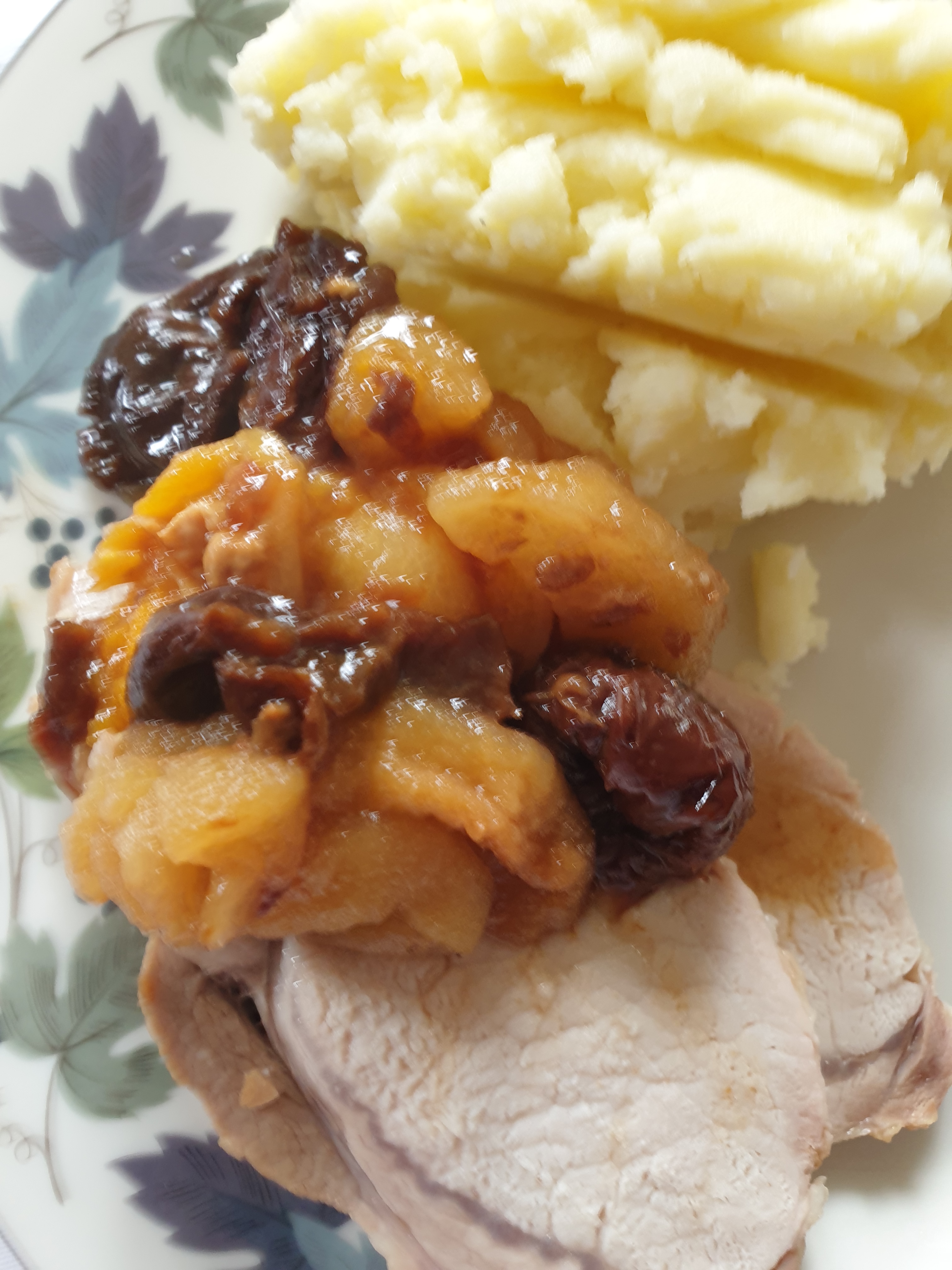
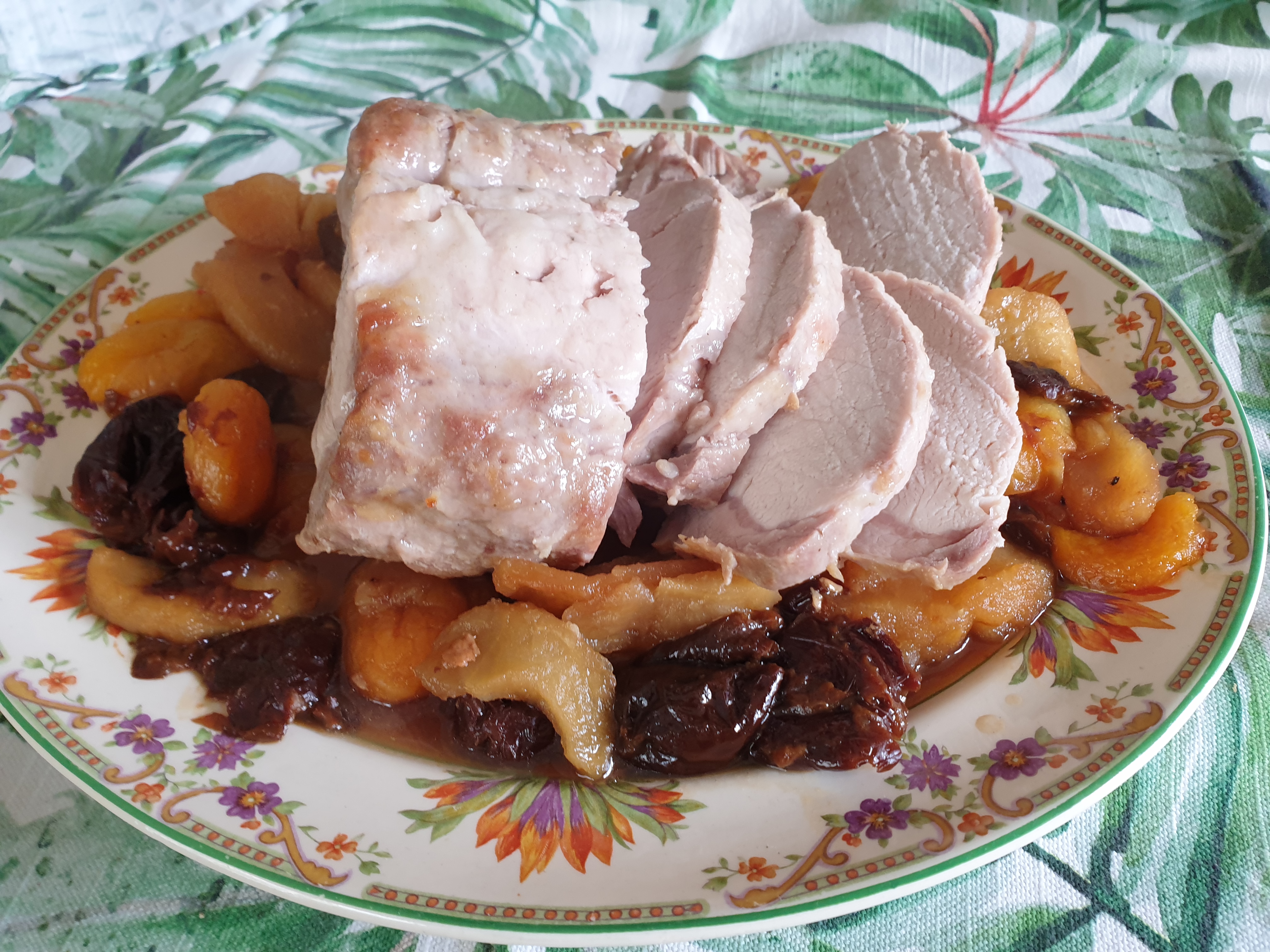
  • Silesian Heaven  – Śląskie niebo
  • Previously I cooked this dish more as a gulasz (casserole).
  • I really liked the mixture of dried fruits: apples, apricots and prunes.
  • Use dried pears also if you can source these.
  • The fruits are rehydrated overnight.
  • I thought why not use this mixture as the base of a roast pork dish as in an old Polish style or as in More Pork and Prunes.

INGREDIENTS

  • Piece of pork loin or leg for roasting
  • 300g of mixed dried apples, apricots and prunes
  • Plain flour & pepper
  • A little oil to seat the joint

METHOD

  • Place the dried fruits in a bowl and cover with boiling water.
  • Leave overnight.
  • *
  • Preheat the oven to GM4 – 180°C.
  • Roll the joint in flour and pepper.
  • Seal lightly on all sides.
  • Place all the fruits and liquid at the base of  an oven roasting tin – one with a lid.
  • Place the joint on top.
  • Put the lid on top.
  • Cook in the oven for the time required for the weight of meat.
  • *
  • You can take the lid off nearer the end of the cooking time.
  • *
  •  Serve the meat surrounded by the fruits.
  • *
  • NOTE – how much the fruits are cooked will depend on the size of the joint.

  • Served here on a serving dish by Allenton & Son

Option

  • Prior to serving, cover and keep the meat warm.
  • Remove the fruits and place in a saucepan with a little more water.
  • Heat with stirring to make them more  a thick sauce.

Gammon & Apricots

  • Grilled gammon and grilled pineapple (usually tinned) is a very popular dish in England.
  • Whilst doing some research I discovered that a much older idea is to have apricots with gammon.
  • Apricots were very popular in Elizabethan times, when fruit and meat together were often served.
  • Apricots in these dishes could have been dried apricots but here I have used tinned apricots halves.
  • Apricots in Polish are morela.
  • Apricots are from the Genus Prunus and they are drupes – stone fruits.
  • *
  • Fruit served with meat is very popular in Poland and I think this dish would be well liked.
  • Gammon slices have been used here but this dish could be adapted to use a large piece of ham or gammon.

    Ingredients

  • A thick piece of gammon per person
  • 2 apricot halves (tinned) per person – ones in syrup are the best.

Method

  • Grill the gammon on both sides.
  • Drain the apricots from their juice/syrup.
  • Grill the apricots.
  • Serve the gammon with the apricots.
  • *
  • This would go well with potatoes & garden peas and/or a cabbage salad.

Classic Mince Pies with Cranberry Mincemeat

  • I think of these as very British – but we all love them and they have become part of our Christmas Day celebrations.
  • I make these with the pastry that I learnt from my mother  – a variation on kruche & półkruche,  pastry (a richer shortcrust pastry).  Using the proportion of 2 parts flour to 1 part butter.
  • Rather than the classic mincemeat – these were made with Cranberry mincemeat – which is lighter and more tart.

Ingredients – Pastry

  • 200g plain flour
  • 100g butter 
  • 1-2 tablespoons of icing sugar
  • 1 egg yolk
  • Juice of 1 lemon (and maybe 1 tablespoon of cold water)
  • *
  • Glaze
  • Lightly beaten egg white
  • Caster sugar

Method for pastry

  • Rub the butter into the flour to make “breadcrumbs”.
  • Mix in the icing sugar.
  • First with a knife and then with your fingertips mix in the yolk & lemon juice (and  maybe a tablespoon of cold water.)
  • You are aiming to get a dough which is not wet.
  • Rest for about 30 minutes in a cool place.
  • *
  • Pre-heat the oven to GM6 – 200°C
  • You need to grease the tins well in order to get the pies out successfully.
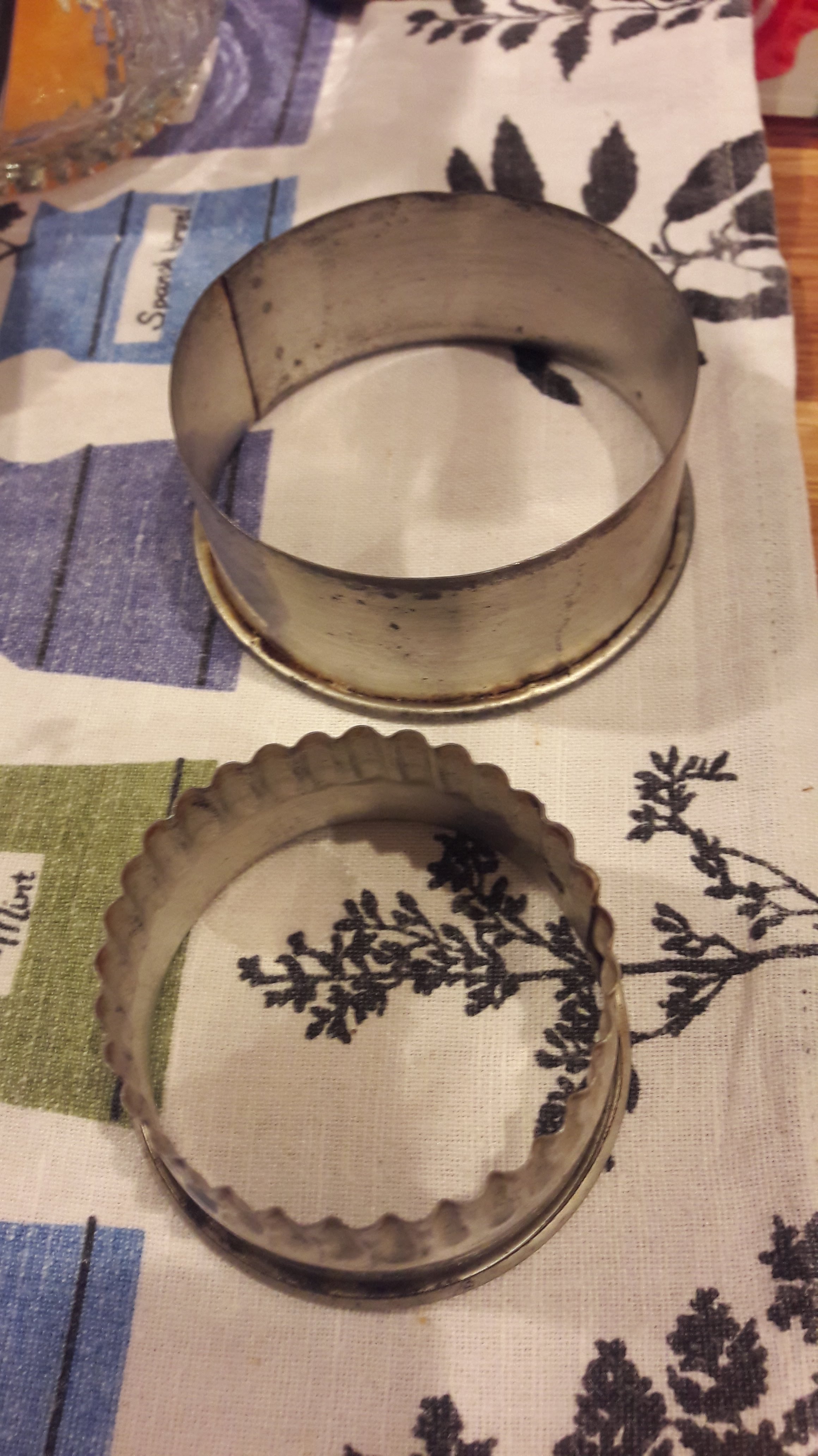
  • 2 sizes of cutters are needed – 1 – 7cm diameter, plain, for the base, 1 – 6cm diameter, crinkle edge for the top.

METHOD – Pies

  • My tins are anodised aluminium and have a gentle rounded shape, this I think make for the perfect balance between the pastry and the filling.
  • I put “tops” on my mince pies – but not fully covered ones.
  • *
  • The tops are brushed with beaten egg white and sprinkled with caster sugar.
  • Cut out the bases and place them in the tins.
  • *
  • Place around a tablespoonful of mincemeat on the pastry.
  • Place the smaller tops on.
  • Lightly beat the egg white and brush this on the tops
  • Sprinkle caster sugar over the egg white.
  • Bake for around 15 minutes – keeping an eye on them – so they do not burn.
  • Leave to cool slightly in the tins & carefully remove them onto a rack to fully cool.

Baking with Cranberry Mincemeat 1 – Easy Little Pies

  • These are the small version of the Easy Apple Cake posted recently.
  • Use the same amount of pastry and divide it into 8 or 6 portions.
  • *
  • Shortcrust pastry made from 200g plain flour, 100g butter, 1 egg yolk, juice of 1 lemon, extra water if necessary – 2 tablespoons of icing sugar optional.
  • *
  • Grease a large baking tray or two.
  • Pre-heat the oven to GM6 – 200°C.
  • Roll out each piece of pastry into a thin rough circle.
  • Brush the centres with some egg yolk.
  • Add a 1-2 tablespoons of the Cranberry mincemeat.
  • Bring up the sides but do not totally cover the filling.
  • Join up the pastry slightly.
  • Brush beaten egg white over the pastry.
  • Sprinkle a little granulated over the sides.
  • Place pies on the baking sheet.
  • Bake for 15 – 20 minutes till golden.
  • Leave to cool still on the baking tray for a few minutes and then transfer onto a wire rack.
  • Serve slightly warm or leave to cool completely.
  • Evesham plate by Royal Worcester. 

Cranberry ‘Mincemeat’

  • Cranberries – in Polish – żurawiny – grew in the area around where my father used to live – the part in the North East that was Poland before WW2.
  • Lingonberries – in Polish  – borȯwki – its smaller rounder ‘cousin’ also grew there.
  • My aunties who now live in Białystok had many memories of going out to pick baskets of these fruits.
  • In fact it is one of these aunts that gave me the recipe for Cranberries & Pears Sauce, which I posted some time ago.
  • The mincemeat’ here is a reference to the old English fruit & spice mixture, popular at Christmas time, that decades ago was made with meat, often mutton.
  • Nowadays in England the only meat reference is the fact that most of this fruit is mixed with beef suet.
  • There is no suet or any other fat in this recipe.
  • This with cranberries is a fresher tasting version but it will only keep in the refrigerator for around a month.
  • If you are worried about this keeping problem then just make it with half these quantities and use quickly

INGREDIENTS

  • 600g fresh cranberries
  • Grated zest of 2 oranges or satsumas
  • 150g granulated sugar
  • 150g currants
  • 150g raisins or sultanas
  • 1 teaspoon of ground cinnamon
  • 1 teaspoon of ground ginger
  • ½ teaspoon of ground cloves
  • 125ml sherry

METHOD

  • Have prepared 4 – 5 sterilised jar jars.
  • Put the cranberries, sugar, zest and juice into a saucepan and heat till the fruit starts ‘popping’.
  • Add the dried fruit and spices and continue heating and stirring for around 5 minutes.
  • Add the sherry and continue heating and stirring for another 5-10 minutes until you have a thick liquid free mixture.
  • Leave to go cold and pot up into cold sterilised jars.
  • Keep in the fridge and use within a month.

  • Option – not tested – some dried cranberries to replace some of the currants or raisins.