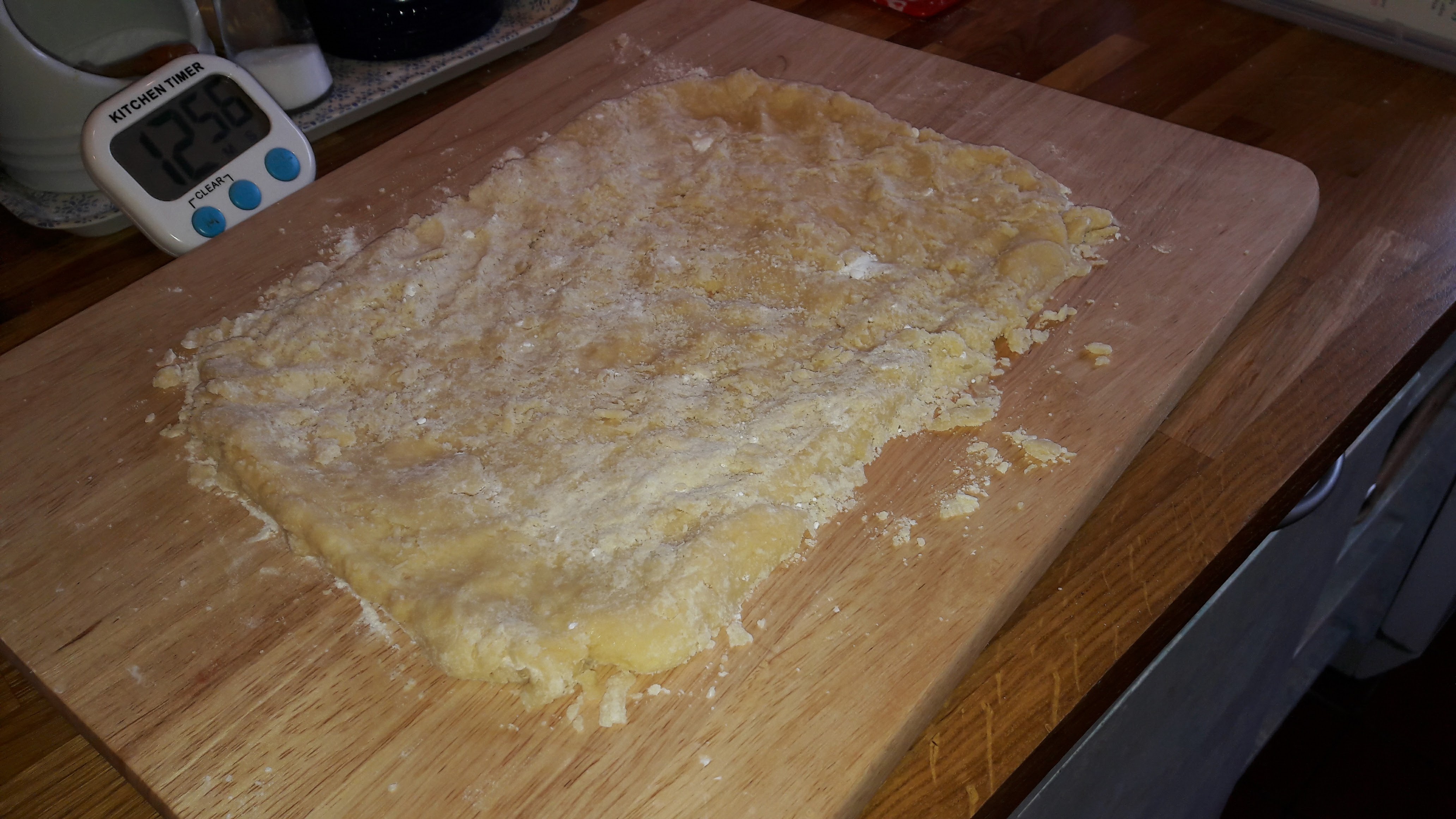
Walnut Tort

This is the same  recipe as the  Hazelnut tort only here ground walnuts  are used instead of hazelnuts.

I used the 6 egg recipe and made it in 2 x 18cm sponge cake tins.

A Little Note About Walnuts

Walnuts (Juglans regia) are native to south-east Europe and south-west China. They are the oldest tree food known dating back to 7,000 BC.

There are accounts of their cultivation in Babylon (now Iraq) in 2,000BC.

Juglans regia means means Jupiter’s royal nut.

They are the seed of a drupe (stone fruit) – not a true Botanical nut.

In Polish walnuts are orzechy włoskie –  nuts Italian – so named it is thought as they were brought to Poland by traders from Imperial Rome.

Black walnuts (Juglans nigra) are native to North America.

Ingredients

6 eggs

225g  caster sugar

225g ground walnuts

2 sponge fingers – crushed.

Optional – extra chopped walnuts for sprinkling on the butter cream or grated dark chocolate.
P1030465

Method

You will need to grind the walnuts and of course an electric grinder makes this very easy.

It is best to chop the walnuts into small pieces as this will make it easier and grind the walnuts in small batches so as not to over strain the motor.

Pre-heat the oven to GM5 – 190°C.

Grease and line 2 x 18cm in diameter tins.

Crush the sponge fingers and mix them with the ground walnuts.


Whisk together the eggs and sugar until they are pale and frothy.

Fold in the walnut mixture.

Divide the mixture between the two tins and bake in the oven for around 20 minutes.

Allow the cakes to cool .

Drizzle each cake with a poncz (sweetened punch). I used 50ml of weak black tea, 1 tablespoon of rum  and 1 tablespoon of  sugar.


Sandwich together with a butter cream & cover the top and sides also.

The following flavours are good with walnuts.

I used a rum butter cream made from 80g butter, 1 egg yolk  1 tablespoon of rum and  around 230g of icing sugar.

Cream the butter and the egg yolk and add the rum.  Mix in the icing sugar until you have the desired consistency.

More butter cream would have been better – I was trying to use the minimum this time!

I added chopped nuts to the top and sides (I used a cake stand with a small lip – a totally flat stand would have make it easier to add the nuts to the sides).


Served on – Tuscan China – Bird of Paradise – Hand Painted – 1930s

An Austrian Influence

A few weeks ago I bought an excellent Austrian cookery book in a charity shop.
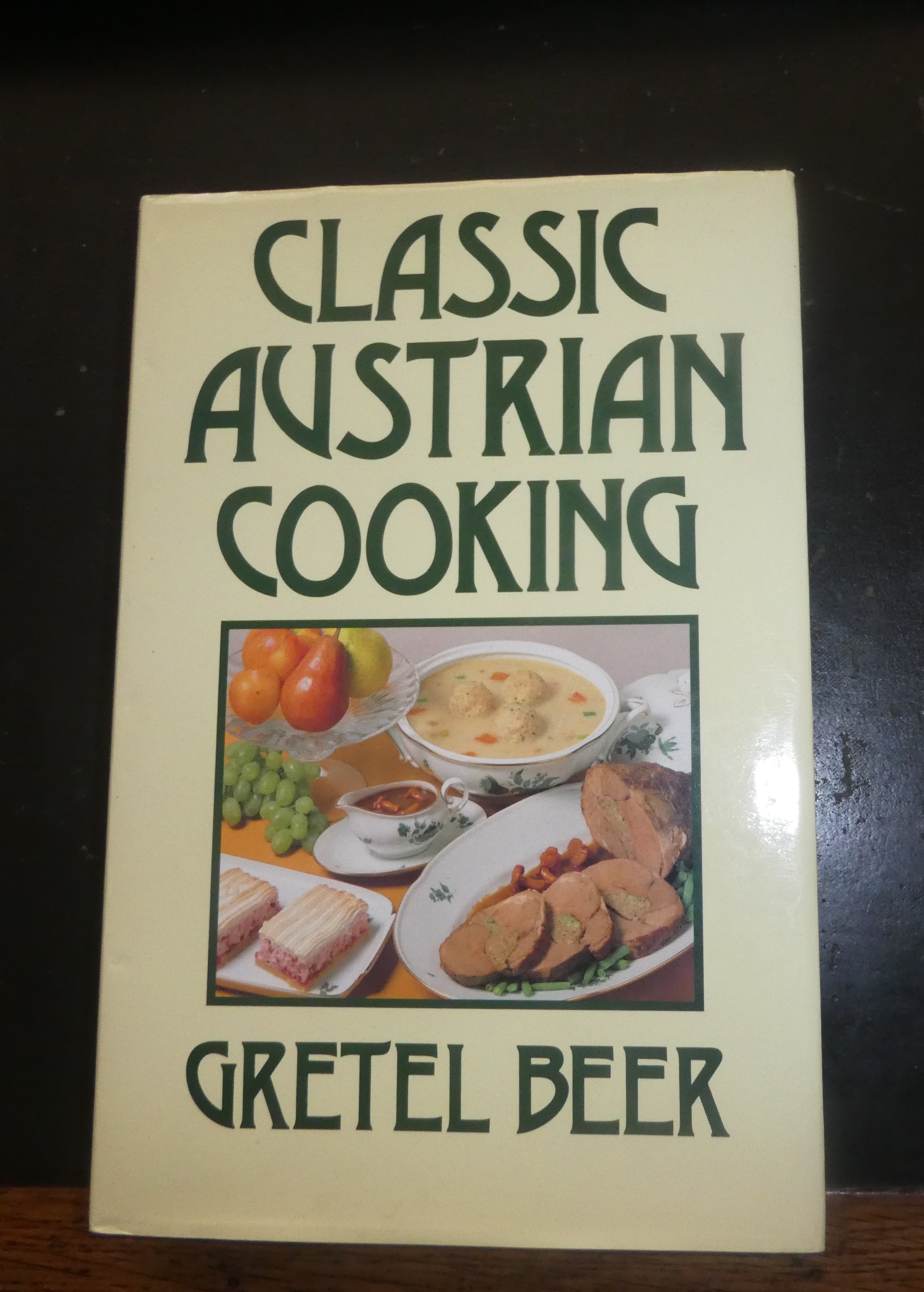


I know that there is a lot of overlap & influence between Polish & Austrian Cookery  and have enjoyed looking at this book and comparing my recipes with ones here.

On the back cover it says

“The culinary flavour of Austria is a gentle flavour. It knows of the fiery spices of Hungary and the elegance of French cuisine. It derives much of its strength from Moravia and much of its daring from Poland.”

For several of the cakes apricot or redcurrant jam is used to cover the top and sides of the cake before icing it.

For a walnut gateau, similar to my recipe, redcurrant jam is used.

I decided to do a variation of this with my walnut tort and to use raspberry jam.

The 2 cakes were made as above.

A poncz(sweet punch) was used made from 50ml of weak black tea and 1 tablespoon of sugar to drizzle the cakes.

The cakes were then sandwiched together with a raspberry butter cream using  60g Butter, 180g icing sugar & 2 tablespoons of raspberry jam which were creamed together.


Then the  top and sides were covered with raspberry jam, warmed slightly for ease of spreading and then this was allowed to dry.

I then made a lemon icing with the juice of 1 lemon and  icing sugar and used this to cover the top and sizes.


Served on Royal Grafton – Woodside  –  from the 1950s

However

This did not work too well – the icing I made was too stiff and I disturbed the jam underneath and got a mottled pink and white icing which  then  dripped down onto the base of the cake stand!!

However my friends thought the cake tasted wonderful and loved the combination of  flavours, so I decided to make the icing with the juice of 1 lemon, 1 tablespoon of raspberry jam & icing sugar and see how that worked.

Storage

Do not cover the cake completely or it will go very soggy – cover it with a net or similar which will let the air circulate but keep insects off.


Alternative Icing 1

I decided to test out the raspberry icing over a creamed sponge cake – I used 4 eggs and equal amounts of butter, caster sugar and self raising flour and baked them in 2 x 20 cm anodised baking tins.

I sandwiched the cakes together with a layer of jam and the raspberry butter cream as above.


I then made a thick icing using the juice of 1 lemon, 1 tablespoon of raspberry jam & icing sugar.


Served on Aynsley  –  Las Palmas – 1960s

Alternative Icing 2

This icing was not as tangy as on the original cake so I tested this again with a more pouring, dripping glaze – this time using the juice a lemon, 1 tablespoon of raspberry jam & enough icing sugar to make a more pouring glaze.

I made just one 22cm round walnut cake and cut it in half &  used a poncz(sweet punch) made from 50ml of weak black tea and 1 tablespoon of sugar to drizzle the cake.


A few thoughts!

With hindsight I would not use one cake again as it was hard to cut it through evenly & there were lots of crumbs – if I only wanted to use 4 eggs,  I would make 2 smaller cakes.

I still have not got the icing quite right – this time there was too much & it was a bit too runny – maybe just the juice of half a lemon would be enough – however the taste was very good.

The cake improved over the next few days as the icing seeped into the cake.


Served on Colclough – Stardust – from the 1960s.

Storage

As with the cakes above do not cover the cake completely or it will go very soggy – cover it with a net or similar which will let the air circulate but keep insects off.


try Save

Save

Save

Save

Save

Save

Save

Save

Save

Save

Save

Save

Save

Save

Save

Save

Save

Save

Save

Save

Save

Save

Save

Save

Save

Save

Save

Save

Save

Save

Save

Save

Save

Save

Save

Save

Save

Save

Save

Save

Save

Save

Save

Save

Placek

Placek is a low flat cake and can be  round or rectangular in shape.

I made two using  each of the recipes in  ciasto półkruche  – a type of shortcrust pastry – with jam fillings and both turned out well.

Placek with jam

Grease and line a 32 x 22 tin

Pre-heat the oven  GM5 – 190°C

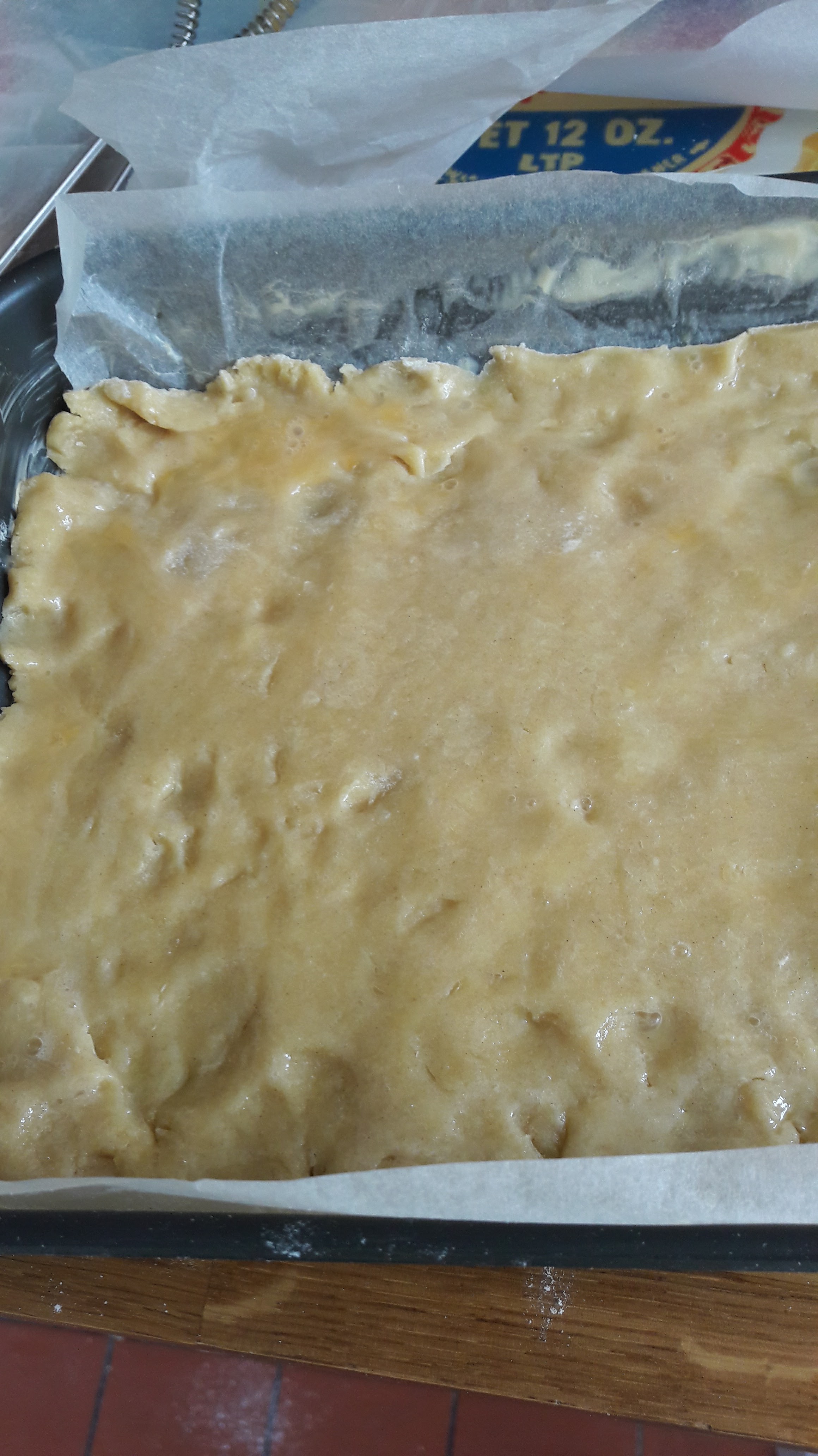
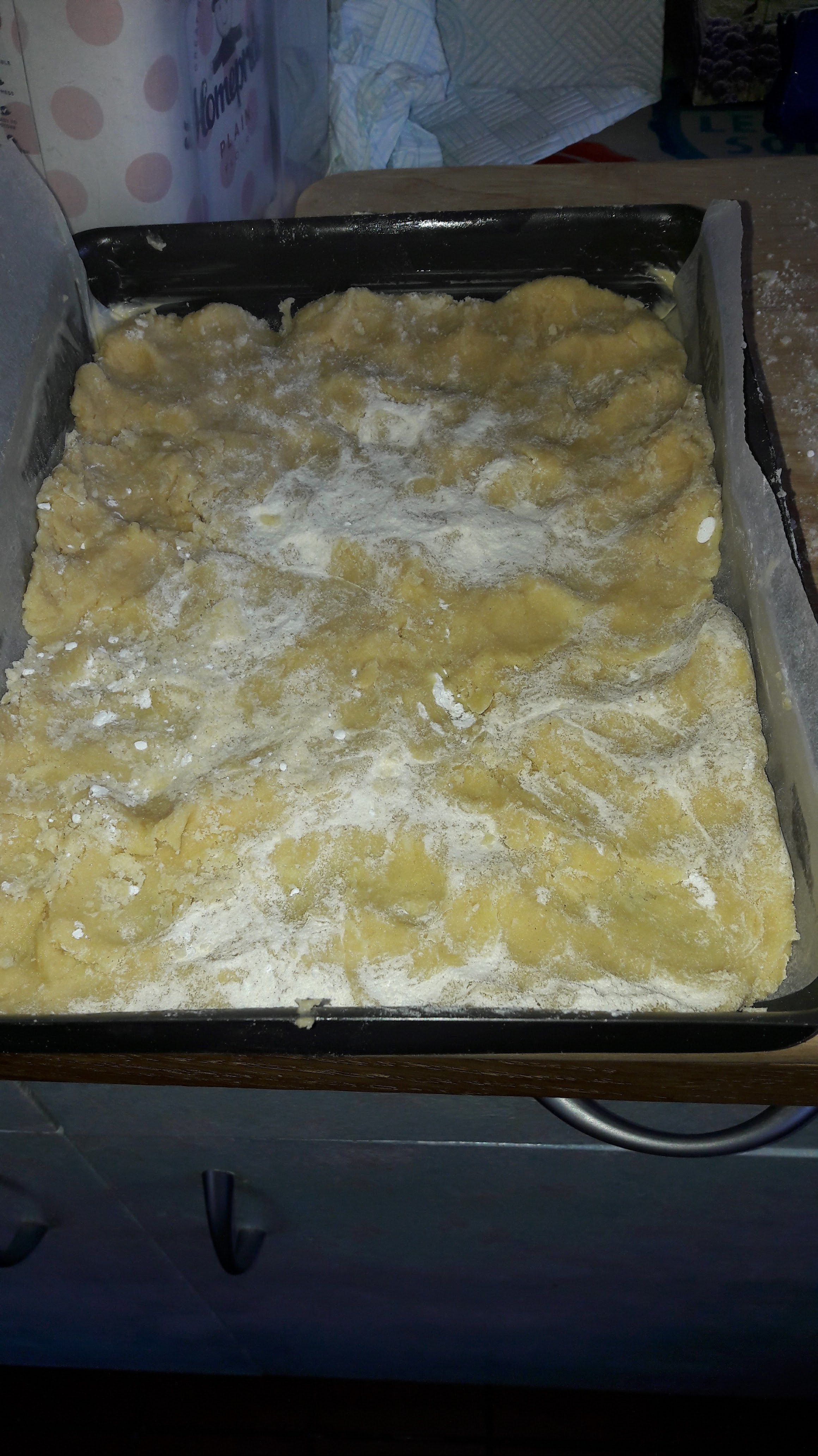
Use half the dough and roll it out to fit the tin.

Spread the dough with jam – you will need around a jar.

Cover the top with the rest of the dough rolled out.

Bake for around 30 minutes.

Dust with icing sugar as soon as you take it out of the oven and leave to cool.

Placek with Blackcurrant Jam


Served on – Colclough – Enchantment-  1950 – 1960s

Placek with Sour Cherry Jam


Served on – Duchess – Bramble Rose – 1960s


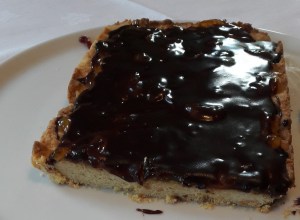
Mazurek with Oranges

This mazurek is one my mother used to make. She used the peanut butter base for sernik as the base.

20170809_153901

This quantity of pastry is enough for a small tin – 26cm x 16cm.

Grease and line the tin.

Pre-heat the oven to GM5 – 190ºC

Press the pastry into the tin and prick the surface of the pastry


Bake for approximately 20 minutes.

Leave the base to cool completely.

The original recipe used a sweet orange jam/sauce  which you made from sweet eating oranges. After a while my mother improvised and used English orange marmalade to which she added a little water and some sugar and heated this up for a few minutes.

Use the orange/marmalade  mixture whilst it is still slightly warm and pour this onto the base.

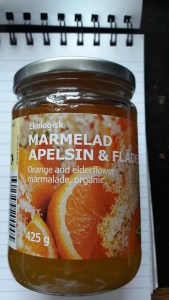
I have now found a jam from IKEA which is orange & elderflower , this has a really nice flavour – warm this slightly so it is easy to spread onto the base.

You need 3-4 tablespoons of jam.

20170804_090748


Leave the orange jam to cool completely.


Over the orange jam is then poured a chocolate topping.

I have used the one from Mazurek – Using Yeast Dough yeast dough.

Chocolate topping

Ingredients

50g butter

30g of granulated sugar

2 tablespoons of cocoa

2 tablespoons of water

Method

In a small saucepan gently melt the butter and sugar .

Add the cocoa and water and mix it till it is all blended together.

Heat this on a low heat – stirring all the while.

Allow to cool slightly and then pour this over the jam.


Tea plates Las Palmas by Aynsley from the 1960s.


Sernik Base with Peanut Butter

My mother often used this base when she made her sernik (baked cheesecake)  – it is a recipe she used in later years as the use of peanut butter is not at all traditionally Polish!

Ingredients

110g butter or block margarine

90g caster sugar

175g plain flour

1 egg yolk

1 tablespoon of peanut butter (I prefer to use crunchy)

Grated rind of 1 lemon

Method

In a large mixing bowl, cream together the butter and sugar.

Add the lemon rind, egg yolk  and peanut butter and cream again.

Mix in the flour with a wooden spoon and then using your hand bring this all together to form a soft dough.

Place the dough in a fridge for several hours.


Pre-heat the over to GM5 – 190°C

Use a loose bottom tin (or spring-form tin)  22cm or 20 cm in diameter.

Grease the base and sides of the tin.

Press the dough onto the base of the tin.

Prick the surface of the dough with a fork.

Bake for around 15 – 20 minutes until the top is golden.

Let the base cool completely before using it.


Using The Base

The base must be thoroughly cooled before use.

The base can be stored on the tin base for later use if needed – wrapped in foil or in an airtight container.

Sernik

Make your sernik (cheesecake) mixture and pour this onto the base and bake as per your recipe.

I used around 450 – 500g of yoghurt cheese with the addition of  mixed peel as in my another cheesecake recipe.


Great cake lifter from Lakeland Plastics.


Cake is on a Lead Crystal cake stand

Cake forks are Crazy Daisy by Portmeirion designed by Sophie Conran in 2009.

Tea plates are Enchantment by Colclough from the mid 1950s – 1960s.


Hazelnut – Tort

Corylus avellana is the hazelnut, also known as  cobnut or filbert nut.  In Polish it is orzech laskowy  – which translates as nut of the forest and as its name implies hazel trees or bushes grow abundantly in Poland.

Turkey is the largest commercial producer of hazelnuts followed by Italy.

Ferrero SpA  – makers of Ferrero Rocher and Nutella use 25% of the global supply of hazelnuts per annum.

Tort is a layer cake (in England the French word gateaux is used) – the layers of cake being sandwiched together with a butter cream (Sweet whipped cream was hardly known in Poland – with soured cream being the norm).

The word tort is originally from the Latin torta – flat cake or round loaf of bread.

A tort can be round or in a block shape – it often has very decorative piping  – my decorations tend to be more simple!

A tort is often made for celebrations and is often very large – I have recipes which call for a dozen or more eggs!

The following recipe only uses 6 eggs!

This tort recipe uses hazelnuts which have been roasted and then ground.

I often buy my hazelnuts from a  dried fruit & nut stall in Leeds Kirkgate Market.  This the largest covered market in Europe and was founded in 1875 and has around 100,000 visitors per week.

On this stall you can buy : whole hazel nuts, roasted hazel nuts and ground roasted hazel nuts.

I use either roasted hazel nuts and grind them myself or roast the hazel nuts myself and then grind them.

Roasting Hazel Nuts

To roast hazelnuts put the shelled nuts on a baking tray and put them in an oven at GM 5 – 190°C for around 10 to 15 minutes – keep checking as it is easy to burn them.

Once they are done, leave them to cool and then rub off the papery skins between your fingers and discard them.


I use an electric grinder which is very useful.


Ingredients

  • 6 eggs
  • 225g  caster sugar
  • 225g roasted & ground hazelnuts
  • 2 sponge fingers – crushed
  • Method

Pre-heat the oven to GM5 – 190°C

Grease and line a 23cm x 32cm baking tray.


Mix together the ground hazelnuts and crushed sponge fingers.


Whisk together the eggs and caster sugar until they are pale and fluffy.


Fold in the nut mixture.

Pour the mixture onto the baking tray and bake for  around 20 minutes until it is golden on top.


Take out and leave it to cool on a cooling tray.

Measure the length of the cake and cut it into 3 equal pieces.


A poncz (sweet punch for moistening the cake) is used on each layer.

I used one made from 150ml of weak black tea, 45 ml of rum and 2 tablespoons of granulated sugar.

Rum Butter Cream

Ingredients

  • 120g butter
  • 2 egg yolks
  • 2 tablespoons of rum
  • 300g icing sugar ( approximate amount)
  • Method

Cream together the butter and egg yolks.

Add the rum and cream again.

Mix in the icing sugar till you have a smooth butter cream


Using a spatulas layer up the cake first with poncz on each layer and then the butter cream.

Cover the top and sides with the butter cream.

Make fancy patterns with spatulas (or you can do fancy piping if you wish).


Little spatulas for decorating with icing.


Tea plates are Silver Rose by Duchess from the 1950s & 1960s.

The cake slice is Water Garden by Portmeirion.

Round Tort

The same quantities and method as above can be used for two 18m diameter cake tins.

Here the poncz was made from 150ml weak black tea and 2 tablespoons of granulated sugar & coffee butter cream was used.

Coffee Butter Cream

Ingredients

90g butter

1 egg yolk

3 tablespoons of very strong coffee

250g of icing sugar (approximate amount)


Method

Cream the butter and egg yolk.

Add the coffee and cream again.

Mix in the icing sugar until you have a thick butter cream.


Use the poncz to moisten the cake & layer up and coat with the icing.

20170730_182946


Very useful cake lifter – from Lakeland Plastics – for moving the cake

20170604_065017


Another cake lifter


Tea set is by Spencer Stevenson Co Ltd, who manufactured in England  between 1948 and 1960.  The design name is not known.

Green Teapot is Café Culture by Maxwell Williams.

Other Cake Sizes

3 eggs with 110g of roasted hazel nuts & 110g of caster sugar for 1 – 18cm diameter cake tin.

4 eggs with 150g of roasted hazelnuts & 150g of caster sugar for 1  – 22cm diameter cake tin.


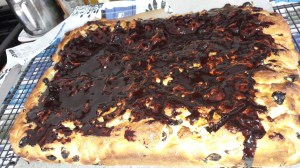
Mazurek – Using Yeast Dough

I came across this recipe for  a yeast dough mazurek in this little recipe book and was very intrigued by the method which is quite different from the usual yeast doughs and thought I would give it a go!

It turned out very well.

20170520_214209


Ingredients

450g plain flour

100g granulated sugar

200g butter or block margarine

50g fresh yeast or 25g of dried yeast

190 ml of milk

3 eggs

200g of bakalie (dried fruits including currants, raisins, peel, figs, dates, prunes etc)

Method

Warm the milk to hand heat and mix in the yeast.

Melt the butter on a gently heat.

In a bowl whisk the eggs with the sugar until they are light and fluffy.

Add the melted butter.

Add the milk and yeast mixture and mix thoroughly.

Leave in a warm place for 8 hours!

Grease and line a large baking tray 33cm x 24cm

Pre-heat the oven to GM5 – 190°C

Mix the bakalie(dried fruits) with the flour.

Mix the flour and fruits with the yeast mixture.


Place the dough into the tin – spreading it out evenly.

Place the dough onto the tray and put in the oven.

Bake for around 25 – 30 minutes.

Prick the surface of the cake with a fork in several places.

Leave it to cool in the tin for a while and then remove from the tin and place on a wire rack to cool.

Pour the hot chocolate topping over the top.

20170524_153320


Topping Ingredients

50g butter

30g of granulated sugar

2 tablespoons of cocoa

2 – 3 tablespoons of water

Note

You could double this amount if you want to it to cover all over and be a bit thicker.

Method

In a small saucepan gently melt the butter and sugar .

Add the cocoa and water and mix it till it is all blended together.


Note

You can decorate the top with dried fruit and nuts – you would really need to do double the topping ingredients for this,


Served on Royal Doulton – Counterpoint  – 1973 – 1987

Mazurek – With Kajmak

Mazurek is the name of a Polish cake which often uses a type of pastry similar to shortcrust  or shortcake.  It is usually made in a square or rectangular shape.

Bake a mazurek base using one of the ciasto kruche  –  pastry recipes and allow it to cool.

Fill the hollow with kajmak.

Mazurek with kajmak

You can decorate the top with nuts and / or dried fruit – this gives you an opportunity to be creative with the decorations.


Alleluja is often written on top at Easter time.

Here served on tea plates by Colclough – Stardust 1950s – 1960s


Mazurek with kajmak and jam

As a contrast to the sweetness of the kajmak you can use a tart jam such blackcurrant or sour cherry jam.

Bake a mazurek base and allow it to cool.

Cover the hollow created with a thin layer of jam.


Blackcurrant jam was used here.

Cover the jam with a layer of kajmak.

Decorate the top of the mazurek with nuts or dried fruits.


Kajmak

Kajmak (or kaimak in my older books) is a speciality make from cream or milk cooked with sugar and then butter is added. It is very sweet and dense,  pliable at first and hardening over time.

It is similar to a creamy type of fudge and it can also be made from tinned condensed milk which has been boiled and so is very like dolce de leche.

In my American-Polish cookery book it is called Turkish Fudge.


It is used in a variety of cakes including mazurek.


Mazurek with kajmak

Kajmak originated in Turkey and appeared in Poland in the 18th century in the reign of Stanisław II Augustus (1764–95).   Sugar was a luxury commodity then and this was originally just popular with the Polish nobility.

Kajmak

Ingredients

1/2 litre of milk (full or semi-skimmed)

400g of granulated sugar.

50g of butter

2 drops of vanilla essence

Method

Put the milk and sugar into a heavy bottomed saucepan and heat gently stirring most of the time to stop the mixture from catching and burning on the base.

Continue cooking and stirring until the volume has reduced to about half of the original and the mixture is thick – rather like jam in the spoon test.

Take the pan from the heat and add the butter and stir till it is incorporated.

Add the drops of vanilla essence and stir them in.

Use the kajmak straight away or pour into a glass bowl that you can heat over a water bath when you want to use it later.


Alternatively you can also pour it into a flat dish and cut it up as cubes or fingers of sweets later.

Kajmak is flavoured with a little bit of vanilla but can also have the following additions: caramel, chocolate or coffee

Caramel

In a frying pan heat 20g of granulated sugar until it just starts to turn light brown, then add 6 tablespoons of water and boil gently until you have a caramel syrup.


Add this to the kajmak before the addition of the butter.

Salted caramel is very popular in England at the moment and you can add a teaspoon of cooking or table salt to the caramel kajmak.

Then once it is poured out you can sprinkle coarse ground or sea salt on the top.


Here the kajmak was poured into a rectangular dish.

Chocolate

50g of cocoa mixed with around 6 tablespoons of water

or

80g of melted dark chocolate

Add this to the kajmak before the addition of the butter and reduce the liquid until the kajmak is the correct consistency.


Coffee

100 to 125 mls of strong coffee made from 20g of ground coffee.


Brew the coffee in a cup or jug, leave for around 10 minutes and then strain the liquid from the grounds.

Add this to the kajmak before the addition of the butter and reduce the liquid until the kajmak is the correct consistency.

Quick Kajmak

In a recipe book I bought recently there is a recipe for kajmak using  krówki which are classic Polish sweets (krówka mleczna = milky cow) described as creamy fudge.

The recipe used 500g of the sweets which would have been two packets – I just used one packet to test them out.

Ingredients

250g of krówki

120ml of milk

1 tablespoon of butter.

Method

Unwrap the krówki and place them with the milk in a small saucepan.

Heat gently, stirring with a wooden spoon until the sweets dissolve.

Add the butter and let it melt.


Use whilst it is warm.

Note

This worked very well & one packet could be enough – I must admit I prefer the original version but this is easier & quicker.


Mazurek

Most people know that a mazurek (mazurka in English)  is a Polish folk dance. It is also the word for someone or something from Mazur (the region known as Mazowsze in Polish) in North Central Poland.

A tasty meaning of mazurek, is a flat Polish cake made with different bases and toppings. The varieties are seemingly endless and vary from region to region and family to family. They can be made with yeast doughs, crumbly shortbread-like doughs  (ciasto kruche) or flaky, puff-pastry-like doughs.

The mazurek is usually baked in a rectangular or square shape.

The topping varieties include: almond paste, dried fruits, fresh fruits, nuts, meringues, kajmak, jam or poppy seed paste.

There is often an icing of some sort poured over the topping.

A mazurek is  rarely over 2.5 cm (1 inch) in height.

It is thought  that  the mazurek, was inspired by sweet Turkish desserts that came to Poland via the spice trade routes from Turkey in the early 17th century .

Mazurek  is traditionally served at Easter when it is considered an Easter treat after 40 days of fasting for Lent and this is maybe why this cake is so sweet.

Another reason is that Holy Week, the period from Palm Sunday to Easter Sunday, is a busy one in a Polish household as the interior and exterior of the house is cleaned from top to bottom so any baking  that could be prepared well in advance of Easter Sunday without getting stale was good and the mazurek, often made with an over-abundance of dried fruits to keep it moist  is well suited to this.

When the top of an Easter mazurek is  iced , it typically is emblazoned with the words “Alleluja” or “Wesołego Alleluja“ (Happy  Alleluja or Happy Easter).


Mazurek made with jam topping

I used ciasto kruche for these, using the versions in pastry-ciasto kruche. 

I liked the one using hard boiled eggs the best.

Method

Pre-heat the oven to GM 5 – 190°C

I used a Mermaid shallow tin, 31cm x 21cm, which I greased and lined – to make it easier to get the mazurek out of the tin.

Using around 1/2 to 2/3rds of the pastry dough, roll out a rectangle for the bottom of the tin – if it is too crumbly you might have to piece and press this in.

Using the rest of the dough make stripes about a finger thickness and place these around the edge of the tin.

Use a sharp knife to make a cut pattern in these strips.


Bake for 25 -30 minutes until the pastry is golden.

Leave to cool completely.

Fill the mazurek hollow with jam.

You will need around a whole jar of jar and you can heat the jam slightly to make it easier to spread.

Make some icing with beaten egg white, lemon juice and icing sugar and drizzle this over the jam.

Mazurek with blackcurrant jam


Served here on a bamboo board and  Las Palmas tea plates by Aynsley from the 1960s

Mazurek with raspberry jam


Served here on a bamboo board and tea plates with a violet design by Colclough from the 1930s.


Pastry – ciasto kruche & półkruche

This was originally posted in June 2017 – I updated it in September 2019. 

There are two classic pastries, kruche and półkruche in Poland & the most difficult part is trying to get a good translation of the names.

Ciasto kruche

Ciasto is pastry and the word kruche means brittle, fragile or crumbly and ciasto kruche is often translated as shortcrust pastry – however it is quite different to British shortcrust pastry – in someways it is nearer to shortbread.

Having done a lot more research, I now think it is what is called in French – pâte sucrée.

This pastry is used to make a Polish cake called Mazurek of which there are many versions.

Ciasto półkruche

The pół part of the word półkruche means half or semi – but semi-shortcrust pastry does not really explain much!

This pastry is often used to make a Polish cake called placek  – a flat cake.

Served here on tea plates – Colclough – Enchantment 1950s – 1960s.

Both of these pastries are much richer than shortcrust pastry.

Ciasto kruche

The 4 ingredients are

  • plain flour
  • butter
  • icing sugar and
  • egg yolks (and a pinch or two of salt)

Notes

  • Use a flour which is low in gluten  – a cake flour not  a bread flour.
  • Butter give the best results but block  margarine can be used .
  • The pastry is fragile due to its high fat content.
  • Use just egg yolks (raw or hard boiled ), because the protein in the whites makes pastry tougher.
  • Using cooked egg yolks gives a more  in crumbly pastry.

Ratios for kruche

  • 3 flour:  2 Butter:  1 Icing sugar
  • or
  • 2 flour: 1 butter:  ½ – 1 Icing sugar
  • Usually – 1 yolk per 100g flour
  • A pinch or two of salt.


Ciasto półkruche

Here flour, butter, icing sugar and egg yolks (and a pinch or two of salt) are also used but there can be other additions such as:

  • baking powder
  • egg whites
  • soured cream or milk,
  • granulated sugar  or vanilla sugar
    .

The proportions of the main ingredients are different in that półkruche has a lower fat content than kruche.

Ratios półkruche

  • 2 flour: 1 butter
  • or
  • 3 flour: 1 Butter

Both kruche  and  półkruche are  baked in an oven heated  at GM5 – 190°C or GM6 – 200° C,  for 20 to 25 minutes.

Ciasto kruche 1 – using raw egg yolks

Ingredients

  • 340g plain flour
  • 170g butter – chilled
  • 100g icing sugar
  • 3 egg yolks
  • pinch of salt.

Method

  • Add a pinch of salt to the flour.
  • Use a knife to cut the chilled butter into small pieces into the flour and then use your fingers to make the mixture like breadcrumbs.
  • Add the icing sugar and mix this together.
  • Add the yolks and gently mix this in then and bring it all together into a dough – try and handle the pastry as little as possible.
  • Wrap the dough in greaseproof paper and avoid touching the dough with warm hands, as it increases its temperature and this leads to increased use of flour.
  • Once the dough has been kneaded, cool (at least 30 minutes in the centre of the refrigerator and up to 2 hours) and then roll out to the desired shape and size.
  • Roll out the dough and shape it as required.

Note

As this dough is very crumbly – I often find I have to piece and press the dough into the cake tin.

 Ciasto kruche 2 – with cooked egg yolks

I have seen recipes using hard boiled yolks and always thought “Strange! – having tried this out – I found that this is the best pastry ever!  Delicious & crisp.

Ingredients

  • 300g plain flour
  • 200g butter – chilled
  • 100g icing sugar
  • 3 cooked egg yolks
  • pinch or two of salt.

There are 2 ways of cooking the egg yolks:

1 – Hard boil the eggs for 10 minutes, allow to cool and separated the cooked yolks from the whites (this give you cooked egg whites to add to salads or similar). Use a fork to break up the yolks into very small pieces.


2 – Separate the raw yolks from the whites, then place these in a colander and cook over hot water (this gives you raw egg whites to use in other recipes).

Method

  • Add a pinch of salt to the flour.
  • Use a knife to cut the chilled butter into small pieces into the flour and then use your fingers to make the mixture like breadcrumbs.
  • Add the icing sugar and mix this together.
  • Add the broken up yolks and gently mix this in then and bring it all together into a dough – try and handle the pastry as little as possible.
  • Wrap the dough in greaseproof paper and chill it in the fridge for about 30 minutes.

Ciasto półkruche -1

Ingredients

  • 300g plain flour
  • 1/2 teaspoon baking powder
  • 150g butter
  • 100g icing sugar
  • 1 egg & 2 yolks
  • 1 – 2  tablespoons of soured cream
  • pinch of salt

Method

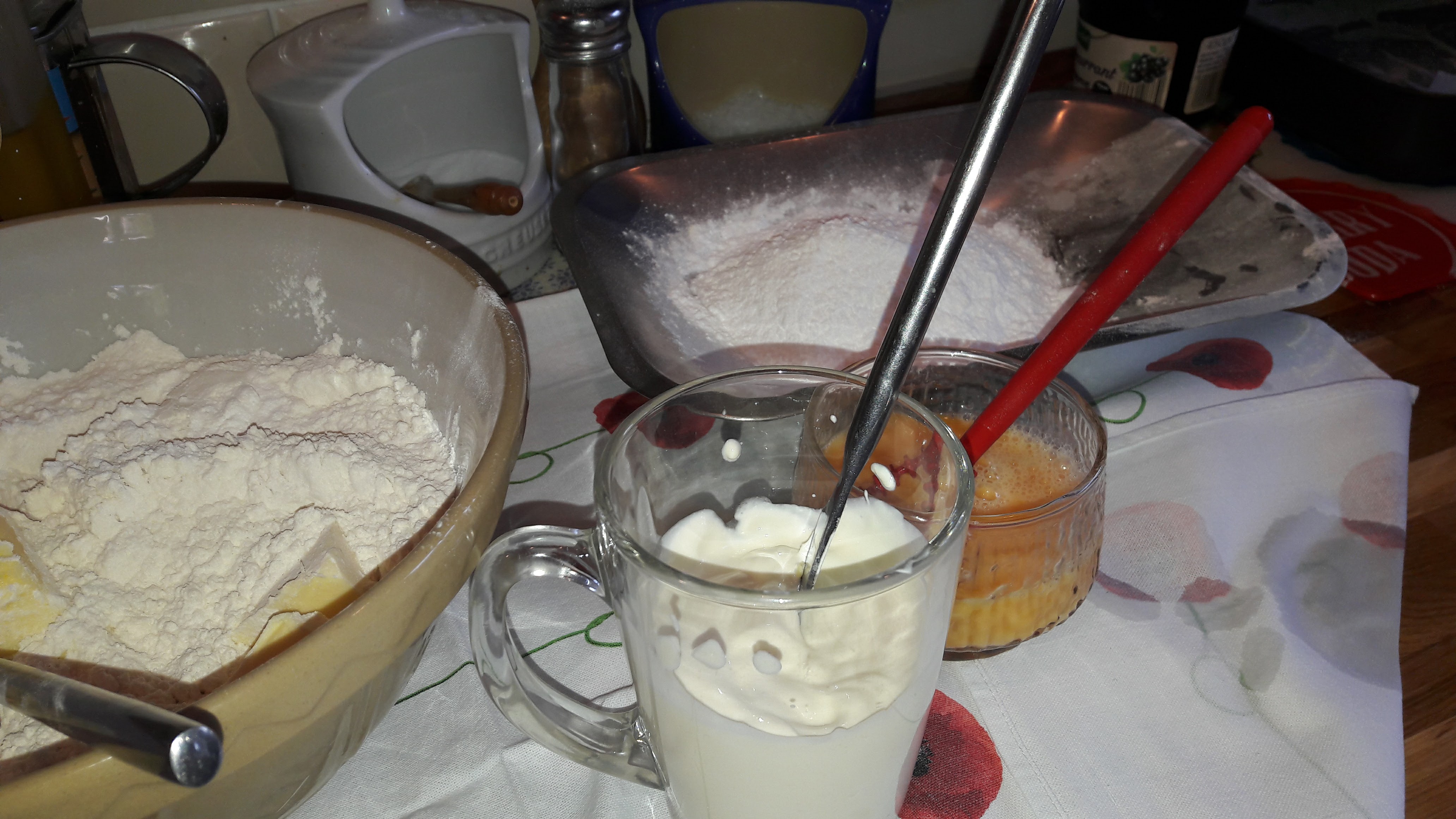
  • Add a pinch of salt and the baking powder to the flour.
  • Use a knife to cut the chilled butter into small pieces into the flour and then use your fingers to make the mixture like breadcrumbs.
  • Add the icing sugar and mix this together.
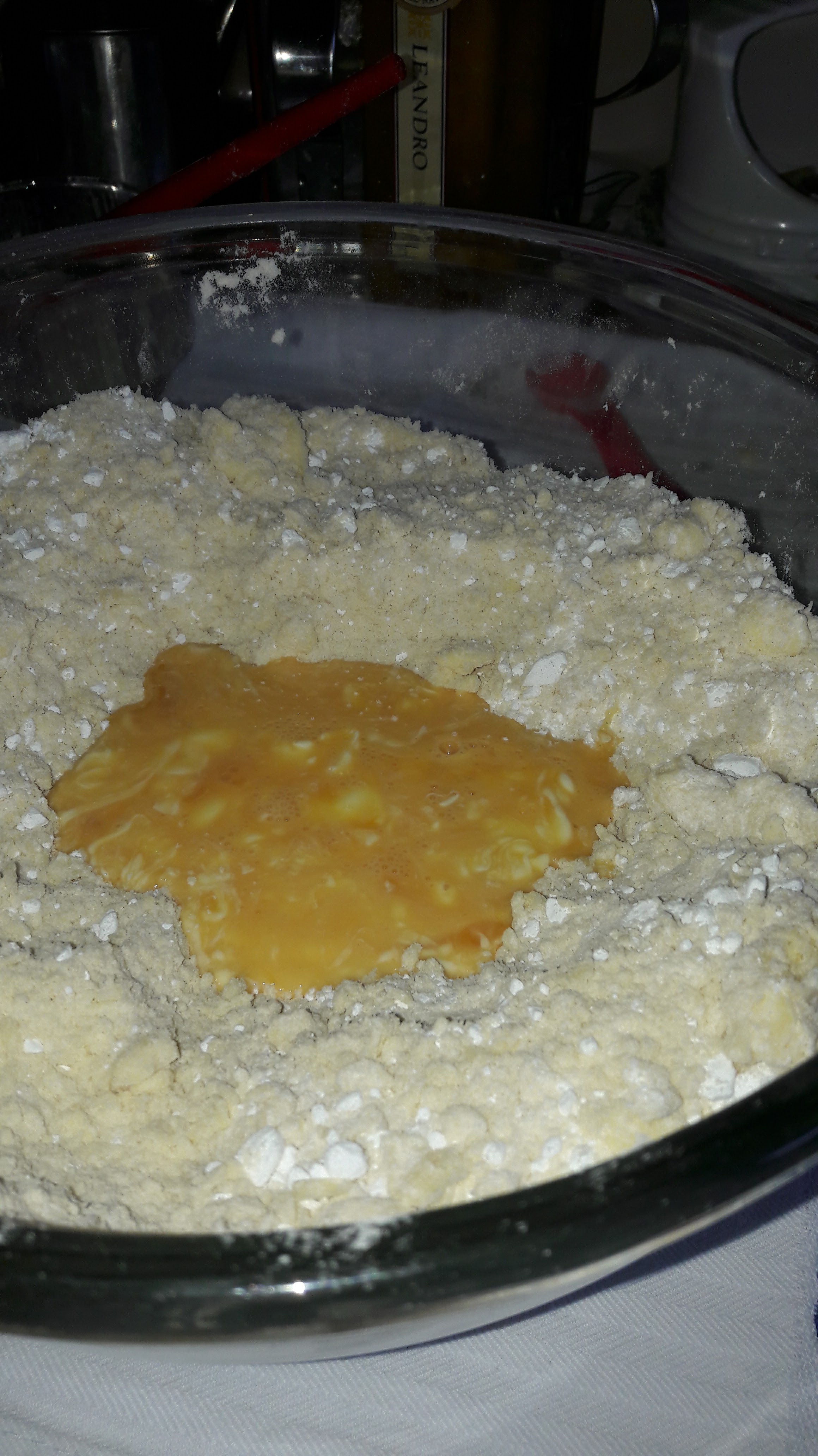
  • Make a well in the centre and add the eggs, yolks and the soured cream and gently mix this in then and bring it all together into a soft dough
  • Try and handle the pastry as little as possible.


  • Because of the use of baking powder this dough is used straight away.
  • I tend to flatten and shape this dough by hand rather than using a rolling pin.


Ciasto półkruche -2

  • 500g plain flour
  • 1 teaspoon baking powder
  • 200g butter
  • 150g icing sugar
  • 2 eggs & 1 yolk
  • 4 -5 tablespoons of soured cream


Method

  • Add a pinch of salt and the baking powder to the flour.
  • Use a knife to cut the chilled butter into small pieces into the flour and then use your fingers to make the mixture like breadcrumbs.
  • Add the icing sugar and mix this together.
  • Make a well in the centre and add the eggs, yolk and the soured cream and gently mix this in then and bring it all together into a soft dough
  • Try and handle the pastry as little as possible.


  • Because of the use of baking powder this dough is used straight away.
  • I tend to flatten and shape this dough by hand rather than using a rolling pin.