Keks

Keks is the word for a light fruit cake which is baked in a loaf tin or even more so a long narrow rectangular tin.

I am not sure how or when the word keks came into the Polish language but I am certain it comes from the English word “cakes” –  however the word keks is singular in Polish and means cake, and the plural is  keksy which is cakes.

It is thought that the keks originated from recipes for cakes from ancient Rome with the cakes being baked with pomegranate seeds, pine nuts and dried grapes and  using barley flour and then later in the middle ages honey was used and other fruits.

Keks is mentioned in a Polish cookery compendium from 1682 by Stanisław Czerniecki.

Nowadays keks is made using wheat flour and bakalie.

Bakalie is usually translated as dried fruits – however it has more varied fruits than the English version of dried grapes (raisins, sultanas, currants) & mixed peel.

Bakalie can be a mixture of the following:

  • Apricots
  • Currants
  • Dates
  • Figs
  • Mixed peel
  • Prunes
  • Raisins
  • Sultanas
  • Nuts – almonds, hazel & walnuts

Of course you can vary the mixture every time you make it.

The use of  sweet dried fruits came into use in Poland through the influence of Turkish cooking where most of these fruit and nuts grow.

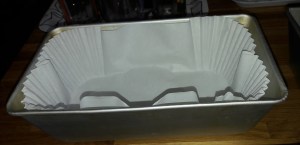
Traditional keks is baked in a long narrow rectangular tin, however I also use the English style 2lb loaf tins especially as you can get greaseproof cake tin liners which make life a lot easier.

NOTE

I have tried these out several times and have found two things that you must do to make turn out well:

  1. Toss the fruit in flour so it does not all clump together.
  2. Bake the cake at a low temperature so it cooks through.

Keks

Ingredients -1

Amounts for a long narrow tin

300g butter or block baking margarine

300g granulated  sugar

6 eggs

2-3 drops vanilla essence

300g plain flour

80g potato flour

2 teaspoons  baking powder

1 teaspoon of ground cinnamon

400g  bakalie (dried fruit  & nuts – see above) & 1 tablespoon plain flour

butter & dried breadcrumbs to prepare the tin or greaseproof paper

Ingredients -2

Amounts scaled down amounts for a 2lb loaf tin

200g butter or block baking margarine

200g granulated  sugar

4 eggs

2-3 drops vanilla essence

200g plain flour

60g potato flour

1.5 teaspoons  baking powder

1 teaspoon of ground cinnamon

300g  bakalie (dried fruit  & nuts – see above) & 1 tablespoon plain flour

Butter & dried breadcrumbs to prepare the tin or greaseproof paper or liner

Method

Prepare the baking tin by either coating with butter & dried bread crumbs or cut a sheet of  greaseproof paper to line the long side and base of the loaf tin or use a liner where appropriate.

Pre heat the oven to GM 3 – 160º C

Prepare the bakalie (dried fruit & nuts) by chopping the larger fruits into smaller pieces.

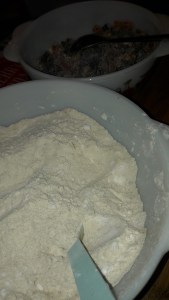
Place them in a bowl with 1 tablespoon of plain flour and mix thoroughly so all the fruit is coated.

20170212_055711

Tip the coated fruit into a large sieve and shake well to remove excess flour.

20170212_060009

Mix the baking powder and cinnamon with the flours

20170216_072648

In a large bowl cream the butter and sugar together until they are light and fluffy

Add the vanilla essence

Add the eggs one by one, each with a tablespoon of flour

Fold in the rest of the flour

20170216_074357

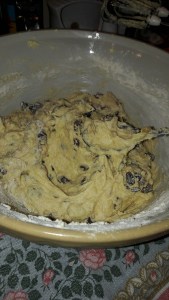
Carefully mix in the bakalie

20170215_065831

Spoon the mixture into the prepared tin and put in the oven

20170215_070044

Bake for around 1 hour 30 minutes for the long tin & 1 hour 20 minutes for the smaller loaf tin

Check at around 1 hour & cover the top with greaseproof paper if it starts to brown on top too quickly

Test the cake with a cake tester or wooden skewer near the end of the cooking time to check that it is baked throughout

Leave the cake to cool in the tin before turning it out.

Aynsley, Las Palmas from the 1960s

Colclough 4212, Art Deco 1930s, Blue Violets/Pansies

Keks – using fruit mincemeat

At Christmas time I make English fruit mincemeat using the recipe from Delia Smith but without the chopped nuts.

20170215_042413

If I have any mincemeat over after the Christmas period  when I make mince pies,  I make a fruit loaf which which is very much a keks.

I bake this in a 2lb loaf tin.

Note

You can also use 2 small 1lb loaf tins or even a round 22cm tin – adjusting the baking time.

Ingredients

  • 150 butter
  • 100g soft brown sugar
  • 75g sultanas or currants  and mixed peel
  • 225g self raising flour
  • 450g jar of mincemeat (exact amount is not critical)
  • 3 eggs
  • Optional 25g flaked almond to sprinkle on top

Method

Pre-heat the oven to GM2- 150ºC

Prepare the loaf tin by greasing it, lining the long sides or using a greaseproof liner.

20170207_112805

Lightly cream the butter and sugar

Beat in the eggs, one by one

Stir in the mincemeat and the  extra dried fruit until it is an even consistency – a wooden spoon is good for this

Stir in the flour.

If the mixture seems a bit dry add a tablespoon of rum or similar

Spoon the mixture into the tin and smooth the top

Sprinkle nuts on top if using

Bake for around 1 hour 15 minutes

Leave to cool in the tin before turning it out.

Kołaczyki – Little Wheels

Sweet Yeast Buns

Kołaczyki means little wheels from the word koła which means wheels.

In a previous post –  Bułeczki – Sweet Yeast Buns– I gave a recipe for basic sweet yeast dough – since then I have tried out a slightly different recipe – nearly the same ingredients but a slightly different method – and I think these turned out to be the best yeast buns I have ever made – so this is  – Basic sweet yeast dough version two. 

A few reminders when using yeast in baking

  • Learn to be patient – you cannot control the timings exactly with yeast, it depends on the temperature of the room and the flour used and other variables.
  • Do yeast baking on a day you are planning to be in & have other things to do, but ones you can break off from when needed.
  • Heat the milk so it is at body temperature – use the finger test – too hot and you will kill the yeast – too cold is okay – it will just take longer.
  • An egg glaze often burns too quickly –  I have found an egg white or egg white & water glaze gives a better result.

Older Polish recipes use fresh yeast. I have used dried yeast and have had very good results.  (I have not tried using easy bake yeast for this recipe).

Basic Sweet Yeast Dough Version 2

Ingredients

Leaven – Starter

  • 100g plain flour
  • 30g fresh yeast or 15-20g dried yeast
  • 125ml  milk

Rest of ingredients

  • 3 egg yolks
  • 60g sugar
  • 50g melted butter or block margarine
  • 400g plain flour
  • 1/4 tsp salt
  • Zest of 1 lemon
  • 2-3 drops of vanilla essence
  • 125ml milk

and

Save 1 egg white for use as a wash on the buns.

Method

  • Warm the milk slightly – so it is just warm to the touch – and add the yeast and mix together.
  • Put the flour in to a bowl and add the milk and yeast  mix it all together and leave it covered until it is double in size.
  • *
  • Melt the butter and leave it to cool.
  • *
  • Whisk the yolks and sugar until they are pale and fluffy.
  • Grease 2 baking sheets – You should get around 15 buns. – invite people round!
  • Into a large bowl put: the flour and the salt, the yeast starter, the yolk mixture, the zest of a lemon, the vanilla essence and the milk.
  • Mix it all together so that you get a soft dough that comes away from the side of the bowl – you do not have to knead it.
  • Then work in the melted butter (this is the hardest part) until it is all incorporated and you have a uniform shiny dough.
  • Cover the dough with a cloth and leave this to rise until it is double in size.
  • Onto a floured surface place the dough and form it into a rectangle and then roll this out until it is around  2cm thick.
  • Using a 8cm diameter cutter cut out circles of dough and place them on the greased baking sheets, leaving room for the dough to rise.
  • Gather together the left over dough and repeat the process.
  • Cover the trays and leave the circles to rise and double in size.
  • Pre heat the oven to GM5 – 190ºC
  • Use a clean napkin or tea towel and cover the base of a tumbler.
  • Use the covered tumbler and press down on the centre of each circle to form an indentation into which you will put a filling.

Fillings

  • These are the ones I tried –
  • Cheese mixture – similar to ones for baked cheesecake.
  • Mix together around 250g of cream cheese/twaróg/curd or yoghurt cheese, 70g icing sugar, 1 egg yolk and 2-3 drops of vanilla essence.
  • Blackcurrant jam (you could use any tart jam such as cherry or gooseberry )
  • English style sweet mincemeat – I use Delia Smith’s recipe (without the nuts)
  • Put a large dollop of the filling onto each circle.

Brush the exposed dough with beaten egg white.

IMG_20151218_075301762

Topping

This is for the jam or mincemeat only – not the cheese mixture.

Kruszonka – Crumble Mixture

Ingredients

  • 50g plain flour
  • 50g butter
  • 50g granulated  sugar

Method

  • Mix together the flour and butter to make fine crumbs then mix in the sugar.
  • Sprinkle around a tablespoon or so over the jam or mincemeat.
  • Bake the buns for around 15 minutes.

Tea plate pattern below is called Mayfair.

They were all delicious – the sweet cheese ones were my favourites!

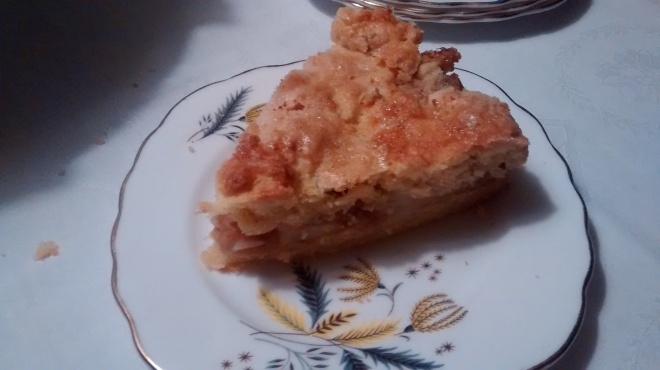
Polish Apple Cake – Jabłecznik

Apple trees (Genus –  Malus) originated in Central Asia and then spread to Northern Europe.  In the 17th century they were taken to North America.

IMG_20160507_183443894
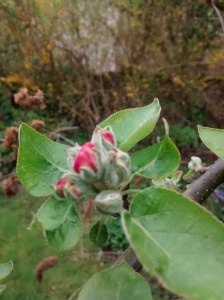
Apple Blossom Buds

Worldwide, measured in tonnes, China is the top apple producer, the United States of America coming second.

Poland is the largest apple producer in Europe.

In Poland in the countryside and even in the towns most houses have at least one fruit tree in the garden – often more – with apple, plum and cherry  being the favourites.


In my garden there are two Bramley apple trees.

Jabłko is the Polish for apple –  jabłecznik is an apple cake.

Some people use the word szarlotka – but my mother used that word for apple crumble.

Apple cake is made with tart cooking apples – Antonówki are very popular in Poland –  these are similar to Bramley apples and the apple filling is kept slightly tart so that the sweetness in the cake gives a lovely contrast.

I think there are as many variations of this cake as cooks in Poland.

This is my mother’s version which I think this is the very best.

Apple Filling – Ingredients

  • 5 to 6 Bramley Apples
  • Granulated Sugar to taste – keep it slightly tart
  • A little water
  • 1 to 1.5 teaspoons of ground cinnamon

Method

  • Make the apple filling first, even the day beforehand as it needs to be cold before you use it.
  • Peel and core the apples and cut them into thick slices.
  • Stew the apples gently with some sugar and very little water. You can make this in a saucepan on the stove or place the apples and sugar in a dish in the oven.
  • Do not add a lot of sugar at the beginning as it does not want to be too sweet, you can adjust the sweetness at the end.
  • Do not make it too much of a purée, cook so that you have some soft apples but with some harder less cooked chunks as well.
  • Leave the mixture to cool and then add the ground cinnamon.  The mixture should look quite brown.

IMG_20151214_161143925

Note

When I have lots of apples, I cook a large amount and portion this up and keep them in the freezer – better to leave out the cinnamon if freezing and add this fresh when making the cake.

Cake – Ingredients

  • 300g self-raising flour
  • 200g butter
  • 75g caster sugar
  • 1 egg yolk (save the white for the topping)
  • 2 to 3 tablespoons of lemon juice or water

    Method

  • You need a round tin with a loose base or a spring form tin or you will not be able to get the cake out.  I always use an anodised aluminium tin, 22cm in diameter and 8 cm deep, which does not rust.
  • Grease the tin well.
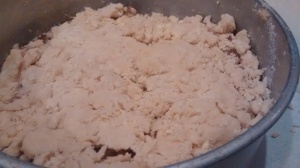
  • Rub the butter into the flour to make fine crumbs and add the sugar.

IMG_20151214_162018319


  • Add the egg yolk and the lemon juice to and mix together to make a soft “dough” (try not to add more flour),  handle it as little as possible.
  • Leave it to chill for about ½ an hour as this makes it easier to handle.
  • Pre heat the oven to GM5 – 190oC.
  • Take slightly more than half the dough and press it into the cake tin.

    IMG_20151214_162527127


  • Spoon the apple mixture on top of this.
  • The rest of the dough will go on top of the apple mixture.
  • I use a rolling pin to make a circle that is smaller than the tin diameter and then place this on top.
  • Do not worry if the dough falls apart, just place it on with the breaks nearly touching.

IMG_20151214_162724024


Topping – Ingredients

  • 1 egg white and caster sugar
  • Slightly beat the egg white with a fork and brush this over the top of the dough.  You will not need it all.


IMG_20151218_075301762


IMG_20151214_162841673


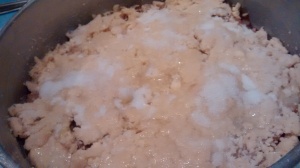
  • Liberally sprinkle caster sugar over the egg white.
  • Bake for around 50 minutes until the top is a golden brown.
  • I tend to check the cake at 40 minutes and will cover the top with greaseproof if it starts to brown but is not yet cooked through.
  • Leave to cool before getting the cake out of the tin.
  • I use a tin can and put the cake tin on this and slide the side of the cake tin down.
  • Do not put the cake in a air-tight covered container as the apples absorb moisture and you loose the crispness of the cake.
  • I hardly ever have any left anyway as I seem to get visitors as soon as they know I am baking this cake.

IMG_20151214_193025987

Tea plates are Stardust by Colclough from the 1950s or early 1960s.

NoteI updated this in March 2020 – I altered the amount of apples in the filling.

Bułeczki – Sweet Yeast Buns

Bułeczki  – this word can cause a little confusion as it can mean –  little white bread rolls or a more sweet yeast bun.

This recipe has been used to make round buns with a filling – it can be used for a variety of sweet buns – all of which are very popular in Poland.

A few reminders when using yeast in baking

  • Learn to be patient – you cannot control the timings exactly with yeast, it depends on the temperature of the room and the flour used and other variables.
  • Do yeast baking on a day you are planning to be in & have other things to do, but ones you can break off from when needed.
  • Heat the milk so it is at body temperature – use the finger test – too hot and you will kill the yeast – too cold is okay – it will just take longer.
  • An egg glaze often burns too quickly –  I have found an egg white or egg white & water glaze gives a better result.

The older Polish recipes use fresh yeast. I have used dried yeast and had very good results.  (I have not tried using easy bake yeast for this recipe).

Basic sweet dough recipe

Ingredients

Yeast starter

  • 25g fresh yeast or 15g dried yeast
  • 1 tablespoon of  sugar
  • 250ml  milk – warmed
  • Rest of dough
  • 3 yolks
  • 100g granulated sugar

*******

  • 500g plain flour
  • 2-3 drops of vanilla essence
  • Zest of 1 lemon
  • 1/4 teaspoon of salt

******

  • 60g of melted butter

******

  • Egg or egg white to glaze (whole egg tends to brown very quickly).

Fillings

Jam – I used strawberry jam and also blackcurrant jam (made by my friend in Leeds) and I think the more tart blackcurrant jam goes better with the semi-sweet dough.

Mincemeat – I used my own mincemeat which is from the recipe by Delia Smith but without the chopped almonds. This of course in one way is very English, but it would be recognised in Poland if  described as bakalie –  which is a  mixture made of dried fruits (often with figs or dates), nuts and honey.

Method

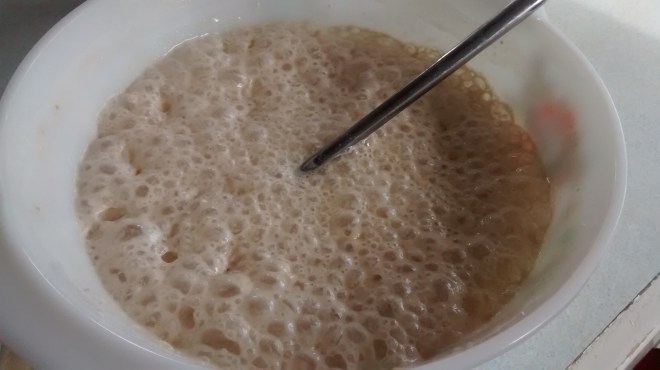
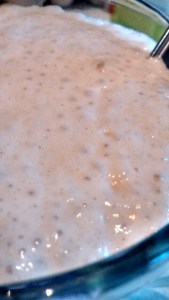
Mix the yeast, sugar and warmed milk together and leave it till it doubles in size.

IMG_20160222_120503215

  • Whisk the yolks and sugar together until the mixture is pale and thick.
  • Put the flour into a large bowl, add the yeast starter, the yolks & sugar mix, vanilla essence, lemon zest and the salt.
  • Combine everything together and knead it together until the dough leaves the side of the bowl clean.
  • Add the melted butter and mix it in and then knead it well until you get a glossy smooth dough.
  • Place it back in the bowl and cover with a cloth and leave it until it doubles in size.
  • Grease 1 or 2 baking sheets to hold 16 buns.
  • Knead the dough again lightly, then cut in to half and half again and so on to give 16 pieces.
  • Roll each piece into a smooth ball, then flatten it and roll it out into a circle.
  • Put a small spoonful of filling onto each circle and then draw the edges of the dough circle together and pinch the dough to seal in the filling.

Turn the balls over so the seal is on the underside.

IMG_20160220_194430607

  • Place the buns on the baking sheets with room apart for them to double in size.
  • Cover the buns with a cloth and leave them to rise to double in size.
  • Pre-heat the oven to GM 5 – 190ºC
  • When the buns have doubled in size brush them with an egg or egg white wash.

IMG_20160220_210416121

  • I used whole egg in this case but since have found that egg white does not burn as quickly.
  • Bake the buns for around 15 minutes.

Leave to cool before serving.

Tea plates are Las Palmas  by Aynsley from the 1960s.

Babka – Polish Cake – Using Potato Flour

Potato flour is used in many Polish recipes for a variety of cakes.

This recipe is for a babka (click here for earlier post) using a mixture of wheat flour and potato flour and is adapted from a recipe in my old Polish cookery book.

IMG_20160130_192651306

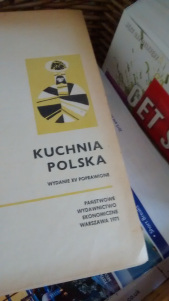
Kuchnia Polska - Polish Kitchen or Polish Cookery
Kuchnia Polska – Polish Kitchen  – Polish Cookery


In the past potato flour was hard to find in England but now you should be able to find it in most Polish shops.

IMG_20151126_161842176
Potato Flour

One of my Polish friends in England said she had tried using cornflour in baking when she could not get  potato flour but she did not think it gave as good results.

Recently in a repeated radio programme on BBC Radio 4 Extra I heard the late Marguerite Patten  say  that cooks in Victorian England  used potato flour in cake baking on a regular basis.

 Ingredients

150g plain flour

1 teaspoon baking powder

100g potato flour

200g butter or block margarine

4 eggs separated

200g icing sugar

Zest of 1 lemon

Juice of 1/2 a lemon

3 to 4 tablespoons of  soured cream or yoghurt – Full Fat-Greek style or home-made Yoghurt – click for earlier post)

(I have made this recipe with soured cream and then with my own yoghurt – both turned our super)

IMG_20150707_200527058

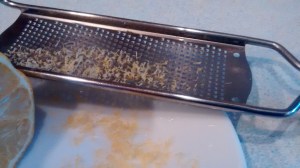
Fine Grater – Microplane Graters are Super For Lemon Zest.

Microplane Professional Series

Method

Grease and flour a large babka tin.

IMG_20151210_071931092

Pre-heat the oven to GM4 – 180°C

Mix the flours together with the baking powder and leave to one side.

In a large bowl, cream the butter and the icing sugar until the mixture is pale and fluffy.

Beat in the egg yolks – one by one.

Then beat in the lemon zest and juice.

In a separate bowl beat the eggs white until they are stiff.

Fold the egg whites into the creamed mixture.

Gently fold the whites in the flour mixture.

Place the mixture into the prepared babka tin.

Place the tin in the centre of the oven and bake for around 30 – 40 minutes.

Check with a cake tester.

Remove from the oven and let the cake cool a little.

IMG_20150902_131105650


IMG_20150902_131036540


When cooled –  remove carefully from the tin – this is easiest when the cake is nearly cold.

Dust the cake with icing sugar or pour over it a runny icing glaze.


IMG_20150902_165350657 IMG_20150902_165339825

IMG_20150902_165420273

IMG_20150902_165334611
Silver Rose – Duchess 1950s & 1960s


Instructions for those who do not have a babka tin

At the moment (February 2016) Marks & Spencer are selling babka tins at a reasonable price – I bought one to add to my collection!

IMG_20151210_071926550
Tin from Marks & Spencer

However if you do not want to go to the expensive but want to try out the cake I have made the cake using 2 types of loaf tins with good results

IMG_20160222_085342694


First using a long narrow tin

IMG_20160222_085422673


and secondly a 2lb loaf tin.

IMG_20160222_085433454


You need to grease and line the tins or use loaf tin liners – I discovered these recently and think they are a boon. You can get them in 2 loaf sizes.  They are available in many stores but also you should also be able to find them in the cheaper discount stores.

IMG_20151120_073255217


IMG_20150907_100000771

The cake takes 40 -45 minutes in a pre-heated oven at GM4 – 180°C

IMG_20150907_111020286

IMG_20150907_111214502

Dust the top with icing sugar

IMG_20150907_165858105

IMG_20150907_165908046

IMG_20150907_170256852 IMG_20150907_170224421


Colclough Longton Bone China ..... Around 1930s
Colclough Longton Bone China …..
Around 1930s


Babka and Babeczki

A babka is a large cake and babeczki are small cakes.

For a general description on what a babka is  –  read my post – Babka.

The following cakes have been made using a creamed sponge mixture –using my mother’s friend’s basic recipe for a creamed sponge.

In this recipe you weigh the eggs in their shells and then use the same weights of butter (or block margarine), caster sugar and self raising flour.

IMG_20150709_061756195
Weighing eggs


IMG_20151209_072508772_HDR
Silver Tin at the front was used.

Marbled Babka

Pre-heat the over to GM4 – 180°C

Grease and flour the tin.

For this babka, 4 eggs were used.

After making the cake mixture, half the mixture was placed in the tin and to the rest 3 tablespoons of cocoa powder was added and lightly folded in. This cocoa mixture was then placed on top of the plain mixture and with a metal spoon lightly mix the two to give a marbling effect.

Bake the cake for 35 to 40minutes.

When the cake is ready, leave it to cool completely before turning it out of the tin.


The babka can be dusted with icing sugar or  you can use a chocolate glaze and allow this to dribble down the grooves.

Medium babeczki

I bought these tins a few years ago in Lidl.

You might be able to find find smaller babka tins like those in the photograph below. (I bought these many years ago in France – sold there as brioche tins).

IMG_20150824_150418237_HDR

Grease and flour the tins.

I used 3 eggs to make these 6 babeczki with the addition of 75g of currants (25g per egg)

Bake these in a pre-heated oven a GM4 – 180°C for around 25 minutes.

Wait till the cakes are cool before turning them out.

You can dust them with icing sugar or drizzle a thin lemon icing over them.

I think the size of these makes them ideal for sharing!

Small babeczki

I bought these small mini bundt tins from Marks & Spencer in January 2016.

They are a good size for an individual small cake (of course you can always have two!)

Grease and flour the tins.

Bake these in a pre-heated oven at GM4 – 180°C for around 20 minutes.

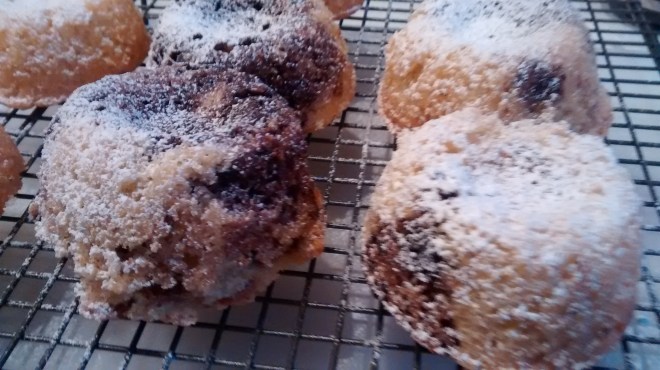
I used a 2 egg mixture with the addition of one and a half tablespoons of cocoa powder for the marbling.

This mixture made  9 cakes. (If you use a 3 egg mixture and 2 tablespoons of cocoa and fill the moulds a little more you should get 12 cakes – I have yet to try this amount.)

Wait till the cakes are cool before turning them out.

Then dust them with icing sugar before serving.


IMG_20160117_162535255


Karnawał – Carnival

The official end of the Christmas & Epiphany season is February 2nd which is 40 days(inclusive) after Christmas and is the feast of the Presentation of Christ in The Temple also known as Candlemas Day.  In Poland it is called Święto Matki Boskiej Gromnicznej – The feast of Our Lady of the Thunder Candles (as the blessed candles are used during thunder storms)

February 2nd is the start of karnawał  – carnival and the festivities leading up to the beginning of Lent which starts on Ash Wednesday.

During karnawał there is lots of dressing up in costumes such as beggars, chimney sweeps, goats, bears, horses or storks and going from farm to farm or house to house and there the revellers would be given food and drink.

The date of Ash Wednesday varies as it is based on the date for Easter which is calculated according to the Paschal full moon.

Easter is the first Sunday after the first full moon, after the spring equinox, which is the 21st of March. So the earliest date for Easter is the 22nd of March and the latest date is the 25th of April.

Ash Wednesday is six and a half weeks before Easter – calculated as 40 days but the Sundays are not included so it is in fact 46 days before Easter Sunday.

Therefore the earliest date for Ash Wednesday is the 4th of February and the latest date is the 10th of March.

In a year when Ash Wednesday is very early – I am sure that  karnawał  festivities would begin a little early!

After Christmas with all the wonderful food it seems like only a few days and it is time to prepare for Lent. All the rich food is used up before Lent, especially on the last day before Ash Wednesday.

In England it is Shrove Tuesday, in France Mardi Gras(Fat Tuesday), in Poland tłusty wtorek (Fat Tuesday) and in some parts of Poland there is also tłusty czwartek (Fat Thursday) and then the last Tuesday can also be be called ostatki (last remnants).

In Poland chrusty and pączki (doughnuts) are made (pancakes are eaten throughout the year and do not feature here.)

My mother always made chrusty, doughnuts we got from other Polish ladies in the neighbourhood.

I was in Kraków once on tłusty czwartek (Fat Thursday) and bought some doughnuts  – I found that these were very special ones made for that day made with rose petal jam.  I am afraid I did not like these – I am used to Polish plum jam or raspberry jam in Polish doughnuts and found theses too perfumed for me. (I have recently seen many English recipes made with rose petal jam – so maybe it is an acquired taste)   

Chrusty

Chrusty are deep fat fried, sugar dusted pastries.

These must be my favourite pastries which my mother would only make once or twice a year before Lent began.

When I was little before I started to help, I could never understand how she made these amazing shapes.

The name chrusty means “dry twigs” which may describe their appearance but not their taste!

You could call them ribbon shaped and in some parts of Poland they are called faworki from the French word  faveur which means  favour as in the coloured ribbons given by ladies to Medieval knights.

My aunty in The United States told me that nowadays they are popular there for weddings and other big parties not just during carnival and that Americans call them Angel wings.

I remember that my mother always fried these in vegetable oil.  During my research I have realised that originally they were fried in lard, and the books say that this makes them very tasty!

They taste best a few minutes after cooking, straight from the pan, when still slightly warm and dusted with icing sugar.  So being in the kitchen when they are being made is the best place to be!

Ingredients

300g plain flour

100g self-raising flour

50g butter

50g caster sugar

2 eggs

2 egg yolks

2 tablespoons of rum (or vodka and 2 drops of vanilla essence)

2 – 3 tablespoon of soured cream to mix (use double cream if not available)

Sunflower oil to deep fat fry

Icing sugar to dust

Method

Mix the flours together and rub in the butter to make fine crumbs and then mix in the sugar.

Mix together the eggs, yolks and alcohol together. Make the decision on how much cream to use or not as you start to mix later.

Make a well in the dry ingredients and add the liquid.

Mix the liquid with the dry ingredients to make a  soft dough.  You can use a knife at first and then your hands.

If the dough needs some extra liquid then add the soured cream bit by bit.

Take about a third of the dough and roll it out on a floured board as thinly as possible.

Using a sharp knife cut strips which are strips 3 to 4 cm wide and about 15cm long, you can cut the short edges diagonally.

In each one cut a slit down the middle long ways and pull the short edge through to make a twist.

Repeat with the rest of the dough, try to use as much as possible in the first cutting but you can mix and re-roll the off-cuts.

Try not to add too much extra flour when re-rolling.

You can brush of excess flour with a pastry brush.

In a pan or fryer heat up the oil and deep fat fry the chrusty, about 2 or 3 at a time till they are golden.  They will rise to the top as they cook, turn them over using bamboo or wooden tongs.

Remove from the hot oil, using the frying basket or bamboo/wooden tongs.

Place onto kitchen roll and dust with icing sugar.

If you have any left put them in an airtight container when they are completely cold and add extra icing sugar when you serve them.


Yeast Babka – Polish Yeast Cake

Babka is the name of a Polish cake. The name means grandmother and it is thought to refer to the the shape of the cake which is round and dumpy or tall and tapered and looks like the full and pleated skirts found in Polish costumes.

A yeast babka  is a classic Polish cake. It is usually made  with the addition of some dried fruits or peel.

A yeast babka is traditional for Easter Sunday.

My mother never had much success with making yeast cakes and so abandoned the process.

In the past I have tried to make a yeast babka also without much success.

Once I started writing this blog I went back to my old Polish cookery book – “my bible”

Kuchnia Polska – Polish Kitchen or Polish Cookery – 15th edition published in 1971.

IMG_20160130_192651306

Book title

I used one of the recipes from this book and the result was wonderful!

I have now realised where I was going wrong:

I had been treating this cake as if I was making bread and in fact the technique is quite different.

  1. You have to use ordinary plain flour not strong flour.
  2. The mixture is a batter – you do not knead it.
  3. You have to have lots of patience – the yeast can take hours and hours to rise.
  4. The yeast will rise even in a coldish kitchen – it just takes a long time – even overnight or in the fridge.

Note

I used dried yeast for this recipe as that is easier for me and nearer to using fresh yeast.

I am sure you can adapt this to use the quick action yeast although I have not tried this myself.

Ingredients

Starter

100g plain flour

250 ml of milk

50g of fresh yeast or 25g of dried yeast

25g of granulated sugar

Rest of cake

5 egg yolks

150g of granulated sugar

400g of plain flour

pinch of salt

2 drops of vanilla essence

100g of melted butter or margarine

50g of raisins or sultanas

Method

First make the starter

Mix toIMG_20151210_072305828gether the yeast and sugar.

Add this to the milk and flour.

Leave in to bubble and rise to around double its size.

IMG_20151210_102402590IMG_20151210_102407333_HDR

Grease and flour a babka tin

IMG_20151210_071931092

Pre-heat the oven to GM5

Place the egg yolks and the sugar in a bowl and whisk until they are pale and creamy.

Add the rest of the flour, the risen starter, the pinch of salt and the drops of vanilla essence and mix it all together.

Add the melted butter a little at a time, mixing it in after each addition.

Add the raisins or sultanas and mix them well in so you have a unified mixture.

Place the mixture in the prepared tin – it should fill around a 1/3rd of the tin.

Cover the tin with a clean tea towel and leave the mixture to rise  and nearly fill the tin.

This can take several hours.

Bake in the oven for around 40 to 45 minutes.

Leave to cool and then carefully remove out of the tin.

Dust with icing sugar.

The  tea plates are Greenway Hostess designed by John Russell 1960 – 1979.

Easter babka

The babka for Easter is normally glazed with a thin icing made with lemon juice & icing sugar or instead of lemon juice you can use vanilla essence and a little water or you can use rum.

Also prior to this glaze you can make a poncz (this word originates from the English word punch) and drizzle this over the babka.

A rum poncz can be made from around 150ml of weak black tea, 45 ml of rum, 1 to 2 tablespoons of granulated  sugar and a squeeze of lemon juice.  These are mixed together until the sugar has dissolved. (You can use tepid tea to dissolve the sugar but not too hot to evaporate the rum.)

IMG_20160201_124213905
Weak Black Tea

A lemon poncz can be make from the juice of a lemon and around 2 tablespoons of icing sugar.

A yeast cake which is fresh will not absorb as much of the liquid poncz, so if you have time you can made this the day before you want add the poncz or wait for several hours at least.

I am hoping to make a yeast babka for Easter with a glaze and will include photos of this in my post for Easter.

Babka

Babka is the name of a Polish cake.

Babka means grandmother and refers to the round dumpy shape reminiscent of an older lady wearing a long full skirt as is traditional in many Polish folk costumes.

Wooden Dolls in Polish Costumes

IMG_20160122_115232764

IMG_20160122_115446112 IMG_20160122_115431469 IMG_20160122_115339715 IMG_20160122_115323452 IMG_20160122_115312632


There are references to this cake in Poland in the early 18 century.

The early cakes will have been yeast cakes.

Later cakes were creamed sponge cakes and  then marbled (usually with cocoa powder) cakes  became very popular.

Yeast cakes are glazed with either warmed honey, a sugar and lemon glaze or poncz (derived from the English word – punch) which is a  sweetened syrup made with tea and rum.

At Easter a yeast babka is very traditional and it would also be covered in a thin icing glaze.

A creamed sponge babka  can be  made with wheat flour or a mixture of potato flour and  wheat flour.

Dried fruit such as currants, sultanas, raisins or candied peel can be added – just small amounts – this is not a heavy fruit cake!

Many are also iced or glazed with  a lemon or vanilla icing

The marbled cakes  are often coated with a runny  chocolate icing which is allowed to run down from the top.

Assorted Babka Tins


Yeast Babka with Raisins – Dusted with Icing Sugar


Creamed Sponge Babka


Marbled Babka

In other parts of Europe there are similar cakes such as Gugelhopf or Kugelhopf in southern Germany, Austria and Switzerland  and Bundkuchen in Northern Germany.

In Italy there is the panetonne – the name for this in Polish is włoska babka which means Italian babka.

In the 1950s Nordic Ware in the USA produced a tin which they trademarked as a Bundt  tin.

It is thought the name comes from a  Bundkuchen   – a cake for a large gathering in Northern Germany.

Babecki – small Babka cakes

IMG_20160112_170556139 IMG_20160112_170548279 IMG_20160111_150948880 IMG_20160111_170817391


Babecki – made in a new tin from Marks & Spencer – which they call a 12 cup mini Bundt tray.

IMG_20160117_155144747

IMG_20160117_162535255


The origin of baba au rhum or rum baba 

Legend has it that when Stanisław Leszczyński   (1677-1766) the exiled King of Poland was living in Lorraine in France (He was made Duke of Lorraine and Bar for his lifetime) he had acquired some (yeast) babka which turned out to be very dry. His pastry chef revived it by soaking it in a sugary rum liquid (very like the poncz they use in Poland). This became the start of baba au rhum in France. These  are usually done as small individual cakes nowadays. note

Dry babka will soak up more liquid than a freshly baked one – so if you are making this it is better to use cake at least a day old.

 Savarin

The savarin was invented in Paris in 1844 and was inspired by the baba au rhum but it is large cake made in a circular(ring) tin. In the centre it usually has fruit in syrup and whipped cream (this is not used in Polish cookery).

Recipes to Follow

Future posts are coming up shortly with recipes for the various types of babka – look out for these!


Makowiec – Roasted Poppy Seed Cake

I came across this recipe recently using roasted poppy seeds which give a slightly nutty flavour to the cake.

The cake part is the same as a previous poppy seed cake – makowiec 4 -and uses the simple all in one method using soft tub margarine.

Here roasted poppy seeds are used and lemon rind is not, nor is there a lemon glaze.

Roasting Poppy Seeds

100g of poppy seeds are used in this recipe.

Poppy seeds

Use a small frying pan without any oil or butter.

Add the poppy seeds to the pan and heat gently for around 5 minutes, stirring the seeds with a wooden spatulas and do not let them burn.

IMG_20151120_073217178

Pour some milk into a jug or bowl and tip the roasted poppy seeds into the milk.

IMG_20151124_133153136

When the poppy seeds have cooled, tip then into a sieve and let them drain away until they are dry.  You can press them with a spoon to speed up the process.

IMG_20151215_073209814(1)

The seeds need to be as dry as possible – you could do this part  several hours earlier or the night before.

This cake is a modern version as soft tub margarine is used and it is an all-in-one method which is so easy to do with an electric hand whisk.

I use either Flora original or Stork for baking – both of these have given good results.

Ingredients

100g poppy seeds – roasted

175g soft tub margarine for baking

225g self-raising flour

1 ½ teaspoons baking powder

175g caster sugar

3 eggs

3 tablespoon milk (full fat or semi-skimmed)

Method

Pre heat the oven to Gas mark 4 – 1800C.

Make this as a tray bake in a tin about 31×22 cm.

I have a selection of Mermaid Hard Anodised rectangular baking tins and they are superb.

Grease the tin and use one piece of greaseproof paper to line the base and the two long sides of the tin.

IMG_20151120_074347436

Place all the ingredients except the poppy seeds into a large bowl and beat well for about 2 minutes until they are well blended.

Add the poppy seeds and  mix them well in.

Put the mixture into the tin and bake for about 30-35 minutes.

Leave to cool on a cooling rack and then take the cake out of the tin.

IMG_20151124_162509672

Dust with icing sugar before serving.

IMG_20151124_170307260(1)

Tea Plates  – Silver Rose by Duchess

IMG_20151124_170151987