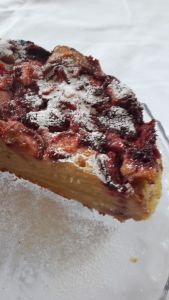
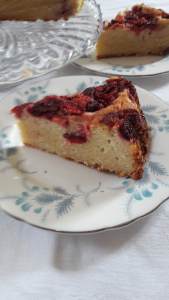
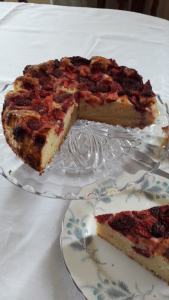
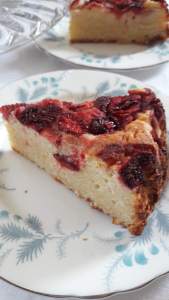
Courgette Cake

I have just returned from a trip to The Netherlands where I stay with my  Dutch friend who I have known for nearly all my life!  We were both born in the same year  – lived just a few doors apart in Lancashire and  went to the same school together. Now we live in differerent countries but we visit each other often.

I am always on the look out for recipes as well as old glass & china. We went to a second-hand street market in Roermond and there was a book sale in one of the churches and strangely enough the books were sold by weight!  I  bought a nearly new copy of a cookery book by Yvette van Boven (I now know she appears on television).

This cake is  based on one of her recipes and reminds me of the light fruit cakes called keks in Polish – though the use of the courgette is novel  –  you would never guess it is in the cake!

Ingredients – Cake

  • 150g self-raising flour
  • pinch of salt
  • 1 tablespoon of vanilla sugar
  • 150g of light brown sugar
  • 1 teaspoon of cinnamon
  • 150g of raisins
  • 150g of currants
  • 100g of roasted and roughly chopped hazelnuts
  • 1 medium size courgette coarse grated
  • 2 eggs
  • 125ml of sunflower oil

Ingredients – Lemon Icing

  • Fine grated rind of 1 lemon
  • 2 tablespoons of lemon juice
  • 150g of icing sugar

Method – Cake

  • Pre-heat the oven to GM4 180°C
  • I used a continental style long loaf tin, greased it  and used a single sheet of grease proof paper  to line the long sides and the base.
  • Mix together the flour, salt, sugars and cinnamon, making sure that any lumps in the brown sugar are all pressed out.
  • Mix together the raisin, currants, nuts and the courgette.
  • Lightly whisk the eggs and oil together.
  • Add the flour mixture to the egg mixture and mix thoroughly together with a wooden spoon.
  • Add the courgette mixture and mix well in.
  • Place the cake mixture into the tin and smooth the top.
  • Bake for 50 – 55 minutes – check after 40 minutes and cover the top with greaseproof or foil if browning too much before it is baked through.
  • Leave to cool before icing.

Method – Icing

  • Place the icing sugar in a bowl and add the grated lemon zest.
  • Mix in the lemon juice until you have a thick icing.
  • You might have to adjust the thickness with  more lemon juice (or water) or with icing sugar.
  • Put the icing on the top of the cake and let it drip down the sides.

Served on Woodside by Royal Grafton from 1940 to 1959.

Carrot Variation

  • I  thought that this might be good using grated carrot instead of courgette – I used a medium sized carrot.
  • I used chopped walnuts, which I had, as when I had gone to get the hazelnuts, I got the last packet from my local shop and did not have time to go to anywhere else!

Nuts for sale in the Food Market in Rotterdam

Served on Stardust by Colclough from the 1960s.

Both versions were delicious and enjoyed by many!

French Connections

Fasolka po bretonsku

This is Beans in a Breton style and is a very popular dish in Poland.

It is a dish of beans cooked with Polish sausage and smoked bacon in a tomato sauce.

When Lidl, the supermarket,  has a Polish Week they often have jars of this for sale.

I have done some research and can find lots of Polish recipes for this but not a single French or Breton recipe which is similar. So I cannot tell you why this typical Polish dish is associated with Brittany or France.

French Connections

There are however many, many connections with Poland and France – here are just a few:

  • Prince Henri de Valois (1551 – 1589) was elected King of Poland and reigned from 1573 to 1575. He resigned to become Henri III of France.
  • King Władysław IV Waza (1595 – 1648) – married the French Princess  Louse Marie Gonzaga
  • King Jan II Kazimierz Waza (1609 –1672) married Louse Marie Gonzaga when she became the widow of the King  Władysław IV Waza.
  • King Jan III Sobieski (1629 –1695) – married Marie Casimire Louise de la Grange d’Arquien.
  • Stanisław Leszczński (1677-1766) was King of Poland and then became the Duke of Lorraine.
  • His daughter Maria Leszczyńska (1703-1768) became the Queen consort of Louis XV(1710– 1774) of France and was the Grandmother of Louis XVI (1754–1793).
  • Poland was an Ally of Napoleon (1769 – 1821) especially in the war against the Russians.

Many Poles went to live and work in France including:

  • Adam Mickiewicz (1798 – 1855) – poet
  • Fryderyk Chopin (1810 – 1849) – composer
  • Cyprian Norwid (1821 – 1883) – poet
  • Maria Skłodowska Curie (1867 – 1934) – scientist
  • André Citroën (1878-1935) – entrepreneur
  • Aleksander (Alexandre) Tansman (1897 – 1986) – composer
  • Tadeusz Baird (1928 – 1981) – composer

Ingredients

Note – these quantities do not have to be exact.

  • 2 cans of beans (approx 420g each) (haricot, canellini  or barlotti)
  • 200g smoked bacon
  • 200g Polish sausage, (I used Toruńska and Śląska)
  • 2 onions
  • 3 tablespoons of tomato puree
  • 500ml of hot water
  • 1 teaspoon of Italian herbs or marjoram
  • 1 teaspoon of sweet paprika (can use hot paprika)
  • 4 grains of allspice
  • 2 – 3 bay leaves

Method

  • Pre-heat the oven to GM 3 – 160°C.
  • Cut the bacon into small squares and fry them up.
  • Cut the onions into small pieces and fry these up.
  • Drain the beans and place them into an oven proof dish (one that has a lid).
  • Add the fried bacon and onions and mix together.

Slice the sausage and add this to the bean mixture.

Mix the tomato puree with the hot water and add the Italian herbs and paprika.

  • Pour this over the bean mixture and add the allspice and bay leaves and mix thoroughly.
  • Cook in the oven for several hours until the beans are soft.
  • This can be eaten as a dish on its own or served with bread.

Note

This is suitable for making in a slow cooker.

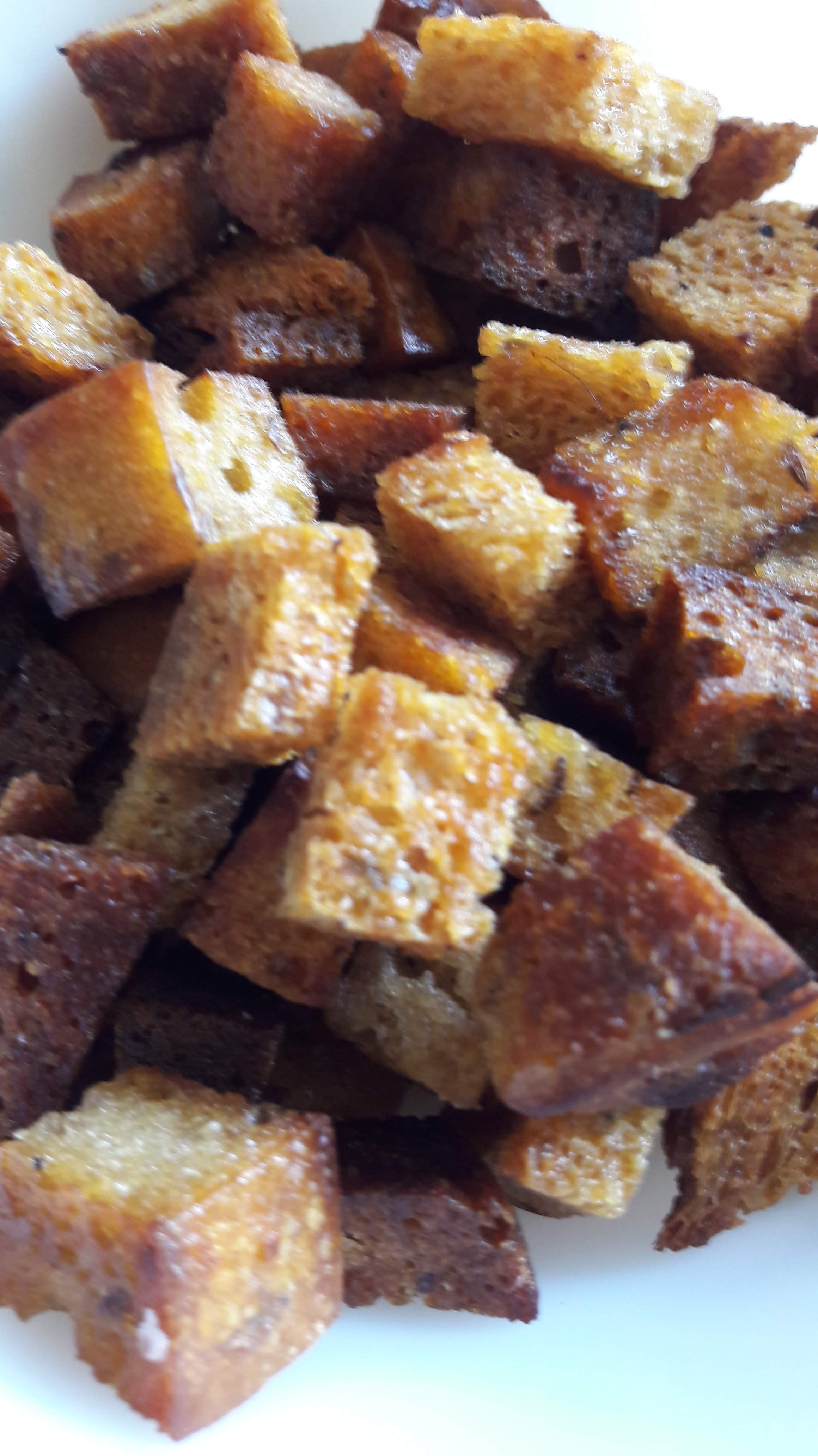
Rye Bread Croutons

Croutons are called grzanki in Polish – the word is plural and means something that have been heated up.

Rye bread croutons are used as a soup accompaniment.

Ingredients

  • Several slices of rye bread
  • 2-3 tablespoons of olive oil (not virgin)

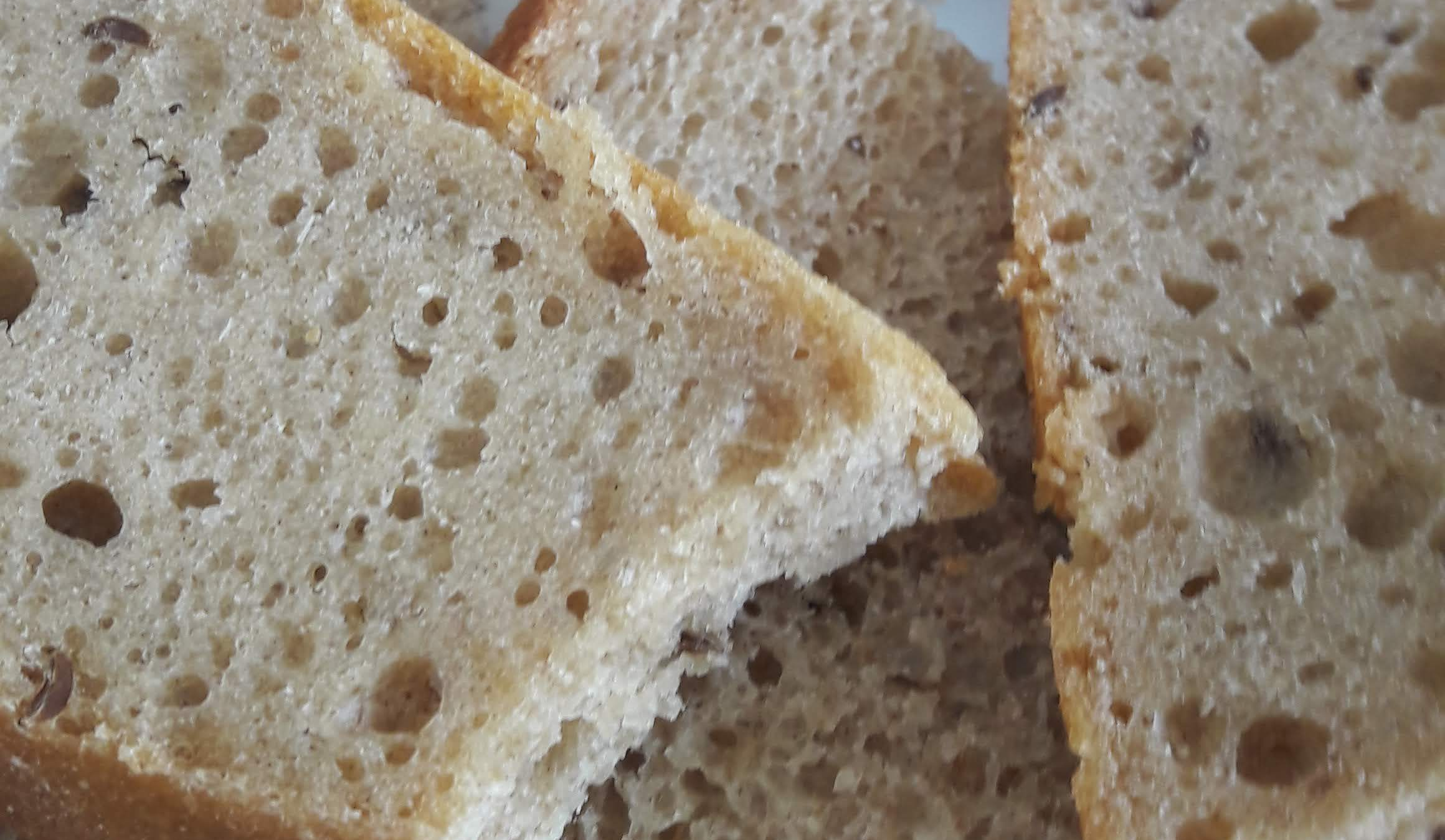
I used some of my own sour dough loaf.


Method

  • Pre-heat the oven to GM4  – 180°C
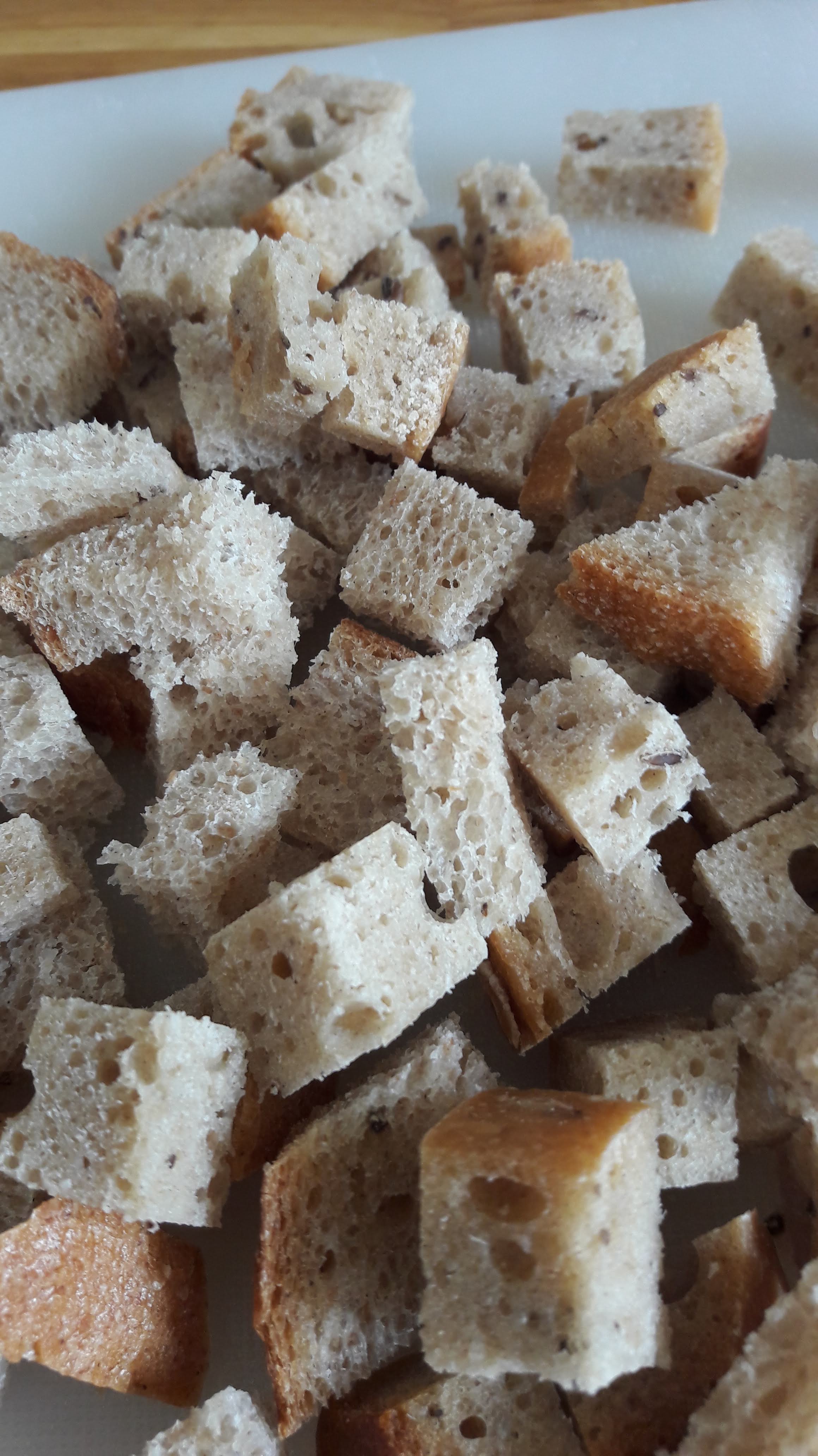
  • Cut the bread into small cubes
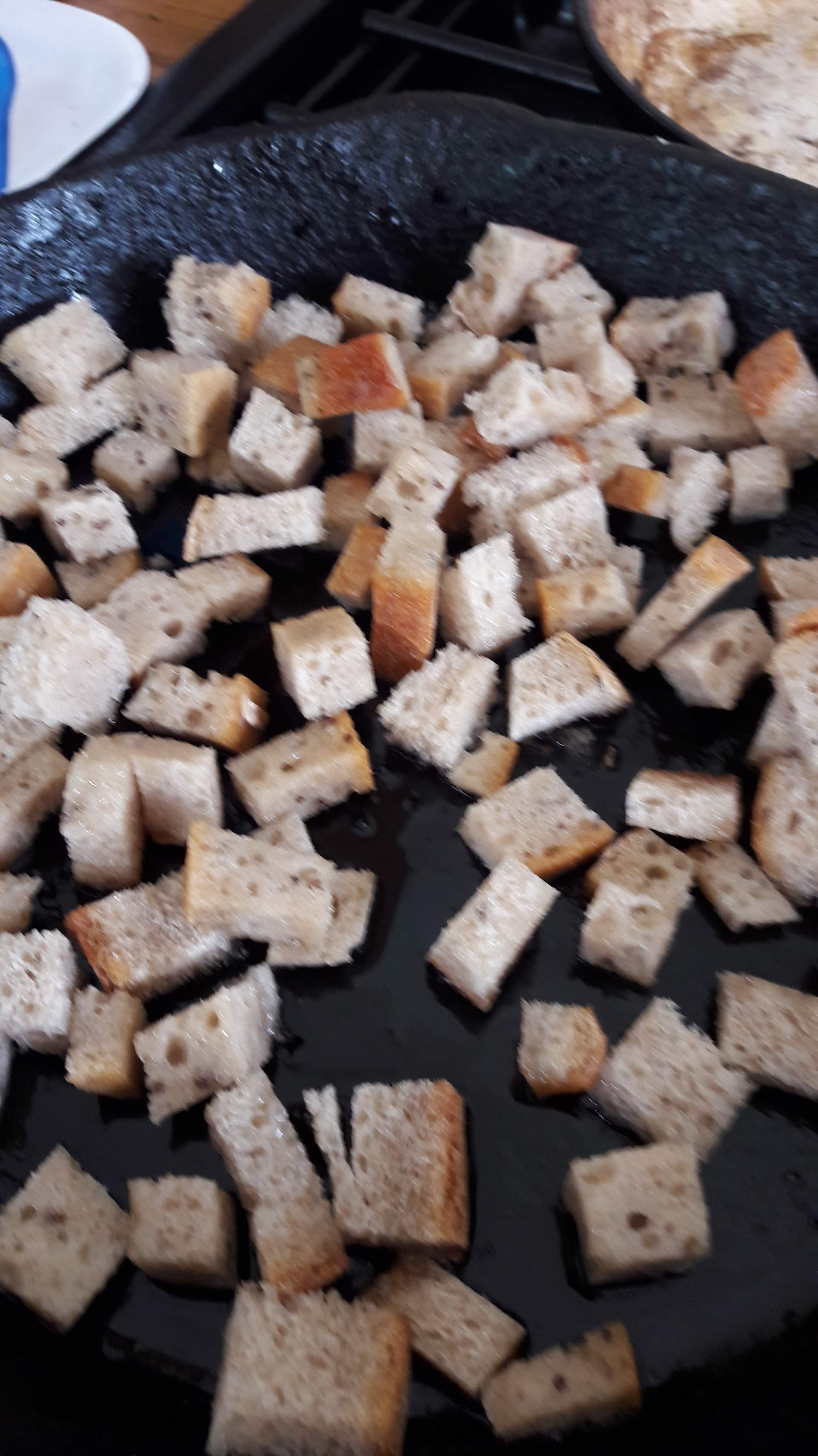
  • Heat the olive oil in a frying pan.
  • Toss the bread cubes in the oil and fry gently for a few minutes.


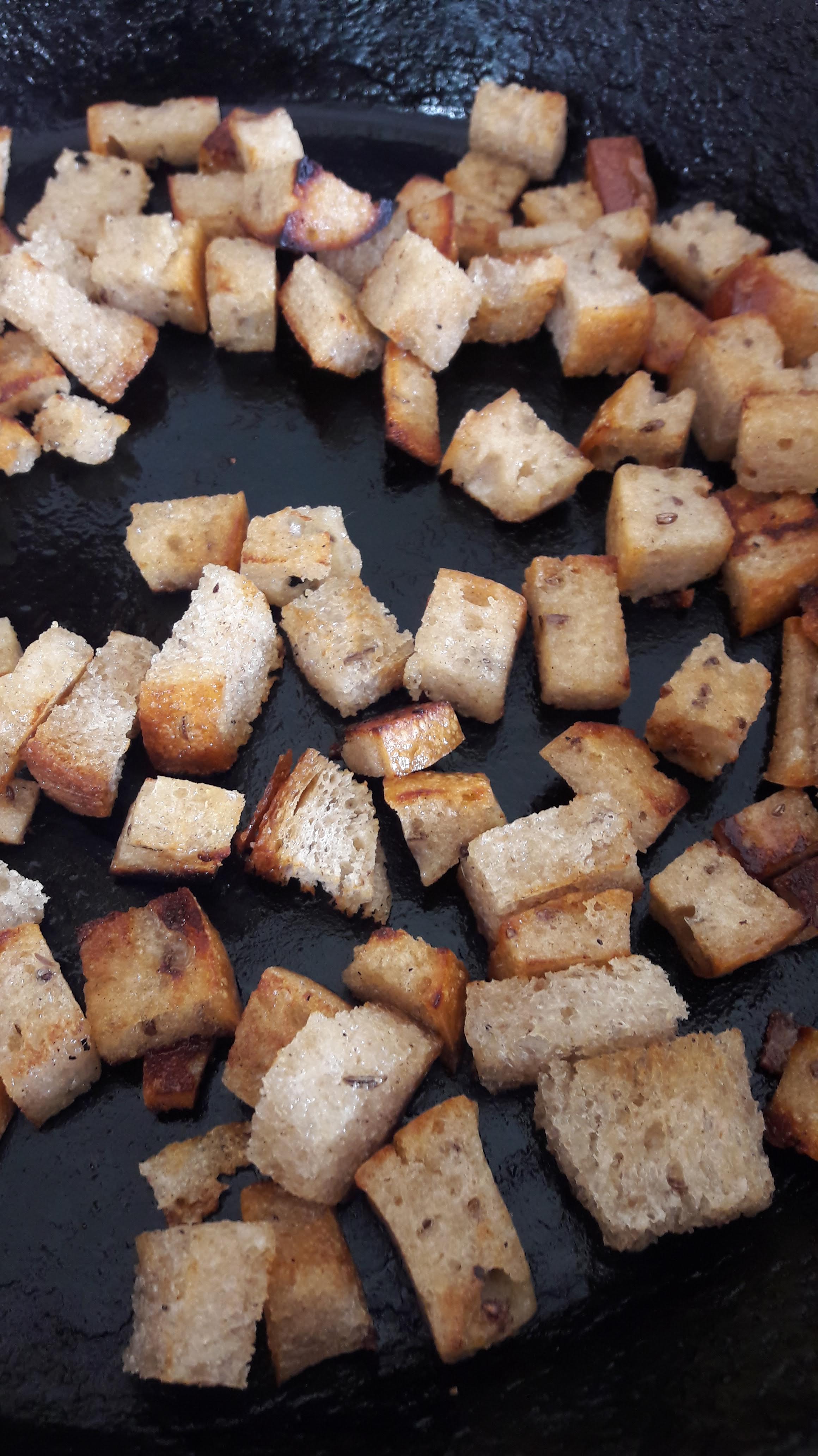
Place the cubes onto a baking tray and put in the oven for around 5 – 10 minutes till golden.

Serving

Add several to each serving of soup.

Sprinkle with salt flakes or ground salt and eat them as a nibble or little snack.


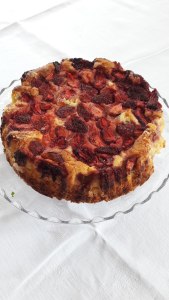
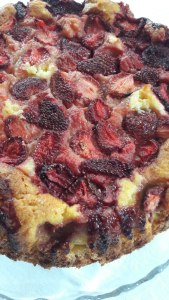
Not Quite a Cheesecake

For this recipe you can  use twaróg, curd cheese, cream cheese or yoghurt cheese but it is quite a bit different from my usual Polish baked cheesecake.

It is a more a ground almond cake with strawberries on top.

I used the last pickings of strawberries from my garden this summer.

I used my own yoghurt cheese and squeezed it out in a cloth to get rid of as much excess liquid (whey) as possible.

Ingredients

  • 115g Butter
  • 115g Caster sugar
  • 3 eggs separated
  • 2 tablespoons of cornflour or potato flour
  • 175g Ground almonds
  • 200g Twaróg , Curd cheese or Yoghurt Cheese
  • 1/2 teaspoon of vanilla essence
  • Pinch of salt
  • Topping
  • Strawberries & 1/2 tablespoon of caster sugar
  • Optional – Icing sugar to dust

Method

  • Line a 20cm in diameter loose bottomed cake tin with a bought paper cake liner.

  • Pre-heat the oven to GM5 190°C
  • Cream the butter and sugar until they are soft and fluffy.
  • Add the egg yolks one by one until you have a smooth mixture.
  • Add the vanilla essence and the salt and mix in.
  • Add the cornflour, ground almonds and the yoghurt cheese and mix together thoroughly.
  • Whisk the egg whites until they are stiff.
  • Fold in the egg whites into the cake mixture.
  • Put the cake mixture into the lined tin.
  • Slice the strawberries and place these on the top and sprinkle them with the sugar.
  • Bake in the oven for 35 minutes.
  • Turn the oven down to GM2 – 150°C and bake for around another 30 minutes.
  • Switch off the oven but leave the cake in there until it is cool.
  • Keep the cake in the refrigerator but bring to room temperature for serving.
  • Served here on tea plates – Las Palmas by Aynsley from the 1960s.

Variations

  • More strawberries on to top would have been okay.
  • Other red summer fruits such as raspberries, blackberries or whinberries (bilberries) would also work well.

Beans – po staropolsku

Po staropolsku  means in an old Polish style and this often includes using  prunes and honey.

Originally this recipe would have been made with dried beans soaked overnight.

To make life easier I usually use tinned beans such as haricot, cannellini (white kidney beans) or black-eyed beans.


Haricot beans in Polish are called fasola jaś which means Johnny bean.  In the British TV comedy programme Mr Bean, which is very popular in Poland, our hero is called Jaś Fasola.

Ingredients

2 tins of beans (haricot, canellini or similar)

250g smoked  bacon

2 onions

12 soft – no need to soak – prunes

2-3 tablespoons of plain flour

3 tablespoons of honey

Sunflower oil for frying

Ground black pepper

Marjoram or Italian herbs

Quarters of lemon to serve

Method

Put the prunes in a dish and cover them with boiling water and leave for around 15 minutes.

Remove the prunes (save the liquor) and chop them into into quarters.

Pre-heat the oven to GM 3 – 160°C

Chop the bacon into small squares and fry these up in a little sunflower oil.

Chop the onions into small pieces and add them to the bacon and fry them all up together.

Lightly brown the flour and add the liquor from the prunes and any more water needed to make a pourable sauce.

Add the fried bacon and onions, honey,  ground pepper and marjoram.

Drain the beans from the cans and put them into an oven proof dish (one that has a lid).

Add the bacon mixture to the beans and mix together.

Put the lid on the dish and cook in the oven for at least 1 hour,  I often cook this for a lot longer as I like the beans quite soft but take care that I top up the liquid if necessary.

Serve each portion with 1 or 2 quarters of lemon – the squeezed juice adds a little zest to beans.

Mincemeat Placek

This is a variation on Prune placek (flat cake) which I posted recently, this time using fruit mincemeat (a very British ingredient) instead of prunes.

I make my own mincemeat using the recipe from Delia Smith but without the chopped almonds.

I only make mince pies around Christmas time – so that they are seen as special and usually  I have a jar left.

I am always looking out for recipes that use mincemeat and my old standby is a variation on a Polish style fruit cake – keks.

So I was glad to try another recipe using the mincemeat and I am very pleased with how this placek has turned out.

There is a base of short crust type pastry, a layer of  mincemeat and a cake topping which contains oats and sesame seeds.

Ingredients

Base

175g plain flour

125g butter or margarine

50g caster sugar

Filling

Around half a jar of fruit mincemeat

Topping

125g butter or margarine

75g caster sugar

1 tablespoon of honey

125g chopped sultanas & mixed peel

125g self-raising flour

1/2 teaspoon of bicarbonate of soda

125g rolled oats

50g sesame seeds.

Method

Base

Grease and line a rectangular 20 x 27cm tin.

Pre-heat the oven to GM 4 – 180°C

Rub the butter into the flour to made breadcrumbs.

Mix in the caster sugar.

Bring the mixture together to make a dough.

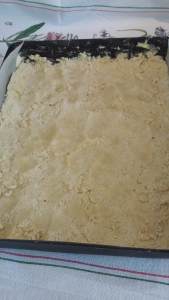
Press the dough into the tin.

Bake the base for around 25 minutes until it is golden on top.

Leave till it is cold.

20180614_120851

Filling

Spread the mincemeat over the base.

20180617_073801

Topping

In a pan gently melt the butter, sugar and honey.

Leave to cool slightly.

Add the chopped sultanas & mixed peel  to the butter mixture and mix .

In a bowl mix the flour, bi-carbonate of soda, oats and sesame seeds.

Add the butter mixture to the dry ingredients and mix well in.

Spread this mixture over the mincemeat.

Sprinkle the reserved sesame seeds over the top.

Bake for 25 – 30 minutes until the top is golden.

Cut into squares or rectangles to serve.

Green teapot is Café Culture by Maxwell Williams.

Cake Stand – made in England.

Tea cups & saucers and tea plates  – Queen Anne – pattern name unknown.

Chleb – Bread

Today is the third anniversary of my blog – I started posting on 4 July 2015 and this will be my 155th post!

I am really enjoying the research, the cooking, the photography  and the writing and have many more recipes to share with you all.

Chleb – Bread

A wedding tradition in Poland is to greet the bride and groom on their arrival at the reception with bread & salt.

The bread is seen as a gift from God and is a wish that they never go hungry.

The salt is a seen as a gift from the earth and is a wish that they overcome the bitterness of life.

Rye

  • To be called bread in Poland the loaves or rolls must contain some rye.
  • Wheat loaves or rolls are called bułki or bułeczki but this is also the name  given to some cakes and buns – hence there is often some confusion!
  • Żyto is the Polish for rye.
  • Rye   – Secale cereale  is a grain and is used for bread and for making some of the best vodkas.
  • It grew  wild in Turkey and  since the Middle Ages it has been cultivate widely in    Central and Eastern Europe.
  • Rye grows well  in poor soil and in cold and harsh conditions.
  • Nowadays rye is grown primarily in Eastern, Central and Northern Europe and the top three rye producing countries are Germany,  Russia & Poland.
  • Poland consumes the most rye per person at 32.4 kg/capita (2009) followed by Nordic and Baltic countries. (From an article in Wikipedia).

Sour dough

  • This method of bread making uses the natural yeasts that are found on the grain and in the atmosphere.
  • I had never tried using a sour dough method before.  I have now tried it out twice –  even as a former science student  – it felt like MAGIC! – the results were wonderful!
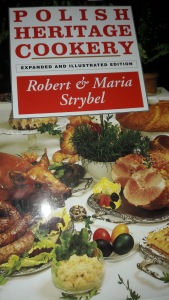
  • This recipe is adapted from one in found in my American book – Polish Heritage Cookery by Robert & Maria Syrybel.

20170619_162207

It takes around 3 days to make 2 loaves.

I suppose I could halve the recipe but I am quite happy to cut and freeze any surplus and the bread keeps for several days and can always be toasted.

Whey

This recipe uses whey which I often have if I have made any twarog – curd cheese.

If I do not have any whey I make a mixture of around 2 parts yoghurt to 1 part water instead.

Method

Day 1

At around 5 pm mix 150g of  rye flour with  250ml of hand hot water in a bowl.

Cover with a tea towel and leave for 24 hours.

Day 2

Again at around 5 pm,  mix 150g of  rye flour with  250ml of hand hot water and the mixture from the night before in a bowl and leave overnight or around 12 hours.

Day 3

In the morning

Ingredients

  • 350g rye flour
  • 350g (strong) plain flour
  • 2 tablespoons honey
  • 2 teaspoons salt
  • 1 teaspoon of granulated sugar
  • 2 tablespoons of caraway seeds
  • 450 – 500ml  of whey  or a mixture of 2 parts yoghurt & 1 part water
  • Plus the starter mix from the days before

Method

  • Combine all the ingredients together.
  • Aim for a “wet” mix – it is harder to handle but gives the best results.
  • Knead for around 5 minutes – longer if you can!
  • Shape the dough – cut  it in half and make 2 oval-shaped loaves and place them on greased baking trays or you can put them into tins – I used  a round – loose bottomed tin – 20cm in diameter in my second bake.
  • Leave to rise  for around 5 hours.
  • Pre-heat the oven to GM4 – 180°C
  • Place some water in a roasting tray at the bottom of the oven.
  • *
  • They take around 50 minutes to bake – I swap the two trays around after about 20 minutes.

Delicious with just butter – Well worth the wait!

Apricot Placek

This is a variation on Prune placek (flat cake) which I posted recently, this time using dried apricots instead of prunes.

There is a base of short crust type pastry, a layer of softened apricots and a cake topping which contains oats and sesame seeds.

Ingredients

Base

  • 175g plain flour
  • 125g butter
  • 50g caster sugar

Filling

  • 225g soft dried apricots
  • 1 tablespoon granulated sugar
  • 1 tablespoon of cornflour

Topping

  • 125g butter
  • 75g caster sugar
  • 1 tablespoon of honey
  • 125g soft dried apricots
  • 125g self-raising flour
  • ½ teaspoon of bicarbonate of soda
  • 125g rolled oats
  • 50g sesame seeds

Method – Base

  • Grease and line a rectangular 20 x 27cm tin.
  • Pre-heat the oven to GM 4 – 180°C
  • Rub the butter into the flour to made breadcrumbs.
  • Mix in the caster sugar.
  • Bring the mixture together to make a dough.
  • Press the dough into the tin.

  • Bake the base for around 25 minutes until it is golden on top.
  • Leave till it is cold.

Filling

  • Chop the apricots into small pieces.
  • Put the apricot and sugar into a small pan and cover them with water
  • Simmer the apricots, sugar and water  for 10 minutes until you have a soft pulp – take care not to boil the mixture dry – add more water if needed.
  • Mix the cornflour with some water to form a paste and add this to the mixture and stir until it thickens.
  • Remove from the heat and leave it till it is cooled completely.

Spread the filling on top of the pastry base.

Topping

  • In a pan gently melt the butter, sugar and honey.
  • Leave to cool slightly.
  • Chop the 125g of apricots into small pieces.
  • Add the apricots to the butter mixture and mix .
  • In a bowl mix the flour, bi-carbonate of soda, oats and sesame seeds.
  • Add the butter mixture to the dry ingredients and mix well in.
  • Spread this mixture over the apricot filling.
  • Sprinkle the reserved sesame seeds over the top.
  • Bake for 25 – 30 minutes until the top is golden.
  • Cut into squares or rectangles to serve.

Tea plates are Bramble Rose by Duchess from the 1960s.

Prune Placek

This recipe was given to me by one of my cousins (British born like me) who lives in Wembley.

Although this is not a traditional Polish recipe it does reminds me of a Polish placek (flat cake) and contains prunes which are very popular and used in many recipes in Poland.

There is a base of  easy to make shortcrust type pastry, a layer of softened prunes and a cake topping which contains oats and sesame seeds.

Muscovado sugar is used – this is definitely not a Polish sugar as it is produced in the process of refining sugar cane whilst in Poland sugar is made from sugar beet.

Note

You can make the filling ahead of when  you need it as it has to be cold.  I often make the base and the filling in the evening and then finish the placek the next day.

Ingredients

Base

175g plain flour

125g butter or margarine

50g caster sugar

Filling

225g no-need-to-soak prunes

1 tablespoon dark muscovado sugar

1 tablespoon of cornflour

Water

Topping

120g butter or margarine

60g caster sugar

1 tabelspoon of honey

125g no-need-to-soak prunes

100g self-raising flour

1/2 teaspoon of bicarbonate of soda

100g rolled oats

50g sesame seeds (keeping  back 2 tablespoons to sprinkle on the top)

Method

Base

Pre-heat the oven to GM 4 – 180°C

Grease and line a rectangular 20 x 27cm tin.

Rub the butter into the flour to made breadcrumbs.

Mix in the caster sugar.

Bring the mixture together to make a dough.

Press the dough into the tin.


Bake the base for around 25 minutes until it is golden on top.

Leave till it is cold.

Filling

Cover the prunes with water in a small pan and add the sugar.

Simmer the prunes, sugar and water  for 10 minutes until you have a soft pulp – take care not to boil the mixture dry – add more water if needed.

Mix the cornflour with some water to form a paste and add this to the mixture and stir until it thickens.

Remove from the heat and leave it till it is cooled completely.

Spread the filling on top of the pastry base.

Topping

In a pan gently melt the butter, sugar and honey.

Leave to cool slighty.

Chop the prunes into small pieces.

Add the prunes to the butter mixture and mix .

In a bowl mix the flour, bi-carbonate of soda, oats and sesame seeds.

Add the butter mixture to the dry ingredients and mix well in.

Spread this mixture over the prune filling.

Sprinkle the reserved sesame seeds over the top.

Bake for 25 – 30 minutes until the top is golden.

Cut into squares or rectangles to serve.

Variations

Other dried fruits can be used for the filling  – such as apricots, dates or figs.


The serving cake plate is a recent purchase from Leeds second hand market.

The design is Field Fare by James Cooper for Washington Pottery, Hanley, Staffordshire from around the 1950s.

The cups and saucers are another very recent purchase from a local car boot sale.

They are bone china by Colclough, pattern number 8266, from I think the 1970s.

The stoneware tea plate is Blue Mist, Burleigh Ware by Burges and Leigh Ltd  from the 1930s.


Włoszczyzna – Italian Stuff

When Italian diplomats who spent time in Poland in the 15th century wrote about Polish food, they complained that it was based mostly on meat and many said that – One Pole eats as much meat as 5 Italians.

Tomatoes and many other vegetables  were brought to Poland in the 16th century by the Italian chefs who came with the Italian Princess Bona Sforza who married the Polish King, Zygmunt the Old in 1518.  Many of the names of vegetables in Polish have Italian roots.

To this day, soup greens* are known as włoszczyzna  or “Italian stuff”.

Włoski is the Polish word for Italian.

Some writers say that vegetables other than cabbage and root vegetables were virtually unknown in Poland until  Princess Bona  introduced them, and her cooks helped to bring in the use  of vegetables in royal Polish cuisine;  however records show that the court of King Jagiello (who died in 1434) enjoyed a variety of vegetables including lettuce, beets, cabbage, turnip, carrots, peas and cauliflower.

*Soup Greens is a phrase found in American cookery writing – I have not really seen it in British writing.

Soup Greens are a vegetable stock basis for soups and other  vegetable or fish dishes.

(They are also the vegetables that are used in any casserole type dish).

In German they are known as  suppengrün and in French mirepoix.

The Classic Ingredients are:

Carrots

Leeks

Celeriac

Parsley root

if these are not availabe then use:

Onions

Celery leaves

Parsley stems and leaves

and also  – Bay leaves, Allspice grains, Peppercorns & Salt

Note

The ingredients for

Suppengrün  are carrots, celery, leek and for Mirepoix  are carrots, celery, onions

Often in Poland (and yesterday in my local Polish shop in England) you can buy a ready mixed packet of  the vegetables needed.


Method

Place all the ingredients in a large pan with water.

Bring to the boil and cover.

Simmer until the vegetables are soft.

Strain the vegetables from the liquid.


Note

If this is being made for a soup  that day,  then some of the vegetables such as the carrots might be sliced and added to the soup.

or

The liquid is kept in glass or plastic containers in the fridge for another time.

If you have no time or ingredients then a very good standby is

Marigold Swiss Vegetable Bouillon Powder.


Note

This post was written in preperation for the huge topic of Soup in Polish Cookery!

This has now been written – here is the link

Zupa -Soup