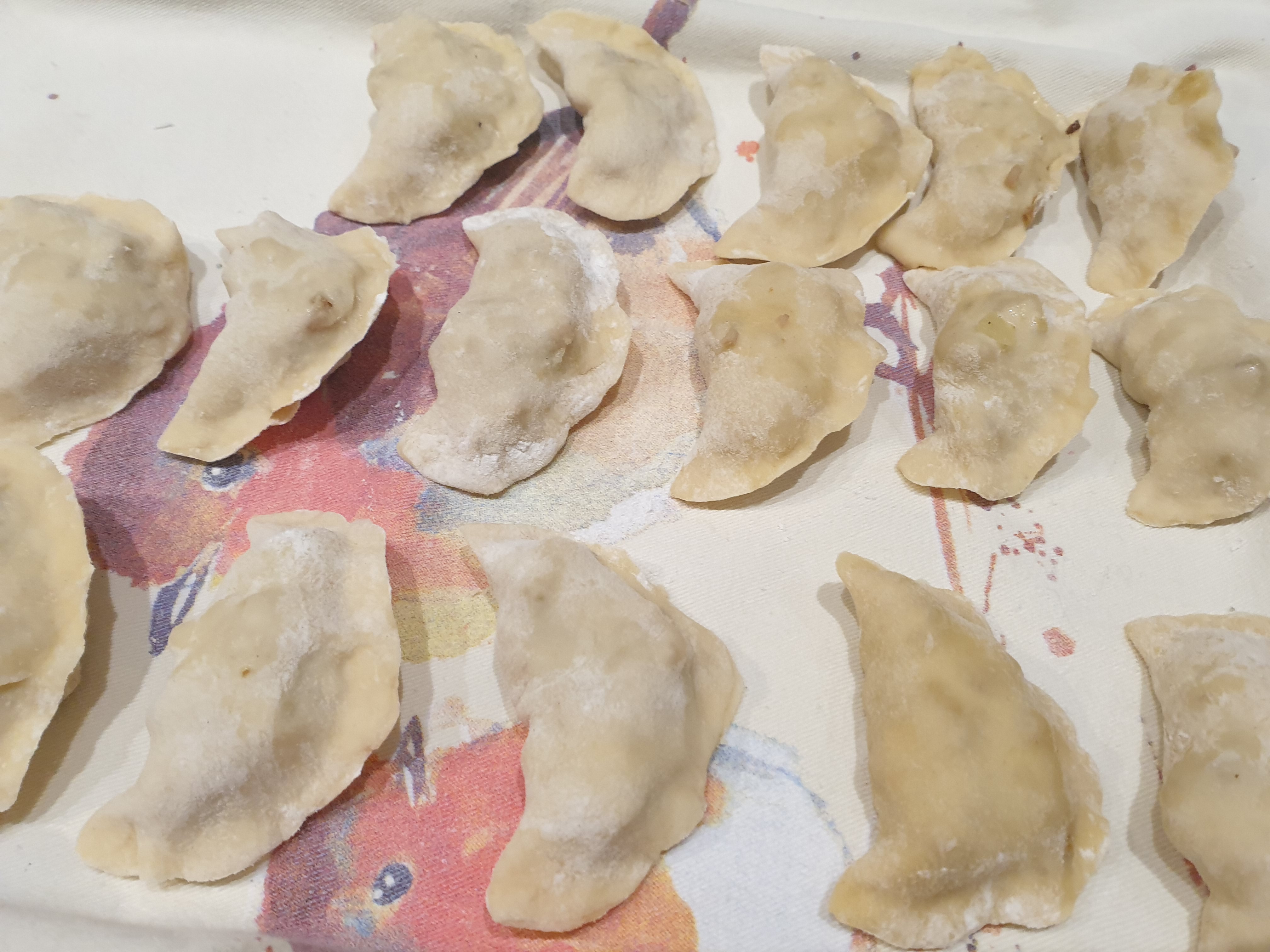
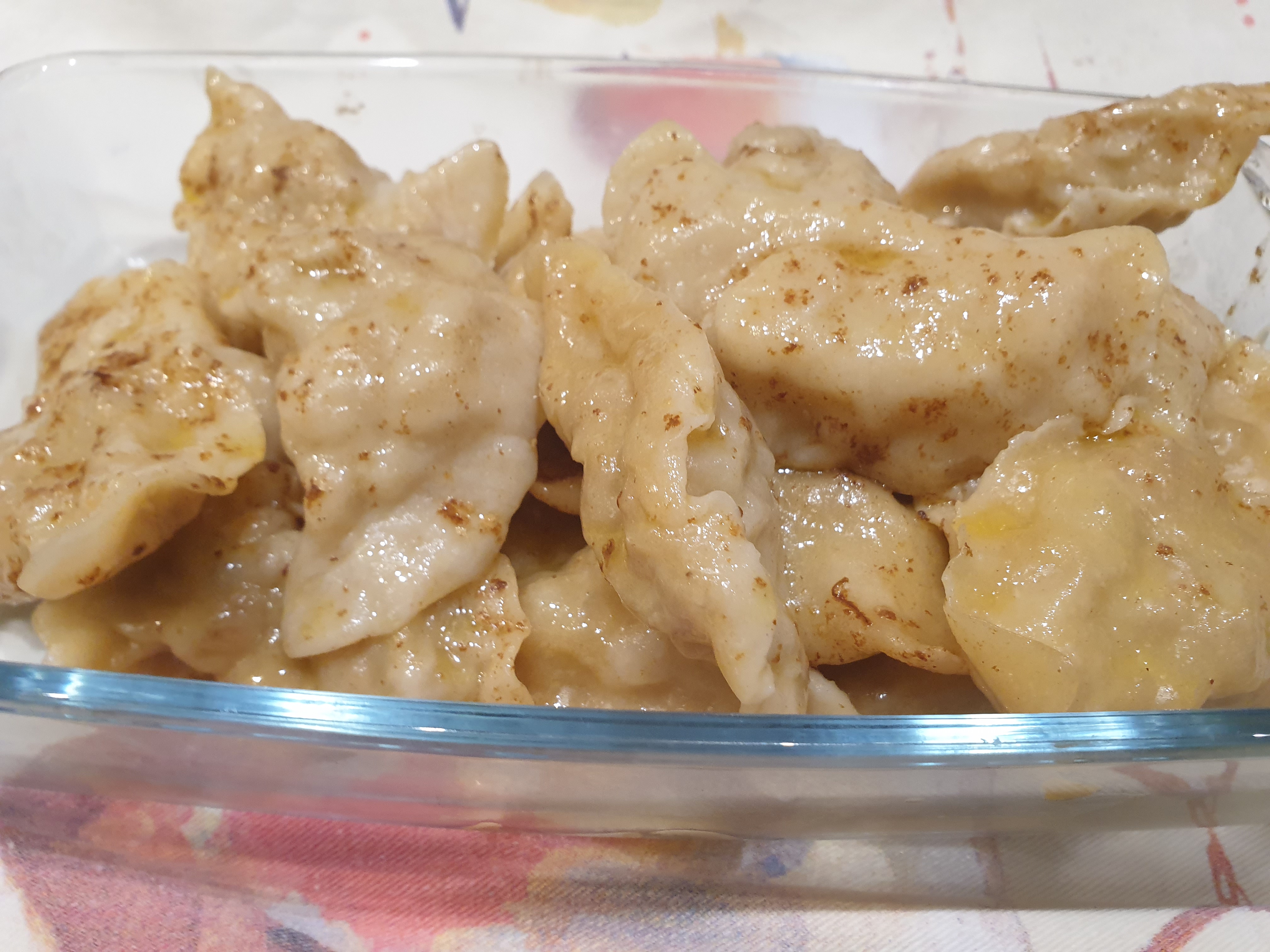
Ewa’s Pierogi Dough

  • One of my Polish friends, Ewa, came round and we made pierogi by her method.
  • It is not so different to mine but she uses spelt flour- orkiszowa.
  • Spelt flour is a more ancient wheat flour and and is a little different to work with,
  • Ewa used cup measurement but I have converted these into weights.
  • The amount of water needed depends on the flour and this is something you learn to gauge as you work with the dough.

INGREDIENTS

  • Around 300 – 350g Spelt flour
  • 1 egg yolk
  • 1 tablespoon sunflower oil
  • Large pinch of salt
  • 150 – 190ml water – depends on the flour.

METHOD

  • Place the flour in a heap on a large pastry board.
  • Make a well in the centre and add the salt, yolk and oil.
  • Start to add the water and combine the liquid with the flour.
  • Keep adding water and mixing until you have a soft dough.
  • (if you add too much water – add more flour).
  • Make a ball with the dough and knead it well for 5 minutes – set a timer.
  • *
  • Use the dough as you would normally –
  • Best to divide into half and roll each portion out into a thin sheet.
  • *
  • Make the pierogi in the usual way with your favourite fillings.
  • *
  • This  amount of dough should make at least 50 pierogi.
  • Fill a large saucepan with water and bring it to the boil.
  • Add half the pierogi and boil them until they rise and float to the surface.
  • Use a slotted spoon to remove them – serve or keep warm with a little butter or oil.
  • Repeat for the other half.
  • (Note this is a slightly different way of boiling than I usually use).
  • *
  • Serve with the toppings you would normally use to go with the filling such as butter, fried onion, skwarki (bacon bits) or soured cream etc.

The ones we made were filled with chicken – made in a different way to how I do a chicken filling – see a later post for this – not yet written.

Spelt Scones – Updated

The updating of this recipe has been the use of different dried fruits.

Instead of sultanas or raisins – option 1 was to use chopped dried apricots and option 2 was to use dried cranberries.

All versions are lovely.

This recipe is a cross between an English scone and soda bread.

In Poland you might call these babeczki – little buns or bułeczki – little bread buns or even ciasteczka.

Spelt flour gives these a lovely taste.

Ingredients

  • 250g spelt flour
  • 1 tablespoon of baking powder
  • 1/4 teaspoon of salt
  • 30g of demerara or granulated sugar  & 1/2 tablespoon
  • 80g of sultanas or raisins *
  • 65g butter – chilled and diced
  • 2 tablespoons of yoghurt & milk to make 125ml of liquid
  • 1 egg

Method

  • Line a baking sheet with grease-proof paper.
  • Preheat the oven to GM7 – 220°C.
  • Mix the flour, baking powder and salt together.
  • Add the butter and mix in with the flour to make breadcrumbs.
  • Add the 30g of sugar.
  • Add the sultanas or raisins.
  • Lightly mix the egg into the yoghurt/milk mixture.
  • Make a well in the flour mixture and pour in the egg mixture.
  • With a knife work the mixture together to make a damp rough ball.
  • Turn the ball of dough on the the baking sheet.
  • Form into a flattened disc around 20cm in diameter.
  • Sprinkle with the 1/2 tablespoon of the demerara sugar.
  • Deeply score the disc into eight sections.
  • Bake for 15 – 20 minutes until golden and firm.

They tastes delicious freshly baked with butter & the next day slightly warmed or toasted.

Served here on  Ansley – Las Palmas tea plates from the 1960s and on Queen Anne tea plates.

*Option 1 instead of sultanas or raisins use dried apricots cut into small pieces

Spelt&apricot

*Option 2 instead of sultanas or raisins use dried cranberries

Courgette Cake – Version 2

  • I wanted to bake a courgette cake as I have made before but found I had spelt flour to use up soon and dried cranberries.
  • Also I did not have any hazelnuts.
  • So I made a variation of this well loved cake.
  • It would be called a keks in Polish – a light fruit loaf.

Ingredients – Cake

  • 150g spelt flour
  • 2 teaspoons of baking powder
  • pinch of salt
  • 1 tablespoon of vanilla sugar
  • 150g of light brown sugar
  • 2 teaspoons of cinnamon
  • 150g of sultanas
  • 150g of dried cranberries
  • 100g of finely cut chopped walnuts
  • 1 medium size courgette coarse grated
  • 3 eggs
  • 125ml of sunflower oil

Ingredients – Lemon Icing

  • Fine grated rind of 1 lemon
  • 2 tablespoons of lemon juice
  • 150g of icing sugar

Method – Cake

  • Pre-heat the oven to GM4 180°C
  • I used a continental style long loaf tin, greased it  and used a single sheet of grease proof paper  to line the long sides and the base.
  • Mix together the flour, salt, sugars and cinnamon, making sure that any lumps in the brown sugar are all pressed out.
  • Mix together the sultanas, dried courgettes, nuts and the courgette.
  • Lightly whisk the eggs and oil together.
  • Add the flour mixture to the egg mixture and mix thoroughly together with a wooden spoon.
  • Add the courgette mixture and mix well in.
  • Place the cake mixture into the tin and smooth the top.
  • Bake for 50 – 55 minutes – check after 40 minutes and cover the top with greaseproof or foil if browning too much before it is baked through.
  • Leave to cool before icing.

Method – Icing

  • Place the icing sugar in a bowl and add the grated lemon zest.
  • Mix in the lemon juice until you have a thick icing.
  • You might have to adjust the thickness with  more lemon juice (or water) or with icing sugar.
  • Put the icing on the top of the cake and let it drip down the sides.

Fruity Yeast Cake

  • This started as a recipe for buns but the dough was much too soft.
  • I decided to make it as a large flat cake ( placek) instead.
  • It has turned out similar to my aunt’s recipe for  drożdżówka  a sweet cake made using yeast.
  • This yeast cake is made with spelt flour (not strong flour) and the mixture is mixed with a wooden spoon or a Danish whisk to form a soft mixture and is not kneaded.
  • As with any recipe made with yeast, timings are so unpredictable depending on many variables including the room temperature.
  • I try to bake with yeast when I am at home for most of the day with other activities to do whilst waiting for the dough to rise.

Ingredients

  • 450g spelt flour
  • 100g granulated sugar
  • 100g butter
  • 180g currants
  • 40g mixed peel
  • 25g fresh yeast
  • Around 280ml of milk – warmed
  • ¼ teaspoon salt
  • 1 teaspoon mixed spice

Method

  • In a bowl mix the flour and salt.
  • Rub in the butter till you have breadcrumbs.
  • Stir in the sugar, mixed spice, currants and mixed peel.
  • Make a well in the centre, add the yeast and enough of the warmed milk to make a soft dough.
  • Cover the bowl and leave it in a warm place to rise.
  • The rise will not be very large.
  • Line a large baking tray with a rim.
  • Tip out the dough and spread it out to the edge of the tray with a spatula.
  • Cover and leave to rise for 30 to 60 minutes.
  • Pre-heat the oven to GM6 – 200°C.
  • Bake for 20 – 25  minutes.
  • Cool on a baking rack for 5 minutes.
  • Remove from the baking paper and put back on the rack to avoid it going soggy at the base.

Royal Doulton – Sonnet  tea plates – 1971 – 1998

As with most yeast cakes this is best eaten as soon as possible as it will soon go stale.

If all is not eaten on the day of baking, I cut the cake into slices and pack into a plastic container and freeze – these are then toasted and served with butter at a later date.

Wholemeal Bread

  • Whilst doing some research on old Yorkshire recipes, I came across this one for a wholemeal loaf.
  • I used wholemeal spelt flour.
  • It is so easy and quick to make and the result is wonderful.
  • The original recipe was for a much larger amount – I have cut it down.
  • Milk is used in this recipe and I think this is why it is so good.
  • There is no kneading or shaping.
  • However you have to bake it in a tin.
  • It has a super crunchy crust.

Ingredients

  • 500g wholemeal spelt flour
  • 15g of dried yeast
  • 1 teaspoon of granulated sugar
  • 125ml of lukewarm water
  • 400ml of lukewarm milk
  • ½ teaspoon of salt

Method

  • Mix the yeast and sugar with the lukewarm water.
  • Leave it to start frothing.
  • Put the flour into a large bowl.
  • Make a well in the centre.
  • Stir in the yeast mixture and the 125ml of lukewarm milk.
  • Leave it for 10 minutes.
  • *
  • Beat in more of the milk to give a stiff batter.
  • Add the salt and beat some more.
  • Cover and leave to rise in a warm place for an hour.
  • *
  • Pre-heat oven to GM6 – 200°C.
  • Very well grease a 20 cm diameter baking tin.
  • Using a large spatula put the dough into the tin.
  • Leave for 20 minutes.
  • Bake for 40 – 45 minutes.

Spelt Scones

This recipe is a cross between an English scone and soda bread.

In Poland you might call these babeczki – little buns or bułeczki – little bread buns or even ciasteczka.

Spelt flour gives this a lovely taste.

Ingredients

  • 250g spelt flour
  • 1 tablespoon of baking powder
  • 1/4 teaspoon of salt
  • 30g of demerara or granulated sugar  & 1/2 tablespoon
  • 80g of sultanas or raisins
  • 65g butter – chilled and diced
  • 2 tablespoons of yoghurt & milk to make 125ml of liquid
  • 1 egg

Method

  • Line a baking sheet with grease-proof paper.
  • Preheat the oven to GM7 – 220°C.
  • Mix the flour, baking powder and salt together.
  • Add the butter and mix in with the flour to make breadcrumbs.
  • Add the 30g of sugar.
  • Add the sultanas or raisins.
  • Lightly mix the egg into the yoghurt/milk mixture.
  • Make a well in the flour mixture and pour in the egg mixture.
  • With a knife work the mixture together to make a damp rough ball.
  • Turn the ball of dough on the the baking sheet.
  • Form into a flattened disc around 20cm in diameter.
  • Sprinkle with the 1/2 tablespoon of the demerara sugar.
  • Deeply score the disc into eight sections.
  • Bake for 15 – 20 minutes until golden and firm.

They tastes delicious freshly baked with butter & the next day slightly warmed or toasted.

Served here on  Ansley – Las Palmas tea plates from the 1960s and on Queen Anne tea plates.

Keks -With Fruit Mincemeat – 2

Keks is the word for a light fruit cake which is baked in a loaf tin or more often in a long narrow rectangular tin.

I am not sure how or when the word keks came into the Polish language but I am certain it comes from the English word “cakes” –  however the word keks is singular in Polish and means cake, and the plural is  keksy which is cakes.

Keks are make with bakalie, which is usually translated as dried fruits – however it has more varied fruits than the English version of dried grapes (raisins, sultanas, currants) and  mixed peel and can include: apricots, dates, figs, prunes and nuts.

Keks – using fruit mincemeat

At Christmas time I make English fruit mincemeat using the recipe from Delia Smith but without the chopped nuts.

If I have any mincemeat left over after the Christmas period I make a fruit loaf which which is very much a keks.

This is my second version of a keks with mincemeat.


Ingredients

  • 150 butter
  • 150g dark brown sugar
  • Grated zest of an orange
  • Grated zest of a lemon
  • 3 eggs
  • 450g jar of mincemeat (exact amount is not critical)
  • 175g  mixture of sultanas, raisins, currants & mixed peel
  • 50g of chopped walnuts
  • 225g  spelt flour
  • 3 level teaspoons of baking powder

Method

  • Preheat the oven to GM3 – 160ºC
  • Prepare the long loaf tin by greasing it and lining the long sides using one piece of greaseproof paper.
  • Lightly cream the butter and sugar.
  • Add the grated zest of the lemon and the orange.
  • Beat in the eggs, one by one.
  • Stir in the mincemeat, the dried fruits and walnuts until it is an even consistency – a wooden spoon is good for this.
  • Mix the spelt flour with the baking powder.
  • Stir in the flour mixture.
  • Spoon the mixture into the tin and smooth the top.
  • Bake for around 60 minutes – check after 50 minutes and cover the top if necessary to prevent burning.
  • Leave to cool in the tin before turning it out.


Served here on hand painted Paragon octagonal tea plates.


Rogaliki – Filled

Rogaliki – Crescent Rolls

Updated 11 January 2024.

Rogaliki means little horns and these rolls are made into a crescent shape which look like horns.

This amount of dough makes 16 rolls and you will need 2 greased baking sheets.

Many Polish yeast recipes  make a rozczyn – a leaven in the form of a batter or starter to begin with – I have liked using this method very much.

Older Polish recipes use fresh yeast.  I tend to use dried yeast and had very good results.  I like using the little measured out sealed packets of dried yeast, which are sufficient for up to 500g of flour and are equivalent to 25g of fresh yeast.

I have two earlier post:

Bułeczki – bread rolls

Here I made a bread roll version of rogaliki.

Kołaczyki  –  little wheels

Here I made a Basic sweet yeast dough – version 2.

Now this could be Basic sweet yeast dough version 3 – I keep refining the recipe and this now has to be the very  best yet!

Ingredients

Leaven – Starter

  • 150g plain flour
  • 200ml warm milk
  • 4 tablespoons of granulated sugar
  • 1 pkt of dried yeast (= 1 tablespoon)

Rest of Ingredients

  • 300g plain flour
  • 100g butter
  • 2 yolks
  • *
  • a little more milk might be needed 
  • Egg white to glaze
  • Icing sugar to dust

Method

  • Mix the yeast and sugar into the hand hot milk.
  • Put the 150g of flour into a bowl and mix in the milk mixture until it is like double cream.
  • Cover the bowl and leave it to rise.
  • *
  • Rub the butter into the 300g of flour until it is like breadcrumbs.
  • Add the egg yolks and the yeast starter.
  • Mix till you get a soft dough – you might need to add a tablespoon or so of milk – depends on the flour.
  • Knead the dough till you have a nice smooth ball.
  • Leave in a bowl, covered,  to rise and double in size.
  • *
  • Pre-heat the oven to GM 4 – 180°C
  • Grease two baking sheets.
  • *
  • Knead the risen dough lightly for a few minutes.
  • Divide the dough into two.
  • Roll the dough out to make a circle/oval.
  • With a knife or pizza cutter divide the dough into 8 (nearly) triangles.
  • Place a teaspoon of filling at the fat end.
  • Roll up the triangle from the fat end to get the horn shape.
  • You can curve it slightly.
  • Place them on a baking sheet – as far apart as possible.
  • Repeat with the rest of the dough.
  • Brush the tops with egg white.
  • Cover loosely and leave for about 15 minutes.
  • Bake for around 14 – 15 minutes.
  • *
  • Leave to cool slightly and then dust with icing sugar.

The tiered cake stand is by Laura Ashley & the tea plates are Las Palmas by Aynsley from the 1960s.

Option

You can use half plain flour & half spelt flour – this also gives good results.

Fillings

You can use a whole range of fillings with the easiest to prepare being jam (though sometimes this is the hardest to keep in the pastry!). Traditional Poppy seed mix and sweet cheese mix as in many of my previous posts are often used.

Here are just a few new ones ….

Prune Filling

  • Make some very strong Earl Grey tea.
  • Chop up around 200g of pitted prunes.
  • Place the prunes into a bowl and cover with the warm tea.
  • Leave for a few hours to plump up the prunes.
  • Add the grated rind of a lemon.
  • Simmer the prunes gently.
  • Keep stirring & heating to drive off the any liquid – you want a thick pulp.
  • Leave to go cold completely before using.

Walnut Filling

  • Grind 100g of chopped walnuts.
  • Add the nuts to around 3 tablespoons of apricot jam.
  • Mix well together.

Ground Almond Filling

  • 100g of ground almond.
  • Add the nuts to around 3 tablespoons of apricot jam.
  • Mix well together

Date Filling

  • Chop 200g of dried dates.
  • Place in a small saucepan and cover with water – you can add a little lemon juice as well.
  • Heat gently and stir.
  • Cook until you have a soft pulp.

….. and of course you can try many more ……