Polish Apple Cake – Jabłecznik

Apple trees (Genus –  Malus) originated in Central Asia and then spread to Northern Europe.  In the 17th century they were taken to North America.

IMG_20160507_183443894
Apple Blossom Buds

Worldwide, measured in tonnes, China is the top apple producer, the United States of America coming second.

Poland is the largest apple producer in Europe.

In Poland in the countryside and even in the towns most houses have at least one fruit tree in the garden – often more – with apple, plum and cherry  being the favourites.


In my garden there are two Bramley apple trees.

Jabłko is the Polish for apple –  jabłecznik is an apple cake.

Some people use the word szarlotka – but my mother used that word for apple crumble.

Apple cake is made with tart cooking apples – Antonówki are very popular in Poland –  these are similar to Bramley apples and the apple filling is kept slightly tart so that the sweetness in the cake gives a lovely contrast.

I think there are as many variations of this cake as cooks in Poland.

This is my mother’s version which I think this is the very best.

Apple Filling – Ingredients

  • 5 to 6 Bramley Apples
  • Granulated Sugar to taste – keep it slightly tart
  • A little water
  • 1 to 1.5 teaspoons of ground cinnamon

Method

  • Make the apple filling first, even the day beforehand as it needs to be cold before you use it.
  • Peel and core the apples and cut them into thick slices.
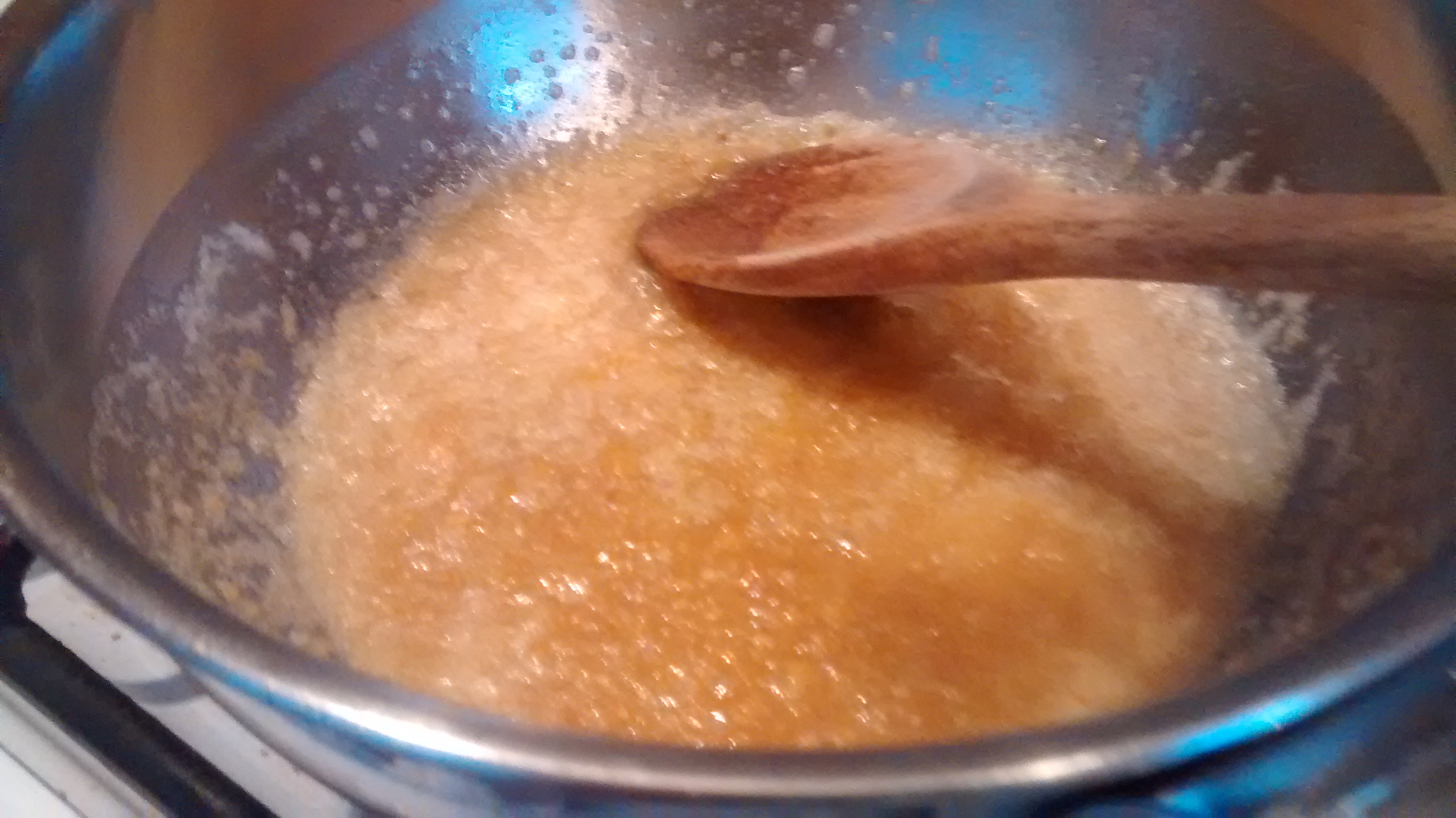
  • Stew the apples gently with some sugar and very little water. You can make this in a saucepan on the stove or place the apples and sugar in a dish in the oven.
  • Do not add a lot of sugar at the beginning as it does not want to be too sweet, you can adjust the sweetness at the end.
  • Do not make it too much of a purée, cook so that you have some soft apples but with some harder less cooked chunks as well.
  • Leave the mixture to cool and then add the ground cinnamon.  The mixture should look quite brown.

IMG_20151214_161143925

Note

When I have lots of apples, I cook a large amount and portion this up and keep them in the freezer – better to leave out the cinnamon if freezing and add this fresh when making the cake.

Cake – Ingredients

  • 300g self-raising flour
  • 200g butter
  • 75g caster sugar
  • 1 egg yolk (save the white for the topping)
  • 2 to 3 tablespoons of lemon juice or water

    Method

  • You need a round tin with a loose base or a spring form tin or you will not be able to get the cake out.  I always use an anodised aluminium tin, 22cm in diameter and 8 cm deep, which does not rust.
  • Grease the tin well.
  • Rub the butter into the flour to make fine crumbs and add the sugar.

IMG_20151214_162018319


  • Add the egg yolk and the lemon juice to and mix together to make a soft “dough” (try not to add more flour),  handle it as little as possible.
  • Leave it to chill for about ½ an hour as this makes it easier to handle.
  • Pre heat the oven to GM5 – 190oC.
  • Take slightly more than half the dough and press it into the cake tin.
    IMG_20151214_162527127


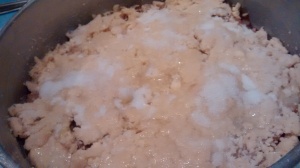
  • Spoon the apple mixture on top of this.
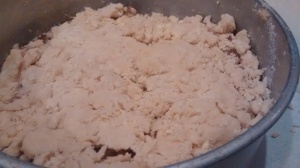
  • The rest of the dough will go on top of the apple mixture.
  • I use a rolling pin to make a circle that is smaller than the tin diameter and then place this on top.
  • Do not worry if the dough falls apart, just place it on with the breaks nearly touching.
IMG_20151214_162724024


Topping – Ingredients

  • 1 egg white and caster sugar
  • Slightly beat the egg white with a fork and brush this over the top of the dough.  You will not need it all.


IMG_20151218_075301762


IMG_20151214_162841673


  • Liberally sprinkle caster sugar over the egg white.
  • Bake for around 50 minutes until the top is a golden brown.
  • I tend to check the cake at 40 minutes and will cover the top with greaseproof if it starts to brown but is not yet cooked through.
  • Leave to cool before getting the cake out of the tin.
  • I use a tin can and put the cake tin on this and slide the side of the cake tin down.
  • Do not put the cake in a air-tight covered container as the apples absorb moisture and you loose the crispness of the cake.
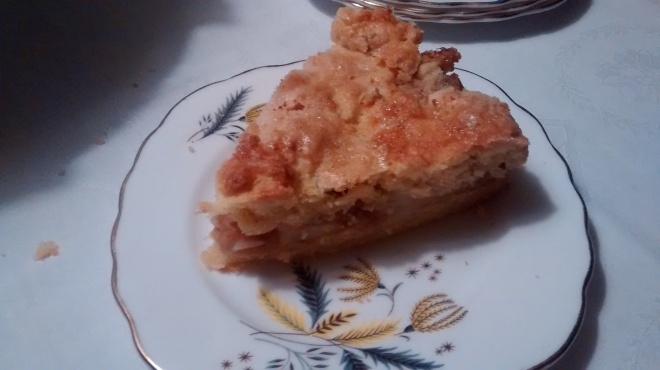
  • I hardly ever have any left anyway as I seem to get visitors as soon as they know I am baking this cake.
IMG_20151214_193025987

Tea plates are Stardust by Colclough from the 1950s or early 1960s.

NoteI updated this in March 2020 – I altered the amount of apples in the filling.

Babka – Polish Cake – Using Potato Flour

Potato flour is used in many Polish recipes for a variety of cakes.

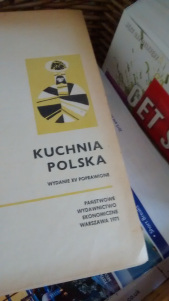
This recipe is for a babka (click here for earlier post) using a mixture of wheat flour and potato flour and is adapted from a recipe in my old Polish cookery book.

IMG_20160130_192651306

Kuchnia Polska - Polish Kitchen or Polish Cookery
Kuchnia Polska – Polish Kitchen  – Polish Cookery


In the past potato flour was hard to find in England but now you should be able to find it in most Polish shops.

IMG_20151126_161842176
Potato Flour

One of my Polish friends in England said she had tried using cornflour in baking when she could not get  potato flour but she did not think it gave as good results.

Recently in a repeated radio programme on BBC Radio 4 Extra I heard the late Marguerite Patten  say  that cooks in Victorian England  used potato flour in cake baking on a regular basis.

 Ingredients

150g plain flour

1 teaspoon baking powder

100g potato flour

200g butter or block margarine

4 eggs separated

200g icing sugar

Zest of 1 lemon

Juice of 1/2 a lemon

3 to 4 tablespoons of  soured cream or yoghurt – Full Fat-Greek style or home-made Yoghurt – click for earlier post)

(I have made this recipe with soured cream and then with my own yoghurt – both turned our super)

IMG_20150707_200527058

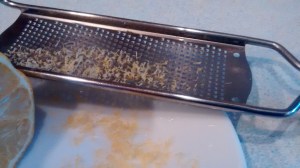
Fine Grater – Microplane Graters are Super For Lemon Zest.

Microplane Professional Series

Method

Grease and flour a large babka tin.

IMG_20151210_071931092

Pre-heat the oven to GM4 – 180°C

Mix the flours together with the baking powder and leave to one side.

In a large bowl, cream the butter and the icing sugar until the mixture is pale and fluffy.

Beat in the egg yolks – one by one.

Then beat in the lemon zest and juice.

In a separate bowl beat the eggs white until they are stiff.

Fold the egg whites into the creamed mixture.

Gently fold the whites in the flour mixture.

Place the mixture into the prepared babka tin.

Place the tin in the centre of the oven and bake for around 30 – 40 minutes.

Check with a cake tester.

Remove from the oven and let the cake cool a little.

IMG_20150902_131105650


IMG_20150902_131036540


When cooled –  remove carefully from the tin – this is easiest when the cake is nearly cold.

Dust the cake with icing sugar or pour over it a runny icing glaze.


IMG_20150902_165350657 IMG_20150902_165339825

IMG_20150902_165420273

IMG_20150902_165334611
Silver Rose – Duchess 1950s & 1960s


Instructions for those who do not have a babka tin

At the moment (February 2016) Marks & Spencer are selling babka tins at a reasonable price – I bought one to add to my collection!

IMG_20151210_071926550
Tin from Marks & Spencer

However if you do not want to go to the expensive but want to try out the cake I have made the cake using 2 types of loaf tins with good results

IMG_20160222_085342694


First using a long narrow tin

IMG_20160222_085422673


and secondly a 2lb loaf tin.

IMG_20160222_085433454


You need to grease and line the tins or use loaf tin liners – I discovered these recently and think they are a boon. You can get them in 2 loaf sizes.  They are available in many stores but also you should also be able to find them in the cheaper discount stores.

IMG_20151120_073255217


IMG_20150907_100000771

The cake takes 40 -45 minutes in a pre-heated oven at GM4 – 180°C

IMG_20150907_111020286

IMG_20150907_111214502

Dust the top with icing sugar

IMG_20150907_165858105

IMG_20150907_165908046

IMG_20150907_170256852 IMG_20150907_170224421


Colclough Longton Bone China ..... Around 1930s
Colclough Longton Bone China …..
Around 1930s


How Did My Sponge Become Sandy?

In Polish the word for a fat free sponge cake which is made with just eggs, sugar and flour is  biszkopt.

A sponge cake which uses butter or margarine which is creamed with the sugar is described as piaskowy – this adjective means sandy – hence the title of this post!

I have not managed to find an explanation as to why it is so described  but have found this term in all my Polish cookery books.

Pani Stasia’s Sponge Cake

This is a recipe which I learnt from my mother’s friend who we knew as pani Stasia*.

Pani Stasia made wonderful cakes but unfortunately I did not write many of them down – however I did for this one and it is the basis for many of my other cakes and buns.

This recipe is equivalent to the British cake –  Victoria Sponge – named after Queen Victoria in whose reign this became popular & who is said to have liked this cake very much.

Having been looking at recipes in my Polish cookery cooks I realise that pani Stasia adapted this recipe for England as self raising flour and caster sugar are not found in Polish shops.

(*Pani  translates as Madam, Lady or Mrs and is a polite form of address – it is like donna in Italian or for example  saying Miss Mary in the Southern States of America.

Stasia is the shortened form of the Polish name Stanisława. (The feminine form of Stanisław)

St Stanisław is the patron saint  of Kraków & Poland, he was a martyr, murdered by the Polish king Bolesław II the Bold in 1079 – a story which has much in common with St Thomas à Beckett and the English king Henry II  in 1170).

Ingredients

Eggs

Butter or Block Baking Margarine

Caster Sugar

Self Raising Flour

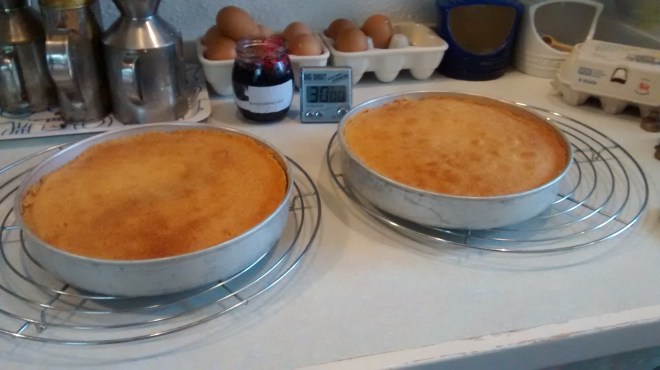
I usually use 3 or 4 eggs for this recipe – in the photographs below I have used 4 eggs to make 2 cakes which were then sandwiched together with jam and white chocolate butter cream.

IMG_20150805_064443123

Method

Grease and line the base of 2 x 21.5cm  sandwich tins. – I find anodised aluminium tins are the best. (my old tins say 8 1/2 inch on the base – 21cm or 22cm would be OK)

Pre-heat the oven to GM 4 – 180°c

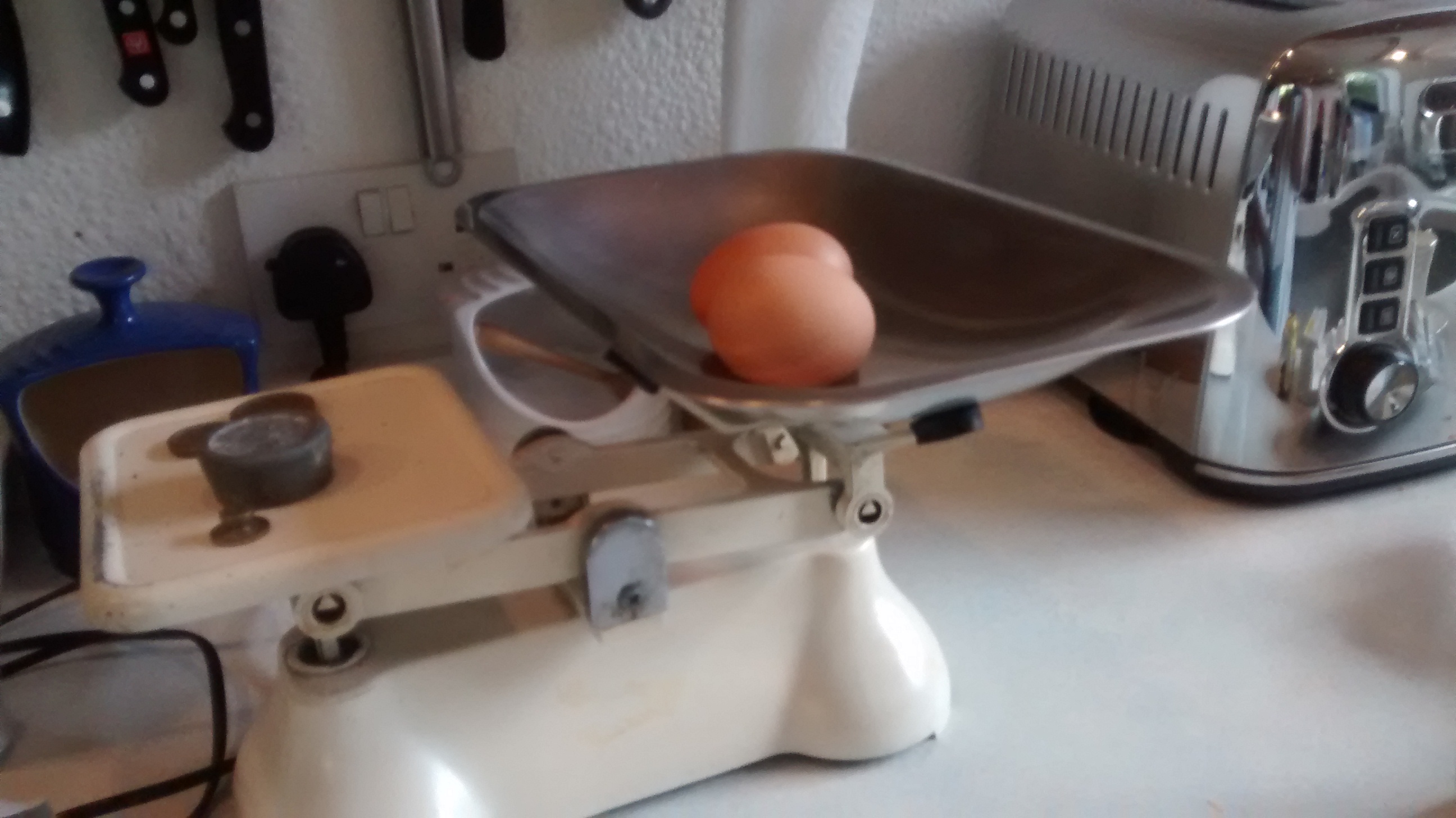
The first thing you have to do is weigh your eggs – complete with their shells.

Weighing Eggs

You then weigh out the same amount of  butter or block margarine, caster sugar and self raising flour.

At first I thought this was very strange but now find that it gives a very good way of getting the right proportions no matter what size the eggs are.

I heard the late Marguerite Patten in an earlier recorded programme on the radio a few weeks ago saying that Victorian cooks often  used this method. 

Cream together the butter and sugar until it is light and fluffy.

Add the eggs, one by one whisking again until the the mixture is light and fluffy again.

Fold in the flour with a metal spoon taking not to over mix the mixture and knock out all the air.

Divide the mixture evenly between the 2 prepared tins.

Bake in the centre of the oven for around 25 to 30 minutes  – the cake should  be golden brown and be clean when a cake tester is used.

IMG_20150804_180730655
Cakes cooling awaiting being sandwiched together

This cake is very versatile and here I have sandwiched it together with blackcurrant jam (given to me by my friend who had made it with fruit from her allotment) and white chocolate butter cream.

Sweet whipped cream is not found in Polish cookery – butter creams and similar are the standard fillings for layer cakes.

On the bottom cake first spread on the jam and then top this with the butter cream.

IMG_20150804_202127960

This butter cream is sweet and needs the contrast of a tart jam, damson jam would be another alternative.

White Chocolate Butter Cream

Ingredients

60g White chocolate

40g Butter – unsalted is best

80g Sieved  icing sugar

 Method

Melt the white chocolate in a glass bowl over a pan of hot water and allow to cool.

Cream the  butter and the icing sugar.

Beat in the cooled, melted chocolate.

Note

Take care  –  if the melted chocolate  is too hot then you will end up having to add more icing sugar and the  butter cream will be very sweet.

Dust the finished cake with icing sugar.

IMG_20150804_202910179

IMG_20150804_202121082

IMG_20150804_202846103
Plates are Burleigh Ware – Burges & Leigh Ltd —– Blue Mist around 1930s


IMG_20150805_064428554


IMG_20150805_065802235

IMG_20150805_065810762


Makowiec – Roasted Poppy Seed Cake

I came across this recipe recently using roasted poppy seeds which give a slightly nutty flavour to the cake.

The cake part is the same as a previous poppy seed cake – makowiec 4 -and uses the simple all in one method using soft tub margarine.

Here roasted poppy seeds are used and lemon rind is not, nor is there a lemon glaze.

Roasting Poppy Seeds

100g of poppy seeds are used in this recipe.

Poppy seeds

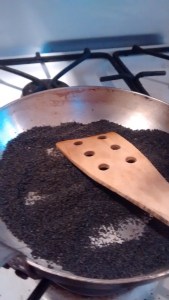
Use a small frying pan without any oil or butter.

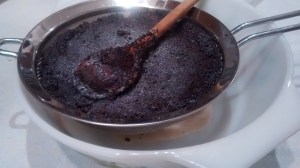
Add the poppy seeds to the pan and heat gently for around 5 minutes, stirring the seeds with a wooden spatulas and do not let them burn.

IMG_20151120_073217178

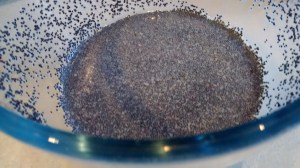
Pour some milk into a jug or bowl and tip the roasted poppy seeds into the milk.

IMG_20151124_133153136

When the poppy seeds have cooled, tip then into a sieve and let them drain away until they are dry.  You can press them with a spoon to speed up the process.

IMG_20151215_073209814(1)

The seeds need to be as dry as possible – you could do this part  several hours earlier or the night before.

This cake is a modern version as soft tub margarine is used and it is an all-in-one method which is so easy to do with an electric hand whisk.

I use either Flora original or Stork for baking – both of these have given good results.

Ingredients

100g poppy seeds – roasted

175g soft tub margarine for baking

225g self-raising flour

1 ½ teaspoons baking powder

175g caster sugar

3 eggs

3 tablespoon milk (full fat or semi-skimmed)

Method

Pre heat the oven to Gas mark 4 – 1800C.

Make this as a tray bake in a tin about 31×22 cm.

I have a selection of Mermaid Hard Anodised rectangular baking tins and they are superb.

Grease the tin and use one piece of greaseproof paper to line the base and the two long sides of the tin.

IMG_20151120_074347436

Place all the ingredients except the poppy seeds into a large bowl and beat well for about 2 minutes until they are well blended.

Add the poppy seeds and  mix them well in.

Put the mixture into the tin and bake for about 30-35 minutes.

Leave to cool on a cooling rack and then take the cake out of the tin.

IMG_20151124_162509672

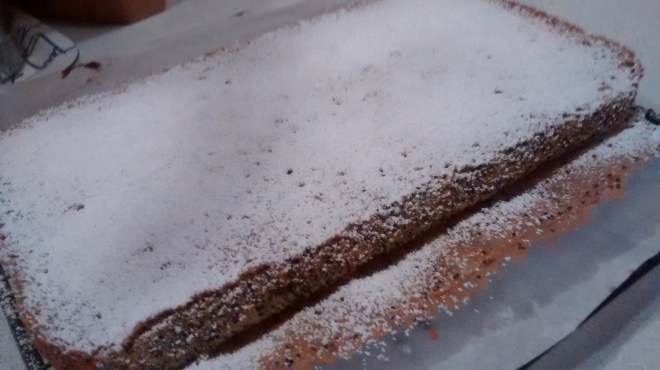
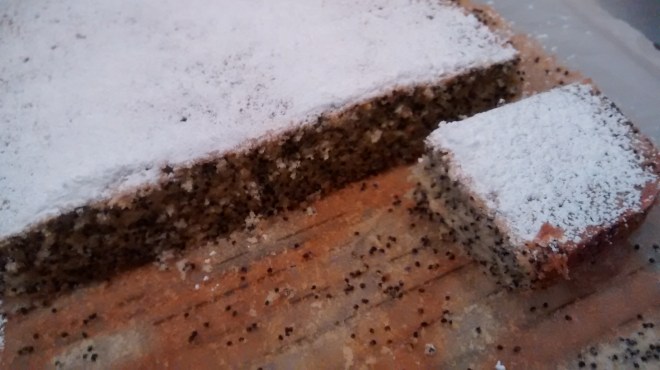
Dust with icing sugar before serving.

IMG_20151124_170307260(1)

Tea Plates  – Silver Rose by Duchess

IMG_20151124_170151987


Sauerkraut Salads

When cooking was much more seasonal this salad was extremely popular in winter when many other vegetables were unavailable.

Using bottled sauerkraut you can make this salad all year around.  You can also buy vacuum packed sauerkraut in many Polish shops.

Preparing the sauerkraut

There are two ways of preparing the sauerkraut. It all depends on the actual sauerkraut which varies with the home-made or vacuum packed  being milder usually than the bottled &  how sour you like it to be.

Sour is indeed a well loved taste in Poland and sour is a description you can apply to many Polish dishes. There will be more posts on this on the future.

These salads could be considered sweet & sour.

IMG_20150711_183051570_HDR

For all the following salads I have used roughly 200g of sauerkraut which is easily enough as a side-dish for two people.

I think all the following salads benefit from being made a few hours ahead and left to allow the flavours to interact and mellow.

Preparation Method 1

Just take some of the sauerkraut and sieve of some of the liquor.

IMG_20151126_070444950
Sieve off some of the liquor

Preparation Method 2

Put the sauerkraut into a jug or bowl and add some water to rinse off the liquor.

IMG_20151126_070120128

Use Water to Rinse the Sauerkraut

IMG_20151126_070444950
Rinse off the Water

My personal preference is to use method 1 with the sauerkraut just drained and not rinsed.

Sauerkraut & Apple Salad

Ingredients

Around 200g of Sauerkraut

1 tasty eating apple such as Jazz or Braeburn

2 to 3 tablespoons of sunflower oil

1 to 2 tablespoons of granulated sugar.

IMG_20151126_065926122

Method

Prepare the sauerkraut and put it in a dish.

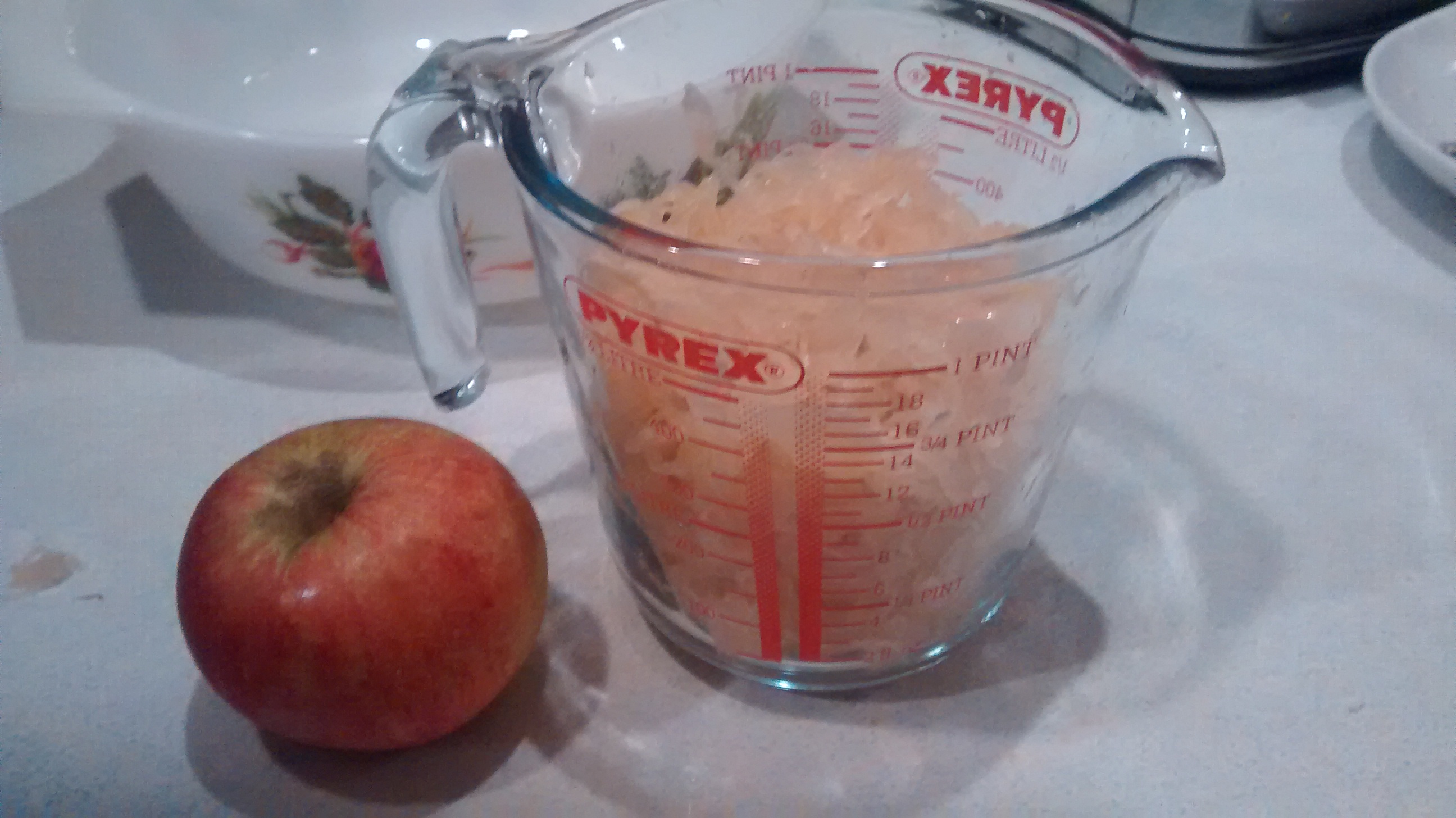
Grate the apple, skin and flesh using a coarse grater and add this to the sauerkraut. Mix the two together.

Add the sunflower oil and sugar and mix well.

Leave in a cool place for a couple of hours before serving.

IMG_20151126_071637240

Serving Dish by J & G Meakin – Topic – designed by Alan Rogers in 1967

In the restaurant in the Polish Centre in Leeds they serve a wonderful sauerkraut and carrot salad – secret recipe of course! – the following is the nearest I can get to it.

Sauerkraut & Carrot Salad 1

Ingredients

Around 200g of Sauerkraut

1 carrot

1 tasty eating apple such as Jazz or Braeburn

2 to 3 tablespoons of sunflower oil

1 to 2 tablespoons of granulated sugar.

IMG_20151125_173758445

IMG_20151126_065938397


Method

Prepare the sauerkraut and put it in a dish.

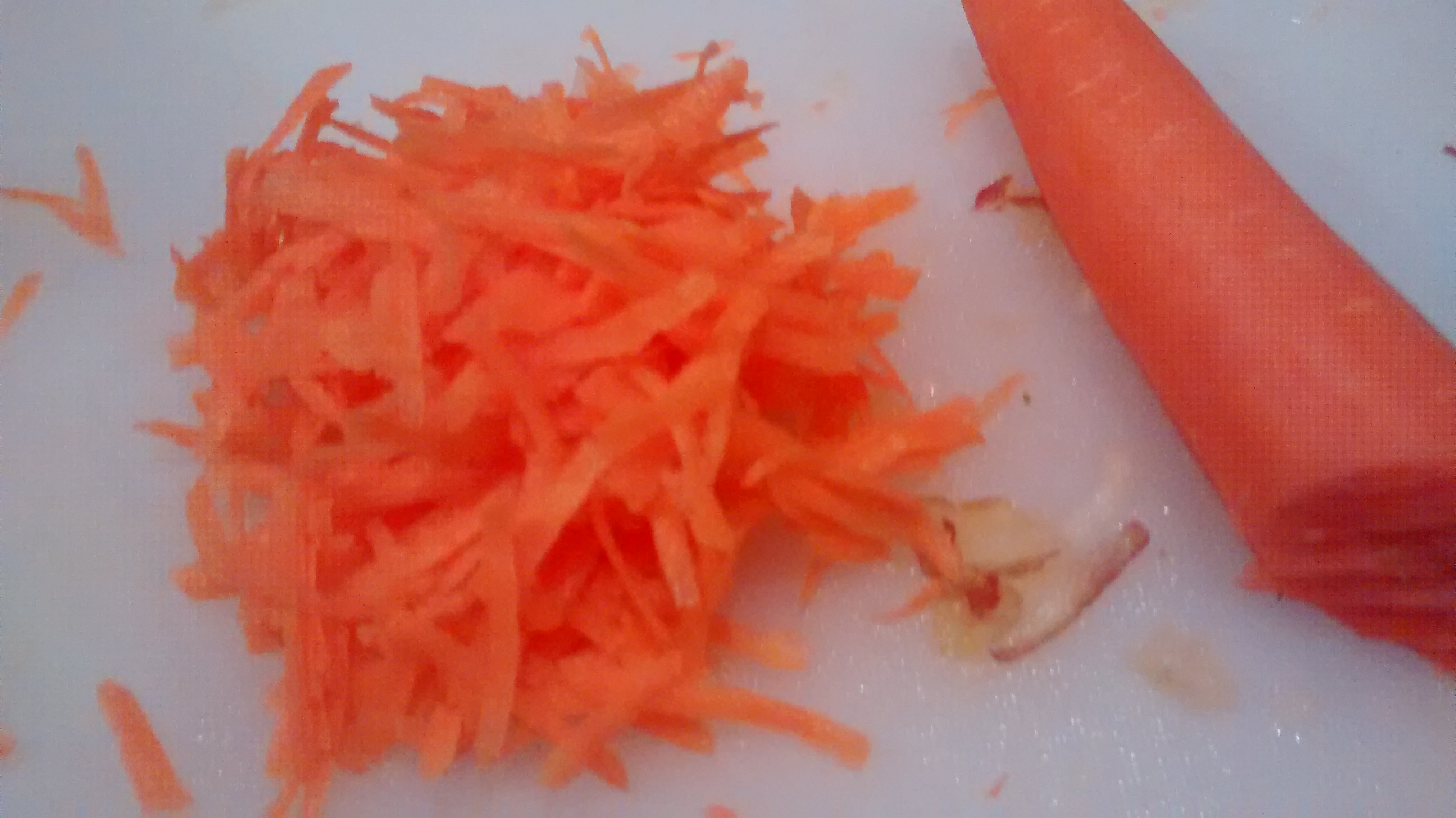
Peel and grate the carrot using a coarse grater.

IMG_20151126_071607024

Grate the apple, skin and flesh, using a coarse grate.

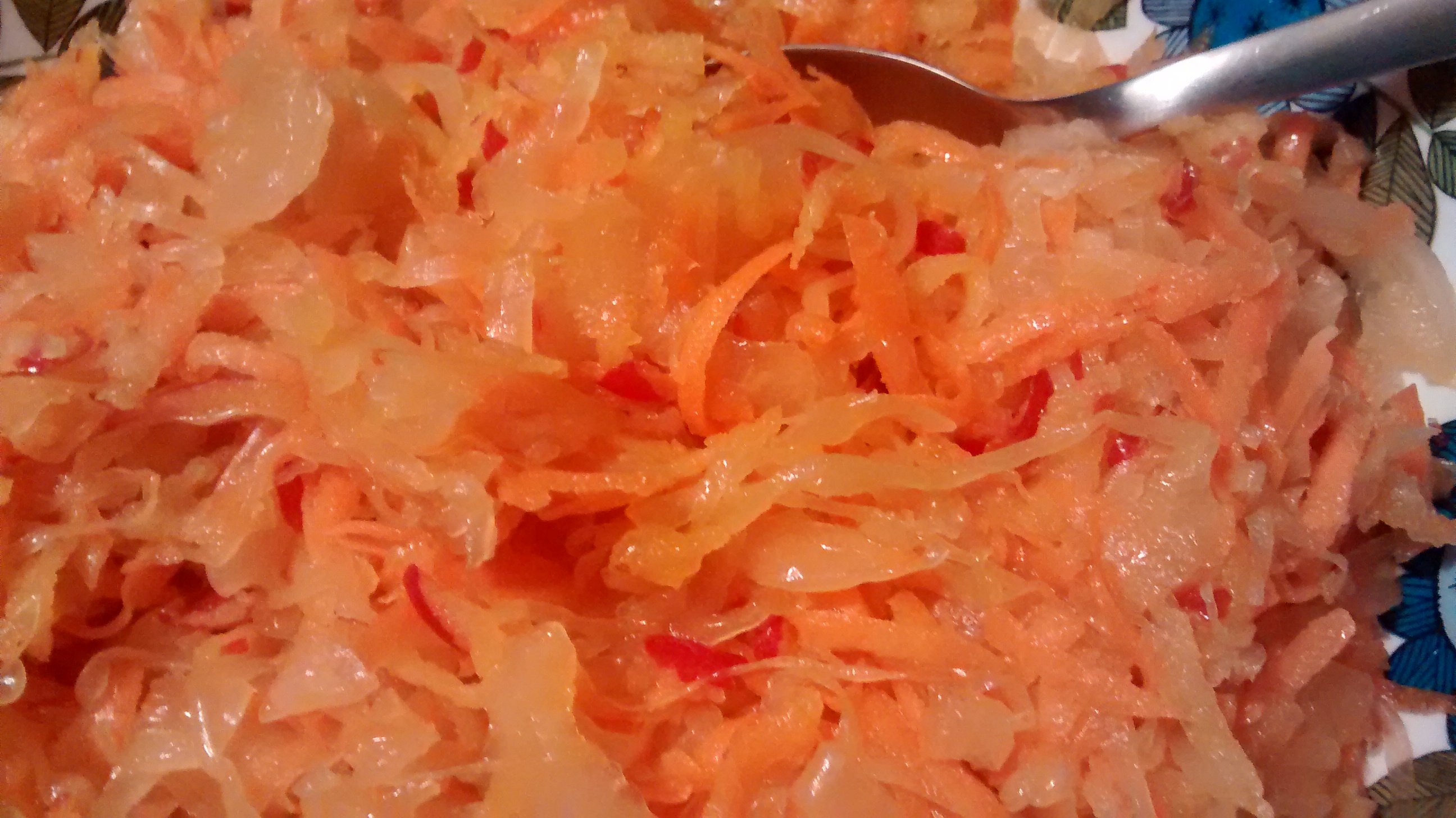
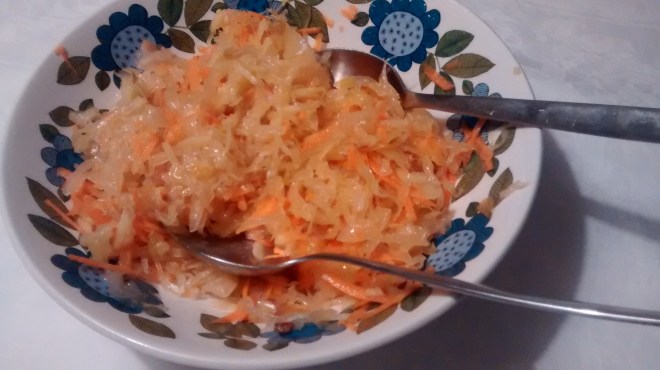
Add the grated carrot and the apple  to the sauerkraut.

Mix them all together.

Add the sunflower oil and sugar and mix well.

Leave in a cool place for a couple of hours before serving.

IMG_20151125_175325600
Mid 20th Century Pyrex Dish

IMG_20151125_180151431

IMG_20151126_072049460

Serving Dish is Carnation by Royal Doulton 1982 to 1998


IMG_20151125_183717288
Meat Loaf  and Sauerkraut & Carrot Salad


Sauerkraut & Carrot Salad 2

Ingredients (as salad 1 but less carrot)

Around 200g of Sauerkraut

Half a carrot

1 tasty eating apple such as Jazz or Braeburn

2 to 3 tablespoons of sunflower oil

1 to 2 tablespoons of granulated sugar.

Method

Prepare the sauerkraut and put it in a dish.

Peel and grate the carrot using a coarse grater.

Grate the apple, skin and flesh, using a coarse grate.

Add the grated carrot and the apple  to the sauerkraut.

Mix them all together.

Add the sunflower oil and sugar and mix well.

Leave in a cool place for a couple of hours before serving.

IMG_20151126_071833315


Tip

Once you have opened a jar of sauerkraut if you are not going to make something else with it in the next day or so you can portion it up and freeze it for later use.


Red Cabbage

A few years ago on one of my  visits to The Netherlands to stay with my Dutch friend, we had a super meal which included a delicious dish of red cabbage that had been cooked with apples.

I thought then that I did not remember my mother ever cooking red cabbage. When I came home I found recipes in both my Polish and English cookery books and tried out many of these.

The following recipe has been refined and altered and this one  with lots of apples and spices is the one  I now use all the time.

As it takes a long time to cook in a low oven or in a slow cooker, I tend to make a lot at once. It freezes and reheats well, so once made I divide it into small portions to freeze.

I think it goes well with roast pork loin and I usually make some before Christmas and serve it with roast pork loin during the holiday period.

Tip 1

Have a lemon ready after handling the chopped red cabbage as you will find your hands become stained blue/purple. Lemon juice will clear the stains away.  Another reason to make this dish in advance.

Tip 2 – Also Excellent as a Salad

I have discovered that this dish is also delicious when it is cold!   I now also serve this with cold meats and Polish style sausage.

Ingredients

  • 1 head of red cabbage
  • 3 or 4 large cooking apples
  • 1 onion – chopped fine
  • 1 or 2 garlic cloves – chopped fine (optional)
  • 6 tablespoons of soft brown sugar
  • 1 level teaspoon of ground cinnamon
  • ¼ level teaspoon of ground cloves
  • Salt & ground black pepper
  • 3 tablespoons of cider or wine vinegar
  • 3 tablespoons of water

IMG_20151206_091850279

Method

  • Pre heat the oven to GM 2 or get your slow cooker ready..
  • You need a large oven-proof dish with a lid to make this.  I either use a very large oval enamel dish or I have now started to use a slow cooker.
  • I mix the ingredients in a large bowl first  and then put them in the cooking dish.
  • Mix together the sugar, spices, salt and pepper, vinegar and water.

IMG_20151206_074532421

  • Remove the core from the cabbage head and cut the cabbage into fine shreds and add these to the spice mixture.

IMG_20151206_075201568

IMG_20151206_094337683

  • Peel, core  and then coarse grate the apples and then add these to the cabbage mixture. Mix the ingredients with a wooden spoon.

IMG_20151206_100124343

  • Put the mixture into the cooking dish (or slow cooker) and put in the oven (or switch on the slow cooker).

IMG_20151206_100200501

  • It should take about  3-4 hours  – it may take longer in the slow cooker.
IMG_20151206_165436551
Red Cabbage Ready to Serve
IMG_20151206_165429509
Serving Dish is Cadiz by Meakin from the 1970s

IMG_20151206_165348782

Miodownik – Piernik – Honey Spice Cake

Miód is the Polish word for honey and so Miodownik is a Honey Cake which usually contains spices. Pierna is an old Polish word for spices and so Piernik is also a Honey Spice Cake.

Some sources say the name is from pieprz – pepper or piorun – thunderbolt or devil – because of its spiciness.

These cakes have been known in Poland since the 12th century and the  spices would have come from Turkey (originally brought back by the crusaders) or India.

Honey was the original sweetener, long before sugar and there are many traditional recipes that use honey not only in cakes, but also in meat dishes.

When you travel in Poland you will find many village ladies selling their own honey, the taste varies greatly depending on where the bees have found their flowers and the honey from a forest region is dark and very flavoursome.

Piernik  can vary  from a soft dense cake to a drier but soft biscuit.

The Polish town of  Toruń is famous for its piernik and  Chopin was very found of this.

Pierniki(plural) coated with chocolate are called Katarzynki –  which means Katherine’s cakes – named after Katarzyna the daughter of one of the bakers.

Similar cakes are found throughout Europe including the French pain d’éspices, the Dutch peperkoek and the German lebkuchen.

Miodownik  and piernik are often translated as  Gingerbread but ginger is a spice rarely used in Polish cookery.

The main spices used are cinnamon and cloves with the addition according to different recipes of cardamon, black pepper, caraway, nutmeg, dried orange and/or lemon peel and then in later recipes allspice which is from the New World.

My older recipe book gives the proportions for mixing spices and there is one with black pepper which I intend to try out in the future.

Whilst looking through some of my more recent cookery books it would appear that it in Poland you can buy ready mixed spices for piernik so I would presume you can get these in Polish shops in England. I will try these out in the future as well.

IMG_20151201_074250058

I use the mixed spice mixture which is sold by Marks & Spencer which contains: dried orange peel, cassia (a variety of cinnamon), ginger, nutmeg, pimento (allspice) and caraway. I think it is the dried orange peel which makes it much nicer than other mixtures I have used.

Some recipes make a cake mixture and then leave it in a cool place for up to several weeks before baking it. I have tried one of these out many years ago and it was very good – I intend to try this again for a post in the early winter of next year.

Piernik in Poland is associated with the Christmas season and would be made for Christmas Eve and for Christmas Day, it would also be made for Święty MikołajDecember 6thSt Nicholas Day. This a day for present giving in Poland to children and I would always get a piernik shaped and decorated to look like the bishop that was St Nicholas.

Mama’s Miodownik

This is of my mother’s recipes and it uses sunflower oil which is a more recent addition to recipes in Polish cookery. It is a dense cake which is lovely and moist and improves with keeping.
IMG_20151130_200822771
Miodownik on Greenway Hostess designed by John Russell 1960 – 1979

IMG_20151130_200807367

Ingredients

  • 450g Clear honey
  • 250g Icing sugar
  • 4 Eggs separated
  • 250ml Tepid water
  • 4 Teaspoons cocoa
  • 250ml Sunflower oil
  • 450g Plain flour
  • Pinch of salt
  • 1 Teaspoon of bicarbonate of soda
  • 1 Teaspoon mixed spice (M&S is the best)
  • 100g mixed peel

Method

  • You can use a 25cm square tin or a 31cm x21cm rectangular tray tin.
  • Grease and line the tin.
  • Pre-heat the oven to Gas Mark 3 – 160º C.
  • In a large bowl, mix the honey and the icing sugar.

IMG_20151130_131702777

  • Add the water, cocoa, egg yolks, oil and then the mixed peel.

IMG_20151130_133606304

IMG_20151130_131717961

  • In a separate bowl mix the plain flour, salt, bicarbonate of soda and the mixed spice.
  • Add the dry mixture to the honey mixture and mix together to make a batter.

IMG_20151130_133902769

  • Whisk the egg whites until they are stiff and fold these into the honey batter.
  • Pour the mixture into the prepared tin.

20171210_114404

IMG_20151130_134205301_HDR

  • Bake on the middle shelf of the oven for around  1hour 30minutes.
  • Take care as this has a tendency to burn  at the top, you might need to cover it after about 1 hour with a piece of greaseproof paper of aluminium foil.
  • Test to make sure it is cooked through with a fine cake tester.
  • Leave to cool in the tin.

20171210_150710


IMG_20151130_200430576

 IMG_20151130_201135944_HDR

 Store in an airtight container or cover in aluminium foil

IMG_20151130_200807367

Miodownik on Greenway Hostess designed by John Russell 1960 – 1979

Addendum

I recently made this for Wigilia (Christmas Eve) around 3 weeks beforehand – it was lovely and moist by then.


Carrot and Apple Salad

When cooking was more seasonal, this was a very popular salad in the late summer and autumn after the apple harvest.

Nowadays with better storage methods, this is a salad you can make all year round.

IMG_20151105_170540010
Serving Dish is Royal Doulton, Carnation 1982 – 1998

The following will make enough for 2 people as a side dish  – use the ratio of 2 to 3 carrots to 1 small or medium eating apple if you want to make more.

Organic carrots may have the edge here for taste but regular ones will still be good.

Use sweet and tasty eating apples such as: Jazz, Pink Lady or Cox’s orange pippins.

IMG_20151105_165014343

Ingredients

2 carrots

1 eating apple

1 tablespoon of granulated sugar

Juice of half a lemon

IMG_20151105_165002452

Method

Peel the carrots and grate them using a coarse grater into a bowl.

IMG_20151105_165441999

Cut the apple into quarters and remove the seed case.

Hold the apple by the skin and grate the flesh,

also using the coarse grater,  into the bowl.

Discard the apple skin.

Sprinkle the mixture with the sugar and add the lemon juice.

IMG_20151105_170519009

Mix everything together, place into a serving dish and serve.

IMG_20151105_170511663

Note

If you do not have any apples then just carrots with the sugar and lemon juice are also good.

à la Polonaise

Polish Style

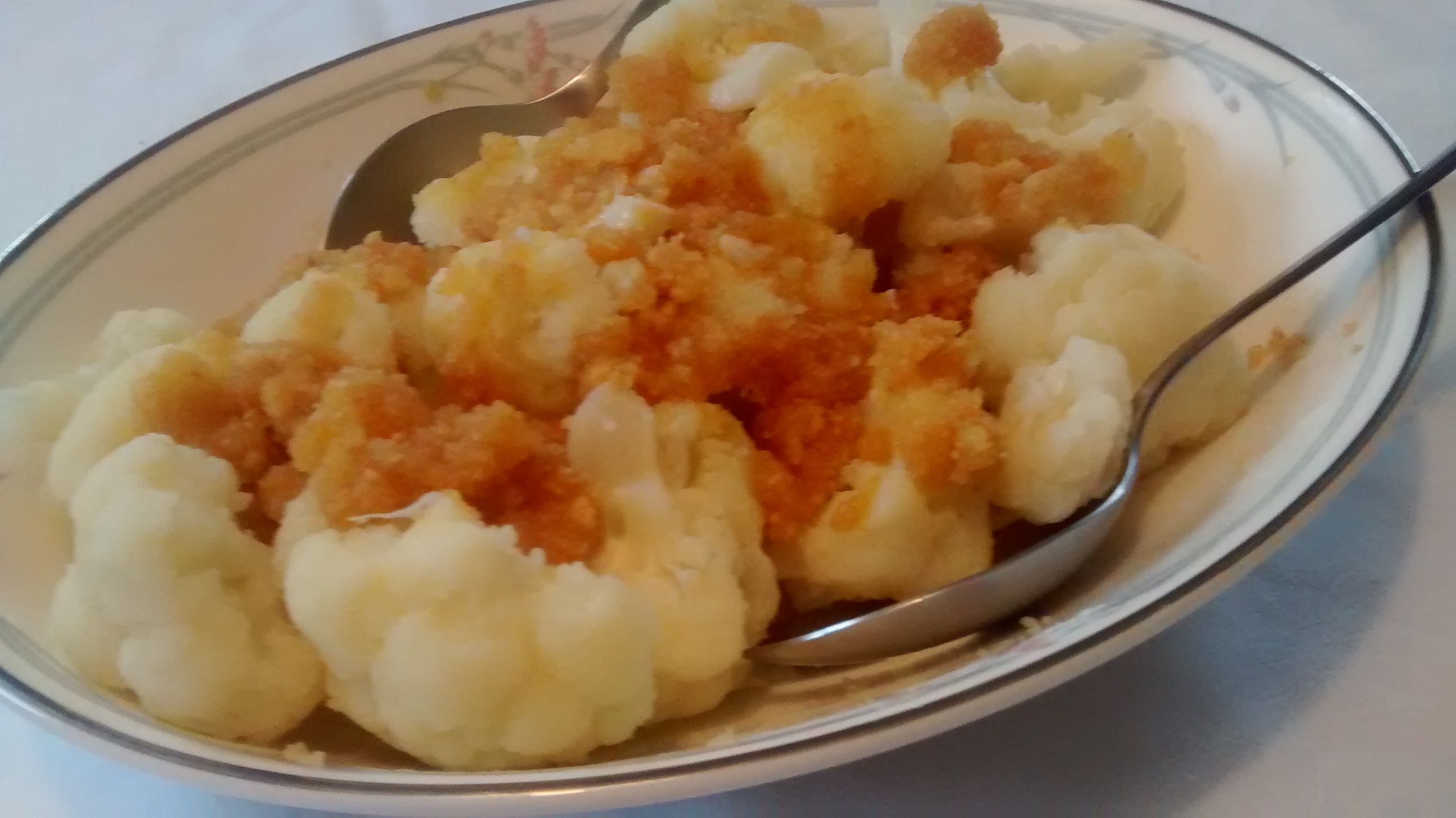
I was well into my 20s before I realised that there was a special French culinary phrase to describe, what to me, was just the regular topping that my mother and aunties put onto certain cooked vegetables.

Within my family I had never been served cauliflower, Brussels sprouts  or whole green beans without a lovely crispy buttery breadcrumb mixture.

I have not discovered when this term was first used in France but some sources think it might have come into use in the early part of the 19th century when many Polish political émigrés came to France and in particular Paris.

Method for the Vegetables

Cook your cauliflower, Brussels sprouts or whole green bean in whatever way you like best.

You can if you wish cook the cauliflower whole – this can have quite a good effect when served.

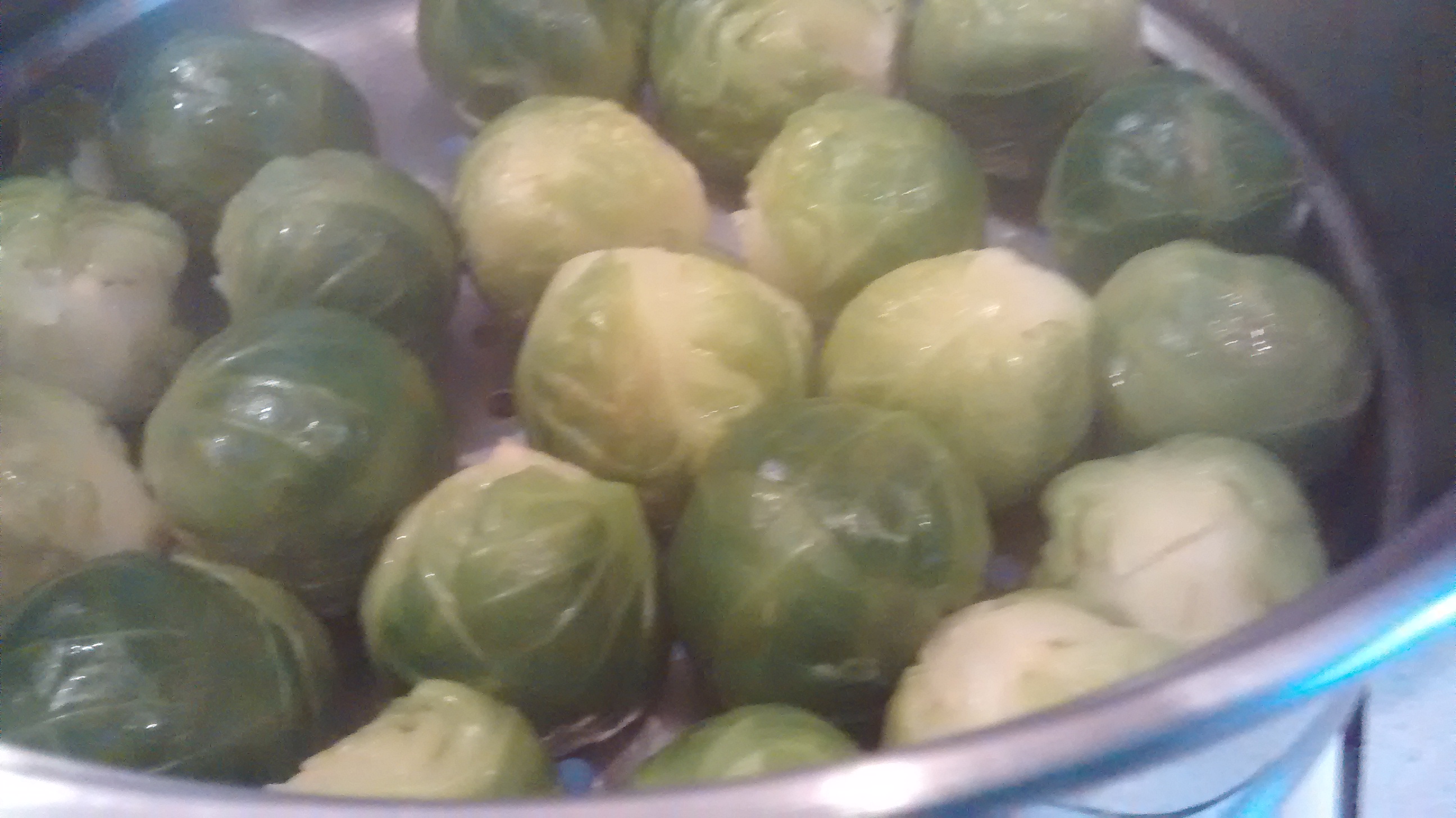
I like to steam the vegetables as I find I can get them just right – cooked – but still with a bit of bite this way.

IMG_20151107_162341255(1)
Steamed Brussels Sprouts

Place the cooked (and drained if necessary) vegetables in a serving dish.

Pour the buttery topping over the vegetables.

You will get a buttery crunchy taste which is a contrast to the vegetables.

Method for the  à la Polonaise topping

IMG_20150817_175613101
Butter & Breadcrumbs
IMG_20150917_100045291
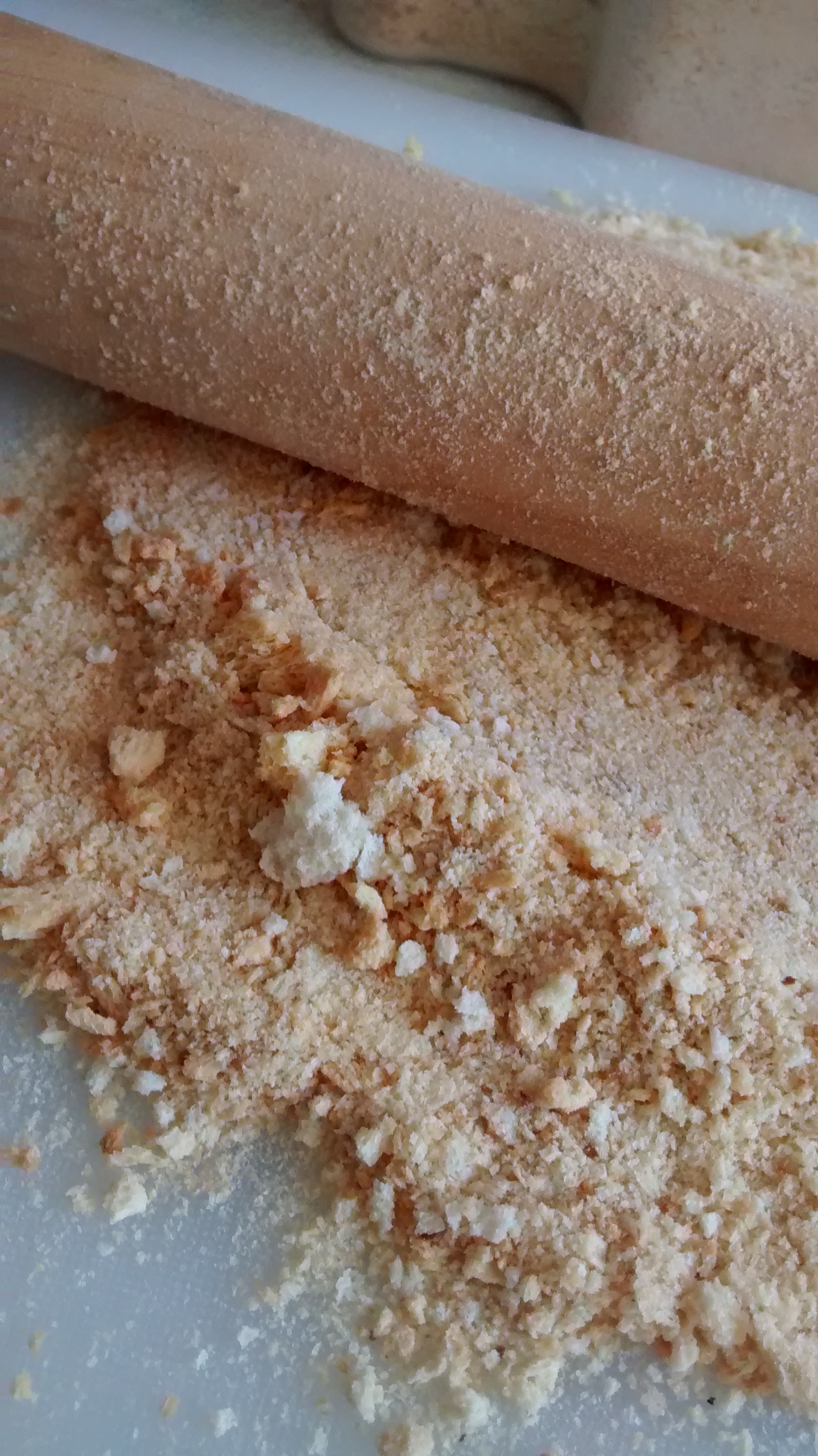
Preparing the Breadcrumbs


The topping is made by melting in a saucepan 2 to 3 tablespoonfuls of butter.

(If you use unsalted butter then add a pinch or two of salt)

IMG_20151103_130608867
Melting the Butter


Add to this around 2 tablespoonfuls of dried breadcrumbs and keep on the heat and stir for a few minutes.

IMG_20150917_100045291
Preparing the Breadcrumbs
IMG_20151107_162253272
Butter & Breadcrumbs


Pour the buttery mix over the vegetables.

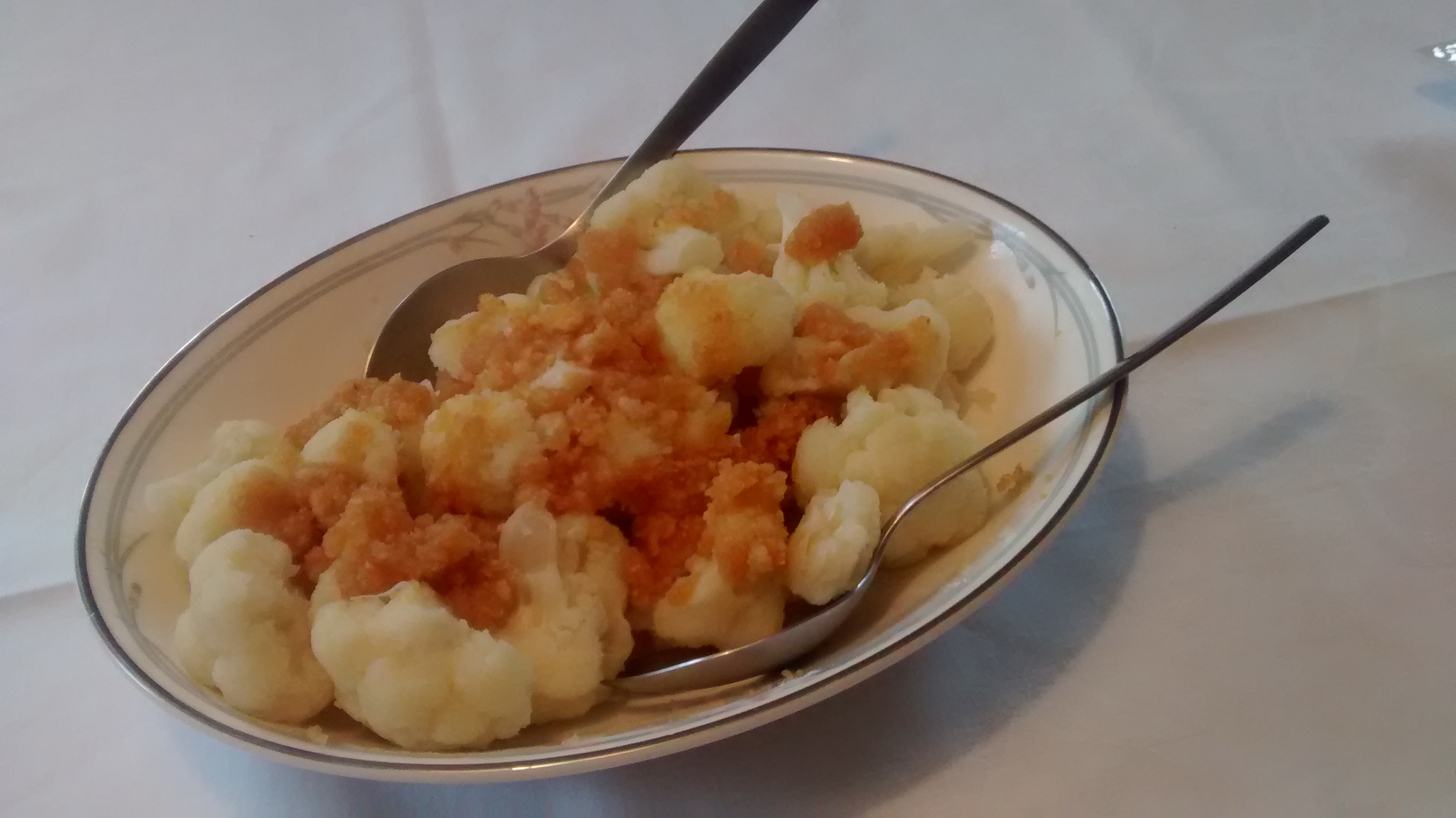
Cauliflower à la Polonaise – served in a Royal Doulton serving dish. The pattern is Carnation produced from 1982 to 1998.

IMG_20150817_180508527

IMG_20150817_180458373

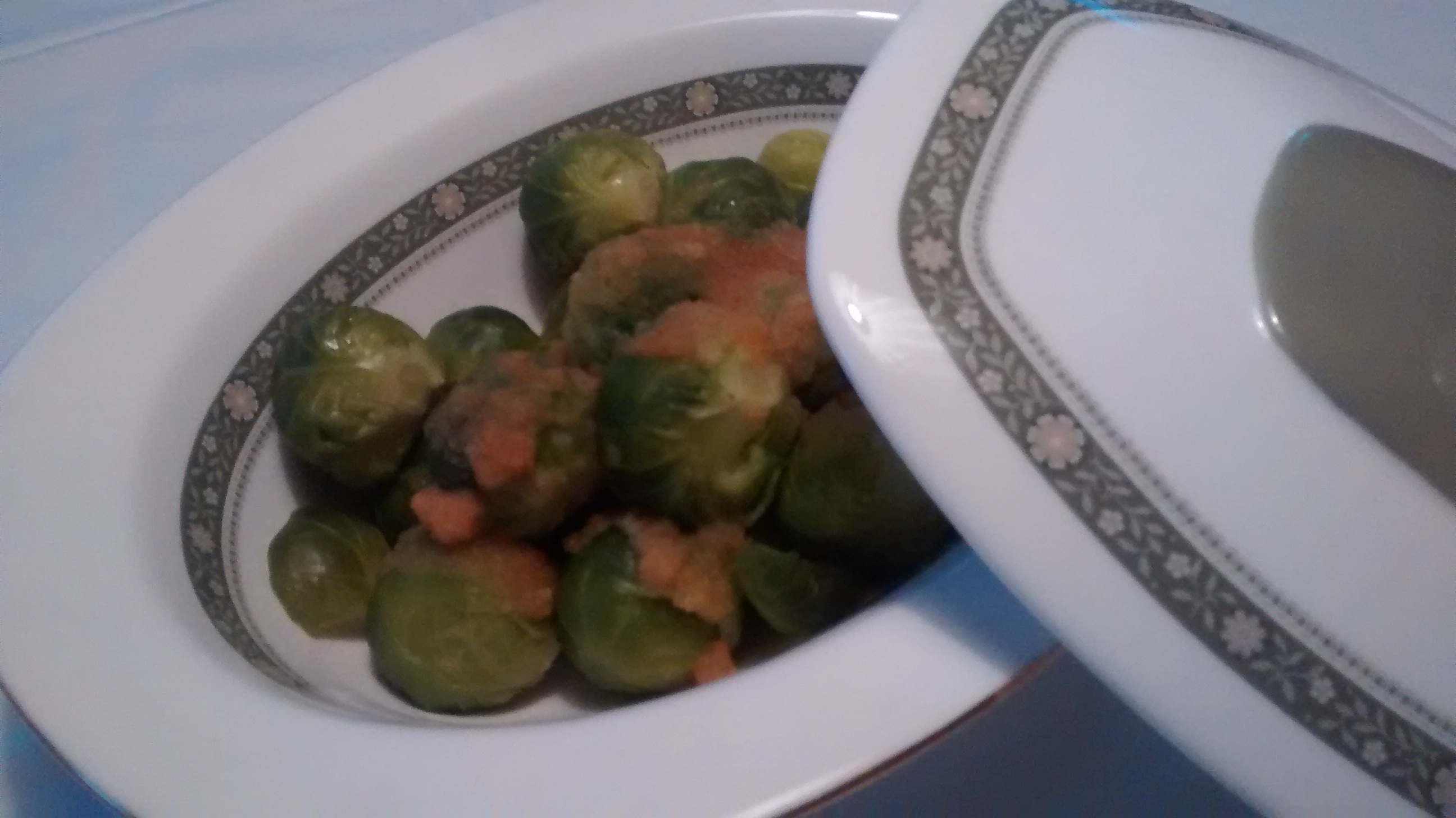
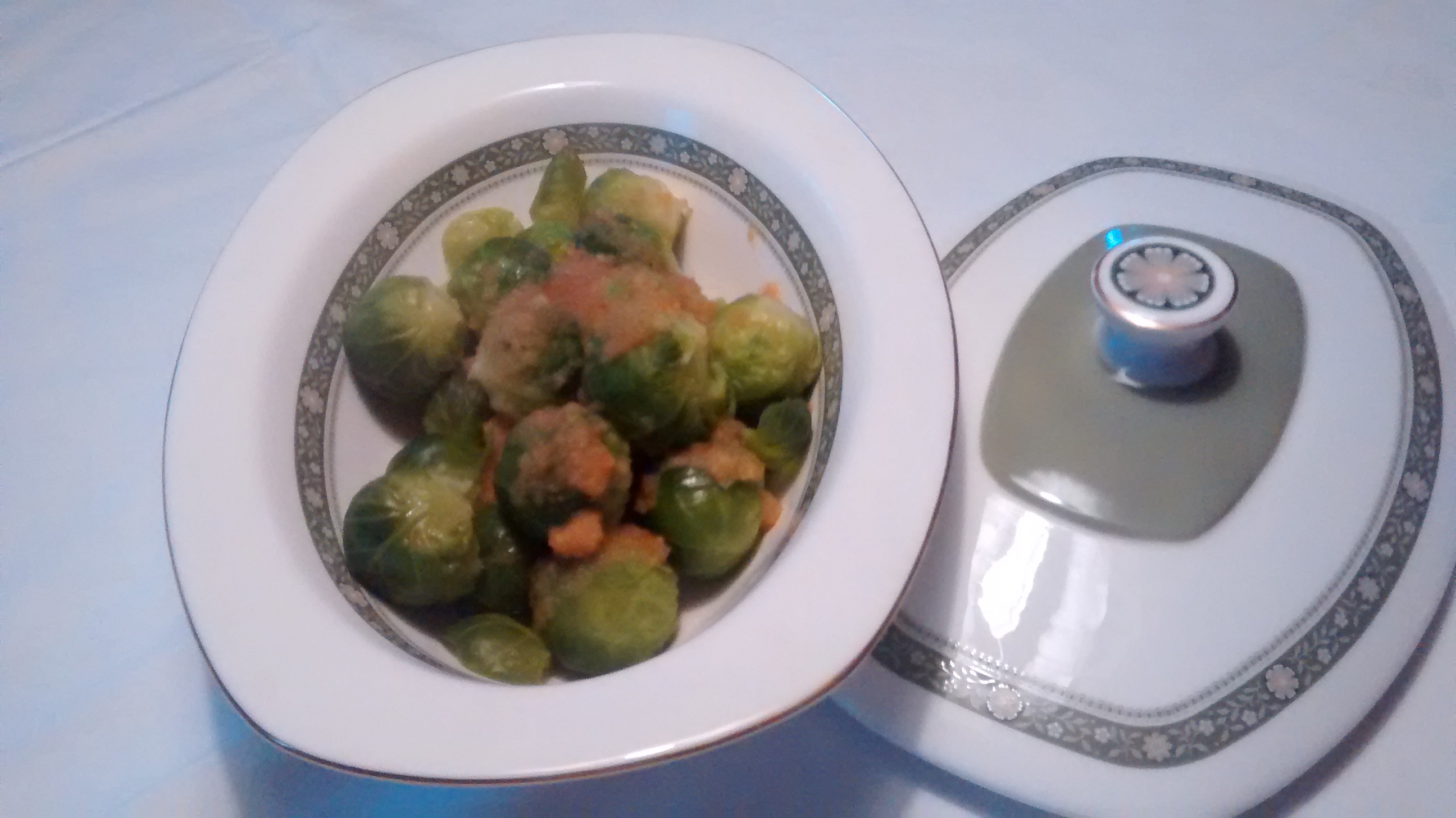
Brussels Sprouts à la Polonaise – served in a Royal Doulton serving dish. The pattern is Roundelay produced from 1970 to 1997.

IMG_20151107_162502658

IMG_20151107_162635204

IMG_20151107_162553021

IMG_20151107_161529233
Royal Doulton – Roundelay

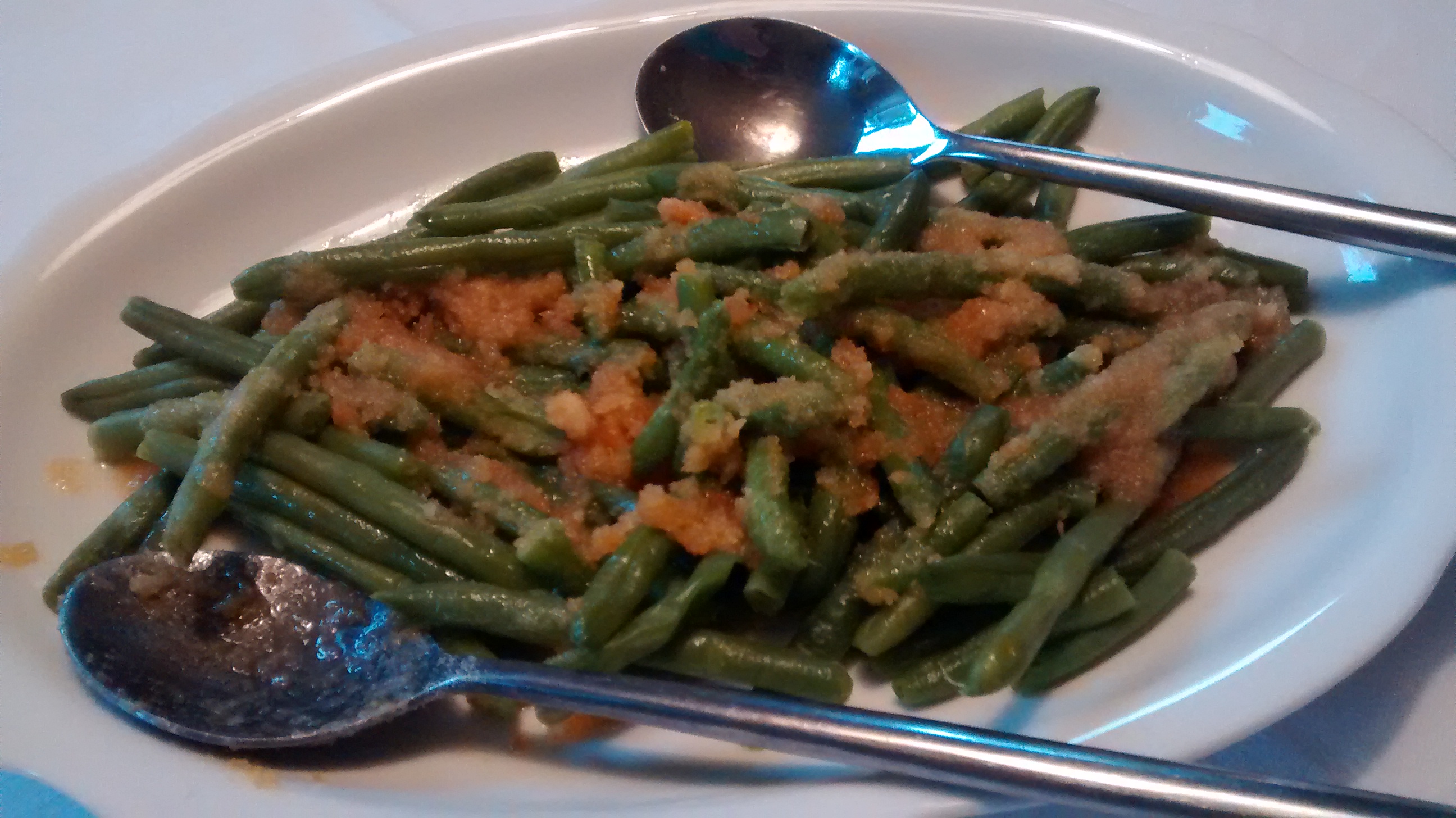
Whole green beans à la Polonaise

IMG_20151103_131204846

IMG_20151103_131159481

Added Note

IMG_20150902_161945936

IMG_20150902_161243414

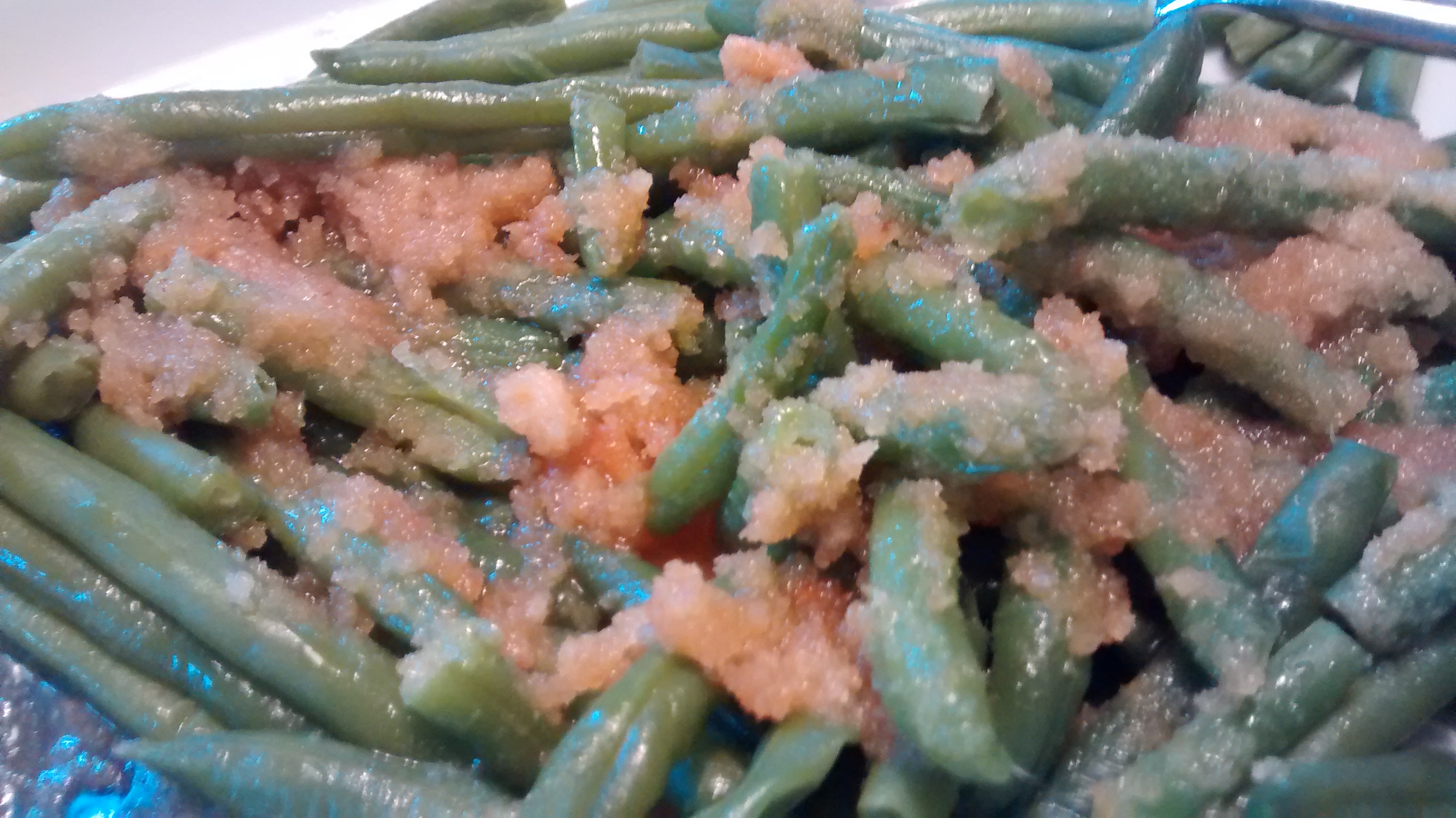
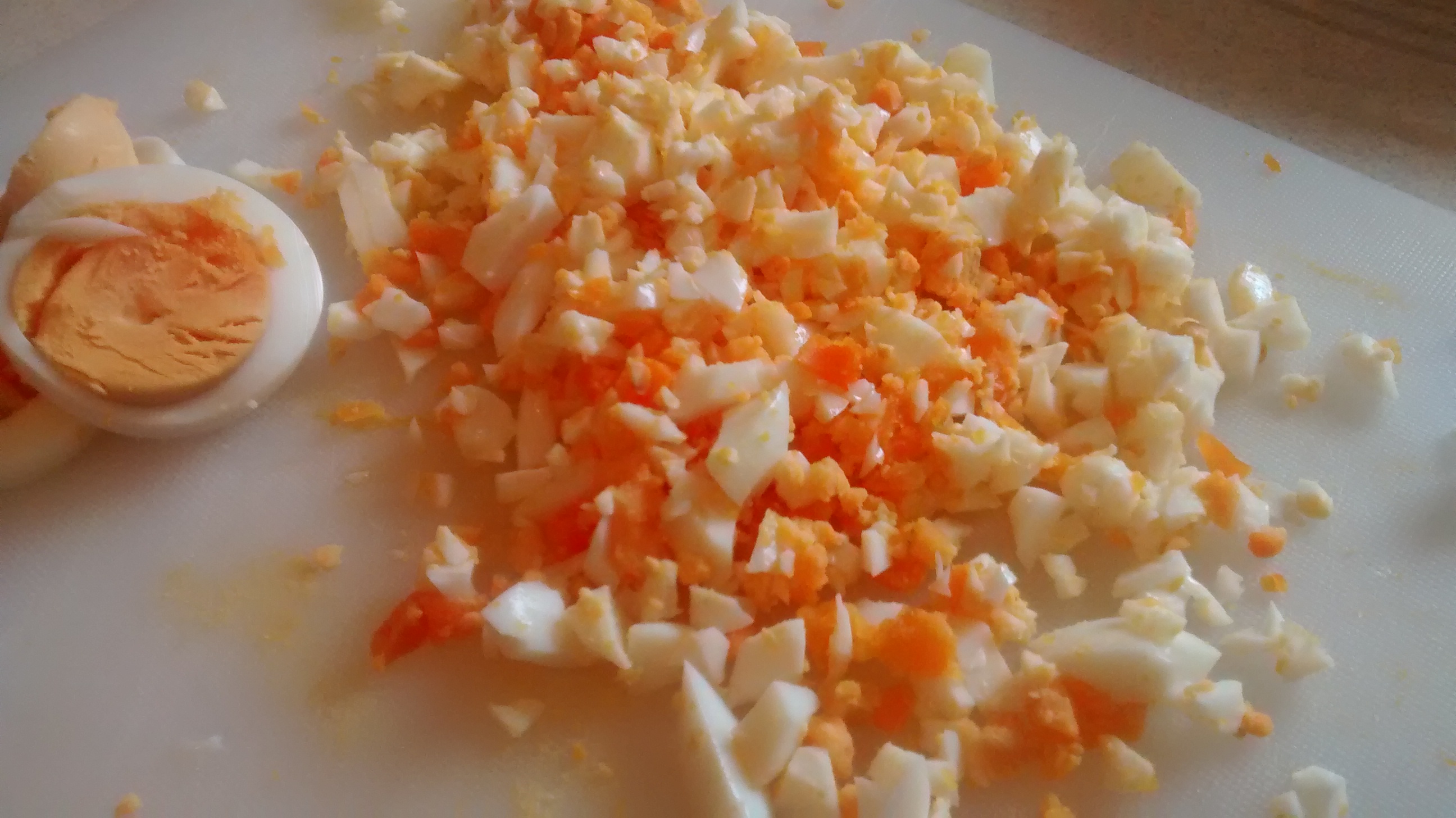
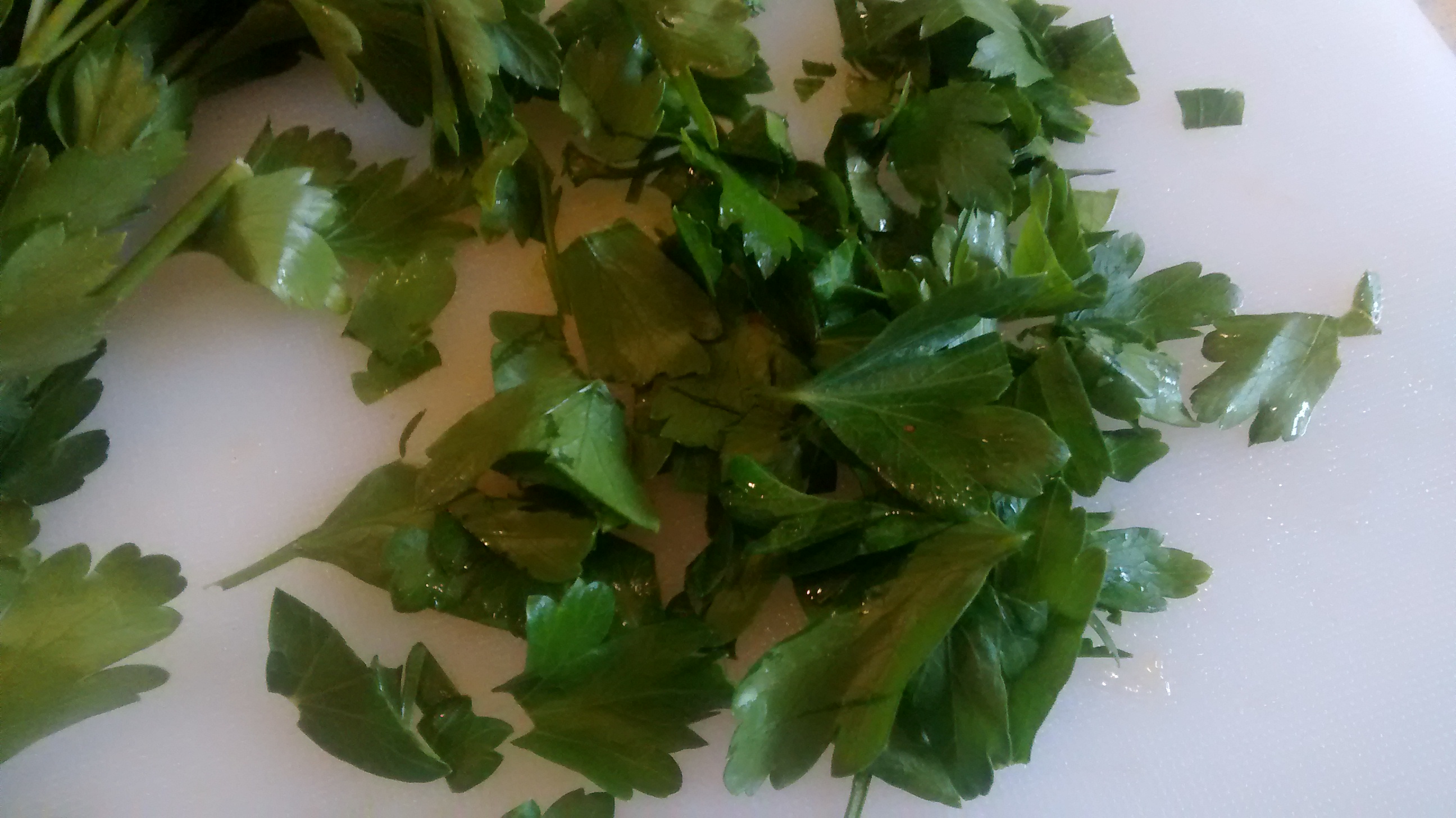
Some cookery books say that chopped hard boiled eggs and chopped flat leaf parsley are added to the topping.
Personally I have not found this to be usually so, although chopped hard boiled eggs are added to many salads and to certain soups in Poland and chopped flat leafed parsley is very often used as a garnish.
Polish Meals

Polish Meals

The following is a general description and of course times  will vary with people and circumstances.

The Polish day seems to start a lot earlier than in England with many people starting work at 7.30am and finishing by 3pm.

Schools often start at 8am and are finished by 2pm.

There are four meals in a Polish day.

1 śniadanie – breakfast

This is a hearty meal from about 5.30amto 7am to set you up for the day.

This will consist of: cured meats, Polish sausage, cheese, hard boiled or scrambled eggs, gherkins, cucumber and tomatoes with bread and rolls, all served with lots of tea. (Tea is quite weak served with slices of lemon or fruit syrup such as raspberry). There may also be some cake.

2 drugie śniadanie – second breakfast

This will be eaten at about 11am. It is a lighter meal than the first breakfast, though often with the same types of food – sometimes it will be just a sandwich – especially if eaten at work or school.

3 obiad – dinner – the main meal of the day

This is eaten between 1pm and 5pm with around 3pm being a very popular time.

This will consist of 2 or 3 courses:

  • Soup
  • Main
  • Dessert of fruit or cake – optional course

Soup is very popular in Poland from hot or cold soups, light consommé types to thick and hearty featuring throughout the year.

I heard a saying on one of my visits to Poland –

Polak bez zupy robi się smutny

This translates as –

A Pole without soup becomes sad.

I think this is very true.

4 kolacja – supper

This is the lightest meal of the day eaten between 7pm to 9pm. It can often be just a slice of cake.

Getting Ready For Dinner

Oak Sideboard
Oak Sideboard
Oak Sideboard
Oak Sideboard
Section of Tablecloths
Some of my Many Tablecloths
Setting the Table for Dinner
Ready for Soup!
Ready for Soup!