Kajmak (or kaimak in my older books) is a speciality make from cream or milk cooked with sugar and then butter is added. It is very sweet and dense, pliable at first and hardening over time.
It is similar to a creamy type of fudge and it can also be made from tinned condensed milk which has been boiled and so is very like dolce de leche.
In my American-Polish cookery book it is called Turkish Fudge.
It is used in a variety of cakes including mazurek.
Kajmak originated in Turkey and appeared in Poland in the 18th century in the reign of Stanisław II Augustus (1764–95). Sugar was a luxury commodity then and this was originally just popular with the Polish nobility.
Kajmak
Ingredients
1/2 litre of milk (full or semi-skimmed)
400g of granulated sugar.
50g of butter
2 drops of vanilla essence
Method
Put the milk and sugar into a heavy bottomed saucepan and heat gently stirring most of the time to stop the mixture from catching and burning on the base.
Continue cooking and stirring until the volume has reduced to about half of the original and the mixture is thick – rather like jam in the spoon test.
Take the pan from the heat and add the butter and stir till it is incorporated.
Add the drops of vanilla essence and stir them in.
Use the kajmak straight away or pour into a glass bowl that you can heat over a water bath when you want to use it later.
Alternatively you can also pour it into a flat dish and cut it up as cubes or fingers of sweets later.
Kajmak is flavoured with a little bit of vanilla but can also have the following additions: caramel, chocolate or coffee
Caramel
In a frying pan heat 20g of granulated sugar until it just starts to turn light brown, then add 6 tablespoons of water and boil gently until you have a caramel syrup.
Add this to the kajmak before the addition of the butter.
Salted caramel is very popular in England at the moment and you can add a teaspoon of cooking or table salt to the caramel kajmak.
Then once it is poured out you can sprinkle coarse ground or sea salt on the top.
Here the kajmak was poured into a rectangular dish.
Chocolate
50g of cocoa mixed with around 6 tablespoons of water
or
80g of melted dark chocolate
Add this to the kajmak before the addition of the butter and reduce the liquid until the kajmak is the correct consistency.
Coffee
100 to 125 mls of strong coffee made from 20g of ground coffee.
Making Strong Ground Coffee
Brew the coffee in a cup or jug, leave for around 10 minutes and then strain the liquid from the grounds.
Add this to the kajmak before the addition of the butter and reduce the liquid until the kajmak is the correct consistency.
Quick Kajmak
In a recipe book I bought recently there is a recipe for kajmak using krówki which are classic Polish sweets (krówka mleczna = milky cow) described as creamy fudge.
The recipe used 500g of the sweets which would have been two packets – I just used one packet to test them out.
Ingredients
250g of krówki
120ml of milk
1 tablespoon of butter.
Method
Unwrap the krówki and place them with the milk in a small saucepan.
Heat gently, stirring with a wooden spoon until the sweets dissolve.
Add the butter and let it melt.
Use whilst it is warm.
Note
This worked very well & one packet could be enough – I must admit I prefer the original version but this is easier & quicker.
This recipe is in an old Polish style – po staropolsku with its use of prunes and honey. I love the flavour of the meat with this sweetness added to it.
This is a dish could be served on special occasions such as Christmas Day.
This recipe needs a large piece of pork loin which will have some of the prunes placed in cuts on the top.
I usually use prunes with the stones still in however in January 2017 there were no prunes with stones on the market in Leeds. The lady on the stall said this was because of a very poor harvest – so I have used these stoned prunes to try out the recipe for the photographs & this post.
Ingredients
1.5kg – 2kg boneless pork loin in one piece – skinless if possible (I used a joint with skin on this time – I think skinless is defiantly better)
200g prunes
100ml of sherry or vermouth
350ml of chicken stock – can be made from stock cubes
bouquet garni made from flat leaf parsley, bay leaf and thyme
1 tablespoon of plain flour
2 tablespoons of butter
1 tablespoon of olive oil
salt & ground black pepper
2 tablespoons of honey
Method
You will need a roasting tin with a lid.
Pour the stock into a pan and bring it to the boil and then add the prunes and cover these with a lid. Let them simmer gently for 20 minutes stirring occasionally.
Allow the prunes to cool so you can handle them and take out the stones.
Take 8-10 of the prunes and put them in a dish and pour the sherry over them and leave them for at least 30 minutes.
Pre heat the oven to Gas Mark 3 – 1600C.
Take the pork and in what will be the top make 8 to 10 deep cuts with a sharp knife. Into each pocket place one of the prunes that has been soaked in the wine.
(If your joint has the skin on it then cut under the skin and put the prunes between the skin and the meat).
Keep the sherry liquid as you will need it later.
Coat the joint with the flour, salt and pepper.
In a frying pan, melt the butter, add the oil and on a high heat, brown all the sides of the joint or if the joint is too large for the pan use the roasting pan on top of the stove to fry it in.
Put the meat and the frying juices into the roasting tin.
Add 6 tablespoons of the stock and cover the dish with the lid and put the dish in the oven for 40 – 50 minutes.
Take the dish out of the oven , add the rest of the prunes and the stock, put the lid back on and cook in the oven for another 40-50 minutes until the meat is tender.
Take out the meat and put it on a warm serving dish cover it with foil and a tea towel and leave it to rest in a warm place whilst you finish the sauce.
Take the bouquet garni out of the dish and add the sherry liquid and honey to the prunes and bring this to the boil. Then simmer it gently and use a balloon whisk to blend the sauce together and break up any large pieces of prunes.
Pour the sauce into a gravy boat or jug and serve with the meat.
Slice up the meat.
Served here on Carnation by Royal Doulton, 1982 – 1998
Prune Sauce
I had some of the prune sauce left over and I had decided to cook some duck breasts.
I thought why not heat up the prune sauce and serve it with the duck, which is what I did – it was delicious together.
So I thought “Why not try to create a prune sauce which can be cooked separately for serving with roast or pan fried meats such as pork, duck or game“.
So I did and here is the recipe.
Ingredients
150g prunes – pitted are easiest for this
250ml hot boiling water
250ml chicken stock – can be from cube or concentrate
1 tablespoon of butter
1 tablespoon of flour
3 tablespoon of honey
50 ml sherry or vermouth
1 bay leaf
Ground black pepper
Method
Place the prunes in a small bowl and pour the hot water over them and leave them to soak for at least an hour.
If using prunes with stones remove these now.
In a saucepan melt the butter and add the flour and heat gently stirring with a wooden spoon to make a roux.
Slowly add the stock and bring this to the boil, stirring constantly so that you do not get any lumps.
Add the prunes and the liquid they were soaked in, the bay leaf and ground black pepper.
Simmer gently until the prunes are soft.
Add the sherry and the honey and simmer for another 3 to 4 minutes.
Remove the bay leaf.
Use a balloon whisk to blend the sauce together and break up any large pieces of prunes.
Pour the sauce into a gravy boat or jug and serve hot with your meat.
Note
If possible, depending on how you have cooked the meat , add any meat juices to the sauce, stirring well.
This recipe is in an old Polish style – po staropolsku with its use of prunes and caraway seeds.
I prefer to use prunes with the stones in and I usually buy then from a Nut & Dried Fruit stall in Leeds Kirkgate Market. However in January 2017 there were no prunes with stones on the market. The lady on the stall said this was because of a very poor harvest – so I used stoned prunes to try out this recipe for the photographs for this post.
This recipe uses a method of cooking which is called duszone – that translates from Polish as suffocated but also when used in cooking asbraised however I think suffocated is much more evocative.
You will need a roasting tin with a lid.
A joint of pork is first sealed by browning it on all sides and then it is placed in a roasting dish with a little liquid and then a lid is placed over the contents and the dish is cooked in an oven. Meat cooked this way is very succulent.
Ingredients
800g boneless pork loin joint
NoteYou can always scale up this recipe for a larger piece of pork.
100g prunes
2 onions – finely chopped
1 tablespoon of plain flour
2 tablespoons of butter
1 tablespoon of olive oil
salt & ground black pepper
1 teaspoon caraway seeds
Method
At least an hour before you want to cook the pork, put the prunes in a small bowl and pour boiling water over the prunes to cover them.
Leave them to plump up and then remove the stones from the prunes. (I left mine for 4 hours).
Retain the liquid from the soaking as this will be needed.
Pre heat the oven to Gas Mark 3 – 1600C
Coat the joint with the flour, salt and pepper.
In a frying pan, melt the butter, add the oil and on a high heat, brown all the sides of the joint.
Put the meat and the frying juices into the roasting tin.
Put the prunes and onions around the pork and add the liquid from the soaking of the prunes, put on the lid and place the dish into the oven.
About 1 ¼ hours should be enough for this weight.
Take out the pork and place it on a warm serving dish, cover with foil, and leave in a warm place whilst you finish the prunes.
Stir the caraway seeds into the onion and prune mixture and heat this up on the top of the stove to thicken for 2 to 3 minutes.
Caraway Seeds
Cut the pork into thick slices and place them on a platter or serving dish and put the prune & onion mixture around them.
Serve with boiled potatoes.
Here served on a bone china platter, Josephine Yellow
In many recipe books and often on menus in restaurants you can see dishes described as po staropolsku which means in an Old Polish Style.
What exactly does that mean?
I have found this a hard question to answer as there two sides to its meaning, one is about hospitality and the other is the ingredients.
Hospitality
When restaurants use po staropolsku they are trying to evoke connections to noblemen & democracy with the chivalry & hospitality that was found in the manor houses in Poland, particularly from the 16th to the 18th century. They are trying to make you think of the quality of the food and the surroundings.
The Poles are thought to be a very hospitable nation and a very famous saying in Poland is – “Gość w dom, Bóg w dom”which means when you have a guest in your house, you have God in your house, meaning treat your guests to the very best.
The chef & writer, the late Maciej Kuroń (1960 – 2008) in his book Kuchnia Polska (Polish Cookery)has a new saying –
“Lepiej gościa zabić, niż nie nakarmić “which means – it is better to kill a guest rather than not feed them well.
I noted this quote many months ago – today when I tried to find the reference in the book, which is a large tome of over 900 pages, I could not find it – when I do in the future I will come back and add it here.
Some of my reference cookery books.
Ingredients
Many old recipes can be classed as po staropolsku – especially if they contain:
Dishes included various soups & especially Sour Soups (I will write about these in the future), honey cakes, pierogi, gołąbki, bigos and dishes with meat & dried fruits.
Pork and Prunes
Some of my favourite dishes in the old Polish style combine pork with prunes, often with honey. I love the flavour of the meat with all this sweetness added to it.
I am going to write up 3 different recipes – the first in this post – the others to follow shortly.
The best pork to use is a boneless joint of pork loin which has also had the skin removed, but if you cannot get this then leg of pork is good as well.
When roasting pork allow 50 minutes per kilo, plus 25 minutes at Gas mark 5 – 1900C.
NoteYou can always scale up this recipe for a larger piece of pork.
I have found that the best prunes are lovely plump ones from Agen in France but the ones that are more dried are also good, you just have to soak them for longer before you can take out the stones.
You can of course use ready stoned prunes – I just prefer the ones with stones in – though they are increasingly harder to find – I can get them from a Nut & Dried Fruit stall in Leeds Kirkgate Market.
However in January 2017 there were no prunes with stones on the market. The lady on the stall said this was because of a very poor harvest – so I have had to use stoned prunes to try out the recipes for the photographs & this post.
Pork and Prunes 1
Ingredients
800g boneless pork loin joint
100g prunes
1 tablespoon of honey
Coarse salt
At least an hour before you want to roast the pork, put the prunes in a small bowl and pour boiling water over the prunes to cover them.
Leave them to plump up and then remove the stones from the prunes.
Retain the liquid from the soaking as this will be needed.
Pre heat the oven to Gas Mark 5 – 1900C.
Place the pork in a roasting tin and rub some coarse salt onto the fat on the top.
Put the prunes under and around the pork with the water from the soaking & extra to cover the bottom of the roasting tin and place in the oven.
Roast the pork – about 1 ¼ hours should be enough for this weight, baste the meat with the liquid from the prunes and juices a couple of times, adding extra water if needed.
When the meat is ready, take out of the oven, cover with foil and then a tea towel and leave it to rest.
Add the honey to the prunes and juices, stir these together over some heat in the roasting pan, you may need to add some more water.
Slice the pork and place on a serving dish and place the prune mixture around the pork to serve.
Here served on a Royal Doulton Plate – Carnation 1982-1998.
To understand a Polish Christmas one has to know about its historical and cultural background as these have shaped what we have today.
Poles love festivals and traditions and there seem to me to be more celebrations in Poland than in England with every possible Saint’s day or other opportunity for a gathering, with eating and drinking, taken.
Polish Recipe Books For Christmas
History & Background
In the first centuries AD, around the river Warta, between the river Odra (Oder) and the river Wisła (Vistula) was the cradle of Poland. (The Wisła runs from the Carpathian Mountains to the Baltic Sea.) This region was immense forest land but many areas along the rivers had been cleared. In the east of Poland there are still the remains of the primeval forest at Białowierza (White Tower), this is a National Park were bison and wild boar roam.
By the 5th century the “Amber Road” was the trade route from the Baltic in the North to the Mediterranean in the South.
In the 6th & 7th centuries, many different Slav tribes arrived there, and as by now more of the land had been cleared, they settled.
The People of the Fields
By the mid 10th centurythe Polanie tribe became dominant – these were the people of the fields – pole means fields in Polish.
Agriculture in General
Compared to England the summers are warmer and the winters much colder, a drier cold than in England, often up to -300 C, with lots of snow.
The fertile plains of Poland have made it an agricultural country and the people are close to the land and understand about the seasons and food production. Even now in towns people have vegetable gardens & allotments.
Main crops are wheat, rye, buckwheat, potatoes and cabbage.
Dill is a favourite herb, also flat leaf parsley and caraway.
Pork is the most popular meat.
Poultry and eggs are used extensively
Butter, milk, soured milk, smetana (soured cream), twaróg (curd cheese) feature in many recipes.
In the south in the Tatra Mountains they make smoked cheeses from sheep’s milk.
In the 16th century southern Poland was 40C warmer than it is today and grapes for wine were grown.
Food from the Forest
Mushrooms, fruits and berries are even today collected from forests, eaten, preserved or even sold at the roadside.
Fish are caught in rivers and lakes, fish farms are becoming popular.
Dried mushrooms provide a lot of flavour in the winter diet.
Food Preservation for the Winter
Drying
Fermentation with Brine
Bottling
Smoking
Marinating
Jams – using sugar
Christianity in Poland
In 966 Duke Mieszko the First, Poland’s first recorded leader converted to Christianity.
By the 13th & 14th centuries Roman Catholicism was the main religion in Poland.
In the late 14th century the marriage of the Polish Queen Jadwiga to the Duke of Lithuania was on the promise of his and his people’s conversion to Christianity and the formation of a new enlarged Poland.
In the 16th century the Reformation did come to Poland and did have followers but it mostly died out following arguments between different factions & the Catholic counter reformation.
After the middle of the 17th century the main religion was again Roman Catholicism and is still so today.
Poland was more tolerant of different religions than many of its neighbours and by the early 20th century it had more Jewish people that any other country in Europe.
Advent
St Andrew’s Day – 30 November is celebrated in Poland, and the eve on 29November has many superstitions and traditions to do with foretelling the future especially with regards to future husbands.
The nearest Sunday to 30 November is the start of Advent, this can be from 27 November to 3 December so there are always 4 Sundays before Christmas day.
Advent is a time of reflection, prayer and preparation.
In the past Advent was like Lent; a time of doing without.
In Poland Christmas is celebrated from the evening of 24 December – Wigilia (the vigil) and parties and visiting relatives and family happens from then on.
It seems very strange to the Poles to have all the Christmas parties before Christmas when is still Advent.
The Christmas days are called Gody – days of Harmony and Goodwill
6 December – St Nicholas Day
Older pictures show Swięty Mikołaj (St Nicholas) in his bishop’s robes, newer ones tend to be more like the English Santa.
Presents were to be found on the doorstep or hidden in the house or under the pillow.
Pierniki – spiced honey cakes are given to children, often in the shape of the bishop.
He returns again on Christmas Eve after the evening meal.
It used to be that presents were given on just one of these days, usually 6 December and Christmas Eve was more about the meal and carols and Church.
Nowadays you are likely to get presents on both days.
Before the Second World War the presents were small tokens such as mandarin oranges (a luxury – as they were imported), chocolates, and an item of new clothes or a small toy.
Christmas Tree
The old Polish Tradition was to hang from the ceiling just the tip of a spruce/fir tree (tip side down) decorated with apples and nuts which were either wrapped in silver or gold paper or painted and ribbons. Old Polish Village houses are made of wood – so it was easy to attach the tree tip.
Doorways and walls were often decorated with separate boughs of the remainder of the tree.
This custom originated in pre-Christian times and texts dating back to the 15th & 16th centuries referred to this use of the tree as a pagan rite. Unable to halt the growing trend, the church then reinterpreted the tree to be the Tree of Knowledge – the tree of good and evil.
The tradition of using the whole tree came from Germany in the late 18th century and early 19th century first into the towns and then into richer villages and by the 1920s this had taken over.
In small flats and in towns, and with small funds, people often still just decorate a branch of a fir tree.
Decorations for the tree
Apples symbolise health & beauty, strength & vitality and paradise
Nuts wrapped in Silver or Gold guarantee prosperity & vitality.
When I was young we tied wrapped sweets & chocolates on the tree.
The Tree is put up on Christmas Eve (though nowadays maybe a day or 2 before) the whole family helps.
Decorated with glass baubles – in the past these were often blown eggs decorated with glitter. There are also many straw decorations – angels and stars.
Many of the old ornaments look like the apples and nuts of before.
Some of my mother’s old nut baubles with a few newer ones
Recent Magazine Feature
Nowadays Polish Glass Factories make 2,500 glass baubles a day, some of them very elaborate and expensive.
Paper chains guarantee love within the family.
Candles and baubles guard the house from malevolent deeds.
The star on the top of the tree helps guide back absent family and friend
Bells symbolise good news
Angels are the guardians of the house.
Clip on candles holders with real candles though nowadays artificial lights are more likely to be used.
Photograph’s of my mother’s clip in candle holders.
Pierniki – spiced honey cakes with white icing were used in some areas.
Polish Cribs – szopka
Cribs are varied in Poland, mostly wooden and carved, often with the shepherds dressed in traditional Polish highland costume.
Every year In Krakow in the Grand Square (Rynek Glówny) there is a competition held on the morning of the first Thursday of December, of Christmas cribs.
Model makers come carrying their cribs and they are judged. The winners are kept in the Museum of Ethnography – the rest are sold.
I saw an exhibition of past winners when they were on tour in England in 2011 at The Lowry in Salford.
This competition began in 1937. It was intended to bring back to life a tradition which had died shortly after the First World War, that of the Crib Theatre and these cribs are portable theatres for traditional puppet Nativity plays.
These ornate cribs are very colourful and richly decorated. They are covered in coloured foils, and are inspired by the architecture of Krakow eg Wawel Cathedral and the unequal spires of The Church of the Virgin Mary – Mariatski
They can be from 15 cm high up to 2 metres high and some have clockwork mechanisms or lights.
In the past the Christmas cribs were mostly the works of Krakow masons in their idle weeks of the Polish rainy late autumn.
Nowadays it is a pastime of many Krakow dwellers of all walks of life. And the city boasts several dynasties of Christmas crib makers where two or three generations construct brand-new cribs every year.
Christmas cards
In the past these were always postcards but now folded cards are coming in to vogue.
Copies of old cards from Zakopane from the 1930s – bought in the Folk Museum there.
From an Old Christmas Card from the 1930s
Cards are only sent to family and friends that will not been seen over Christmas.
In Communist times cards depicted, branches of fir trees and baubles, nowadays many religious cards are sent.
A Polish Christmas Card
Often when Poles send cards to family abroad they include a piece opłatek. This was originally bread but now a paper thin wafer with an impression of the Nativity scene is used and is a symbol of forgiveness, unity and love.
The opłatek usually has the corner nipped off to show that this is being shared. My aunty in America always does this.
This is a very Important Meal – Poles want to be with their family on this evening.
This Christmas Eve supper became a fixed tradition in Poland in the 18th century.
It is a completely unique experience with an ordinary evening meal transformed into a celebration of family love and solidarity and it is also so strange that in a country of meat lovers this meatless meal is so important and loved.
The days before the meal were a time to thoroughly clean the house.
The day used to be a day Fasting & Abstinence as the last day of Advent – no meat on that day (abstinence) and only 1 main/large meal (fasting)
There are usually 12 dishes for the 12 apostles though some areas have an odd number of dishes either 7, 9 or 11.
I only make dishes which would have been available through food preservation in the winter or are seasonal.
Presents
If there are presents they are placed under the tree and opened at the end of the meal.
In some areas of the West of Poland– presents today come from Gwiazdor – Starman
In the South West of Poland from an angel or baby Jesus.
In Communist times to try and remove the religious idea – many tried to favour Gwiazdor often portrayed in red robes with gold star or even to introduce the Russian Grandfather Frost on January 1st – unsuccessfully.
However Gwiazdor had links with St Nicholas (Swięty Mikołaj) as he often carries a star in front of St Nicholas.
Carols
The oldest hymn/carol in the Polish Language is Bogurodzica (Mother of God) and is known from the beginning of the 13th Century.
Carols are rich and varied with examples from many different centuries with ones originating from:
church music
to many with music from the Royal Court such as the Polonaise
to lively folk & dance music &
quiet lullabies.
Many carols feature shepherds as the Poles from the countryside felt an empathy with them.
Bóg się Rodzi – a Polonaise( Polonez )– words from the 18th Century.
Przebieżeli do Betlejem – music from the 16th Century.
Carols are sung from midnight mass till 2nd February in Church.
Carollers went from the second day of the Holiday – 26 December until 6 January – carrying:
a star,
a crib,
a stork – the New Year – new life
a baby goat – fertility
a bear – hostile forces of Nature
In some areas Carollers went from Christmas Eve – after their own meal.
They are welcome visitors however if your house is left out then this is seen as a sign of bad luck.
Food for Christmas Day
Many would say that this meal is just like a very special Sunday Dinner.
There are not as many must have dishes on Christmas Day
As with all Polish dinners there is soup to start and this would be most likely rosol – clear chicken consommé with small pasta pieces (the original chicken noodle soup)
There will be lots of MEAT with Pork Dishes mainly such as:
Tort – rich layer cake often made from hazel nuts.
Nowadays there will also there will be chocolates & these Polish dried plums with chocolate continue the tradition of dried fruits at Christmas time – I love them!
My China & Tableware – A New Tradition
Classic white china would be the norm for Christmas but over the last couple of years I have started to use china with poppies* and other red flowers at Christmas time as well as china with autumn and winter foliage from my collection of china.
*Although not a Christmas flower – these poppies are a remembrance to the Battle at Monte Cassino in May 1944 & the military song – Czerwone maki na Monte Cassino – Red poppies on Monte Cassino. As my father fought there, these are very special for me.
New Year’s Eve – Sylwestra
31 December is the feast of Saint Sylwester (Sylvester) and this is the name of the festival in Polish.
In the towns & cities the evening is often celebrated with a dance – no special traditional dishes – more of the Christmas Day type food.
Sleigh rides from house to house, with food at each, were popular in times gone by on the eve and on New Year’s Day.
The 3 Kings – 6 January – Epiphany
During the Christmas period the priest would visit all the homes of his parishioners and say prayers, bless the house and get an offering. He would also bless some chalk or blessed chalk would be obtained at the Mass on 6 January. This chalk is used on 6 January to write over the door frame in the house –
For example for next year – 2017
20+ K + M + B + 17
For the year and Kasper, Melchior and Baltazar – the traditional names of the kings.
To bless all who enter or leave in the coming year.
The end of the Christmas period
In the church – 2 February – Candlemas day – 40 days after Christmas – is the official end of Christmas and then karnawał starts – the festive time before Lent.
The word kotlety(plural) come from the Italian word cotoletta(singular) for cutlet or chop.
Kotlety are made from pork loin or porkchops and the meat is beaten thin, dipped in beaten egg, coated in dried breadcrumbs and quickly shallow fried in oil
They can also be called bitki – which means something that is beaten or kotlety panierowane – which means coated in breadcrumbs.
Coteletta alla Milanesie is veal coated in breadcrumbs and is thought to be the inspiration for Wiener Schnitzel.
I do not know if the dish arrived in Poland from Italy or Austria however for many this is thought of as a very Polish dish. I have had this served in every Polish home I have visited and it is usually on most Polish restaurant menus.
My mother used to make them with either pork chops or pork loin if it was available. Nowadays pork loin is readily available and that is what I use.
Ingredients
Thin slices of pork loin – around 2 pieces per person
Beaten egg – 1 tends to be enough for up to 3 to 4 people
Dried breadcrumbs – home made – look for bułka tarta in a Polish shop
Sunflower oil for frying
Method
Trim the fat from the meat.
Use a metal or wooden kitchen mallet – (I find the wooden ones with very spiky heads are a bit too rough.) to beat the meat slices, turning them over to do both sides.
Have the beaten egg in a shallow dish and dip in a slice or two meat at a time.
Have the breadcrumbs on a large plate and dip the egg coated slices in the breadcrumbs, turning them over to cover both sides.
I use a cast iron frying pan into which I put some sunflower oil and heat this up to a medium to highish heat.
Quickly fry the kotlety, first on one side and then turn them over to do the over side.
You do not want the oil too hot so it burns the breadcrumbs however you do not want the heat too low or the breadcrumbs will soak up too much oil and be very greasy.
I find you can do two at a time (three if they are small pieces).
You can place the cooked ones onto kitchen paper whilst you do the rest and you can also keep them in a low oven till they are all done.
I like the freshly cooked ones the best – I always choose the last ones fried!
I serve these with creamy mashed potato, cooked frozen green peas and a Polish salad such as the ones made with sauerkraut.
Sometimes I add an English style, home made apple sauce made from the Bramley apples in my garden.
Beetroot is a very popular vegetable in Poland and is served both hot and cold and is the main ingredients of barszcz (The classic Polish beetroot soup).
Now this may just my imagination but the beetroot in Poland just tastes so much better than the ones I have had in England, maybe it is the variety that is grown there or the soil. I think you have to use home-grown or organic beetroot to get as good a taste.
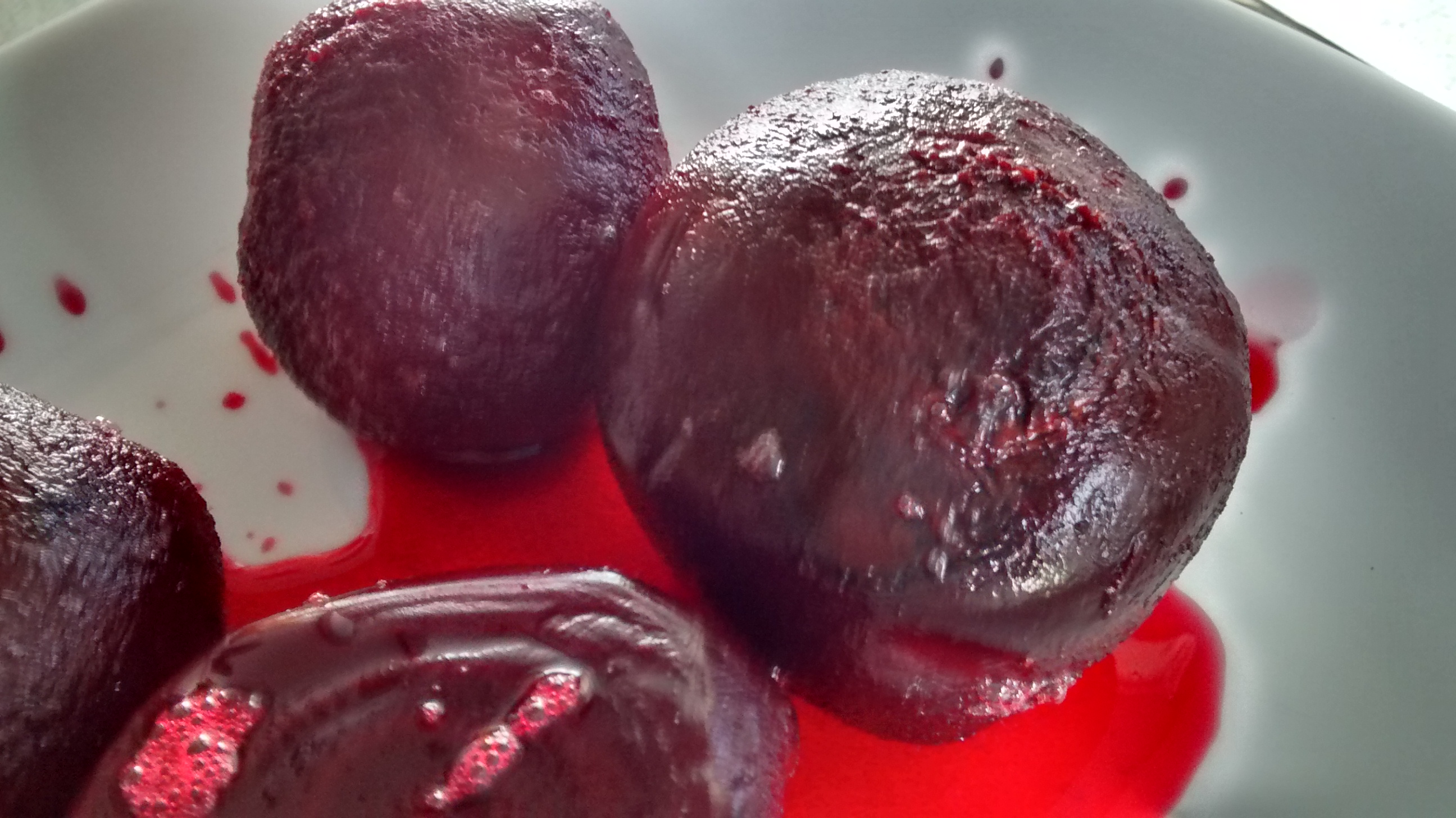
In the following recipes I have used vacuum packed boiled beetroots – boiling or roasting raw beetroot should give a better flavour but when you only want to make a small amount or you have little time this will work as well especially if you adjust the flavour with lemon juice or a little sugar.
A popular variant is something called botwinka – this is very young beetroot – sold in bunches (rather like radishes) and consists of the small “bulb” and the young green leaves, which are all used. As I have not seen this for sale in England I will not be including any recipes – but if you are ever in a position to try this (often in the form of a soup) you will taste something very delicious.
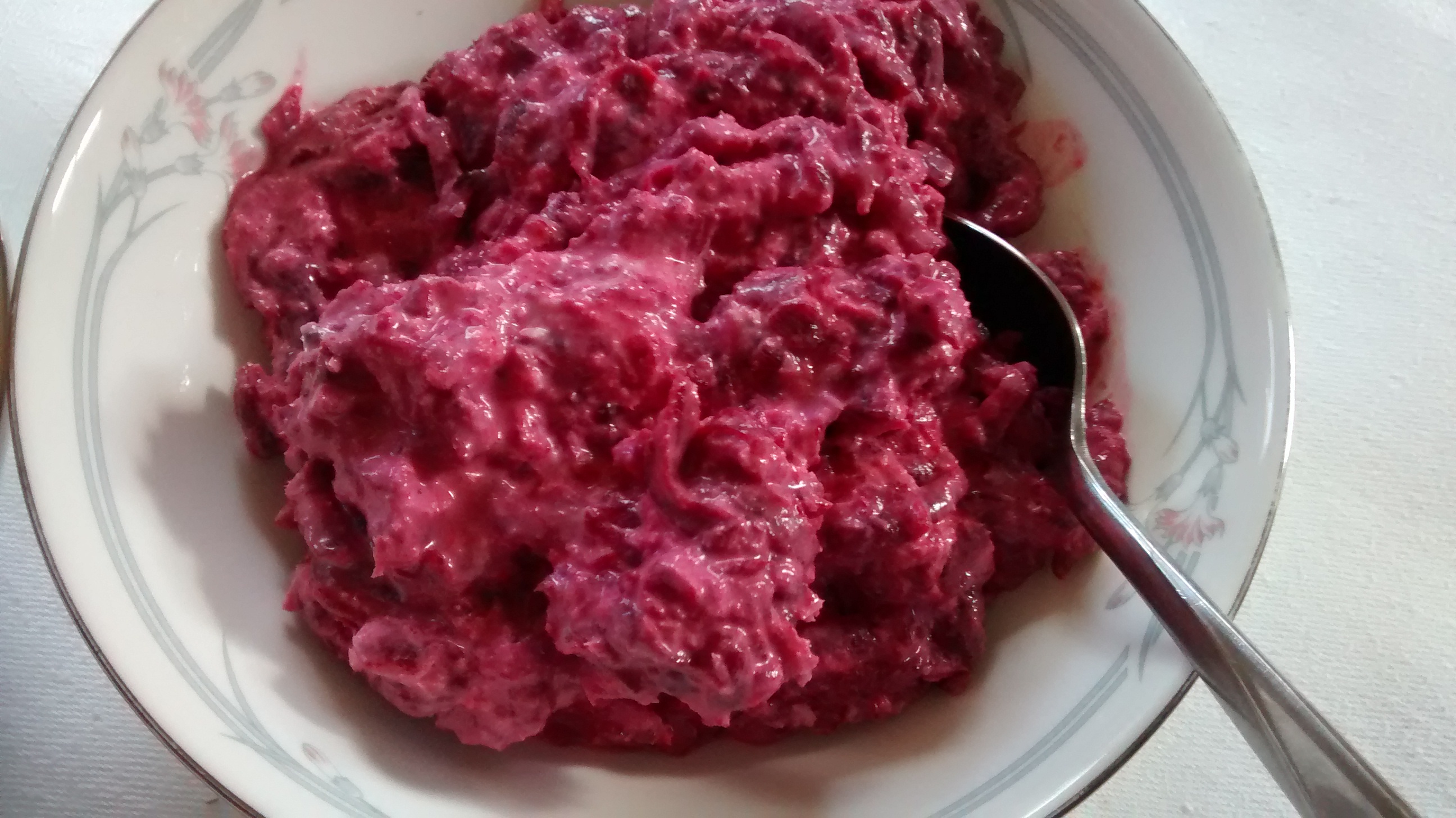
Ćwikła is the most typical Polish accompaniment to roasted and smoked meats and sausage. This salad or relish is made from grated cooked beetroot which is mixed with grated horseradish – chrzan.
The first recorded recipe for ćwikła comes from the writings of Mikołaj Rej (1505 – 1569) who is known as the “Father of Polish Literature”. He was the first person to write exclusively in Polish.
He was born 59 years before Shakespeare (1564 – 1616).
Ćwikła
Ingredients
2 or 3 boiled beetroots
Horseradish sauce
Soured Cream
Extra lemon juice – optional
Method
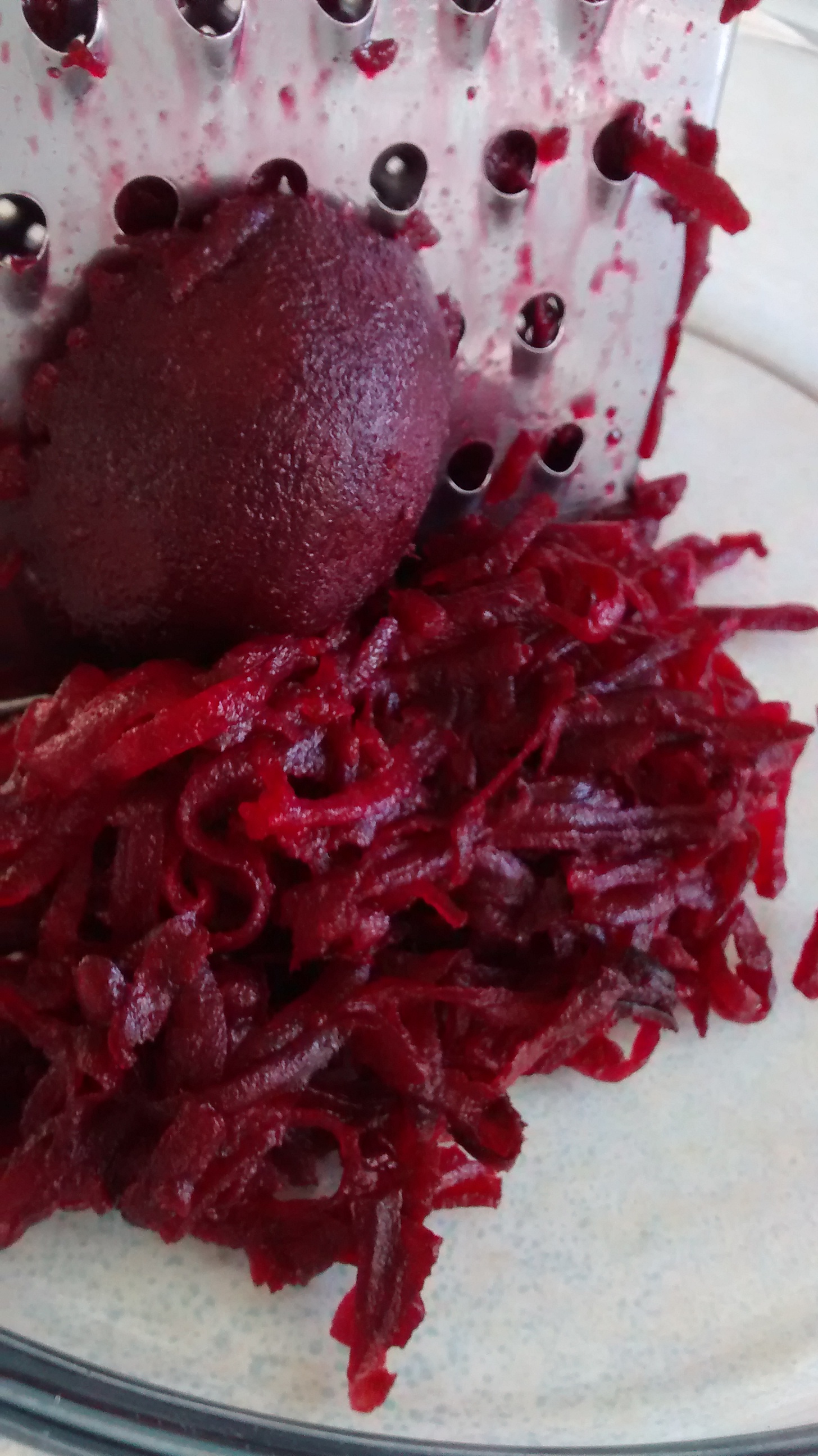
Grate the beetroots using a fine or medium grater and put this into a bowl.
In the past I always used a fine grater but now I prefer to use my medium grater.
Medium Grated
Fine Grated
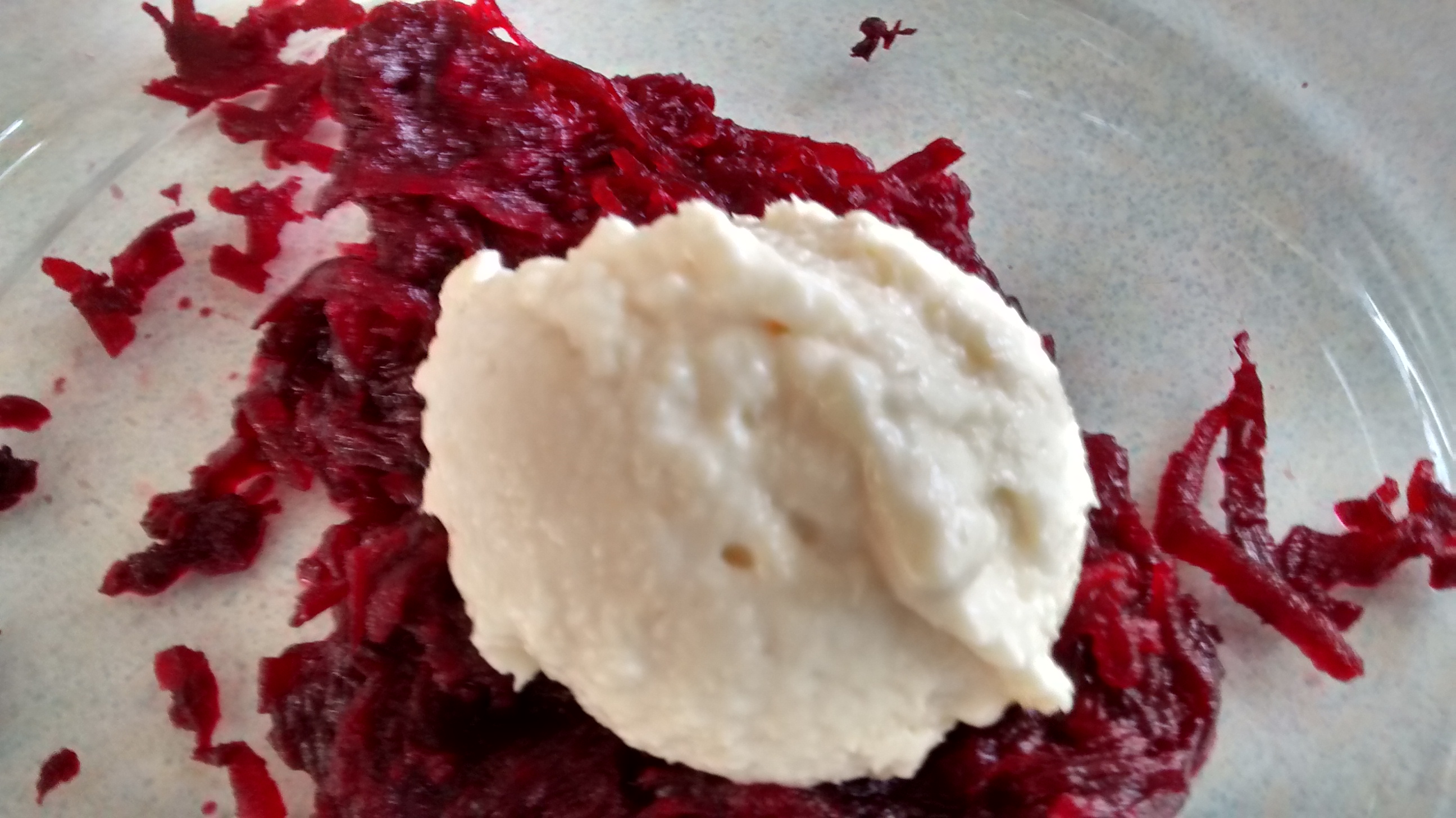
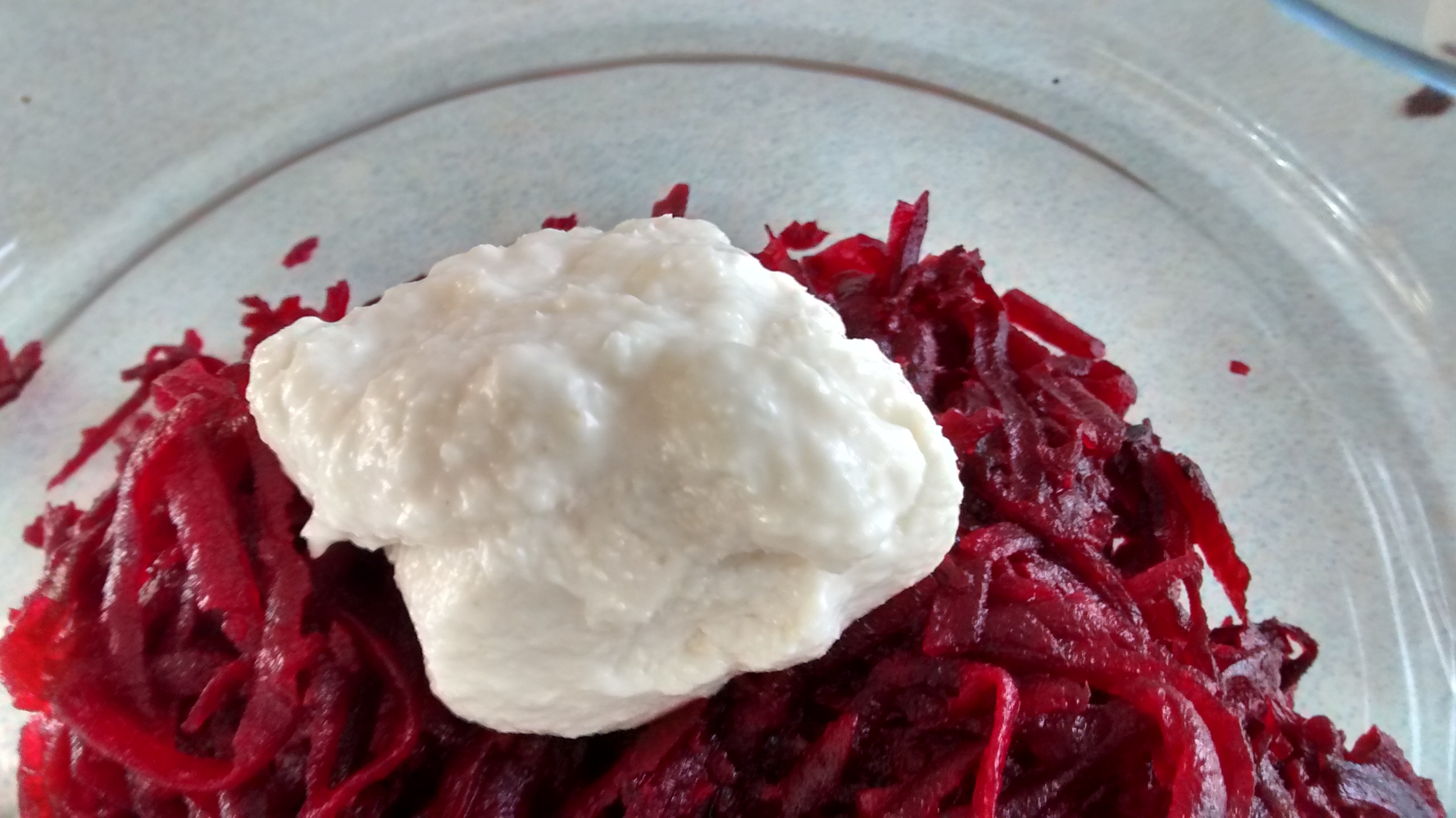
Add a large dollop or two of horseradish sauce.
Below are two kinds, one with soured cream and one without.
I like the one with soured cream more.
A few years ago I thought it would be a good idea to grow my own horseradish – that was a mistake! It starts to take over with the roots spreading underground. However the dark leaves are very attractive and the air does smell of horseradish when you walk up to it. You just need to be able to contain it.
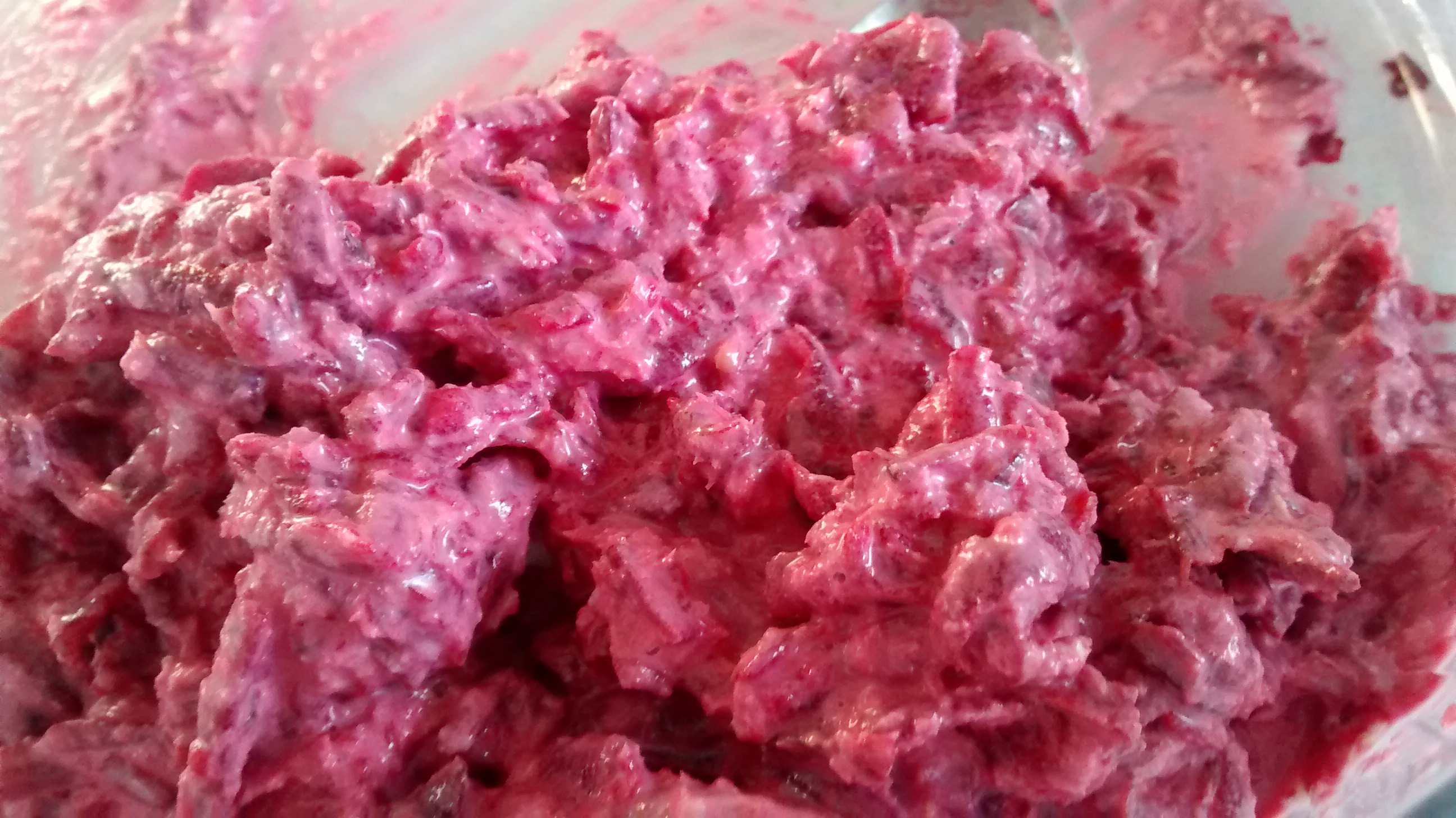
Mix the grated beetroot and horseradish sauce together.
Add soured cream – if using the sauce with this in already you might not need as much.
You can add lemon juice as well.
Carnation Serving Dish by Royal Doulton
Beetroot & Apple Salad
Ingredients
2 or 3 boiled beetroots
1 eating apple with a good flavour such as Jazz, Braeburn or Pink Lady.
Juice of half or a whole lemon
Sugar – optional
Method
Grate the beetroots using a medium grater.
Peel and core the apple and grate this using a medium grater.
Mix the two together.
Add lemon juice to taste.
You can add some extra sugar to taste.
NOTE
This tastes much better if it is left so all the ingredients mingle together for a few hours.
I make this in the morning if I want it for the evening or I make it the night before for lunch time the next day.
Creamed Beetroot
This is a delicious way of serving beetroot warm with a roast dinner.
Ingredients
3 or 4 boiled beetroots
Large tablespoon of butter
1 or 2 tablespoons of flour
Juice of a lemon & some extra water
3- 4 tablespoons of soured cream
Salt & pepper to taste
A little sugar to taste – optional
Method
Grate the beetroots using a medium grater and put them into a saucepan with the lemon juice and a little water.
Put a lid on the saucepan and gently simmer the beetroot – taking care not to let it dry out or burn.
Melt the butter in a small frying pan and add the flour – let it colour slightly.
Add 2 tablespoons of soured cream and a little water and combine this well.
Add this mixture to the simmering beetroots, once again combining well.
Let this simmer for 5 to 10 minutes – keep checking, and stirring and adding more soured cream, lemon juice or water if it looks like it is going to dry out.
Add salt & pepper and a little sugar to taste.
Serving dish is Topic designed by Alan Rogers in 1967 for J & G Meakin.
Easter is celebrated on the first Sunday, after the first full moon, after the spring equinox, which is the 21st of March. So the earliest date for Easter is the 22nd of March and the latest date is the 25th of April.
In English the word Easter comes from the name of the pagan goddess of dawn or spring – Eastre or Eostre and her festival was in spring time and hence this old word has stuck.
In Polish the name is Wielkanoc – which translates as Great Night – as it is the night of The Resurrection.
Eggs at Easter were originally a pagan tradition as symbols of fertility, rebirth and the revival of nature and heralded in the start of spring.
The tradition was absorbed by Christianity and the egg is now the symbol of the tomb and as the chick hatches from the egg with life so it symbolises the Resurrection of Jesus Christ.
Pisanki are the decorated eggs you find in Poland. The word comes from the Polish verb pisać which nowadays means to write, however in old Polish it also meant to paint.
There are many different ways of decorating eggs and each of these has its own specific name – one method uses beeswax and dyes are used to give wax resist patterns – another scratches away the dye to revel the original shell colour.
In Kraków there is the Museum of Ethnography, founded in 1902, which has superb displays of intricate and beautiful pisanki through the ages – well worth a visit.
Below are photographs of an egg which was decorated using the beeswax and dye method – onion skins in this case. It belongs to the Director of the Leeds Polish Saturday School and was one of many made two years ago with instructions from a visiting tutor at a workshop session for the teachers and pupils at the school.
I make very simple coloured eggs by hard boiling eggs with onion skins.
Boiling eggs with brown onion skins dyes the egg shells a rich brown colour.
Boiling eggs with red onion skins dyes the egg shells a dark red-brown colour.
You can buy sheets of coloured paper dyes which give a range of colours – safe edible dyes of course – I have tried these in the past but now just use onions as they are always in my vegetable basket.
Tip
When hard boiling eggs use eggs that are at least three days old as very fresh eggs are hard to peel.
These hard boiled eggs form part of the basket of food which is taken to church on the Saturday before Easter to be blessed see Palm Sunday & Holy Saturday.
The blessed eggs are peeled and cut into quarters to be shared at the Easter Breakfast with all the people present.
Other non- blessed hard boiled eggs are used in a game of tapping eggs together to see which one cracks first.
A wooden imitation of these lovely decorated eggs is now a very popular item for sale throughout the year in Poland. It is a something that many tourists buy to take home.
Pisanki for sale in Kraków
My Wooden Pisanki
Wooden Eggs belonging to my friend in Leeds
In these the wooden eggs have been painted and carved to expose the pale wood imitating the method of scratching with a fine tool the paint or dye and exposing the egg shell colour of real eggs
Easter Greetings
The photographs are taken from recent Easter cards from Poland.
Wesołych Świąt
Happy Holy (Holiday) Day
Wesołych Świąt Wielkanocnych
Happy Holy (Holiday) Day at Easter
Wesołego Alleluja
Happy Alleluia
Because of the egg theme you may also hear
Smacznego jajka
May the eggs be delicious.
PS
After posting the above I received an Easter card from Poland with the following stamp.
Palm Sunday is the Sunday before Easter and marks the beginning of Holy Week.
Palms are blessed in church on this day to commemorate Christ’s entry into Jerusalem.
Of course palm trees do not grow in Poland and so other plants are substituted. Often pussy willow is used as the catkins are usually out around this time. My mother always called pussy willow – palma – the Polish for palm.
Twigs For Sale in the Old Square in Kraków
Palms are also made from dried grasses and corn which are often dyed to make them colourful or from coloured paper which is rolled and the edges cut to make a fringe.
In many villages the farmers would make huge palms for the procession completing with each other to see who had the biggest and best.
The Main Square in Kraków – Decorated with Large Palms
It is still Lent in Holy Week so the food eaten is simple and often meat, butter and egg free. Most baking and cooking done now is to make food to eat at Easter.
As well as going to church services it is a time for houses to undergo a massive clean-up especially inside.
Holy Saturday is the last day of Lent – the day before Easter.
This is the only day in the Catholic year on which Mass is not celebrated.
In Poland there is the tradition on this day to have the food for Easter blessed.
This has its roots in the early medieval church in the 12th Century and the food would have originally been just bread and eggs.
In times past in villages the priest would have gone around to people’s houses and blessed the food there. Nowadays people bring a basket of food to the church and the food is blessed with Holy Water and is then taken home and not eaten till the Easter Sunday Breakfast.
Once blessed this basket is called święconka meaning that which has been blessed
The basket is lined with a cloth – often white linen and sometimes embroidered. A white linencloth is used to cover the basket. These cloths represent the white shroud in which Jesus was wrapped.
What goes into the basket depends on several factors but hard boiled eggs and bread are usually present. Everything in the basket has a symbolic meaning.
Eggs – Christ’s Resurrection – a symbol of life.
Bread – Christ as the Bread of Heaven.
Salt – Preservation & Purification & Zest for Life
Horseradish – The Harsh & Bitter sacrifice of Christ.
Cooked Meat & Sausage – Joy & Abundance of God’s mercy.
Babka – The risen dough – this represents the Risen Christ.
Shaped Lamb (butter/cake/bread) – Christ – The Lamb of God -(see Lamb Bread)
Cabbage is a vegetable that plays a very large part in Polish cookery. It can be eaten raw in a variety of salads or cooked in many different ways.
Cabbages grow well in Poland and they can be stored for part of the winter so giving a supply for most of the year.
Cabbages For Sale in a Polish Market
Cabbages can also be preserved by allowing them to ferment using brine. This fermented cabbage is called sauerkraut in German which means sour cabbage.
My parents used to tell me about how their parents made barrels and barrels of fermented cabbage, shredding the cabbage finely, adding salt and packing it firmly into the barrels. This was standard work after harvesting cabbages and would provide a basic ingredient for many dishes throughout the coming year.
One of my aunties in Poland who lives in a block of flats makes her own sauerkraut in a bucket which stands on her balcony. She is not alone in this.
Street market in Krakow – Sauerkraut and SausageSauerkraut and Sausage
On a recent trip to Poland I bought a little book on cabbage cookery. The title, translates as “Falling in Love with Cabbage”; I think most Poles do this at a very early age as cabbage features, fresh or sour, in so many meals.
Falling In Love With Cabbage
In my next posts I am going to cover some classic Polish recipes for cabbage including bigos and gołąbki (cabbage rolls)-as seen on the book cover.






 Journey From A Polish Kitchen