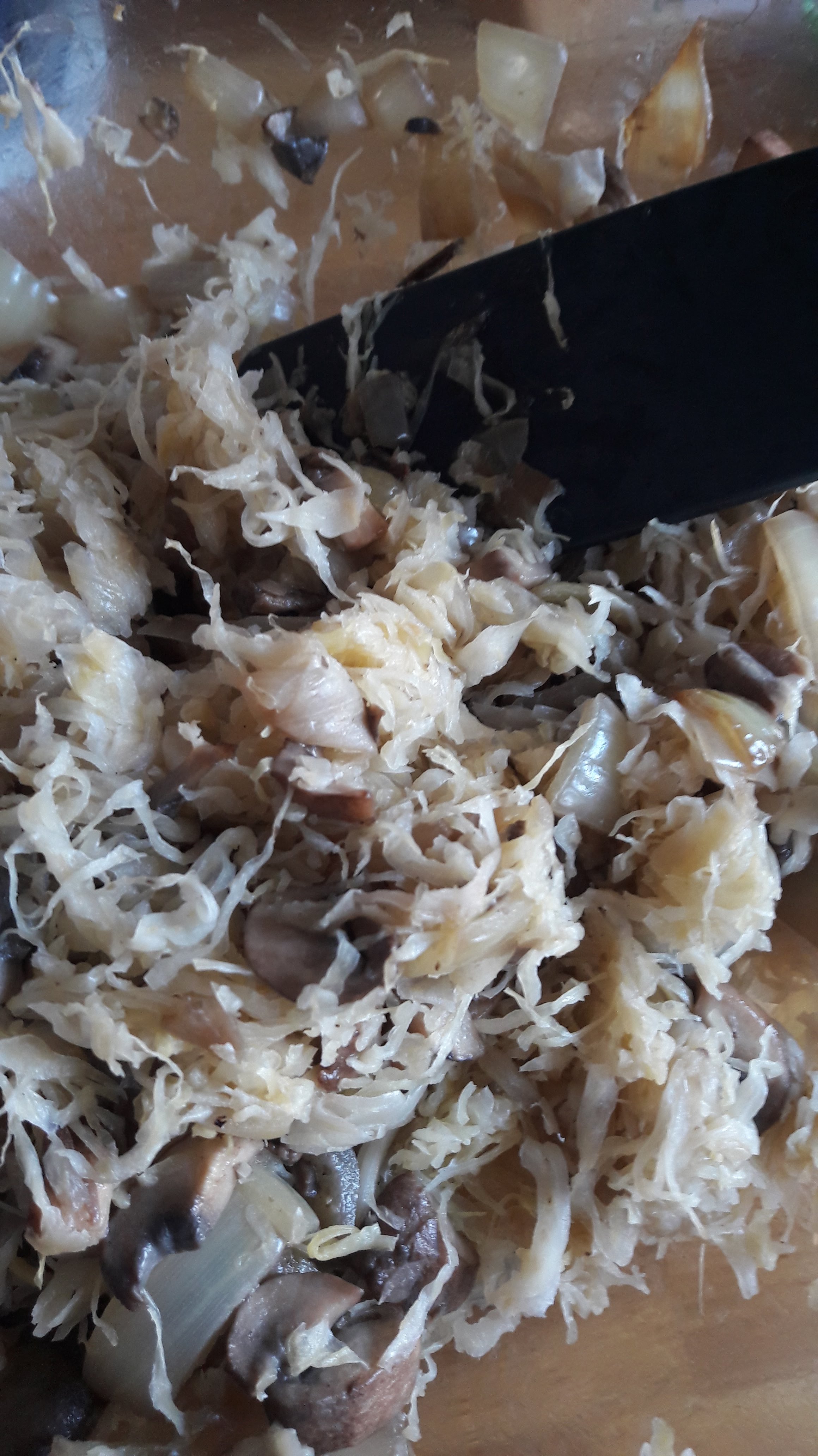
Sauerkraut – Traditional with Bacon

This is  a very popular dish to make in the winter time with produce from the stores.

Ingredients

1 large jar sauerkraut – 800-900g

100g smoked streaky bacon

1 onion

1 teaspoon caraway.

2-3  tablespoons of plain flour

Oil or bacon fat for frying

1 tablespoon granulated sugar*


*The acidity of sauerkraut varies very much and homemade is often not as acid.

*Rinsing bottled sauerkraut before use will lower the acidity.

*The amount of  sugar  you add to the dish is a personal preference – if rinsed 1 tablespoon should be enough – if not rinsed you might need 1 -2 tablespoons more.


Method

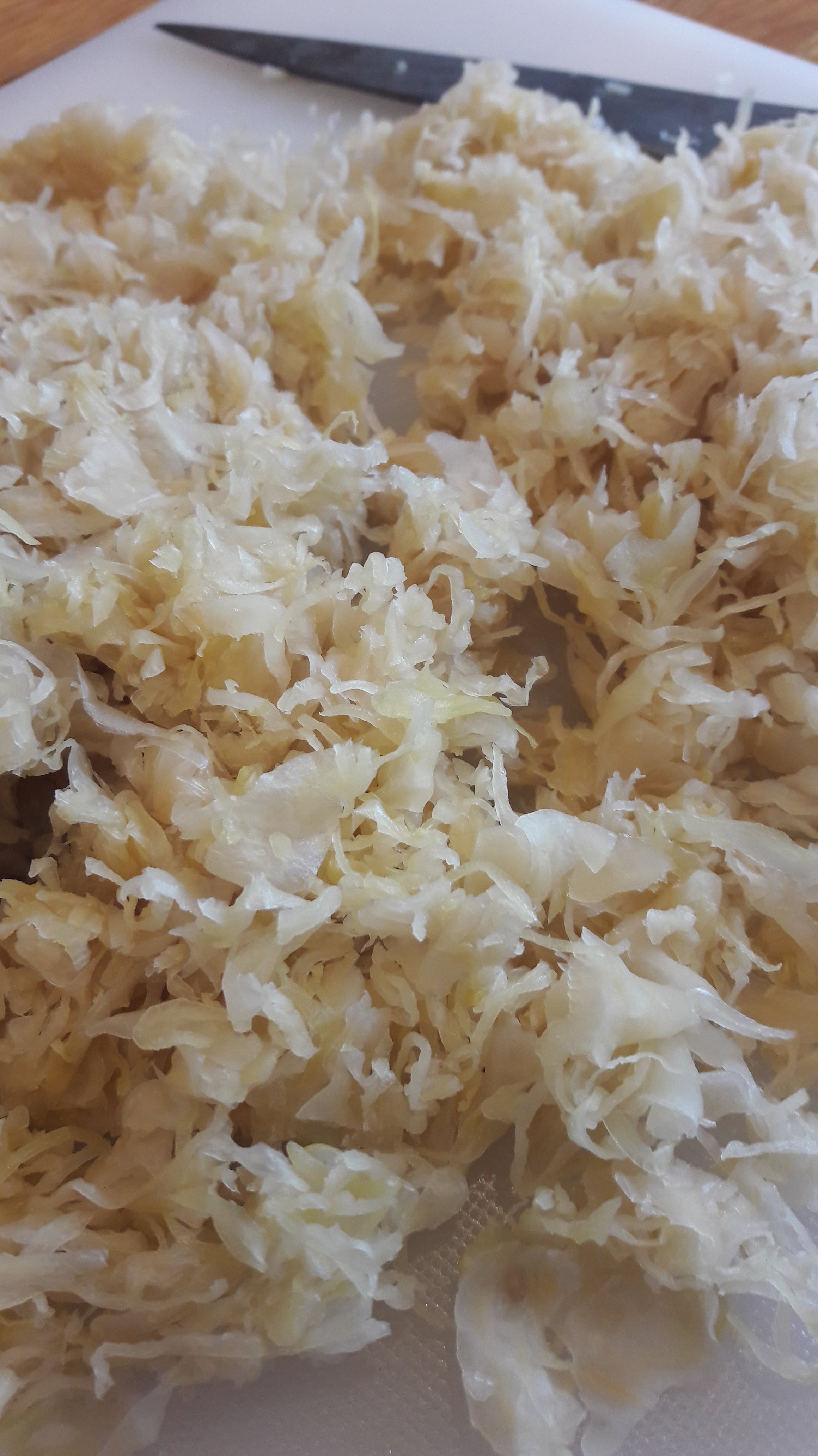
Drain the sauerkraut and keep the liquid ( you may want to use it to adjuct the acidity of the dish later ).

Rinse the sauerkraut with cold water.

Place the sauerkraut in a large saucepan and pour boiling water over it until it just covers it.

Add the sugar.

Bring to the boil and then cover the saucepan with a lid and let it gently simmer for around 10  minutes.

Continue heating either gently on top of the stove or put the pan with the lid into a low to medium oven.

Cook for  around another 30 minutes until the sauerkraut is soft.

Remove the pan from the heat and add the caraway seeds – put the dish  back into oven or keep on the stove with the lid on.

Chop the bacon into small squares and heat gently in a frying pan to release the fat.

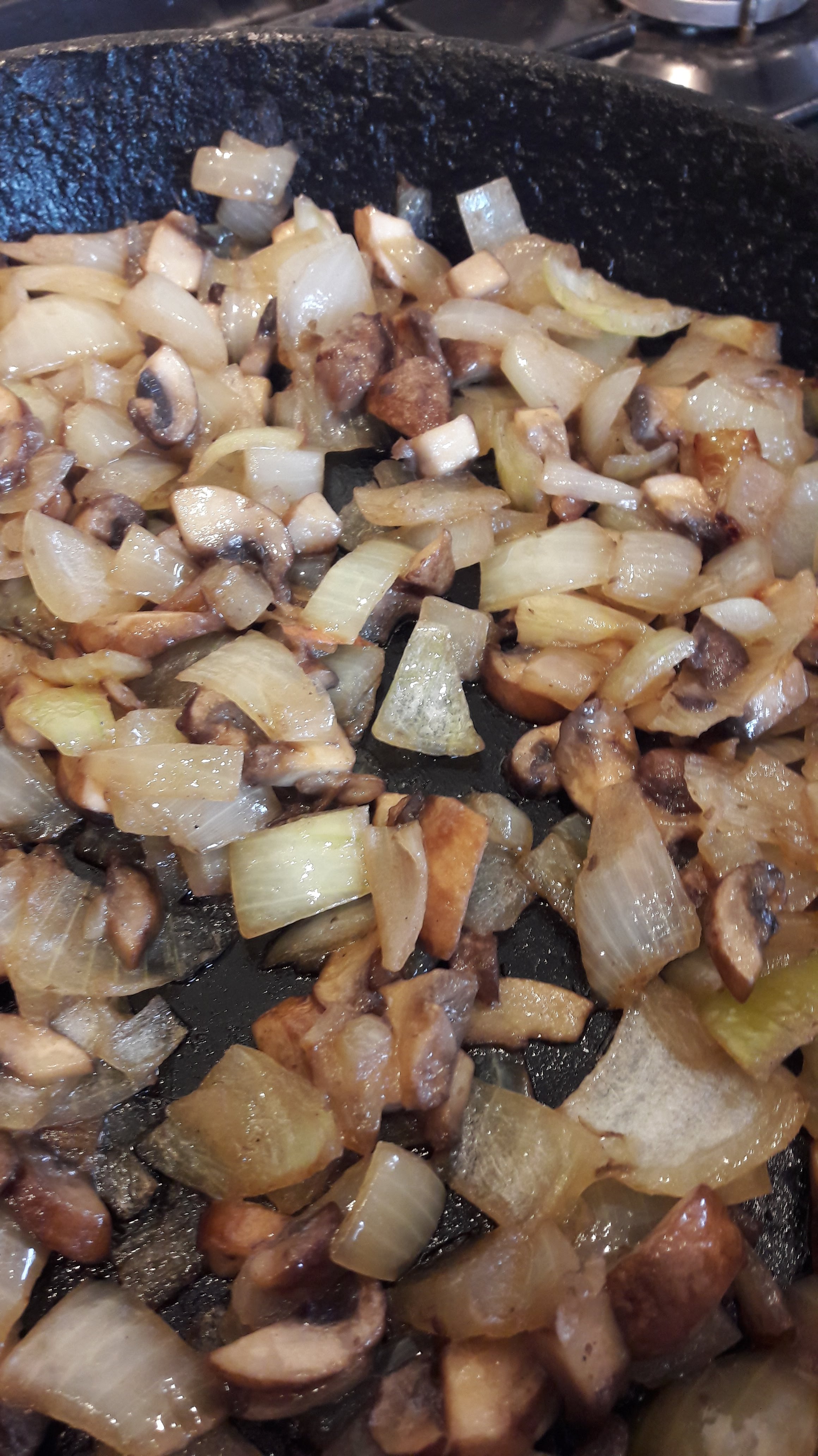
Chop the onions into small pieces and add them to the pan and fry the onions until they are golden.

Sprinkle the flour over the onions and heat gently to brown the flour.

Add spoonfuls of liquid from the sauerkraut mixture to the onion mix.

Stir and heat to form a thickening roux/paste.

Add this to the sauerkraut mixture and mix throughly.

Put the pan back in the oven for around 10 minutes – or heat gently on the stove.

Sprinkle ground black pepper on the top before serving.

Serve with rye bread or boiled potatoes and hot roast pork or cooked Polish sausages.


Here served with Kolos rye bread,  from the Bradford Ukranian Bakery,  founded in 1961 and grilled Polish sausage from Torun (kiełbasa Toruńska) – the birthplace of the astronomer Copernicus (Kopernik ) – also famous for its spiced honey cake (piernik)

Served on Carnation by Royal Doulton, 1982 – 1998.


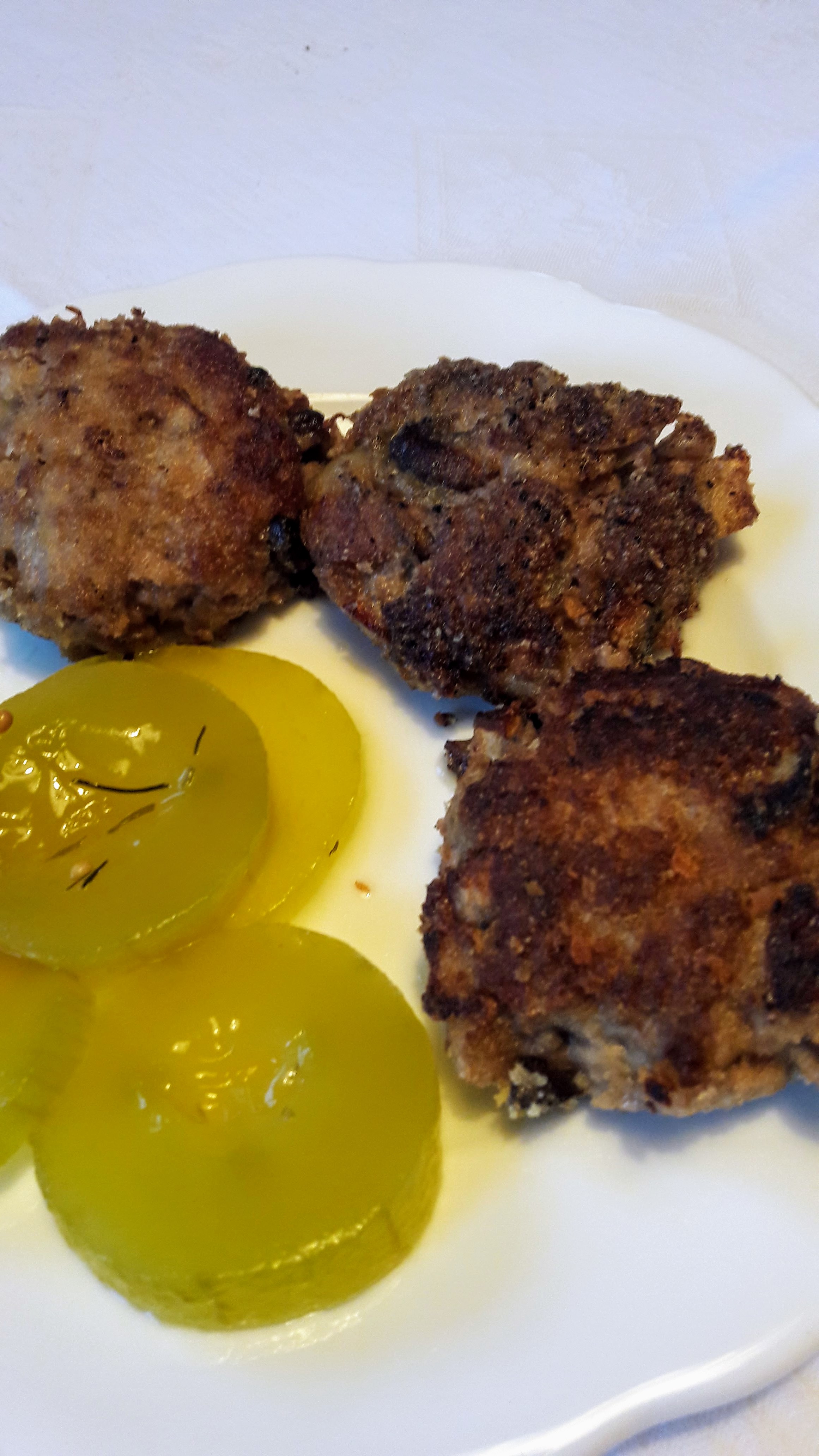
Kotlety with Cabbage

  • On my last trip to Poland my  cousin in Białystok suggested this variation on kotlety mielone – minced meat burgers.
  • The idea is to add shredded white cabbage to the minced meat mix.
  • I used the following  amounts by weight:
  • 2 parts minced meat : 1 part cabbage – you can go up to equal weights of each.

Ingredients

  • 500g beef mince
  • 250g white cabbage
  • 1 onion – chopped fine
  • 3  tablespoons semolina*
  • 2 eggs
  • Dried breadcrumbs
  • Salt  and pepper
  • * I used semolina instead of my usual white bread soaked in milk – I was pleased with this as an alternative.
  • Sunflower oil  for frying

Method

  • Chop the onion fine and fry in a little hot oil till lightly browned then leave till cold.
  • Cut the cabbage into fine shreds and then across so you have small squarish pieces.
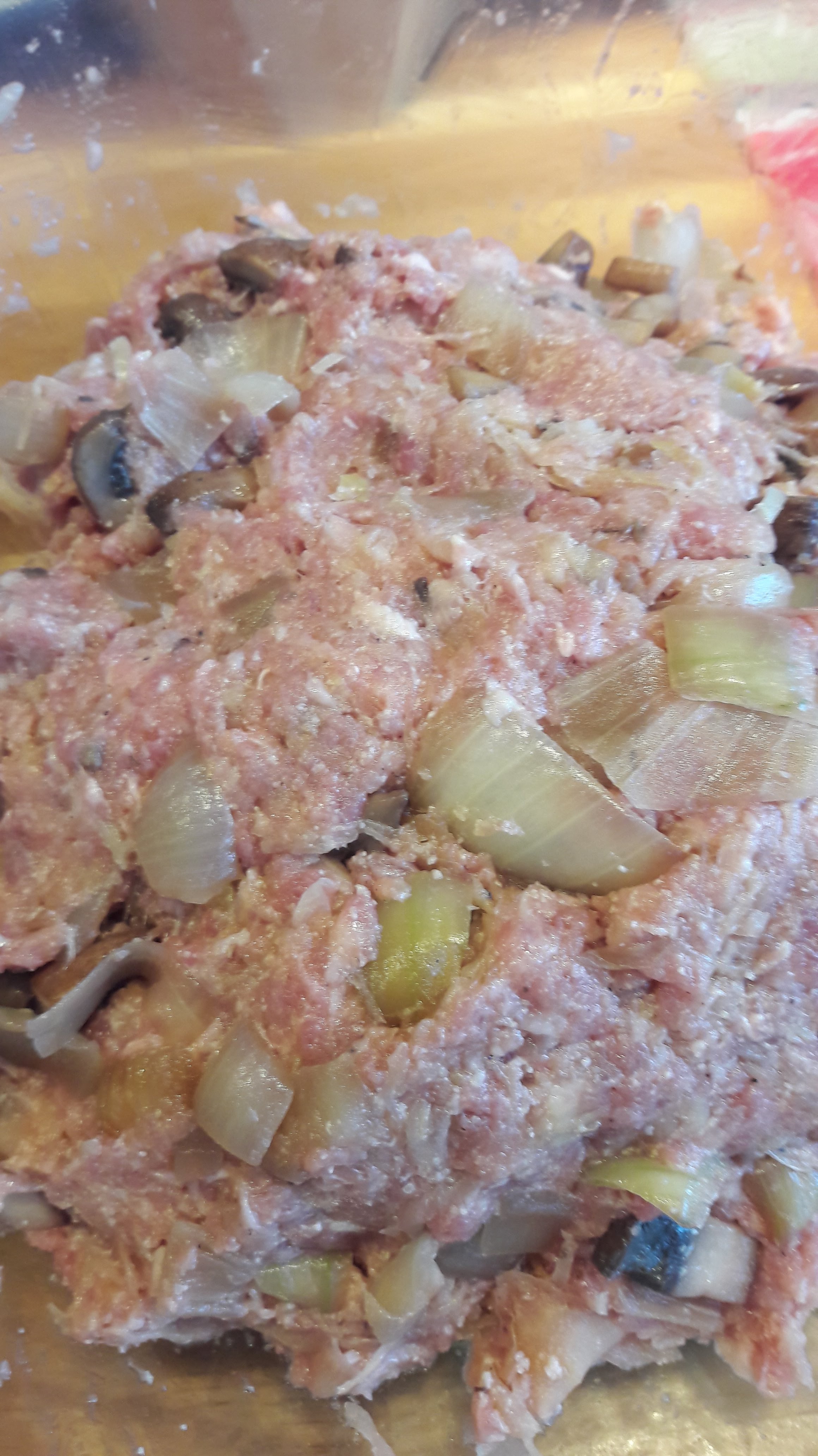
  • In a large bowl mix the minced meat and cabbage till they are evenly mix.
  • Add the fried onions and mix again.
  • Add the eggs and mix.
  • Add the semolina, salt and pepper and mix until you get a uniform mixture.

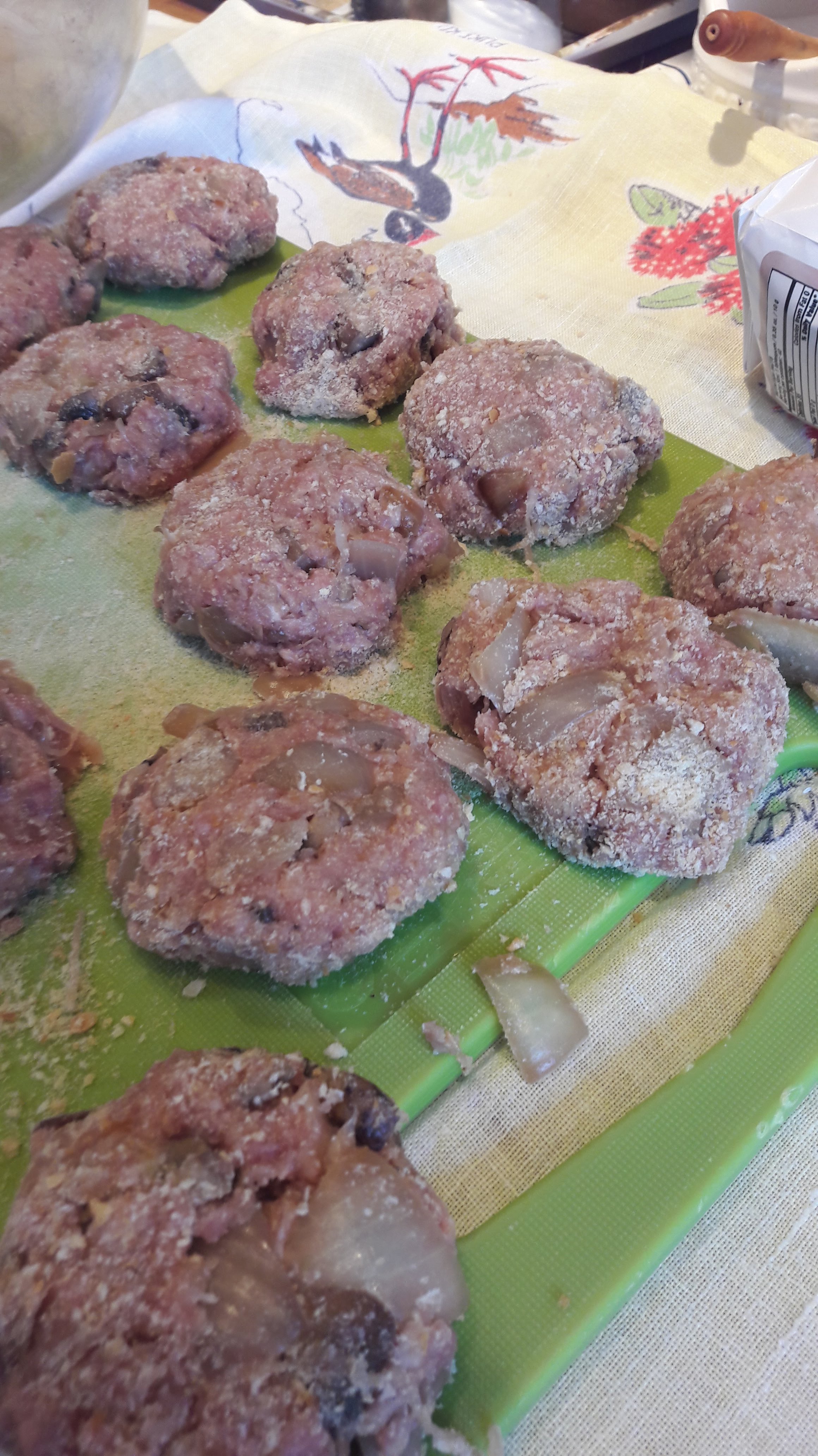
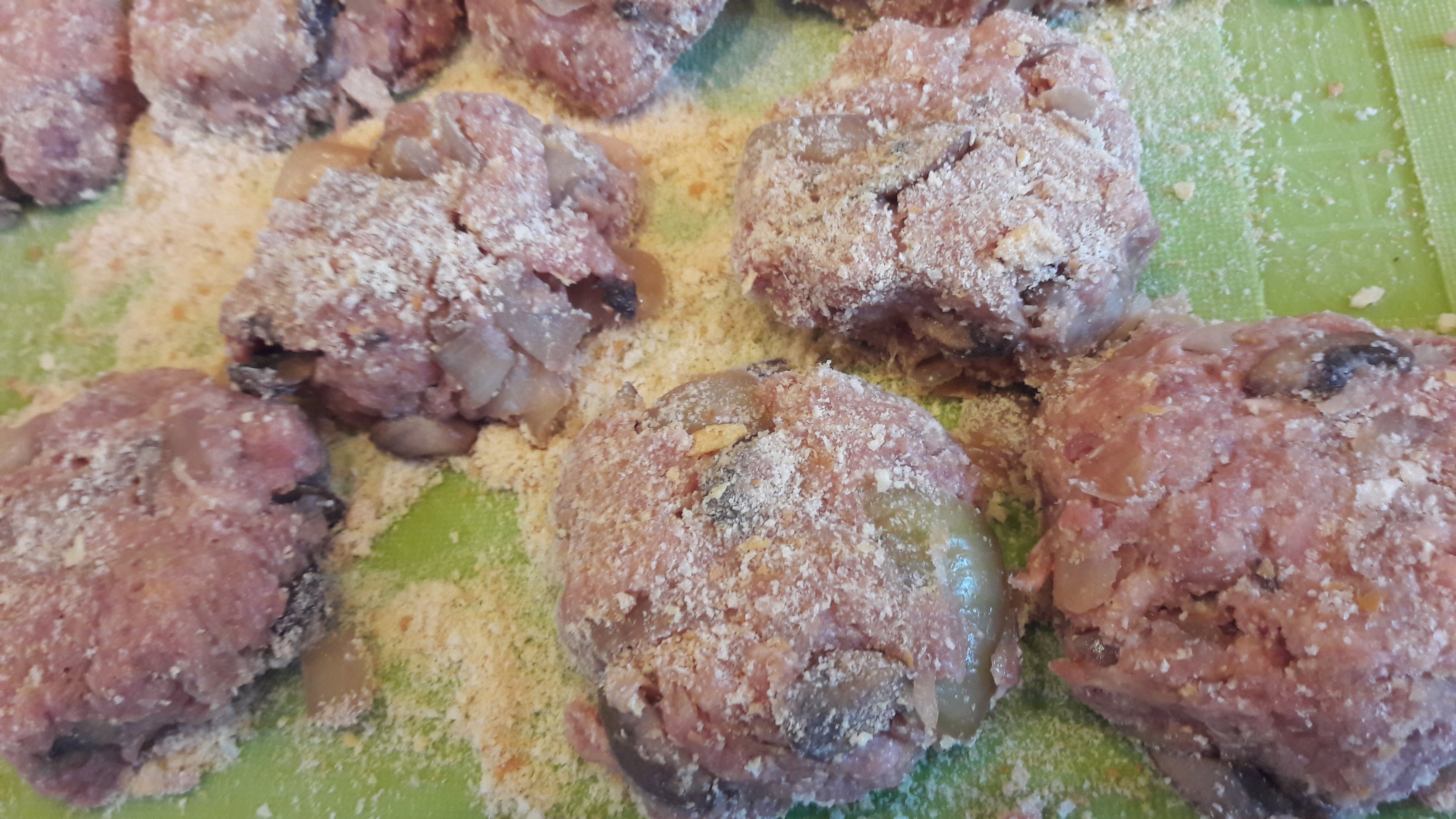
Try to make each one the same size, take a handful of the mixture and press it between your hands to make a flattened circle and then place this in the dried breadcrumbs and turn it over to cover both sides and edges.

  • Once coated place them on a tray dusted with breadcrumbs until you have used all the mixture up.
  • Shallow fry the kotlety in hot oil, depending on the frying pan size,  you can do 3 to 4 at a time, turning them over so that both sides are done. Place them on kitchen roll on a plate or metal tray till they are all cooked –  you can keep them warm in a low oven.
  • I had found I like these more when they have been in the oven for a while after frying – evenly cooked through.
  • These can be served in many ways, with boiled or mashed potatoes or rice and a variety of salads.

20180127_185749

Served  here with steamed & buttered new potatoes and carrot & apple salad – on

Royal Doulton – Carnation – 1982 – 1998.

Version 2 – using Cooked Cabbage

Whilst doing some research on this recipe,  I found that some cooks used cooked cabbage rather than raw.

Ingredients

As above but this time with 400g – 500g of uncooked white cabbage  (around the same weight as the minced meat).

Method

  • Chop the cabbage into large pieces and steam it till cooked.
  • Dry the cabbage with a clean tea towel to get rid of as much water as possible.
  • Chop the cabbage into very fine pieces.
  • Proceed as in the method above.

Note

For both versions, should you have any left,  you can reheat them in sauce made with chicken or vegetable stock.

Ribs with Cabbage

Once when on a visit to my late cousin, Krystyna, in the Mazurian lakes, many years ago, she made this dish with pork ribs.


The Mazurian Lakes – The Land  of a thousand lakes in North East Poland.

Maybe because it was the summer time or maybe the type of pork but I remember this meat as being so flavoursome.

It was as a really delicious meal  with the meat just falling of the bones  and we ate the ribs with lovely mashed potatoes.

Use the best pork you can buy – I used some locally reared Yorkshire pork.

Ingredients

1 or 2 racks of pork ribs

2  carrots – coarse grated

2 onions – sliced thinly

Half a head of a small cabbage – cut into fine shreds.

3-4 allspice berries

3-4 peppercorns

2 cloves of garlic – chopped

500ml of chicken stock & more for top-up (can be from a cube or concentrate)

Method

Pre-heat the oven to GM4 – 180°C.

Use a large oven proof dish with a lid.

Put the carrots, onions and cabbage into the dish.

Add the allspice, peppercorns and garlic

Pour the stock over the vegetables.


Place the ribs so they sit on top of the vegetables.

Put the lid on top and cook in the oven for several hours.

Check occasionally and add more stock if required.

Lower the temperature of the oven to GM 2 – 150°C for a few more hours-  OR – take out of the oven and reheat for several hours at  GM4 – 180°C the next day.

Tomato Variation

After the original cooking – the next day add stock which has had 2 to 3 tablespoons of tomato puree added to it.


Zrazy – made with Minced Meat

These zrazy are like the ones made with braising beef in that the minced meat mixture surrounds various stuffings.

The minced meat mixture  is similar to kotlety mielone  &  pulpety – but  zrazy are cooked differently.

You take a large handful of minced meat mixture , place the stuffing on it and then close up the mixture so you have an oval shape with the stuffing on the inside.

Ingredients

500g minced beef

1 beaten egg

4 tablespoons of semolina

1 onion chopped and fried

Salt & pepper

plain flour for coating

Sunflower oil for frying

Stock

500ml of chicken stock

1 -2 bay leaves

3-4 Peppercorns

2-3 Allspice berries

Stuffing

Two stuffings often used are –

Pieces of bottled peppers


Sticks of Gouda cheese or similar

20180130_120003

Method

Pre-heat the oven to GM 3 – 160°C

Mix the beef, fried onion, egg and semolina together.

Season with salt & pepper.

Divide the mixture into around 6 pieces

Flatten out each piece and place the stuffing in the centre.

Close up the mixture around the stuffing to make an oval shaped ball.

Dust the ball with plain flour.


Lightly seal these by browning then in hot oil.


Place the zrazy into an oven proof dish – one that has a lid – so they are not touching.

Pour in the stock – enough to have some at the bottom but do not cover the zrazy.


Put the lid on and cook in the oven for 1 -2 hours.

Sauce

You can thicken the stock that the zrazy are cooked in with cornflour or you can add other ingredients such as fried mushrooms and soured cream when you come to serve them.


Two shown here – cut through – one with cheese & one with peppers,  served with a mushroom and soured cream sauce.

Served on Royal Doulton  Carnation – 1982-1998


Placek with Cranberries, Chocolate & Nuts

After Christmas I found  I had lots of dried cranberries & nuts left from other recipes.

So I decided to make a variation on my placek (flat cake) with chocolate, nuts & sultanas

Ingredients

  • 120g butter
  • 120g Demerara sugar
  • 2 eggs
  • 120g plain flour
  • 1 teaspoon of baking powder
  • 1/4 teaspoon of vanilla essence
  • 100g dried cranberries
  • 100g chopped chocolate (a mixture of dark & white)
  • 80g chopped nuts

Method

  • Grease and line a 21 x 26 cms baking tray.
  • Pre-heat the oven to GM4 – 180°C
  • Chop the nuts and the chocolate.
  • Mix the nuts, chocolate & cranberries together.
  • Cream together the butter and Demerera sugar.
  • Mix in the vanilla essence and the eggs.
  • Mix in the nut mixture.
  • Mix the baking powder with the flour.
  • Gently fold in the flour.
  • Put the mixture into the baking tray.
  • Bake for around 30 – 35 minutes.
  • Leave to cool in the tin.
  •  

Cut into squares to serve.

Served on Queen Anne tea plates – design name unknown.

Updated on 27 July 2023

I used just white chocolate in the recipe and chopped almonds.


Heathcote Cake Stand

Zrazy – Meat Roll-ups

Zrazy (this word is plural) is a meat dish popular in Eastern Poland & Lithuania and can be traced back to the 16th & 17th century in the times  of the  Polish-Lithuanian Commonwealth (1569 – 1795).

(I have seen zrazy  translated as Meat Roll-ups, Meat Olives or Collops)

Classic zrazy have a rolled shape and are made of thin slices of  beef,  beaten with a mallet, which are stuffed with a variety of ingredients including  mushrooms.

You need to use beef which is good for  braising and slow cooking  –  I used a thin cut of topside and this worked very well.


The stuffed meat is rolled and secured with thread or thin string, then lightly fried and placed in a casserole dish with stock and slow cooked at a low temperature.


Stock

For the stock,  I  use chicken or vegetable stock (this can be from a stock cube or powder)  and add bay leaves, whole peppercorns and sometimes whole allspice.


Prior to serving, the threads are removed.


Zrazy are eaten with the sauce in which they were cooked, though extra ingredients can be added to this such as  soured cream, mushrooms or tomato.

You can add some cornflour to thicken the sauce.

Po nelsońsku  –  in Lord Nelson’s style –  is when mushrooms and soured cream are added to the sauce. (I have not been able to discover why this name is used.)


Here served on Royal Doulton – Carnation – 1982 – 1998

Zrazy are often served with buckwheat or boiled potatoes, and beetroot or sauerkraut salad.

Classic Ingredients for the Stuffing

There is no end to the variety of fillings you can use, the following are two traditional ones.

The amounts you need will vary according to how many zrazy you are filling – these are a guide to proportions.

Onions & Rye bread

1/2 slice of rye bread – made into breadcrumbs

1 onion – chopped and fried in butter till golden

1/2 teaspoon of caraway seeds

Salt & pepper

You can spread a little made up mustard onto the meat first.


Dried Mushrooms

20g dried mushrooms  – add around 250ml of boiling water and soak these overnight – chop into small pieces then simmer in the liquid.

1 onion – chopped and browned in butter till golden

Add the onion to the mushrooms and continue simmering till most of the liquid is gone.


Add salt and pepper to taste.


A Little Caper!

Capparis spinosa is the caper bush.  The plant is best known for the edible, unripened  flower buds – capers – kapary (in Polish)  which are often used as a seasoning and are usually  pickled in brine, vinegar or wine.

These perennial plants are native to the Mediterranean and some parts of Asia. Their use dates back to around 2,000 BC  where they are mentioned as a food in Sumerian literature.

The caper buds are picked by hand which can make the cost of a small jar expensive.

Pickled nasturtium (Tropaeolum maius) (nasturcja in Polish)  seeds – often called poor man’s capers are a good substitute.

Cooking With Capers

Capers have long been used in the Mediterranean region especially  in Italian cooking.

Capers are usually  added to the dish toward the end of the cooking process, to keep their shape and flavour.

Sos kaparowy – Caper sauce

This is very popular in Poland and is made with chopped capers and mayonnaise  and is served with hard-boiled eggs.

Potato Salad with Capers

This is my variation of the classic Polish potato salad with caper  sauce.

Ingredients

  • 200g  waxy potatoes
  • 100g whole green beans
  • 100g peas
  • 2-3 spring onions – green part
  • 2 tablespoons of capers – drained
  • 2-3 tablespoons mayonnaise – home-made or a good full fat bought variety
  • 1 tablespoon of made up mustard
  • Salt & pepper
  • 2 – 3  hard-boiled eggs

    Method

  • The potatoes, green beans and the peas all need to be boiled or steamed, drained and then dried as much as possible using a clean tea towel.
  • I usually use starchy potatoes for potato salad but have found that waxy ones are better for this one.
  • Chop the beans into small pieces.
  • Chop the green parts of the onion into fine pieces.

Mix together the mayonnaise and the mustard.

I have found that the lighter sort of mayonnaise soon makes this salad have a watery dressing after a very short time.

It is better to use home-made mayonnaise or a good bought one – I use Hellmann’s.

  • Mix the vegetables with the dressing and add salt & pepper to taste.
  • Chop the hard-boiled eggs and scatter these on the top of the salad to serve.

Served here in a bowl by Meakin  –  Cadiz  – 1964  – 1970

Pasta Salads

The general word for pasta in Polish is makaron .. from the Italian macaroni or maccheroni which is thought to originate from the Greek makariafood made from barley.

You need some cooked pasta – small shapes are the best – I often use Fiorelli – little tubes with lacy edges.


When I am cooking some pasta for a meal,  I often do a bit more so I have some left to make a salad the next day.

Try not to over cook the pasta.

The weight of dry pasta will result in around double the weight of cooked pasta  eg 250g of dry pasta will result in around 500g of cooked pasta.

I find that mayonnaise or mayonnaise based dressing  are best with these salads.

Cooked vegetables work well with these salads and also tinned or bottled vegetables and so it is a good store cupboard dish.

Below are several ideas – but you can do many variations – I always use a few different colours to make it look attractive.

Pasta, Peppers & Sweetcorn Salad

  • 400 – 500g cold cooked pasta.
  • 1 small tin of sweetcorn, drained (or frozen loose sweetcorn – cooked)
  • 1 or 2  fresh red peppers or 2-3 pieces of  bottled peppers.
  • 1-2 tablespoons of mayonnaise
  • Salt & ground back pepper

20171108_094335


IMG_20150819_064345546


Method

  • In a large bowl mix the pasta and sweetcorn together.
  • If using fresh peppers then remove the stalk and the seeds and chop the flesh into small pieces.
  • Blanch the peppers by putting them in a dish with boiling water and letting them stand for about 10 minutes then drain and pat dry.


  • If using bottled peppers then drain them from the liquid and cut into small pieces.
  • Add the peppers to the salad mixture.
  • Mix in the mayonnaise.
  • Add salt & pepper to taste.


Pasta, Peas, Peppers  & Sweetcorn Salad

Ingredients

  • 400 – 500g cold cooked pasta.
  • 1 small tin of sweetcorn, drained (or frozen loose sweetcorn – cooked)
  • 1 or 2  fresh red peppers or 2-3 pieces of  bottled pepper
  • 150g of cooked frozen peas
  • 1-2 tablespoons of mayonnaise
  • Salt & ground back pepper.

Method

Make the salad as above then add the cooked peas and mix well


Pasta, Peppers & Sweetcorn Salad with Tuna

  • 400 – 500g cold cooked pasta.
  • 1 small tin of sweetcorn, drained (or frozen loose sweetcorn – cooked)
  • 1 or 2  fresh red peppers or 2-3 pieces of  bottled peppers.
  • 1  x  145g tin of tuna chunks in oil or brine – drained
  • 1-2 tablespoons of mayonnaise (variation –  add half a teaspoon of tomato puree or even hot pepper sauce)
  • Salt & pepper to taste – you will need less salt if you are using the tuna in brine.

Method

  • Make the salad as in Pasta, Peppers & Sweetcorn Salad up to the addition of the mayonnaise.
  • Break up the tuna into smaller pieces and add this to the salad and mix it in.
  • Add the mayonnaise.
  • Salt & pepper to taste – (you will need less salt if you are using the tuna in brine).

20180114_165443

Variations

Add some chopped chillies to the mixture – I use  green ones to differentiate them from the red peppers.

Pasta, Peas, Peppers & Sweetcorn Salad with Tuna

Ingredients

  • 400 – 500g cold cooked pasta.
  • 1 small tin of sweetcorn, drained (or frozen loose sweetcorn – cooked)
  • 1 or 2  fresh red peppers or 2-3 pieces of  bottled pepper
  • 150g of cooked frozen peas
  • 1  x  145g tin of tuna chunks in oil or brine – drained
  • 1-2 tablespoons of mayonnaise
  • Salt & ground back pepper.

Method

  • Make the salad as in Pasta, Peas, Peppers,  & Sweetcorn Salad
  • Break up the tuna into smaller pieces and add this to the salad. and mix it in
  • Salt & pepper to taste – (you will need less salt if you are using the tuna in brine).

20180114_170929

Pasta, Peas, Peppers & Sweetcorn Salad with Polish Smoked Sausage.

Ingredients

  • 400 – 500g cold cooked pasta.
  • 1 small tin of sweetcorn, drained (or frozen loose sweetcorn – cooked)
  • 1 or 2  fresh red peppers or 2-3 pieces of  bottled pepper
  • 150g of cooked frozen peas
  • 200g of Polish smoked sausage or ham
  • 1-2 tablespoons of mayonnaise
  • Salt & ground back pepper

Method

  • Make the salad as in Pasta, Peas, Peppers & Sweetcorn Salad.
  • Slice the sausage into thin slices and then chop these into halves and quarters.
  • Add this is to the salad and mix in
  • Salt & pepper to taste.

IMG_20160302_063114078


20180114_171331


Hard Boiled Egg Garnish

1 or 2 hard boiled eggs can be chopped and used to garnish the tuna or smoked sausage salads.


Lemon Cream Roulade

This cake is a roulade – in Polish  – rolada.

I made this cake for my nephew when he came to visit recently as he loves cakes with lemons.

You need to make the sponge for a “Swiss roll” and then fill it with lemon cream.

The sponge cake made using potato flour is very Polish but fresh double cream is not usually found in Polish cookery – soured cream is the norm.  Also lemon curd I think of as quite British although I did come across something similar in one of my Polish cooks books.   You can make your own lemon curd but I  use Sicilian lemon curd from Marks & Spencer as I think this is so lemony.


I made the sponge using the recipe  Biszkopt – Sponge Cake using Potato Flour

Or to be easier, use the English Style fat free sponge recipe from

Sponge with Sweet Orange Jam

Use the instructions for how to make and roll the roulade from the first recipe.

Both of  these recipes use 2 eggs.

Lemon Cream

I used a large tub of double cream 250ml/300ml – it was more than enough – I did not use it all.

I would think that 200ml of double cream would be enough.

I  whisked this up till it was thick and stiff.

I then added 3 -4 tablespoons of lemon curd and whisked again.

Unroll the cold sponge, spread it with the cream and roll up again.

Dredge with icing sugar


Cake Plate H & K Tunstall


Served on – Tuscan China – Bird of Paradise – Hand Painted – 1930s


Lemon Drizzle Cake

This is not a Polish recipe but my nephew loves cakes with lemons and after trying many versions this is the one I baked for him especially when he came to visit recently.  I will be sticking with this recipe from now on.

Ingredients – Cake

  • 175g butter or block margarine
  • 175g caster sugar
  • 3 eggs
  • Zest of 2 lemons
  • Juice of 1 lemon
  • 160g self-raising  flour

Ingredients – Drizzle

  • Juice of 1 lemon
  • 110g caster sugar

Method

  • Grease and line a large (2lb) loaf tin – or use a ready bought liner.
  • Pre-heat the oven to GM 4 – 180oC
  • Cream the butter and sugar till soft and fluffy
  • Add the lemon zest and mix again.
  • Add the eggs, 1 by 1, and mix well.
  • Add the juice of 1 lemon and mix well.
  • Fold in the flour with a metal spoon.
  • Put the mixture into the loaf tin and gently level the top.

  • Bake for around 50 – 60 minutes – check after 40 minutes and cover the top with greaseproof paper if needed to prevent the top burning.
  • Leave to cool slightly in the tin and then remove and place on a cake rack and allow to cool a little more.
  • Prepare the drizzle by mixing the sugar and lemon juice until it dissolves.
  • Remove the greaseproof paper or liner and place the cake onto a plate (a long rectangular one with a lip around the side is the best ) so that the base is flat and excess drizzle does not run off.
  • Prick the top of the cake with a skewer
  • Gently spoon all the drizzle over the top of the cake

Save