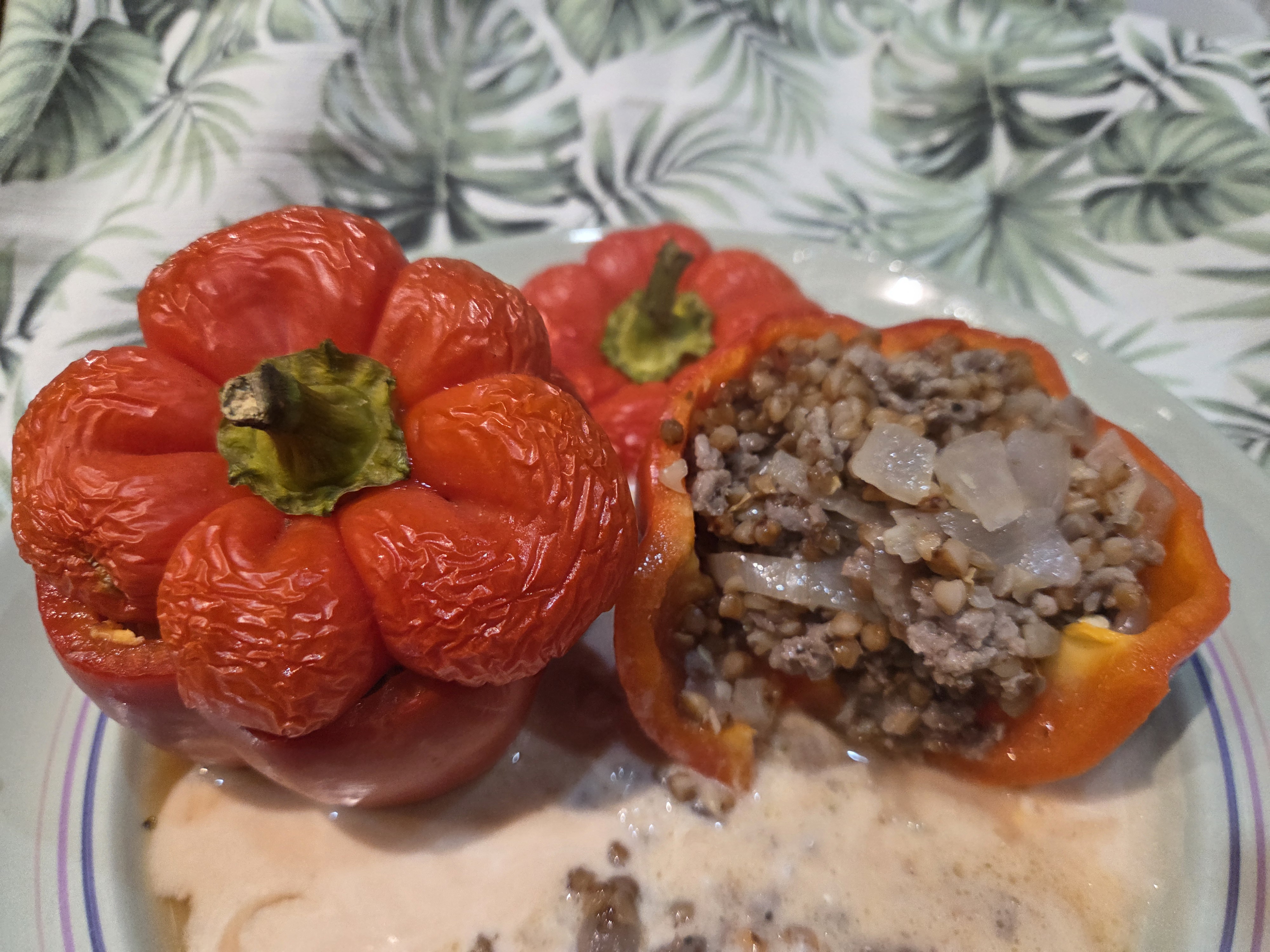
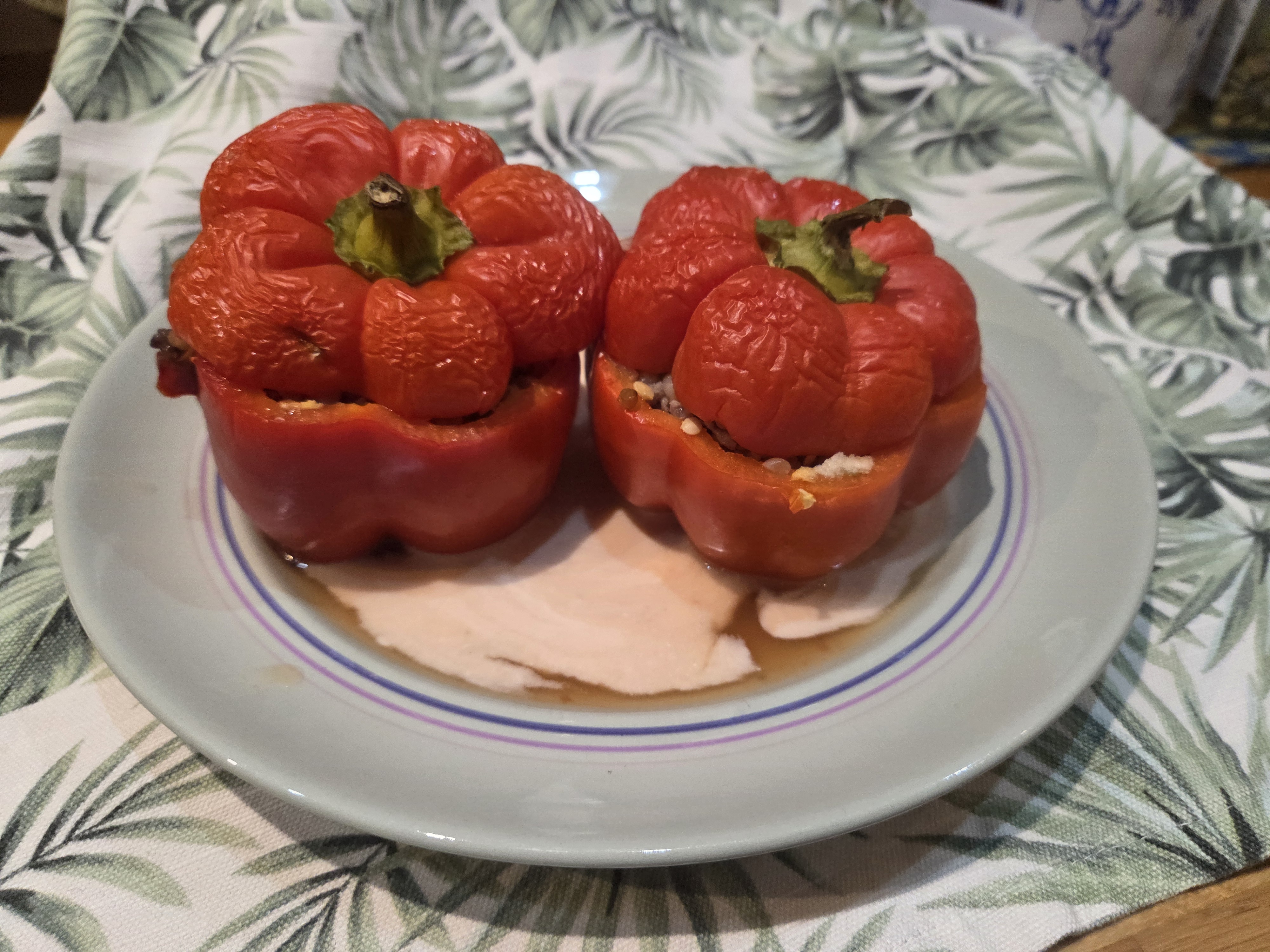
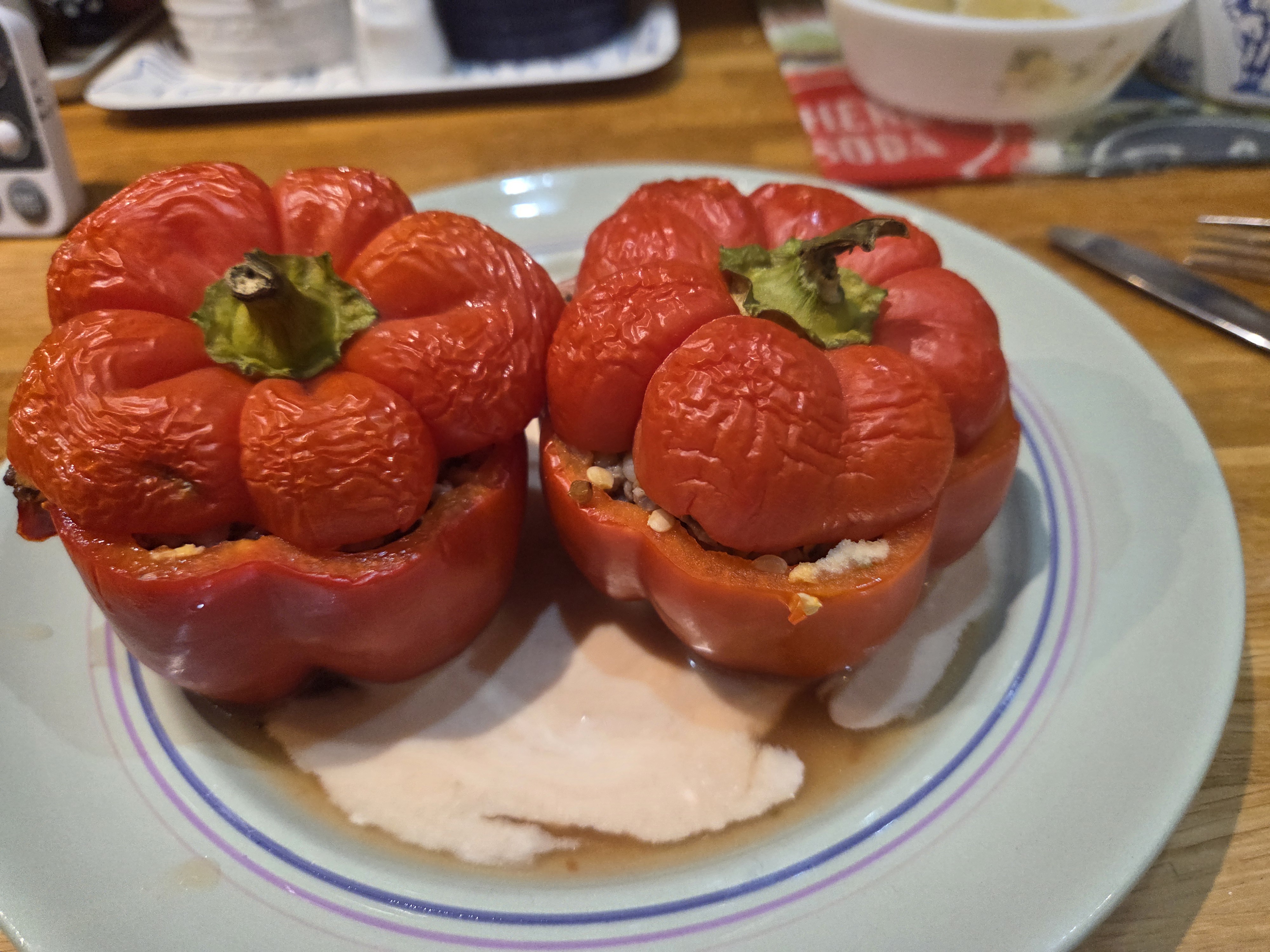
When I was served this in Poland, the peppers were really big and smelt wonderful.
You can vary the stuffing to suit but I will write up the dish I was served.
Cooked buckwheat or rice is used.
INGREDIENTS
4 to 6 large red peppers
100g cooked buckwheat or rice
1 large onion – chopped and lightly fried
2 cloves of garlic – chopped.
200g – 250g minced beef
*
Salt & pepper to taste.
Dried marjoram or mixed herbs
*
Vegetable stock – can be from powder or a cube
2 tablespoons of tomato purée or tomato ketchup
1 teaspoon of ground paprika
2-3 tablespoons of soured cream
METHOD
Pre- heat the oven to GM3 – 150°C.
Cut the tops of the peppers and keep to one side.
Scoop out the seeds from the peppers.
Put the peppers into a roasting tray.
Add some of the vegetable stock to the base.
Cook for around 10 minutes to soften the peppers.
Leave to cool slightly.
Turn up the oven to GM4 – 180°C
Mix together the cooked buckwheat(or rice) with the minced meat, onion, garlic, marjoram or herbs.
Season to taste.
Fill each pepper with the filling and put on the tops.
*
Add the rest of the vegetable stock and add the paprika and tomato purée or ketchup and stir.
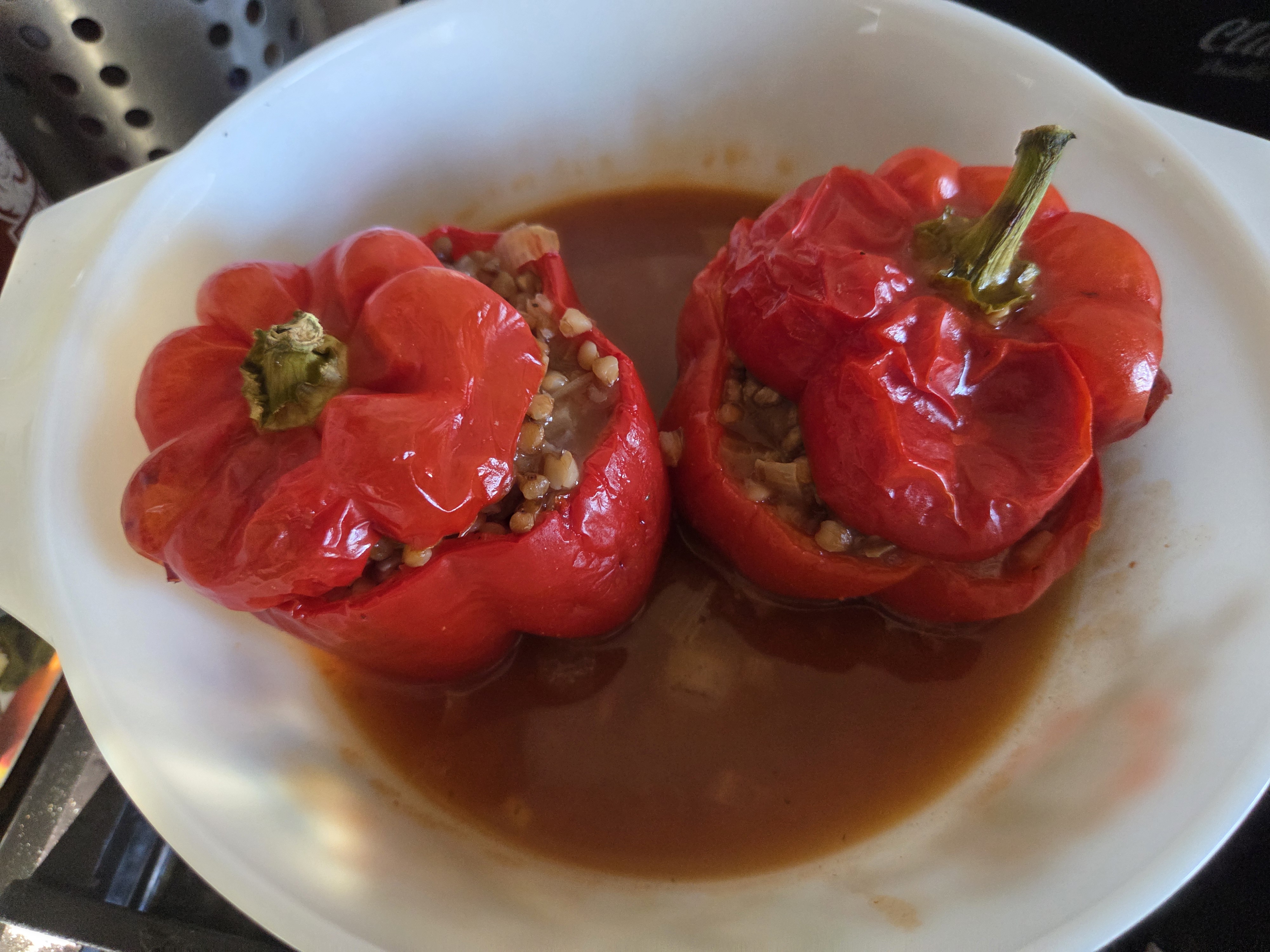
Put the peppers to stand in the stock mixture.
Put back into the oven and cook for around 1 hour.
You might need longer so the peppers are softish.
*
Add the soured cream to the stock mixture to make a sauce.
If you think you will have any left – before adding the soured cream put them into an ovenproof pyrex dish with a lid with some tomato stock liquid – you can reheat them the next day in a microwave and them add some soured cream.
These were so delicious and I am planning to try out some different fillings soon.
I love goląbki – but must admit they are time consuming to make.
I came across this idea of using all the ingredients and making them into large kotlety( meatballs) cooking them in stock and then adding a tomato sauce.
I love goląbki – but must admit they are time consuming to make.
I came across this idea of using all the ingredients and making them into large kotlety( meatballs) cooking them in stock and then adding a tomato sauce.
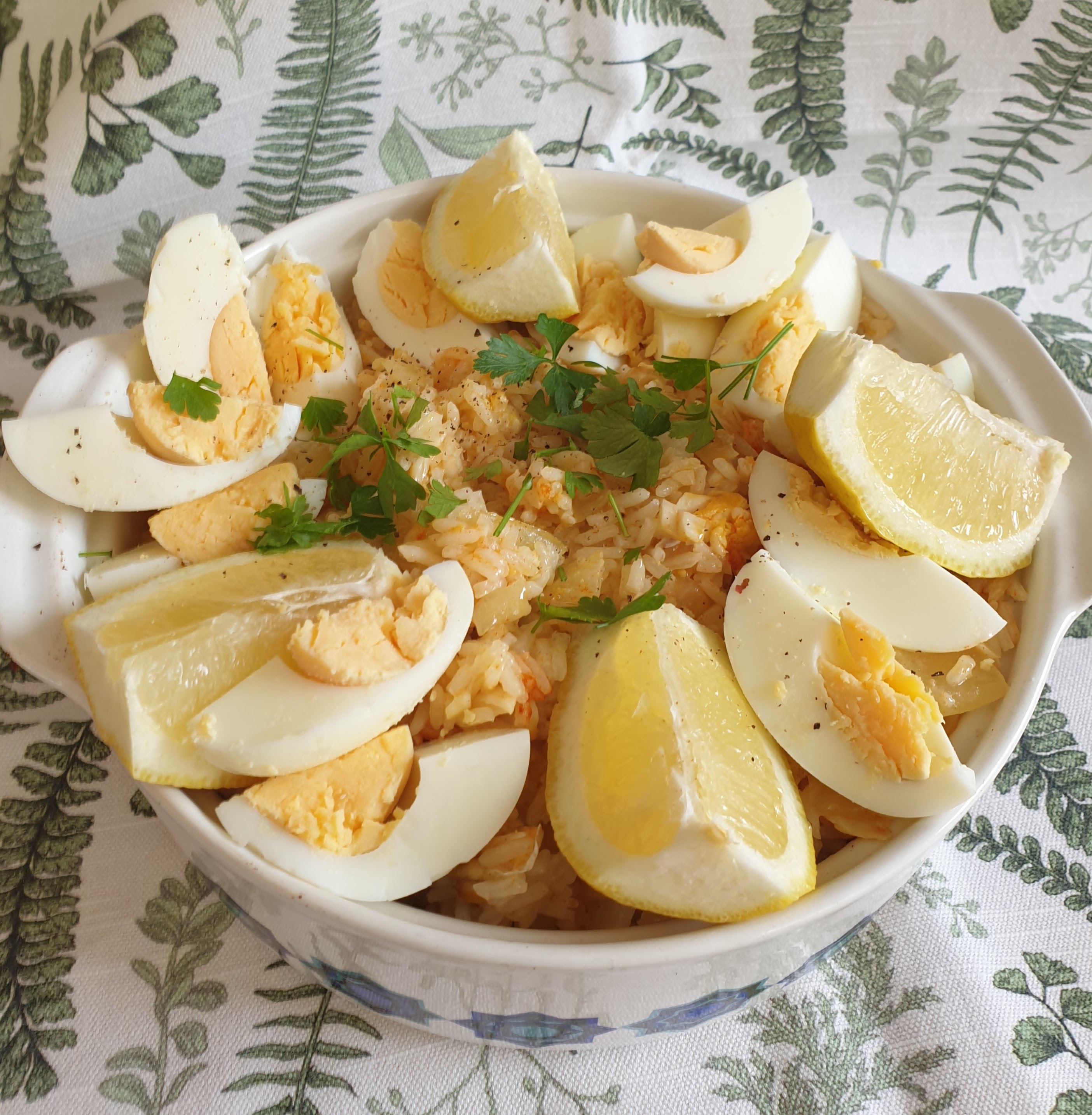
This dish was very popular in Victorian times in Britain.
It originated in India and was often served for breakfast.
It originated in India and was called –‘khichari’.
It was started as a dish with rice, fried onion, lentils and eggs.
Over time, the lentils were left out and fish was added.
There are many different recipes but they all include: boiled rice, fish (often smoked) and hard boiled eggs. Paprika, cayenne pepper or curry powder is added.
I made this whilst doing some research into old English recipes.
Everyone loved it and I thought that it would be a “hit” in Poland too.
INGREDIENTS
2 onions – finely chopped
75g butter (do not stint on this)
300ml of vegetable stock
200g-250g long grained rice – boiled
250g-300g smoked haddock
3 – 4 hard boiled eggs – cut into quarters
1 lemon – cut into quarters
1 teaspoon ground paprika or cayenne pepper
Salt and pepper to taste
*
Flat leaved parsley to garnish
METHOD
Poach the fish in the vegetable stock for 6 – 8 minutes.
Remove the skin and flake the fish.
Meantime melt the butter in a large frying pan.
Gently fry the onions till golden.
Add rice and a few tablespoons of the stock.
Add the paprika, stir and continue cooking.
Add the flaked fish and more stock if too dry.
Cook through for a few minutes.
Season to taste.
Serve in a large dish with hard boiled eggs and lemons around the side.
Garnish with flat leaved parsley.
Diners should squeeze lemon juice over their portion.
There are many versions of tomato soup – some people just add tomato puree or a tin of tomatoes to rosół, (chicken bullion). For many this was standard practice on Monday with any that was left over from Sunday lunch and also in winter months in the past when fresh tomatoes were not so readily available.
I prefer to make a more refreshing fresh tomato soup.
Ripe tomatoes make the best soup – if you are lucky enough to have your own from the garden or allotment then these will be great or look out for ripe tomatoes on a market rather than the hard bullet ones often sold for salads.
Many years ago, well before Poland joined the European Union, when there were not as many Poles living in England, one of my English friends went for dinner at at a Polish lady’s house. On telling me about the lovely food she said ” ….we had tomato soup with rice in it!” My instant reply without thinking was “but tomato soup always has rice in it”.
Ingredients
700g – 800g of ripe fresh tomatoes
1 large or 2 medium onions
1.5 litres of vegetable stock – came be from a cube or powder
Salt & ground pepper to taste
A little granulated sugar – optional – might not be needed.
Boiled rice to serve
Method
Pour boiling water over the tomatoes in a bowl and leave to cool.
Skin the tomatoes.
Chop the tomatoes into quarter.
Chop the onion into fine pieces.
Place the tomatoes, onion and vegetable stock into a large saucepan.
Bring to the boil and then put on the lid and simmer for at least 30 minutes.
You want the tomatoes and onions to have cooked away into the liquid -no large pieces left.
Season to taste.
Although sour soups are popular in Poland – tomato soup does not want to be sour. Depending on the tomatoes used, I sometimes add a little granulated sugar.
To serve place a handful of cooked boiled rice into each soup plate.
Served here in my mother’s Crown Devon – Fieldings – Glenwood soup plates – made in England – 1939.
Soup plays such huge part in Polish meals and I will be writing much on the subject soon (I could write a huge book on Polish soups alone).
Soups are usually served with some sort of accompaniments or garnish.
Some soups have traditional accompaniments but every cook will improvise with what they have.
These accompaniments include a wide variety of pasta and noodles, dumplings, rice, potatoes, croutons, hard-boiled eggs, pulpety (little meatballs) chopped, cooked sausage and crispy fried bacon and so on …. the list is endless.
Many of the soups to which these are added are of the clear consommé type.
Pasta, Noodles & Rice
Very small pasta shapes are used or larger pasta is cut into small pieces.
The pasta, noodles or rice are all cooked beforehand and a small amount is placed in the soup dish and hot soup poured over them to serve.
Often a small amount of pasta, noodles or rice is kept back from when they are being cooked for another dish – these are best kept in the fridge.
The chopped eggs are sprinkled on top of the soup or several pieces ‘floated’ on top of the soup when serving.
Krokiety
These are made using pancakes which are filled with sauerkraut & mushrooms, meat or cheese then folded and rolled, then dipped in bread crumbs and fried.
I have found a firm that has these ready made for frying and I think they are good.
I fry them in quite a lot of oil on both sides and then put them in the oven at GM4 – 180°C for around 20 minutes.
I have not made them from scratch myself – I must do this soon .
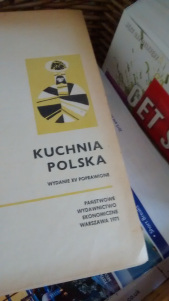
Photo below from my Kuchnia Polska book,1971
Kuchnia Polska, 1971 – Polish Kitchen or Polish Cookery
Pasztecik
This is similar to an English sausage roll, often made with a yeast dough pastry, and filled with pasztet (paté), meat, sauerkraut & mushrooms or cheese.
Photos below from my Kuchnia Polska book, 1971
I have eaten these in Poland in cafes and restaurants but not made these myself – something else to try out soon.
Bread
Bread can be served with soup – it is usually not buttered.
For these salads you will need some cold cooked rice – I use long grained or Basmati rice – but it can be whatever you like to use.
I rarely cook the rice specially – I am more likely to use what is left from a previous meal.
However for these I cooked some rice to see how much was needed.
I find the best dressing for these salads is one based on lemon juice with the addition of some runny honey if you want a little sweetness.
Rice, Peas & Sweetcorn Salad
Ingredients
400g cold boiled rice
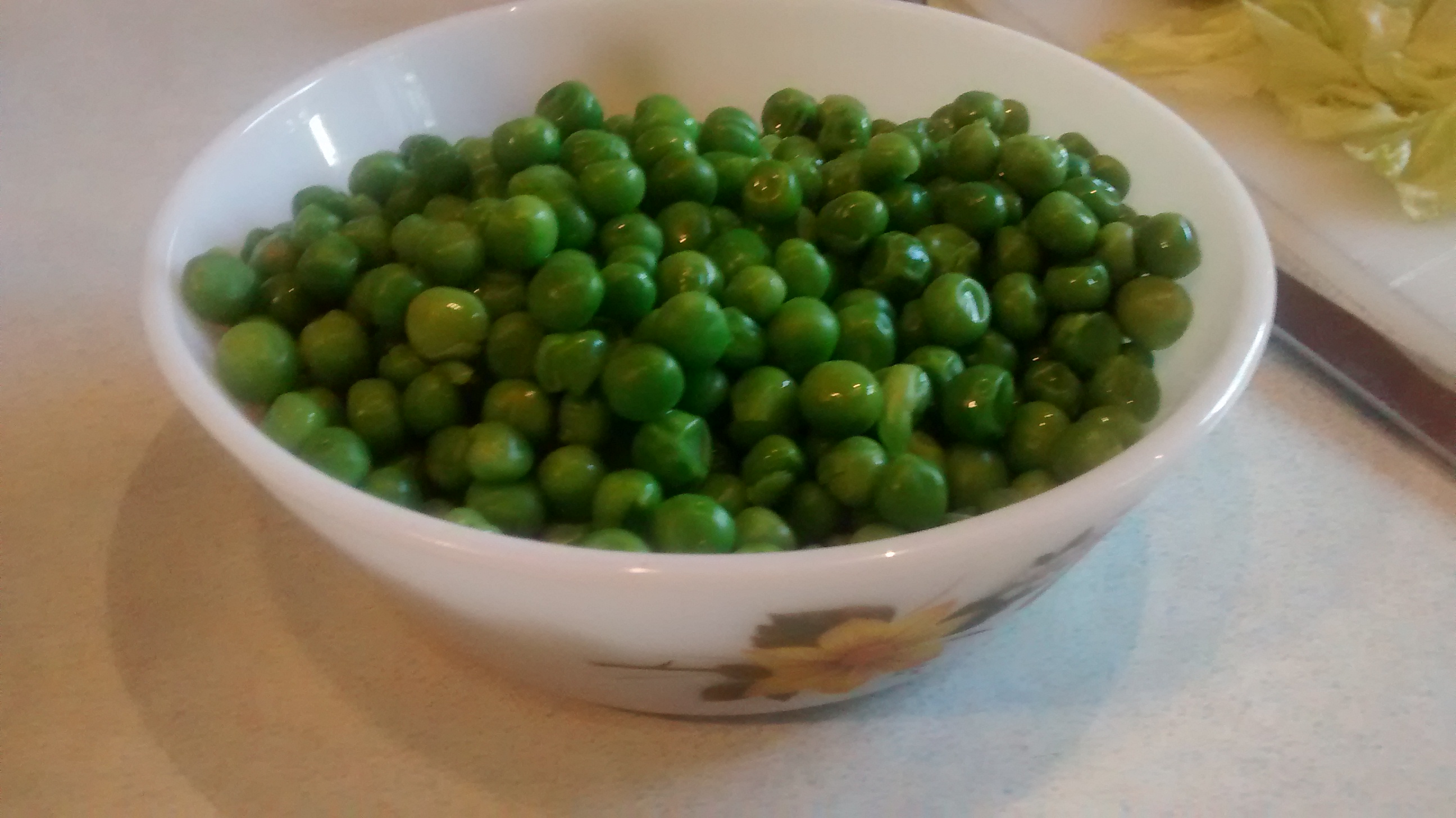
100g of cooked garden peas
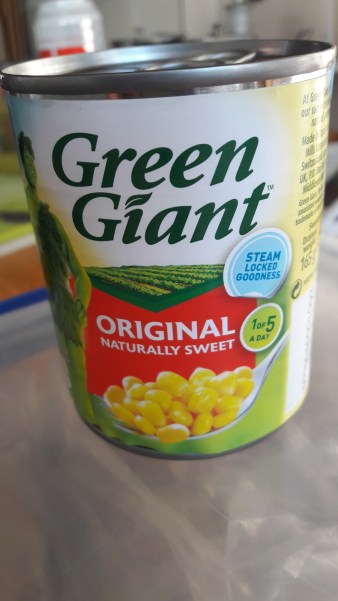
1 small tin of sweetcorn, drained (or frozen loose sweetcorn – cooked)
Juice of 1 lemon
Salt & ground back pepper
1 tablespoon of honey if desired
Method
In a large bowl mix the rice, peas and sweetcorn together.
Pour over the juice of the lemon and mix well.
If you are adding honey then warm about 1 tablespoon gently and mix that in.
Add salt and pepper to taste.
Rice, Peas,Sweetcorn & Peppers Salad
Ingredients
400g cold boiled rice
100g of cooked garden peas
1 small tin of sweetcorn, drained (or frozen loose sweetcorn – cooked)
1 or 2 fresh red peppers or bottled ones
Juice of 1 lemon
Salt & ground back pepper
1 tablespoon of honey if desired
Method
In a large bowl mix the rice, peas and sweetcorn together.
If using fresh peppers then remove the stalk and the seeds and chop the flesh into small pieces.
I often blanch the peppers by putting them in a dish with boiling water and letting them stand for about 10 minutes the drain and pat dry.
If using bottled peppers then drain them from the liquid and cut into small pieces.
Add the peppers to the salad mixture.
Pour over the juice of the lemon and mix well.
If you are adding honey then warm about 1 tablespoon gently and mix that in.
Add salt and pepper to taste.
Inspired in Castor – Rice Salad with Leeks
Not long ago I spent a stitching week in Castor, Cambridgeshire, with a group of super ladies. I was responsible for some of the catering. One evening there was a large amount of leftover cooked rice, peas & sweetcorn, so I decided to make this into a salad with other ingredients we had in the kitchen.
This turned out to be a delicious salad and it got a lot of approval & I will certainly be making this again.
Ingredients
400g cold cooked rice
100g Cooked peas
1 small tin of sweetcorn – drained (or frozen loose sweetcorn – cooked)
1 -2 Grated carrots
1 grated eating apple
1 -2 leeks
Green part of spring onions – chopped fine
Flat Leaf parsley – chopped fine
Salt & ground back pepper
Juice of 1 – 2 lemons.
Flat Leaved Parsely
Method
Chop the leeks as fine as you can into circles and then cut these into half and put them into a large dish.
Cover the leeks with boiling water and leave them to stand until the water is cool.
Strain the leeks, leave them to cool down completely and then dry them with a clean tea towel or kitchen roll.
Mix the rice, apple & vegetables together in a large dish.
Pour the lemon juice over the salad.
Add salt and pepper to taste.
This was served with a beef in beer gulasz (casserole) & the salad provided a good balance against the richness of the casserole.













 Journey From A Polish Kitchen