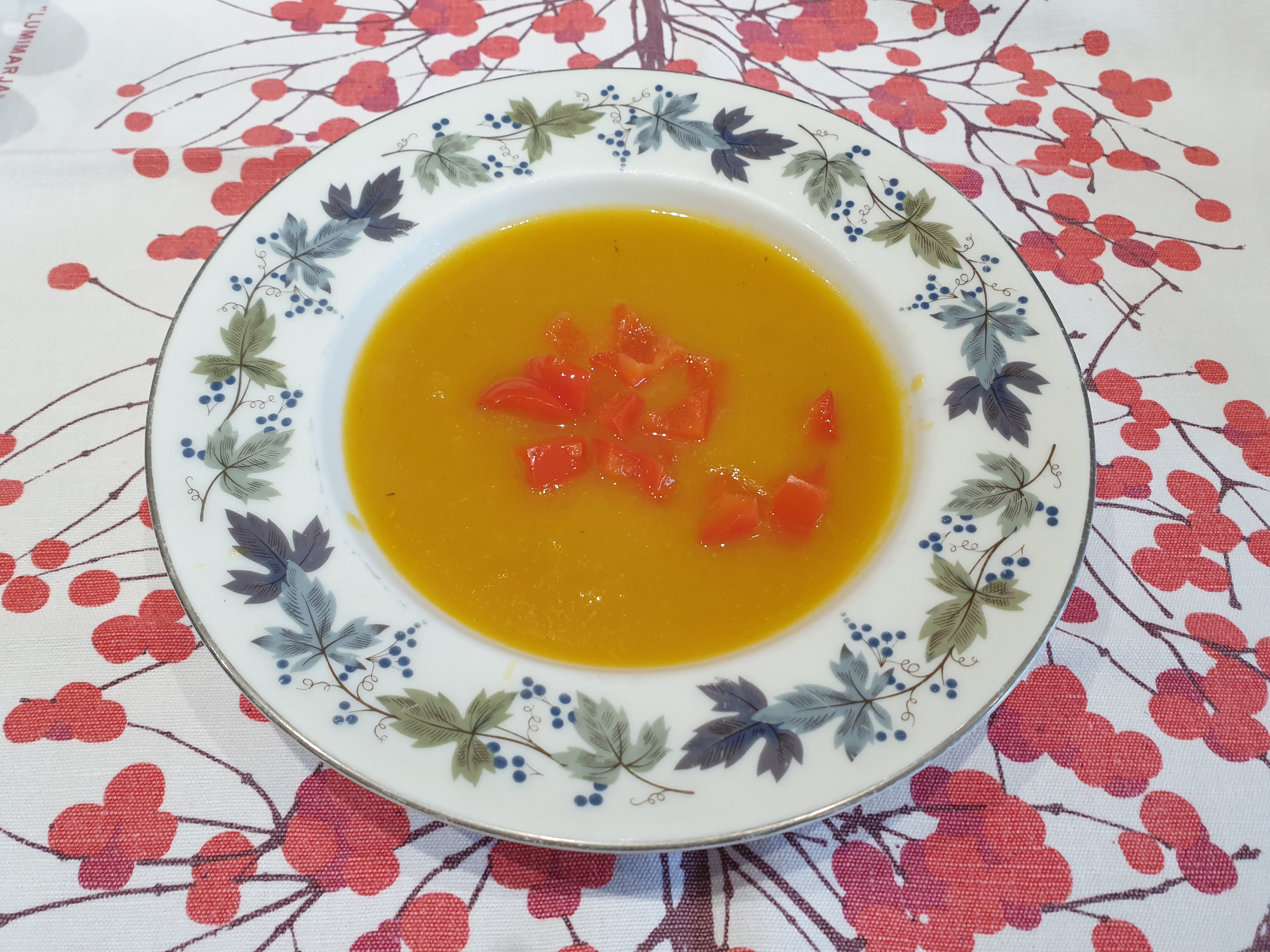
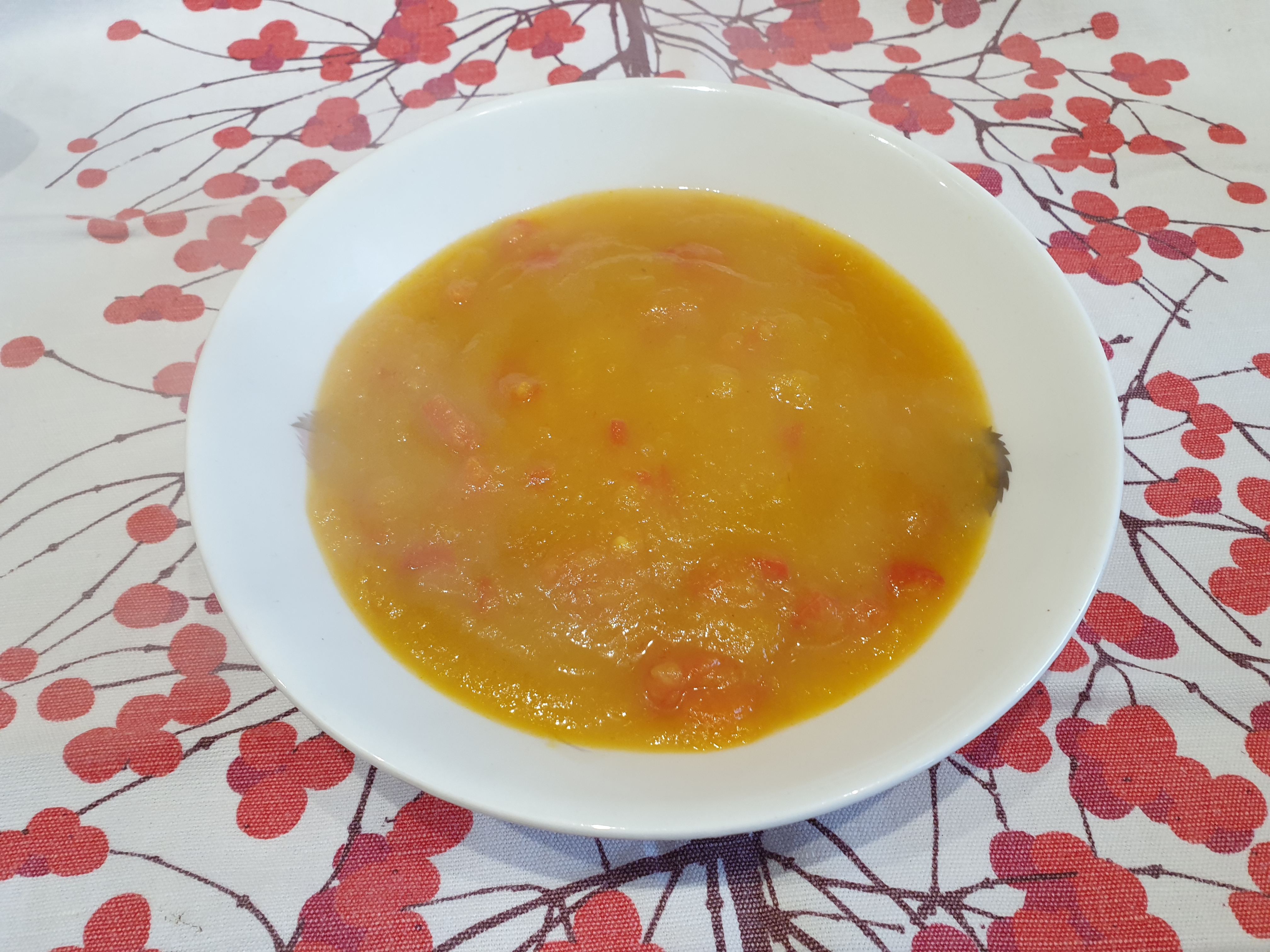
Butternut Squash Soup

  • I was looking for a recipe for pumpkin – dynia in Polish – soup and found one in what I call my Polish Classic “bible”.
  • I will try this out in the autumn but as there are lots of butternut squashes – dynia piżmowa  or dynia orzechowa– in Polish – in the shops at the moment I decided to try this instead.
  • I have never really cooked with butternut squash before and my main piece of advice is to be very careful peeling it.
  • I found it is best to slice off the top and bottom with a sharp knife or cleaver.
  • I found it easier to then cut it into two horizontally  and have the cut surface on a board.
  • Then use a vegetable peeler to remove the skin.
  • The soup has a mild sweet taste.

Ingredients

  • 1 butternut squash
  • 2 onions
  • 2 red or orange peppers
  • 1 ½ litres of vegetable stock
  • Around 3 tablespoons of butter
  • 125ml soured cream
  • Salt & pepper & sugar to taste.
  • *
  • Extra teaspoons of soured cream to serve

Method

  • Peel the butternut squash,
  • Chop the squash into chunks.
  • Chop the onions into small pieces.
  • Chop up the peppers and remove the seeds.
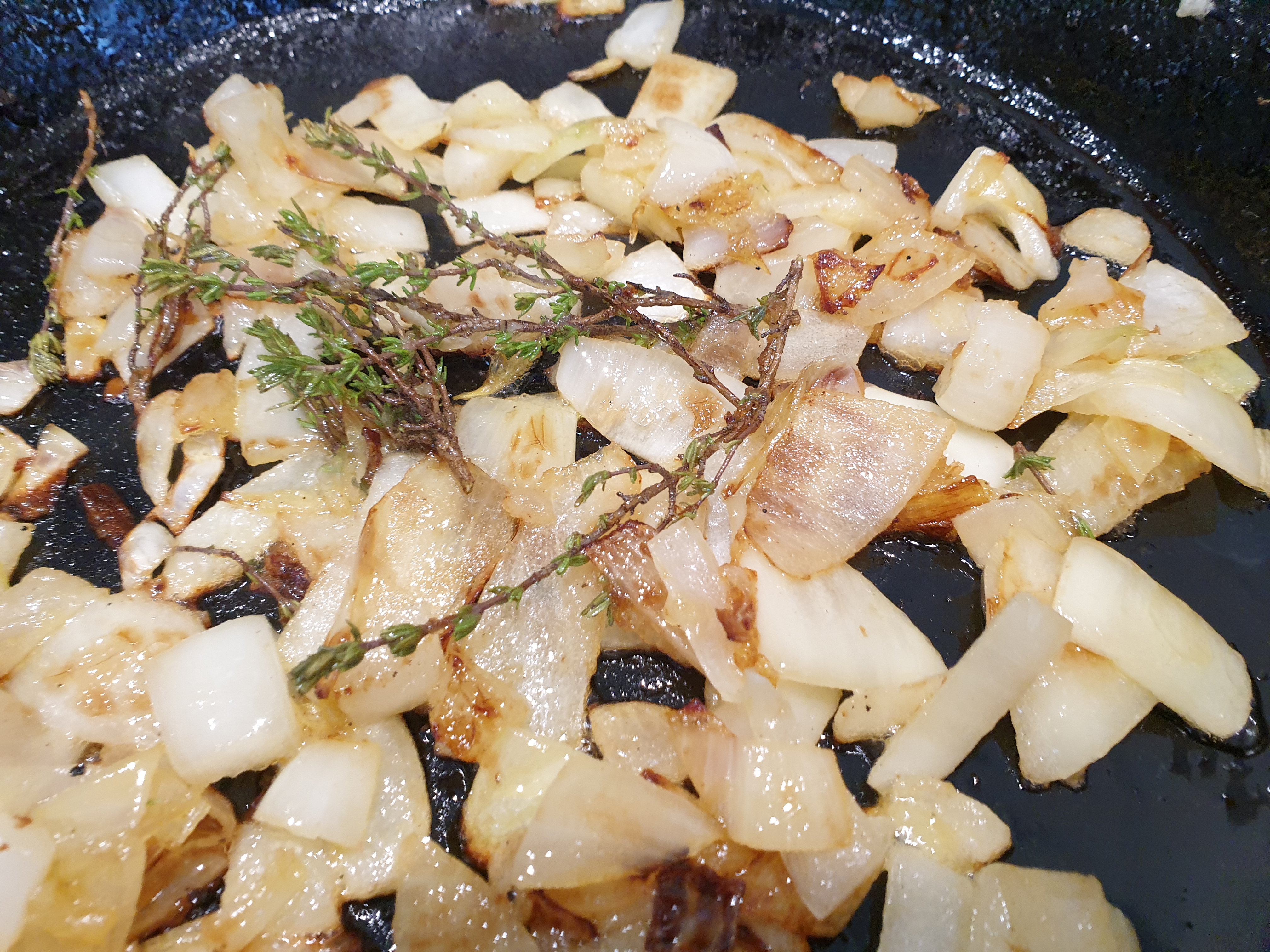
  • Gently fry the onions in the butter till golden,
  • Add the peppers and fry for a minute or two.
  • Add the vegetable stock and simmer for around 10 minutes.
  • Add the butternut squash and simmer for another 10 minutes or so.
  • Use a stick blender to purée the soup.
  • Season to taste.
  • Add the soured cream and stir before serving.
  • *
  • Add an extra teaspoon of soured cream to each serving if you want,

Meakin – Spanish Garden soup dish.

Yorkshire Cake

  • Nearly every Yorkshire cookery book has a version of this light fruit cake.
  • It is usually called ‘cut & come again cake’.
  • It originated as a cake using yeast but by the mid 1800s with the invention of baking powder the recipes became more like this one.
  • In Poland it would be called a keks.
  • Rather than bake it in a loaf tin or a square tin I have found that a lower rectangular tin is good – rather like a placek.
  • It is very easy to make as there is just rubbing in of butter into flour and then the other ingredients are stirred in.
  • The recipe uses brown sugar – not readily available in Poland – but granulated sugar should work as well.

INGREDIENTS

  • 275g plain flour
  • 2 ½ teaspoons baking powder
  • ¼ teaspoon of ground cinnamon
  • 175g butter
  • 175g soft brown sugar
  • 120g currants
  • 175g sultanas
  • 50g raisins
  • 50g chopped mixed peel
  • 4 beaten eggs
  • 3 tablespoons of brandy (or milk – not tested)

METHOD

  • Preheat the oven to GM4 – 180°.
  • Grease and line three sides of a 32×22 cm baking tin using 1 long piece of baking paper.
  • Mix the flour with the baking powder.
  • Rub in the butter until it is like breadcrumbs.
  • Stir in the cinnamon.
  • In another bowl mix together the dried fruits and sugar.
  • Mix the flour mixture together with with fruit and sugar mixture.
  • Stir in the beaten eggs.
  • Mix in the brandy to make a soft consistency.
  • Spoon the cake mixture into the tin and flatten the top.
  • Bake for around 45 minutes – cover the top if it starts to burn.
  • Leave to cool in the tin and then on a wire rack.


Lazy Goląbki – 2

  • I love goląbki – but must admit they are time consuming to make.
  • I came across this idea of using all the ingredients and making them into large kotlety( meatballs) cooking them in stock and then adding a tomato sauce.
  • They are called goląbki leniwe – lazy goląbki.
  • I made them with steamed cabbage as in  lazy goląbki – 1. 
  • Now I have  made kotlety with shredded fresh cabbage .
  • Here cooked rice is used as well.
  • No bread is added but semolina is used to help bind the ingredients.
  •  
  • This time I made them with fresh cabbage.

Ingredients

  • 500g minced beef
  • 100 – 150g boiled rice
  • ½  head of a small cabbage or a whole sweetheart cabbage
  • 2 egg – beaten
  • 1 teaspoons of salt
  • Ground black pepper
  • *
  • Semolina
  • Sunflower oil for lightly frying.
  • *
  • 750 ml vegetable stock
  • Several tablespoons of tomato purée 
  • *
  • Soured cream – optional

Method

  • Shred the cabbage and then chop into small pieces..
  • Pre-heat the oven to GM3 – 160°C
  • Mix the cabbage, meat and rice together until well mixed.
  • Add the beaten eggs.
  • Add the salt and pepper.
  • Mix everything together.
  • Add a little semolina if needed.
  • Using your hands make large oval shaped balls.
  • Roll then gently in the semolina.
  • *
  • Fry lightly on both sides.
  • Place tightly packed in a large roasting tin.
  • *
  • Mix the vegetable stock and tomato purée and pour over the goląbki.
  • Cover the dish with a sheet of baking foil.
  • Cook for around 2 hours.
  • *
  • Stir some soured cream into the sauce and serve.
  • *
  • TIP
  • I think it is best to make this the day before and then make up more vegetable stock and and tomato purée.
  • Pour this over the goląbki and heat again for at least an hour.
  • Add soured cream to the sauce and serve.
  • Option – not tested.

  • Add some grated cabbage to the mixture.

VERDICT

  • All my testers like the fresh cabbage version best.
  • These are meant to be lazy but they still required a lot of work.
  • Mixing the ingredients together took time.
  • I would find it easier to make my kotlety with cabbage  or even with sauerkraut and make them in tomato sauce and serve them with boiled rice.

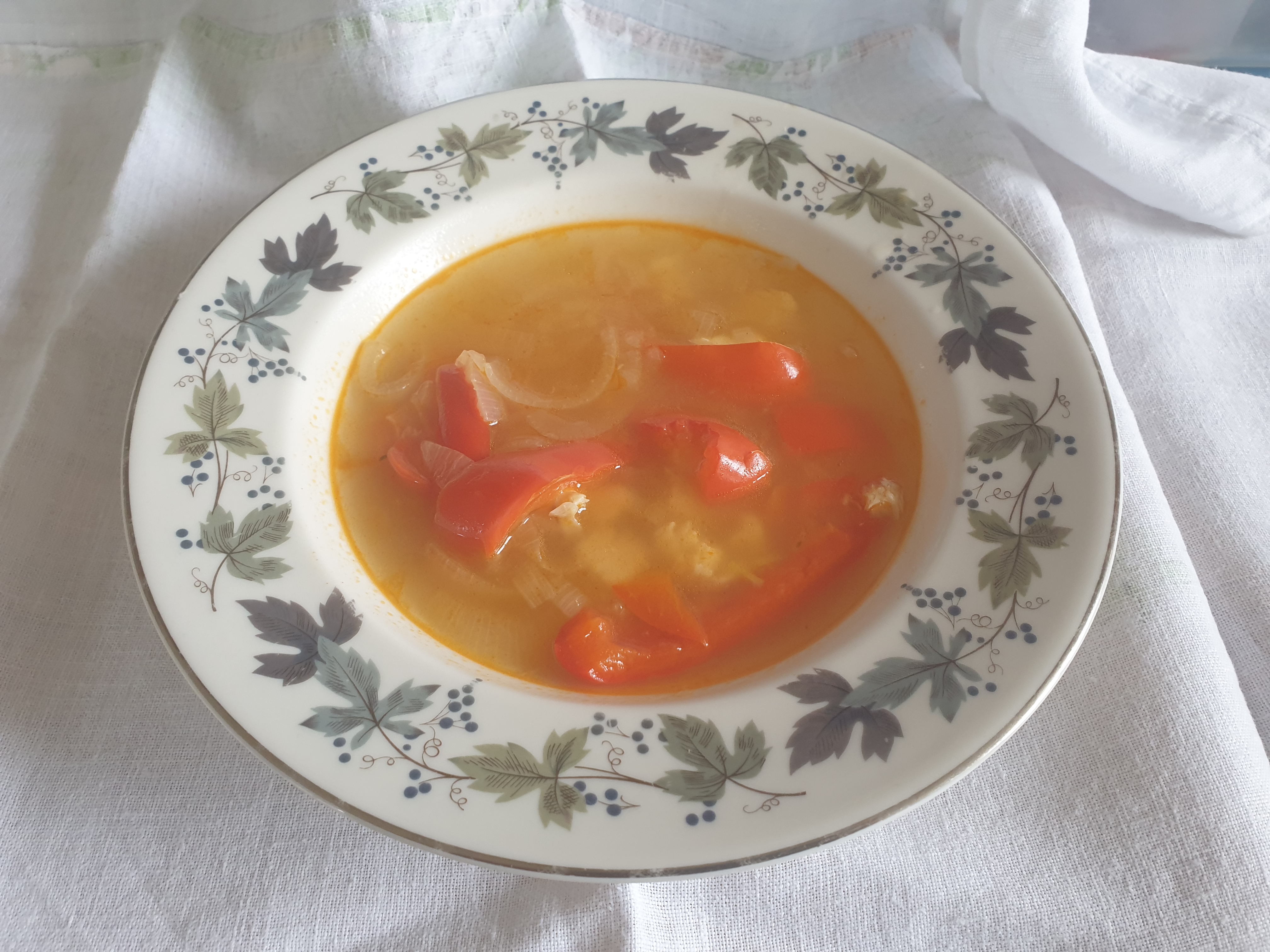
Another Carrot Soup

  • This is a French recipe known as Potage à la Cressy because the best carrots are said to be grown in France in the area of Cressy.
  • There are several versions of this soup with potatoes being added in some.

Ingredients

  • 8 medium/large carrots
  • 1 head of celery
  • 2 onions
  • 2 tablespoons of butter
  • 100g boiled ham
  • 4 grains of allspice
  • 1.5 litres of vegetable stock
  • Salt & pepper to taste 
  • Sugar – optional
  • *
  • A few chopped celery, lovage leaves or chives to garnish.

Method

  • Chop the onions into small pieces.
  • Gently fry the onions in the butter until golden.
  • Chop the celery stems into small pieces and add these to the onions.
  • Peel and chop the carrots into small circles.
  • Chop the celery into small pieces.
  • Chop the boiled ham into small pieces.
  • Place then all into a large saucepan with the stock.
  • Add the all spice.
  • Bring to the boil and then reduce the heat and leave it all to simmer.
  • Place the lid on the saucepan and let the soup cook for until the carrots and celery are soft.
  • This may take over an hour.
  • Use a stick blender to purée the soup.
  • Season to taste.
  • Add a little sugar – optional.
  • *
  • Garnish with chopped leaves if available.
  • Royal Doulton Burgundy soup plates.

Lazy Goląbki – 1

  • I love goląbki – but must admit they are time consuming to make.
  • I came across this idea of using all the ingredients and making them into large kotlety( meatballs) cooking them in stock and then adding a tomato sauce.
  • They are called goląbki leniwe – lazy goląbki.
  • Now I have  made kotlety with shredded fresh cabbage and with cooked cabbage before.
  • Here cooked rice is used as well.
  • No bread is added but semolina is used to help bind the ingredients.
  • I decided to make these with steamed cabbage,
  • I will try fresh cabbage next time.

Ingredients

  • 500g minced beef
  • 100 – 150g boiled rice
  • /½  head of a medium cabbage or a whole sweetheart cabbage
  • 1 egg – beaten
  • 1 teaspoons of salt
  • Ground black pepper
  • *
  • Semolina
  • Sunflower oil for lightly frying.
  • *
  • 750ml – 1 litre vegetable stock
  • Several tablespoons of tomato purée 
  • *
  • Soured cream – optional

Method

  • Shred the cabbage and then steam it.
  • Dry the cooked cabbage and chop into small pieces.
  • Pre-heat the oven to GM3 – 160°C
  • Mix the cabbage, meat and rice together until well mixed.
  • Add the beaten egg.
  • Add the salt and pepper.
  • Mix everything together.
  • Add a little semolina if needed.
  • Using your hands make large oval shaped balls.
  • Roll then gently in the semolina.
  • *
  • Fry lightly on both sides.
  • Place tightly packed in a large roasting tin.
  • *
  • Mix the vegetable stock and tomato purée and pour over the goląbki.
  • Cover the dish with a sheet of baking foil.
  • Cook for around 2 hours.
  • *
  • Either stir some soured cream into the sauce and serve
  • Or
  • Serve with a dollop of soured cream at the side.

Pork Loin with Apricot Sauce

  • After making this dish with gammon I thought I would try it with pork loin.
  • This was voted delicious too!
  • INGREDIENTS
  • Pork loin joint – 1kg or more
  • Tin of apricots in syrup
  • *
  • 1 tablespoon of potato or corn flour – optional
  • Sugar – optional
  • METHOD
  • Pre-heat the oven to GM5 – 190° C.
  • This is best cooked in an enamelled tin with a lid.
  • Empty the apricots and the syrup into the base of the baking tin.
  • Place pork loin joint on top.
  • Place the lid over the tin.
  • Place in the oven and cook for the time specified for that weight of meat.
  • *
  • Just before the cooking time is up seperate the apricots and the meat.
  • Put the meat back into the oven with the lid on the tin.
  • Put the apricots into a small saucepan and heat up a little whilst stirring.
  • The apricots should have become a thick pulp with just a few large pieces.
  • Though this will depend on the size of the joint.
  • *
  • Optional
  • Mix the potato flour or cornflour with a little water.
  • Stir this into the apricots and heat gently with stirring to thicken the sauce.
  • Sweeten the sauce with sugar to taste.
  • *
  • Slice up the joint and serve with the sauce.

Cake with Rhubarb

  • This is the same recipe as Cake with Sour Fruits – 1.
  • I got this recipe from my Polish friend in Leeds.
  • It is a batter style cake but made with melted butter rather than oil, which I have used before in cakes such as
  • Victorian Apple Cake  or 
  • Cake with Peaches  
  • The original recipe was for rhubarb –   rabarbar  – in Polish and this is what I used now it is in season.
  • You need to use quite a lot of rhubarb as the cake rises and the fruit moves apart.
  • *
  • If the rhubarb is too sour you can dust the cake with icing sugar before serving.

INGREDIENTS

  • 250g butter
  • 200g granulated sugar
  • 60ml cold water
  • 3 eggs
  • 340g plain flour
  • 2 teaspoons of baking powder 
  • *
  • 450 – 500g rhubarb – cut into small pieces.

METHOD

  • Grease and line 3 sides of a 32x22cm baking tin.
  • Pre-heat the oven toGM4 – 180°C
  • *
  • Mix the baking powder with the flour.
  • Melt the butter & sugar in a saucepan – do not boil.
  • Add the water and leave to cool.
  • Beat the eggs into the flour.
  • Add the butter mixture and mix well until you have a thick batter.
  • Pour into the tin and level out the batter to all sides.
  • Cover the top with the rhubarb pieces.
  • Bake for 50-55 minutes.
  • Check the cake part is ready with a tester.
  • Leave to cool in the tin.
  • *
  • Optional – dust with icing sugar before serving.

Duchess – Silver Rose Tea Plate

Lemon Meringue Pie

  • I am sure this would be a popular dessert in Poland and would be a bezowa (meringue) tarta (tart)
  • This is said to have originated in the United States of America.
  • Custard pies of various kinds using egg yolks had been made in Britain and then America for years but the first mention of Lemon Meringue Pie is in a cookery book of 1869.

  • Mrs Elizabeth Goodfellow, who ran a pastry shop in Philadelphia, decided to use the leftover egg whites as a topping over a lemon custard.

  • Mrs Elizabeth Goodfellow also started America’s first cookery school.


    INGREDIENTS

    Shortcrust pastry

    *

    40g cornflour

    25g butter

    300ml water

    2 lemons rind & juice

    2 egg yolks

    50g caster sugar

    *

    2 egg whites

    50g & 50g caster sugar

    METHOD

    It is best to use a metal dish especially one with a loose base.

    Any diameter from 18cm to 22cm.

    Grease the dish well.

    Roll out the shortcrust pastry and line the dish.

    Place a circle of baking paper over the base and add “baking beans”.

    Bake blind at GM 7 – 220°C for around 15 minutes.

    Remove the beans and paper and bake for another 5 minutes.

    Leave to cool.

    *

    In a saucepan blend a little of the water with the cornflour.

    Add the rest of the water and the butter.

    Bring to the boil and then lower the heat

    Stir and cook for 3 minutes.

    Remove from the heat.

    Add the lemon rind and juice.

    Add the yolks and 50g of caster sugar.

    Mix well and leave to cool.

    *

    Pre-heat the oven to GM3 – 160°C.

    *

    Fill the pastry with the lemon mixture.

    *

    Whisk the egg whites till stiff.

    Whisk in 50g of caster sugar till stiff.

    Fold in 50g of caster sugar.

    Cover the pie with the egg white mixture.

    Make random peaks over the surface.

    Bake for 25 minutes.

    *

    Leave to cool before serving.

    OPTION

    If you have an extra egg white, say from making the pastry, use this with extra sugar for the topping.

  • Served here on Royal Doulton Tapestry.

Gammon & Apricot Sauce

  • After cooking grilled gammon and apricots I thought about making the dish with a larger gammon joint.
  • Mine was around – 1kg.
  • I think this is best with an unsmoked joint.
  • Tinned apricots in syrup are best.

Ingredients

  • Unsmoked gammon joint – 1kg or more
  • Tin of apricots in syrup
  • *
  • 1 tablespoon of potato or corn flour – optional
  • Sugar – optional

Method

  • Pre-heat the oven to GM5 – 190° C.
  • This is best cooked in an enamelled tin with a lid.
  • Empty the apricots and the syrup into the base of the baking tin.
  • Place gammon joint on top.
  • Place the lid over the tin.
  • Place in the oven and cook for the time specified for that weight of meat.
  • *
  • Just before the cooking time is up seperate the apricots and the meat.
  • Put the meat back into the oven with the lid on the tin.
  • Put the apricots into a small saucepan and heat up a little whilst stirring.
  • The apricots should have become a thick pulp with just a few large pieces.
  • Though this will depend on the size of the joint.
  • *
  • Optional
  • Mix the potato flour or cornflour with a little water.
  • Stir this into the apricots and heat gently with stirring to thicken the sauce.
  • Sweeten the sauce with sugar to taste.
  • *
  • Slice up the joint and serve with the sauce.

Meakin serving plate and Royal Doulton Burgundy dinner plate.

Thought – will be trying this with a pork loin joint next!

Fried Kopytka

  • My Mama often made kopytka potato dumplings but I do not remember them ever being fried afterwords.
  • I had this dish of rabbit in a garlicky cream sauce with fried kopytka in a restaurant in Wrocław.
  • They were super!
  • I decided to have a go at these myself.
  • Now you can cheat if you have a Polish shop near you that sells ready made kopytka that you can boil first.
  • I decided to make these from scratch, which does involve a few steps & time.
  • *
  • THE STEPS
  • *
  • Boil starchy potatoes
  • Leave to go cold
  • *
  • Make kopytka
  • Boil the kopytka
  • Leave to go cold
  • *
  • Fry the kopytka

Ingredients

  • Starchy potatoes – boiled and left to go cold – around 500 – 600g
  • 1 egg & 1 egg yolk
  • Plain flour – around 200g
  • ½ teaspoon salt
  • Sunflower oil for frying

Method

  • Peel the potatoes cut them up into pieces and boil them in salted water.
  • Drain the potatoes
  • Mash them so that there are no lumps.
  • I have a ricer which is very good for this.
  • Leave the potatoes to cool.
  • Use a large bowl and put the cold potatoes into the bowl.
  • Lightly beat the egg and the yolk together and add this to the potatoes.
  • Add a little salt.
  • Weigh out the flour to give an idea of how much is needed,
  • This will depend on the type of potato and the size of the eggs.
  • Add the flour and mix first with a wooden spoon and then by hand, you might not need all the flour or you may need more.
  • Mix until you have a soft dough.
  • *
  • Divide the dough into quarters and using a floured board shape the dough and roll it with you hands until you have a long sausage about 3cm in diameter.
  • If the dough sticks to the board then you need to add more flour.
  • Use a sharp knife to cut the dough into pieces, make the first cut at a diagonal and make the thickness about 1 to 1.5cm.
  • You will get a sort of oval shape.
  • Repeat this with the rest of the dough.
  • *
  • Fill a large pan with water, add some salt and bring this to the boil.
  • When the water is boiling, add the dumplings one by one, do not over fill the pan or they will stick together.
  • I tend to do this in 4 batches.
  • As they cook they will float to the surface, give them about another minute and then remove them with a slotted  or a perforated spoon and put them in a colander.
  • I have a colander sitting in an empty pan by the side of the large pan in which I am boiling the dumplings.
  • I find that the maximum from putting  them into the water to taking them out will be 3 minutes, if you cook these too long they will start to fall apart.
  • *
  • You need to let the kopytka dry off and go cold.
  • NOTE – kitchen roll tends to stick – baking paper is better.
  • Gently shallow fry the kopytka in sunflower oil.
  • Take care not to burn them.
  • Served here on a vintage pyrex plate.
  • Good with other fried foods or served with a sauce.

VERDICT

Everyone thought them delicious and want them to be made often!

Dividing the timing of boiling potatoes, making and boiling kopytka and then frying them to serve with a meal needs to be spaced out to make life easier!