I tried this recipe from one of my recently bought Polish magazines.
I have not make a cake dough with twaróg/yoghurt cheese before.
I would only make a small alteration to the amounts in the ingredients next time – a little more sugar with the topping of twaróg/yoghurt cheese which is how I have written this up.
It was huge success.
INGREDIENTS
250g plain flour
100g granulated sugar
2 teaspoons of baking powder
¼ teaspoon of salt
120g – melted butter – allowed to cool.
3 eggs
125g + 125g twaróg/yoghurt cheese (very well strainned)
1½ – 2 tablespoons of icing sugar
300g of fruit – around 150g of apples – the rest blackberries/raspberries or fruits of the forest (can be frozen – defrosted and dried with kitchen roll).
*
Sieved icing sugar to serve.
METHOD
Grease and line on 3 sides a 20 x 26cm baking tin.
Pre-heat the oven to GM3 – 160ºC.
Mix the dry ingredients together in a bowl.
In another bowl mix lightly whisk together the eggs and 125g of the twaróg/yoghurt cheese
Mix the contents of the 2 bowls together.
Add the cooled, melted butter and mix to get a soft dough.
Press the dough into the tin.
*
In a bowl mix the other 125g of the twaróg/yoghurt cheese with the icing sugar.
*
Peel and core the apples
Slice them into very thin slices.
*
Spread the sweetened twaróg/yoghurt cheese over the dough nearly up to the edges.
Sprinkle the apple slices over this.
Then sprinkle on the black fruit (I used fresh blackberries).
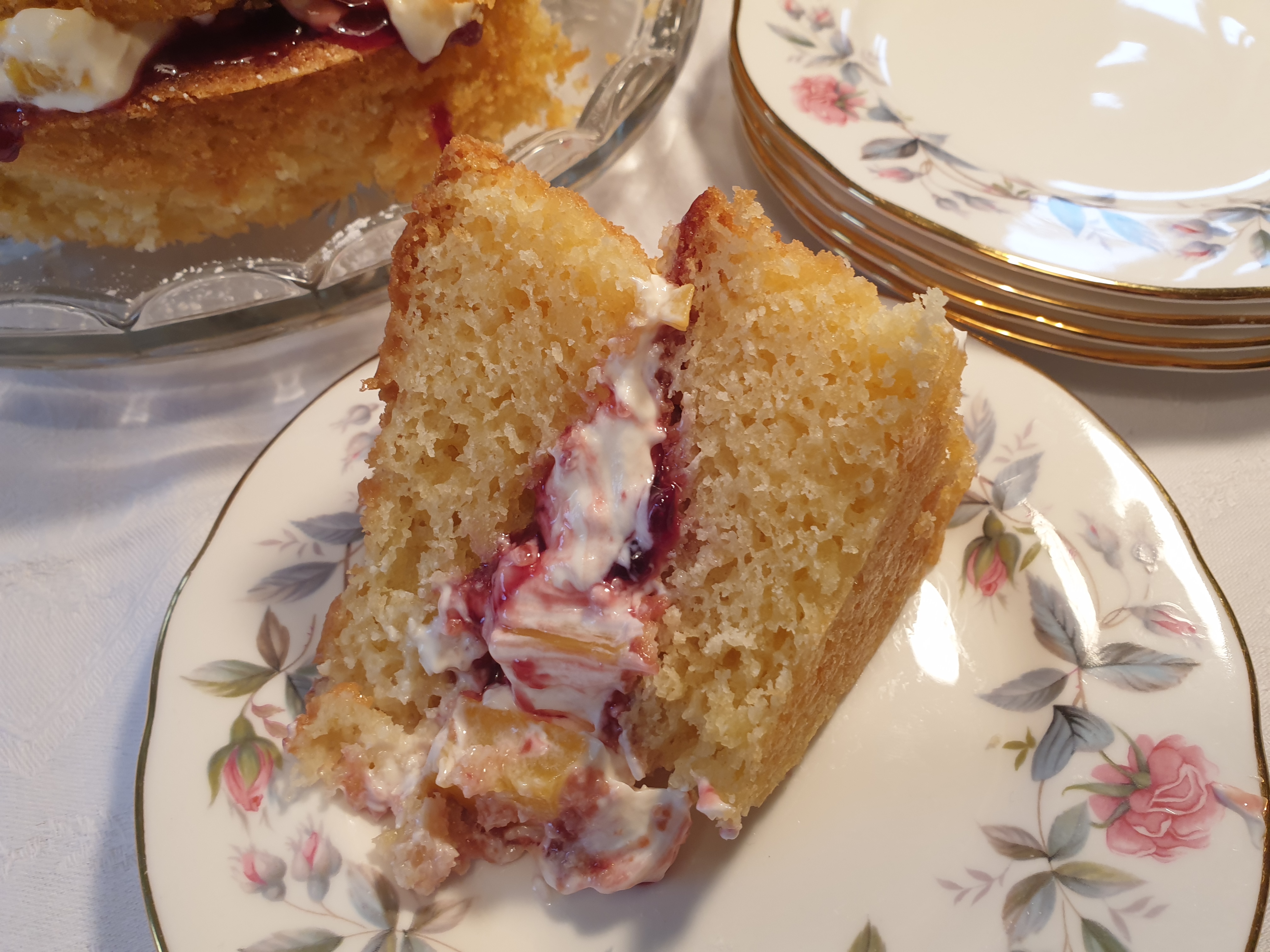
It is a recipe for a fat free sponge cake, sandwiched with a filling made from yoghurt cheese or cream cheese and puréed tinned peaches plus a thick raspberry sauce.
I used an English quick style version of the sponge cake.
Ingredients -Fat Free sponge
4 eggs
150g caster sugar
150g plain flour
2 teaspoons of baking powder
Method – Fat Free sponge
Pre-heat the oven to GM4 – 180°C
Grease and line the base of two 18cm diameter baking tins.
In a bowl whisk the eggs and caster sugar until they are pale and creamy.
Sift the flour and the baking powder together.
Gently fold in the flour.
Pour the mixture into the tins and bake for 25-30 minutes until golden.
Leave to cool completely.
Ingredients -Filling
Tin of peaches
200g of yoghurt cheese or cream cheese
1-2 tablespoons of icing sugar
Method – Filling
Drain the peaches from the juice/syrup.
Save the juice.
Chop the peaches and then purée them.
Mix together the yoghurt cheese and the puréed peaches.
Add the sugar – do not make it too sweet.
Ingredients – Raspberry Sauce
100g of raspberry jam
50ml of water
Method – Raspberry Sauce
Put the jam and water into a small saucepan.
Heat gently and stir with a wooden spoon.
Heat until the sauce is thick and smooth.
Leave to cool.
Assembling the cake
Place one of the cakes onto a serving plate or stand.
Prick the cake with a wooden skewer.
Sprinkle half the peach juice over the cake.
*
Spread half the raspberry sauce over the cake.
Spread the peach filling on the cake. (You might not need all of it)
Drizzle the rest of the raspberry sauce on the filling.
*
Prick the other cake with a wooden skewer.
Place the second cake on top.
Sprinkle the rest of the peach juice over the cake.
*
Dust with icing sugar before serving.
Greenway Hostess tea plate by John Russell 1960 – 1979
Note
There is more than enough filling with this size cake.
You might try using some to slightly cover the sides of the cake as well.
This modern spreading of the icing is called “semi-naked”.
This is a recipe for a large sponge cake, sandwiched with a filling made from yoghurt cheese or cream cheese and chopped tinned peaches plus a thick raspberry sauce.
Pierogi leniwe – means lazy pierogi or lazy dumplings.
I wrote about kopytka – Polish potato dumplings a good while back and these have the same shape.
Traditional recipes use twaróg – Polish curd cheese – I use my own yoghurt cheese. I have found that you can use crumbly, white, mild, English cheeses such as: Cheshire, Lancashire or Wensleydale.
They can be served savoury or sweet – with melted butter, à la Polonaise(buttered breadcrumbs) or skwarki (crisp, fried, small squares of bacon) or sweet with a cinnamon sugar mixture.
Ingredients
400g of twaróg (curd cheese), yoghurt cheese or a white, crumbly cheese.
3 egg yolks
160 – 200g of plain flour
½ teaspoon of salt
Method
Mix the yolks with the cheese.
Add the salt
Weigh out the flour to give an idea of how much is needed – this will depend on the cheese and the size of the eggs.
Add the flour and mix first with a wooden spoon and then by hand, you might not need all the flour or you may need more.
Mix until you have a soft dough.
Divide the dough into quarters and using a floured board shape the dough and roll it with you hands until you have a long sausage about 3cm in diameter. If the dough sticks to the board then you need to add more flour.
Use a sharp knife to cut the dough into pieces, make the first cut at a diagonal and make the thickness about 1 to 1.5cm. You will get a sort of oval shape.
Repeat this with the rest of the dough.
Fill a large pan with water, add some salt and bring this to the boil.
When the water is boiling, add the dumplings one by one, do not over fill the pan or they will stick together. I tend to do around 8 at a time.
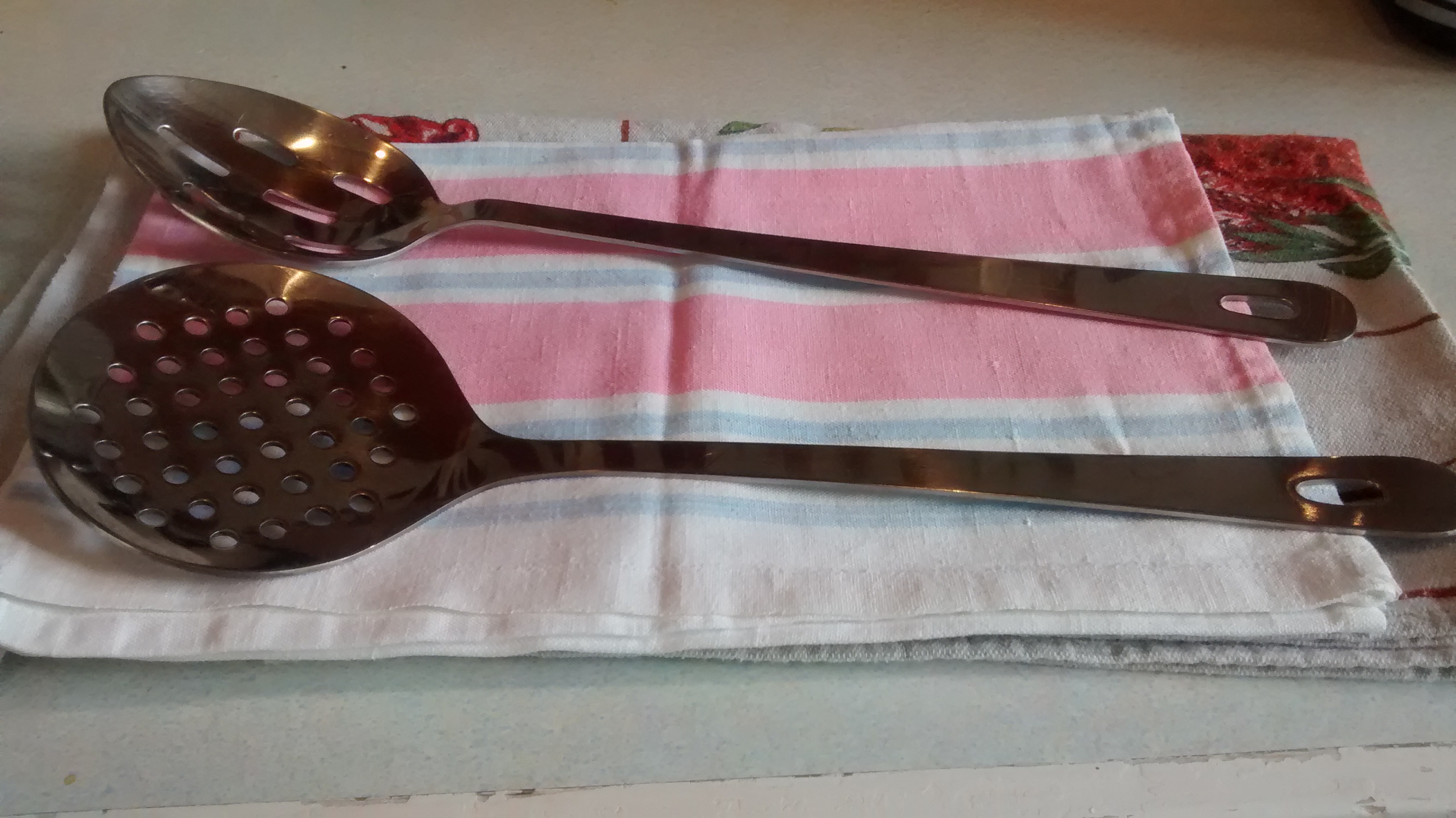
As they cook they will float to the surface, give them about another minute and then remove them with a slotted or a perforated spoon and put them in a colander.
I have a colander sitting in an empty pan by the side of the large pan in which I am boiling the dumplings.
I find that the maximum from putting them into the water to taking them out will be 3 minutes, if you cook these too long they will start to fall apart.
Here served as suggested above with melted butter and with skwarki (crisp, fried, small squares of bacon).
Served on –
J & G Meakin – Topic – around 1967
Wedgwood – Chelsea garden – early 21st century.
Here served à la Polonaise(buttered breadcrumbs) in a handled dish by
Rörstrand Sweden Granada Ovenware from the 1960s
They can be also be served sweet with a cinnamon sugar mixture.
There are two similarly named pastries in Polish cookery:
Ciasto francuskie – translates as French pastry – this is puff pastry.
Ciasto pȯłfrancuskie – translates as half or semi French pastry.
I have seen ciasto pȯłfrancuskie described as rough puff pastry – but it is not – rough puff is a slightly easier and quicker version of puff pastry.
I have seen many different recipes for this semi-French pastry and they fall into three broad categories:
ciasto pȯłfrancuskie – śmietanowe – dough made with some soured cream.
ciasto pȯłfrancuskie – serowe – dough made with twaróg – curd cheese.
ciasto pȯłfrancuskie – drożdźowe – dough made with yeast.
Ciasto pȯłfrancuskie 2 – with curd cheese – twaróg
Ingredients
225g plain flour
225g butter
225g twaróg – curd cheese or yoghurt cheese
2 tablespoons of soured cream – maybe needed – depends on dampness of the cheese
Note – as you use equal parts of the three main ingredients, you can make an amount suited to you needs – I usually go by how much yoghurt cheese I have.
Method
Preheat the oven to GM7 – 220ºC
Grease several baking sheets.
You need to get the curd cheese as dry as possible, if you are using homemade then allow this to strain as long as possible.
Put the flour into a large bowl.
Add the butter and with a knife chop it up roughly.
Then with your finger tips rub the butter in until you have fine breadcrumbs.
Mix in the curd cheese and bring the dough together, adding as much soured cream as is needed.
When using my own yoghurt cheese I often do not need any soured cream.
Shape the dough into a ball and leave in a cool place for 20 – 30 minutes.
Divide the dough into 4 and work with each quarter at a time, leaving the rest in a cool place .
Roll the dough out thinly
Cut into circles using a 7cm cutter.
Add around a teaspoon of filling* see below and fold the circle into half.
Pinch the edges together carefully.
Place the pastries on the greased baking sheets.
Bake for 10 to 12 minutes until golden.
For ones with sweet fillings dust with icing sugar whilst still warm.
Fillings
You can use lots of savoury or sweet fillings – here are a few suggestions:
Date
Poppy seed mixture
Walnut
Hazelnut
All filling must be cool before using.
Date
Chop 200g of dried dates.
Place in a small saucepan and cover with water (and you can add a little lemon juice).
Daucus carota – the carrot – was cultivated from wild carrots in the countries we now know as Afghanistan & Iran and are mentioned there in the 10th century and by the 12th century they were mentioned in Europe.
These tap roots were originally white, yellow or purple in colour.
The orange colour that we recognise today was breed by growers in Europe in the 17th century especially in the Netherlands. It is thought that this was in honour of Prince William of Orange-Nassau (Willem van Oranje) who had an orange stripe on his flag. Nowadays orange is thought of as the national colour for the Netherlands.
These pancakes made with carrots in Polish are called racuszki z marchwi.
They are small round pancakes like American pancakes or dropped scones and are served with sugar or sweetened soured cream.
Ingredients
450g carrots, peeled and finely grated
140g twaróg/cream cheese or yoghurt cheese
2 eggs separated
3 tablespoons of plain flour
1/2 teaspoon of baking powder
Sunflower oil for frying
To Serve
Caster sugar or soured cream sweetened with icing sugar.
Method
Whisk the whites until they are stiff.
In a small dish mix the baking powder with the flour.
In a large bowl mix together well the finely grated carrots, the cream (or yoghurt) cheese and the egg yolks.
Add the flour mixture.
Fold in the stiff egg whites.
Heat some sunflower oil in a cast iron frying pan or griddle.
Use 2 tablespoonfuls of the mixture for each pancake, cook on one side and then turn them over and cook on the other side.
Sprinkle with caster sugar or with a dollop of sweetened soured cream.
Served here on Wedgwood – Hathaway Rose – 1959 -1987.
Note
I have also tried them with maple syrup poured on them & these too were delicious.
A racuch – according to my dictionary is a kind of pancake.
Racuszki or racuchy are plural words for them- used much more as you never have just one! They are small thick pancakes similar to dropped scones, Scotch pancakes or American style pancakes.
In my old Polish recipe book, the recipe uses soured milk, but as I do not have this, I use my own thick yoghurt instead.
Racuszki
1 egg
250ml yoghurt
200g plain flour
1/2 teaspoon of bicarbonate of soda
large pinch salt.
Method
In a large bowl mix the flour, pinch of salt, the egg and some of the yoghurt, mix it with a wooden spoon. I found my new one with a hole in it which I bought in The Netherlands very good for this.
Keep adding the yoghurt (and some water if needed) and mix till you get a batter which is thick and then beat it more till it is smooth and glossy.
Then add the bicarbonate of soda and give this a final mix.
Use a griddle or thick cast iron frying pan and use oil to grease it lightly and heat it up.
You need to try and keep a low to medium heat so as not to burn the pancakes.
Place tablespoonfuls of the batter on the frying pan and cook until the base is set and golden then turn them over and cook the other side.
They are traditionally served warm with jam or thick fruit syrup – caster sugar also goes well.
With Sour Cherry Jam
Yoghurt Cheese Pancakes
I have recently been to The Netherlands to stay with my friend and was looking at the local newspaper and saw a recipe for pancakes using qwark (I can manage enough Dutch words to figure out some recipes – especially if there is a photograph!)
I thought they sounded very much like racuszki, so I jotted the recipe down and when I came home I adapted it slightly by using self raising flour, adding a little vanilla essence and used my own yoghurt cheese instead of qwark.
In the original recipe they served them warm with yoghurt & honey, I also tried them with melted butter & sugar, and with maple syrup – from the large bottle I got from my friend who lives in Canada.
They were super and ones I had left could be easily reheated and were still soft and not rubbery – I will be using this recipe lots from now on.
Ingredients
2 eggs separated
2 tablespoons sugar
250g yoghurt cheese
200ml milk (you might not need it all)
125g self raising flour
Pinch salt
2-3 drops of vanilla essence
Method
Whisk the egg whites until they are stiff – I tend to do this first so you can use the beaters for the rest of the recipe – without having to wash them to remove the grease.
In a large bowl mix the egg yolks, sugar, yoghurt cheese, flour, pinch of salt, vanilla essence and around half the milk.
Keep adding more milk and mix well until you have a thick batter – like double cream.
With a metal spoon fold in the stiff egg whites.
Use a griddle or thick cast iron frying pan and use oil to grease it lightly and heat it up.
You need to try and keep a low to medium heat so as not to burn the pancakes.
Place tablespoonfuls of the batter on the frying pan and cook until the base is set and golden then turn them over and cook the other side.
Ciocia* Pola’s Apple Racuszki
*Aunty
Many years ago I went to stay with my one of mother’s sisters (Apolonia) who lived in the area called mazury – the Masurian Lake District in North East Poland.
With apples from the garden she made racuszki – using a thick yeast risen batter and roughly chopped apples – a cross between a pancake and a fritter. They were delicious.
I have made them here many times using her recipe. Whilst researching and checking other variations I saw that several recipes used grated apples – these came out stodgy with little taste of the apple – you need to keep the pieces fairly large.
Ingredients
125 ml of milk (full or semi-skimmed)
25g caster sugar and 1 teaspoon
10g fresh yeast or 5g dried yeast
25g butter
1 egg
125g plain flour
pinch of salt
2 Bramley apples
*
Icing sugar, caster sugar or cinnamon sugar to dust.
Method
Warm half the milk and add a teaspoon of caster sugar and the yeast and mix it all together and leave it to froth up.
Melt the butter and leave it to cool.
Whisk the egg with the sugar until it is thick and creamy.
Put the flour and salt into a large bowl.
Use a wooden spoon (one with a hole works really well) and beat in the yeast mixture, the egg & sugar mixture and then the melted butter.
Slowly add the rest of the milk, mixing until the mixture has the consistency of double cream.
Cover the bowl with a cloth and leave this to rise.
Peel, core and quarter the apples and cut them into small chunks or slices cut in half.
Add the apples to the risen batter and mix them well in to coat them.
Use a griddle or thick cast iron frying pan and use oil to grease it lightly and heat it up.
You need to try and keep a low to medium heat so as not to burn the pancakes.
Place large tablespoons of apple and batter onto the pan and cook them so that they are golden brown on both sides.
Remove them from the pan and dust them with icing sugar, caster sugar or cinnamon sugar.
Eat them whilst they are hot & as they say in Poland – Smacznego! (may they be delicious!)






 Journey From A Polish Kitchen