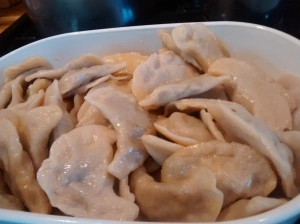
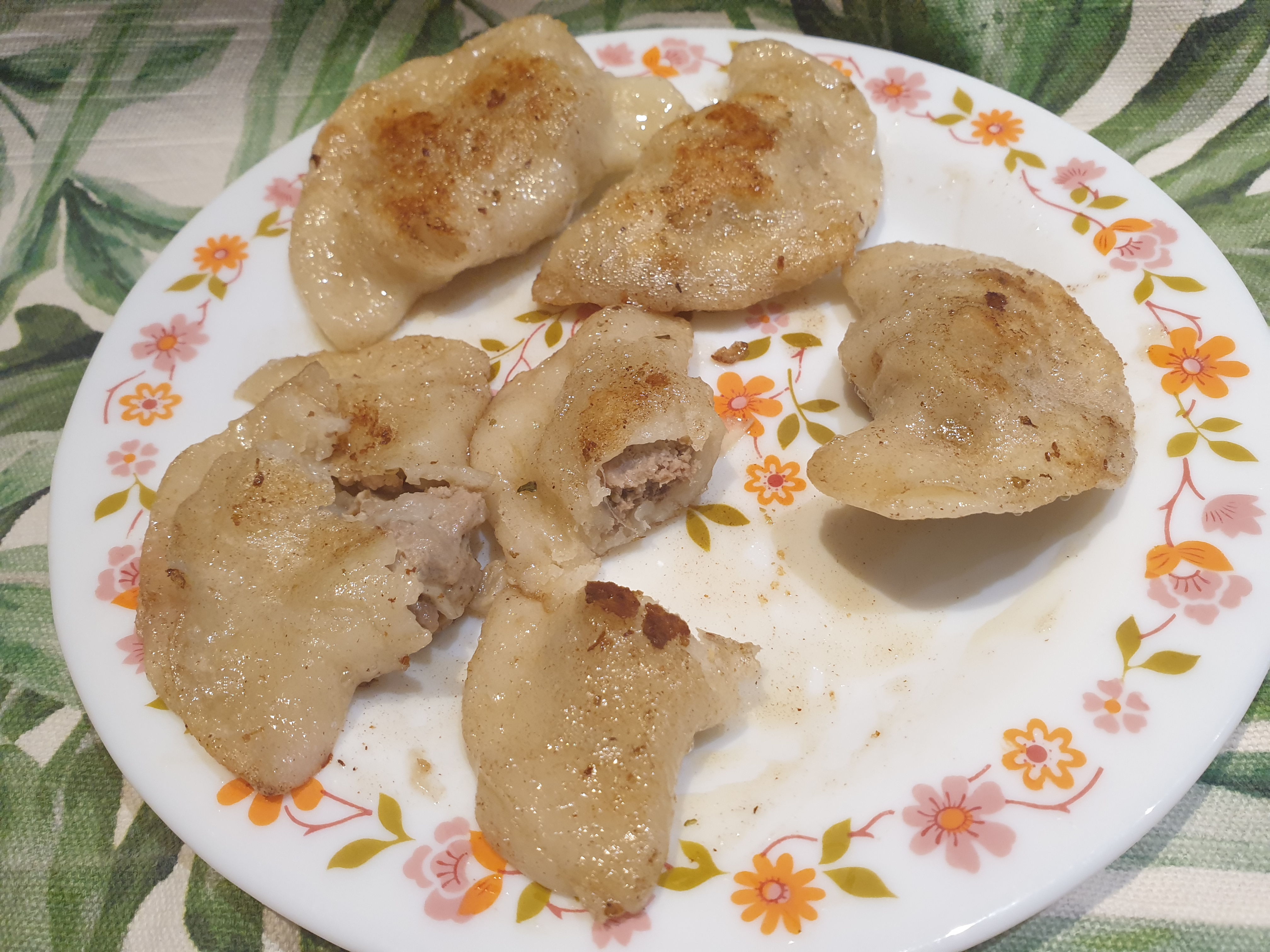
Pierogi – Sauerkraut & Mushrooms

  • I started to write up a new filling for pierogi and realised that many of my different fillings were in one general pierogi – Polish filled pasta  post.
  • This was one of my earlier posts before I realised that shorter posts were better.
  • So I am going back and posting shorter versions of this original post.
  • Each with just 1 filling.
  • Sauerkraut & Mushrooms is a very popular filling.
  • Some people make these for Wigilia – Christmas Eve.

Ingredients – Filling

  • 1 jar of sauerkraut
  • 25 – 30g of dried mushrooms
  • 1 or 2 onions – chopped fine
  • 1 -2 bay leaves
  • Ground pepper to taste

Method – Filling

The filling must be allowed to cooled before using  –  you can make it in advance – even the day before.

At the end the filling must be as dry as possible to make the assembly of the pierogi easier.

  • Put the mushrooms in a small bowl and cover them with boiling water.
  • Leave them overnight.
  • Strain the mushrooms – but keep the liquid.
  • Chop the mushrooms into small pieces.
  • *
  • Strain the sauerkraut, keep the liquid, and chop into small pieces.
  • IMG_20160608_085355101
  • Put the sauerkraut into a pan, add the liquid from the sauerkraut and some from the mushroom liquid.
  • Cover with boiling water if need be.
  • Add the bay leaves.
  • Cover the pan with a lid.
  • Simmer gently for around 30 minutes.
  • Checking it does not dry out.
  • Remove the lid.
  • Then boil off as much liquid as possible without burning the sauerkraut.
  • *
  • Allow the sauerkraut to cool and remove the bay leaves.
  • Strain the sauerkraut using a sieve to get it as dry as possible.
  • You can put this into a clean dry cotton or linen cloth and twist the ends together –
  • Squeeze to get it really dry.
  • *
  • Whilst the sauerkraut is cooking heat the chopped mushrooms gently in a small pan with the rest of the liquor, stirring to prevent it burning but reducing as much of the possible.
  • *
  • Chop the onions finely and fry them till they are soft and golden.
  • Add them to the mushroom mixture and mix well together.
  • Mix the sauerkraut, mushrooms and onions together.
  • Add some ground black pepper to taste; salt should not be necessary.
  • OPTION 
  • Add fresh mushrooms fried in butter and chopped fine to the filling.
  • Ingredients – Dough

  • 250g pasta flour or strong flour or plain flour & 2 tablespoons of fine semolina
  • 150ml water
  • 1 tablespoon oil – sunflower or light olive
  • ½ teaspoon salt
  • 1 egg yolk
  • *
  • Melted butter for serving or chopped onions cooked in butter.

Method – Dough

  • In a jug or bowl mix together the water, oil and the yolk.
  • Put the flour and salt into a large bowl and make a well in the centre.
  • Pour in the liquid from the jug and initially use a knife to mix this into the flour and then use your hands to mix the liquid and flour to get a ball of dough.
  • Turn this out onto a floured board and knead the dough for a few minutes until you have a smooth ball.
  • Cut the dough into quarters.
  • On a floured board roll out a quarter at a time until you have a sheet of thinly rolled dough.
  • Now prepare a large tray and cover it with a clean tea towel and sprinkle this with flour.
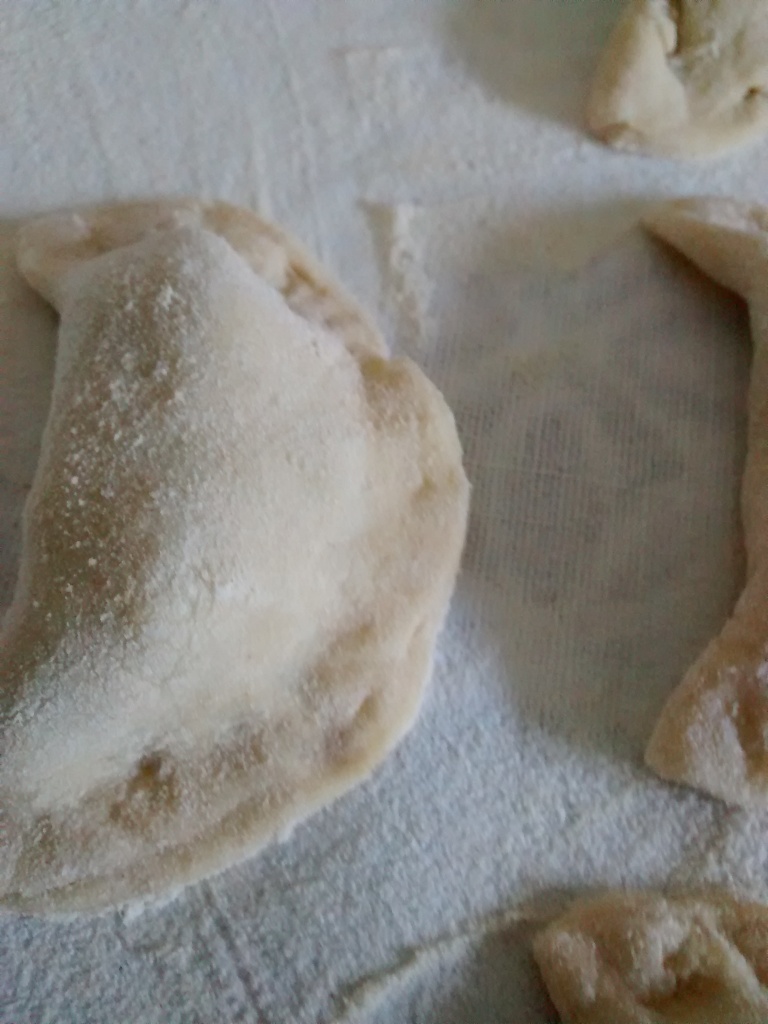
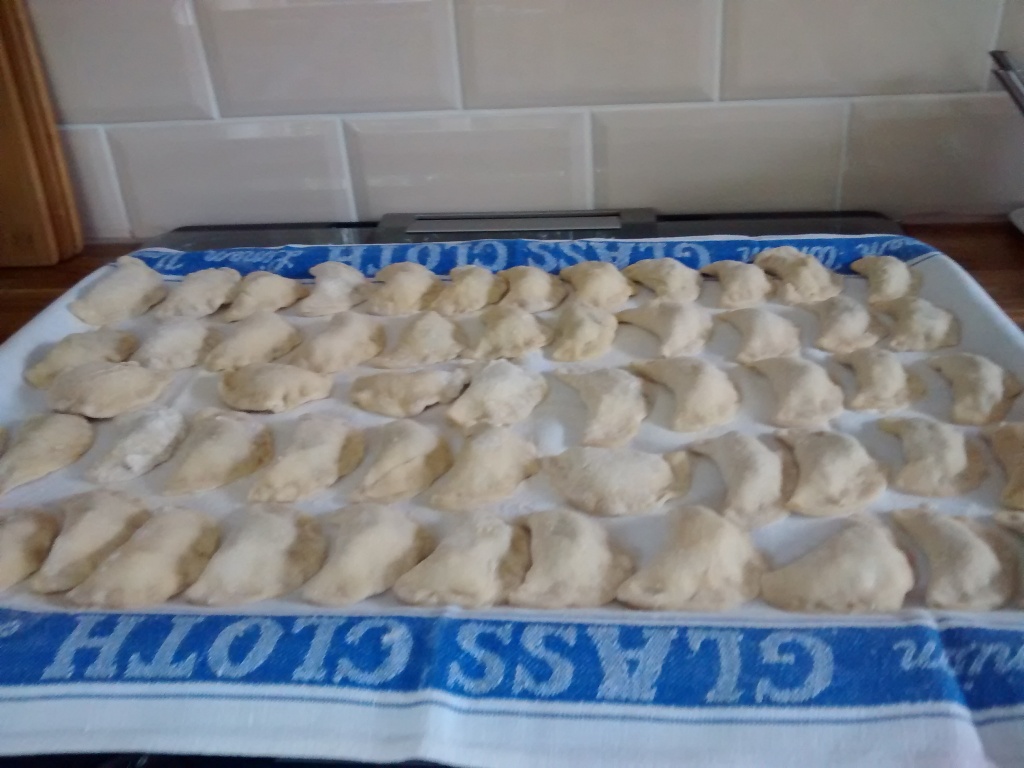
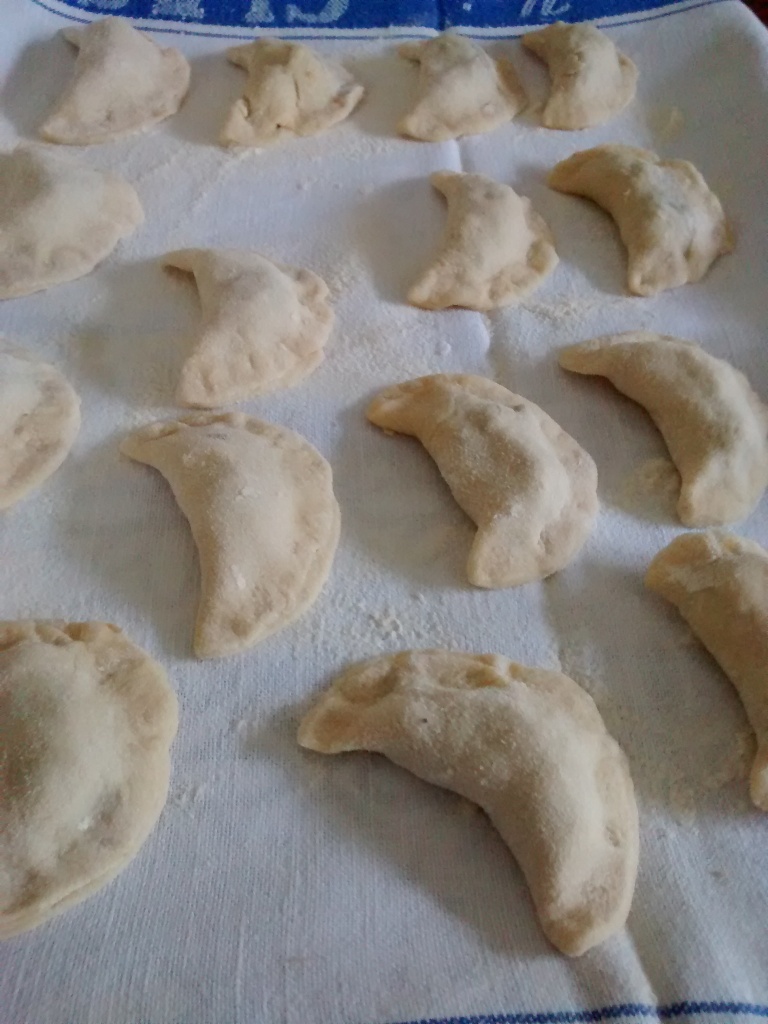
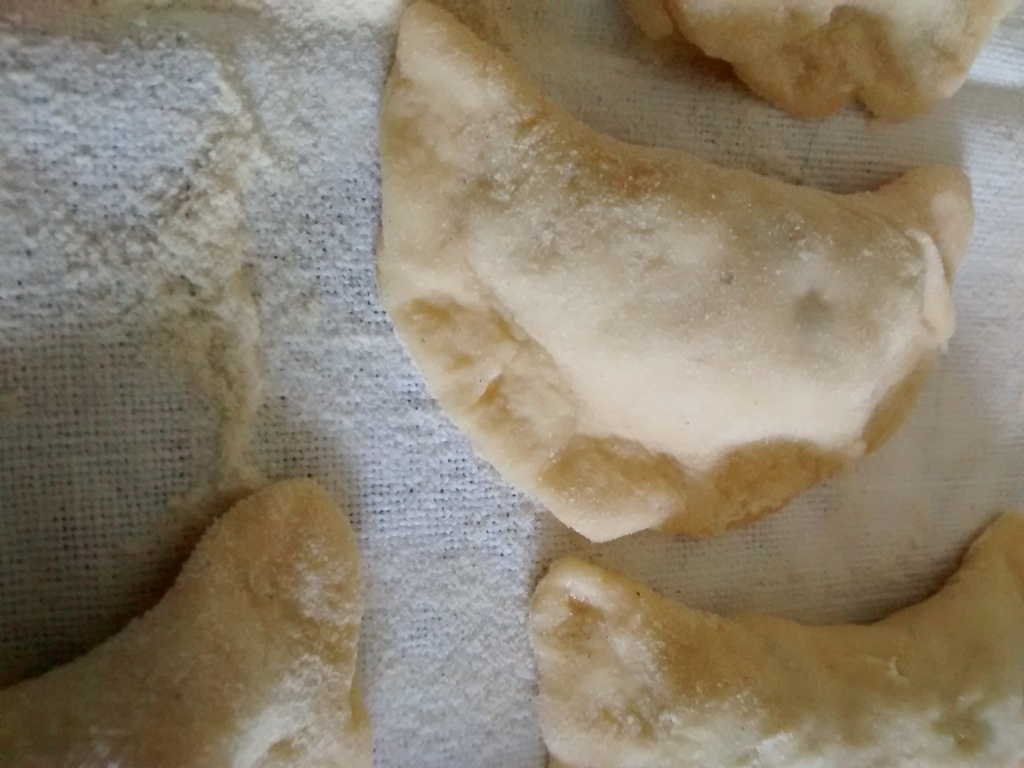
  • Have a large surface such as a tray covered with a cotton or linen cloth which has been lightly floured ready  and place the sealed pierogi on this until they are all made, do not let then touch each other.
  • I cut them out using a 7 cm diameter cutter.
  • I have noticed some people make them larger – I will try this out soon.
  • The excess dough can be re-mixed and rolled out again.
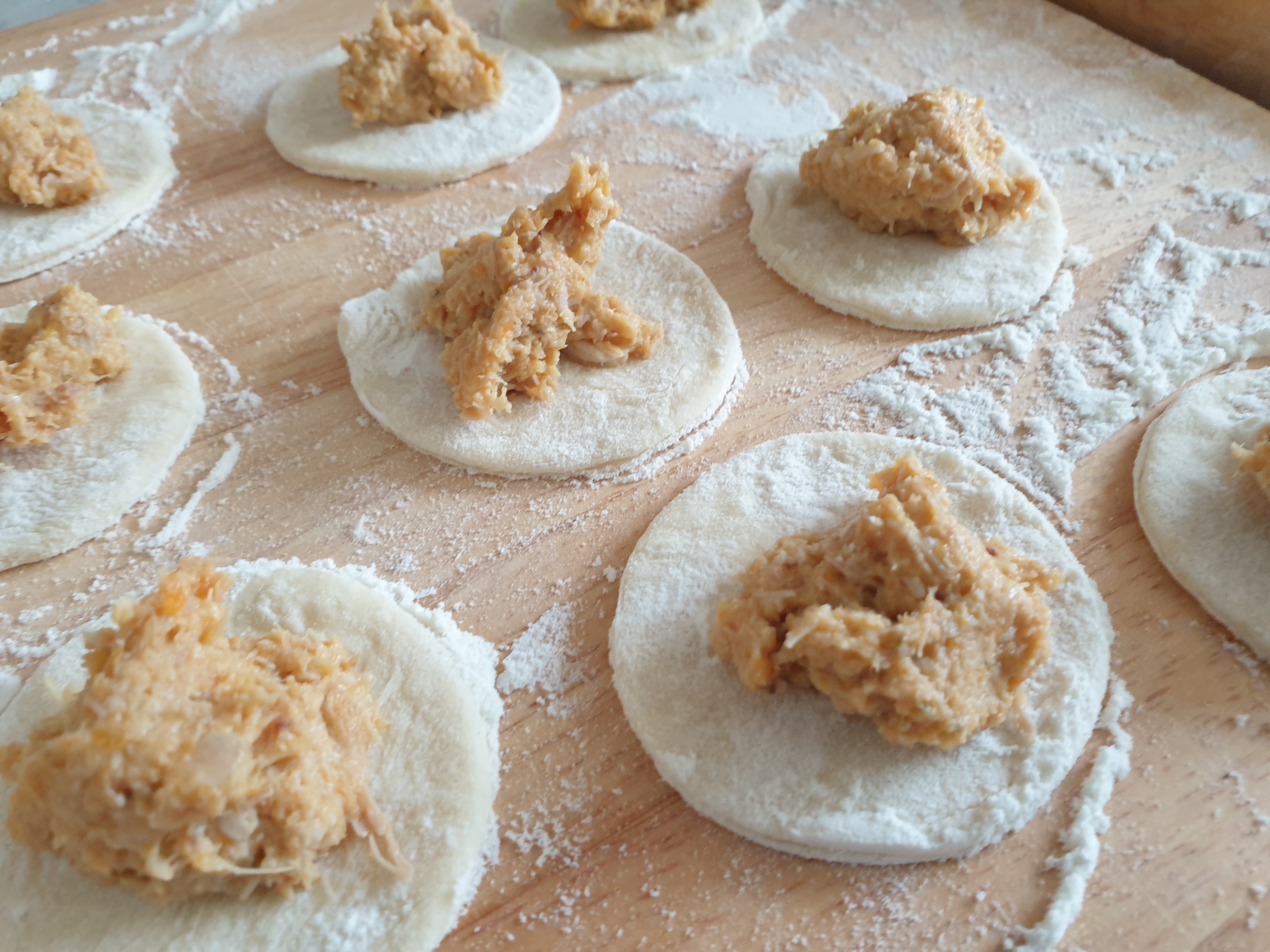
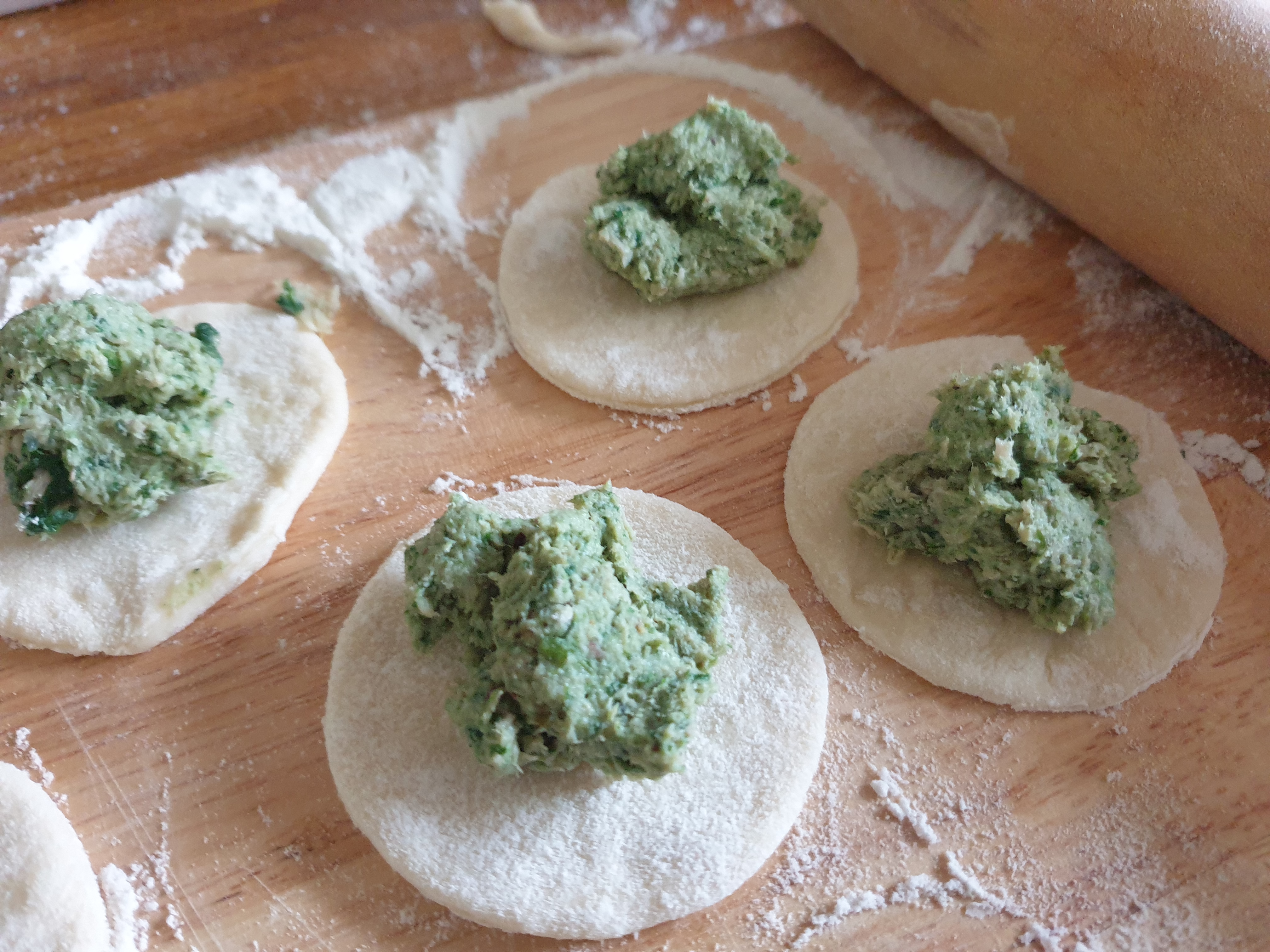
  • Around a half tablespoon of filling is put on  each circle and then they are folded over and the edges pinched together to make a good seal.
  • You learn from experience how much filling to put in as too much will make it hard to seal them and if not properly sealed they will burst on boiling. 
  • Do not worry if you have a few mishaps – it still happens to me even with experience – it is hard to salvage one that has gone wrong – just accept that there will be a few that you do not cook.
  • *
  • To cook the pierogi, use a large pan of boiling water to which you have added some salt and a drizzle of oil.
  • Drop the pierogi in one by one and allow them to boil.  I usually do about 6 to 8 at a time (I only do 6 at a time if using frozen ones).
  • As they cook they will float to the surface, let them boil for 2 to 3 minutes, (a bit more if they were frozen*), and
  • Then remove them with a slotted or perforated spoon and put into a colander above a pan for a few seconds to drain and serve.
  • Continue boiling batches in the same water.
  • If you want to make all the pierogi to serve together then you need to get a large shallow dish.*
  • Put in the pierogi and add melted butter.
  • Keep the dish warm in a low oven.
    • *I often open freeze them for later.

  • Serve with melted butter or
  • Melted butter and breadcrumbs or
  • Onions fried in butter or
  • Fried bacon bits – skwarki.

Chocolate Orange Cake – 3

  • This is based on my Chocolate Orange Cake – 2 with the addition of small chunks of chocolate to the cake mixture.
  • Sunflower oil and Greek style yoghurt help to make this a moist cake with a great texture.

INGREDIENTS

  • 200g of plain flour
  • 2 teaspoons of baking powder
  • 200g granulated sugar
  • Zest of 1 large orange
  • 190ml of Greek style yoghurt
  • 3 eggs
  • 125ml of sunflower oil
  • 100g of dark chocolate
  • Large pinch of salt

METHOD

  • Add the zest to the sugar and leave for about 30 minutes.
  • Chop the chocolate into small chunks.
  • Pre-heat the oven to GM4 – 180°C
  • Use a loaf liner to line a 2lb loaf tin.
  • Mix the flour, baking powder and salt together.
  • Add the yoghurt, eggs and oil to the sugar mixture.
  • Gradually add the flour mixture and mix well.
  • Stir in the chopped chocolate.
  • Pour the batter into the loaf tin and smooth the top.
  • Bake for around 45 minutes.
  • Check a little earlier and cover with greaseproof paper if it is starting to burn.
  • Leave to cool in the tin.

Chocolate Orange Icing – Ingredients

  • 50g dark or milk chocolate
  • Grated rind of 1 orange
  • 25g butter
  • 2 tablespoons of icing sugar

Method

  • Put the chocolate into a bowl over a pan of hot water.
  • Add the orange rind and butter.
  • Stir whilst the chocolate melts.
  • Add the icing sugar until you have a thick icing.
  • Use this to cover the top of the cake.

Colclough Stardust tea plate

Apple Tart – French Style

  • This recipe is based on one in a new (to me) Polish book about pastries & cakes.
  • It is however rather like some French tarts.
  • I have changed it around quite a bit.
  • The shortcrust pastry used is different from my own in that a whole egg is used rather than just yolks.
  • Having the egg white in the pastry makes the dough much harder and stronger and easier to work with.
  • But it is not as “short” or crumbly.

INGREDIENTS – Pastry

  • 250g plain flour
  • 1 egg – beaten
  • 125g butter – softened
  • 1 tablespoon granulated sugar
  • Water
  • Pinch of salt

INGREDIENTS – filling

  • 3 – 4 eating apples depends on the size
  • Juice of 1 lemon
  • 2 tablespoons of granulated sugar
  • *
  • 150ml soured cream
  • 2 egg yolks
  • 2 tablespoons of granulated sugar
  • *
  • Melted butter for greasing the tart tin.

METHOD 

  • Rub the butter into the flour till it is like breadcrumbs.
  • Mix in the salt and sugar.
  • Start to add the egg yolk and then the water as needed.
  • Make into a ball – leave in a cool place for 30 minutes.
  • *
  • Pre-heat the oven to GM5 – 190°C.
  • Brush the melted butter over the base and side of a 20 cm loose bottomed tart tin.
  • *
  • Peel and core the apples and cut them into quarters or eighths – depending on the size of the apples.
  • Pour the lemon juice over them.
  • *
  • Roll out the pastry and line the base and sides of the tart tin.
  • Prick the pastry all over with a fork.
  • Place the apples in a neat pattern on the pastry.
  • Sprinkle 2 tablespoons of sugar over the apples.
  • Bake for around 20 -30 minutes. 
  • *
  • Meanwhile whisk 2 yolks and 2 tablespoons of sugar until creamy.
  • Mix in the soured cream.
  • *
  • Take the tart out of the oven and pour the egg mixture over it.
  • Put back in the oven and bake until the “custard” sets – could be 20 to 30 minutes.
  • Cool the tart on a wire cooling rack.
  • *
  • Royal Grafton Woodside tea plate

Lithuanian Book

  • I have been buying lots of Polish cookery books lately, some new and some second hand.
  • In Gdańsk, I bought “Wilno”, which is written in Polish.
  • In England, I then came across “Lithuanian Tradition Food”
  • The original was written in Lithuanian.
  • This version has been translated into English.
  • As Poland & Lithuania were joined together for centuries it is not surprising that there are many similar recipes to Polish ones.
  • As ingredients do not have borders, there is a long list of them that you will find in both traditions.
  • Rye, curd cheese (twaróg), poppy seeds, caraway, dill, mushrooms, dried fruits and fruits of the forest to name just a few.
  • In the next few months I will be trying out some of the recipes especially those that are a bit different.

Apple Cake – a different way

This is my 600th post!

  • For this apple cake use eating apples.
  • You can use Gala or Braeburn – I think the Braeburn were the better ones.
  • It is made in quite a different way to my usual Polish apple cake.

INGREDIENTS

  • 100g of butter – softened.
  • 95g of granulated sugar
  • ½ teaspoon of vanilla essence 
  • 150g plain flour
  • 50g potato flour
  • 2 teaspoons of baking powder
  • ¼ teaspoon of salt
  • 4 tablespoons of soured cream
  • 100g of cream cheese (or yoghurt cheese)
  • 3 eggs
  • *
  • Butter to grease the tin
  • *
  • 5 or 6 eating apples – such as gala
  • 20g granulated sugar and ¼ teaspoon of ground cinnamon
  • Royal Doulton Carnation Tea Plate

METHOD

  • Brush a 26cm in diameter loose bottomed tin with the melted butter.

  • Pre-heat the oven to GM4 – 180°C.

  • Cream the butter with the 95g of sugar.
  • Add the cream cheese, soured cream and eggs and whisk well together.
  • Mix the plain flour, potato flour, salt and baking powder.
  • Add the flour mixture gently to the other ingredients and mix well together.
  • Leave in the bowl whilst you prepare the apples.
  • *
  • Mix the 20g of sugar with the cinnamon.
  • Peel and core the apples and cut then in halves.
  • Criss-cross the domed tops of the apples with a sharp knife.
  • Put them into the sugar mixture.
  • *
  • Put the cake batter into the tin and smooth flat.
  • Put the apple halves cut side down on top of the batter.
  • Bake for 45-50 minutes.
  • Leave to cool in the tin.

Dust with icing sugar before serving.

Stuffed Eggs

  • This dish is one often found on buffet tables in Poland.
  • It is easy to make in advance.
  • It could also be served as an hor d’oeuvre.
  • It works well will any tinned fish.
  • The hardest part is peeling the hardboiled eggs.
  • Did you know that very fresh eggs are the hardest to peel?
  • It is better to boil eggs that are slightly older.
  • They can be served on a bed of lettuce with sliced lemons.

Ingredients

  • 6 or more hard boiled eggs – large are best
  • 1 small tin of salmon, tuna or sardines – drained
  • Juice of ½ a lemon
  • 2 tablespoons of mayonnaise
  • Salt & pepper to taste
  • *
  • Flat leaved parsley to garnish
  • *
  • OPTION – 1 tablespoon of tomato ketchup instead of 1 of the mayonnaise. 

Method

  • Hard boil the eggs and leave to cool completely.
  • Carefully peel the eggs.
  • Cut the eggs in half.
  • The yolks are used in the filling.
  • In a bowl use a fork to mix the yolks, fish, lemon juice and mayonnaise.
  • Put a large tablespoonful of fish mixture into each egg white hollow.
  • Arrange the eggs on the serving plate with the flat leaved parsley.
  • Grind some black pepper over the tops.

Oat & Rye Biscuits

  • I have been able to buy lots of second hand Polish cookery books in the past few weeks.
  • Inside one of them was a handwritten recipe for these biscuits.
  • It is written in the lovely handwriting people are taught in Poland.
  • I wish my writing was clear and neat as this.
  • I decided to try these biscuits and was very pleased with the result.
  • They only have a small amount of sugar so they go well with cheese.

Heathcote cake plate – Made in England

INGREDIENTS

  • 120g butter – softened
  • 70g soft brown sugar
  • 1 egg
  • 100g rolled oats
  • 140g rye flour
  • ½ teaspoon of baking powder.

METHOD

  • Pre-heat the oven to GM4 – 180°C.
  • Grease two baking sheets.
  • Beat the butter and sugar together
  • Add the egg and carry on beating.
  • Mix the oats, rye flour and baking powder together.
  • Add this dry mixture to the butter mix.
  • Mix together until everything is combined.
  • Make small balls of the mixture and place these on the sheets.
  • Bake for 15 – 20 minutes.
  • About half way through the baking – flatten the balls with a spatula.
  • Leave the trays to cool on a wire baking rack.

Kołduny

  • Looking in my new recipe book “Wilno” I came across a recipe for kołduny.
  • They looked very much like pierogi and did I some research to find out how they were similar and how different.
  • Firstly the dough is made with just flour and hot (not boiling) water! – I was very curious as to how this would work out.
  • The filling is meat, usually pork or beef or a mixture.
  • The filling is raw minced meat – not cooked meat as in pierogi.
  • Most recipes used “fatty” meat or added lard (I did not).
  • The chopped onion is also raw.
  • Garlic is added – I have not come across this used in pierogi.
  • Kołduny are described as smaller than pierogi – I now realise that my pierogi are small so these did not seem much smaller.
  • In order to cook the kołduny they are simmered for 20 minutes – much longer than pierogi are boiled.
  • The kołduny are served with marjoram (fresh or dried) and butter or soured cream or
  • They are often served in soup usually rosoł clear chicken soup.
  • In the book it states that the kołduny are not eaten with a knife and fork but with a soup!
  • I found it hard to eat the ones in the soup as they were very hot to bite through!
  • VERDICT
  •  The dough was good and I would make that again. 
  • However I suppose it is what one is used – but we all preferred the Polish cooked meat fillings of pierogi.

INGREDIENTS – DOUGH

  • 480g plain flour
  • ¼ teaspoon salt
  • Around 500ml of water at about 70°C (you might not need it all)

METHOD – DOUGH

  • In a bowl mix the flour with the salt.
  • Make a well in the centre and add 250ml of the water.
  • At first using a knife or spoon – later with your hands –
  • Keep adding water slowly and mix this in with the flour until you have a smooth ball of dough.
  • Leave this to rest for 30 minutes.

INGREDIENTS – FILLING

  • 500g of  minced pork or beef or a mixture.
  • 1 egg
  • 1 onion – chopped fine
  • 2 cloves of garlic – chopped fine
  • Marjoram – fresh or dried
  • Salt & pepper

METHOD – FILLING

  • Mix the ingredients together.
  • Season with the salt & pepper.

Making the kołduny

  • Prepare trays with floured tea towels to put the kołduny on.
  • Cut the dough into quarters.
  • Roll out the dough until it is thin.
  • Cut out circles around a tumbler or cutter around 7cm in diameter. 
  • Place a ball of filling in the centre.
  • Seal up the edges with your fingers to get a semi circle.
  • Place on the floured trays.
  • Repeat with the rest of the dough and with re-rollings from the cutting.
  • *
  • Use a wide saucepan or deep frying pan.
  • Add boiling water, salt and a little oil.
  • Add about 8 kołduny and simmer them for 15 minutes.
  • Remove with a slotted spoon.
  • Repeat with the rest of them.
  • *
  • Serve with butter and marjoram or
  • In rosoł – clear chicken soup.
  • Take care when biting in as the filling will be very hot.
  • *
  • Although not traditional we fried up left over kołduny the next day.

Sour Cherry Sauce – 2

  • This sauce is good for desserts.
  • It can be served hot or cold.
  • Use it with pancakes – hot
  • or cold to pour over baked cheesecake when serving
  • or add to Greek style yoghurt

Ingredients

  • Jar or part jar of sour cherries
  • 4 cloves
  • Small stick of cinnamon
  • 1 tablespoon of potato or cornflour
  • *
  • Optional – a little sugar to taste

Method

  • Put the cherries and the juice into a saucepan.
  • Add the cloves and cinnamon.
  • Simmer gently for around 10 minutes.
  • Leave to cool.
  • Remove the spices.
  • Mix the potato or cornflour with a little of the juice.
  • Stir this into the cherries.
  • Bring up to the boil, stirring often.
  • The sauce will thicken.
  • Leave on a low heat if serving hot or
  • Leave to cool.

Skubaniec

  • Skubaniec comes from the word skubać – to pinch or to pluck.
  • This is because the cake dough is pinched into little pieces and then assembled.
  • It could be said this cake is related to pleśniak – a very recent discovery of mine.
  • There is a recipe in the Christmas pamphlet, which I bought but I have adapted it after looking at other recipes. 
  • As in pleśniak there is plain and cocoa cake dough, sour fruits and meringue.
  • Baking powder is used in this dough.
  • Some recipes pinch all the dough including the base, others roll out the base.
  • The next is a meringue layer, then the fruits, followed by a pinched dough topping of plain and cocoa dough.
  • Sour cherries, blackcurrants, gooseberries are the most used fruits but I have seen recipes for apples and for rhubarb.
  • You can use 2 or more fruits – I used fresh blackberries in 1 third and bottled sour cherries in the rest.
  • Bottled fruit, drained, can be used as was here.
  • Frozen fruits can be used and the cake made out of season.
  • Defrost frozen fruit and dry the water away.
  • Egg yolks are used in the dough and then the whites in the meringue.

Ingredients – Dough

  • 420g plain flour
  • 120g icing sugar
  • 120g butter
  • 1¼ teaspoons of baking powder
  • 1 tablespoon of cocoa
  • 4 yolks
  • Cold water to bind the dough

Ingredients – Meringue 

  • 4 egg whites
  • 1 tablespoon of icing sugar

Ingredients – Fruit

  • 200g bottled cherries

Putting the cake together

  • Line 3 sides of a 26 x 23cm rectangular tin.
  • Pre-heat the oven to GM4 – 180°C.
  • Rub the butter into the flour until it is like breadcrumbs.
  • Mix in the icing sugar and the baking powder.
  • Divide the dough into three parts.
  • Take 2 parts, add 3 yolks and water to make a soft dough.
  • Add the cocoa to the other dry mixture.
  • Add 1 egg yolk and water to make a cocoa dough.
  • Take 1 half of the plain dough and roll it into a rectangle to fit the base of the tin.
  • *
  • Drain the fruit from the liquid in the jar (keep the liquid for other things).
  • *
  • Whisk the egg white till stiff.
  • Add the icing sugar, whisk again till stiff.
  • *
  • Spread the egg white mixture over the dough base.
  • *
  • Put the fruit evenly over the egg white.
  • *
  • Pinch small pieces of each colour of dough.
  • Place them on top of the fruit alternating between plain and cocoa.
  •  Bake for around 40 minutes.
  • Leave to cool in the tin.
  • NOTE
  • I did find that the cake went stale quite quickly.
  • Next time I will try using 210g of butter.