Walnut Tort

This is the same  recipe as the  Hazelnut tort only here ground walnuts  are used instead of hazelnuts.

I used the 6 egg recipe and made it in 2 x 18cm sponge cake tins.

A Little Note About Walnuts

Walnuts (Juglans regia) are native to south-east Europe and south-west China. They are the oldest tree food known dating back to 7,000 BC.

There are accounts of their cultivation in Babylon (now Iraq) in 2,000BC.

Juglans regia means means Jupiter’s royal nut.

They are the seed of a drupe (stone fruit) – not a true Botanical nut.

In Polish walnuts are orzechy włoskie –  nuts Italian – so named it is thought as they were brought to Poland by traders from Imperial Rome.

Black walnuts (Juglans nigra) are native to North America.

Ingredients

6 eggs

225g  caster sugar

225g ground walnuts

2 sponge fingers – crushed.

Optional – extra chopped walnuts for sprinkling on the butter cream or grated dark chocolate.

P1030465

Method

You will need to grind the walnuts and of course an electric grinder makes this very easy.

It is best to chop the walnuts into small pieces as this will make it easier and grind the walnuts in small batches so as not to over strain the motor.

Pre-heat the oven to GM5 – 190°C.

Grease and line 2 x 18cm in diameter tins.

Crush the sponge fingers and mix them with the ground walnuts.


Whisk together the eggs and sugar until they are pale and frothy.

Fold in the walnut mixture.

Divide the mixture between the two tins and bake in the oven for around 20 minutes.

Allow the cakes to cool .

Drizzle each cake with a poncz (sweetened punch). I used 50ml of weak black tea, 1 tablespoon of rum  and 1 tablespoon of  sugar.


Sandwich together with a butter cream & cover the top and sides also.

The following flavours are good with walnuts.

I used a rum butter cream made from 80g butter, 1 egg yolk  1 tablespoon of rum and  around 230g of icing sugar.

Cream the butter and the egg yolk and add the rum.  Mix in the icing sugar until you have the desired consistency.

More butter cream would have been better – I was trying to use the minimum this time!

I added chopped nuts to the top and sides (I used a cake stand with a small lip – a totally flat stand would have make it easier to add the nuts to the sides).


Served on – Tuscan China – Bird of Paradise – Hand Painted – 1930s

An Austrian Influence

A few weeks ago I bought an excellent Austrian cookery book in a charity shop.


I know that there is a lot of overlap & influence between Polish & Austrian Cookery  and have enjoyed looking at this book and comparing my recipes with ones here.

On the back cover it says

The culinary flavour of Austria is a gentle flavour. It knows of the fiery spices of Hungary and the elegance of French cuisine. It derives much of its strength from Moravia and much of its daring from Poland.”

For several of the cakes apricot or redcurrant jam is used to cover the top and sides of the cake before icing it.

For a walnut gateau, similar to my recipe, redcurrant jam is used.

I decided to do a variation of this with my walnut tort and to use raspberry jam.

The 2 cakes were made as above.

A poncz(sweet punch) was used made from 50ml of weak black tea and 1 tablespoon of sugar to drizzle the cakes.

The cakes were then sandwiched together with a raspberry butter cream using  60g Butter, 180g icing sugar & 2 tablespoons of raspberry jam which were creamed together.


Then the  top and sides were covered with raspberry jam, warmed slightly for ease of spreading and then this was allowed to dry.

I then made a lemon icing with the juice of 1 lemon and  icing sugar and used this to cover the top and sizes.


Served on Royal Grafton – Woodside  –  from the 1950s

However

This did not work too well – the icing I made was too stiff and I disturbed the jam underneath and got a mottled pink and white icing which  then  dripped down onto the base of the cake stand!!

However my friends thought the cake tasted wonderful and loved the combination of  flavours, so I decided to make the icing with the juice of 1 lemon, 1 tablespoon of raspberry jam & icing sugar and see how that worked.

Storage

Do not cover the cake completely or it will go very soggy – cover it with a net or similar which will let the air circulate but keep insects off.


Alternative Icing 1

I decided to test out the raspberry icing over a creamed sponge cake – I used 4 eggs and equal amounts of butter, caster sugar and self raising flour and baked them in 2 x 20 cm anodised baking tins.

I sandwiched the cakes together with a layer of jam and the raspberry butter cream as above.


I then made a thick icing using the juice of 1 lemon, 1 tablespoon of raspberry jam & icing sugar.


Served on Aynsley  –  Las Palmas – 1960s

Alternative Icing 2

This icing was not as tangy as on the original cake so I tested this again with a more pouring, dripping glaze – this time using the juice a lemon, 1 tablespoon of raspberry jam & enough icing sugar to make a more pouring glaze.

I made just one 22cm round walnut cake and cut it in half &  used a poncz(sweet punch) made from 50ml of weak black tea and 1 tablespoon of sugar to drizzle the cake.


A few thoughts!

With hindsight I would not use one cake again as it was hard to cut it through evenly & there were lots of crumbs – if I only wanted to use 4 eggs,  I would make 2 smaller cakes.

I still have not got the icing quite right – this time there was too much & it was a bit too runny – maybe just the juice of half a lemon would be enough – however the taste was very good.

The cake improved over the next few days as the icing seeped into the cake.


Served on Colclough – Stardust – from the 1960s.

Storage

As with the cakes above do not cover the cake completely or it will go very soggy – cover it with a net or similar which will let the air circulate but keep insects off.


try Save

Save

Save

Save

Save

Save

Save

Save

Save

Save

Save

Save

Save

Save

Save

Save

Save

Save

Save

Save

Save

Save

Save

Save

Save

Save

Save

Save

Save

Save

Save

Save

Save

Save

Save

Save

Save

Save

Save

Save

Save

Save

Save

Save

Kawa – Coffee

Kawa is the Polish for coffee & the word comes from the Turkish kahveh and earlier the Arabic qahwah.

The Coffea plant grows as a bush with fragrant white flowers and the fruits are red berries (related to cherries and plums) – the botanical name for these are drupes  – fruits contain a single seed known often as a stone – so they are not beans in the botanical sense at all.

Short History of Coffee

Legend has it that in the 9th century a goat-herder  noticed that his goats were more lively after eating the leaves and berries of the Coffea bush

Coffee was known in Ethiopia in the 11th century and then it was the leaves that were boiled and drunk  and they were thought to have medicinal powers.

Coffee is recorded in the Yemen in the mid -14th century.

By 1555 coffee is known in Istanbul and it is now the beans which are roasted and ground and heated with water – hence Turkish coffee.

Coffee came to Europe first through Venice with the first recorded coffee shop being in 1645.

In 1683 after the victory by the Polish King Jan Sobieski III(1629 – 1696) against the Turks in Vienna, many sacks of coffee were left behind. One of his Polish officers,  Jerzy Franciszek Kulczycki,  received these sacks of coffee beans.   He opened one of the first coffee houses in Vienna serving small cups of Turkish coffee.

Coffee arrived in America not long after this in the late 17th century.

Coffee became popular in Poland in the 18th Century.  The first coffee café (kawiarnia) was opened in Warsaw in 1724.

Coffee in Poland

Coffee in Poland is served as strong black coffee – coffee without milk or cream.

It is known as Kawa parzona  which means coffee scalded!

The tradition way is to make coffee in a tall glass with a large tablespoon of ground coffee put in the bottom of the glass and hot boiled water poured onto this and this is left for about 3-4 minutes and then the top is stirred.

When you drink the coffee you do not drink down to the bottom, the sediment – the grounds or  the lees  & in Polish – fusy – are left.

I often make myself a coffee this way – it is quick and you only need 1 tablespoonful.

Note

I collect the used coffee ground from this and other methods and use them as top dressing around my strawberry plants & Hostas- many think this is a deterrent to snails.


I have an uncle in Białystok who loves coffee and when I was there he showed me various different ways of making coffee; as he used to work in the Middle East we made Turkish coffee several times.

There are many methods of making coffee often with electrical equipment.

The method I use the most is with a  Cafetière or French Press. I think it is the nearest to the old Polish method but the grounds are separated from the coffee in an easy way.

Note

Both the French & the Italians lay claim to inventing the Cafetière.  A method of making coffee using a plunger was known in France from the 1850s but a patent was issued in the 1920s to an Italian from Milan.


Coffee making equipment

Including: a coffee grinder (a present from my friend in The Netherlands), a Hornsea pottery coffee container, an old and a new  cezve or ibrik (Turkish coffee maker) and a pyroflam coffee maker jug from The Netherlands.


Assorted Coffee makers including stove top espresso makers

Coffee Pots

An assortment of coffee pots including:

  • Royal Doulton  – Regalia – 1988 – 1997
  • Royal Tuscan – Samoa – 1960 – 1967
  • Myott – China Lyke – Majorca
  • Studio Meakin – Topic – 1967
  • Empire Porcelain Minou
  • Rörstrand (Sweden) – Amanda by Christina Campbell 1968 – 1977

and some coffee cups – Royal Adderley – Masquerade – 1960s  & Portmeirion – Tivoli designed by Susan Williams Ellis

Coffee Cups & Saucers

Elizabethan – Greensleeves  &

Royal Doulton –  Sonnet – 1971 – 1998


Greenway Hostess – Design by John Russell – 1960 – 1979  &

Elizabethan – Lace – 1960 – 1979


Wedgwood – Susie Cooper design – 1950s – Flower motif series B  &

Elizabethan – Carnaby 1970s


Save

Save

Pea Fritters

A few notes about peas

Pisum sativum is groch in Polish and pea in English.

The pea belongs to the legume family, the plant family with pods as fruit and from the botanical point of view the pea pod is a fruit, the round peas, the seeds, however from the  culinary point of view it is classed as a vegetable.

Peas are recorded in the Middle East over 4,000 years BC.

Dried peas were the stables of Mediaeval cooking in Europe.

The eating of the fresh green peas is a fairly modern idea – it started for the rich in the 17th & 18th centuries.

Mangetout (eat all in French) is a pea variety with an edible pod  The idea of eating the immature pea pods was known in the 17th century in France.  They only became popular in the UK in 1970s.

Marrow fat peas are a variety of Pisum sativum called medullare. They are sold with their skins still on and are often cooked with bi-carbonate of soda which helps break down this hard to digest skin.

Split peas  come as yellow & green – these are dried peas with the hard to digest skin removed and then the  pea splits naturally  into its 2 cotyledons(parts). This process came into use in the late 19th century.

20171008_074421

My original recipe for pea fritters was exactly the same the same as my bean fritters recipe but using  dried split peas  – so I have added the instructions for doing this.

This variation is now the one I use the most.

Reconstituting the Spit Peas

Most packets of split peas give a variety of  method for reconstituting the split peas.

  • I do not usually bother to soak them over night.
  • I cover them with water and let them boil gently, this will take at least half an hour.
  • I keep checking on them giving them an occasional stir so they do not stick to the bottom of the pan.
  • Adding water if needed if it looks like it is going to run dry.

20171008_074709

  • I cook them until  they are soft and all the water has been absorbed.
  • If you have added too much water then you will need to strain the excess off.
  • Using a masher, mash the peas until you have a thick smooth thick purée.

20171008_084544

Split Pea Fritters

Ingredients

  • 250g of yellow or green split peas (reconstituted as above & mashed to a smooth purée)
  • 1 carrot – chopped into small pieces
  • 1 onion – chopped into small pieces
  • 1 clove of garlic – chopped
  • 1 red pepper – chopped into small pieces
  • Some butter for frying the onions, garlic, carrot & pepper
  • 1 teaspoon Italian mixed herbs
  • 1 teaspoon of sweet paprika
  • 1 egg – beaten
  • Dried Breadcrumbs
  • Salt & pepper
  • optional – 1 teaspoon of chilli flakes

Method

  • Reconstitute the split peas, mash them and leave them to cool completely.
  • Melt some butter in a frying pan and gently fry the onion, garlic, carrots and the pepper until they are soft, then leave them to cool.

Mix the mashed pea mixture and the cooked vegetables together,

20171008_102802

  • Add the Italian mixed herbs, paprika and salt & pepper(& chilli flakes if using) and mix well.
  • Add the beaten egg and mix thoroughly – if the mixture appears to wet add a spoonful of breadcrumbs.
  • Put some breadcrumbs on a plate or board, make small balls and flatten them and coat all the sides with the breadcrumbs.
  • Shallow fry the fritters in hot sunflower oil till they are golden on both sides.
  • These fritters go well with a crisp salad, salsa or a sauce such as tomato or mushroom.
  • They also go well with meat dishes in a sauce  such as gulasz, pulpety or chicken casserole.

Save

Save

Save

Save

Save

Save

Save

Save

Save

Save

Save

Save

Save

Save

Tea Soaked Fruit Cake

This cake recipe is one I came across recently and I like it because it uses tea – a drink well loved in Poland.

It is similar to a keks which is usually made in a loaf tin but I like to make this one in a round tin.

The recipe uses 8 tea bags and I think Earl Grey,  Lady Grey & Empress Grey tea bags are really good. (If you do not have tea bags then use 8 teaspoons of loose tea, but have it in a muslin bag as you do not want the tea leaves in the cake.)

I have used dried fruits consisting just of currants, raisins, sultanas & peel.

You could make it more Polish by using a bakalie mixture which also has chopped dates, figs & prunes, however I would not add nuts – or if you want to use them – add them after the overnight soaking.

Ingredients

500g mixed dried fruit

8 tea bags (Earl Grey, Lady Grey or Empress Grey)

300ml boiling water

500g self-raising flour

325g butter or block margarine

1 teaspoon mixed spice

pinch of salt

5 eggs

Method

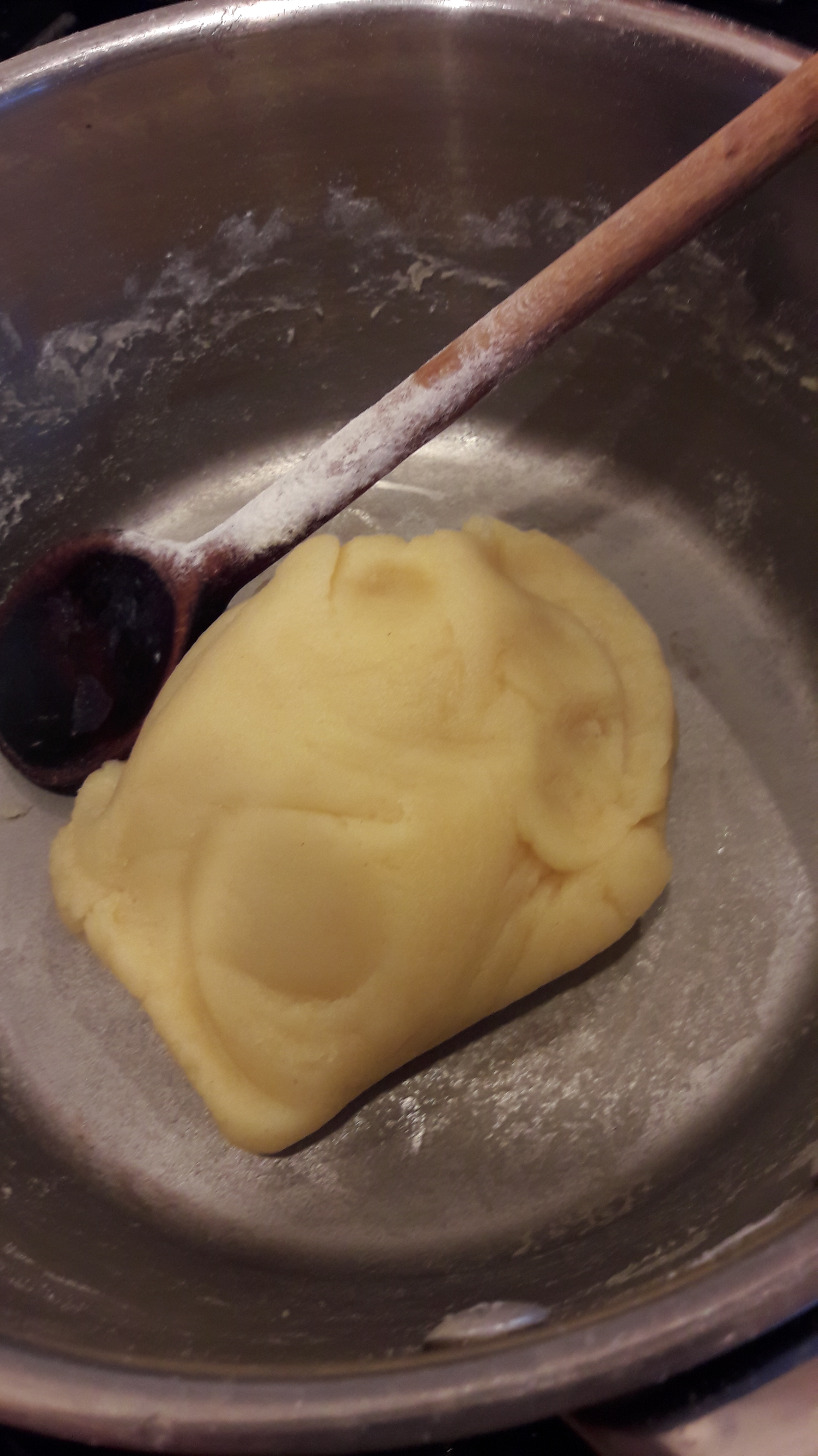
Place the teabags in a large bowl and add the boiling water and stir to make a very strong tea.

Add the dried fruit and stir well.

Leave the fruit to soak overnight.


Pre-heat your oven to GM 3 ,  150°C.

Grease and line a 23cm loose bottom or a spring-form tin.

Place the flour and butter or margarine into a large bowl and use your finger tips to rub in the fat until the mixture looks like breadcrumbs.

In a bowl mix the sugar, salt & mixed spice thoroughly.

Add the sugar mixture to the flour & butter mixture and stir well.

Add the eggs and the soaked fruit and all the remaining liquid and stir well.


Pour the mixture into the baking tin and level the top.

Bake in the  oven for 1 hour 40 minutes.

Check after an hour and place a piece of foil or greaseproof  paper on the top if it is beginning to burn.

Check to see if the cake is done with a cake tester or skewer.

NoteThis cake is large and you run the risk of having it underdone in the middle – make sure it is cooked in the middle when testing.

Leave to cool in the tin.

P1030671


Served on tea plates – Greenway  Hostess – design by John Russell, 1960 – 1979.

Smaller Sized Cake

This cake is large so I thought I would have a go at making a smaller version.

There are 5 eggs in the original recipe so I  decided to do a 3 egg version.

To make it more Polish, I used a bakalie mixture which had chopped dates, figs, peel & prunes as well as the currants, raisins & sultanas.

Ingredients

300g bakalie or dried mixed fruit

5 tea bags (Earl Grey, Lady Grey or Empress Grey)

200ml boiling water

300g self-raising flour

200g butter or block margarine

1 teaspoon mixed spice

pinch of salt

3 eggs


Method

As above – using a 20cm tin.

Bake for around 1 hour 20 minutes – checking after 50 minutes and covering if necessary with a piece of greaseproof paper to stop the top burning.
Note

Maybe because of the different dried fruits I thought it came out drier than the large one & I served it sliced with some butter.

However I have found that if you wrap the cake in aluminium foil for a day or two – it improves – becoming  more moist.


Served on tea plates – La prune – by Jet for Ter Steege in The Netherlands.

Bean Fritters

The Polish for these is kotlety z fasoli  – cutlets from beans.

The word kotlety(plural) comes from the Italian word cotoletta(singular) for cutlet or chop.

Phaseolus vulgaris, common bean, originated from Central and South America, where it was cultivated as early as 6,000 BC in Peru and 5,000 in Mexico.  it was introduced to the Old World by the Spanish and the Portuguese.

It is a legume which means it is a plant that has its seeds contained in a shell or pod.

Most of the recipes in my books use dried beans and they are prepared by soaking them overnight and then boiling them for the required amount of time.

For ease I usually use tinned beans.

You can use haricot beans (wash off the sauce from baked beans), cannellini (white kidney) beans, butter beans and many others.

Ingredients

2 tins of beans

1 onion

butter for frying the onion

1 teaspoon of mixed herbs or Italian herbs

1 egg

1 – 2 tablespoons of potato flour

Dried breadcrumbs

Salt & ground black pepper

Sunflower oil for frying

Method

Chop the onion into small pieces and gently fry in butter.

Leave to cool completely.


Rinse and drain the beans from the tins.


Pat the beans dry with kitchen roll or a clean tea towel.

Mash the beans until you have a thick smooth paste.


Add the onions and the mixed herbs.

Add the egg and mix well.

Add the potato flour to make the mixture thick.

Add salt & ground black pepper

Cover a plate or board with dried breadcrumbs.

Make flattened balls from the mixture – coating them on all sides with breadcrumbs.

Fry the fritters in hot sunflower oil.


They can be kept warm in the oven whilst you cook them in batches.

They can be reheated in the oven at GM5 – 190°C – for around 15 minutes.

Bean Fritters with Peppers & Chilli

This is a variation on the above recipe – to the mixture as above you add – 2 chopped peppers & 1-2 medium chillies or 2-3 small chillies, which have all been softened by gently frying in some butter and then added to the onion mixture. You can also add some chilli flakes.


Continue as above


Both versions of these fritters go well with a crisp salad, salsa or a sauce such as tomato or mushroom.  They also go well with meat dishes in a sauce  such as gulasz, pulpety or chicken casserole.

Save

Placek

Placek is a low flat cake and can be  round or rectangular in shape.

I made two using  each of the recipes in  ciasto półkruche  – a type of shortcrust pastry – with jam fillings and both turned out well.

Placek with jam

Grease and line a 32 x 22 tin

Pre-heat the oven  GM5 – 190°C

Use half the dough and roll it out to fit the tin.

Spread the dough with jam – you will need around a jar.

Cover the top with the rest of the dough rolled out.

Bake for around 30 minutes.

Dust with icing sugar as soon as you take it out of the oven and leave to cool.

Placek with Blackcurrant Jam


Served on – Colclough – Enchantment-  1950 – 1960s

Placek with Sour Cherry Jam


Served on – Duchess – Bramble Rose – 1960s


Vegetable Fritters

The Polish for these is kotlety z jarzyn  – cutlets from vegetables.

The word kotlety(plural) comes from the Italian word cotoletta(singular) for cutlet or chop.

These are made with boiled or steamed vegetables.

Root vegetables are good here as well as cooked cabbage – you can also add cooked pulses such as peas and beans –  I am writing a post just about bean fritters which will be posted soon.

The following vegetable are ones I often use: cabbage, carrots, celeriac, cauliflower, parsnip and potato.

The cooked vegetables need to be chopped fine, minced or mashed – whichever is more suitable or easiest.

For this post I cooked the vegetables especially but this is a good way to use up any leftover cooked vegetables.

Ingredients

  • Around 500g of cooked vegetables – chopped, mashed or minced as appropriate.
  • 2 onions – chopped fine
  • Butter to fry the onions
  • 1 egg (can add another egg yolk as well)
  • 2 – 3 tablespoons of potato flour – depends on how moist or starchy the vegetables are.
  • Salt & pepper
  • Dried Breadcrumbs
  • Sunflower oil for frying
  • Extras – you can add chopped parsley, dill or chives or any other herbs you like.

Method

Chop fine, mash or mince the vegetables as appropriate.

Chop the onions and fry them gently in butter till golden and leave to cool.

  • Mix the vegetables and the onion together.
  • Add the egg and mix well.
  • Add enough potato flour to make the mixture fairly stiff.
  • Add salt and pepper.
  • Put dried breadcrumbs on a board or large plate.
  • Make largish balls of the mixture and flatten them onto the breadcrumbs, turn them over  and cover all the sides.
  • Fry them gently in hot sunflower oil.
  • You can keep them warm on a baking tray in the oven whilst making the rest.

Reheating

I like these reheated – Place them on a baking tray into a pre-heated hot oven GM6  200°C for around 15  minutes.

The combinations are endless – here are some ideas ….

Cauliflower & Spring Onions or Chives

As in the instructions above with the addition of chopped spring onion (the green part) or chives.

Carrot & Parsnip

Carrot, Potato & Peas

.

Buckwheat

Buckwheat (Fagopyrum tataricum) is gryka  in Polish – and I have written already about the use of its flour to make bliny & pancakes.

Buckwheat is not a grain but a seed – however  it is classed under grains for culinary purposes.

The small triangular seeds have a strong scent which is quite distinctive.

In the United States – they are called groats.

Kasza porridge – is very popular in Poland and refers to grains or seeds boiled in water or milk – usually served salted  – rather than sweet.

Kasza gryczanna is cooked buckwheat and  was eaten in Poland long before the introduction of the potato in the 18th century

You can get  buckwheat grains  which are roasted or not roasted.

You can get loose grains & if you are cooking these you need twice as much water by volume as the buckwheat and you simmer this gently with a lid on the pan, until all the water is absorbed.

Then add a large knob of butter (or bacon fat) and place this in an oven-proof dish with a lid or covered in foil and placed in a low oven for at least 20 minutes.

Note

In olden times the dish could be covered with a pillow or small duvet to keep it warm for hours – so it could be prepared early on for eating later.

This is similar to using a hay box which was much used in England in earlier times.

An easy way of cooking the buckwheat is to use the boil in the bag method.

You can buy packets of buckwheat which come in 4 x 100g perforated bags.

Place the bag in 1 litre of salted boiling water and simmer with the lid on for 15 minutes.


Then empty the grains out of the bag and add a large knob of butter and place this in an oven-proof dish with a lid or covered in foil and place in a low oven for at least 20 minutes.


Because of the distinctive strong taste of the buckwheat it is best served with food with “robust” flavours such as beef or pork gulasz.


You can reheat the boiled buckwheat by frying it gently in butter, with fried onion or with skwarki*.


*Skwarki

Skwarki are crisp smoked bacon bits. My mother would use streaky bacon and cut this into little squares and heat them in a frying pan so all the fat would come out.

Other people might use a more fatty, smoked belly pork to make skwarki.

This smoked streaky bacon was quite lean!


Are lardons the same as skwarki?

I have been trying to get a definitive answer to this for ages!

Well  – Yes & No or They can be!

As I understand it lardons are cubes of pork belly which may or may not be smoked.

Swarki for me will always be smoked and the pieces are small flat pieces rather than cubed.


Sponge with Sour Cherry Jam

Wiśnie  is the Polish for sour cherries  which I have described in More Duck.

Having made sponge with sweet orange jam I thought I would try this with sour cherry jam – the one I used is from Lidl and is very good with a sharp sour taste. The taste goes really well with the  dark chocolate.


I made an English style sponge for ease.

Ingredients

2 eggs

75g caster sugar

75g self raising flour

Method

Pre-heat the oven to GM4 – 180°C

Grease and line the base of  a round 18cm diameter  baking tin.

In a bowl whisk the eggs and caster sugar until they are pale and creamy.

Gently fold in the flour.

Pour the mixture into the tin and bake for 20 – 25 minutes until golden.


You will need around 3 to 4 tablespoons of jam.

Warm the jam slightly to make it easier to spread.

Sandwich the cake halves together with the jam.


Make a dark chocolate glaze as in mazurek  using yeast dough  and again in mazurek with oranges.


Here served on Royal Doulton – Counterpoint  1973 – 1987.


Sponge with Sweet Orange Jam

This cake was inspired firstly by mazurek with oranges and also by the very British Jaffa cakes.

Jaffa cakes were first made in 1927 by McVitie & Price (Established in Edinburgh in 1830)  – little sponges with orange jelly and a chocolate topping – named after the port (now called Tel Aviv) from where the Victorians and Edwardians imported oranges).

A fat-free sponge cake is cut in half and sandwiched together with a sweet orange jam and then covered  with a chocolate glaze or icing.

I have tried out several versions – and made a fat-free sponge using  the recipe with  potato flour   this time using a round 19cm baking tin which has been greased and lined with a circle of greaseproof paper on the base and baked for 20 – 25 minutes at GM4 – 180°C


A quicker version is to use a more English sponge recipe ( this has slightly less volume so a smaller baking tin is used).

Ingredients

  • 2 eggs
  • 75g caster sugar
  • 75g self raising flour

Method

  • Pre-heat the oven to GM4 – 180°C
  • Grease and line the base of  a round 18cm diameter  baking tin.
  • In a bowl whisk the eggs and caster sugar until they are pale and creamy.
  • Gently fold in the flour.
  • Pour the mixture into the tin and bake for 20 – 25 minutes until golden.


  • Leave to cool and cut the sponge in half


20170804_090748
Orange & Elderflower Jam from IKEA
  • Warm the jam slightly to make it easier to spread.
  • Sandwich the cake halves together with the jam.

Chocolate glaze – using the one from Mazurek – with Yeast Dough


Served on Bramble Rose by Duchess from the 1960s


The more milk chocolate icing below is the one from chocolate babka.


Served here on tea plates by Spencer Stevenson Co Ltd 1948 – 1960, design name not known.