Pancake Rolls

  • I have been thinking about making savoury pancakes for a while.
  • I came across a new word (to me) – ruloniki. 
  • Sweet pancakes are served – fan folded whereas savoury ones are rolled up.
  • Either the pancake is just rolled up or – 
  • Two sides are first folded in slightly and then the pancake is rolled up.
  • I made these with a mushroom filling – based on my mushroom sauce – adding more potato flour to make the sauce thicker.
  • First make a batch of pancakes and keep them warm or heat them up later when needed.

INGREDIENTS for mushroom sauce

  • 450g of mushrooms sliced
  • Butter for frying
  • 1 mushroom stock cube
  • 500ml hot water
  • 2-3 tablespoons of potato flour or cornflour
  • 3 tablespoons of milk
  • 60ml of soured cream

METHOD for mushroom sauce

  • Dissolve the stock cube in the hot water.
  • Slice the mushroom caps into fine slices and fry them gently in some butter till they are soft.
  • Add the mushrooms to the mushroom stock,
  • Simmer gently for about 5 to 10 minutes.
  • In a little dish mix the potato flour or cornflour with the milk.
  • Add the potato or cornflour mixture to the cooked mushrooms and stir gently over the heat until the sauce thickens.
  • Remove from the heat and add the soured cream and mix.
  • *
  • Spread some sauce over a pancake.
  • Two sides are first folded in slightly and then the pancake is rolled up.
  • *
  • You can serve these individually or say 3 at a time.
  • *
  • Keep them warm in a low oven whilst you are making them. 

A vintage Pyrex plate is used here.

Fish Soup with Tomatoes

  • Here is another recipe adapted from some of my Polish soup books.
  • It is a very filling chunky soup – nearly a meal in itself.

INGREDIENTS

  • 350g of white fish (cod, haddock or pollock)
  • 1 large onion – chopped
  •  2 -3 tablespoon sunflower oil to fry the onions
  • ¼ of a large celeriac or 4 stalks of celery – chopped into small pieces.
  • 1 leek – the white part – chopped into rings
  • 1 carrot – coarse grated.
  • 1 tin of chopped tomatoes
  • 1 ½ to 2 litres of vegetable stock
  • 1 bay leaf
  • 4 peppercorns
  • Salt & Pepper, if needed, to taste
  • *
  • 75 g macaroni or other small pasta – cooked.
  • Large handful of chopped flat leaved parsley to serve.

METHOD

  • Gently fry the onions in the sunflower oil without browning.
  • Add the celery, leek and carrot, mix and fry a little longer.
  • Add the vegetable stock, bay leaf and peppercorns.
  • Bring to the boil and then simmer gently until the vegetables are soft.
  • Add the can of tomatoes and simmer a little longer.
  • Add the pieces of fish and simmer for around 10 minutes.
  • Break up the cooked fish into smaller pieces.
  • Add the cooked macaroni and heat for another minute or two.
  • *
  • Season if necessary (might not be needed)
  • Serve with chopped parsley of top.

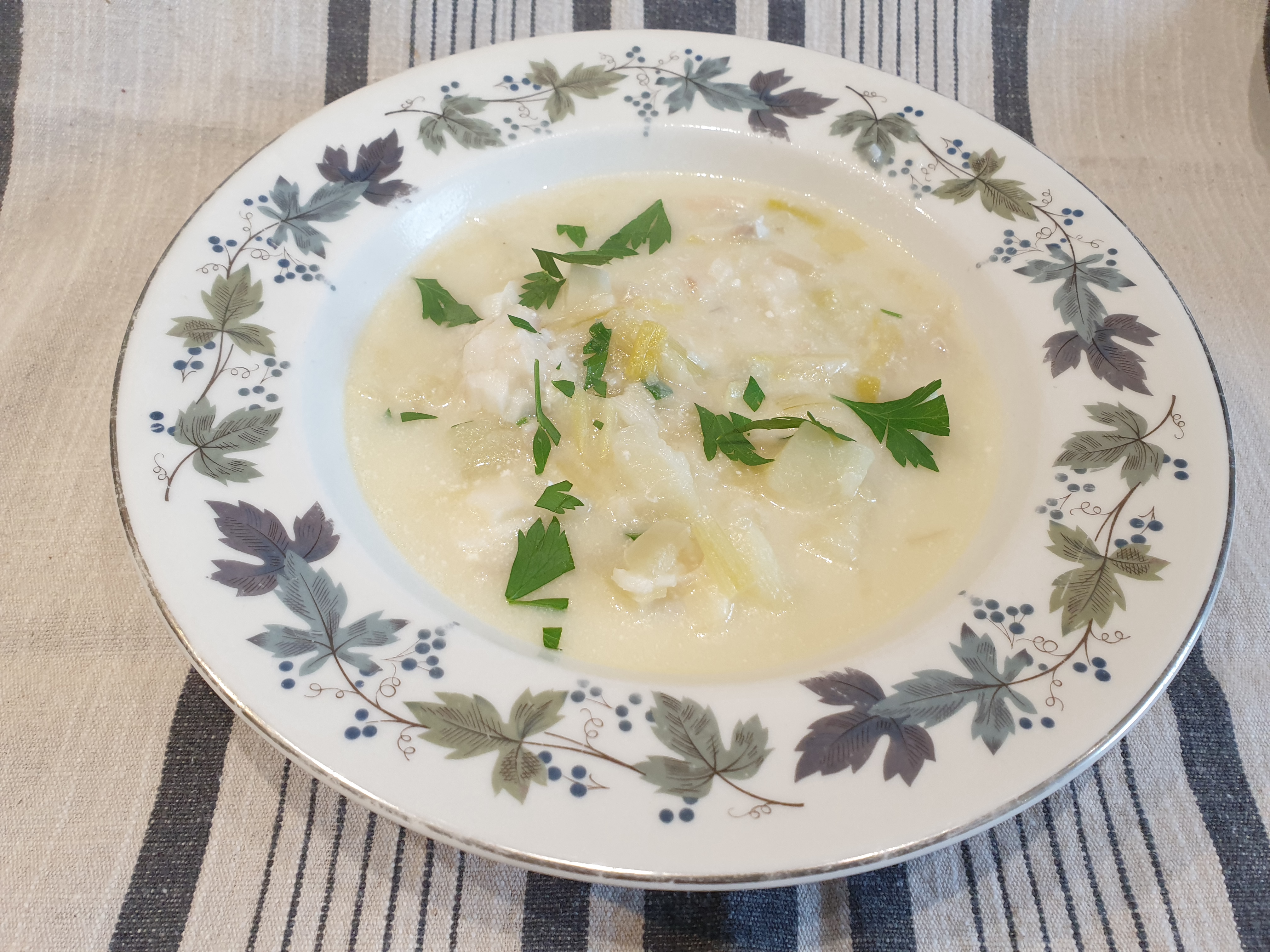
Royal Doulton Carnation soup plate.

Fish Soup with Celery

  • I have been looking at some of my Polish soup books and have seen several recipes for fish soups.
  • I decided to try some of them out and this is one of them.
  • I have posted several fish soup recipes before, one with peppers – one with salmon  and one similar white  fish soup recipe.
  •  

INGREDIENTS

  • 350 g of white fish (cod, haddock or pollock)
  • Juice of 1 lemon
  • 1 large onion
  • 2 leeks – the white part
  • 2 tablespoons of butter  to fry the onions
  • 3 stalks of celery
  • 3 carrots
  • 1½ litres of vegetable stock
  • 2 bay leaf
  • 3 grains of allspice
  • 3 grains of black pepper
  • Salt & Pepper to taste – if needed.
  • *
  • 125ml of soured cream
  • Large handful of chopped flat leaved parsley to serve.

METHOD

  • Cut the fish into large chunks.
  • Wrap the fish with the lemon juice in a foil parcel and keep chilled for 30 minutes.
  • Chop the onion into small pieces.
  • Slice up the leek into rings.
  • Slice the celery into small pieces.
  • Chop the carrots into small cubes.
  • Gently fry the vegetables in oil without browning them.
  • Add the stock, bay leaves, allspice and peppercorns.
  • Bring to the boil and them simmer gently until the vegetables are soft.
  • Add the fish and simmer for around 10 minutes.
  • Separate the fish chunks into smaller pieces. 
  • *
  • Add the soured cream and stir.
  • Season to taste,
  • Serve with the parsley sprinkled on top. 

Royal Doulton Carnation soup plate

Rafaelo Dessert

  • Raffaello chocolates were first made in 1990 by the Italian firm Ferrero. 
  • I have noticed that they are very popular in Poland and nearly always on sale in Polish shops in England.
  • They contain: almonds, wafer, white chocolate and coconut.
  • I have been looking for a definitive recipe for a Raffeallo or Rafealo tort based on this confectionary.
  • There are just so many different ideas on how to make this.
  • I have found a vast number of variations including no-bake versions using biscuits or sponge fingers.
  • I then looked at the more baked ones.
  • The cake most used is a fat free sponge – sometimes this includes ground almonds.
  • The filling is a creamy budyń (Polish custard) with large amounts of added butter,
  • Some versions use white chocolate in their ingredients.
  • The tort is topped with desiccated coconut.
  • The tort is often baked in a square or rectangular tin and each served piece is usually square.
  • However a circular one might be easier if using homemade biszkopt – sponge cake.
  • *
  • I decided to make a lighter dessert, instead with a coconut budyń and sponge cake and a lot less butter.
  • I used a 18cm fat free sponge made with two eggs – cut into two layers.
  • My first attempt was getting the budyń right.

    INGREDIENTS for budyń

  • 500ml milk
  • 1 tablespoon of butter
  • 2-3 tablespoons of granulated sugar
  • 3 egg yolks
  • 3 tablespoons of potato flour (or cornflour)
  • 50 – 80g desiccated coconut & 2 tablespoons
  • 50g white chocolate – coarse grated

Method for budyń

    • Put 300ml of the milk, the butter and sugar into a saucepan.
    • Heat gently till the butter has melted and the sugar dissolved, stirring all the time.
    • Bring this to the boil for a few seconds and then take off the heat.
    • Blend the potato flour with the rest of the milk (200ml) and with the egg yolks.
    • Add some of the boiled mixture to this and stir well.
    • Add this mixture to the rest of  the boiled mixture and stir well.
    • Put the pan back on the heat and bring back to boiling point, stirring gently.
    • Keep at boiling for 1 minute, stirring all the time.
    • Add in the 80g of coconut.
    • Leave to cool.
    • *
    • Use a glass dish and layer up cake, budyń, cake and budyń for the top.
    • Sprinkle the 2 tablespoons of coconut and grated chocolate on the top.
    • Chill in the fridge before serving
OPTION
  • Make the budyń with 750ml of milk and 4 egg yolks.
  • Layer up with some budyń first, then cake, budyń, cake, budyń as before.

Thoughts

  • I liked the version with more budyń. (750ml milk)
  • This was more like a dessert.
  • The version using 500ml of milk was more like a cake with filling.
  • However – they were both voted delicious.

Pierogi Links

ASSORTED PHOTOS

Smacznego!

Horseradish Soup

  • Zupa chrzanowa – horseradish soup  – this is one I came across recently when I found it on a list on favourite Polish soups.
  • It is often made at Easter* time however it is NOT one my mother ever made!
  • It is a “white” soup due to its use of white vegetables and soured cream.
  • You could call it a “cousin” of zurek – sour rye soup.
  • The original recipes use fresh grated horseradish but this is not so easy to come by in England so I used 2 small jars of creamed horseradish sauce instead.
  • Parsley root is also not to easy to find but the amount of celeriac can be increased slightly.
  • White turnip can be used if you cannot find any celeriac in the shops.
  • The soup is served with halves of hard boiled eggs and sometimes skwarki – crispy bacon bits.

INGREDIENTS

  • 3 or 4 slices of streaky smoked bacon – optional
  • 4 -5 Frankfurter style sausages – chopped into small lengths.
  • 2 -3 medium onions
  • Butter to fry 
  • (1 parsley root – if available – chopped)
  • ½ of a celeriac – chopped into small cubes
  • 2-3 medium sized potatoes – chopped into small cubes**
  • 2  litres of chicken stock
  • ½ teaspoon of dried marjoram
  • 2 bay leaves
  • 4 grains of allspice
  • 4 peppercorns
  • 2 small jars of creamy horseradish sauce
  • 4 hard boiled eggs – halved – 1 egg per serving
  • Salt & pepper to taste – if needed
  • ** You can use already boiled potatoes – cubed and added at a later stage of the soup making.

METHOD

  • Chop the bacon into small pieces and fry gently to remove the fat and make skwarki. These will be used to garnish the soup.
  • Chop the onions into small pieces.
  • Fry these gently in the butter till soft – do not brown.
  • Put the stock into a large pan and add the onions, the parsley and celeriac.
  • Also add the marjoram, bay leaves, allspice and peppercorns.
  • Heat gently until the vegetables are becoming soft.
  • Add the sausages and horseradish sauce and heat for another 5 minutes or so.
  • Season to taste.
  • *
  • Served with the bacon pieces and the halved hard boiled eggs.

Served in Royal Doulton Carnation soup plates.

*Horseradish is in the Easter basket that is blessed. It is a symbol of the bitter sacrifice of Christ.

Spelt Scones – Updated

The updating of this recipe has been the use of different dried fruits.

Instead of sultanas or raisins – option 1 was to use chopped dried apricots and option 2 was to use dried cranberries.

All versions are lovely.

This recipe is a cross between an English scone and soda bread.

In Poland you might call these babeczki – little buns or bułeczki – little bread buns or even ciasteczka.

Spelt flour gives these a lovely taste.

Ingredients

  • 250g spelt flour
  • 1 tablespoon of baking powder
  • 1/4 teaspoon of salt
  • 30g of demerara or granulated sugar  & 1/2 tablespoon
  • 80g of sultanas or raisins *
  • 65g butter – chilled and diced
  • 2 tablespoons of yoghurt & milk to make 125ml of liquid
  • 1 egg

Method

  • Line a baking sheet with grease-proof paper.
  • Preheat the oven to GM7 – 220°C.
  • Mix the flour, baking powder and salt together.
  • Add the butter and mix in with the flour to make breadcrumbs.
  • Add the 30g of sugar.
  • Add the sultanas or raisins.
  • Lightly mix the egg into the yoghurt/milk mixture.
  • Make a well in the flour mixture and pour in the egg mixture.
  • With a knife work the mixture together to make a damp rough ball.
  • Turn the ball of dough on the the baking sheet.
  • Form into a flattened disc around 20cm in diameter.
  • Sprinkle with the 1/2 tablespoon of the demerara sugar.
  • Deeply score the disc into eight sections.
  • Bake for 15 – 20 minutes until golden and firm.

They tastes delicious freshly baked with butter & the next day slightly warmed or toasted.

Served here on  Ansley – Las Palmas tea plates from the 1960s and on Queen Anne tea plates.

*Option 1 instead of sultanas or raisins use dried apricots cut into small pieces

Spelt&apricot

*Option 2 instead of sultanas or raisins use dried cranberries

Lemon Soup

  • Once again this is a soup my mother never made.
  • It does fit in with the Polish love of ‘sour’.
  • It is very refreshing and would be good on  hot summer’s day.

INGREDIENTS

  • 150g of cooked rice – pudding or risotto works well. (around 50g per person).
  • 1½ litres of stock – I used 2 chicken stock cubes & 1 teaspoon of vegetable stock powder
  • 4-5 lemons
  • 2 tablespoons of potato flour (or cornflour)
  • 125ml of soured cream
  • Salt & Pepper to taste

METHOD

  • Cook the rice and leave to cool.
  • Bring the stock to the boil and leave at a gentle simmer.
  • Mix the potato flour with a little water and add this to the stock,
  • Stir well until the soup thickens.
  • Add the juice of 2 lemons.
  • Season to taste.
  • You can add more lemon juice if you wish.
  • Remove the skin from the other lemons and cut them into thin slices.
  • Add the lemon slices to the hot soup.
  • Put some rice into a soup dish for serving.
  • Pour the hot soup over this including some lemon slices.
  • Serve straight away.
  • *
  • Squeeze the juice out of the lemon slices when you are eating the soup.

Keks – With Yorkshire Connections

  • Keks is the word for a light fruit cake which is baked in a loaf tin or even more so a long narrow rectangular tin.
  • This recipe is adapted from an old Yorkshire recipe but would equally be liked in Poland.
  • The fruit in this recipe is may be bit higher than in some keks recipes,
  • In England this cake could be made at Christmas time.
  • The soft brown sugar could be replaced by granulated sugar (not tested)
  • The cake has to be started the night before.

INGREDIENTS

155g butter

140g soft brown sugar

3 eggs

*

225 raisins

225 currants

80g glacé cherries

50ml of brandy

*

155g plain flour

1½ teaspoons of baking powder

55g ground almonds

½ teaspoon of freshly ground nutmeg

1 teaspoon of mixed spice

METHOD

Soak the fruit with the brandy overnight.

Use a cake liner to line a 2lb loaf tin.

Pre-heat the oven to GM2.

Mix the dry ingredients together.

Cream the butter with the sugar.

Add the dry ingredients with an egg one at a time.

Stir in the fruit mixture.

Place the cake mixture into the cake tin and cook for around 1 hour 20 -25 minutes.

Pierogi – Cheese Savoury

  • Mama made these very often – I loved them.

  • She often made them for Friday, when this was a meatless day.
  • In Poland you may see these savoury cheese ones on a menu  as Pierogi ruskie   – that is  Ruthanian pierogifrom the old word for the Ukraine.
  • My mother would  boil extra potatoes on one day and save some to make these fillings the next.
  • They are super fried up later.

Ingredients – Cheese 1

Method

  • Peel and boil the potatoes in salted water, strain and mash, then leave to cool.
  • Chop the onion finely and fry it till it is soft and golden, allow it to cool.
  • Mix together thoroughly, the potatoes, onions, cheese and egg yolk.
  • Add salt and pepper to taste.

Ingredients – Cheese 2

  • When my mother did not have any curd cheese, she used Lancashire cheese, as that was the cheese most readily available to her.
  • Both versions taste good, the secret with this one is to grate the cheese as finely as possible and mix it in well.
  • *
  • 400g floury potatoes
  • 1 onion
  • 200g white crumbly cheese such as Lancashire
  • 1 egg yolk
  • Butter & oil to fry the onion
  • Salt & ground black pepper to taste

Method

  • Peel and boil the potatoes in salted water, strain and mash, then leave to cool.
  • Chop the onion finely and fry it till it is soft and golden, allow it to cool.
  • Grate the cheese as finely as possible.
  • Mix together thoroughly, the potatoes, onions, cheese and egg yolk.
  • Add salt and pepper to taste.

Make the pierogi in the usual way – instructions are given below.

  • Ingredients – Dough

  • 500g pasta flour or strong flour or plain flour & 2 tablespoons of fine semolina
  • 300ml water
  • 1 – 2 tablespoons oil – sunflower or light olive
  • ½ teaspoon salt
  • 2 egg yolks
  • *
  • Melted butter for serving or chopped onions cooked in butter.

Method – Dough

  • In a jug or bowl mix together the water, oil and the yolks.
  • Put the flour and salt into a large bowl and make a well in the centre.
  • Pour in the liquid from the jug and initially use a knife to mix this into the flour and then use your hands to mix the liquid and flour to get a ball of dough.
  • Turn this out onto a floured board and knead the dough for a few minutes until you have a smooth ball.
  • Cut the dough into quarters.
  • On a floured board roll out a quarter at a time until you have a sheet of thinly rolled dough.
  • Now prepare a large tray and cover it with a clean tea towel and sprinkle this with flour.
  • Have a large surface such as a tray covered with a cotton or linen cloth which has been lightly floured ready  and place the sealed pierogi on this until they are all made, do not let then touch each other.
  • I cut them out using a 7 cm diameter cutter.
  • I have noticed some people make them larger – I will try this out soon.
  • The excess dough can be re-mixed and rolled out again.
  • Around a half tablespoon of filling is put on  each circle and then they are folded over and the edges pinched together to make a good seal.
  • You learn from experience how much filling to put in as too much will make it hard to seal them and if not properly sealed they will burst on boiling. 
  • Do not worry if you have a few mishaps – it still happens to me even with experience – it is hard to salvage one that has gone wrong – just accept that there will be a few that you do not cook.
  • *
  • To cook the pierogi, use a large pan of boiling water to which you have added some salt and a drizzle of oil.
  • Drop the pierogi in one by one and allow them to boil.  I usually do about 6 to 8 at a time (I only do 6 at a time if using frozen ones).
  • As they cook they will float to the surface, let them boil for 2 to 3 minutes, (a bit more if they were frozen*), and
  • Then remove them with a slotted or perforated spoon and put into a colander above a pan for a few seconds to drain and serve.
  • Continue boiling batches in the same water.
  • If you want to make all the pierogi to serve together then you need to get a large shallow dish.*
  • Put in the pierogi and add melted butter.
  • Keep the dish warm in a low oven.
    • *I often open freeze them for later.