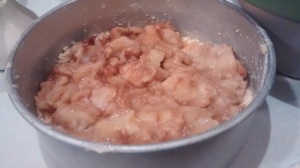
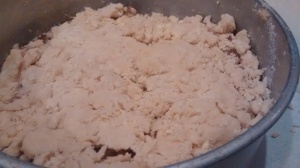
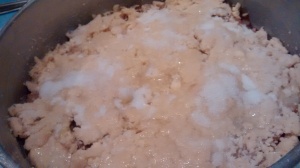
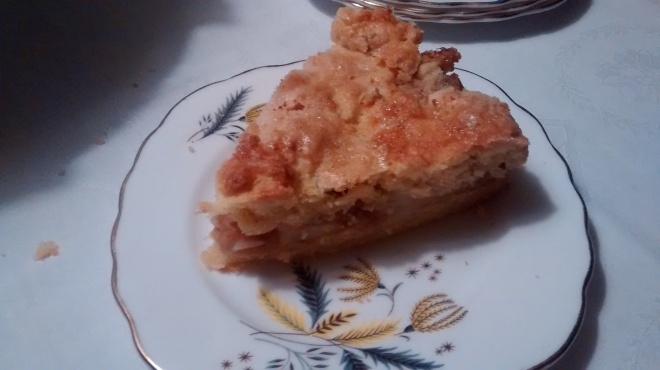
I came across this recipe recently using roasted poppy seeds which give a slightly nutty flavour to the cake.
The cake part is the same as a previous poppy seed cake – makowiec 4 -and uses the simple all in one method using soft tub margarine.
Here roasted poppy seeds are used and lemon rind is not, nor is there a lemon glaze.
Roasting Poppy Seeds
100g of poppy seeds are used in this recipe.
Use a small frying pan without any oil or butter.
Add the poppy seeds to the pan and heat gently for around 5 minutes, stirring the seeds with a wooden spatulas and do not let them burn.
Pour some milk into a jug or bowl and tip the roasted poppy seeds into the milk.
When the poppy seeds have cooled, tip then into a sieve and let them drain away until they are dry. You can press them with a spoon to speed up the process.
The seeds need to be as dry as possible – you could do this part several hours earlier or the night before.
This cake is a modern version as soft tub margarine is used and it is an all-in-one method which is so easy to do with an electric hand whisk.
I use either Flora original or Stork for baking – both of these have given good results.
Ingredients
100g poppy seeds – roasted
175g soft tub margarine for baking
225g self-raising flour
1 ½ teaspoons baking powder
175g caster sugar
3 eggs
3 tablespoon milk (full fat or semi-skimmed)
Method
Pre heat the oven to Gas mark 4 – 1800C.
Make this as a tray bake in a tin about 31×22 cm.
I have a selection of Mermaid Hard Anodised rectangular baking tins and they are superb.
Grease the tin and use one piece of greaseproof paper to line the base and the two long sides of the tin.
Place all the ingredients except the poppy seeds into a large bowl and beat well for about 2 minutes until they are well blended.
Add the poppy seeds and mix them well in.
Put the mixture into the tin and bake for about 30-35 minutes.
Leave to cool on a cooling rack and then take the cake out of the tin.
Wigilia means vigil and in Poland this word is used for the meal that is eaten on the evening(vigil) before Christmas Day – so that is the evening meal on Christmas Eve.
In Poland Christmas is celebrated from Wigilia and parties and visiting relatives and family happens from then on. It seems very strange to the Poles to have all the Christmas parties before Christmas which is still Advent.
This Christmas Eve meal is very important to people and most will try to go to family to share this meal.
It is a meal that has many traditions, many more than Christmas Day itself.
It is a meal which is filled with memories, many from childhood, and you will find that every family has developed its own traditions. Many years ago when I spoke with my cousins in Poland – my mother’s family – I discovered that the meal they had at Wigilia though based on the same principles was very different that the one we had at home.
Advent
Advent is the time leading up to Christmas is observed from the 4th Sunday before Christmas (this will be from the 27th November to the 3 December) so that there will be 4 Sundays in Advent. It is a time of reflection, prayer and preparation.
24th December is the last day of Advent and used to be a day of Fasting & Abstinence.
no meat was eaten on that day (abstinence) and
there was only 1 main/large meal (fasting).
Many people, myself included, keep to this custom.
The Christmas days are called Gody – days of Harmony and Goodwill.
The official end of the Christmas celebrations in church is the 2nd of February the feast of Candlemas or The Presentation of Christ in The Temple when karniwal – carnival starts in the lead up to Lent.
Traditions Around The Wigilia Meal
12 dishes to represent the 12 apostles
Meat is not served.
Some people have 3 soups, 3 fish dishes, 3 vegetable dishes and 3 cakes or dried fruit dishes.
The meal starts after the first star is seen in the sky as a reminder of the Star of Bethlehem used by the 3 Kings to find the Infant Jesus. (This is much later than the usual main meal of the day in Poland).
The food should be from: the fields, the orchard, the garden, the forest and from water.
I try to use only foods that would be found in winter in Poland such as seasonal vegetables & preserved foods which have been dried, bottled, fermented, smoked etc.
You should try to taste every dish to ensure that there will be nothing lacking in the house & harvest in the coming year.
The main dish is the fish – and in olden times some people had up to 12 fish dishes and counted these as ONE!
Fish is the symbol of harmony, freedom and liberation – from the Greek ICHTHYS – for fish & the initials of Jesus Christ Son of God and Redeemer
The table should be covered with a white table cloth over straw or hay to remind us of the manger. (People in towns often have a token bunch of hay).
Sheaves of wheat are placed in the 4 corners of the room.
An extra place is always set so that there will be a place for Jesus as the stranger who may knock at the door. The Poles think that on this night no one should be hungry or alone. (The Poles are very hospitable and I think there will always be a place no matter what time of year.)
Opłatek
At the start of the meal is the sharing of opłatek which was originally bread but now is a wafer (like the communion host) and is a symbol of forgiveness, unity and love.
Each person has a piece and shares it with everyone else offering each other best wishes for the coming year.
People often send a piece of opłatek to family and friends who live far away.
Dishes for Wigilia
The following is a short list of some of the dishes that are often served at Wigilia:
Some of these recipes I have already covered & the links have been inserted – others will be appearing throughout the coming year.
Fish – often Carp which is a fresh water fish and therefore available but it can be Trout , Salmon, Pike or Sea fish such as Haddock baked in the oven with butter
The Christmas tree tradition came from Germany in the late 18th Century and early 19th Century into the towns and into richer villages in the 1920s and took over from an earlier Polish Tradition of hanging from the ceiling just the tip of a spruce/fir tree (tip side down) decorated with apples, nuts which were either wrapped in silver or gold paper or painted and ribbons. Old Polish village houses are made of wood so it is easy to attach the tree tip to the ceiling.
Doorways and walls were often decorated with separate boughs of the remainder of the tree.
People in small apartments and in towns or with limited funds often still just decorate a branch of a fir tree.
This custom originated in pre-Christian times and texts dating back to the 15th and 16th centuries referred to this use of the tree as a pagan rite. Unable to halt the growing trend, the church then reinterpreted the tree to be the Tree of Knowledge – the tree of good and evil.
The tree is put up on Christmas Eve (or maybe a day or 2 before) – the whole family helps – though the candles or lights are not usually lit until Wigilia.
Decorations for the Christmas Tree
Apples symbolise health and beauty.
Nuts wrapped in Silver or Gold guarantee prosperity and vitality.
When I was young we tied wrapped sweets and chocolates on the tree.
Bombki – Glass baubles – in the past these were often blown eggs decorated with glitter. There are also many straw decorations – angels or stars.
Glass baubles originated in Germany in the 19th century but they were soon being made in Poland with their large glass blowing industry. Many are made in small family run workshops, some making around 150,000 per day! Some now specialise in individual and unusual designs.
Mama’s Old Nut Shaped Baubles
Candles in clip on holders with real candles – though now more likely to be artificial lights.
My mother’s candle holders
Candles and baubles guard the house from malevolent deeds.
Paper chains guarantee love within the family.
The star on the top of the tree helps guide back home absent family and friends.
Bells symbolise good news.
Angels are the guardians of the house.
Presents
If there are presents they are placed under the tree and opened at the end of the meal.
It used to be that presents were given on December 6th, St Nicholas Day and Christmas Eve was more about the meal and carols and Church.
Nowadays likely to get presents on both days. In some parts of Poland these gifts are said to be from aniołek – little angel.
Before the Second World War the presents were small tokens such as mandarin oranges (a luxury – as they were imported), chocolate, and an item of new clothes or a small toy.
Pasterka – The Shepherds’ Mass – Midnight Mass
After the meal people go to Mass in memory of the long wait for the Messiah and the Shepherds coming to pay homage to the Infant Jesus.
Kolędy – Carols are sung from midnight mass till the 2nd of February in Church.
Carols are rich and varied with examples from many different centuries with ones originating from church music, to many with music from the Royal Court such as the Polonaise and to folk & dance music.
The oldest carol in the Polish Language is Bogurodzica (Mother of God) and has been known from the beginning of the 13th Century.
When cooking was much more seasonal this salad was extremely popular in winter when many other vegetables were unavailable.
Using bottled sauerkraut you can make this salad all year around. You can also buy vacuum packed sauerkraut in many Polish shops.
Preparing the sauerkraut
There are two ways of preparing the sauerkraut. It all depends on the actual sauerkraut which varies with the home-made or vacuum packed being milder usually than the bottled & how sour you like it to be.
Sour is indeed a well loved taste in Poland and sour is a description you can apply to many Polish dishes. There will be more posts on this on the future.
These salads could be considered sweet & sour.
For all the following salads I have used roughly 200g of sauerkraut which is easily enough as a side-dish for two people.
I think all the following salads benefit from being made a few hours ahead and left to allow the flavours to interact and mellow.
Preparation Method 1
Just take some of the sauerkraut and sieve of some of the liquor.
Sieve off some of the liquor
Preparation Method 2
Put the sauerkraut into a jug or bowl and add some water to rinse off the liquor.
Use Water to Rinse the Sauerkraut
Rinse off the Water
My personal preference is to use method 1 with the sauerkraut just drained and not rinsed.
Sauerkraut & Apple Salad
Ingredients
Around 200g of Sauerkraut
1 tasty eating apple such as Jazz or Braeburn
2 to 3 tablespoons of sunflower oil
1 to 2 tablespoons of granulated sugar.
Method
Prepare the sauerkraut and put it in a dish.
Grate the apple, skin and flesh using a coarse grater and add this to the sauerkraut. Mix the two together.
Add the sunflower oil and sugar and mix well.
Leave in a cool place for a couple of hours before serving.
Serving Dish by J & G Meakin – Topic – designed by Alan Rogers in 1967
In the restaurant in the Polish Centre in Leeds they serve a wonderful sauerkraut and carrot salad – secret recipe of course! – the following is the nearest I can get to it.
Sauerkraut & Carrot Salad 1
Ingredients
Around 200g of Sauerkraut
1 carrot
1 tasty eating apple such as Jazz or Braeburn
2 to 3 tablespoons of sunflower oil
1 to 2 tablespoons of granulated sugar.
Method
Prepare the sauerkraut and put it in a dish.
Peel and grate the carrot using a coarse grater.
Grate the apple, skin and flesh, using a coarse grate.
Add the grated carrot and the apple to the sauerkraut.
Mix them all together.
Add the sunflower oil and sugar and mix well.
Leave in a cool place for a couple of hours before serving.
Mid 20th Century Pyrex Dish
Serving Dish is Carnation by Royal Doulton 1982 to 1998
Meat Loaf and Sauerkraut & Carrot Salad
Sauerkraut & Carrot Salad 2
Ingredients (as salad 1 but less carrot)
Around 200g of Sauerkraut
Half a carrot
1 tasty eating apple such as Jazz or Braeburn
2 to 3 tablespoons of sunflower oil
1 to 2 tablespoons of granulated sugar.
Method
Prepare the sauerkraut and put it in a dish.
Peel and grate the carrot using a coarse grater.
Grate the apple, skin and flesh, using a coarse grate.
Add the grated carrot and the apple to the sauerkraut.
Mix them all together.
Add the sunflower oil and sugar and mix well.
Leave in a cool place for a couple of hours before serving.
Tip
Once you have opened a jar of sauerkraut if you are not going to make something else with it in the next day or so you can portion it up and freeze it for later use.
A few years ago on one of my visits to The Netherlands to stay with my Dutch friend, we had a super meal which included a delicious dish of red cabbage that had been cooked with apples.
I thought then that I did not remember my mother ever cooking red cabbage. When I came home I found recipes in both my Polish and English cookery books and tried out many of these.
The following recipe has been refined and altered and this one with lots of apples and spices is the one I now use all the time.
As it takes a long time to cook in a low oven or in a slow cooker, I tend to make a lot at once. It freezes and reheats well, so once made I divide it into small portions to freeze.
I think it goes well with roast pork loin and I usually make some before Christmas and serve it with roast pork loin during the holiday period.
Tip 1
Have a lemon ready after handling the chopped red cabbage as you will find your hands become stained blue/purple. Lemon juice will clear the stains away. Another reason to make this dish in advance.
Tip 2 – Also Excellent as a Salad
I have discovered that this dish is also delicious when it is cold! I now also serve this with cold meats and Polish style sausage.
Ingredients
1 head of red cabbage
3 or 4 large cooking apples
1 onion – chopped fine
1 or 2 garlic cloves – chopped fine (optional)
6 tablespoons of soft brown sugar
1 level teaspoon of ground cinnamon
¼ level teaspoon of ground cloves
Salt & ground black pepper
3 tablespoons of cider or wine vinegar
3 tablespoons of water
Method
Pre heat the oven to GM 2 or get your slow cooker ready..
You need a large oven-proof dish with a lid to make this. I either use a very large oval enamel dish or I have now started to use a slow cooker.
I mix the ingredients in a large bowl first and then put them in the cooking dish.
Mix together the sugar, spices, salt and pepper, vinegar and water.
Remove the core from the cabbage head and cut the cabbage into fine shreds and add these to the spice mixture.
Peel, core and then coarse grate the apples and then add these to the cabbage mixture. Mix the ingredients with a wooden spoon.
Put the mixture into the cooking dish (or slow cooker) and put in the oven (or switch on the slow cooker).
It should take about 3-4 hours – it may take longer in the slow cooker.
Red Cabbage Ready to ServeServing Dish is Cadiz by Meakin from the 1970s
Miód is the Polish word for honey and so Miodownik is a Honey Cake which usually contains spices. Pierna is an old Polish word for spices and so Piernik is also a Honey Spice Cake.
Some sources say the name is frompieprz – pepper or piorun – thunderbolt or devil – because of its spiciness.
These cakes have been known in Poland since the 12th century and the spices would have come from Turkey (originally brought back by the crusaders) or India.
Honey was the original sweetener, long before sugar and there are many traditional recipes that use honey not only in cakes, but also in meat dishes.
When you travel in Poland you will find many village ladies selling their own honey, the taste varies greatly depending on where the bees have found their flowers and the honey from a forest region is dark and very flavoursome.
Piernik can vary from a soft dense cake to a drier but soft biscuit.
The Polish town of Toruń is famous for its piernik and Chopin was very found of this.
Pierniki(plural) coated with chocolate are called Katarzynki – which means Katherine’s cakes – named after Katarzyna the daughter of one of the bakers.
Similar cakes are found throughout Europe including the French pain d’éspices, the Dutch peperkoek and the German lebkuchen.
Miodownik and piernik are often translated as Gingerbread but ginger is a spice rarely used in Polish cookery.
The main spices used are cinnamon and cloves with the addition according to different recipes of cardamon, black pepper, caraway, nutmeg, dried orange and/or lemon peel and then in later recipes allspice which is from the New World.
My older recipe book gives the proportions for mixing spices and there is one with black pepper which I intend to try out in the future.
Whilst looking through some of my more recent cookery books it would appear that it in Poland you can buy ready mixed spices for piernik so I would presume you can get these in Polish shops in England. I will try these out in the future as well.
I use the mixed spice mixture which is sold by Marks & Spencer which contains: dried orange peel, cassia (a variety of cinnamon), ginger, nutmeg, pimento (allspice) and caraway. I think it is the dried orange peel which makes it much nicer than other mixtures I have used.
Some recipes make a cake mixture and then leave it in a cool place for up to several weeks before baking it. I have tried one of these out many years ago and it was very good – I intend to try this again for a post in the early winter of next year.
Piernik in Poland is associated with the Christmas season and would be made for Christmas Eve and for Christmas Day, it would also be made for Święty Mikołaj – December 6th – St Nicholas Day. This a day for present giving in Poland to children and I would always get a piernik shaped and decorated to look like the bishop that was St Nicholas.
Mama’s Miodownik
This is of my mother’s recipes and it uses sunflower oil which is a more recent addition to recipes in Polish cookery. It is a dense cake which is lovely and moist and improves with keeping.
Miodownik on Greenway Hostess designed by John Russell 1960 – 1979
Ingredients
450g Clear honey
250g Icing sugar
4 Eggs separated
250ml Tepid water
4 Teaspoons cocoa
250ml Sunflower oil
450g Plain flour
Pinch of salt
1 Teaspoon of bicarbonate of soda
1 Teaspoon mixed spice (M&S is the best)
100g mixed peel
Method
You can use a 25cm square tin or a 31cm x21cm rectangular tray tin.
Grease and line the tin.
Pre-heat the oven to Gas Mark 3 – 160º C.
In a large bowl, mix the honey and the icing sugar.
Add the water, cocoa, egg yolks, oil and then the mixed peel.
In a separate bowl mix the plain flour, salt, bicarbonate of soda and the mixed spice.
Add the dry mixture to the honey mixture and mix together to make a batter.
Whisk the egg whites until they are stiff and fold these into the honey batter.
Pour the mixture into the prepared tin.
Bake on the middle shelf of the oven for around 1hour 30minutes.
Take care as this has a tendency to burn at the top, you might need to cover it after about 1 hour with a piece of greaseproof paper of aluminium foil.
Test to make sure it is cooked through with a fine cake tester.
Leave to cool in the tin.
Store in an airtight container or cover in aluminium foil
Miodownik on Greenway Hostess designed by John Russell 1960 – 1979
Addendum
I recently made this for Wigilia (Christmas Eve) around 3 weeks beforehand – it was lovely and moist by then.
This recipe has evolved from two of my mother’s recipes. One was for klops – Polish meatloaf and the other was for the meat stuffing that she used in her roast chicken.
The meatloaf would have been made in Poland with minced pork but often in England my mother used minced beef as it was more available. To this was added grated onion, bread moistened with milk, a beaten egg, salt & pepper; this was shaped into an oval shape and covered with dried breadcrumbs and baked in the oven.
In many of the Polish recipes the meatloaf is baked in a loaf tin or a shallow roasting tray. I however like the open baked version as I love the crunchy breadcrumbs on the outside.
The meat stuffing for chicken was originally made with minced pork, (if this was not available my mother used English style sausage meat) grated onion, bread moistened with milk, a beaten egg and salt & pepper and dried breadcrumbs were added to firm it up and this was used to stuff the chicken.
Meatloaf – Waiting to go into the oven
As there was usually some left my mother would shape this, put dried breadcrumbs on top and bake this in the oven with the chicken. We always wanted to eat some of this and even liked the extra bit better that the actual stuffing because of its crispy coat. She started to make more of it so that we could all have some at dinner. My nephew and nieces called this Grandma’s meat.
This extra stuffing has also evolved, the grated raw onion has been replaced by chopped fried onion ( though you can use both ) and now I use a mixture of minced pork and English style sausage meat.
Frying a Chopped Onion
Luxury or Premium sausage meat is the best to use but often shops only have this available at Christmas, when it is in stock I buy quite a lot and freeze it for several occasions. Sometimes it is sold in 1kilogramme packs, I usually cut these into two or four and re-wrap.
When I cannot get the luxury sausage meat I buy good quality pork sausages and remove the skins.
Now when I have visitors for a roast chicken they always want to make certain that I will be doing a meatloaf as well, some say this is what they most look forward to eating on Christmas Day!
Ingredients
None of the amounts given are exact; they are only for a guide.
500g of luxury sausage meat
500g of lean minced pork
2 medium onions finely chopped and fried till golden brown
1 large egg beaten with salt & pepper
1 slice of white bread – left for half an hour in a bowl with a little milk – do not use the excess milk.
2 teaspoons of Italian herbs or similar
Dried breadcrumbs
Method
Pre heat the oven to GM 5 – 190oC
Bread Soaking up some Milk
Lightly grease a thick baking sheet.
In a large mixing bowl mix everything together except the dried breadcrumbs. Use your hands to get everything thoroughly mixed in.
Waiting To Be MixedWell Mixed Ingredients
Add some dried breadcrumbs to firm up the mix as necessary.
Dried Breadcrumbs
Shape your mixture on to the baking sheet making it into an oval shape rather like a bloomer loaf of bread – make it as high as you can.
Cover the loaf with lots of dried breadcrumbs and place into the oven. It will take about 1hour 30minutes maybe longer – it needs to be done to a golden to very golden colour and the breadcrumbs will be crispy.
Cooked MeatloafWaiting to be sliced
Cut into thick slices to serve, any left can be eaten cold with a salad.
Sliced Meatloaf
Cold Meatloaf with Carrot & Sauerkraut Salad
Note
If you have any left over and cannot eat it the next day or so – then it freezes very well – I wrap slices first in aluminium foil and then in a plastic freezer bag.
When cooking was more seasonal, this was a very popular salad in the late summer and autumn after the apple harvest.
Nowadays with better storage methods, this is a salad you can make all year round.
Serving Dish is Royal Doulton, Carnation 1982 – 1998
The following will make enough for 2 people as a side dish – use the ratio of 2 to 3 carrots to 1 small or medium eating apple if you want to make more.
Organic carrots may have the edge here for taste but regular ones will still be good.
Use sweet and tasty eating apples such as: Jazz, Pink Lady or Cox’s orange pippins.
Ingredients
2 carrots
1 eating apple
1 tablespoon of granulated sugar
Juice of half a lemon
Method
Peel the carrots and grate them using a coarse grater into a bowl.
Cut the apple into quarters and remove the seed case.
Hold the apple by the skin and grate the flesh,
also using the coarse grater, into the bowl.
Discard the apple skin.
Sprinkle the mixture with the sugar and add the lemon juice.
Mix everything together, place into a serving dish and serve.
Note
If you do not have any apples then just carrots with the sugar and lemon juice are also good.
This is another way my mother had of using boiled potatoes – I do not remember her boiling the potatoes especially for these – she would make them with leftover boiled potatoes. (Not that she did not know how many to potatoes to cook for a meal – she would often cook more so she had some for a different use the next day.)
I have given approximate weights below – once you have made them you will know what to expect – I do not think my mother ever weighed out the quantities – just went by eye and consistency.
Ingredients
This will make around 12 croquettes
500g of starchy potatoes – such as King Edward or Maris Piper
20g of melted butter
1 beaten egg
2 to 3 tablespoons of plain flour
Breadcrumbs
Vegetable oil such as sunflower for shallow frying
Method
Mash the boiled,cold potatoes so that they are smooth and without lumps.
Add the slightly cooled, melted butter and the beaten egg and mix together.
Add the flour and mix to a soft dough – not too much flour as a soft dough gives a more fluffy croquette.
Boiled PotatoesPreparing the Breadcrumbs
Divide the dough into 4 manageable pieces and roll out into a long sausage shape and divide them into 3. You are aiming for equal sizes of around 3cm deep and 4cm wide by 10cm long.
Shaped and Coated Croquettes
Shallow Frying
Shallow fry the croquettes in hot vegetable oil in a frying pan, turning them over so that both sides are golden and crispy.
Potato Croquettes – A Variation
The above is how my mother made these croquettes, whilst looking through my Polish cookery books I came across the following variation also which I tried out & I liked these as well.
Method – as above – but instead of just melted butter, fry till golden, half a finely chopped onion in 20 -30g of butter.
Leave this to cool before adding it to the potato mixture.
I was well into my 20s before I realised that there was a special French culinary phrase to describe, what to me, was just the regular topping that my mother and aunties put onto certain cooked vegetables.
Within my family I had never been served cauliflower, Brussels sprouts or whole green beans without a lovely crispy buttery breadcrumb mixture.
I have not discovered when this term was first used in France but some sources think it might have come into use in the early part of the 19th century when many Polish political émigrés came to France and in particular Paris.
Method for the Vegetables
Cook your cauliflower, Brussels sprouts or whole green bean in whatever way you like best.
You can if you wish cook the cauliflower whole – this can have quite a good effect when served.
I like to steam the vegetables as I find I can get them just right – cooked – but still with a bit of bite this way.
Steamed Brussels Sprouts
Place the cooked (and drained if necessary) vegetables in a serving dish.
Pour the buttery topping over the vegetables.
You will get a buttery crunchy taste which is a contrast to the vegetables.
Method for the à la Polonaise topping
Butter & BreadcrumbsPreparing the Breadcrumbs
The topping is made by melting in a saucepan 2 to 3 tablespoonfuls of butter.
(If you use unsalted butter then add a pinch or two of salt)
Melting the Butter
Add to this around 2 tablespoonfuls of dried breadcrumbs and keep on the heat and stir for a few minutes.
Preparing the BreadcrumbsButter & Breadcrumbs
Pour the buttery mix over the vegetables.
Cauliflower à la Polonaise – served in a Royal Doulton serving dish. The pattern is Carnation produced from 1982 to 1998.
Brussels Sprouts à la Polonaise – served in a Royal Doulton serving dish. The pattern is Roundelay produced from 1970 to 1997.
Royal Doulton – Roundelay
Whole green beans à la Polonaise
Added Note
Some cookery books say that chopped hard boiled eggs and chopped flat leaf parsley are added to the topping.
Personally I have not found this to be usually so, although chopped hard boiled eggs are added to many salads and to certain soups in Poland and chopped flat leafed parsley is very often used as a garnish.
Breadcrumbs are needed for many recipes in Polish cookery and especially in the topping à la Polonaise.
So I always make sure I have some in my store cupboard.
Bułka tarta is usually translated as breadcrumbs – they are the dried and then ground or grated crumbs from white rolls (bułka is a bread roll) or white (wheat) bread.
Bread in Poland is normally made from rye flour or a mixture of rye and wheat flour. White bread and rolls were viewed as a luxury in days gone by.
I usually make my own breadcrumbs as in the past the ones you could buy in England were often dyed orange and I did not like them at all.
Nowadays there are many Polish shops and Polish bakeries that sell these dried breadcrumbs.
I have used them and they are good.
If you want to buy them then
Bułka tarta
is what you are looking for – usually sold in 500g bags.
I still make my own as they are a good use of any type of white bread you have left over and the crumbs keep for ages in an airtight box.
Making Breadcrumbs
You need white (wheat) bread – either slices from a loaf or bread rolls – cut in half.
Put your oven on its lowest setting – on mine this is GM1
You can put the slices of bread directly on the oven shelves or you can use a silicone mesh sheet which is good as the moisture which come off the bread does not condense under the bread and it is easier to remove the dried bread from the oven when it is ready.
Leave the bread in the oven for an hour or more – it wants to be a golden brown.
Lightly Dried Bread – It can be a darker brown if desired
Put the dried bread on a chopping board and use a rolling pin to crush it.
I store my breadcrumbs in an airtight plastic box – I use Sistema™ boxes which are made in New Zealand.