Years ago one of my colleagues had a book about Eastern European cookery in which it stated that at one time the Poles were the biggest meat eaters in Europe.
I have tried to find this publication for this reference but to no avail.
I looked up figures for meat consumption in Europe per capita and figures for the early 21st century have Luxenbourg, Spain & Austria in the top three.
Surprisingly for a nation of supposed meat lovers, a common surnames is Jarosz and Jaroszewicz and other variations on this which comes from the word jarosz which means vegetarian. We had several family friends with this surname.
If you hear the word meat in Poland, then think pork, that is the nation’s favourite, be it fresh pork or changed into the wide variety of sausages and smoked meats. I think pork will always take top place in a meal at a Polish special occasion.
In communist times, I visited my mother’s sister who had a small farm and kept pigs and made her own sausages, smoking them in a special smoking unit which was in the attic of the house; they were delicious.
On a more recent trip to other relatives in a large town, I learnt that they had put in a special order for smoked sausages and meats from a lady in a nearby village when they knew I was coming and these were far superior to what was available from the shops.
In the past, cattle were mainly kept for milk, cream, butter and cheese and any beef recipes would be for dishes that require long slow cooking. In recent times dishes are appearing in restaurants and magazines which feature cuts such as sirloin steak.
Sheep were mainly kept for wool and in the mountain regions in the South of Poland for their milk for making cheese.
There are many recipes for wild boar, venison, rabbit or hare in regional cookery.
Goose, duck and chicken are often eaten – of course a village chicken is always preferred if possible.
This post is an introduction to th meat dishes that I will be posting in the future – although I have posted a few already
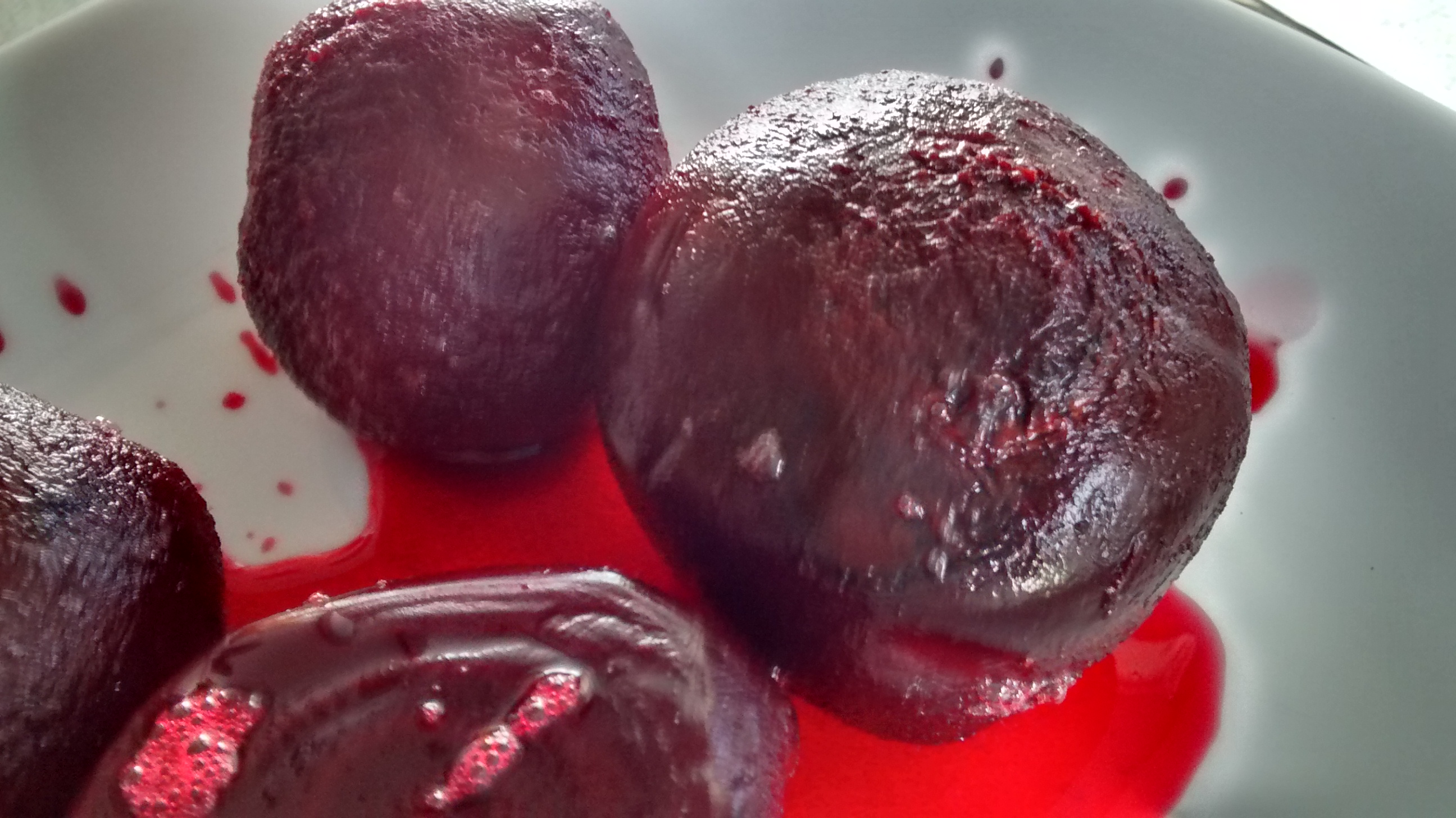
Beetroot is a very popular vegetable in Poland and is served both hot and cold and is the main ingredients of barszcz (The classic Polish beetroot soup).
Now this may just my imagination but the beetroot in Poland just tastes so much better than the ones I have had in England, maybe it is the variety that is grown there or the soil. I think you have to use home-grown or organic beetroot to get as good a taste.
In the following recipes I have used vacuum packed boiled beetroots – boiling or roasting raw beetroot should give a better flavour but when you only want to make a small amount or you have little time this will work as well especially if you adjust the flavour with lemon juice or a little sugar.
A popular variant is something called botwinka – this is very young beetroot – sold in bunches (rather like radishes) and consists of the small “bulb” and the young green leaves, which are all used. As I have not seen this for sale in England I will not be including any recipes – but if you are ever in a position to try this (often in the form of a soup) you will taste something very delicious.
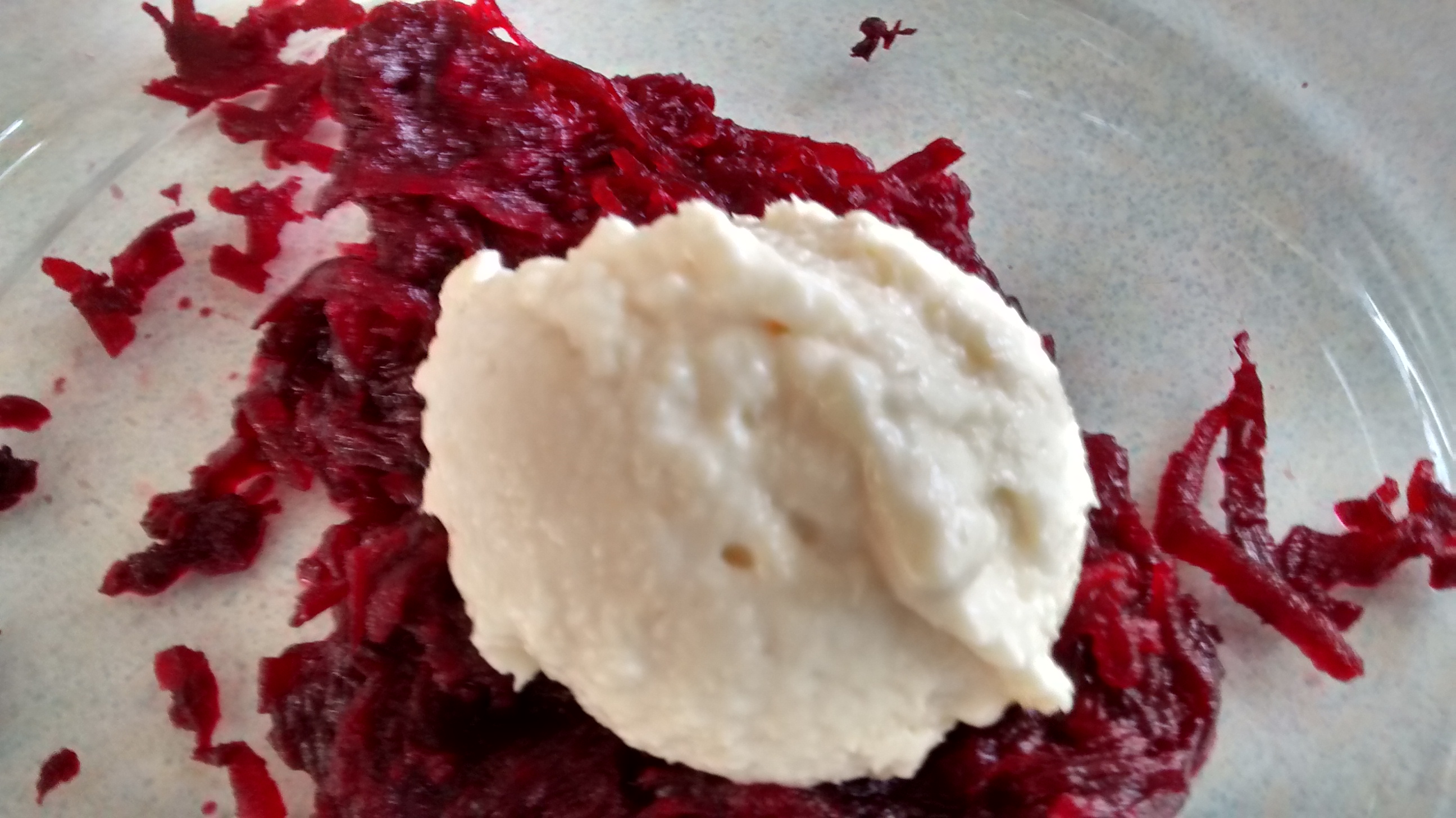
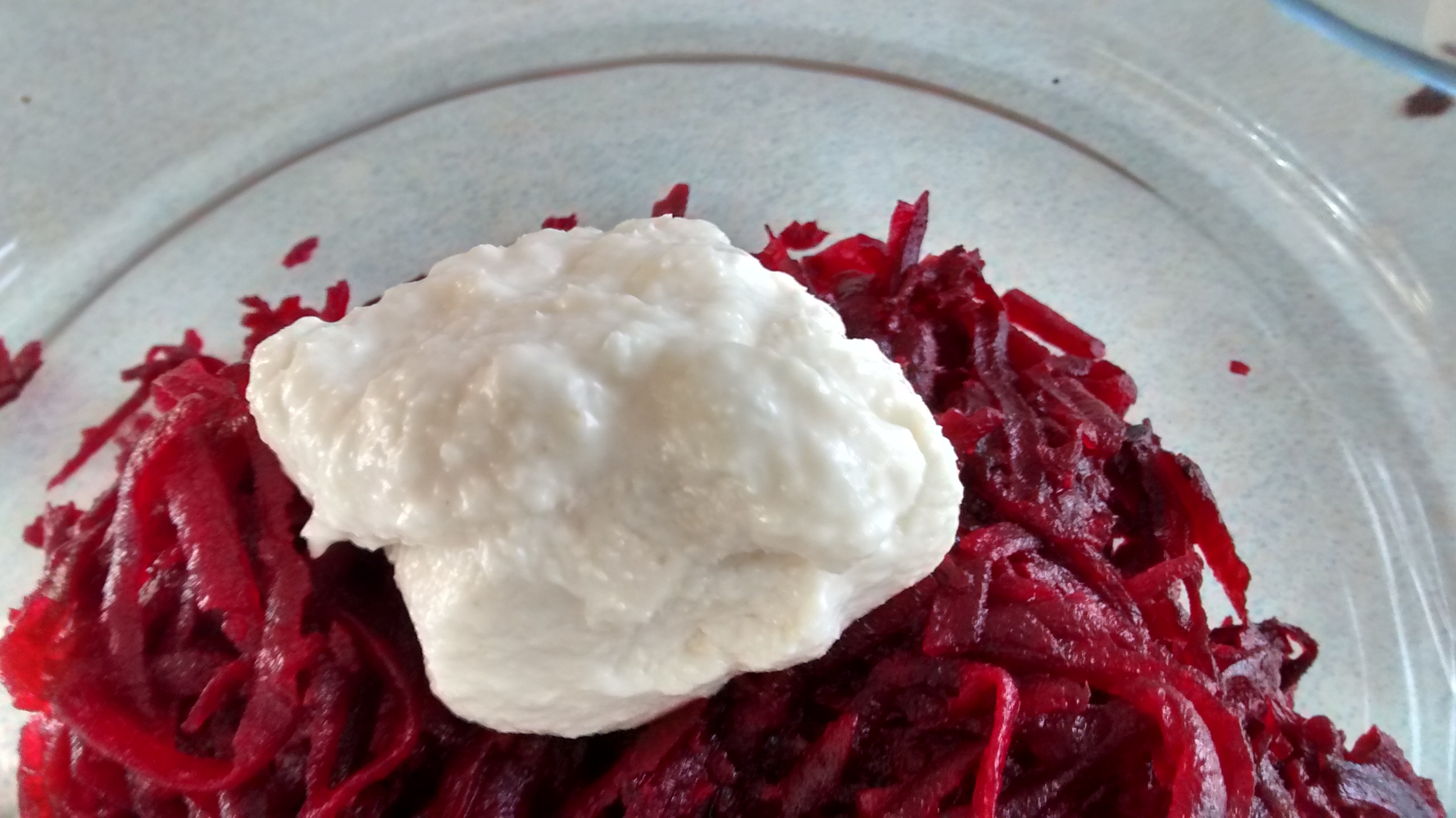
Ćwikła is the most typical Polish accompaniment to roasted and smoked meats and sausage. This salad or relish is made from grated cooked beetroot which is mixed with grated horseradish – chrzan.
The first recorded recipe for ćwikła comes from the writings of Mikołaj Rej (1505 – 1569) who is known as the “Father of Polish Literature”. He was the first person to write exclusively in Polish.
He was born 59 years before Shakespeare (1564 – 1616).
Ćwikła
Ingredients
2 or 3 boiled beetroots
Horseradish sauce
Soured Cream
Extra lemon juice – optional
Method
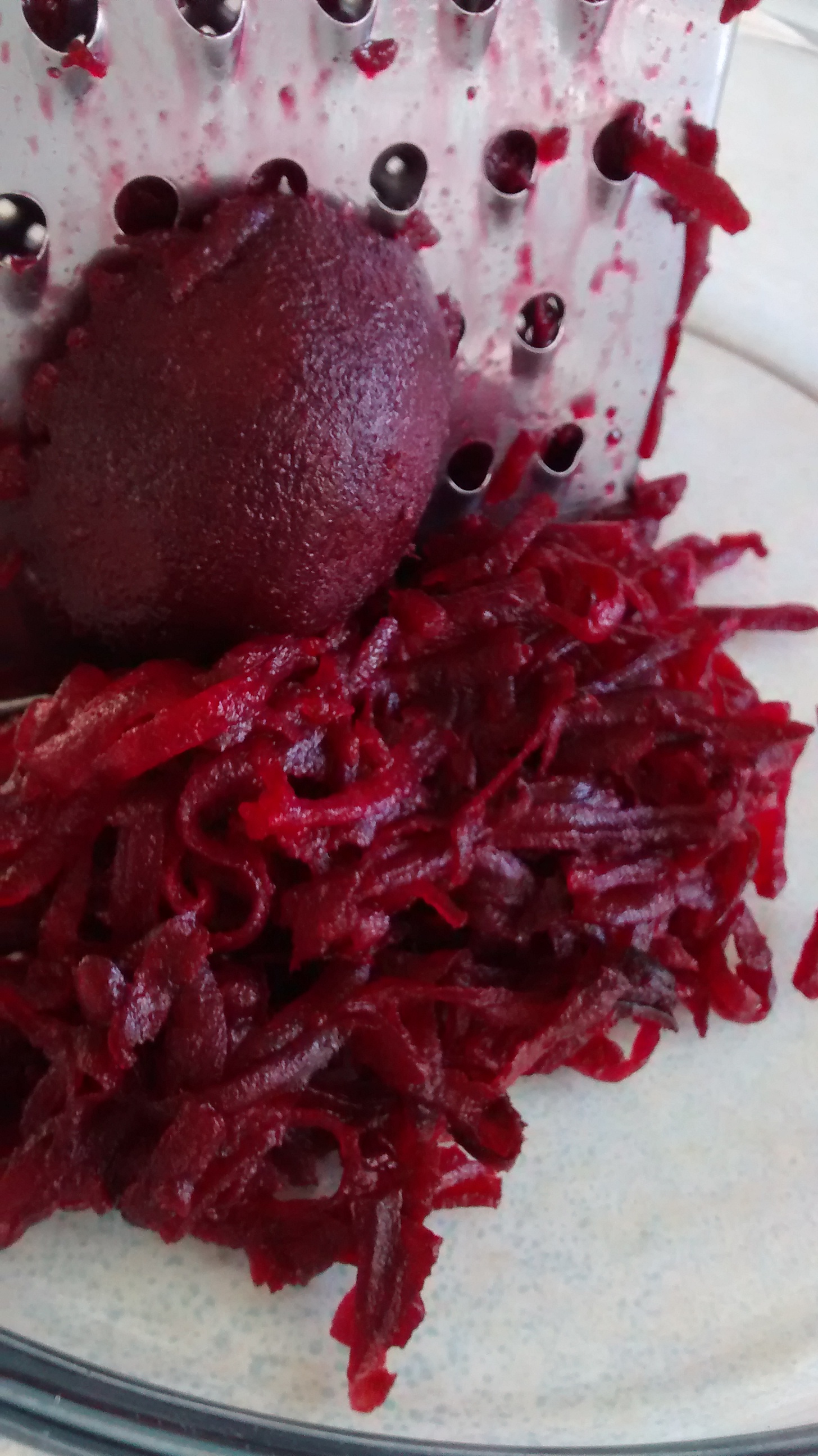
Grate the beetroots using a fine or medium grater and put this into a bowl.
In the past I always used a fine grater but now I prefer to use my medium grater.
Medium Grated
Fine Grated
Add a large dollop or two of horseradish sauce.
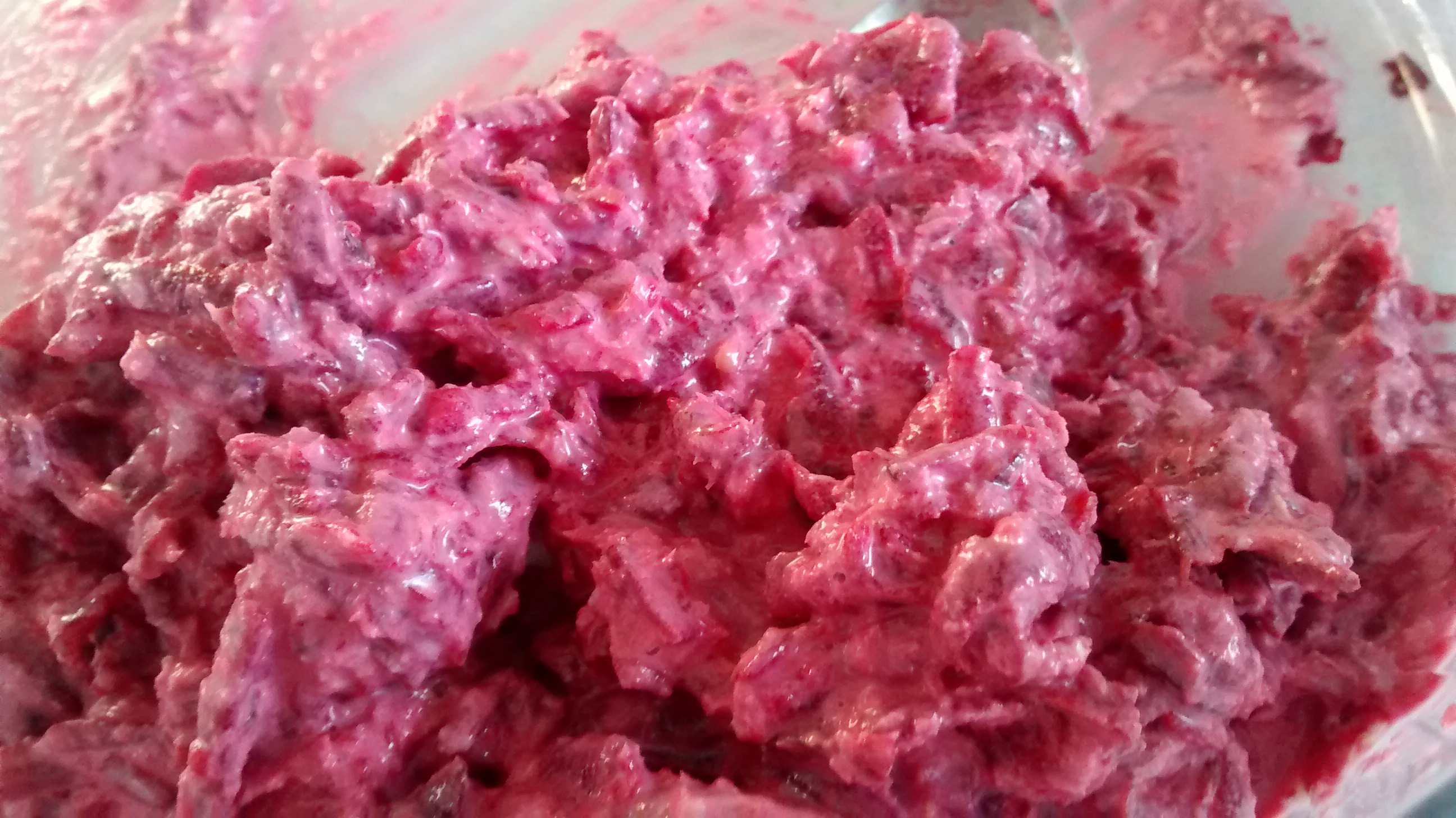
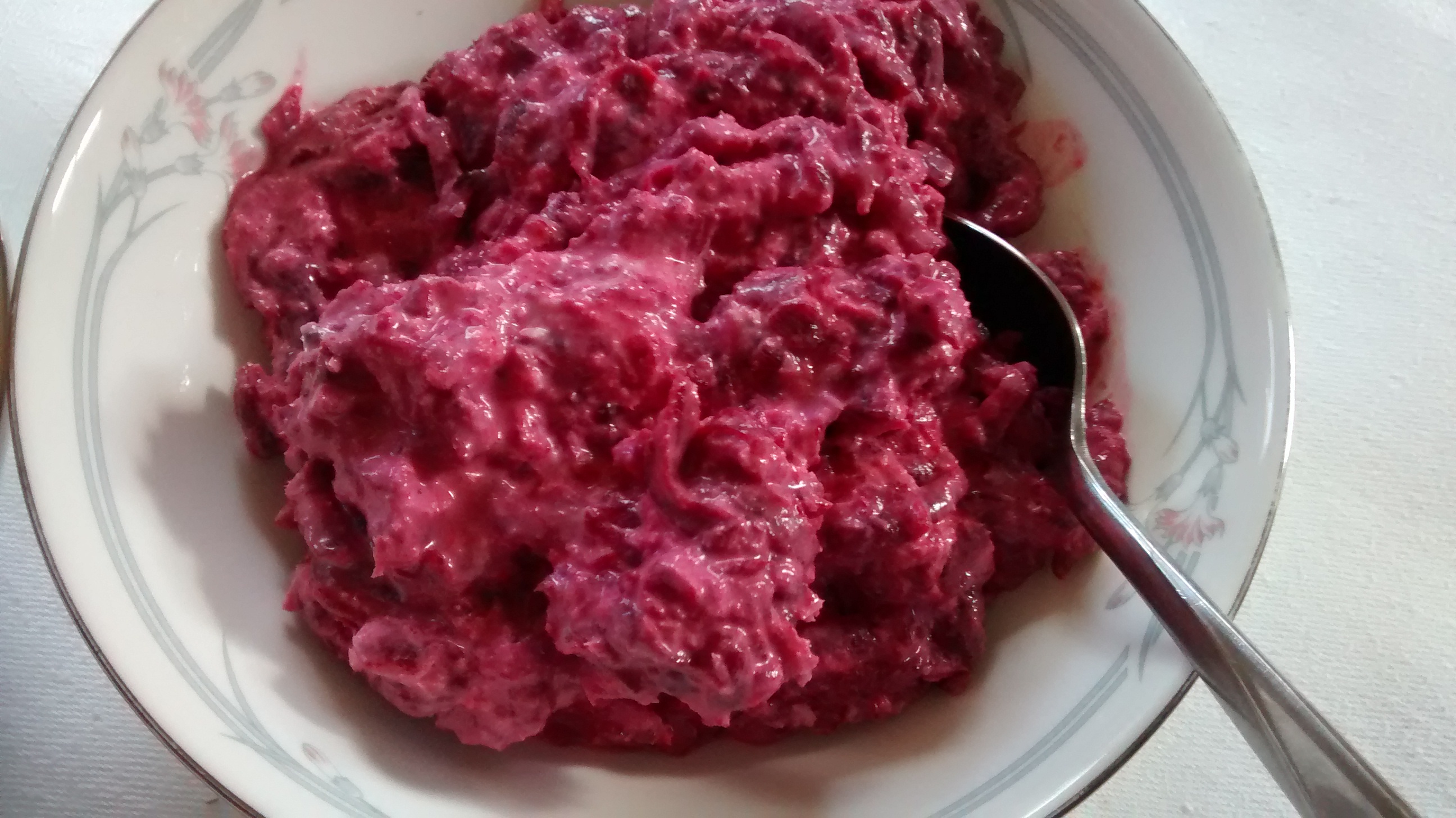
Below are two kinds, one with soured cream and one without.
I like the one with soured cream more.
A few years ago I thought it would be a good idea to grow my own horseradish – that was a mistake! It starts to take over with the roots spreading underground. However the dark leaves are very attractive and the air does smell of horseradish when you walk up to it. You just need to be able to contain it.
Mix the grated beetroot and horseradish sauce together.
Add soured cream – if using the sauce with this in already you might not need as much.
You can add lemon juice as well.
Carnation Serving Dish by Royal Doulton
Beetroot & Apple Salad
Ingredients
2 or 3 boiled beetroots
1 eating apple with a good flavour such as Jazz, Braeburn or Pink Lady.
Juice of half or a whole lemon
Sugar – optional
Method
Grate the beetroots using a medium grater.
Peel and core the apple and grate this using a medium grater.
Mix the two together.
Add lemon juice to taste.
You can add some extra sugar to taste.
NOTE
This tastes much better if it is left so all the ingredients mingle together for a few hours.
I make this in the morning if I want it for the evening or I make it the night before for lunch time the next day.
Creamed Beetroot
This is a delicious way of serving beetroot warm with a roast dinner.
Ingredients
3 or 4 boiled beetroots
Large tablespoon of butter
1 or 2 tablespoons of flour
Juice of a lemon & some extra water
3- 4 tablespoons of soured cream
Salt & pepper to taste
A little sugar to taste – optional
Method
Grate the beetroots using a medium grater and put them into a saucepan with the lemon juice and a little water.
Put a lid on the saucepan and gently simmer the beetroot – taking care not to let it dry out or burn.
Melt the butter in a small frying pan and add the flour – let it colour slightly.
Add 2 tablespoons of soured cream and a little water and combine this well.
Add this mixture to the simmering beetroots, once again combining well.
Let this simmer for 5 to 10 minutes – keep checking, and stirring and adding more soured cream, lemon juice or water if it looks like it is going to dry out.
Add salt & pepper and a little sugar to taste.
Serving dish is Topic designed by Alan Rogers in 1967 for J & G Meakin.
The official end of the Christmas & Epiphany season is February 2nd which is 40days(inclusive) after Christmas and is the feast of the Presentation of Christ in TheTemple also known as Candlemas Day. In Poland it is called Święto Matki BoskiejGromnicznej – The feast of Our Lady of the Thunder Candles (as the blessed candles are used during thunder storms)
February 2nd is the start of karnawał – carnival and the festivities leading up to the beginning ofLent which starts on Ash Wednesday.
During karnawał there is lots of dressing up in costumes such as beggars, chimney sweeps, goats, bears, horses or storks and going from farm to farm or house to house and there the revellers would be given food and drink.
The date of Ash Wednesday varies as it is based on the date for Easter which is calculated according to the Paschal full moon.
Easter is the first Sunday after the first full moon, after the spring equinox, which is the 21st of March. So the earliest date for Easter is the 22nd of March and the latest date is the 25th of April.
Ash Wednesday is six and a half weeks before Easter – calculated as 40 days but the Sundays are not included so it is in fact 46 days before Easter Sunday.
Therefore the earliest date for Ash Wednesday is the 4th of February and the latest date is the 10th of March.
In a year when Ash Wednesday is very early – I am sure that karnawał festivities would begin a little early!
After Christmas with all the wonderful food it seems like only a few days and it is time to prepare for Lent. All the rich food is used up before Lent, especially on the last day before Ash Wednesday.
In England it is Shrove Tuesday, in France Mardi Gras(Fat Tuesday), in Poland tłusty wtorek (Fat Tuesday) and in some parts of Poland there is also tłusty czwartek (Fat Thursday) and then the last Tuesday can also be be called ostatki (last remnants).
In Poland chrusty and pączki (doughnuts) are made (pancakes are eaten throughout the year and do not feature here.)
My mother always made chrusty, doughnuts we got from other Polish ladies in the neighbourhood.
I was in Kraków once on tłusty czwartek (Fat Thursday) and bought some doughnuts – I found that these were very special ones made for that day made with rose petal jam. I am afraid I did not like these – I am used to Polish plum jam or raspberry jam in Polish doughnuts and found theses too perfumed for me. (I have recently seen many English recipes made with rose petal jam – so maybe it is an acquired taste)
Chrusty
Chrusty are deep fat fried, sugar dusted pastries.
These must be my favourite pastries which my mother would only make once or twice a year before Lent began.
When I was little before I started to help, I could never understand how she made these amazing shapes.
The name chrusty means “dry twigs” which may describe their appearance but not their taste!
You could call them ribbon shaped and in some parts of Poland they are called faworki from the French word faveur which means favour as in the coloured ribbons given by ladies to Medieval knights.
My aunty in The United States told me that nowadays they are popular there for weddings and other big parties not just during carnival and that Americans call them Angel wings.
I remember that my mother always fried these in vegetable oil. During my research I have realised that originally they were fried in lard, and the books say that this makes them very tasty!
They taste best a few minutes after cooking, straight from the pan, when still slightly warm and dusted with icing sugar. So being in the kitchen when they are being made is the best place to be!
Ingredients
300g plain flour
100g self-raising flour
50g butter
50g caster sugar
2 eggs
2 egg yolks
2 tablespoons of rum (or vodka and 2 drops of vanilla essence)
2 – 3 tablespoon of soured cream to mix (use double cream if not available)
Sunflower oil to deep fat fry
Icing sugar to dust
Method
Mix the flours together and rub in the butter to make fine crumbs and then mix in the sugar.
Mix together the eggs, yolks and alcohol together. Make the decision on how much cream to use or not as you start to mix later.
Make a well in the dry ingredients and add the liquid.
Mix the liquid with the dry ingredients to make a soft dough. You can use a knife at first and then your hands.
If the dough needs some extra liquid then add the soured cream bit by bit.
Take about a third of the dough and roll it out on a floured board as thinly as possible.
Using a sharp knife cut strips which are strips 3 to 4 cm wide and about 15cm long, you can cut the short edges diagonally.
In each one cut a slit down the middle long ways and pull the short edge through to make a twist.
Repeat with the rest of the dough, try to use as much as possible in the first cutting but you can mix and re-roll the off-cuts.
Try not to add too much extra flour when re-rolling.
You can brush of excess flour with a pastry brush.
In a pan or fryer heat up the oil and deep fat fry the chrusty, about 2 or 3 at a time till they are golden. They will rise to the top as they cook, turn them over using bamboo or wooden tongs.
Remove from the hot oil, using the frying basket or bamboo/wooden tongs.
Place onto kitchen roll and dust with icing sugar.
If you have any left put them in an airtight container when they are completely cold and add extra icing sugar when you serve them.
Wigilia means vigil and in Poland this word is used for the meal that is eaten on the evening(vigil) before Christmas Day – so that is the evening meal on Christmas Eve.
In Poland Christmas is celebrated from Wigilia and parties and visiting relatives and family happens from then on. It seems very strange to the Poles to have all the Christmas parties before Christmas which is still Advent.
This Christmas Eve meal is very important to people and most will try to go to family to share this meal.
It is a meal that has many traditions, many more than Christmas Day itself.
It is a meal which is filled with memories, many from childhood, and you will find that every family has developed its own traditions. Many years ago when I spoke with my cousins in Poland – my mother’s family – I discovered that the meal they had at Wigilia though based on the same principles was very different that the one we had at home.
Advent
Advent is the time leading up to Christmas is observed from the 4th Sunday before Christmas (this will be from the 27th November to the 3 December) so that there will be 4 Sundays in Advent. It is a time of reflection, prayer and preparation.
24th December is the last day of Advent and used to be a day of Fasting & Abstinence.
no meat was eaten on that day (abstinence) and
there was only 1 main/large meal (fasting).
Many people, myself included, keep to this custom.
The Christmas days are called Gody – days of Harmony and Goodwill.
The official end of the Christmas celebrations in church is the 2nd of February the feast of Candlemas or The Presentation of Christ in The Temple when karniwal – carnival starts in the lead up to Lent.
Traditions Around The Wigilia Meal
12 dishes to represent the 12 apostles
Meat is not served.
Some people have 3 soups, 3 fish dishes, 3 vegetable dishes and 3 cakes or dried fruit dishes.
The meal starts after the first star is seen in the sky as a reminder of the Star of Bethlehem used by the 3 Kings to find the Infant Jesus. (This is much later than the usual main meal of the day in Poland).
The food should be from: the fields, the orchard, the garden, the forest and from water.
I try to use only foods that would be found in winter in Poland such as seasonal vegetables & preserved foods which have been dried, bottled, fermented, smoked etc.
You should try to taste every dish to ensure that there will be nothing lacking in the house & harvest in the coming year.
The main dish is the fish – and in olden times some people had up to 12 fish dishes and counted these as ONE!
Fish is the symbol of harmony, freedom and liberation – from the Greek ICHTHYS – for fish & the initials of Jesus Christ Son of God and Redeemer
The table should be covered with a white table cloth over straw or hay to remind us of the manger. (People in towns often have a token bunch of hay).
Sheaves of wheat are placed in the 4 corners of the room.
An extra place is always set so that there will be a place for Jesus as the stranger who may knock at the door. The Poles think that on this night no one should be hungry or alone. (The Poles are very hospitable and I think there will always be a place no matter what time of year.)
Opłatek
At the start of the meal is the sharing of opłatek which was originally bread but now is a wafer (like the communion host) and is a symbol of forgiveness, unity and love.
Each person has a piece and shares it with everyone else offering each other best wishes for the coming year.
People often send a piece of opłatek to family and friends who live far away.
Dishes for Wigilia
The following is a short list of some of the dishes that are often served at Wigilia:
Some of these recipes I have already covered & the links have been inserted – others will be appearing throughout the coming year.
Fish – often Carp which is a fresh water fish and therefore available but it can be Trout , Salmon, Pike or Sea fish such as Haddock baked in the oven with butter
The Christmas tree tradition came from Germany in the late 18th Century and early 19th Century into the towns and into richer villages in the 1920s and took over from an earlier Polish Tradition of hanging from the ceiling just the tip of a spruce/fir tree (tip side down) decorated with apples, nuts which were either wrapped in silver or gold paper or painted and ribbons. Old Polish village houses are made of wood so it is easy to attach the tree tip to the ceiling.
Doorways and walls were often decorated with separate boughs of the remainder of the tree.
People in small apartments and in towns or with limited funds often still just decorate a branch of a fir tree.
This custom originated in pre-Christian times and texts dating back to the 15th and 16th centuries referred to this use of the tree as a pagan rite. Unable to halt the growing trend, the church then reinterpreted the tree to be the Tree of Knowledge – the tree of good and evil.
The tree is put up on Christmas Eve (or maybe a day or 2 before) – the whole family helps – though the candles or lights are not usually lit until Wigilia.
Decorations for the Christmas Tree
Apples symbolise health and beauty.
Nuts wrapped in Silver or Gold guarantee prosperity and vitality.
When I was young we tied wrapped sweets and chocolates on the tree.
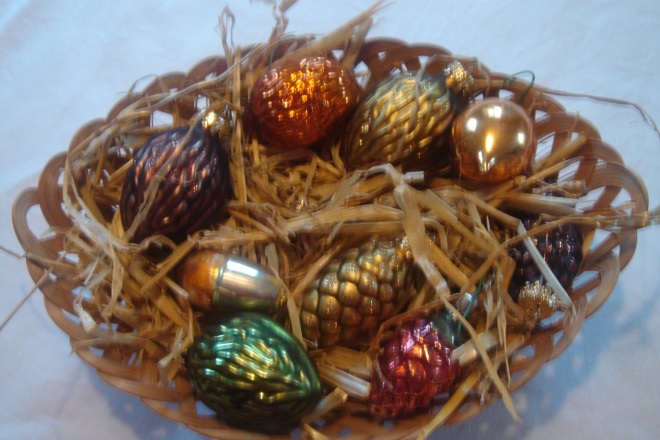
Bombki – Glass baubles – in the past these were often blown eggs decorated with glitter. There are also many straw decorations – angels or stars.
Glass baubles originated in Germany in the 19th century but they were soon being made in Poland with their large glass blowing industry. Many are made in small family run workshops, some making around 150,000 per day! Some now specialise in individual and unusual designs.
Mama’s Old Nut Shaped Baubles
Candles in clip on holders with real candles – though now more likely to be artificial lights.
My mother’s candle holders
Candles and baubles guard the house from malevolent deeds.
Paper chains guarantee love within the family.
The star on the top of the tree helps guide back home absent family and friends.
Bells symbolise good news.
Angels are the guardians of the house.
Presents
If there are presents they are placed under the tree and opened at the end of the meal.
It used to be that presents were given on December 6th, St Nicholas Day and Christmas Eve was more about the meal and carols and Church.
Nowadays likely to get presents on both days. In some parts of Poland these gifts are said to be from aniołek – little angel.
Before the Second World War the presents were small tokens such as mandarin oranges (a luxury – as they were imported), chocolate, and an item of new clothes or a small toy.
Pasterka – The Shepherds’ Mass – Midnight Mass
After the meal people go to Mass in memory of the long wait for the Messiah and the Shepherds coming to pay homage to the Infant Jesus.
Kolędy – Carols are sung from midnight mass till the 2nd of February in Church.
Carols are rich and varied with examples from many different centuries with ones originating from church music, to many with music from the Royal Court such as the Polonaise and to folk & dance music.
The oldest carol in the Polish Language is Bogurodzica (Mother of God) and has been known from the beginning of the 13th Century.
I have tried this out as a just vegetable variation.
In my Polish cookbooks there are many variations without meat and they use mushrooms or other vegetables and grains, but these tend to use just dried mushrooms and often rather than rice use buckwheat or pearl barley. Whilst these grains are maybe more traditionally Polish in style I wanted to do a recipe which would initially be more appealing to the English taste. Also I wanted to use mainly fresh mushrooms.
Ingredients for the filling
150 to 200g of rice
400g of mushroom caps – white and/or chestnut
Some butter to fry the mushrooms
5g of dried mushrooms (more if you desire)
A few tablespoons of boiling water
Salt & pepper to taste
Method
In a small bowl add the boiling water to the dried mushrooms , just enough to cover them, and leave overnight.
Stepped Dried Mushrooms and Chopped Fresh Mushrooms
Parboil the rice and leave to go cold. (You can use any already cooked rice you might have cooked already – it is not that critical – it will just have a softer texture).
Finely Slice up the mushroom caps (You can chop them into smaller pieces) and fry them in the butter until they are soft.
Making a Pulp of Dried Mushrooms
Using a knife make a pulp of the dried mushrooms or chop them into small pieces if they have not softened enough.
Add the mushroom pulp and the liquor in which they were steeped to the frying mushrooms and continue cooking the mixture evaporating of most of the liquid or about 10 minutes.
Leave the mushrooms to cool.
In a large bowl mix the parboiled rice and mushroom mix, add salt and pepper to taste.
Mushroom & Rice Mixture
Prepare the cabbage leaves
You need a large white cabbage or a savoy cabbage or I have now started using sweetheart cabbage – you might need 2 of these as they are not usually so large.
Patience is called for here to avoid getting scalded fingers. You have to heat or steam the cabbage to make the leaves pliable so you can remove them one by one and use them to encase the filling.
You need the largest pan you have into which you place the cabbage head.
I boil some water in a kettle and pour this over the cabbage in the pan. With some heat under the pan I let the cabbage cook a little. The temptation is to boil too quickly so making some of the leave too soft and runs the risk of getting scalded as you try to remove the leaves.
Another method is to place the cabbage into a metal colander and set this over the pan of water so that it is steamed rather than boiled – I think this method is the one I like best.
As the leaves become soft, you have to cut them off from the stalk and stack them up for to use later, you can cut out the thickest part of the stalk from the first few larger leaves. Pre heat the oven to GM3 – 160oC
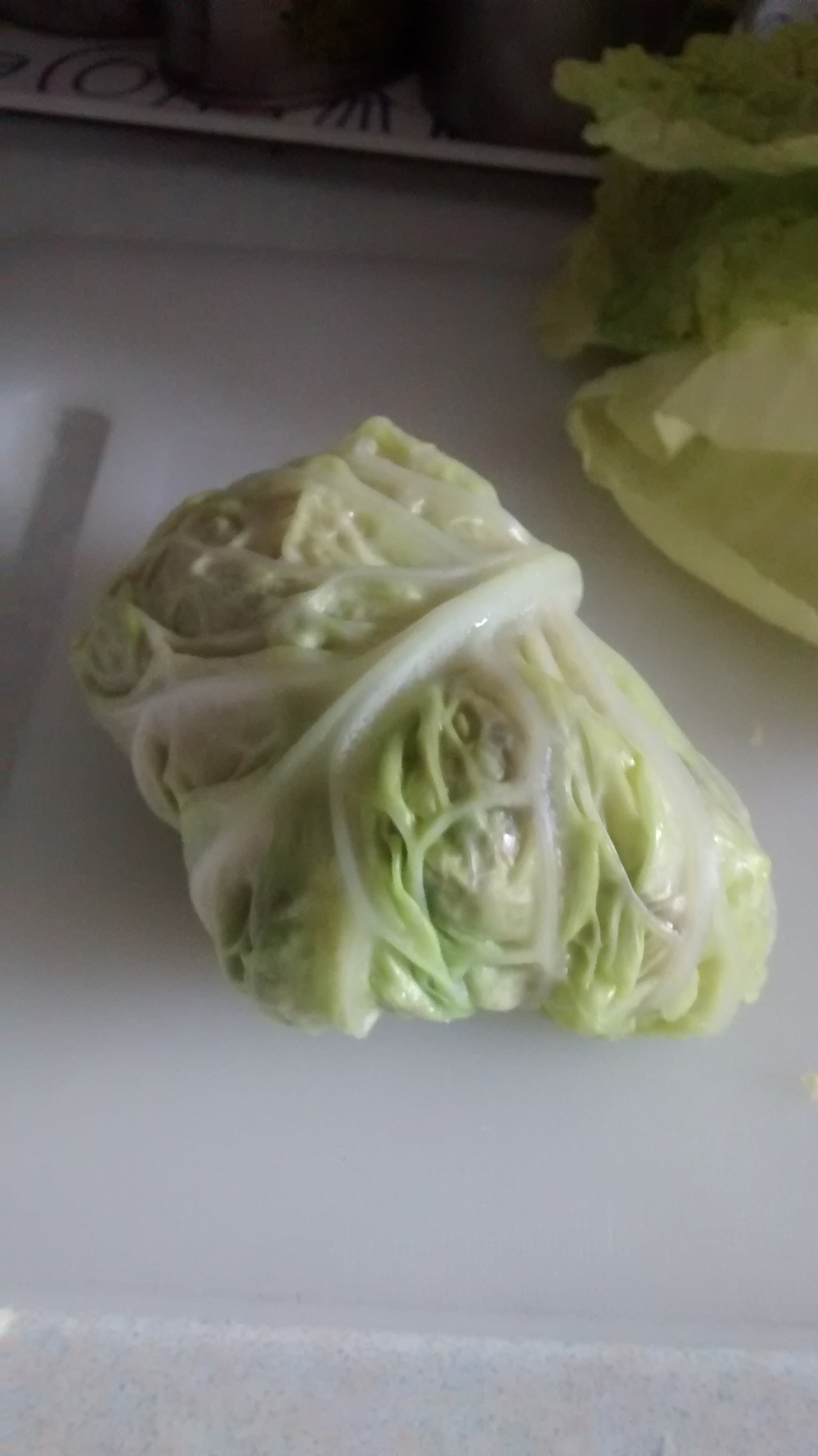
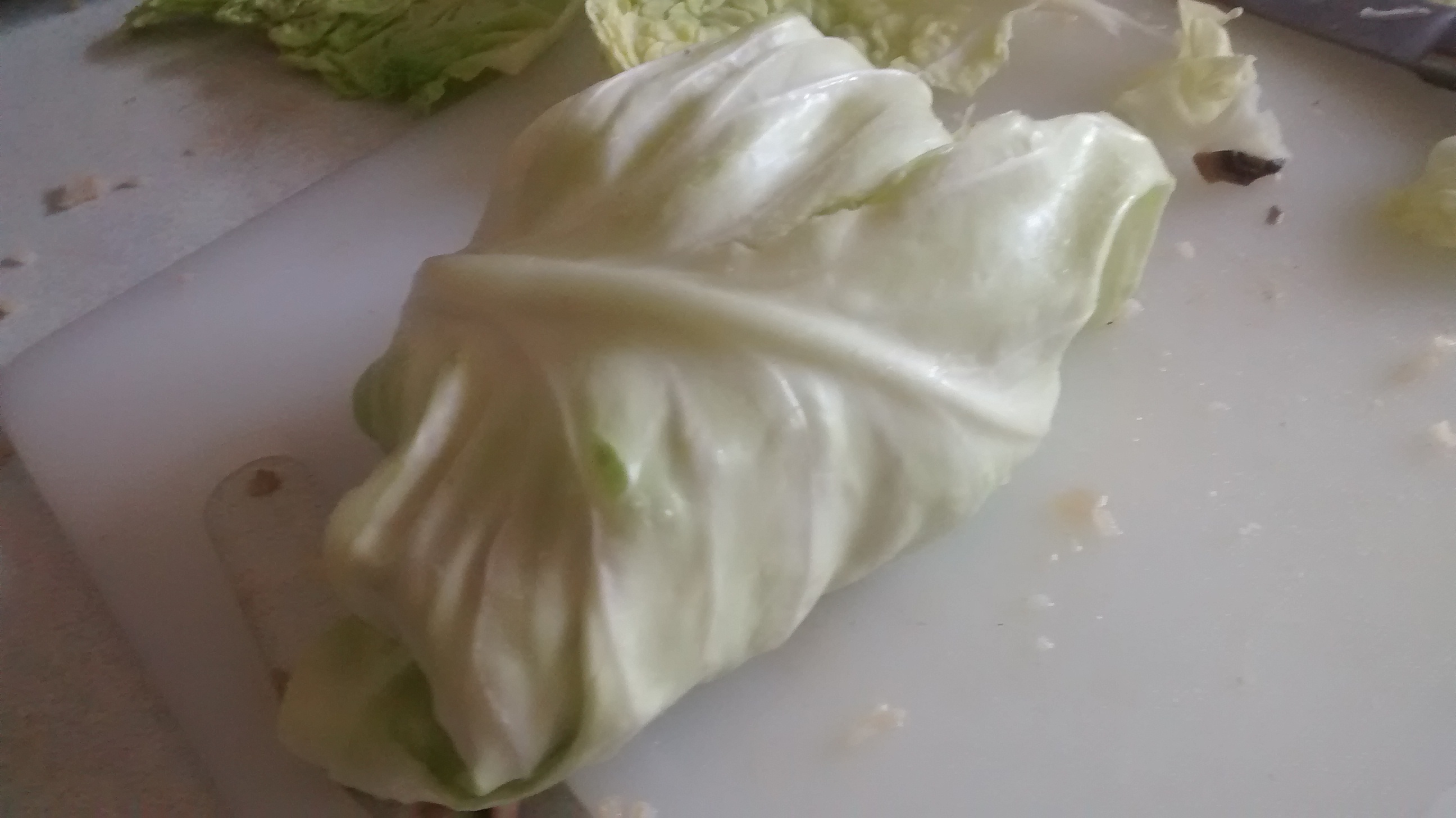
Fill the leaves with the rice & mushroom mix and roll them up from the stalk end, tuck in the sides and secure with the outer edge of the leaf to make a small parcel.
Place the rolls into a large casserole dish, packing as many rolls as possible in rows in the dish. Depending on the depth of the dish repeat this for another layer.
If you have any extra cabbage leaves place these on the base of the dish and then to put extra leaves on the top of the rolls.
The rolls sometimes have a habit of getting slightly burnt on the top as they come out of the liquid and sometimes at the base if they have been in the oven a long time, these extra layers protect the rolls and can be discarded at the end.
Make a vegetable stock and pour this over the cabbage rolls.
Ingredients for Vegetable Stock
Vegetable stock – I like to use the Swiss Marigold Bouillon vegetable stock powder which is in a tub mixed with boiling water
1 tube of tomato purée
2 bay leaves
3 or 4 peppercorns or allspice or both.
salt & pepper ( note there might be enough salt in the stock cube)
Mix up the stock powder in a jug with boiling water, add the tomato purée and then the rest of the ingredients. You need a large amount to cover the cabbage rolls.
Pre heat the oven to GM3 – 160oC
Cover the rolls with this liquid. It is a good idea to have extra which you can use to top up as they are cooking.
Cover with a lid and place in the oven and cook for several hours. Check them occasionally and keep them covered with liquid as much as possible.
As mentioned earlier I make these a day beforehand and then put them back in the oven for an hour or so before serving.
They are a complete meal in themselves but you can give serve them with some bread to mop up all the liquid sauce.
Note
Wigilia – Christmas Eve
I will be writing a post all about the special meal on this day later when all the dishes are meatless.
Cabbage Rolls in the style of Dom Polonii in Kraków.
KrakówKrakówKrakówKrakówKraków
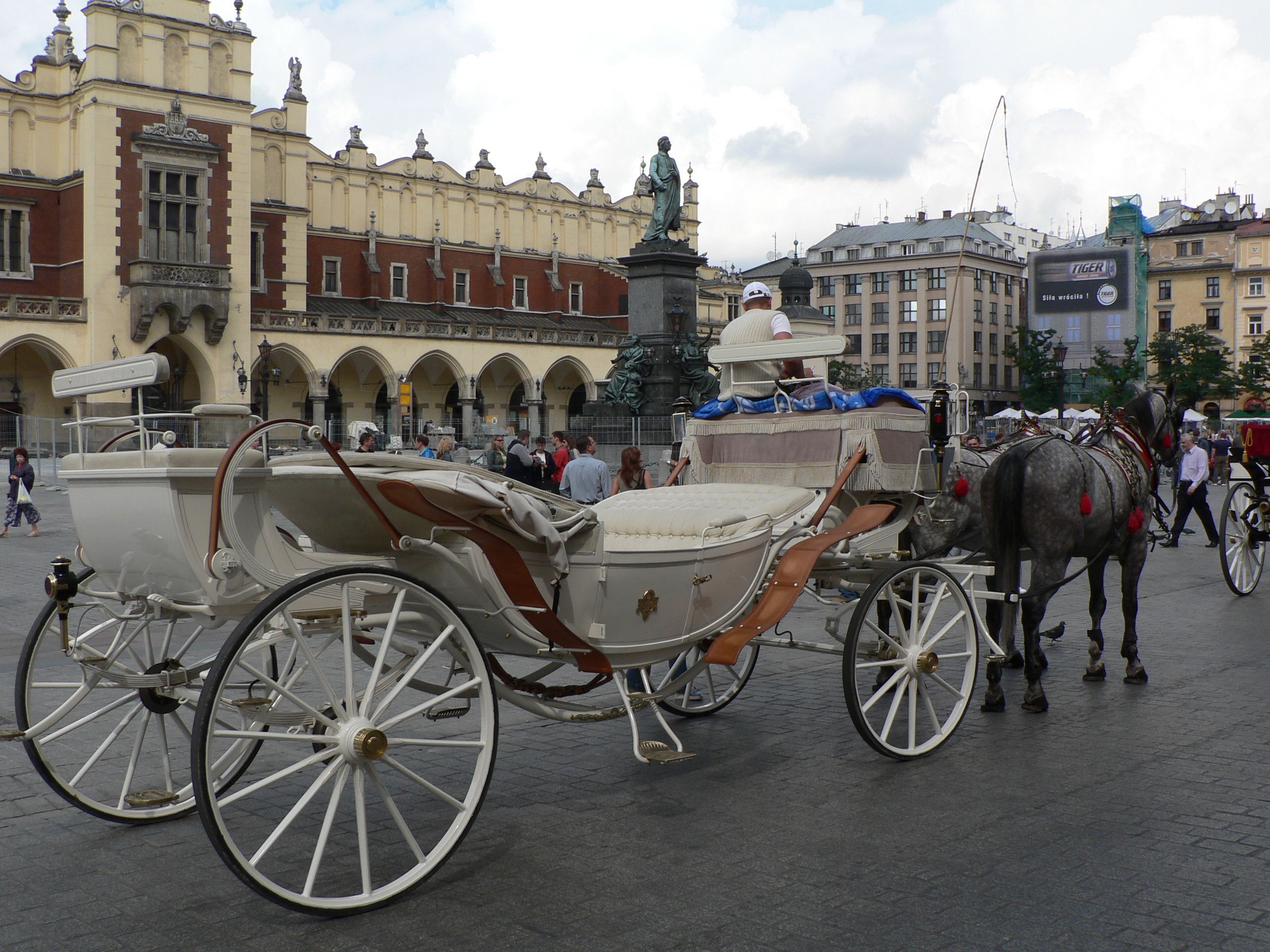
In Kraków, just off the main square (Rynek Główny), there is a building called Dom Polonii (The House of the Poles). It is a medieval tenement building and hosts Chopin concerts in a lovely room with a grand piano on the first floor. I have enjoyed listening to many concerts there. On the ground floor there is a small restaurant. On my trips to Kraków I have found that I eat there the most as it is very reasonably priced and the food is very much like home cooking.
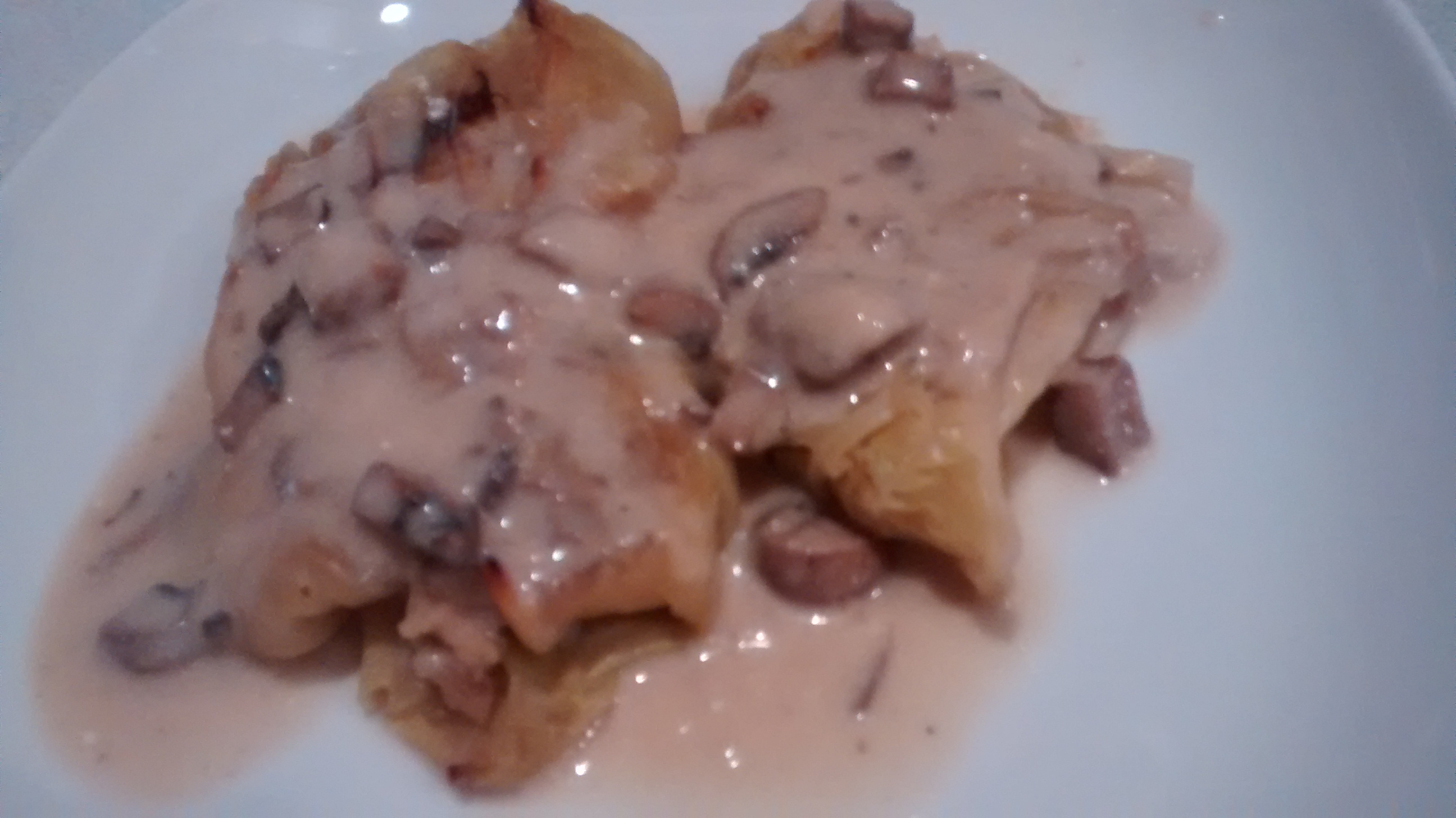
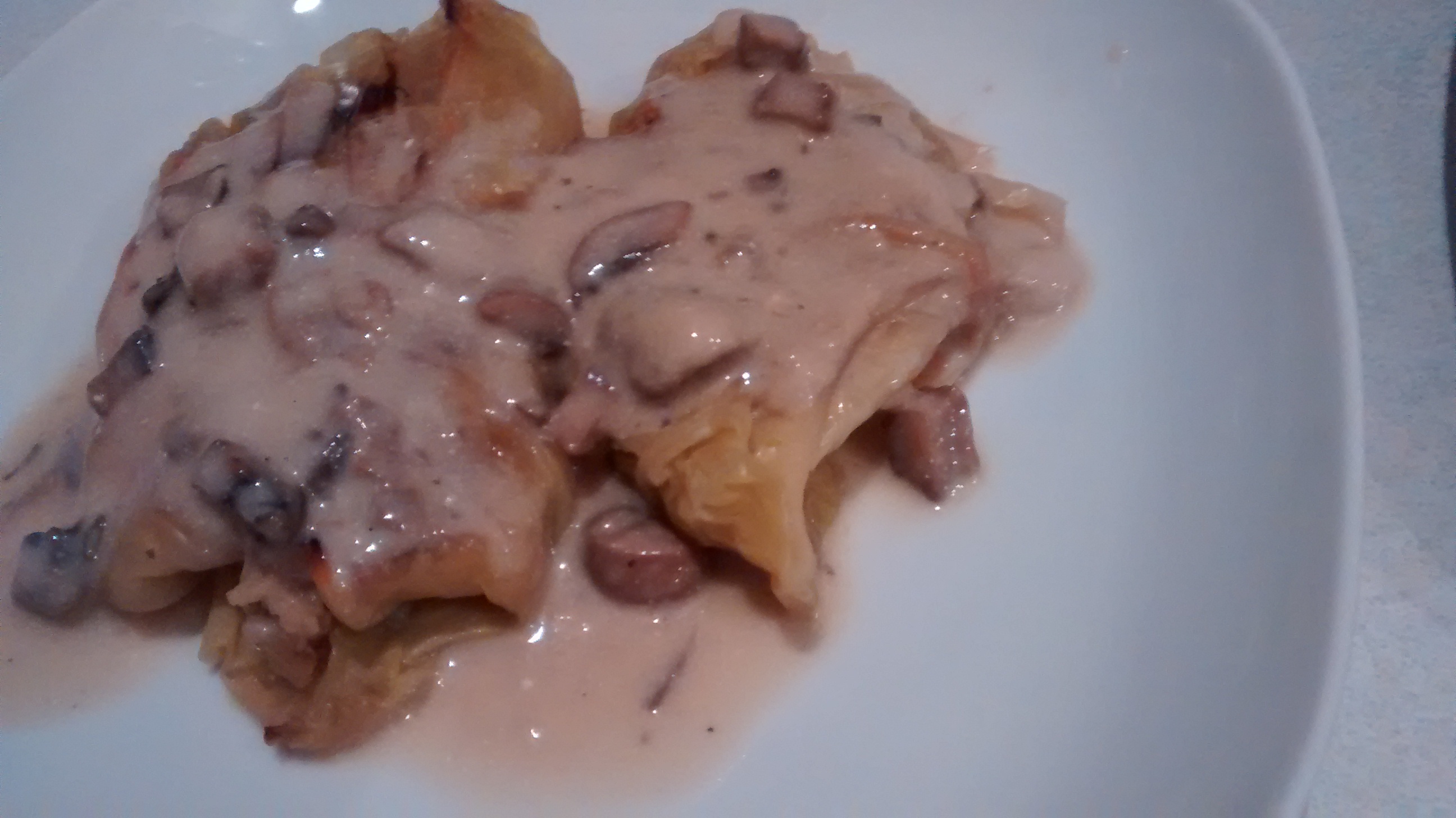
They serve gołąbki there which are cooked without tomatoes and then served with a creamy mushroom sauce.
The following is my recreation of this recipe.
First I made the gołąbki as in my previous post but without tomato purée in the cooking stock but adding some lemon juice as this prevents the leaves from falling apart too quickly.
I will give a quick re-cap of this recipe at the end of this post.
Then I made a mushroom sauce and served the gołąbki with this poured on the top.
Mushroom Sauce
I looked through my Polish cookbooks and many of the mushroom sauces are made with just dried mushrooms. These are delicious and have a strong flavour however it works out very expensive and are not available everywhere.
I am going to give instructions for a sauce using fresh mushroom and just a small amount of dried mushroom.
I will give 2 versions of this mushroom sauce, the first using dried mushrooms, the second a mushroom stock cube.
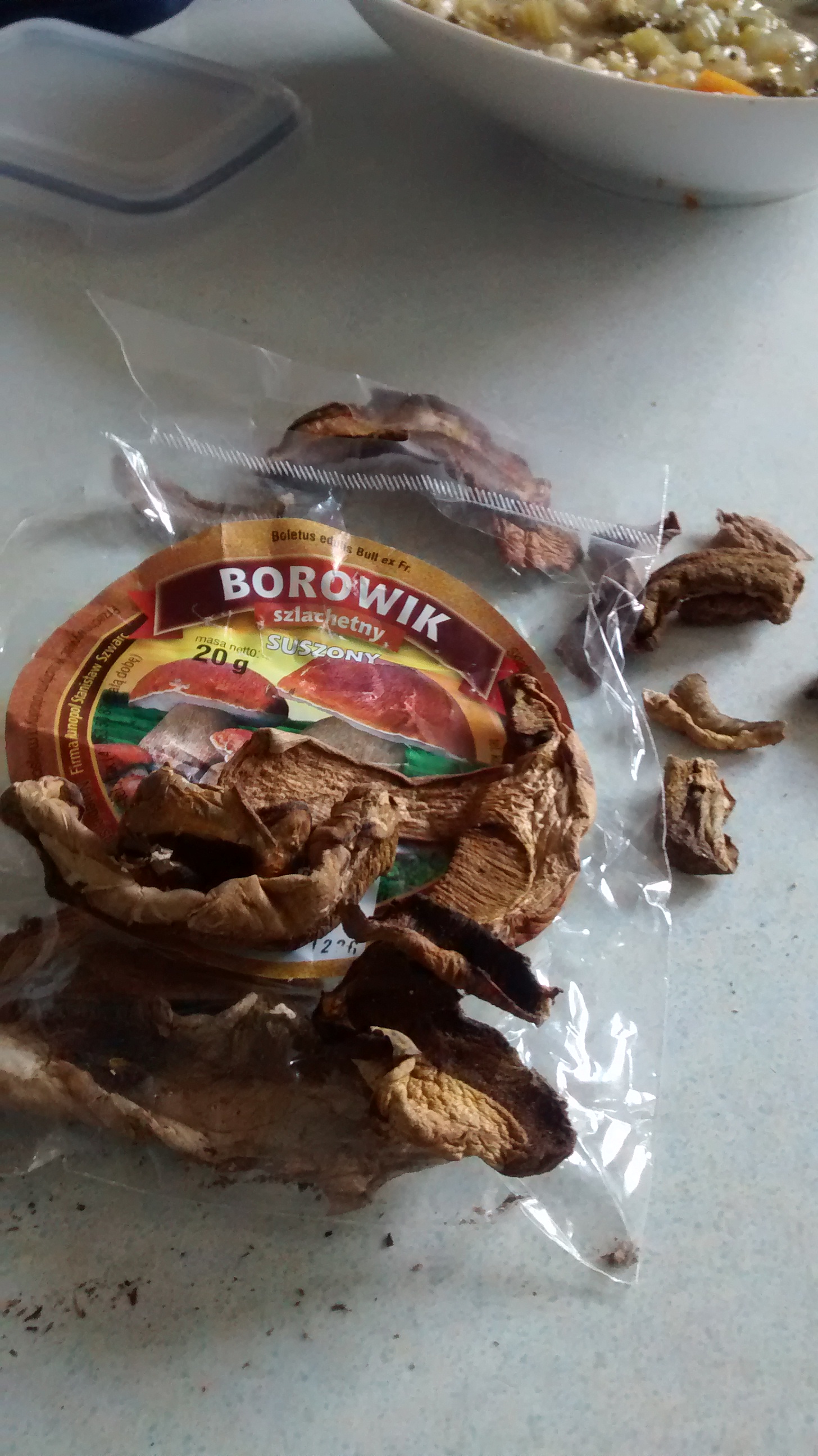
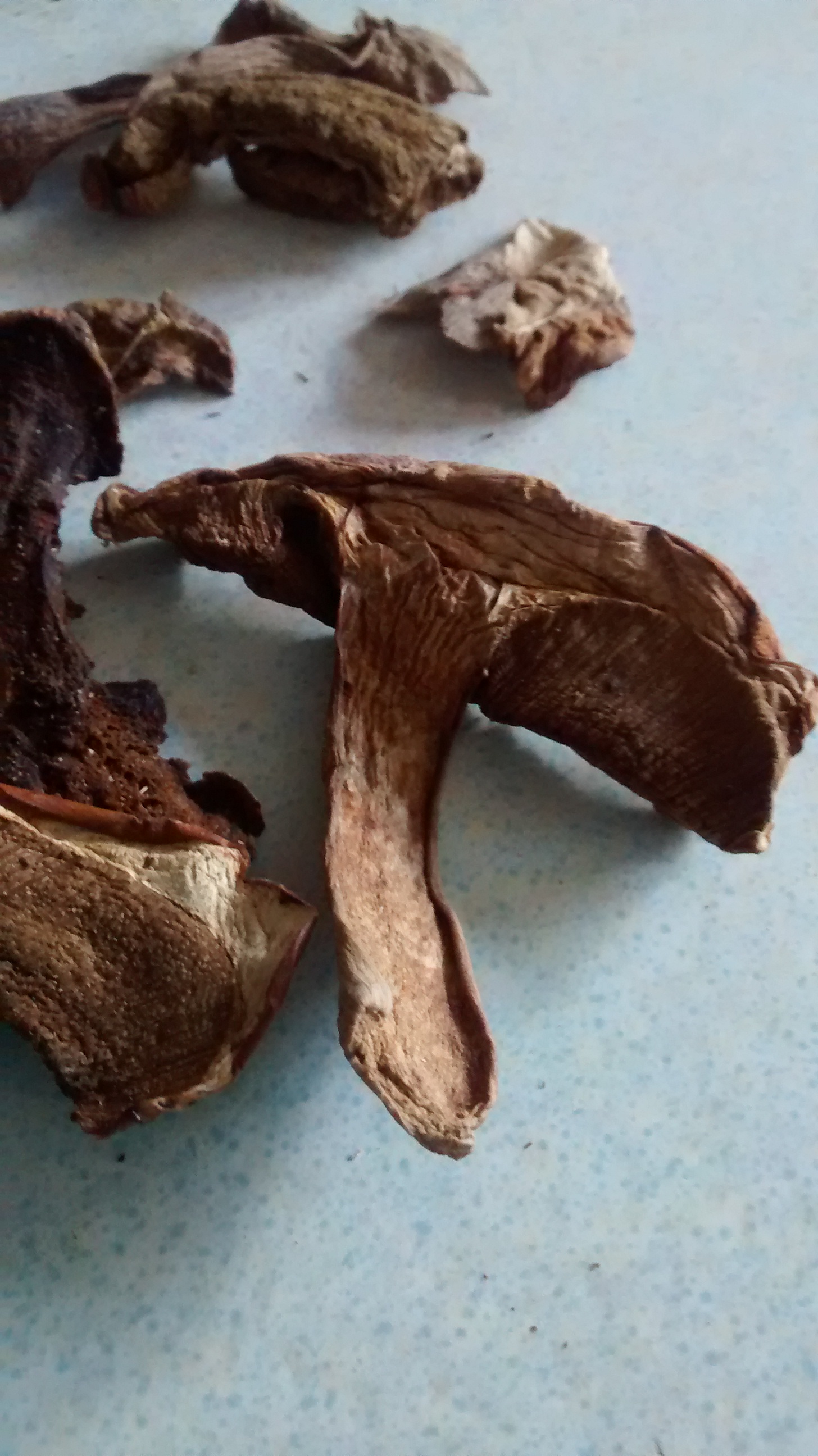
The best dried mushrooms are Boletus edulis, in Poland they are called borowik or prawdzik, in Italy porcini.
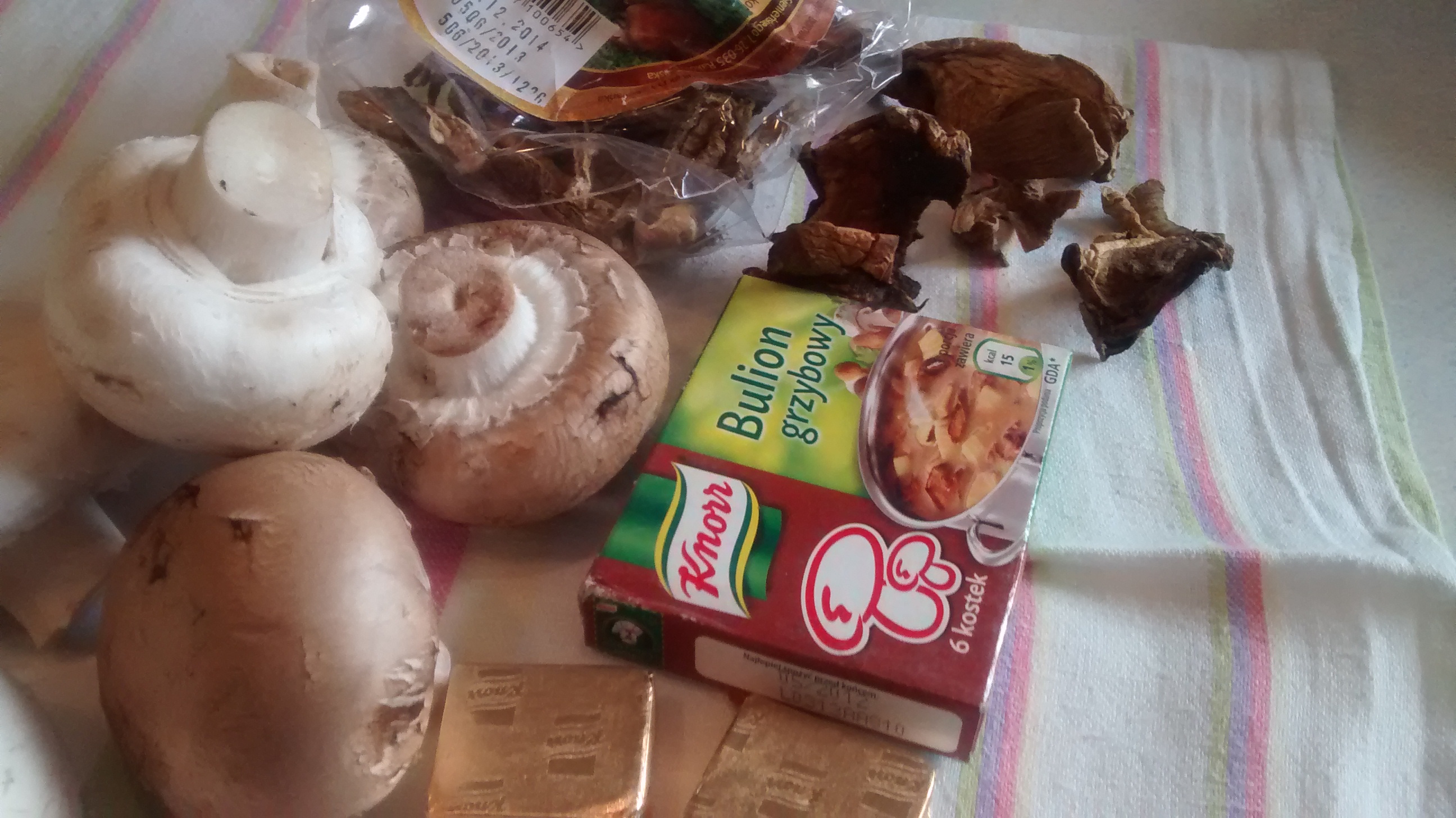
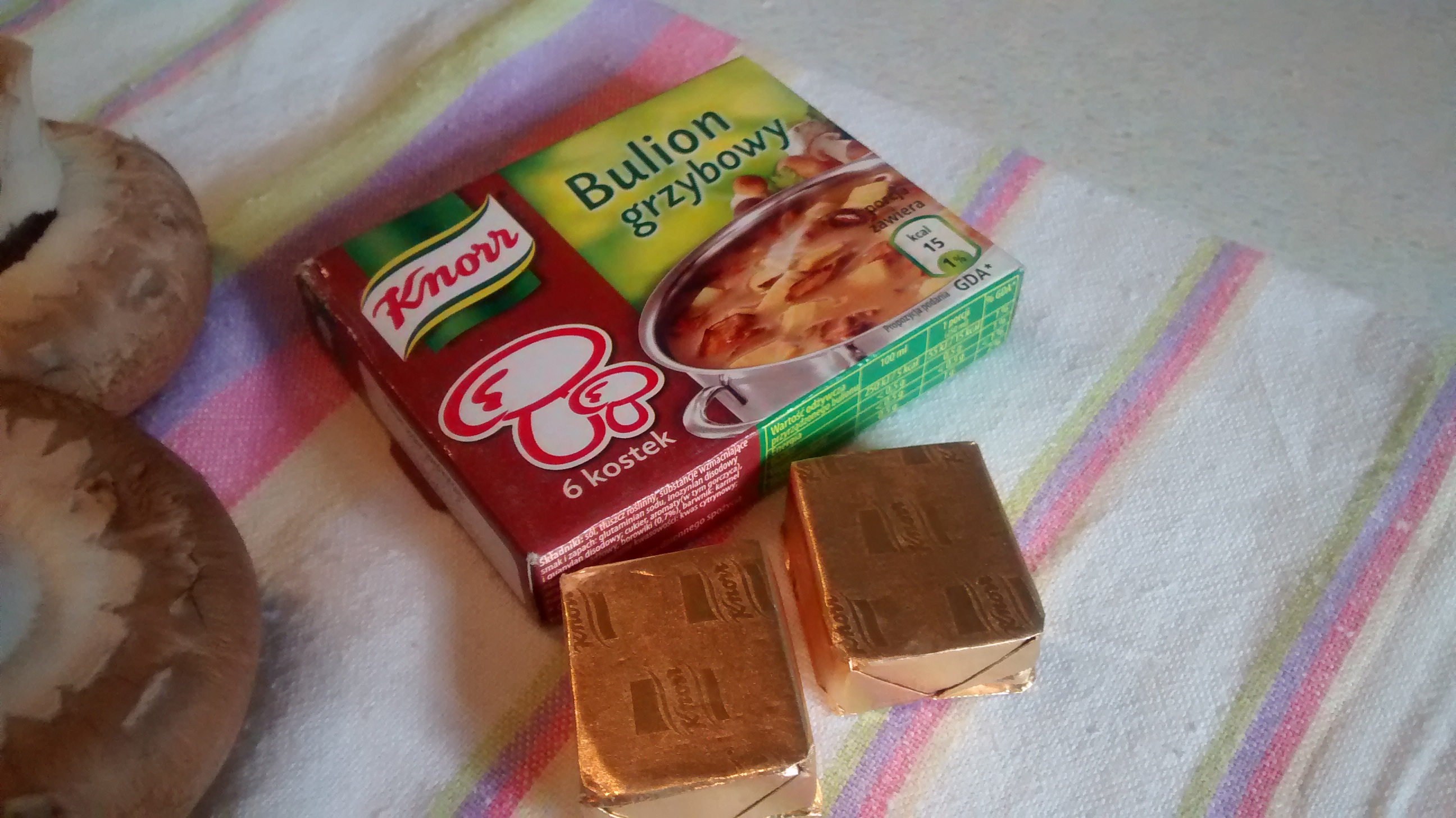
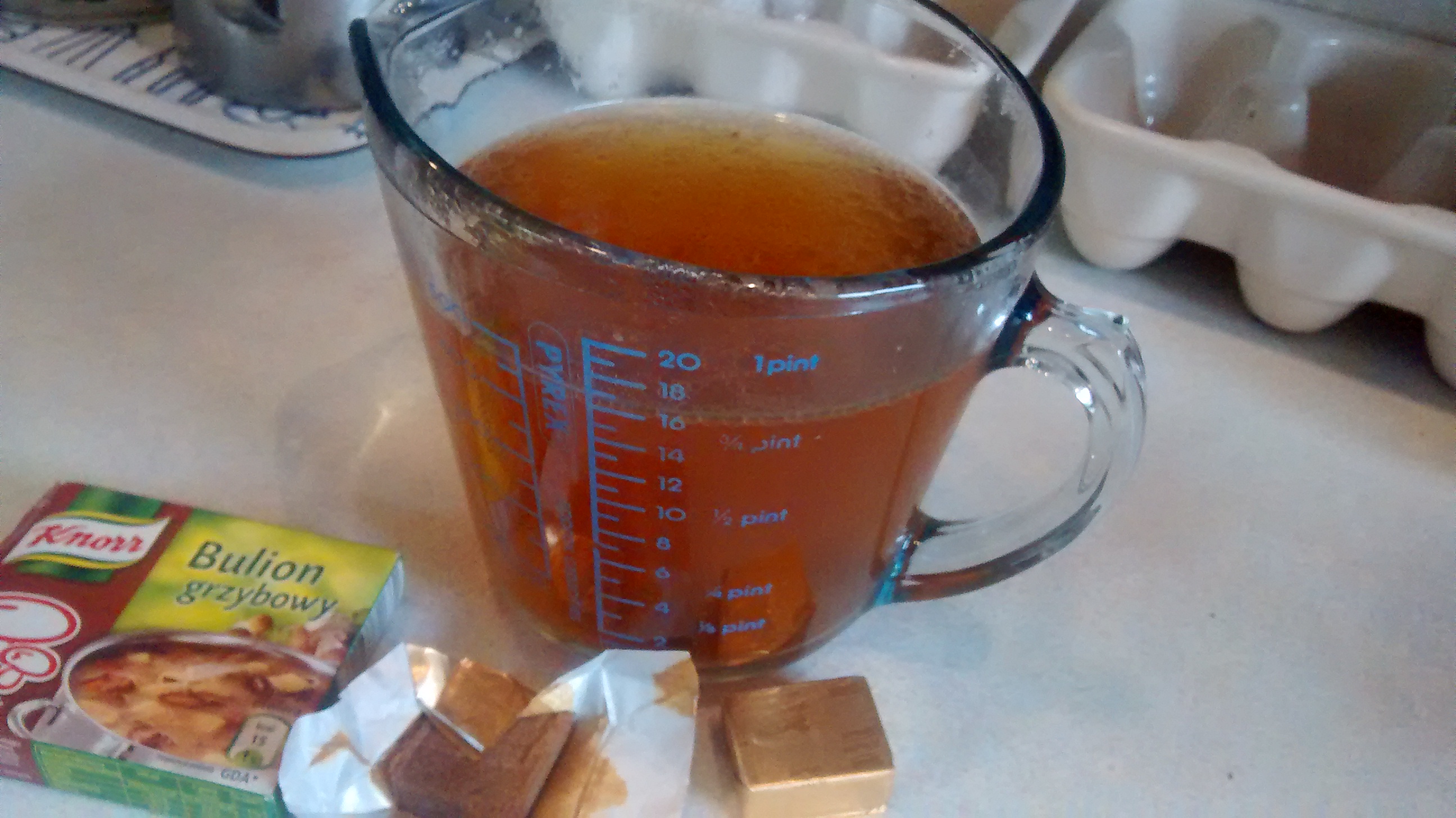
Knorr – mushroom stock cubes
In Poland there are now mushroom stock cubes which are very useful especially for making sauces. Years ago I brought loads back to England, now you can find these in the many Polish food shops. The ones I use are made by Knorr and are shown on the photographs in this post. These stock cubes contain a small amount of dried mushroom extract.
The 2 sauces have the same starting points it is the addition of reconstituted mushrooms or stock cubes for the extra taste which is the difference.
Mushroom sauce 1 – using dried mushrooms
Ingredients
150g fresh button mushroom caps – white and/or chestnut
5g of dried mushroom (around 3 slices)
500ml hot boiling water
1 heaped tablespoon of cornflour
3 tablespoons of milk
2 large tablespoons of soured cream.
butter to cook the mushrooms in
salt & pepper to taste
Method
You have to start this sauce the night before or in the morning for use in the evening.
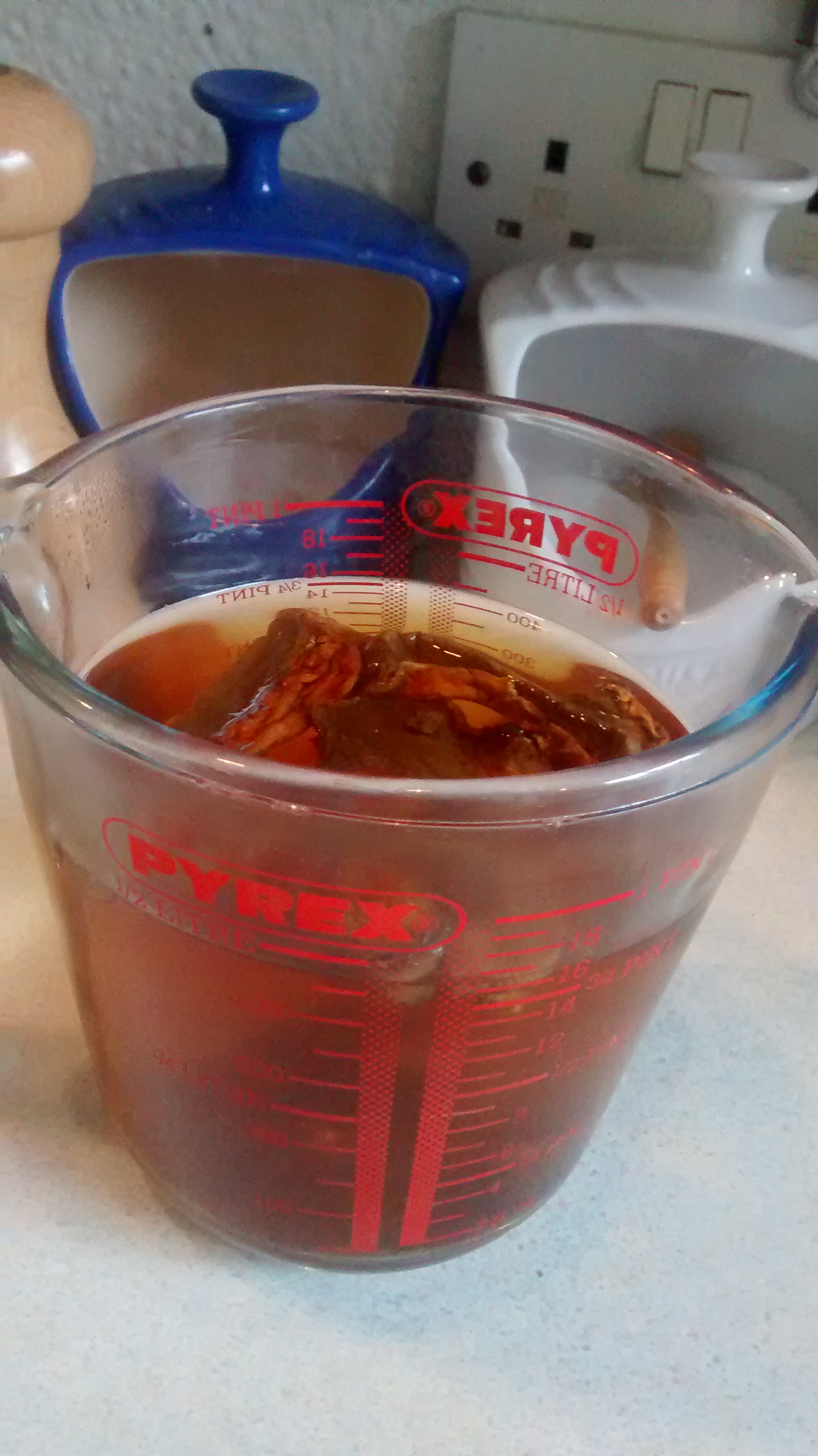
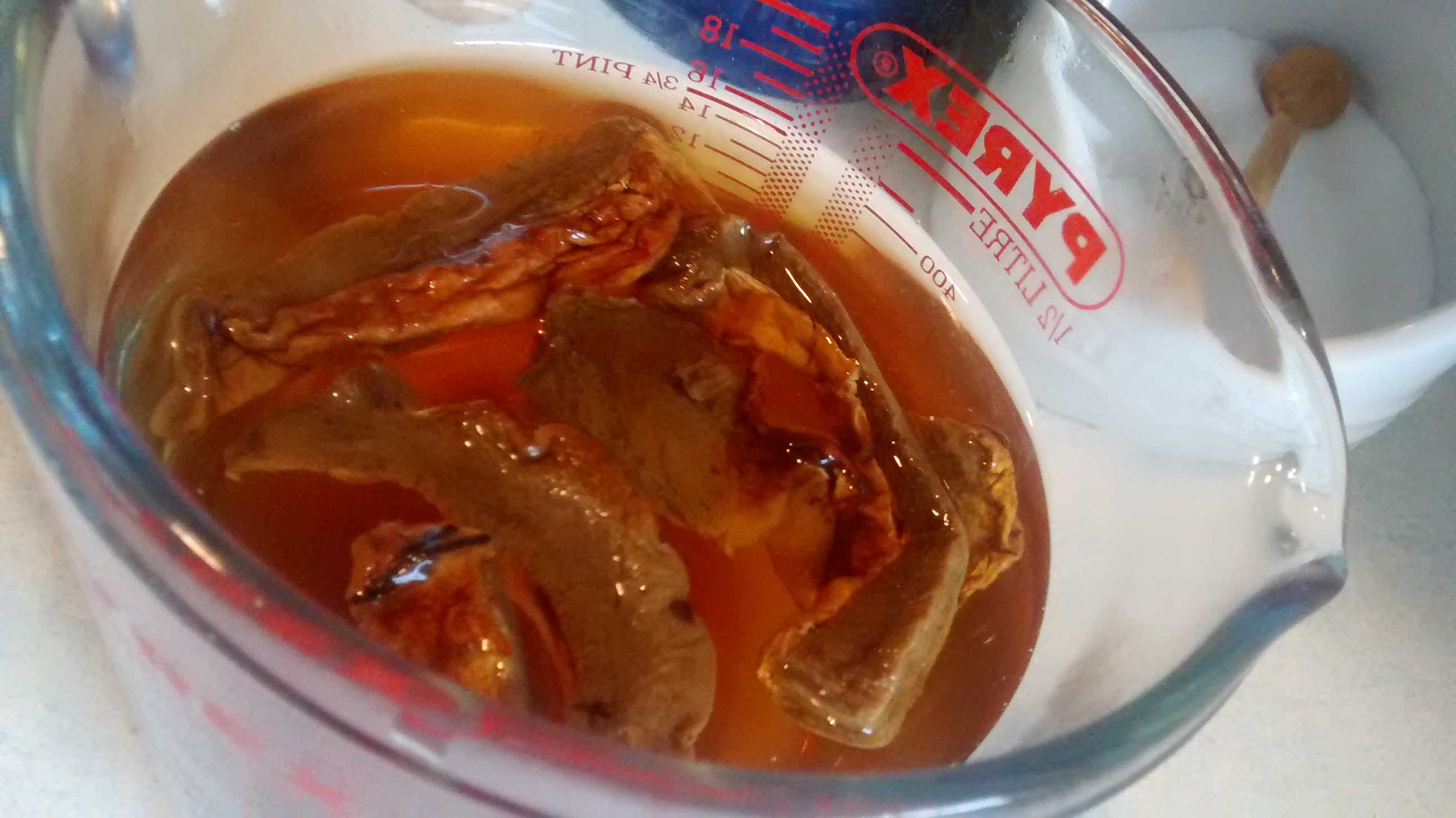
Cover the dried mushrooms with 500ml of boiling water and leave to soak.
Preparing Dried MushroomsDried Mushroom in Hot Water
The following day take out the reconstituted mushrooms and using a knife you can chop then up into tiny pieces or if the are soft enough you can spread out the pulp on a chopping board.
Reconstituted MushroomsMaking a Pulp of Mushrooms
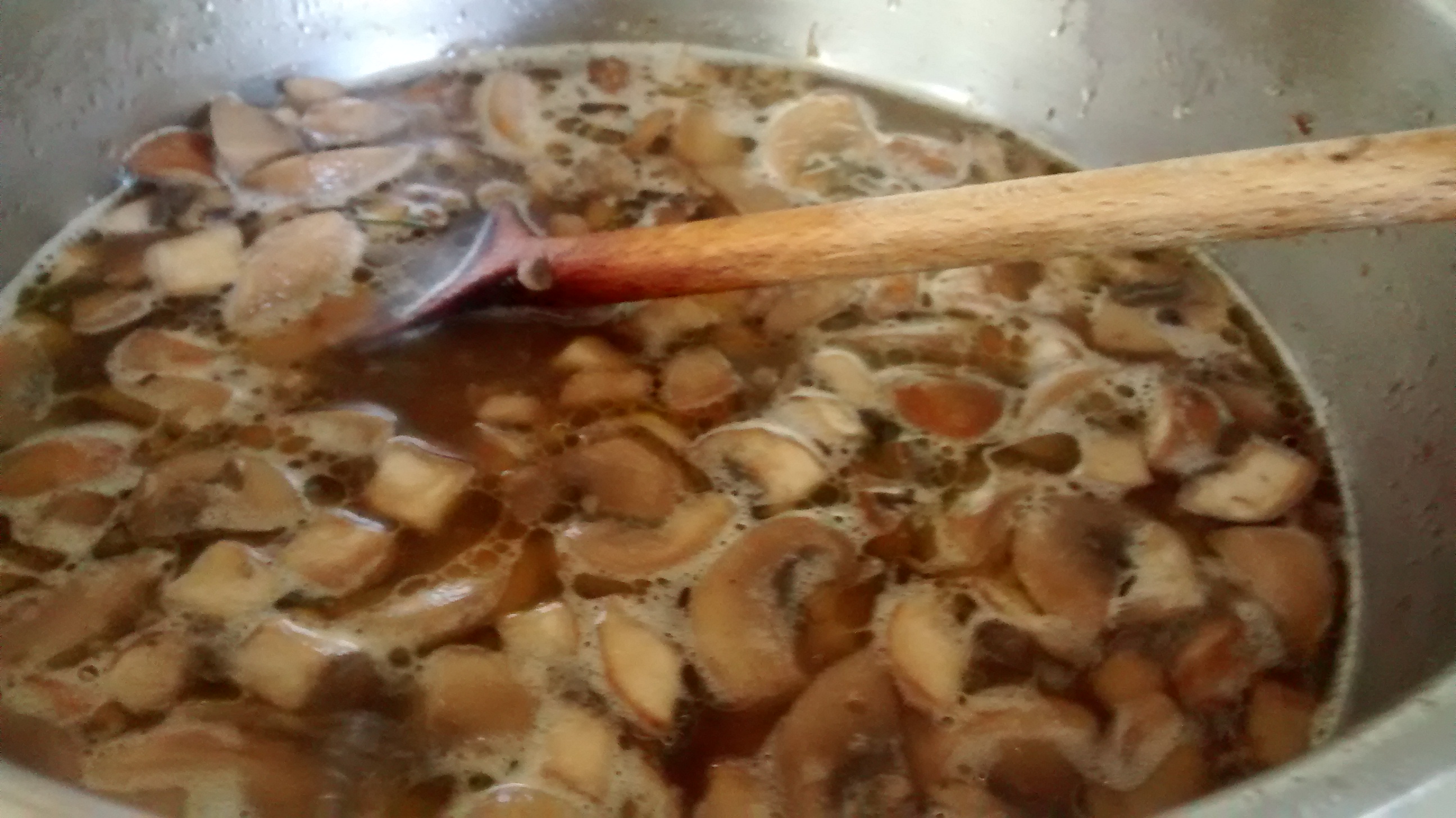
Slice the mushroom caps into fine slices and fry them gently in some butter till they are soft.
Add the dried mushroom pulp and the liquor in which they were seeped.
Simmer gently for about 5 to 10 minutes.
In a little dish mix the cornflour with the milk.
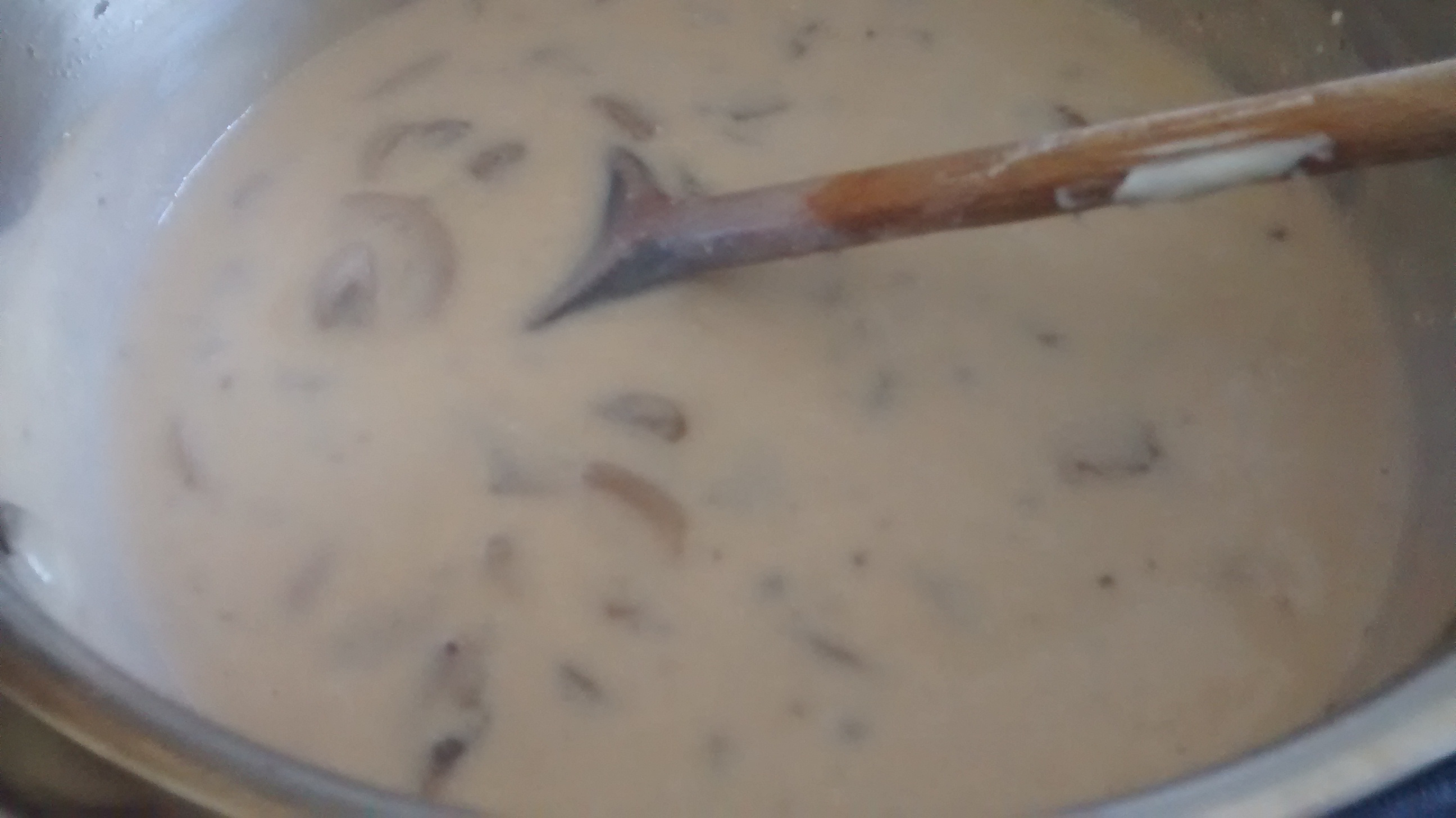
Add the cornflour mixture to the cooked mushrooms and stir gently over the heat until the sauce thickens.
Add salt & pepper to taste.
Remove from the heat and add the 2 large spoonfuls of soured cream and mix well in.
Note
None of these amounts are exact – they are a rough guide depending on what you have – you can use more water, milk or soured cream and so on.
Mushroom sauce 2 – using a mushroom stock cube
Ingredients
150g fresh button mushroom caps – white and/or chestnut
500ml hot boiling water
1 heaped tablespoon of cornflour
3 tablespoons of milk
2 large tablespoons of soured cream.
butter to cook the mushrooms in.
note
I rarely have to add any more salt or pepper as the stock cube has enough seasoning in it.
Method
Dissolve the stock cube in the hot water.
Preparing a Mushroom Stock Cube
Slice the mushroom caps into fine slices and fry them gently in some butter till they are soft.
Simmer gently for about 5 to 10 minutes.
In a little dish mix the cornflour with the milk.
Add the cornflour mixture to the cooked mushrooms and stir gently over the heat until the sauce thickens.
Remove from the heat and add the 2 large spoonfuls of soured cream and mix well in.
If you can get the stock cubes then version 2 is the quickest.
Basic gołąbki recipe without tomatoes
Ingredients
1 large head of white cabbage or Savoy cabbage*
400g rice
500g of minced beef or pork
Chicken stock – a cube or concentrate will do
salt & pepper
2 bay leaves
3 or 4 peppercorns or allspice or both
juice of 1 or 2 lemons.
*As you need whole largish cabbage leaves I sometimes use 2 cabbages to get the bigger leaves. Recently I have started to use Sweetheart cabbage which has large leaves on the outside but you will most likely need 2 of these.
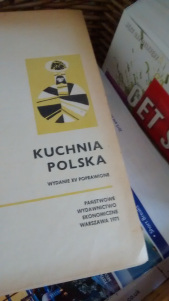
Instructions from my Polish cookbook “bible”
You need to parboil the rice in salted water so that it is about half way to being cooked and then strain the rice and let it go cold, but if you have some plain boiled rice left from another day you could use this, as this is not critical.
In a large bowl mix the rice and minced meat and add salt and pepper. The exact amounts do not matter. I like it to look about 50/50 white and pink but these can be made with much more rice to eke out the meat available.
Next comes the hardest part and patience is called for here to avoid getting scalded fingers. You have to heat or steam the cabbage to make the leaves pliable so you can remove them one by one and use them to encase the filling.
You need the largest pan you have into which you place the cabbage head. I boil some water in a kettle and pour this over the cabbage in the pan with some heat under the pan I let the cabbage cook a little. The temptation is to boil to quickly so making some of the leave too soft and runs the risk of getting scalded as you try to remove the leaves.
Another method is to place the cabbage into a metal colander and set this over the pan of water so that it is steamed rather than boiled.
As the leaves become soft, you have to cut them off from the stalk and stack them up for to use later, you can cut out the thickest part of the stalk from the first few larger leaves.
Pre heat the oven to GM3 – 160oC
Place a small handful of the rice & meat mixture onto a cabbage leaf and roll up from the stalk end, tuck in the sides and secure with the outer edge of the leaf to make a small parcel.
Place the rolls into a large casserole dish, packing as many rolls as possible in rows in the dish. Depending on the depth of the dish repeat this for another layer.
A tip I got from my late cousin, Krystyna, is to use extra cabbage leaves on the base of the dish and then to put extra leaves on the top of the rolls.
The rolls sometimes have a habit of getting slightly burnt on the top as they come out of the liquid and sometimes at the base if they have been in the oven a long time, these extra layers protect the rolls and can be discarded at the end.
Make a large amount of stock with hot water and lemon juice and add bay leaves, peppercorns and allspice.
Cover the rolls with this liquid. It is a good idea to have extra which you can use to top up as they are cooking.
Cover with the lid and place in the oven and cook for several hours. Check them occasionally and keep them covered with liquid as much as possible.
I always think these taste better when made a day before hand and left for the liquid to seep in more and then reheated in the oven as required.
In the style of Dom Polonii
Sprinkling some chopped dill or flat leaf parsley on the top will be even better (Sadly I did not have any on the day of this photograph).
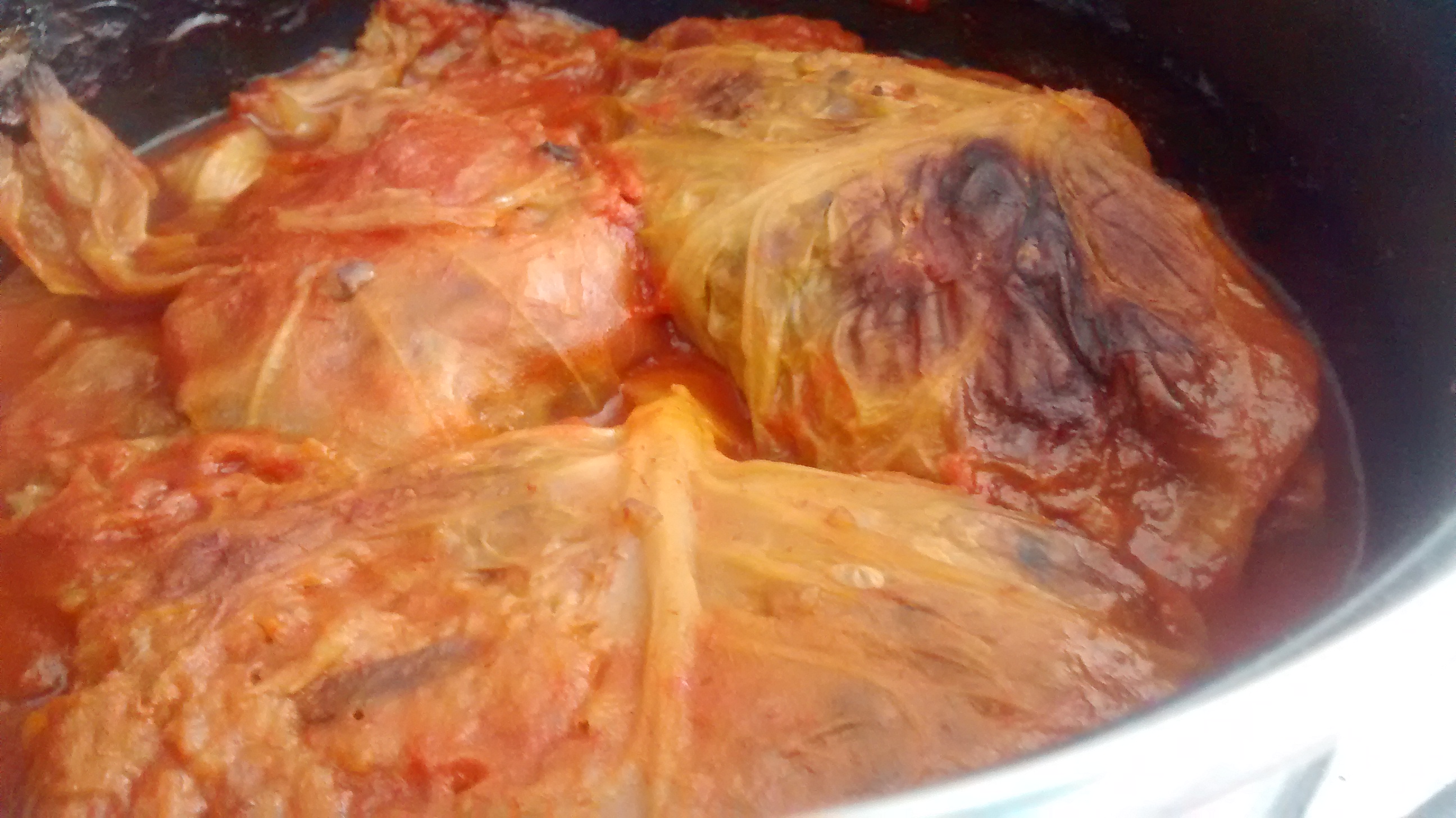
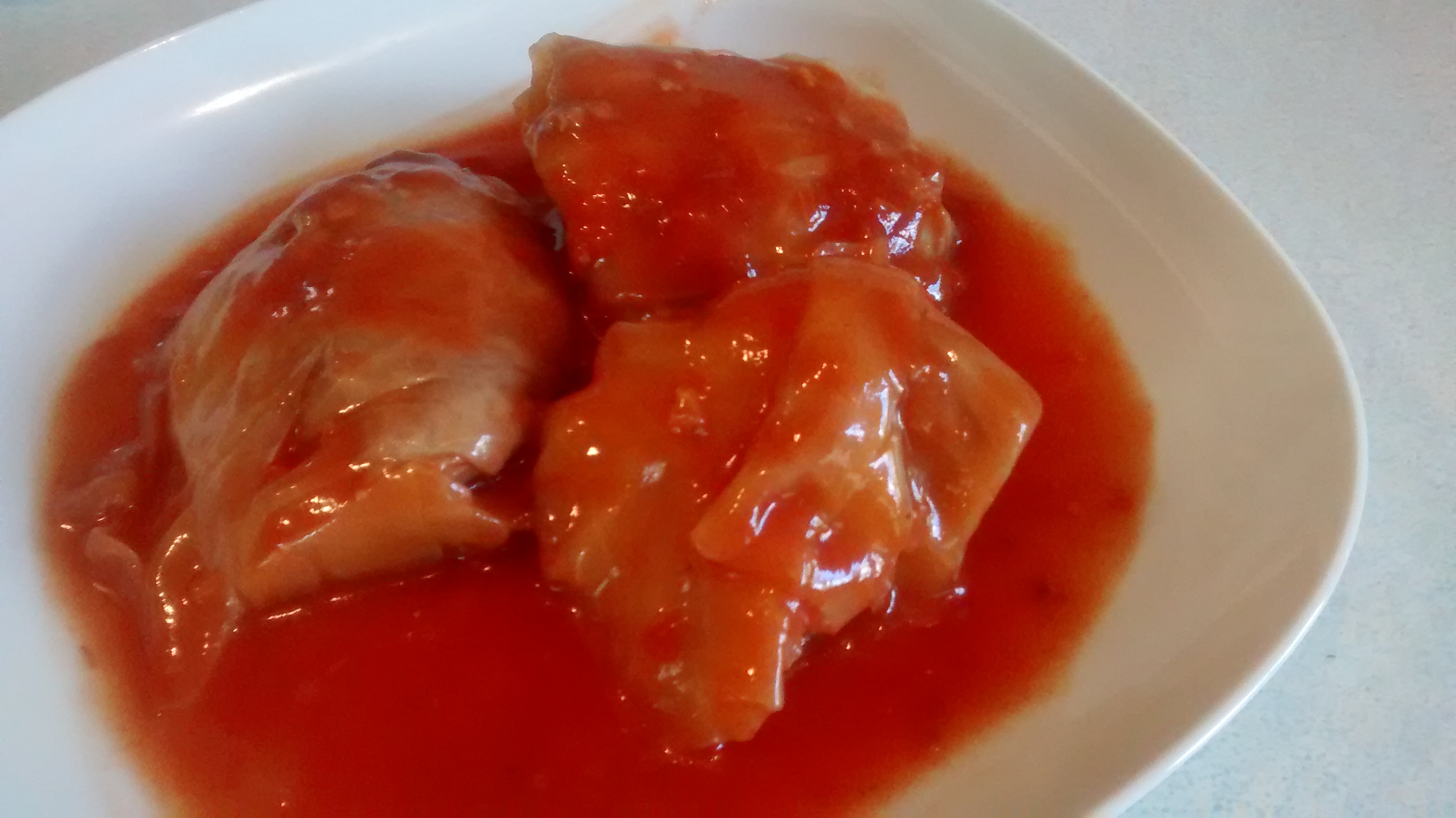
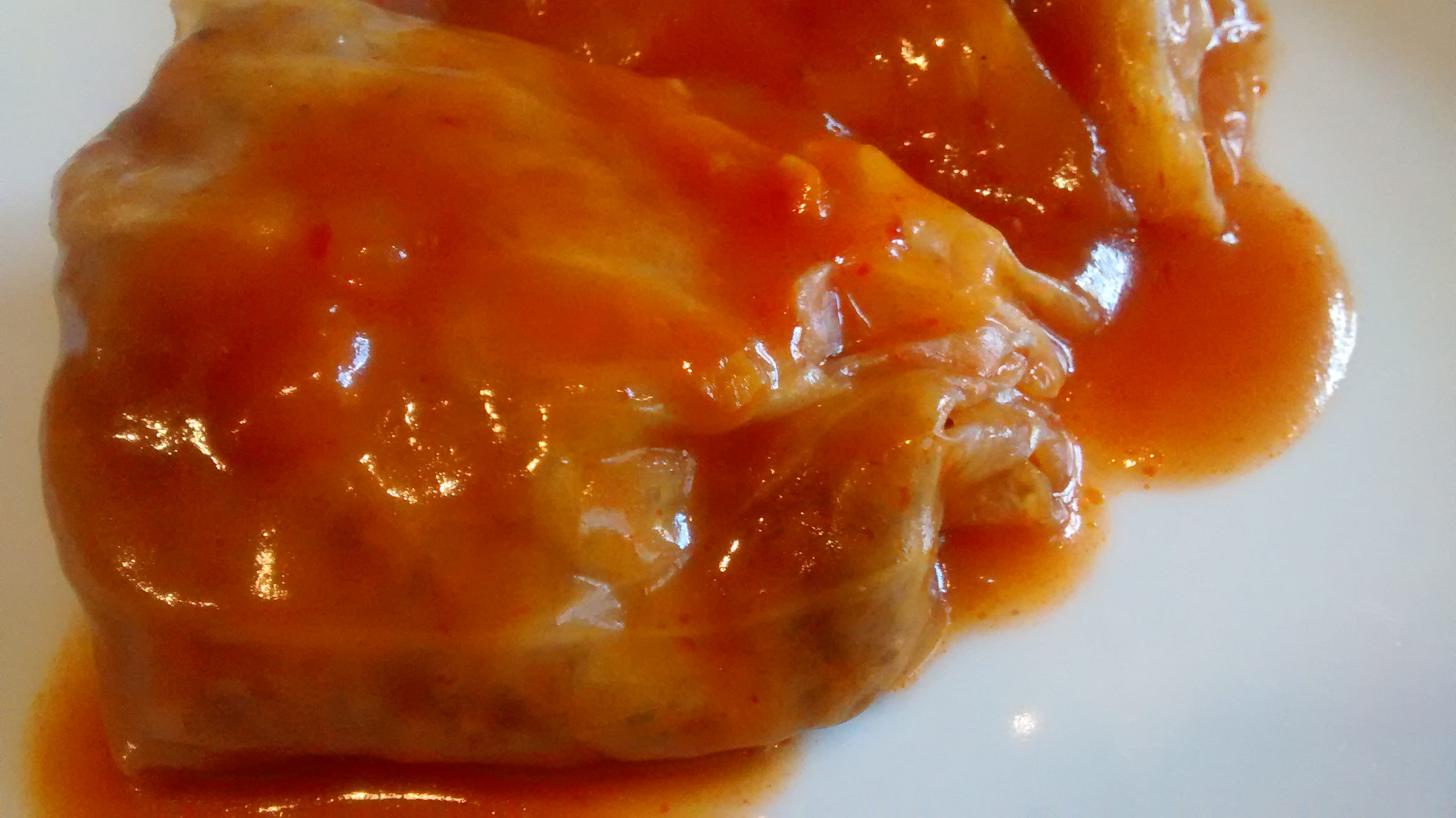
Gołąbki are made using fresh cabbage and the name means little pigeon or dove. This name comes about from its size and shape and also from to the idea of this being a little delicacy.
The cabbage leaves are used to make a little parcel with a meat and rice filling and these are then cooked in a liquid stock or sauce.
I have read that this is a very old dish which originally came from the Byzantine Empire and was made with vine leaves, as it came north; cabbage leaves replaced the vine leaves.
The main 3 ingredients are: cabbage, rice and minced meat, and you also need a liquid to cook them in, which in my mother’s case was always a stock with tomatoes.
You can use white or Savoy cabbage. White cabbage has softer more pliable leaves and I think make the best gołąbki . Savoy cabbage has firmer leaves that are easier to work with but take longer to cook; these can be easier for a novice to use.
You need a large head of cabbage to get large leaves.
You can use any type of rice but the stickier types are the best.
The traditional Polish version uses pork. My mother used beef as this was more readily available in England. Now that minced pork is more available and you do not have to hand mince it, I use either or even mix the two.
There are many variations using, fresh or dried mushrooms, buckwheat instead of rice, and a stock without tomatoes. In fact buckwheat is a more older version as it grows in Poland and rice would have to be imported.
This recipe is my mother’s and for me this is just right!
Mama’s Classic Recipe
Ingredients
1 large head of white cabbage or Savoy cabbage
400g rice
500g of minced beef or pork
chicken stock – a cube or concentrate will do
1 tube of tomato purée
salt & pepper
2 bay leaves
3 or 4 peppercorns or allspice or both
Although the gołąbki take a while to put together, you then leave them to cook in a slow oven for hours which is easy.
You can reheat them on the next day and in fact I think they taste better the longer they have been steeped in the cooking liquid and I always make them a day in advance.
They also freeze very well, so I pack any left in portions of 2 or 4 for a later date. Because of this I like to make as big a batch as I can in one go.
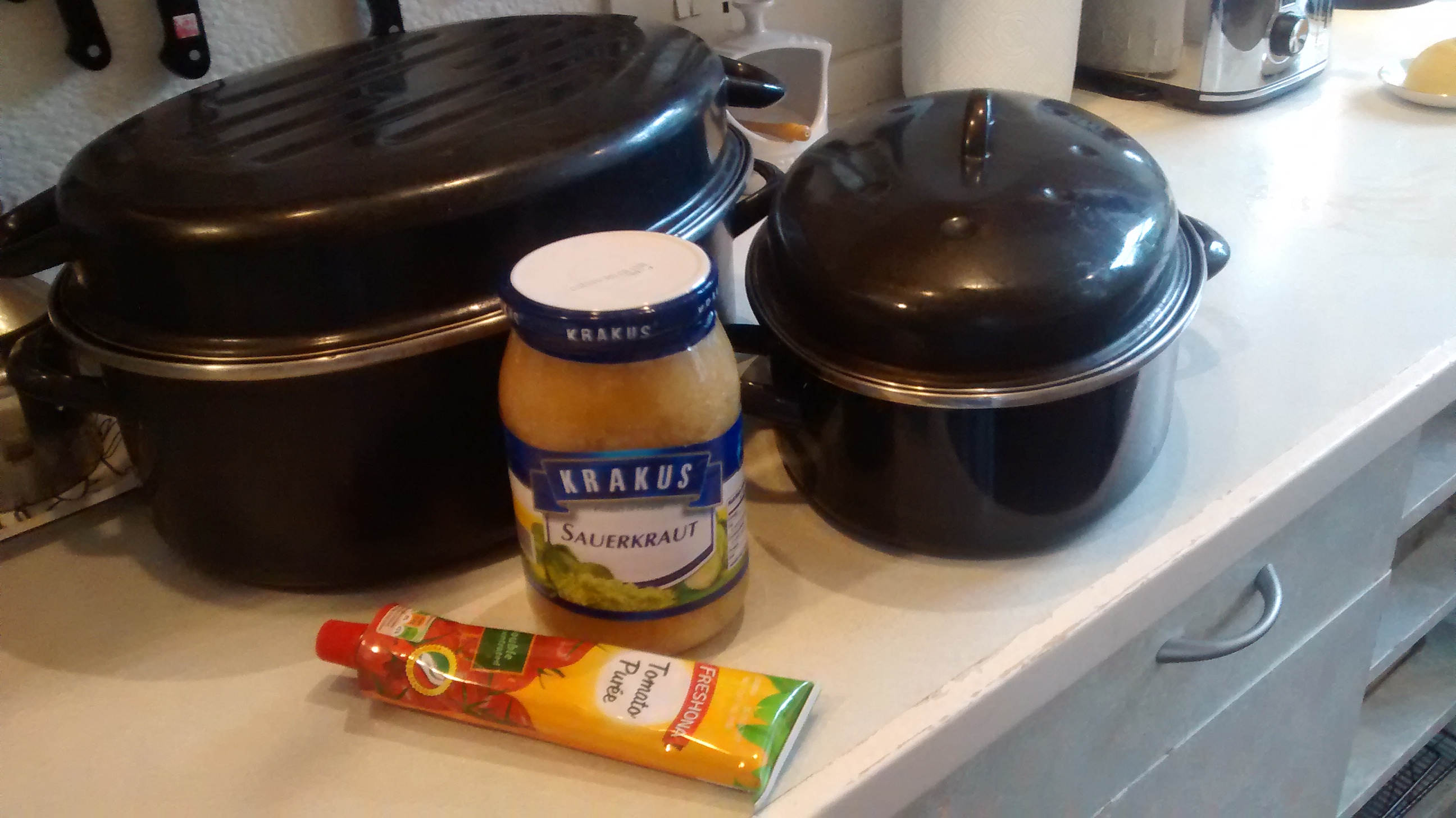
I use a very large enamelled oval dish with a lid which is ideal for this.
As you need whole largish cabbage leaves I sometimes use 2 cabbages to get the bigger leaves.
You need to parboil the rice in salted water so that it is about half way to being cooked and then strain the rice and let it go cold, but if you have some plain boiled rice left from another day you could use this as this is not critical.
In a large bowl mix the rice and minced meat and add salt and pepper. The exact amounts do not matter. I like it to look about 50/50 white and pink but these can be made with much more rice to eke out the meat available.
Next comes the hardest part and patience is called for here to avoid getting scalded fingers. You have to heat or steam the cabbage to make the leaves pliable so you can remove them one by one and use them to encase the filling.
You need the largest pan you have into which you place the cabbage head. I boil some water in a kettle and pour this over the cabbage in the pan with some heat under the pan I let the cabbage cook a little. The temptation is to boil to quickly so making some of the leave too soft and runs the risk of getting scalded as you try to remove the leaves. Another method is to place the cabbage into a metal colander and set this over the pan of water so that it is steamed rather than boiled.
As the leaves become soft, you have to cut them off from the stalk and stack them up for to use later, you can cut out the thickest part of the stalk from the first few larger leaves.
Instructions from my Polish cookbook “bible”
Pre heat the oven to GM2 – 150oC
Place a small handful of the rice & meat mixture onto a cabbage leaf and roll up from the stalk end, tuck in the sides and secure with the outer edge of the leaf to make a small parcel.
Place the rolls into a large casserole dish, packing as many rolls as possible in rows in the dish. Depending on the depth of the dish repeat this for another layer.
A tip I got from my late cousin, Krystyna, is to use extra cabbage leaves on the base of the dish and then to put extra leaves on the top of the rolls.
The rolls sometimes have a habit of getting slightly burnt on the top as they come out of the liquid and sometimes at the base if they have been in the oven a long time, these extra layers protect the rolls and can be discarded at the end.
Make a large amount of liquid stock with hot water and tomato purée and add bay leaves, peppercorns and allspice.
Cover the rolls with this liquid. It is a good idea to have extra which you can use to top up as they are cooking.
Cover with the lid and place in the oven and cook for several hours. Check them occasionally and keep them covered with liquid as much as possible.
As mentioned earlier I make these a day beforehand and then put them back in the oven for an hour or so before serving.
They are a complete meal in themselves but you can give serve them with some bread to mop up all the liquid sauce.
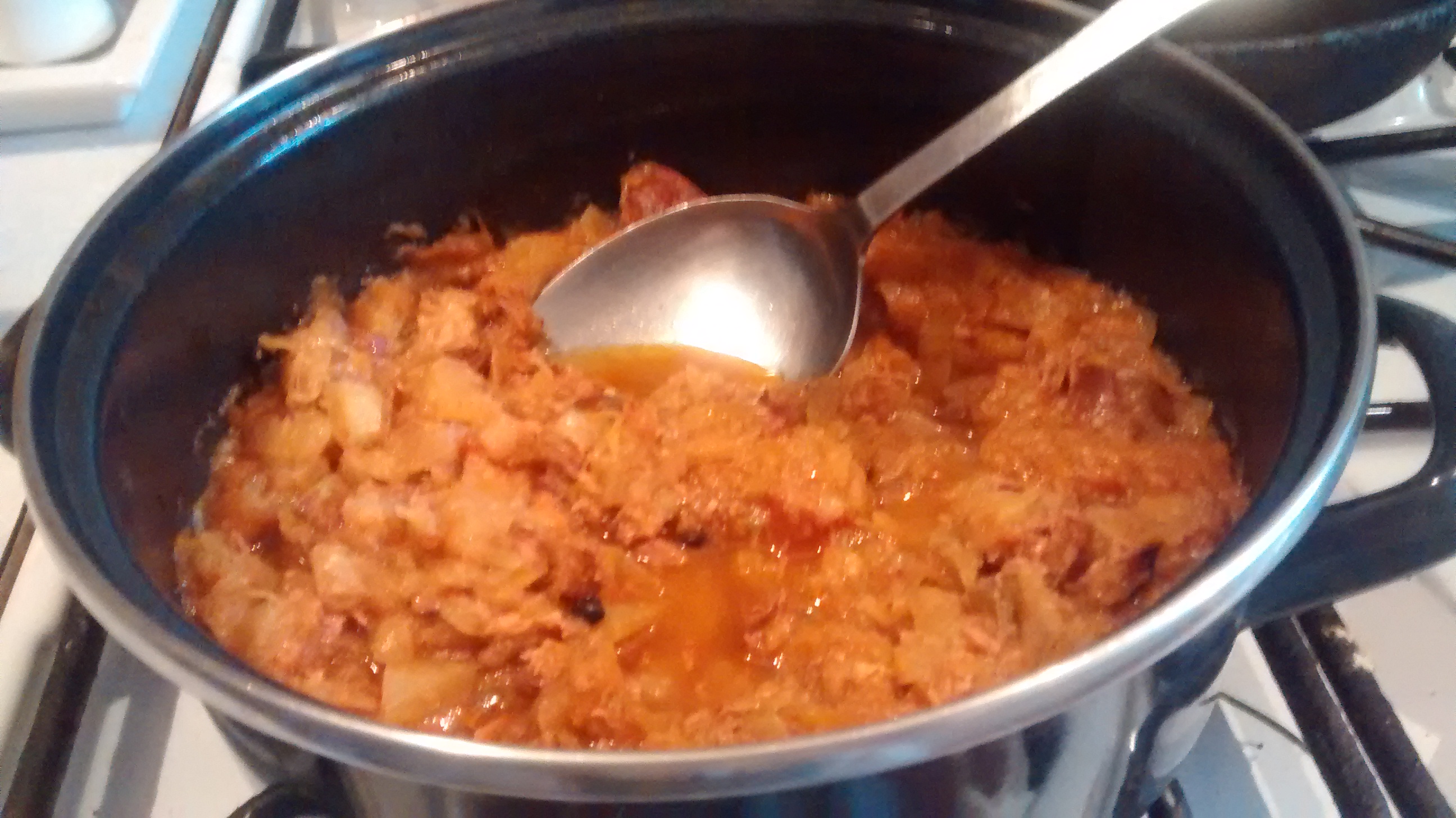
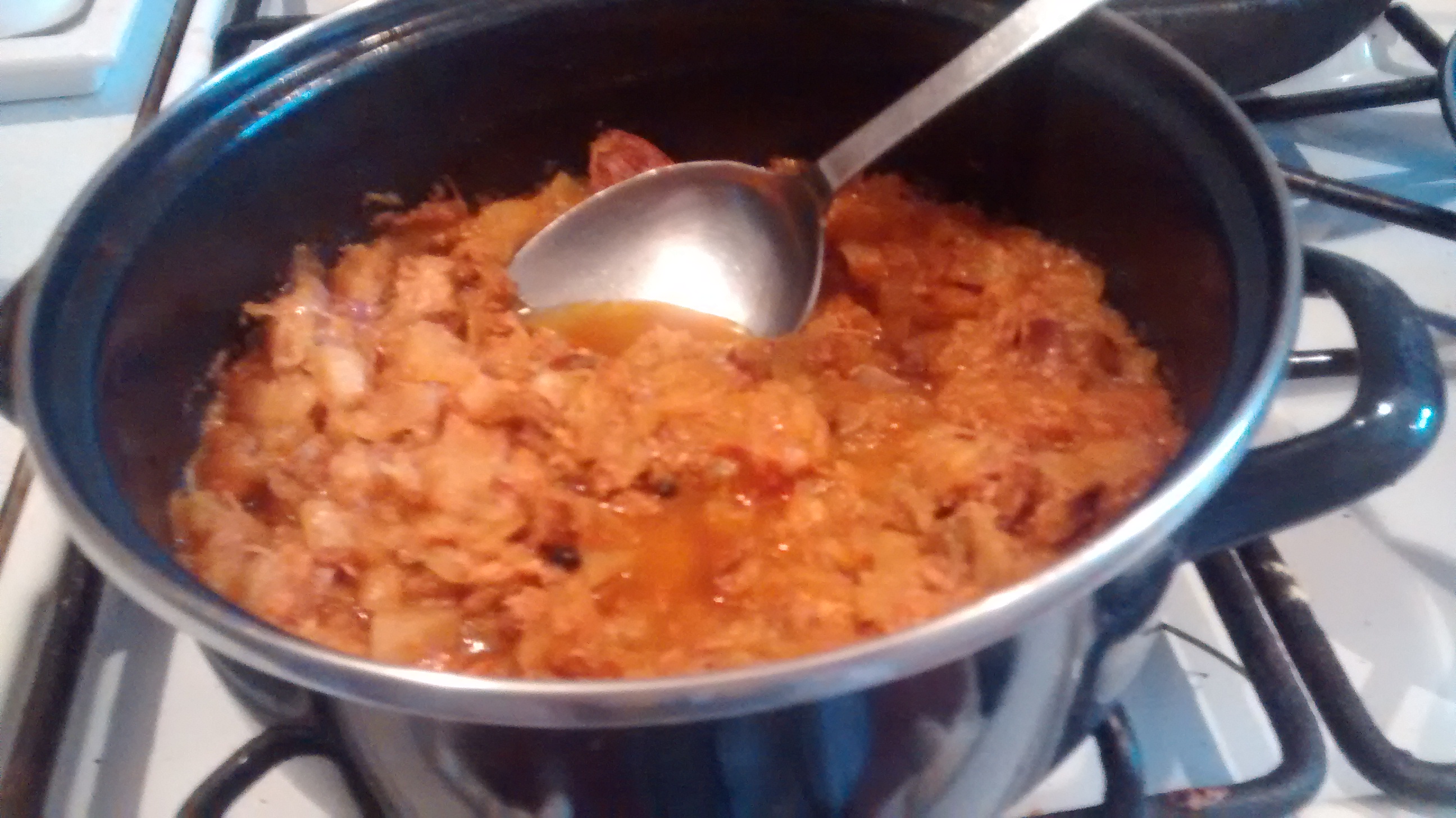
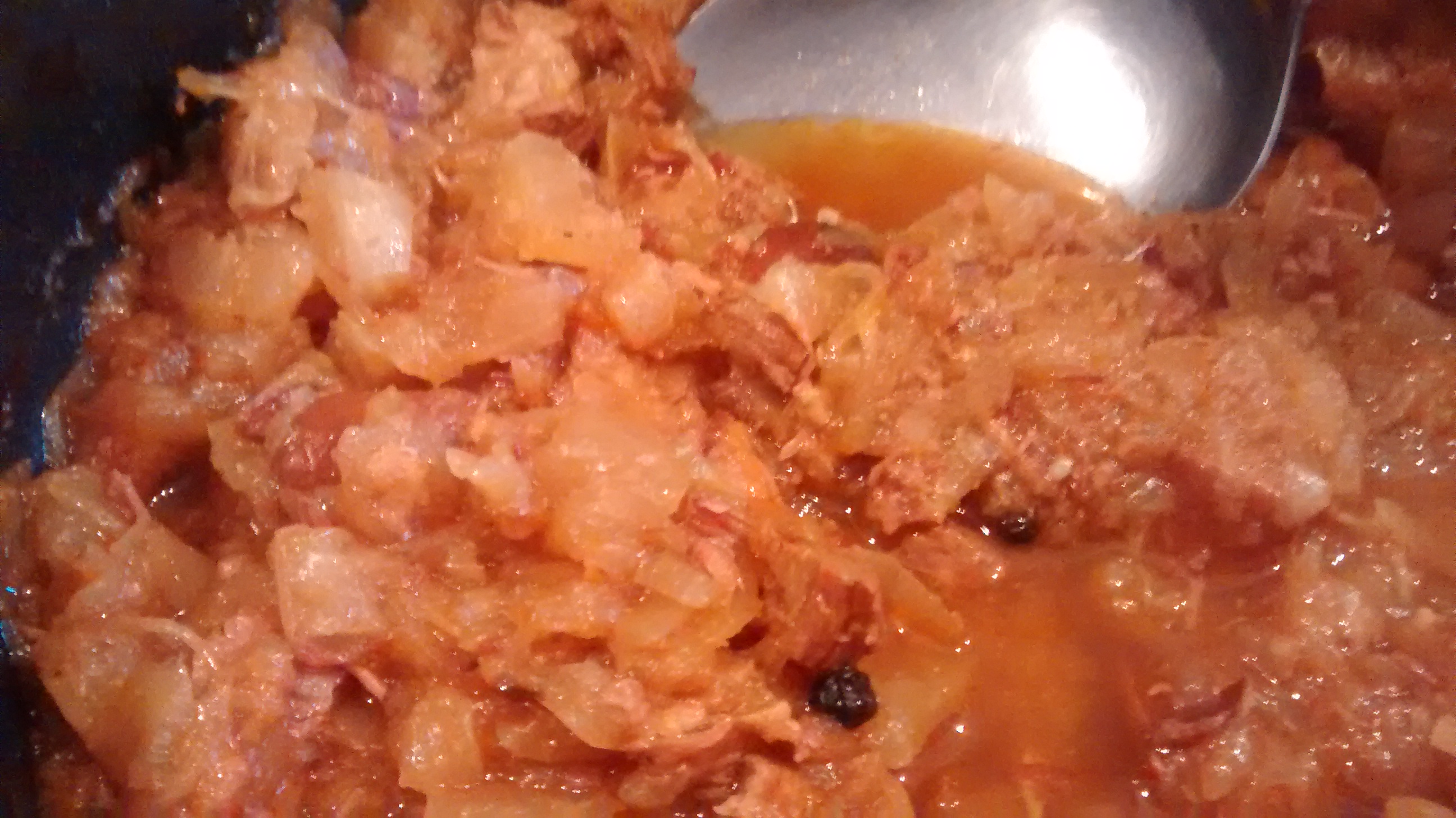
Bigos is often called Poland’s national dish. It is Poland’s sweet and sour dish using sweet (fresh) cabbage and sour(fermented) cabbage (sauerkraut).
Quick Bigos
This is a smaller, quicker version than the traditional bigos recipe.
I often make it somewhere in between the traditional recipe and this quick recipe as all the amount are very flexible.
If you can only get large jars of sauerkraut then you can put half the contents into a plastic bag or box and freeze it for later use.
Getting Ready to Cook Bigos
BigosBigos
Ingredients
500g sauerkraut (1 small tin or jar or half a large jar)
300g fresh white cabbage – 1 small head or half a large head
100g of Frankfurters or Polish Ring
100g smoked bacon
1 large onion
100g tomato purée (1/2 tube)
20g plain flour
2 bay leaves
3 to 4 peppercorns
sugar or lemon juice to taste – optional
fat/oil to fry in
note – salt should not be needed as the sausage and bacon contain salt.
Finely chop the fresh cabbage into long strands and place in a large pan with the sauerkraut.
In a jug mix the tomato purée with some hot water and then add this to the pan. Add more boiling water to cover the cabbage mixture.
Add the bay leaves and peppercorns and then boil gently till the cabbage is becoming soft.
Slice up the various smoked sausages, chop the bacon into small squares and add to the cabbage mixture and boil gently till everything is soft.
Chop the onion into small pieces and fry till golden, add the flour and fry till the mixture is just about to burn and then add this mixture to the bigos.
Adjust the sourness to taste with sugar and or lemon juice.
Now you can either heat it all together gently over a low heat with a lid on the pan, stirring the mixture occasionally or put the mixture into a large oven proof dish (I use an enamelled dish) with a lid and put it in the oven at GM 4 – 180oC for about 2 hours.
Bigos tastes better if made one day, left overnight, and then reheated in a saucepan or in a dish in the oven.
Note
Bigos freezes well – I portion it up into manageable portions which will serve 2 or 3 – wrapping it in plastic bags within a plastic box to prevent the tomato staining the plastic.
Serving
Bigos is usually served with rye bread but I often serve it with boiled or mashed potatoes.
Cabbage is a vegetable that plays a very large part in Polish cookery. It can be eaten raw in a variety of salads or cooked in many different ways.
Cabbages grow well in Poland and they can be stored for part of the winter so giving a supply for most of the year.
Cabbages For Sale in a Polish Market
Cabbages can also be preserved by allowing them to ferment using brine. This fermented cabbage is called sauerkraut in German which means sour cabbage.
My parents used to tell me about how their parents made barrels and barrels of fermented cabbage, shredding the cabbage finely, adding salt and packing it firmly into the barrels. This was standard work after harvesting cabbages and would provide a basic ingredient for many dishes throughout the coming year.
One of my aunties in Poland who lives in a block of flats makes her own sauerkraut in a bucket which stands on her balcony. She is not alone in this.
Street market in Krakow – Sauerkraut and SausageSauerkraut and Sausage
On a recent trip to Poland I bought a little book on cabbage cookery. The title, translates as “Falling in Love with Cabbage”; I think most Poles do this at a very early age as cabbage features, fresh or sour, in so many meals.
Falling In Love With Cabbage
In my next posts I am going to cover some classic Polish recipes for cabbage including bigos and gołąbki (cabbage rolls)-as seen on the book cover.
The following is a general description and of course times will vary with people and circumstances.
The Polish day seems to start a lot earlier than in England with many people starting work at 7.30am and finishing by 3pm.
Schools often start at 8am and are finished by 2pm.
There are four meals in a Polish day.
1 śniadanie – breakfast
This is a hearty meal from about 5.30amto 7am to set you up for the day.
This will consist of: cured meats, Polish sausage, cheese, hard boiled or scrambled eggs, gherkins, cucumber and tomatoes with bread and rolls, all served with lots of tea. (Tea is quite weak served with slices of lemon or fruit syrup such as raspberry). There may also be some cake.
2 drugie śniadanie – second breakfast
This will be eaten at about 11am. It is a lighter meal than the first breakfast, though often with the same types of food – sometimes it will be just a sandwich – especially if eaten at work or school.
3 obiad – dinner – the main meal of the day
This is eaten between 1pm and 5pm with around 3pm being a very popular time.
This will consist of 2 or 3 courses:
Soup
Main
Dessert of fruit or cake – optional course
Soup is very popular in Poland from hot or cold soups, light consommé types to thick and hearty featuring throughout the year.
I heard a saying on one of my visits to Poland –
Polak bez zupy robi się smutny
This translates as –
A Pole without soup becomes sad.
I think this is very true.
4 kolacja – supper
This is the lightest meal of the day eaten between 7pm to 9pm. It can often be just a slice of cake.
Getting Ready For Dinner
Oak SideboardOak SideboardSection of TableclothsSome of my Many TableclothsSetting the Table for DinnerReady for Soup!



















 Journey From A Polish Kitchen