Semi-Steamed Fruit Cake

  • I came across this recipe the other day in a Christmas magazine.
  • It is different in many ways from other fruit cakes (keks) that I have made in several ways.
  • The dried fruits included apricots and dates.
  • All the dried fruits were left overnight in apple juice.
  • Butter and Sunflower oil were used.
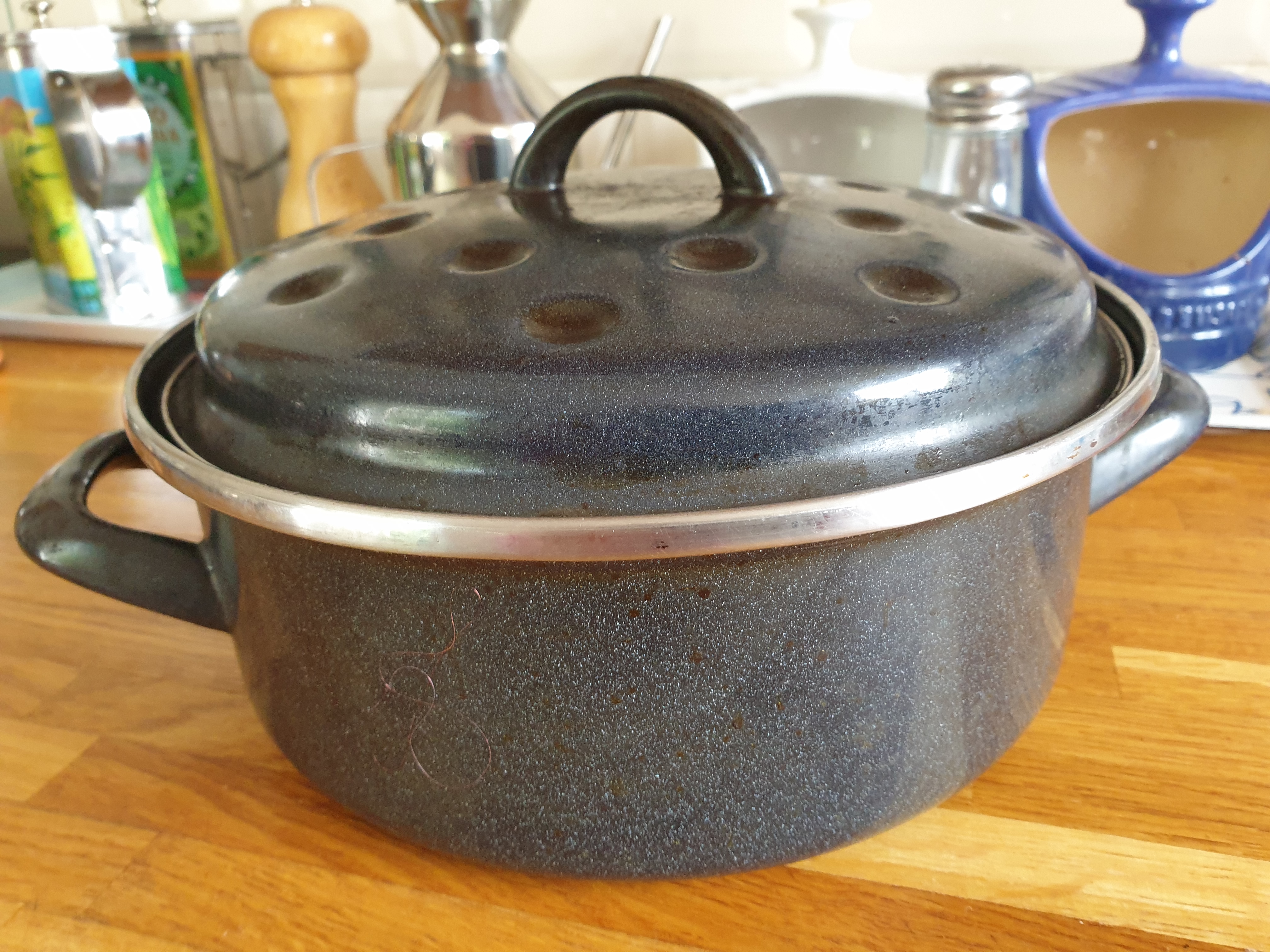
  • When baking the tin was covered for some off the time – which resulted in the cake being more steamed than baked.
  • Then the lid or foil was removed and the cake was baked for the rest of the time.
  • *
  • I adjusted a few of the ingredients so that this fruit cake – could be more easily made.
  • I halved the original quantities.
  • A large circular dish was originally used – I tried a 26x20cm tin.
  • Rectangular or square cakes are much easier to slice up than circular ones.
  • *
  • The result was a very lovely moist fruit cake, which I will be making often.

Note – you start this cake the evening before

INGREDIENTS

  • 150g raisins
  • 75g dried apricots – chopped
  • 40g mixed peel
  • 75g glacé cherries – chopped
  • 90g dates – chopped
  • 125ml apple juice
  • *
  • 55g butter – softened
  • 90g granulated sugar
  • 60ml sunflower oil
  • 1½ tablespoons of runny honey
  • *
  • pinch of salt
  • ¼ teaspoon baking powder
  • ¼ teaspoon ground ginger
  • ¼ teaspoon freshly ground nutmeg
  • ½ teaspoon ground cinnamon
  •  *
  • 2 eggs
  • 100g plain flour
  • *
  • 45g chopped walnuts – optional

METHOD

  • The evening before baking put all the fruits into a saucepan and add the apple juice.
  • Mix well over a low heat until all the fruits are covered.
  • Cover the pan and leave this until the next day.
  • *
  • Pre-heat oven to GM3 – 160°C
  • Grease and line base and 2 sides of a 26×20 cm baking tin.
  • Cream the butter and sugar together.
  • Add the sunflower oil and mix well.
  • Add the salt and spices and mix well.
  • Add the eggs one at a time and mix well.
  • Add the fruit mixture.
  • Add the walnuts and stir until everything is evenly mixed.
  • *
  • Pour the mixture into the tin and smooth the top.
  • Cover the tin with aluminium foil.
  • Bake for 65 -75 minutes until the top is set.
  • Remove the foil and bake for 25 – 30 minutes.
  • *
  • Leave to cool on a wire rack.
  • Cut into squares or rectangles to serve.

Royal Standard – Lynsdale tea plate

Option – not tested

  • Use a round pyrex dish with a lid for the first part of the baking.
  • Then remove the lid for the final part.

Iced Lime Yoghurt Cake

  • This is based on my Iced Lemon Yoghurt Cake.
  • This is a wonderful ‘plain cake’ using yoghurt and the texture is good.
  • I did not have any lemons but had some limes – limonka – so tried this out.
  • I learnt a new tip, which was to add the lime rind to the sugar for about 30 minutes – this releases more lime oil.

Ingredients

  • 200g plain flour
  • 2 teaspoons of baking powder
  • 200g granulated sugar
  • Zest of 3 limes
  • 185ml of Greek style yoghurt
  • 3 eggs
  • 120ml sunflower oil
  • Large pinch of salt

Method

  • Add the lime zest to the sugar and leave for about 30 minutes.
  • Pre-heat the oven to GM4 – 180ºC.
  • Use a loaf liner to line a 2 lb loaf tin.
  • Mix the flour, baking powder and salt together.
  • Add the yoghurt and eggs to the sugar mixture.
  • Gradually add the flour mixture and mix well.
  • Add the oil and mix well again.
  • Pour the batter into the loaf tin and smooth the top.
  • Bake for around 45 to 50 minutes.
  • Check a little earlier and cover with greaseproof  paper if it is starting to burn.
  • Leave to cool in the tin.

Lemon Icing – Ingredients

  • 100g icing sugar – approx
  • 1 tablespoon of lime juice

Lemon Icing – Method

  • Mix the icing sugar with the lime juice.
  • Adjust sugar or juice to make a thin pouring icing.
  • Once the cake is cold, pour this over the cake.
  • Smooth down with a warm spatula.
  • Served on Royal Doulton – Tapestry Tea Plate
Chocolate Meringues

  • The original recipe made a circle/nest of the meringue.
  • I find individuals ones easier and more useful.
  • The sugar in the original was all icing sugar – I found this very hard to whisk up so if you can find caster sugar it is much easier to use.

INGREDIENTS

  • 2 egg whites
  • 90g caster sugar
  • *
  • 15g icing sugar
  • 2 teaspoons of cocoa powder

METHOD

  • Pre-heat the oven to GM2 – 150°C
  • Line a baking tray with baking paper
  • *
  • In a small dish mix the 15g of icing sugar and the cocoa powder.
  • *
  • Whisk the egg white until they are stiff.
  • Add the caster sugar and whisk until stiff again.
  • With a metal spoon fold in the icing sugar and cocoa mixture.
  • Place spoonfuls of the mixture onto the baking sheet.
  • You should get 6 or 8 meringues.
  • Place them in the oven for around 1hour 25 minutes.
  • Turn off the oven – you can keep them in there for an extra 15 minutes if required.
  • Leave the baking tray on a wire rack to cool completely.

Using the Meringues

  • These chocolate meringues are very useful for a variety of desserts.
  • They go well with sweetened yoghurt or yoghurt cheese.
  • They can be used with flavoured butter creams using rum or coffee or even more chocolate.
  • In England whipped double cream can be used.
  • In the glass dish above greek yoghurt was mixed with some sour cherry jam as the base and a dollop of the yoghurt was put on top of the meringue.
  • Try with chocolate budyń –– Polish custard.
  • They should be great with vanilla ice cream.

Half Size – Mama’s Never too Late Christmas Cake

  • Because of not being able to see many friends or family these last 3 years, I have not made an English style Christmas Cake for ages.
  • I have just been making one for my friend who is about to celebrate a significant birthday and loves fruit cake.
  • I found that the usual amount was quite a lot and I had forgotten how hard it was to mix it all up.
  • I thought that next time I would just make a half sized one.
  • Rather than halve the amounts ‘on the hoof’  I thought I would write this up with the half sized amount.
  • Decided it was better to do this now whilst things are fresh in my mind.
  • Of course I will not have the timings for baking but I can give estimates and check these later when I make this size of  cake.
  • It is a very moist cake and therefore it will only keep for about 2 months.

  • *
  • However if you want to add marzipan & icing then you should make it about 2- 3 weeks in advance, to give time for this to be done.

Ingredients

  • 450g mixture of currants, raisins & sultanas
  • 100g chopped mixed peel
  • 100g glacé cherries cut in half
  • Grated rind of 1 lemon & 1 orange
  • 1 medium cooking apple, peeled and coarse grated
  • 100g fine grated carrots
  • 1 tablespoon rum
  • 60 ml strong cold tea (I use a scented one like Earl Grey)
  • *
  • 175 g Butter
  • 175 g soft dark brown sugar
  • 2 tablespoons of black treacle
  • 3 large eggs – beaten
  • *
  • 200g plain flour – sieved
  • 1/4 level teaspoon salt
  • 3 level teaspoons mixed spice
  • ½ level teaspoon of cinnamon
  • ¼  grated nutmeg
  • ½ tablespoon cocoa  – yes cocoa! – sieved
  • 1 tablespoon ground almonds 

Method

  • Put all the fruit, rinds, carrots, rum & tea into large bowl,  mix and leave for 15 minutes.
  • Pre-heat the oven to Gas Mark 2 – 150oC.
  • Grease and line the cake tin – 20cm or 18cm square.
  • In another  large bowl, cream the margarine and sugar, beat in the treacle and eggs.
  • Mix all the dry ingredients together & fold them in using a large metal spoon.
  • Fold in the fruit mix using a large metal spoon
  • *
  • Put all the cake mixture into the tin to fill the shape and smooth the top.
  • 20 cm square – try 1hr 30mins
  • 18 cm square  -try 1hr 15 mins 
  • The above are guides as it does depend on your oven – you need to check earlier.
  • Leave to cool completely in the tin.
  • *
  • Wrap in several layers of foil to store.

Decorating the cake

  • It depends on who is coming and whether there are  lots of marzipan & icing lovers on how much I decorate the cake.
  • *
  • Sometimes I just dust the top with icing sugar.
  • See the full sized recipe for more details.
  • Cut down the amounts to suit the cake size.

Horseradish Sauce

  • Recently I posted kotlety mielone – meatballs with a mustard sauce.
  • I was then inspired to make a similar dish but this time with horseradish sauce.
  • Make your favourite meatballs – making them a bit smaller than usual.
  • I used a beef and pork mixture for mine.
  • You could also make pulpety – very small meatballs.

METHOD

  • Make your smaller style meatballs 
  • Keep warm – whilst you make the sauce.
  • *
  • Pre-warm the oven to GM 4 – 180°C.

INGREDIENTS – for sauce

  • 500ml of chicken or vegetable stock
  • 1 tablespoon of potato or corn flour
  • 1-2 tablespoons of made horseradish sauce

METHOD – for sauce

  • In a saucepan bring the stock to simmer.
  • Mix the potato flour with a little cold water.
  • Add this to the stock – stirring with a wooden spoon until it thickens.
  • Stir in the made horseradish sauce.
  • Heat together gently until it thickens.
  • Adjust the thickness with water or stock  if necessary.

METHOD – Overall

  • Put  a layer of meatballs in an oven proof dish.
  • Pour the sauce over the meatballs.
  • Cover with a lid or foil.
  • Put the dish in the pre-heated oven for at least 30 minutes.
  • *
  • Serve with mashed potatoes, boiled rice, pearl barley or buckwheat.
  •  
  • Served on Royal Doulton – Burgundy plate

Placek with Figs 2

  • My father loved English Fig Rolls so he would have loved this pastry.
  • It is based on an English recipe for a pie that was served on Palm Sunday – 2 April in 2023.
  • You have to start the fig filling the evening before and then cook it the next morning.
  • The filling needs to be completely cold before using.
  • I made it using my kruche ciasto – shortcrust pastry.

INGREDIENTS – Pastry

  • 250g plain flour
  • 125g butter
  • 1 egg yolk
  • Juice of 1 lemon
  • Cold water to mix the dough.
  • *
  • Egg white to glaze

METHOD – Pastry

  • Rub the butter into the flour until you have breadcrumbs.
  • Mix in the egg yolk, lemon juice and enough water until you have a soft dough.
  • Cover and rest in the fridge for 30 minutes.

INGREDIENTS  – FILLING

  • 250g dried figs
  • Juice of 1 lemon
  • 2 tablespoons of granulated sugar
  • 1-2 tablespoons of cornflour
  • 1 teaspoon of mixed spice

METHOD – Filling

  • Place the figs in a bowl with the lemon juice.
  • Pour enough boiling water over the figs to cover them and leave overnight.
  • Sieve the figs from the liquid – but keep the liquid.
  • Chop the figs into small pieces.
  • Take a few tablespoons of the liquid and mix with the cornflour.
  • Put the rest of the liquid in a saucepan and add the sugar and spice.
  • Heat gently and then add the cornflour paste.
  • Carry on heating until the liquid thickens.
  • Add the chopped figs and heat gently to reduce the liquid until you have a thick paste.
  • Leave to cool – this must be cold when you use it.

METHOD – Placek

  • Grease and line a 26 x 16cm tin.
  • Pre-heat the oven to GM 6 – 200°C
  • Divide the pastry into two.
  • Roll out one half and use this to line the base of the tin.
  • Spread out the fig paste over the pastry.
  • Roll out the rest of the pastry and cover the top of the tin.
  • Brush the top of the pastry with beaten egg white.
  • Bake for 30 – 35 minutes


  • Served on Crown bone china tea plates.

OPTIONS – Not Tested.

  • Add 2 tablespoons of icing sugar to the flour when making the pastry dough.
  • Sprinkle 1-2 tablespoons of granulated sugar on top of the egg white glaze.
  • Dust with icing sugar when serving.

Swede Soup

  • Swede – brukiew  – in Polish –  is quite a sweet vegetable.
  • The soup is pureed so it is more an English style soup.

INGREDIENTS

  • Around 500g of peeled swede
  • 1 large onion
  • 2 medium potatoes
  • 1½ litres chicken stock
  • Butter for frying
  • 125ml soured cream
  • Salt and pepper to taste
  • *
  • Skwarki(crispy bacon bits) or charred onion bits to serve

METHOD

  • Chop the onion into small pieces and fry gently in the butter.
  • Chop the swede into small chunks and add to the onions.
  • Add the stock and simmer gently for about 10 minutes.
  • Peel and chop the potatoes into chunks and add to the soup.
  • Simmer gently for around 15 minutes until both the swede and potato are soft.
  • This may take longer.
  • Take the pan off the heat and purée with a stick blender.
  • Bring back to heat and stir in the soured cream.
  • Season to taste and serve.
  • *
  • Serve here with charred onions.

Mustard Sauce

  • I had a meal in a local restaurant  where roast pork loin was served in a mustard sauce.
  • This inspired me to make this dish but easier with meatballs.
  • Make your favourite meatballs – making them a bit smaller than usual.
  • I used a beef and pork mixture for mine.
  • You could also make pulpety – very small meatballs.

METHOD

  • Make you smaller style meatballs 
  • Keep warm – whilst you make the sauce.
  • *
  • Pre-warm the oven to GM 4 – 180°C.

INGREDIENTS – for sauce

  • 500ml of chicken or vegetable stock
  • 125 ml milk
  • 1 tablespoon of potato or corn flour
  • 1-2 tablespoons of made mustard ( Polish or French style rather than English)
  • 125ml soured cream – optional

METHOD – for sauce

  • In a saucepan bring the stock to simmer.
  • Mix the potato flour with the milk.
  • Mix the milk mixture with the stock – stirring with a wooden spoon.
  • Stir in the made mustard.
  • Heat together gently.
  • Adjust the thickness with milk if necessary.
  • Stir in the soured cream if using.

METHOD – Overall

  • Put  a layer of meatballs in an oven proof dish.
  • Pour the sauce over the meatballs.
  • Cover the dish with a lid or foil.
  • Put the dish in the pre-heated oven for at least 30 minutes.
  • *
  • Serve with mashed potatoes, boiled rice, pearl barley or buckwheat
  • *

  • Spanish Garden plate by Meakin
  • Mustard

Gammon & Apricots

  • Grilled gammon and grilled pineapple (usually tinned) is a very popular dish in England.
  • Whilst doing some research I discovered that a much older idea is to have apricots with gammon.
  • Apricots were very popular in Elizabethan times, when fruit and meat together were often served.
  • Apricots in these dishes could have been dried apricots but here I have used tinned apricots halves.
  • Apricots in Polish are morela.
  • Apricots are from the Genus Prunus and they are drupes – stone fruits.
  • *
  • Fruit served with meat is very popular in Poland and I think this dish would be well liked.
  • Gammon slices have been used here but this dish could be adapted to use a large piece of ham or gammon.

    Ingredients

  • A thick piece of gammon per person
  • 2 apricot halves (tinned) per person – ones in syrup are the best.

Method

  • Grill the gammon on both sides.
  • Drain the apricots from their juice/syrup.
  • Grill the apricots.
  • Serve the gammon with the apricots.
  • *
  • This would go well with potatoes & garden peas and/or a cabbage salad.

Caraway & Cinnamon Biscuits

  • I came across this recipe in an English book about the Lake District.
  • I thought the spice combination was a little unusual and would be liked in Poland.
  • I changed soft brown sugar for granulated sugar, which is used in Poland.

INGREDIENTS

  • 125g butter
  • 125g granulated sugar
  • 175g plain flour
  • 2 teaspoons baking powder
  • 1 teaspoon of caraway seeds
  • 1 teaspoon of ground cinnamon
  • 1 egg – beaten

METHOD

  • Grease several baking trays.
  • Pre-heat the oven to GM4 – 180°C.
  • Mix the baking powder and flour together.
  • Rub in the butter until you get breadcrumbs.
  • Stir in the sugar and spices.
  • Slowly add the egg (you might not need all) and mix to give a soft dough.
  • Roll out the dough on a floured board till thin.
  • Use a 6 cm diameter cutter to cut out the biscuits.
  • Leave space on the trays as they will rise a little.
  • Bake for 10-12 minutes.
  • Leave to cool slightly and then remove and place on a wire rack to cool completely.
  • These could be made using Christmas cutters for Christmas