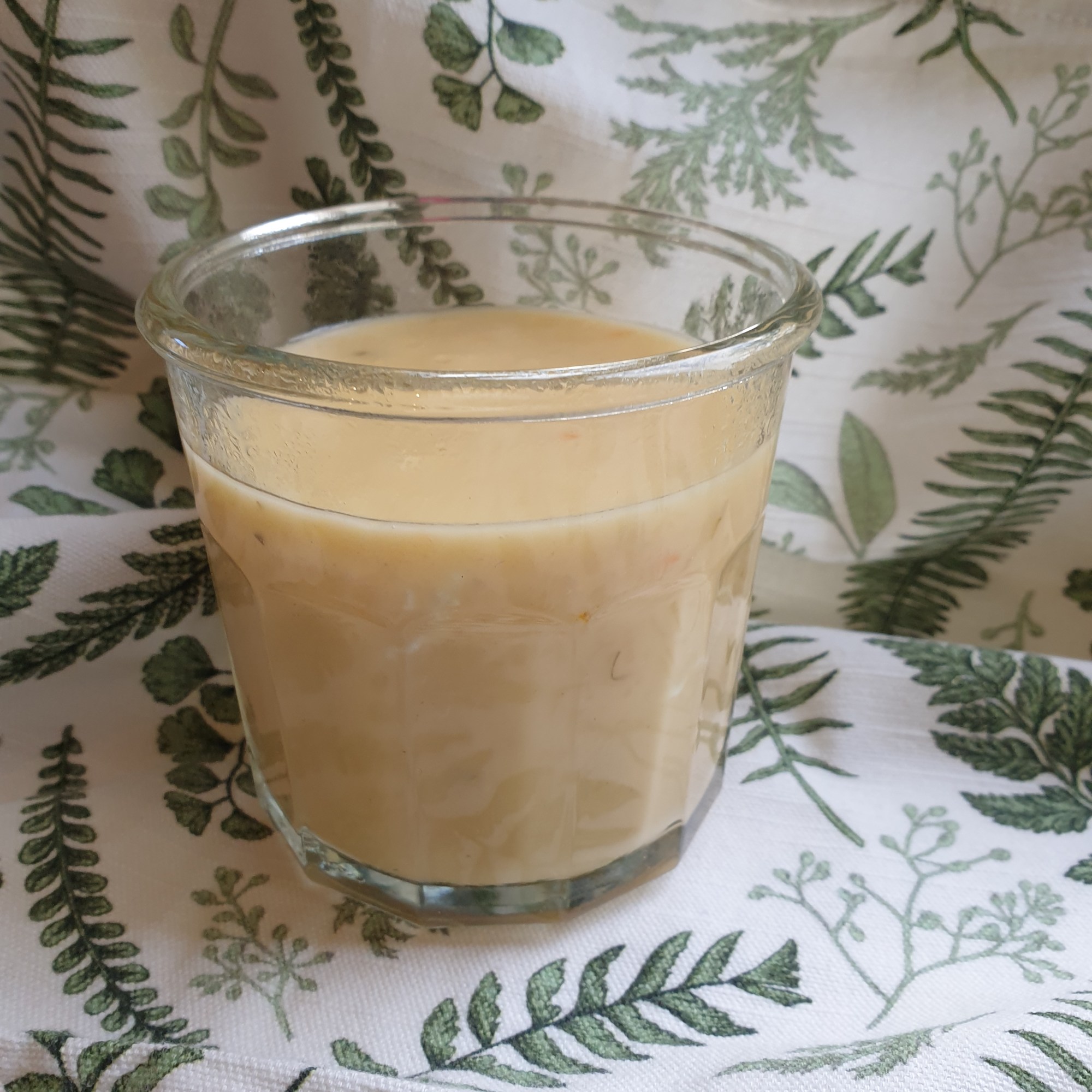
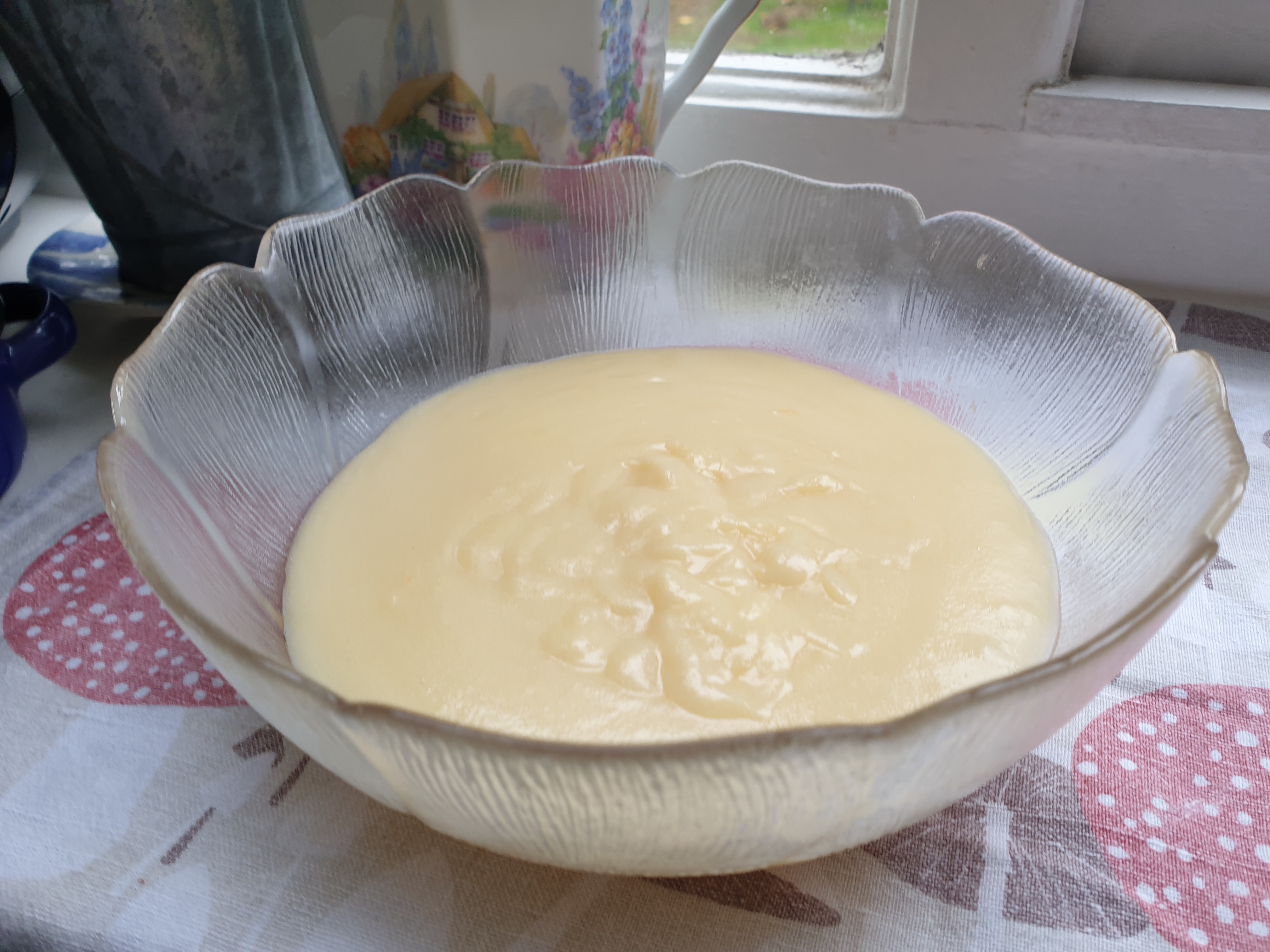
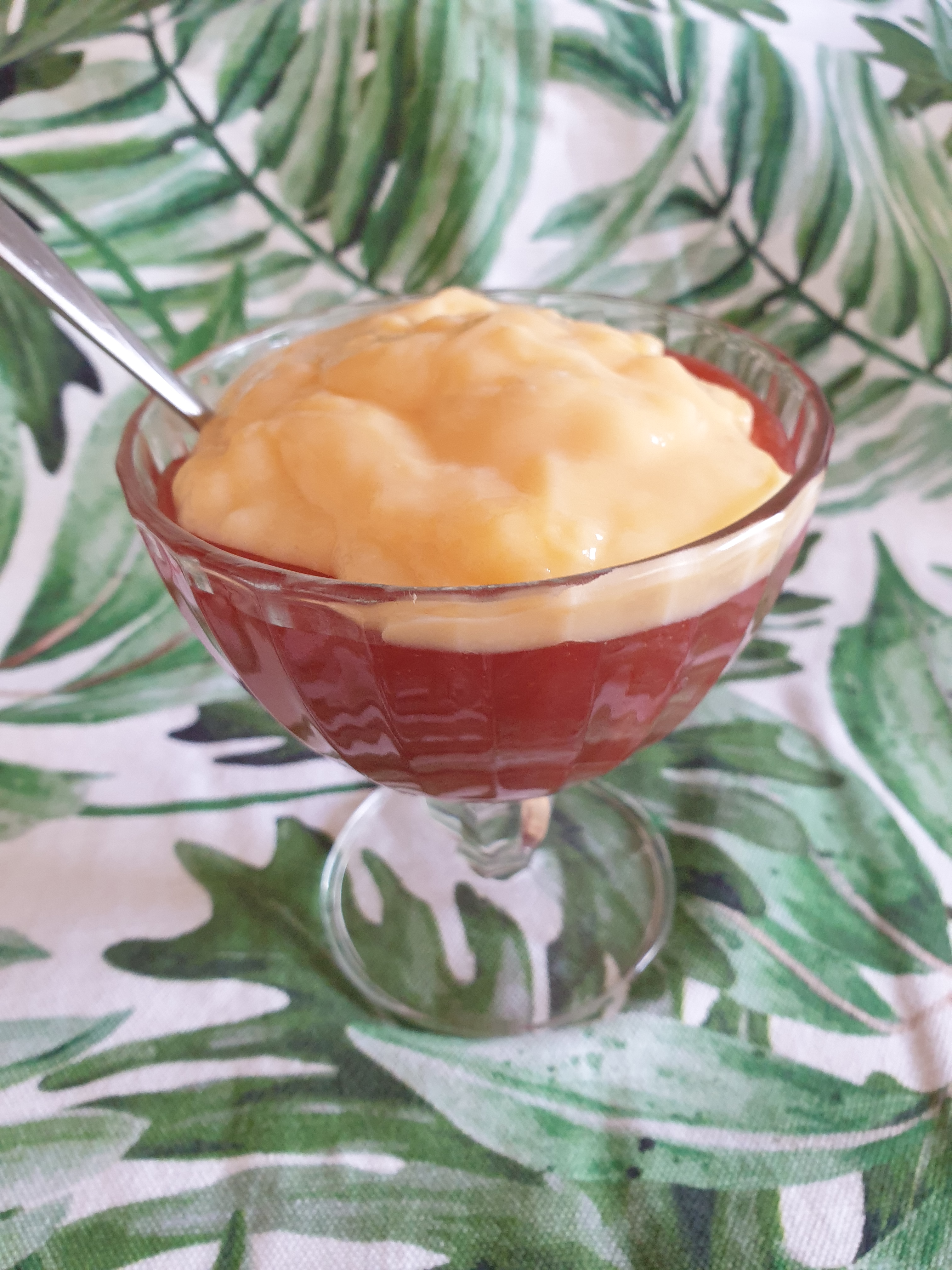
Kisiel – Red Fruits

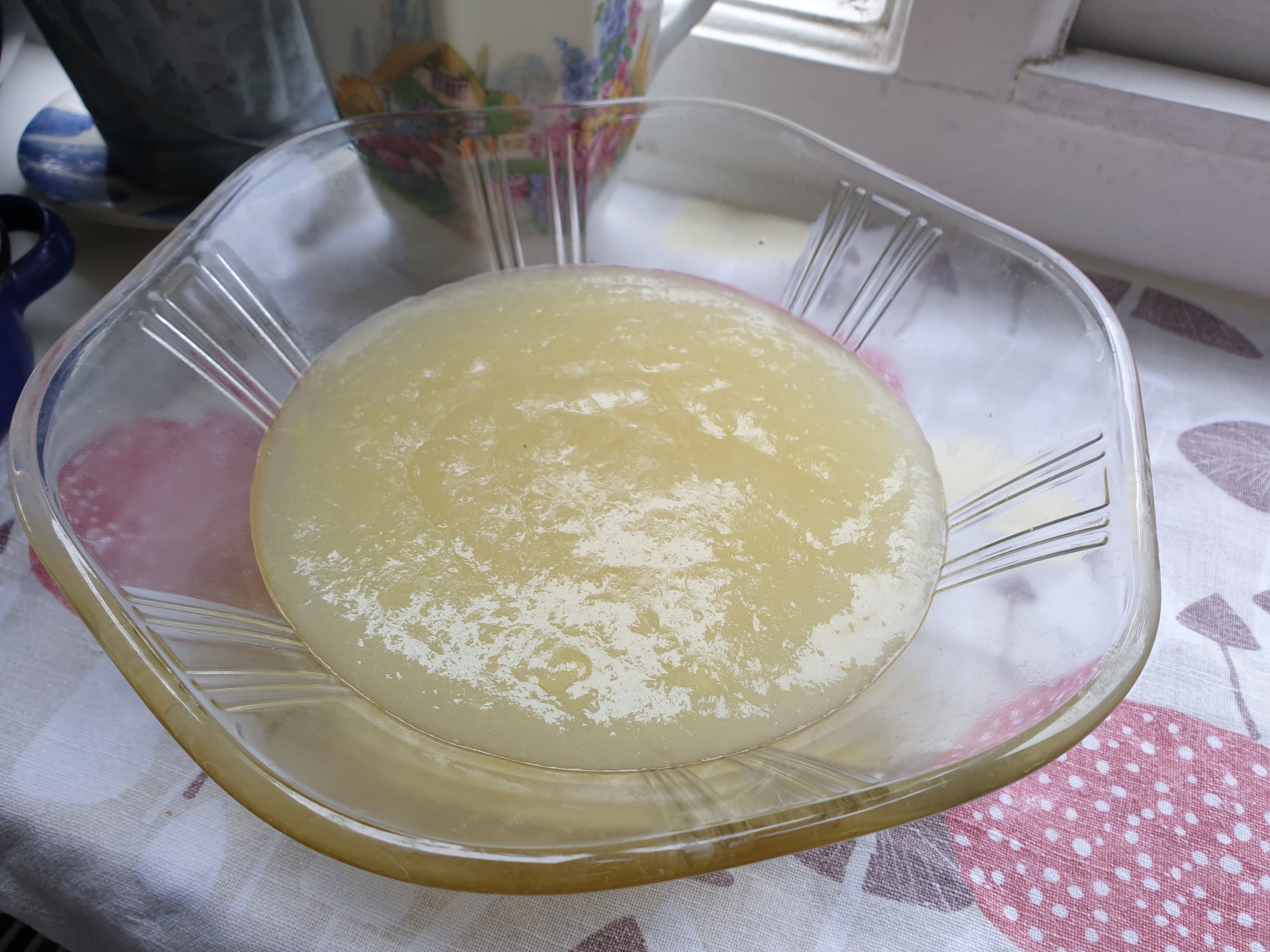
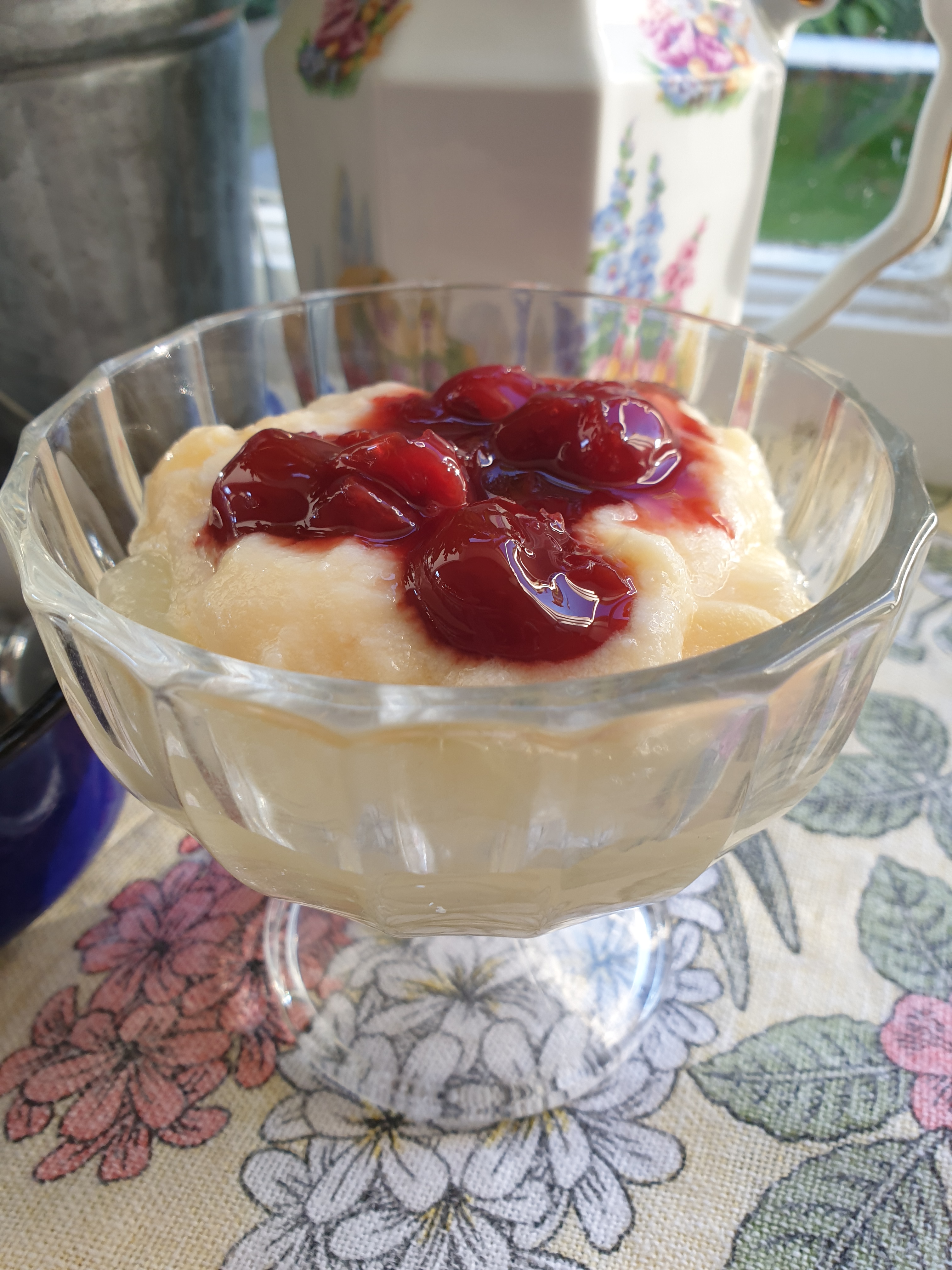
  • There is no good translation of kisiel into English.
  • I remember my mother making this dessert in the summer time.
  • She made it with red fruits from our garden: strawberries, raspberries and redcurrants.
  • I now know that this is a very old dessert and would have originally been made with oat or millet starch.
  • This dessert was made before the introduction of gelatine and is a set dessert but not as set as a jelly.
  • My mother used potato starch or cornflour if she could not get that.
  • I used frozen raspberries and sour cherries.
  • Serve kisiel chilled.

Ingredients

  • 400g red berries
  • 350 ml water
  • 50g potato flour
  • 80g granulated sugar (less if your fruit is very ripe and sweet)

Method

  • If necessary, remove any stalks and such from the fruit.
  • Place the fruit in a saucepan and add the water.
  • Bring to the boil and then simmer gently until the fruit has fallen apart.
  • Use a stick blender to turn the liquid into a purée if necessary.
  • You can sieve the liquid – optional.
  • Add the sugar and bring to the boil then take it off the heat.
  • Mix the potato flour with 3 tablespoons of cold water to get a paste.
  • Add the cornflour to the fruit mixture.
  • Heat gently, stirring all the time until the mixture thickens.
  • Pour into individual serving glasses or into a large serving bowl.
  • The kisiel looks best in a glass dish.
  • Chill before serving.

Sweet Knedle – 1

Knedle – Dumplings – With Plums

  • For me these are sweet pierogi –  but I have been assured by my aunties in Poland – who made them for me on my last visit  – that because of their shape – round balls – these are always called knedle. (This if from the German word  knödel – for dumplings).
  • The dough is just the same as for pierogi and they are also boiled in the same way but will take a bit longer to cook depending on the size of the plums.
  • In Poland small dark plums called węgierki (Hungarian plums) are used.
  • I think that in America these are called Italian plums.
  • Serve them warm, dusted with icing sugar and soured cream.

Pierogi Dough

  • Use the standard recipe for pierogi, just using 250g of flour (see below)
  • Best not to make too many as they should be served warm and do not freeze well.

Plum Filling

  • 500g fresh plums – small ones are best for the round shape.
  • Mix around 3 tablespoons of granulated sugar with 1 teaspoon of ground cinnamon.
  • Wash and dry the plums and remove the stalks. 
  • Remove the stone but do not cut through completely.
  • Put ½ to 1 teaspoon of the sugar mixture in the cavity.
  • Roll out the dough – slightly thicker than for pierogi.
  • Cut strips of dough more than twice the size of the plum.
  • Place the filled plum on one side of the dough.
  • Fold over the other part of the dough and seal the edges well with your fingers  – take care as the added sugar produces liquid – use excess dough to give a good seal then cut away this excess dough to give a more rounded shape.
  • Drop them into boiling water.
  • Simmer for around 10 minutes.
  • Remove with a slotted spoon into a colander.
  • Dust with icing sugar and serve with soured cream.

Ingredients – Dough

  • 250g pasta flour or plain flour & 2 tablespoons of fine semolina
  • 150ml water
  • 1 tablespoon oil – sunflower or light olive
  • ½ teaspoon salt
  • 1 egg yolk

Method – Dough

  • In a jug or bowl mix together the water, oil and the yolk.
  • Put the flour and salt into a large bowl and make a well in the centre.
  • Pour in the liquid from the jug and initially use a knife to mix this into the flour and then use your hands to mix the liquid and flour to get a ball of dough.
  • Turn this out onto a floured board and knead the dough for a few minutes until you have a smooth ball.
  • Cover and leave to rest for about ½ an hour.
  • Roll the dough out – slightly thicker than you would do for pierogi..

Plum Soup

  • Last year in the summer I wrote about 3 fruit soups – rhubarb, sour cherry and strawberry.
  • Later in the autumn I made an apple soup.
  • This year I have made plum soup.
  • Just like other soups this is served as a first course.
  • This soup is best served hot.

Ingredients

  • 500g plums.
  • 50-75g granulated sugar
  • 1½ tablespoons of potato flour or cornflour
  • Small cinnamon stick
  • 1.5 litres of water
  • 125ml of soured cream
  • *
  • White bread croutons or cold cooked pasta to serve

Method

  • Put the water and cinnamon  into a large saucepan.
  • Add the plums to the pan.
  • Bring to the boil then simmer with a lid on the pan till the plums are falling apart.
  • Strain the liquid into a large bowl.
  • Return the strained liquid to the pan.
  • Add the sugar to the liquid (check for sweetness – should be slightly tart).
  • Bring to the boil.
  • Leave to cool a little.
  • Mix the potato flour with a little water.
  • Add this to the soup.
  • Bring to the boil, stirring gently.
  • Simmer and stir until the soup thickens.
  • Remove from the heat and stir in the soured cream.
  • Serve hot.
  • Can serve with white bread croutons or cold cooked pasta.
Royal Stafford – Blossom Time from the 1950s

Broccoli Soup

  • This is a delicate creamy soup.
  • The Polish for broccoli is brokuły and comes from the Italian broccoli meaning a cabbage sprout.

Ingredients

  • Large head of broccoli
  • 1 large potato
  • 1 litre of vegetable or chicken stock
  • 125ml of soured cream
  • Salt and pepper to taste

Method

  • Peel and chop the potato into small chunks.
  • Chop the broccoli stalks into small pieces.
  • Add the potatoes and broccoli stalks  to the stock.
  • Bring to the boil and simmer until the vegetables are nearly soft.
  • Add the rest of the broccoli and bring back to the boil.
  • Simmer till soft.
  • Remove from the heat.
  • Purée the soup – a stick blender is good for this.
  • Stir in the soured cream.
  • Season to taste.
  • Bring back to the boil and then serve.

Pampuchy – 2 – Sweet

  • These  sweet pampuchy are made exactly like the ones in  pampuchy – 1.
  • There is no extra sugar in the dough.
  • The jam inside and the sugar on top is enough sweetness.

Ingredients

  • 350g plain flour
  • 250 warm milk
  • 2 teaspoons of granulated sugar
  • ½ tablespoon of dried yeast
  • Large pinch of salt
  • 2 egg yolks
  • 2 tablespoons of melted butter
  • *
  • 1 teaspoon of jam for each one – apricot and whinberry were used here.
  • *
  • Granulated or icing sugar to dust 

Method

  • To the milk add the sugar, yeast and 1 tablespoon of the flour.
  • Leave to froth up for around 20 minutes.
  • Add the yeast mixture to the flour and salt and add the egg yolks.
  • Mix together to make a rough ball.
  • Add the melted butter and mix it in until you have a ball again.
  • Knead for about 5 minutes.
  • Cover and leave to rise for about 1 hour.
  • Bring the dough together and gently knead for about 2 minutes.
  • Divide the dough into 16 equal parts.
  • Roll them gently into smooth balls.
  • Place each one on a wooden board and flatten it into a disc with you fingers.
  • Place a spoonful of jam in the centre.
  • Bring up the dough around the jam and seal each one in a ball.
  • Place on a tray or board, cover and leave for about 30 minutes.
  • Steam them for 10 minutes.
  • *
  • Dust with granulated or icing sugar to serve (optional) 
  • *
  • Some people serve these with a warm, fruit sauce

Pampuchy – 1

  • The word pampuchy is another of those many items of food translated as dumplings.
  • These are steamed yeast buns also known as  bułeczki naparze  or kluski drożdżowe.
  • The  puch part  in the word mean down as in duck or goose down and signifies lightness and fluffiness. (Though I have also read the word may come from a German word for pancake).
  • In olden times these were steamed using a cloth over a wide pan of water with a domed lid.
  • I use my 2 tier steamer and can do 2 layers of 4 at a time.
  • I think they are similar to Chinese steamed buns but doubt they would have had butter in them as that is not used much there.
  • Maybe no egg yolks either as the Chinese buns do not look as cream coloured.

Ingredients

  • 350g plain flour
  • 250 warm milk
  • 2 teaspoons of granulated sugar
  • ½ tablespoon of dried yeast
  • Large pinch of salt
  • 2 egg yolks
  • 2 tablespoons of melted butter

Method

  • To the milk add the sugar, yeast and 1 tablespoon of the flour.
  • Leave to froth up for around 20 minutes.
  • Add the yeast mixture to the flour and salt and add the egg yolks.
  • Mix together to make a rough ball.
  • Add the melted butter and mix it in until you have a ball again.
  • Knead for about 5 minutes.
  • Cover and leave to rise for about 1 hour.
  • Bring the dough together and gently knead for about 2 minutes.
  • Divide the dough into 16 equal parts.
  • Roll them gently into smooth balls.
  • Place on a tray or board, cover and leave for about 30 minutes.
  • Steam them for 10 minutes.
  • *
  • Best served immediately.
  • *
  • They go well with a dish with a lot of sauce such as gulasz or mushroom sauce.

Here they were served with beef pulpety in a gulasz style pepper & tomato sauce.

Honeyed Carrots

  • The original recipe was for whole small young carrots and used a bunch of around 15 carrots still with their tops.
  • I tend to use medium carrots and after topping and tailing them, I cut them lengthwise to give strips of carrots, say into quarters.
  • Here the difference between the two recipes below is the additions to the honey dressing used.
  • I used some lovely Polish honey from the Mazurian lakes.
  • Both versions are delicious.

Carrots with honey and thyme

Ingredients

  • 4-5 medium to large carrots
  • 1 tablespoon of olive oil
  • 2 tablespoons of runny honey
  • 1 tablespoon of lemon juice
  • 3-4 sprigs of fresh thyme
  • Salt & Pepper

Method

  • Pre-heat the oven to GM6 – 200°C
  • Peel the carrots.
  • Top and tail them.
  • Cut into quarters.
  • Place the carrots on a baking sheet.
  • Pour the olive oil over them.
  • Sprinkle with salt and pepper.
  • Roast for 20 minutes.
  • Strip the leaves from the stalks of the thyme.
  • Mix the thyme with the honey and lemon juice.
  • Pour the mixture over the carrots and roast for another 10 minutes.

Carrots with honey and orange

Ingredients

  • 4-5 medium to large carrots
  • 1 tablespoon of olive oil
  • 2 tablespoons of runny honey
  • Zest and juice from a small orange
  • Salt & Pepper

    Method

  • Pre-heat the oven to GM6 – 200°C
  • Peel the carrots.
  • Top and tail them.
  • Cut into quarters lengthwise.
  • Place the carrots on a baking sheet.
  • Pour the olive oil over them.
  • Sprinkle with salt and pepper.
  • Roast for 20 minutes.
  • Mix the orange zest and juice with the honey.
  • Pour the mixture over the carrots and roast for another 10 minutes.

Note

Should you have any left , chop them up and use as a topping to sandwiches or add to salads.

Keks – Carrot Fruit &Nut

This is a variation on the courgette keks – light fruit cake –  I posted a couple of years ago.

Ingredients – Cake

  • 150g plain flour
  • 1 teaspoon of baking powder
  • Pinch of salt
  • 1 tablespoon of vanilla sugar
  • 150g of light brown sugar
  • 1 teaspoon of cinnamon
  • 100g of raisins
  • 100g of currants
  • 100g dried apricots chopped fine
  • 80g of roasted and roughly chopped hazelnuts or almonds
  • 1 large coarse grated carrot
  • 2 eggs
  • 125ml of sunflower oil

Ingredients – Lemon Icing

  • Fine grated rind of 1 lemon
  • 2 tablespoons of lemon juice
  • 150g of icing sugar

Method – Cake

  • Pre-heat the oven to GM4 180°C
  • I used a continental style long loaf tin, greased it  and used a single sheet of grease proof paper  to line the long sides and the base.
  • Mix together the flour, baking powder, salt, sugars and cinnamon, making sure that any lumps in the brown sugar are all pressed out.
  • Mix together the raisin, currants, nuts and the carrot.
  • Lightly whisk the eggs and oil together.
  • Add the flour mixture to the egg mixture and mix thoroughly together with a wooden spoon.
  • Add the carrot and fruit and nut mixture and mix well in.
  • Place the cake mixture into the tin and smooth the top.
  • Bake for 50 – 55 minutes – check after 40 minutes and cover the top with greaseproof or foil if browning too much before it is baked through.
  • Leave to cool before icing.

Method – Icing

  • Place the icing sugar in a bowl and add the grated lemon zest.
  • Mix in the lemon juice until you have a thick icing.
  • You might have to adjust the thickness with  more lemon juice (or water) or with icing sugar.
  • Put the icing on the top of the cake and let it drip down the sides.

Note

  • Keep in an airtight container.
  • Keep in the container for at least a day before serving.

Breaded Aubergines

  • I went to my favourite restaurant in the area, which is very near to where I live.
  • It is called Healds Hall .
  • They had a new starter on the menu, which was delicious.
  • I decided to recreate this at home.
  • I used Polish honey from the Mazurian Lakes, which was delicious.
  • The Polish word for aubergine is bakłażan and it comes from the Persian – badigan. 
  • Americans call aubergines – egg plant.

Ingredients

  • 1 Aubergine
  • Plain flour
  • 1 egg – beaten
  • Salt and pepper
  • Dried breadcrumbs
  • *
  • Sunflower oil to fry
  • *
  • To serve
  • *
  • Runny honey
  • Yoghurt cheese or cream cheese

Method

  • Slice the aubergine into 1 – 1.5cm circles.
  • Sprinkle them with salt and put them into a colander over a bowl.
  • Leave for around 30 minutes.
  • Dry the slices with kitchen roll.
  • Sprinkle with a little pepper.
  • Have ready dishes of flour, beaten egg and dried breadcrumbs.
  • Dip each slice of aubergine first into the flour, then the beaten egg and lastly the dried breadcrumbs.
  • In a frying pan heat up the oil.
  • Fry the slices gently on both sides till golden.
  • Remove from the oil, place onto kitchen roll to remove some of the oil.
  • Serve with yoghurt cheese or cream cheese with runny honey on top.

Cabbage Carrot & Pear Salad

  • This is a variation on my usual cabbage salad.
  • Mayonnaise is not used just lemon juice as a dressing. 
  • Rather than apples I used pears for this salad.
  • Conference pears or other hard pears are good for this.
  • The pears need to be ripe but not too “mushy”.
  • I would peel the pears as the skins are often very tough.

Ingredients

  • ½ head of white cabbage
  • 3-4 hard pears
  • 2 carrots
  • Juice of 1 lemon
  • *
  • Chopped flat leafed parsley or chives to serve

Method

  • Shred the cabbage into fine shreds.
  • Peel the pears and then coarse grate them.
  • Coarse grate the carrots.
  • Mix them all together.
  • Pour the lemon juice over them and mix.
  • Sprinkle with flat leaved parsley or chives.