Bean Soup

  • This is a lovely winter soup.
  • It would once have been made with reconstituted dried beans but now it is easy to open tins of beans.
  • Any white beans are good such as Haricot, Cannellini or even Black-eyed beans.
  • This can be made in a stock pot on the cooker or in the oven however I find that using a large slow cooker to cook it makes life a lot easier.

Ingredients

  • 2 tins of white beans such as Haricot, Cannellini or Black-eyed beans.
  • 3 large carrots
  • 2 onions
  • 1½ litres of vegetable stock – can be from a cube or powder
  • 150g smoked bacon.
  • 8 peppercorns
  • 3 allspice grains
  • 1 teaspoon dried marjoram  or 1 tablespoon of fresh
  • Butter to fry the onions.
  • Salt & pepper to season – may not be necessary depending on the bacon and stock.
  • Chopped flat-leaf parsley or chives to garnish when serving

Method

  • Chop the onions into small pieces.
  • Gently fry the onions till golden.
  • Chop the carrots into circles and halve or quarter them.
  • Chop the bacon into small pieces.
  • Drain the beans from the cans.
  • Put all the ingredients into a pot.
  • Bring to the boil and then simmer – or use a slow cooker.
  • Cook until the carrots are soft.
  • Allow the soup to cool slightly.
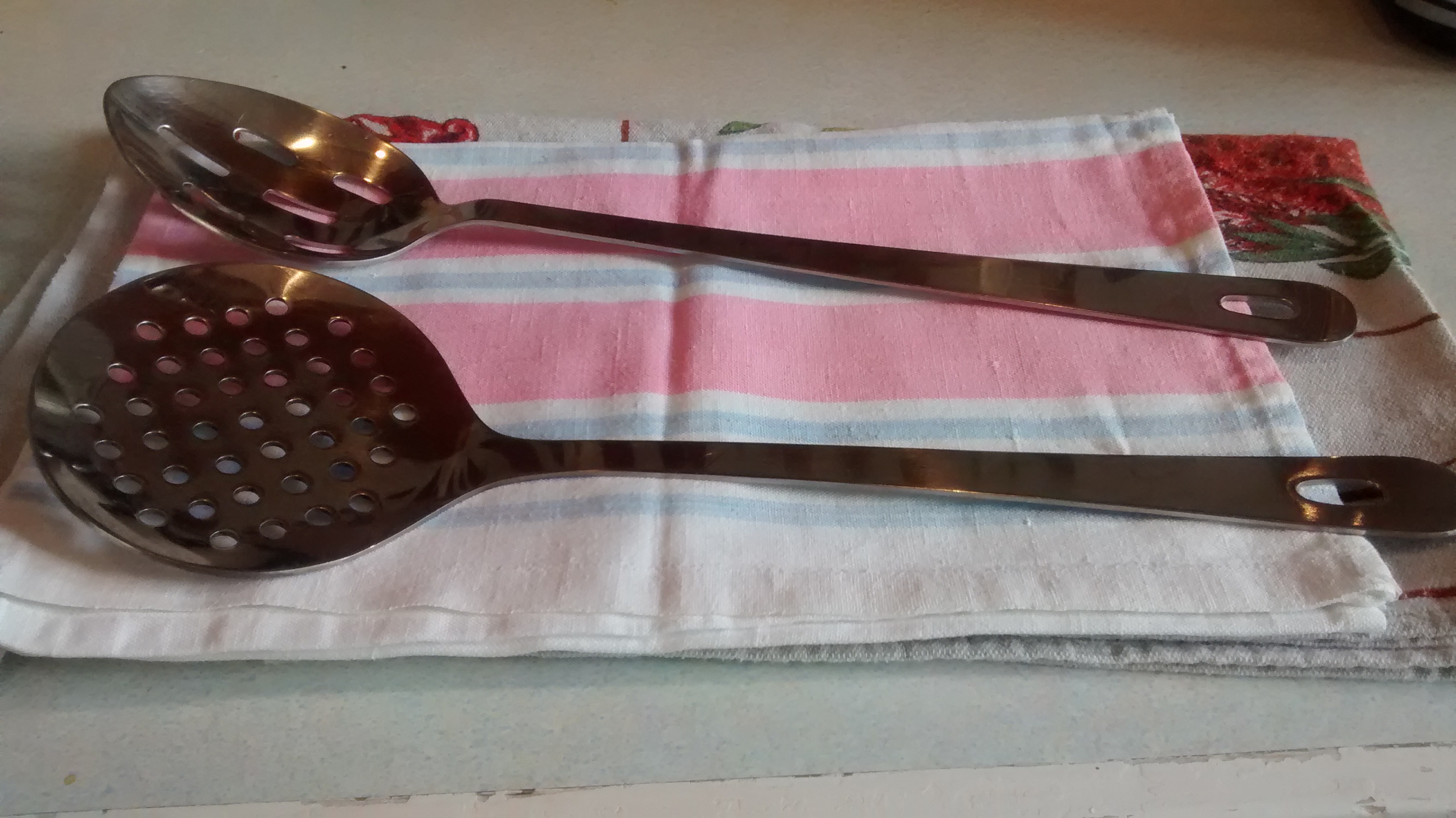
  • Remove about half of the beans and carrots with a slotted spoon and put them in a bowl.
  • Purée the soup left in the pan – using a stick blender is good.
  • Put the beans and carrots back into the soup and stir.
  • Bring back to the boil and simmer for a couple of minutes.
  • Garnish with chopped flat-leaf parsley or chives.


Royal Doulton – Tapestry soup plate – 1966 to 1988.

Placek with Figs

  • This placek – flat cake- has a filling of bakalie – dried fruit and nuts – there are lots of figs in this mixture, which make it extra delicious.
  •  The pastry used is a variation on my Polish  kruche ciasto – shortcrust pastry.

Ingredients – Pastry

  • 225g plain flour
  • 110g butter
  • 1 tablespoon of granulated sugar
  • 2 egg yolks
  • 5 tablespoons of water
  • *
  • 1 tablespoon of caster sugar to sprinkle

Ingredients – Filling

  • 190g dried figs – chopped
  • 60g currants
  • 60g raisins
  • 60g walnuts – chopped
  • 60g soft dark brown sugar
  • Grated rind of 1 lemon
  • 125ml water

Method – Filling

This filling needs to be cold – so make this first.

  • Put all the ingredients into a small pan and heat gently.
  • Stir occasionally until the mixture is soft and the water is adsorbed.
  • A little more water might be needed and more heating.

Method – Pastry

  • A rich pastry is made in the traditional rubbed in method with the ingredients listed above.
  • Chill the pastry for around 30 minutes.
  • Pre-heat the oven to GM 5 – 190°C.
  • Grease and line a shallow tray 21cm x 26cm.
  • Divide the pastry into two.
  • Roll out one piece to line the bottom of the tin.
  • Spread the filling evenly over the pastry – not quite to the edges.
  • Roll the second piece of pastry out and use to cover the filling.
  • Press the edges down to seal.
  • Bake for around 30 minutes until golden.
  • Remove from the oven and sprinkle with the caster sugar.
  • Leave to cool in the tin.
  • Cut into squares when cold.

Hand painted Paragon plates.

Friends who tried this said “Please make this again!”

Fruity Cabbage Salad

Here is a salad made with one of Poland’s favourite vegetables – cabbage.

It is a more fruity variation of a cabbage & orange salad I posted over three years ago!

Ingredients

  • A small white cabbage or sweetheart cabbage
  • 2 oranges
  • 3 eating apples – red skinned for colour contrast.
  • 1 tin of  pineapples
  • 80g raisins or sultanas
  • A pinch of salt & pepper to taste
  • *
  • Dressing – Mayonnaise & pineapple juice

Method

  • Peel the oranges removing all the pith.
  • Cut them into slices, separate the segments and then chop these into small pieces.
  • Finely shred and chop the cabbage
  • Core the apples and chop them into small pieces.
  • Drain the pineapples from the juice.
  • Chop the pineapples into small pieces.
  • Mix the cabbage and fruits together.
  • Mix mayonnaise and some pineapple juice together to make a thin dressing.
  • Add the dressing and mix everything well together.
  • You can add salt and pepper here if desired.

Served here in my mother’s vintage glass bowl.

I tend to make this salad a while before it is needed as with the magic of osmosis – raisins become plumped up with the juice from the oranges and pineapple. The dressing becomes sweet from the sugars in the raisins.

This salad goes well with roast dinners, cold smoked meats and Polish style sausages.

Chocolate Limes – Torcik

In England there are some old fashioned sweets called chocolate limes, which I really like. They consist of a crunchy lime coating over a dark chocolate paste centre.

I have been making several chilled cakes – torcik – and thought I would try out a variation based on this chocolate and lime idea.

This torcik is a variation on ones that I made previously with different fruits and bases.

I tried out a few variations on the proportions of the ingredients and decided that just having two layers worked best with a chocolate flake decorations on the top.

  1. Biscuit & chocolate base
  2. Sweet curd cheese with lime jelly

Ingredients

  • 100g of plain biscuits such as petit beurre, morning coffee or rich tea
  • 40g butter
  • 50g dark  chocolate
  • *
  • 300g twaróg or yoghurt cheese (could use full fat cream cheese)
  • 150g icing sugar
  • 80g butter
  • 4 yolks
  • 1 packets of lime jelly
  • *
  •  Cadburys flake or grated dark chocolate to decorate.

Method

  • Use a 22cm diameter loose bottomed or spring-form tin.
  • This is a smaller size than for my previous ones.
  • Lightly rub the base with some butter.
  • *
  • Crush the biscuits into small crumbs.
  • Melt the butter and chocolate gently, stirring to prevent burning.
  • Add the biscuit crumbs and mix well together.
  • Put the mixture into the base of the tin and press it down firmly.
  • Leave till it is cold.
  • *
  • Dissolve the lime jelly in 150ml of boiling water and leave to cool.
  • The tricky bit is having the jelly at the right temperature to use.
  • *
  • Cream together the butter and icing sugar.
  • Add the egg yolks, one by one, alternating with the twaróg.
  • Mix thoroughly.
  • *
  • Gently mix in the cool jelly.
  • Pour the mixture over the base.
  • Level the top.
  • *
  • Leave for around 30 minutes so the jelly is starting to set.
  • Decorate  the top with sprinkled grated chocolate or flakes or both.
  • Leave to set – best in the fridge – for at least 3 hours.
  • Take great care when removing the torcik out of the tin.
  • Use a long thin spatula to ease the edge.
  • Use a tin to place the cake tin on to move it apart from the base.


Tea plates Waterlily by Taylor and Kent

Oatmeal Bread

  • I have been doing lots of yeast baking recently and came across this recipe.
  • It is adapted from – Favourite Lancashire Recipes compiled by Dorothy Baldcock, Published by J. Salmon Ltd.
  • It is a very delicious and easy to make soft bread.
  • This amount makes two cobs.
  • For centuries oats have been used as a stable food in the hilly areas of the North of England.

Ingredients

  • 250g oatmeal – or blitzed rolled oats
  • 300ml of milk
  • *
  • 1 teaspoon of granulated sugar
  • 2 tablespoons of fresh yeast or 1 tablespoon of dried
  • 50ml of water
  • *
  • 350g strong flour
  • 2 teaspoons of salt
  • 50g melted butter
  • *
  • Extra oatmeal for dusting

Method

  • Put the oatmeal and milk in a bowl and leave to soak for 30 minutes.
  • Dissolve the sugar in warm water and add the yeast.
  • Leave in a warm place for about 10 minutes until it starts to froth.
  • In a large bowl mix together the soaked oatmeal, flour, salt and melted butter.
  • Add the yeast and mix until you have a soft dough.
  • Turn the dough onto a lightly floured surface and knead for about 10 minutes (set a timer!).
  • The dough should be soft and pliable.
  • Shape into a ball, cover (a disposable shower cap is good) and leave to rise until doubled in size.
  • *
  • Knock back and knead for 2-3 minutes.
  • Shape into two round cobs and place on a lightly floured sheet.
  • Cover and prove again until doubled in size.
  • *
  • Pre-heat the oven to GM8 230°C.
  • Brush tops with milk and sprinkle with oatmeal.
  • Bake in the centre of the oven for about 25 minutes.
  • Leave to cool on a wire rack.

Savoury Ducks

  • I have been looking at old North of England recipes and came across Savoury Ducks , which are also known as Faggots.
  • I think they are similar to  Polish liver pulpety .
  • They are made from pig’s liver, oats and sage and served hot with gravy.
  • Originally they would have been wrapped in caul – a thin lacy looking membrane of animal fat – and then cooked. Nowadays this is hard to find.
  • The origin of the names is obscure.
  • Use of the words savoury ducks was recorded 1840.
  • Some think it is a reference to the conical shape, which is like a duck’s egg.
  • The word faggots originally mean a bundle of sticks tied with string.
  • In 1851 the word faggots was noted as a type of meatball.

Ingredients

  • 500g pig’s liver
  • 150g of belly pork
  • 2 medium onions
  • 2 or 3 sprigs of thyme
  • Lots of fresh sage leaves
  • 1 egg – beaten
  • Salt and pepper
  • 100g oatmeal or rolled oats blitzed
  • Salt & pepper
  • Plain flour for shaping –  or
  • 50g butter or lard – if using tray method

    Method

  • Pre-heat the oven to GM4– 180°C.
  • Slice the liver, onions and pork thinly.
  • Put in an oven proof dish, which has a lid, with the thyme, sage, salt and pepper and cover with water.
  • Cook for 1 – 1 ½ hours.
  • Strain off the liquid and save for the gravy.
  • Add more fresh sage leaves to the cooked ingredients.
  • Mince (or use a mini-chopper)the cooked liver, meat, onions and extra sage finely.
  • Add the beaten egg and oatmeal to make into a fairly firm mixture.
  • Leave for around 20 minutes.
  • Pre-heat the oven to GM6 – 200°C.
  • With floured hands form the mixture into small balls.
  • Place in a baking tin with some of the strained liquid at the bottom.
  • Bake for 45 minutes until nicely browned.
  • Serve with thickened gravy made with more fresh sage.

Variation

  • An easier option is to press the mixture into a well greased baking dish.
  • Mark out into squares.
  • Dot the top with the butter or lard.
  • Again bake for 45 minutes and serve with thickened gravy made with more fresh sage.

Cherry Torcik

  • The inspiration behind the flavours in this torcik is from a Black Forest Gateau, which is a chocolate cake with sour cherries and Kirshwasser – a cherry spirit, and often with cream.
  • It is claimed to have been invented in 1915 but other sources say it was in the 1930s.
  • It was very popular in Britain in the 1970s and 1980s.
  • This torcik is a variation on two that I made previously with different fruits and bases.

When making a torcik you need time to let one layer set before starting on the next.

This torcik is composed of 3 layers

  1. Chocolate sponge base
  2. Sweet curd cheese with black cherry jelly
  3. Drained bottled cherries in black cherry jelly

Ingredients – base

Ingredients – cherry layers

  • 300g twaróg or yoghurt cheese (you could use full fat cream cheese)
  • 100g icing sugar
  • 80g butter
  • 4 yolks
  • 1 packet of black cherry jelly
  • *
  • Sweet or sour bottled cherries
  • 1 packet of black cherry jelly

Method

  • Use a 22cm diameter loose bottomed or spring-form tin.
  • Lightly rub the base and sides with some butter.
  • *
  • Melt the butter and chocolate and leave to cool a little.
  • Stir in the cake crumbs.
  • Mix together well.
  • Place on the base of the tin and pat down with a spoon.
  • Leave to go cold.
  • *
  • Dissolve the cherry jelly in 150ml of boiling water and leave to cool.
  • The tricky bit is having the jelly at the right temperature to use.
  • *
  • Cream together the butter and icing sugar.
  • Add the egg yolks, one by one, alternating with the twaróg.
  • Mix thoroughly.
  • Gently mix in the cool jelly.
  • Pour the mixture over the sponge base.
  • Level the top.
  • Leave to set – best in the fridge – for at least 3 hours.
  • *
  • Mix up the black cherry jelly as per the instructions with 500ml of boiling water.
  • Leave the jelly to cool.
  • *
  • Drain the cherries from the juice.
  • Arrange the drained cherries over the black cherry/cheese layer.
  • Gently put the black cherry jelly over the cherries – use one spoon to pour this over the back of a second spoon.
  • Leave it to set again in the fridge – can take several hours.
  • Take great care when removing the torcik out of the tin.
  • Sprinkle some chocolate curls or flakes around the serving plate.


Tea Plates by Royal Crown Derby – Derby Posies  – 1972


Pierogi leniwe

Pierogi leniwe – means lazy pierogi or  lazy dumplings.

I wrote about kopytka – Polish potato dumplings a good while back and these have the same shape.

Traditional recipes use twaróg – Polish curd cheese – I use my own yoghurt cheese.  I have found that you can use crumbly, white, mild, English cheeses such as: Cheshire, Lancashire or Wensleydale.

They can be served savoury or sweet – with melted butter, à la Polonaise (buttered breadcrumbs) or skwarki (crisp, fried, small squares of bacon) or sweet with a cinnamon sugar mixture.

Ingredients

  • 400g of twaróg (curd cheese), yoghurt cheese or  a white, crumbly cheese.
  • 3 egg yolks
  • 160 – 200g of plain flour
  • ½ teaspoon of salt

Method

  • Mix the yolks with the cheese.
  • Add the salt
  • Weigh out the flour to give an idea of how much is needed – this will depend on the cheese and the size of the eggs.
  • Add the flour and mix first with a wooden spoon and then by hand, you might not need all the flour or you may need more.
  • Mix until you have a soft dough.
  • Divide the dough into quarters and using a floured board shape the dough and roll it with you hands until you have a long sausage about 3cm in diameter.  If the dough sticks to the board then you need to add more flour.
  • Use a sharp knife to cut the dough into pieces, make the first cut at a diagonal and make the thickness about 1 to 1.5cm. You will get a sort of oval shape.
  • Repeat this with the rest of the dough.
  • Fill a large pan with water, add some salt and bring this to the boil.
  • When the water is boiling, add the dumplings one by one, do not over fill the pan or they will stick together. I tend to do around 8 at a time.
  • As they cook they will float to the surface, give them about another minute and then remove them with a slotted  or a perforated spoon and put them in a colander.
  • I have a colander sitting in an empty pan by the side of the large pan in which I am boiling the dumplings.

IMG_20151020_094418143


  • I find that the maximum from putting  them into the water to taking them out will be 3 minutes, if you cook these too long they will start to fall apart.

Here served as suggested above with  melted butter and with skwarki (crisp, fried, small squares of bacon).

Served on –

  • J & G Meakin – Topic – around 1967
  • Wedgwood – Chelsea garden – early 21st century.

Here served  à la Polonaise (buttered breadcrumbs)  in a handled dish by

Rörstrand Sweden Granada Ovenware  from the 1960s


They can be also be served  sweet with a cinnamon sugar mixture.

Orange Cake – 2

I posted a recipe for an orange cake over a year ago  – it was made with sunflower oil and yoghurt.

Whilst looking through my box of recipes I came across this recipe, which I had not made for a while.

This orange cake is made in a large loaf tin and has a sticky glaze poured over it once it is baked.

Ingredients

  • 225g self raising flour
  • 75g butter
  • 125 caster sugar
  • 50g mixed peel
  • 2 eggs
  • 3 tablespoons of milk
  • 2 oranges – grated rind and 3 tablespoons of juice
  • *
  • 3 tablespoons of orange juice and 40g icing sugar for the glaze

Method

  • Use a cake liner to line a large loaf tin.
  • Pre-heat the oven to GM4 – 180°C.
  • Rub the butter into the flour until you have “breadcrumbs”.
  • Stir in the sugar.
  • Stir in the mixed peel and fine grated orange rind.
  • Mix in the egg, milk and juice.
  • Bake for 40-45 minutes.
  • Cool for a few minutes.
  • *
  • Place the orange juice and icing sugar into a small saucepan.
  • Mix well and whilst stirring bring it up to the boil.
  • *
  • Spoon the glaze gently over the cake surface.
  • Leave to cool completely in the tin.

Tea set – Lyndale by Royal Standard from the 1950s.

Serving plate by Burleigh Ware – Burges & Leigh Ltd – Blue Mist from the 1930s.

Custard Tart

  • Whilst trying out some old English recipes I made this custard tart.
  • It is made with a shortcrust pastry case, which is filled with an egg custard.
  • Ground nutmeg is a popular spice in England.

I think that this would be liked in Poland as it is similar to Budyń – Polish custard which is also made from milk, egg yolks and sugar.

  • Shortcrust pastry or a richer pastry such as  kruche ciasto is used.
  • The pastry case is baked blind first in a loose bottomed tart tin.
  • This can be made the day before.

Ingredients

  • Shortcrust pastry to line the base and sides of a 20cm diameter loose bottomed tin
  • 300ml of milk
  • 3 tablespoons of sugar
  • 4 eggs – beaten
  • Freshly grated nutmeg

Method

  • Pre-heat the oven to GM6 – 200°C.
  • Roll out the pastry thinly and line the base and sides of the tin.
  • Bake blind for 15 minutes.
  • Take out the “beans” and bake for another 5 minutes.
  • Leave the pastry to become completely cold.
  • Lower the oven to GM4 – 180°C.
  • Put the tart tin on a baking sheet (makes it easier to handle).
  • Have the beaten eggs in a large bowl.
  • In a deep saucepan, add the sugar to the milk and gently bring to the boil, stirring a few times.
  • Pour the hot milk mixture onto the beaten eggs and whisk together quickly.
  • Allow the mixture to cool completely.
  • Pour the egg mixture into the baked pastry case.
  • Grate the nutmeg liberally over the surface of the custard.
  • Bake for 30 – 35 minutes until the custard is nearly set.
  • Turn of the oven and open the door slightly.
  • Leave the custard in the oven for around 15 minutes.
  • Take it out and leave to cool on a wire cake rack.
  • Leave it to cool before taking it out of the tin.
  • Serve at room temperature.


Tea plates:

  • Burleigh Ware – Burges and Leigh Ltd – Blue Mist from the 1930s
  • Aynsley – Las Palmas from the 1960s.