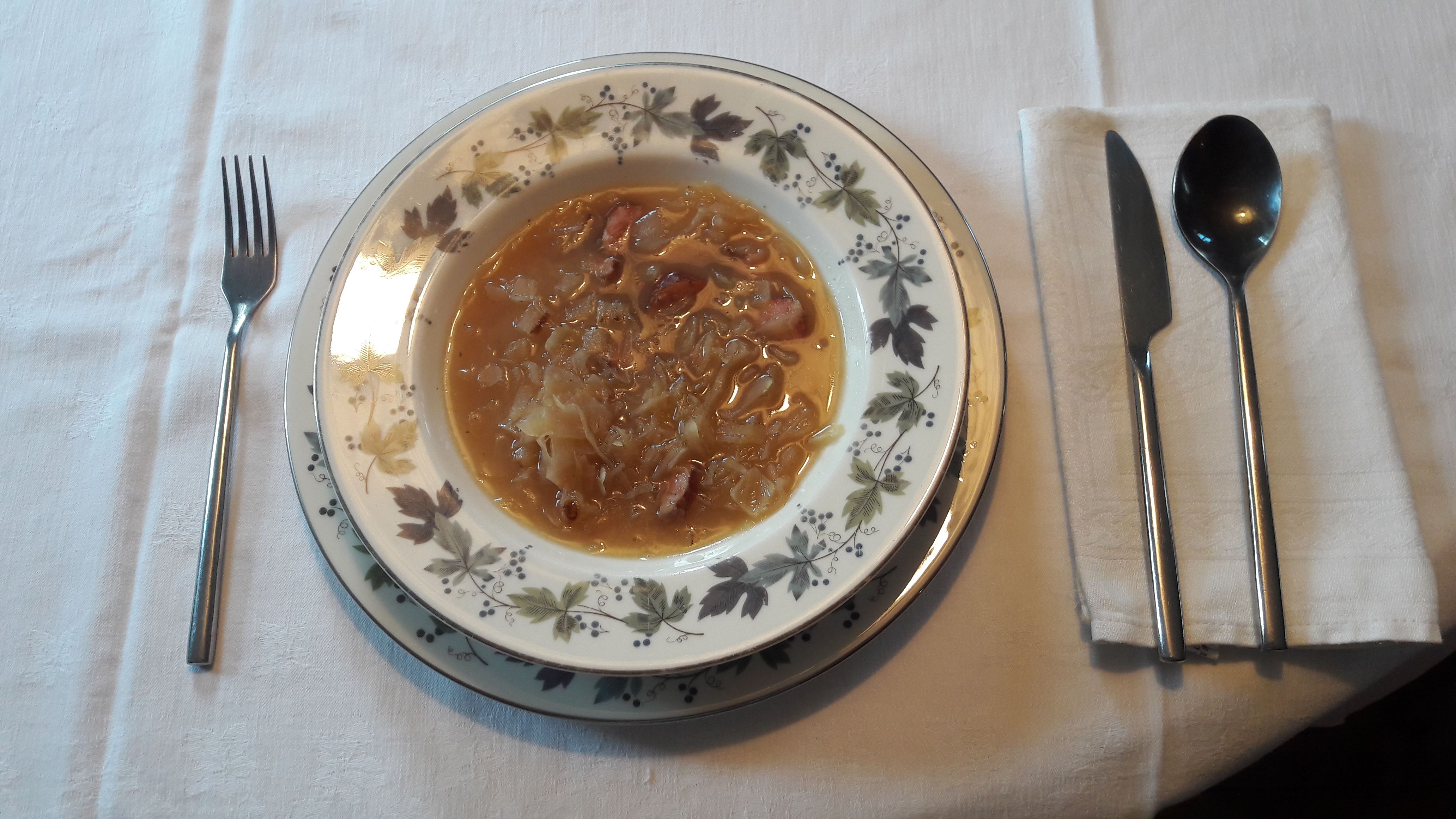
Tomato Soup

There are many versions of tomato soup – some people just add tomato puree or a tin of tomatoes to rosół, (chicken bullion). For many this was standard practice on Monday with any that was left over from Sunday lunch and also in winter months in the past when fresh tomatoes were not so readily available.

I prefer to make a more refreshing fresh tomato soup.

Ripe tomatoes make the best soup – if you are lucky enough to have your own from the garden or allotment then these will be great or look out for ripe tomatoes on a market rather than the hard bullet ones often sold for salads.

Little note from the Metro newspaper

My mother always served boiled rice as the soup accompaniment.

Many years ago, well before Poland joined the European Union, when there were not as many Poles living in England, one of my English friends went for dinner at at a Polish lady’s house.  On telling me about the lovely food she said ” …. we had tomato soup with rice in it!” My instant reply without thinking was “but tomato soup always has rice in it”.   

Ingredients

  • 700g – 800g of ripe fresh tomatoes
  • 1 large or 2 medium onions
  • 1.5 litres of vegetable stock – came be from a cube or powder
  • Salt & ground pepper to taste
  • A little granulated sugar – optional – might not be needed.
  • Boiled rice to serve

Method


  • Pour boiling water over the tomatoes in a bowl and leave to cool.
  • Skin the tomatoes.
  • Chop the tomatoes into quarter.
  • Chop the onion into fine pieces.
  • Place the tomatoes, onion and vegetable stock into a large saucepan.
  • Bring to the boil and then put on the lid and simmer for at least 30 minutes.
  • You want the tomatoes and onions to have cooked away into the liquid -no large pieces left.
  • Season to taste.

Although sour soups are popular in Poland – tomato soup does not want to be sour.  Depending on the tomatoes used, I sometimes add a little granulated sugar.

  • To serve place a handful of cooked boiled rice into each soup plate.

Served here in my mother’s Crown Devon – Fieldings – Glenwood soup plates – made in England – 1939.

Dutch Cold Dish & Other Salads

I recently returned from a trip to The Netherlands to visit my friend again.

I always have a great time visiting different parts of the country and enjoying the wonderful hospitality.

One dish I have had many times is Koudeschotel – this translates as Cold Dish.

I think it is a sort of  “posh cousin” to  several Polish cooked salads such as Potato Salad and Mixed Vegetable Salad.

It is often made in large quantities as the centrepiece in a buffet meal.

There is a central mound made with boiled potatoes mashed with mayonnaise, onions, peas, carrots and cooked meat like chicken, pork or beef.

This is then decorated with items such as hard boiled eggs, gherkins, silver-skin onions, prawns or shrimps, asparagus, tomatoes, cooked or smoked meats and dusted with a little sweet paprika.


The koudeschotel on my arrival from England this year.

If the central mound is made without meat it is sometimes called Huzarensalade – Huzar’s Salad.

Ingredients – for the central mound

The original recipe  was for a large amount suitable for a big party – I have scaled it down.

  • 1 Kg of cold boiled potatoes
  • Around 200ml of mayonnaise – real full fat is best
  • 100g of cooked peas
  • 1 large onion chopped fine
  • 2 boiled carrots – diced
  • 200g of cooked chicken, pork or beef – shredded (meat used to make soup or stock is good)
  • Salt & pepper to taste

Notes

Many supermarkets and delicatessens in The Netherlands sell this mixture ready made.

Method

  • Mash the potatoes with the mayonnaise.
  • Add the peas, carrots, onion and meat and mix well.
  • Season to taste.
  • Arrange the mixture in the centre of a serving plate.

Decorate with a selection of the following:

  • Hard boiled eggs – sliced or quartered
  • Gherkins – small or large ones sliced
  • Silver-skin onions
  • Cooked prawns or shrimps,
  • Cooked asparagus spears or slices
  • Tomatoes – quartered
  • Cooked or smoked meats – chopped or in little slices
  • Dusted with a little sweet paprika.

Now is the time to be a little creative with the decoration – I tend to do rows of the different ingredients and dust with sweet paprika at the end.

(For smaller gatherings sometimes the mixture is placed in a bowl and the eggs and gherkins etc are just placed on top)

Other Salads

One day we went to a neighbour’s house for a BBQ and koudeschotel was one of the dishes served with the grilled meats.

We were also served the following two lovely salads –

Cabbage & Pineapple Salad

Ingredients

  • Small white cabbage
  • 8 rings of fresh or tinned in juice pineapple
  • 50 – 80g of raisins

Method

  • Soak the raisins in pineapple juice for at least 30 minutes
  • Shred and chop the cabbage
  • Chop the pineapple rings into small pieces
  • Mix the cabbage, pineapple and the raisins in juice together

Salad with Smoked Salmon & Capers

Ingredients

  • Crunchy lettuce such as Cos or  Little Gem – I used a Red Little Gem
  • 100g Smoked Salmon
  • 2 or 3 sticks of celery – finely sliced
  • 1 tablespoon of capers
  • 100g of cooked small sized pasta
  • Juice of half a lemon
  • Ground black pepper

Method

  • Hand tear the lettuce into medium sized pieces.
  • Chop the smoked salmon into small pieces.
  • Mix the smoked salmon, capers and pasta together and
  • Mix this with the lettuce.
  • Pour the lemon juice over this and mix.
  • Season with black pepper.
  • Extra salt should not be needed because of the capers & smoked salmon.


You could serve this as a starter using a few lettuce leaves as a bed on each plate with the smoked salmon mixture in the centre.

Barszcz – Beetroot Soup

 Barszcz  is the classic Polish beetroot soup.

Now this may just my imagination but beetroots in Poland just taste so much better and sweeter than the ones I have had in England, maybe it is the variety that is grown there or the soil.   I think you have to use home-grown or organic beetroot to get as good a taste.

I like the clear, meat-free, Lenten barszcz made for Wigilia – Christmas Eve and have tried over the years many recipes using fresh beetroots, which I have boiled or roasted and also used ready cooked vacuum packed beetroot and adjusted the taste with lemon juice or a little sugar.


I have never been truly happy with the results which did not seem to have the sweetness and flavour or the soups I have had made for me.

Nowadays the way I make  barszcz is my biggest cheat!

Many years ago I started to make my barszcz with beetroot concentrate as the base, with the addition of  vegetable stock and some grated beetroot to make it look authentic and this proved very popular.


A few years ago I was recommended to try barszcz from a carton – and would you believe it – everyone said this was the best barszcz they had ever had!

I have used this ever since.

Served in Carnation by Royal Doulton 1982 – 1998

Uszka (mushroom filled Polish pasta) are often served in barszcz or a dollop of soured cream is added on serving.


Orange Cake

This cake using sunflower oil and  yoghurt has a really good texture and reminds me of English Madeira cake, which was invented in the mid 19th Century taking its name from the Portuguese Madeira wine with which this cake was often served.

It started out in my hunt to make a cake using lemon balm – (melisa in Polish) which grows abundantly in my garden. Sadly none of the cakes I made captured its taste at all!

However I  adapted this recipe to make an orange cake and the result is delicious.

Short History of Oranges

Oranges originated in Ancient China and sweet oranges are recorded in Chinese literature in very early times.

They are thought to have been brought by Italian and Portuguese traders to the Mediterranean area in the 15th century.

The name is of  Middle Eastern origin:

  • Arabic – nāranj
  • Persian – narang
  • French – l’orange
  • Italian – arancia
  • Portuguese –  laranja
  • Spanish – naranja
  • Polish – pomarańcz
  • Whilst in Dutch it is – sinaasappel – meaning  Chinese apple.

Oranges in Poland were very expensive before World War 2 and my mother would tell me that at St Nicholas and Christmas time an orange or a tangerine would be a common gift.

Christopher Columbus took oranges to the Caribbean on his second voyage in 1493.

Later,  Spanish settlers introduced orange plants to North America,  first to Florida and then to California.

Figures from 2017 show Brazil as being the largest orange producer in the world with the United States of America coming second and  Florida produces 70% of that country’s oranges.

Ingredients

  • 85- 90ml of Greek yoghurt (full fat is best)
  • 2 large oranges – finely grated rind & juice (not all will be needed)
  • 125ml of orange juice
  • 180g of caster sugar
  • 320g of plain flour
  • 2 teaspoons of baking powder
  • 1/4 teaspoon of salt
  • 170ml of sunflower oil
  • 2 eggs
  • 1 tablespoon of lemon juice

Method

  • Pre-heat the oven to GM 5 – 190°C.
  • Finely grate the rind of the oranges.
  • Squeeze the juice from the oranges (you will not need all of it).
  • Mix the yoghurt with 125ml of the  orange juice.
  • Prepare a 23cm loose bottom or spring  form tin with a cake liner.
  • In a bowl mix the flour, baking powder and salt.
  • In a large bowl whisk together the sugar, oil and orange rind.
  • Add the eggs and whisk again.
  • Lightly mix in the flour.
  • Mix in the lemon juice.
  • Mix in the yoghurt and orange juice mixture to give a thick batter.
  • Pour into the cake tin.
  • Bake for 30 – 35 minutes (check after 25 minutes and cover the top lightly if necessary).

Served on Duchess – Bramble Rose – tea-plates from the 1960s.


Szczawowa – Sorrel Soup

One of my earliest food memories is walking from our street in a little town in Lancashire to the fields beyond and picking fresh sorrel with my mum to make this soup.

At that time my English was limited and my mum was much amused when one of our English neighbours came to inquire about the “grass” that I had told her we had picked that morning to make into soup.

One of my sisters, much younger than me, came to visit a few weeks ago and out of the blue she suddenly asked if  I remembered picking sorrel.  She did not know I had just been writing about it.

Yesterday I had lunch with a new Polish friend who was born in Lincolnshire and whilst talking about food our mothers cooked, she too remembered  going down to the fields with her mother and her friends to pick basket-fulls of sorrel, much to the bewilderment of their English neighbours.

Rumex acetosa is sorrel – szczaw in Polish.

The word sorrel comes from the Old French  – sorele –  meaning – sour.

Sorrel belongs to the Polygonaceae family and it is related to the dock – Rumex obtusifolius and to buckwheat.

It has a pointed broad leaf which has a sharp taste due to oxalic acid in the leaves.

At the moment I am growing this in pots in the garden, when I do a sort out in the garden I am going to move some to a patch in the ground.

I tried growing Rumex sanguineus – red veined sorrel once but I found it tasteless.

Szczawowa is such a typical Polish soup made from fresh picked ingredients and has the sourness so loved by the Poles.  It is usually served with lots of chopped hard boiled eggs on top.

Note

Because of the oxalic acid in the sorrel do not use cast iron or aluminium pans.

Ingredients

  • 4-5 chicken wings
  • Lots of chopped sorrel leaves – around 500ml if possible.
  • 1 onion – finely chopped
  • 1 coarse grated carrot
  • 1 tablespoon of vegetable stock powder or vegetable stock cube
  • 3-4 peppercorns
  • 125ml of soured cream
  • Salt to taste
  • Chopped hard boiled eggs to serve – at least one per person

Method

  • Place 4-5 chicken wings in a pan of water and bring to boil and simmer for about half hour.
  • And the chopped onion, grated carrot  and peppercorns and bring them to a boil and simmer for another half hour.
  • Add the vegetable powder or cube.
  • Add chopped sorrel leaves – lots, bring to a boil and then simmer for about 10 minutes.
  • Remove the chicken wings (they are not served with the soup).
  • Add salt and more ground pepper if liked – it should be sour! (lemony but more so).
  • You can do this and then leave for it later – just bring to boil and then simmer when ready to use.
  • Add the soured cream and stir this in.
  • Have prepared some hard boiled eggs  – chopped finely.
  • Pour soup into soup plates and sprinkle the chopped eggs over the top to serve.

Served in Royal Doulton – Carnation 1982  – 1998.

Scufflers

A few weeks ago I had lunch in Holmfirth (Last of the summer wine country) in a little café called Scufflers.

I wondered what the name meant – was it to do with fighting or a garden implement?

I have now discovered it is a Yorkshire word  from the area around Castleford – and it is a used for a triangular shaped teacake or bread bun. In Poland these would be called bułeczki

I found a recipe and made some.

The enriched dough was super to work with – my shapes were a bit “random” – it would be easier to make round buns. They were delicious and I will certainty be adding this to my list of favourite doughs.

Ingredients

  • 450g strong flour
  • 30g butter
  • 1 teaspoon of granulated sugar
  • 1/2 teaspoon salt
  • 1 teaspoon of dried yeast
  • 1 egg
  • 250ml water

Method

  • Rub the butter into the flour until the mixture is like breadcrumbs.
  • Stir in the sugar, salt and dried yeast.
  • Mix together the egg and water.
  • Make a well in the centre of the flour mixture.
  • Add the egg mixture.
  • Using a knife at first and then your hands bring this together to make a dough.
  • Knead the dough for 10 minutes. (There is only one kneading so try and do the full time here).
  • Put the dough into a bowl and cover with a tea cloth and leave till it has doubled in size.
  • Dust a tray with flour.
  • Preheat the oven to GM7 – 220°C.


  • Press the dough into a rough rectangular shape  – cut this into two squares and then divide these diagonally so you have eight triangles.
  • Place the triangles onto the floured baking tray.
  • Lightly dust with flour.
  • Bake for around 15 minutes – until golden brown.


Paragon – hand painted tea-plates – I could not resist the lovely shape and bought them recently.

Amusing Thought

In the café, some of the choices for  lunch were sandwiches on baguettes, ciabatta  or  pannini   – but despite its name –there was not a scuffler in sight!

Rhubarb & Date Cake

As I have rhubarb growing in the garden I am always on the lookout for recipes  for  rhubarb cakes and have tried many from English, American & Polish recipe books and magazines.

Some recipes just used 1 or 2 stalks of rhubarb – as I have lots of rhubarb – I wanted a recipe that used more.

I was talking with my old school friend who lives in Leeds and she told me her husband makes a lovely rhubarb cake with the rhubarb they have growing on their allotment.

So, I tried it out and it was indeed lovely!

Ingredients

  • 340g plain flour
  • 1 teaspoon baking powder
  • 170g  butter
  • 230g caster sugar
  • 450g rhubarb, chopped into small cubes
  • 230g stoned dates, chopped into small pieces
  • 2 eggs
  • 120ml milk (either whole or semi skimmed)

Method

  • Preheat the oven to GM 5 – 190°C
  • Line the base of a 26cm round spring-form or loose bottomed tin with baking paper. (You can use a 23cm tin)
  • Place the chopped rhubarb and dates into a bowl.
  • Place the flour and baking powder into another bowl.
  • Cut the butter into cubes and rub it into the flour using your fingertips until you have a mixture that resembles breadcrumbs.
  • Stir in the sugar.
  • Stir the chopped rhubarb and dates into the mixture.
  • Combine the eggs and milk in a jug and beat a little.
  • Stir into the cake mix until well combined.
  • Spoon the batter into the prepared cake tin and level the surface.
  • Bake for approximately 1 – 1 & 1/4  hours or until a skewer inserted into the cake comes out clean – best check on it after an hour and cover top if necessary to prevent burning.
  • Leave to cool on a wire rack until the tin is cool enough to safely handle.
  • Remove the cake from the tin and leave to cool completely on the wire rack

Although the cake keeps well, I think it is best eaten when fresh as then the rhubarb taste is strong and the cake delicious.

Crown china tea plates – no pattern named.

Note

The rhubarb season is now over in my garden as it has just past July – next year I am going to try some variations on this cake eg – without the dates or with raisins etc.

Tomato & Gherkin Soup

Several years ago after a large family gathering I had some gherkin and tomato salad left and decided to use this to make a soup.

It was really delicious and I now often make this soup either from left over salad or create it from scratch.

It is one of those refreshing summer style soups with a touch of sourness as loved by the Poles.

Ingredients

  • 8 tomatoes
  • 4 gherkins
  • 1 onion
  • 1 litre of vegetable stock – I use Marigold powder
  • 60ml  of gherkin liquid.
  • Chopped chives
  • Chopped parsley
  • Ground black pepper to taste.

Method

  • Slice the tomatoes and cut the slices in two.
  • Chop the onion fine.
  • Slice the gherkins and cut the slices into two.
  • Put all the ingredients(apart from the ground pepper) into a saucepan, bring to the boil and then let this simmer for around 30 – 40 minutes.
  • Adjust seasoning if needed.


Served in Royal Doulton, Burgundy soup plates, 1959 – 1981.

Pork with Rhubarb

Having made pork with sour plums, I thought, why not do something similar with the rhubarb that is growing in the garden?

I was cooking the rhubarb for a cake as well and chopped up the rhubarb and placed it in a large roasting dish with some sugar – not too much –  it does not want to be too sweet – keep it tart.

I placed this into a low oven GM2 -150°C for around 45 – 60 minutes – you want it soft but not totally disintegrated.


After roasting a loin of pork, I placed some of the rhubarb and juices into a saucepan and heated it through – adjusting the sugar if necessary.

You could just grill or pan fry pork chops rather than do a roast.

Serve the rhubarb hot with the pork.


Served here with new potatoes and carrots on Royal Doulton – Carnation – 1981 -1998.

Pork with Sour Plums

My holiday in Poland earlier this year has inspired many new recipes and posts.

This one was from a meal of slow cooked belly pork with caramelised sour plums and roast potatoes, which I had at the Gvara Restaurant.


I tried doing caramelised plums but did not have any success, as it was the sourness I liked, I did the plums a different way.

This works well with plums that are not quite ripe, I used small ones from the supermarket, the sort they say will ripen at home (I find they never do!).

Sour Plums

  • 4-5 per person depending on size.
  • Simmer whole with some water and a little sugar in a shallow wide pan with a lid till soft.
  • Keep taking off the lid and stirring and adjusting the heat etc.
  • You do not want a lot of liquid .
  • Aiming for cooked but still sour – add a little sugar at end if needed.


Roast Pork with Sour Plums

I roasted a joint of pork loin – I think that is much nicer than leg of pork.  You could just grill pork chops for this.

Serve the pork with the plums.

Served on Royal Doulton Tapestry 1966 – 1988.


Slightly Chinese Style Slow Cooked Belly Pork


Ingredients

  • Large piece of belly pork
  • 1 can of Jamaican fiery ginger beer – regular with sugar (NOT sweetener)
  • Sliced piece of peeled root ginger – around 8cm long (finger length)
  • 3- 4 crushed garlic cloves
  • Several long chilies, fresh or dried.
  • 3-4 grains allspice or cloves.
  • 3-4 bay leaves
  • 8 black peppercorns

Method

  • Place everything in a slow cooker and cook for at least 4 hours (often more)– till flesh is soft.
  • Remove from juices and cut into thick slices to serve. 


Served on Royal Doulton Tapestry 1966 – 1988.