I wrote about kopytka – Polish potato dumplings a good while back.
Since then I have tried another version which uses cheese as well as potatoes.
Traditional recipes use twaróg – Polish curd cheese – I have found that crumbly, white, mild, English cheeses such as: Cheshire, Lancashire or Wensleydale are also good.
Whilst looking at many recipes, I saw that the proportions of boiled potatoes to cheese varied greatly.
I have gone for roughly equal weights of boiled starchy potatoes to cheese.
The exact amounts are not critical but you must use starchy potatoes such as King Edward or Maris Piper.
Serve with either melted butter, à la Polonaise(buttered breadcrumbs) or skwarki (crisp, fried, small squares of bacon) or a hot sauce such as mushroom.
Ingredients
300g of boiled starchy potatoes
300g of twaróg (curd cheese) or white, crumbly cheese such as Lancashire
2 egg yolks
160 – 200g of plain flour
Salt
Oil to add to water for boiling
Method
Use a large bowl and put the cold boiled potatoes into the bowl.
Crumble the cheese and add it to the potatoes and mash them both together.
Add the yolks to the mixture.
Add a little salt.
Weigh out the flour to give an idea of how much is needed; this will depend on the type of potato and the size of the eggs. Add the flour and mix first with a wooden spoon and then by hand, you might not need all the flour or you may need more. Mix until you have a soft dough.
Divide the dough into quarters and using a floured board shape the dough and roll it with you hands until you have a long sausage about 3cm in diameter. If the dough sticks to the board then you need to add more flour.
Use a sharp knife to cut the dough into pieces, make the first cut at a diagonal and make the thickness about 1 to 1.5cm. You will get a sort of oval shape.
Repeat this with the rest of the dough.
Fill a large pan with water, add some salt and bring this to the boil.
When the water is boiling, add the dumplings one by one, do not over fill the pan or they will stick together. I tend to do this in 4 batches.
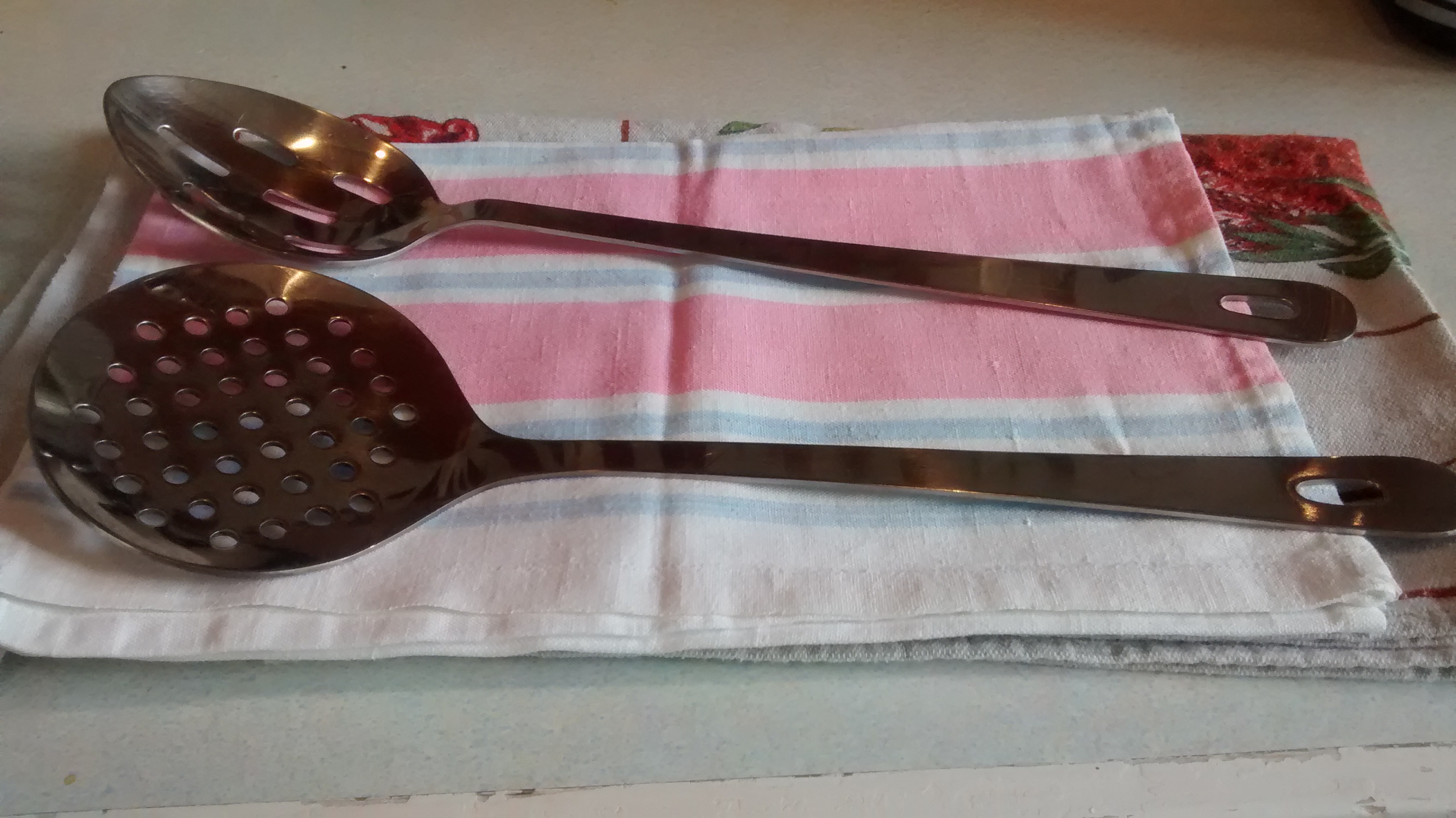
As they cook they will float to the surface, give them about another minute and then remove them with a slotted or a perforated spoon and put them in a colander. I have a colander sitting in an empty pan by the side of the large pan in which I am boiling the dumplings.
I find that the maximum from putting them into the water to taking them out will be 3 minutes, if you cook these too long they will start to fall apart.
Served on –
Royal Douton – Carnation – 1982 – 1998
J & G Meakin – Topic – around 1967
Wedgwood – Chelsea garden – early 21st century.
Here served as suggested above with melted butter, with skwarki (crisp, fried, small squares of bacon) and a gulasz.
When I think of Polish cooking three popular herbs which always spring to mind are caraway, dill and parsley.
They all belong to the Apiaceae family which includes carrot and celery.
This family is also calledUmbelliferae (from the Latin – umbella – for parasol or sunshade) – the flower heads consists of umbels which have equal length flower stalks coming from a central point which forms a flattened head – rather like an umberella.
Carum carvi is caraway – kminek – in Polish.
It is native to Europe, North Africa & Western Asia.
Caraway – Drawing taken from Wikapedia
Caraway fruits are often called seeds.
Caraway is thought to be an aid to digestion.
In 2011 Finland supplied over 25% of the world’s caraway.
Daucus carota – the carrot – was cultivated from wild carrots in the countries we now know as Afghanistan & Iran and are mentioned there in the 10th century and by the 12th century they were mentioned in Europe.
These tap roots were originally white, yellow or purple in colour.
The orange colour that we recognise today was breed by growers in Europe in the 17th century especially in the Netherlands. It is thought that this was in honour of Prince William of Orange-Nassau (Willem van Oranje) who had an orange stripe on his flag. Nowadays orange is thought of as the national colour for the Netherlands.
These pancakes made with carrots in Polish are called racuszki z marchwi.
They are small round pancakes like American pancakes or dropped scones and are served with sugar or sweetened soured cream.
Ingredients
450g carrots, peeled and finely grated
140g twaróg/cream cheese or yoghurt cheese
2 eggs separated
3 tablespoons of plain flour
1/2 teaspoon of baking powder
Sunflower oil for frying
To Serve
Caster sugar or soured cream sweetened with icing sugar.
Method
Whisk the whites until they are stiff.
In a small dish mix the baking powder with the flour.
In a large bowl mix together well the finely grated carrots, the cream (or yoghurt) cheese and the egg yolks.
Add the flour mixture.
Fold in the stiff egg whites.
Heat some sunflower oil in a cast iron frying pan or griddle.
Use 2 tablespoonfuls of the mixture for each pancake, cook on one side and then turn them over and cook on the other side.
Sprinkle with caster sugar or with a dollop of sweetened soured cream.
Served here on Wedgwood – Hathaway Rose – 1959 -1987.
Note
I have also tried them with maple syrup poured on them & these too were delicious.
I had a request from the 93 year old mother of one of my friends to make her a cake that included beetroot in the ingredients – maybe a red velvet cake.
Now I had never seen one of these cakes and certainly never made one and I did have doubts about it.
I did some research and found lots of recipes for red velvet cakes but nearly all of them used just red food colouring.
I then found a recipe for a cake using beetroot and tested it out and surprisingly it came out very, very well. The recipe uses sunflower oil and is an easy to make batter cake.
This is not a traditional Polish recipe at all but it does contain a favourite Polish vegetable – namely – beetroot.
Ingredients
250g cooked beetroots (I used ready cooked vacuum packed beetroots – 1 pack is more than enough)
1/2 teaspoon of vanilla extract
300g caster sugar
250ml sunflower oil
3 eggs
225g plain flour
1 teaspoon of bicarbonate of soda
1/4 teaspoon salt
6 tablespoons cocoa powder
Method
Grease and line a 21 x 31 cm baking tin.
Preheat the oven to Gas mark 4 – 180ºC
Drain the beetroots from the water and place in a sieve for a while to ensure they are dry – you can dry them with some kitchen roll as well.
Purée the beetroots – using a food chopper or blender
In a large bowl combine the puréed beetroots, eggs, vanilla essence, oil and sugar.
In a separate bowl mix together the flour, bicarbonate of soda, salt and cocoa.
Add the dry ingredients to the other bowl and beat well together.
Pour the batter mixture into the prepared tin.
Bake for 45 to 50 minutes.
Test if done with a cake tester or wooden skewer.
Leave to cool in the tin.
The cake is delicious and moist – it has a slightly red tinge to the very dark nearly black colour.
Here I have just served it plain.
Served on Royal Doulton, Counterpoint, 1973 – 1987.
You can dust the top with icing sugar if desired.
The cake is delicious on its own but many versions have a topping of some description.
I made one using butter, cream cheese ( or yoghurt cheese), icing sugar and lemon.
Ingredients for Topping
50g butter
100g of full fat cream cheese, twaróg or yoghurt cheese
Finely grated rind of 1 lemon
1 teaspoon of lemon juice
250 – 300g icing sugar
Method
The butter needs to be at room temperature.
Cream the butter, lemon rind, lemon juice and the cream cheese and 2 tablespoons of the icing sugar until the mixture is smooth and well combined.
Slowly add the icing sugar and mix well in until it is smooth and firm enough to use as a topping.
You can make the topping ahead of time and keep it in a container in the fridge – topping the cake later when needed.
Take care not to get too many brown cake crumbs in the icing when spreading it on the cake.
Served on Colclough, Enchantment, tea plates from the 1960s
Pierogi arelittle semicircular parcels of pasta which are made with a multitude of fillings.
Even though I make these myself, it is the dish I always crave when I go to Poland.
There are several theories as to how pasta style dishes came into Poland.
The general word for pasta especially noodles is makaron , which certainly has its roots in Italian; and as Italian cooking has influenced Polish cooking from the 16th century I used to think that was where the dishes originated. I find it amusing that ravioli in Polish are called pierogi włoskie (Italian pierogi).
After doing some research it seems however that pierogi were around in Poland in the middle ages, they are mentioned in the 13th century and the name comes from an old Slav word for feast or festivity.
Many people believe that they came to Poland from the Far East through Siberia and Russia.
When I was in China in the 1990s, imagine my surprise when I was on several occasions offered dishes which were called Jiaoxi (dumplings) and they were exactly the same shape and size as pierogi and cooked in the same way!
Whatever the origins, the Poles have made pierogi their own; there are lots of traditional fillings, both savoury and sweet, and several ways of serving them.
In a pierogi cookery book I bought in Poland there are around 40 traditional ones and more than 20 new style ones. In a pierogi restaurant I went to in Kraków there were around 30 options on the menu.
Home-made pierogi
Pierogi
Pierogi are made from a thinly rolled out dough using a circular cutter, about 7 cm in diameter, we used to use a medium sized wine glass. A largish teaspoon of the filling is placed on the circle and this is then folded in half and the edges pinched together to seal them – this is done to give them a slightly crimped edge.
You learn from experience how much filling to put into the pierogi as too much will make it hard to seal them and if not properly sealed they will burst on boiling. Do not worry if you have a few mishaps – it still happens to me even with experience – it is hard to salvage one that has gone wrong – just accept that there will be a few that you do not cook.
Pierogi Dough
Pierogi dough is made from flour, egg and water and I have seen many variations of the recipe. The following is my mother’s and I think it is the best I have ever used and tasted.
She never used whole eggs, just the yolks and this gives a dough which is soft and not tough and can be easily rolled out. The recipes which use whole eggs give a tougher dough which is much harder to roll out.
My mother originally used plain flour and added a tablespoon or two of fine semolina but now that strong flour or even pasta flour is readily available this is what I use the most.
Another point is that flour does vary and it is possible to add more flour to the dough as you are mixing it but you cannot add more liquid if it is too dry!
As you mix the ingredients in the first few minutes you should be able to tell if it will be too dry and you can add some more water initially but once it is all mixed together you cannot – if it goes wrong – just start again.
The quantities that I have given work well and but you should allow for extra flour if needed.
Ingredients
500g pasta flour or strong flour or plain flour & 2 tablespoons of fine semolina
300 ml water
1 tablespoon oil – sunflower or light olive
½ teaspoon salt
2 egg yolks
Method
In a jug or bowl mix together the water, oil and yolks.
Put the flour and salt into a large bowl and make a well in the centre.
Pour the liquid mixture into the well and then with your hands incorporate the flour into the liquid until you have a large ball of dough.
Turn this out into a floured board and knead the dough for a few minutes until it is a smooth ball.
You can then use the dough straight away, cutting it into 4 quarters and rolling out a quarter at a time on a floured surface until the dough is thin. You can pull it out a bit at the beginning to give a more rectangular shape of even thickness.
You can cover the dough with a cloth and place it in the fridge till needed.
You can freeze the dough for a few days for later use, it is best to cut it into quarters and wrap these in cling film or plastic and place these in another bag or container.
Shaping The Pierogi
Rolled out the dough until it is thin and use a circular cutter, about 7cm in diameter, to make lots of circles. You can re-roll the cuttings to make more circles until all the dough is used.
A largish teaspoon of the filling is placed on to the dough circle and this is then folded in half and the edges pinched using your thumb and first finger to seal them – giving them a slightly crimped edge.
This quality of dough will make about 70 to 80 pierogi – depends on how thinly you roll the dough and the size of your cutter.
You can open freeze pierogi so sometimes I make a batch and open freeze half of them – then store them in a plastic box. They should be cooked from frozen just allowing a little extra time.
Pierogi Fillings
The quantities that I have given should be enough for the 500g batch of dough. Many of the fillings once made can be frozen; I sometimes make the mixture and freeze it in 2 to 3 small batches for later use.
A good tip is not to make the filling too moist, as any liquid on the dough will prevent you getting a good seal.
Have a large surface such as a tray covered with a cotton or linen cloth which has been lightly floured ready and place the sealed pierogi on this until they are all made, do not let then touch each other.
Cooking The Pierogi
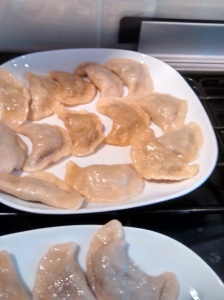
To cook the pierogi, use a large pan of boiling water to which you have added some salt and a drizzle of oil. Drop the pierogi in one by one and allow them to boil. I usually do about 6 to 8 at a time (I only do 6 at a time if using frozen ones). As they cook they will float to the surface, let them boil for 2 to 3 minutes, a bit more if they were frozen, and then remove them with a slotted or perforated spoon and put into a colander above a pan for a few seconds to drain and serve. Continue boiling batches in the same water.
Serving Suggestion
Traditionally savoury pierogi are served with melted butter, skwarki – crispy smoked bacon bits, small pieces of fried onion or melted butter and dried breadcrumbs (à la Polonaise).
If you want to make all the pierogi to serve together then you need to get a large shallow dish and put the melted butter or skwarki or fried onions into the dish and keep the dish warm in a low oven. As you take out the cooked pierogi add them to the dish, mix them with the butter, skwarki or onions to prevent them sticking. Keep on adding more as they cook and keep shaking the dish to coat and mix them.
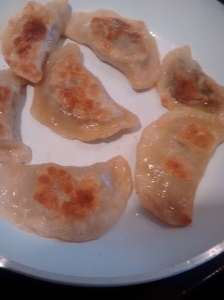
Once your have had your meal and you have any left (I leave some deliberately) then they are wonderful fried up later. You need a hot frying pan and should be able to just use the butter etc that they are coated in, maybe adding a little extra oil if needed. Fry them till the dough is golden and crispy.
Tip – spread out the cooked and coated pierogi for later frying to prevent them sticking
Savoury Fillings
Below are some of my favourite fillings.
All the filling must be allowed to cooled before using them – you can make these in advance – even the day before.
Sauerkraut & Mushroom
These is often served at Wigilia – the Christmas Eve meal
Ingredients
Approx 500g of sauerkraut (I used to get small jars but have not seen these lately – use part of a large jar – use the rest for something else)
20- 30g dried mushrooms.
1 onion
1 bay leaf
Ground black pepper to taste
Method
Put the mushrooms in a small bowl and cover them with boiling water and leave them overnight.
Strain the mushrooms but keep the liquid and then chop the mushrooms into small pieces.
Strain the sauerkraut but keep the liquid and chop the sauerkraut into small pieces.
Put the sauerkraut with the liquid from the tin or jar into a pan and cover with boiling water. Add some of liquid from the soaked mushrooms and the bay leaf.
Cover the pan and boil the sauerkraut gently for about 30 minutes. Then uncover and boil off as much of the liquid as possible – without burning the sauerkraut.
Allow the boiled sauerkraut to cool and remove the bay leaf. Strain it using a sieve and pressing it down with a spoon to get the mixture as dry as possible (If you want you can put the strained mixture into a clean dry cotton or linen teacloth, twist the ends together to squeeze it to get it really dry).
Whilst the sauerkraut is cooking heat the chopped mushrooms gently in a small pan with the rest of the liquor, stirring to prevent it burning but reducing as much of the possible.
Chop the onion finely and fry it till it is soft and golden and add this to the mushroom mixture and mix it well together.
Mix the sauerkraut, mushrooms and onions together and add some ground black pepper to taste; salt should not be necessary.
Note
If your sauerkraut is very sour, you can add a little sugar to the mixture or you can put it into a sieve or colander and wash it for a few minutes in cold water before you start cooking it – you might want to add a little salt at the end if you use this method – taste and see)
Peel and boil the potatoes in salted water, strain and mash, then leave to cool.
Chop the onion finely and fry it till it is soft and golden, allow it to cool.
Mix together thoroughly, the potatoes, onions, cheese and egg yolk.
Add salt and pepper to taste.
Cheese 2
When my mother did not have any curd cheese, she used Lancashire cheese, as that was the cheese most readily available to her. Both versions taste good, the secret with this one is to grate the cheese as finely as possible and mix it in well.
Ingredients
400g floury potatoes
1 onion
200g white crumbly cheese such as Lancashire
1 egg yolk
butter & oil to fry the onion
salt & ground black pepper to taste
Method
Peel and boil the potatoes in salted water, strain and mash, then leave to cool.
Chop the onion finely and fry it till it is soft and golden, allow it to cool.
Grate the cheese as finely as possible.
Mix together thoroughly, the potatoes, onions, cheese and egg yolk.
Add salt and pepper to taste.
Note
My mother would boil extra potatoes on one day and save some to make these fillings the next.
In Poland you may see these savoury cheese ones on a menu as Pierogi ruskie – that is Ruthanian pierogi – from the old word for the Ukraine
Pork
Ingredients
300g shoulder or spare rib pork
1 onion
1 egg yolk
1 tablespoon of dried breadcrumbs
approx 250 ml of chicken stock – can be from stock cubes
butter & oil to fry the onion
salt & ground black pepper to taste
Method
Pre heat the oven to GM 3 – 1600C
Put the pork into a small casserole dish and cover it with the stock and put on the lid.
Put the dish in the oven for at least 1 hour, depending on the meat you might need longer.
I cook the meat until it is tender and can be broken up with a fork and most of the liquid has been absorbed. Allow the meat to cool. You can mince the meat but I find that if you cook it long enough you do not need to, you can just chop it with a sharp knife .
Chop the onion finely and fry it till it is soft and golden, allow it to cool.
Mix thoroughly together: the meat, onion, yolk and breadcrumbs and then add salt and pepper to taste.
Chicken
You can cook a piece of breast chicken as for the pork filling, however neither my mother or myself ever did this; we used leftover roast chicken from a roast dinner.
Ingredients
300g of roast chicken
1 onion
1 egg yolk
1 slice of white bread
small amount of milk
butter & oil to fry the onion
salt & ground black pepper to taste
Method
Take the slice of bread and remove the crusts removed and leave this for half an hour in a bowl with a little milk – do not use the excess milk just the wet slightly squeezed bread.
Finely chop or mince the chicken.
Mix together the chicken, onion, egg yolk and bread to get a uniform mixture.
Sweet Fillings
The dough and method of making sweet pierogi is just the same as for the savoury ones.
Once boiled sweet pierogi are dredged with icing or caster sugar and are often served with soured cream. They are best eaten straight away.
I must admit that when I was younger I did not really like sweet pierogi but now I think they are utterly delicious especially when with soured cream.
Sweet Cheese 1
Ingredients
200g curd cheese/twaróg or yoghurt cheese
40g caster sugar
1 egg yolk
2 drops of vanilla essence
tiny pinch of salt
Method
Thoroughly mix all the ingredients together.
Sweet Cheese 2
Ingredients
250g curd cheese/twaróg or yoghurt cheese
40g caster sugar
2-3 tablespoons of soured cream
tiny pinch of salt
Method
Thoroughly mix all the ingredients together.
Red Fruits
In the summer in Poland, when all the fruits of the forests and the garden are ripe, that is when these pierogi are at their best. However bottled fruit is available all year round and I often make my sweet pierogi with these.
The following fruits are traditionally used –
Morello Cherries
Blackberries
Whinberries (bilberries) these grew in Lancashire near my home and also could be bought in baskets imported from Poland. (I think the larger American Blueberry is nowhere near as tasty.) When we went to pick these I know this always made my mother think of her childhood in Poland.
I tend to use half the amount of dough when making these fruit ones as they do not freeze well with fruit.
Depending on the size of the fruit, you need about 3 or 4 per circle.
Do not add sugar to fresh fruit as this will make too much liquid and the pierogi will not seal.
If using bottled fruit you need to strain as much juice away as possible.
Drenched the cooked pierogi in icing sugar and serve with sour cream. The sugar contrasts with tartness of the fruit.
A Variation ….
Knedle – Dumplings – With Plums
To me these are sweet pierogi – but I have been assured by my aunties in Poland – who made them for me on my last visit – that because of their shape – round balls – these are always called knedle.
The dough is just the same as for pierogi and they are boiled in just the same way but will take a bit longer to cook depending on the size of the plums.
Serve them dusted with icing sugar and serve with soured cream.
Plum Filling
500g fresh plums – small ones are best for the round shape & sugar – you will need about a half a teaspoon per plum.
Wash and dry the plums and remove the stalks. If the plums are small then use whole ones and if they are large use a sharp knife to cut them in half and remove the stone.
Cut strips of dough more than twice the size of the plum or plum half. Place the plum on one side and sprinkle with the sugar.
Fold over the other part of the dough and seal the edges well with your fingers – take care as the added sugar produces liquid – use excess dough to give a good seal then cut away the excess dough to give a more rounded shape.
Uszka
Uszka – means ‘little ears’ and they are much smaller and a different shape than pierogi and are always savoury.
They are made from squares of dough, about 4cm square. Half a teaspoon of filling is placed onto the square and then it is folded into a triangle and the edges sealed. The two ends at the folded side of the triangle are brought together and then pinched together giving a shape which is slightly rounded triangle with a pointed part, looking like a little ear.
When you have rolled out the dough until it is thin you cut the dough into squares no more than 4cm square. I used to use a sharp knife but have now found that using a pizza wheel to cut the dough is much easier. There is little waste dough with each rolling but you can still use all the scrapes to make one last batch.
The quality of dough will make about 150 and because of this I often only make half quantities – using 250g of flour, 150ml of water, 1 egg yolk and half a tablespoon of oil. (Except at Wigilia – the Christmas Eve meal, when I make the full amount)
The uszka are boiled in just the same way as pierogi, they are usually ready when they float to the surface.
The most traditional fillings are mushroom – see below – and Sauerkraut & Mushroom.
Uszka can be served just as pierogi with melted butter or they can be served floating in a clear soup such as rosól – clear chicken soup or in barszcz – beetroot soup.
Traditionally mushroom uszka are made for Wigila – the Christmas Eve meal either on their own with butter or served floating in barszcz (clear beetroot soup).
Mushroom Filling
In Poland these will have been made with just dried mushrooms, here in England my mother made them with fresh mushrooms with the addition of dried mushrooms when she could get them. I like them like this the best.
Ingredients
250g mushrooms – older open ones are better than button mushrooms.
Pour a small amount of boiling water into the dried mushrooms and leave these overnight.
You can remove the stalks from the older fresh mushrooms as these tend to be ‘woody’ and then cut them into thin slices.
Chop the onion into small pieces.
Fry the mushrooms and onions together in the butter. It does depend on the mushrooms and the way they are fried as to how much liquid is produced, if you get a lot, then let them simmer gently to evaporate as much as possible or strain some of this excess off (you can use this liquor in soups or sauces).
Allow the mixture to cool.
Chop the reconstituted dried mushroom (again you can save the liquor for other recipes) and add these to the mixture.
The mixture then needs to be minced which used to take me a long time and much effort. I now use a hand blender which works really well taking care not to liquidise it too much.
To the minced mixture add the egg yolk and then enough breadcrumbs to make a stiff filling.
Add salt and lots of ground black pepper.
Cut the dough into quarters
On a floured board roll out each piece until it is thin.
Using a sharp knife or pizza wheel cut the dough into 4cm squares (they can be smaller but they are harder to work).
Fold over each piece to form a triangle and pinch the edges together with your fingers.
Half a teaspoon of filling is placed onto the square and then it is folded into a triangle and the edges sealed. The two ends at the folded side of the triangle are brought together and pinched together giving a shape which is slightly rounded triangle with a pointed part.
They are cooked just as the pierogi in boiling water with the addition of salt and oil.
I serve them with melted butter.
If you are going to add them to soup do not coat them with butter – 2 to 4 are added to each serving.
Our New Tradition
After the Wigilia meal on Christmas Eve we always leave some uszka for the Christmas Day breakfast and we have fried eggs, grilled bacon with fried uszka – delicious!
PS
This must be my longest post as there is so much to say – I have only touched on the fillings that you can use & you can always make up your own.
Kołaczyki means little wheels from the word koła which means wheels.
In a previous post – Bułeczki – Sweet Yeast Buns– I gave a recipe for basic sweet yeastdough – since then I have tried out a slightly different recipe – nearly the same ingredients but a slightly different method – and I think these turned out to be the best yeast buns I have ever made – so this is – Basic sweet yeast dough version two.
A few reminders when using yeast in baking
Learn to be patient – you cannot control the timings exactly with yeast, it depends on the temperature of the room and the flour used and other variables.
Do yeast baking on a day you are planning to be in & have other things to do, but ones you can break off from when needed.
Heat the milk so it is at body temperature – use the finger test – too hot and you will kill the yeast – too cold is okay – it will just take longer.
An egg glaze often burns too quickly – I have found an egg white or egg white & water glaze gives a better result.
Older Polish recipes use fresh yeast. I have used dried yeast and have had very good results. (I have not tried using easy bake yeast for this recipe).
Basic Sweet Yeast Dough Version 2
Ingredients
Leaven – Starter
100g plain flour
30g fresh yeast or 15-20g dried yeast
125ml milk
Rest of ingredients
3 egg yolks
60g sugar
50g melted butter or block margarine
400g plain flour
1/4 tsp salt
Zest of 1 lemon
2-3 drops of vanilla essence
125ml milk
and
Save 1 egg white for use as a wash on the buns.
Method
Warm the milk slightly – so it is just warm to the touch – and add the yeast and mix together.
Put the flour in to a bowl and add the milk and yeast mix it all together and leave it covered until it is double in size.
*
Melt the butter and leave it to cool.
*
Whisk the yolks and sugar until they are pale and fluffy.
Grease 2 baking sheets – You should get around 15 buns. – invite people round!
Into a large bowl put: the flour and the salt, the yeast starter, the yolk mixture, the zest of a lemon, the vanilla essence and the milk.
Mix it all together so that you get a soft dough that comes away from the side of the bowl – you do not have to knead it.
Then work in the melted butter (this is the hardest part) until it is all incorporated and you have a uniform shiny dough.
Cover the dough with a cloth and leave this to rise until it is double in size.
Onto a floured surface place the dough and form it into a rectangle and then roll this out until it is around 2cm thick.
Using a 8cm diameter cutter cut out circles of dough and place them on the greased baking sheets, leaving room for the dough to rise.
Gather together the left over dough and repeat the process.
Cover the trays and leave the circles to rise and double in size.
Pre heat the oven to GM5 – 190ºC
Use a clean napkin or tea towel and cover the base of a tumbler.
Use the covered tumbler and press down on the centre of each circle to form an indentation into which you will put a filling.
















 Journey From A Polish Kitchen