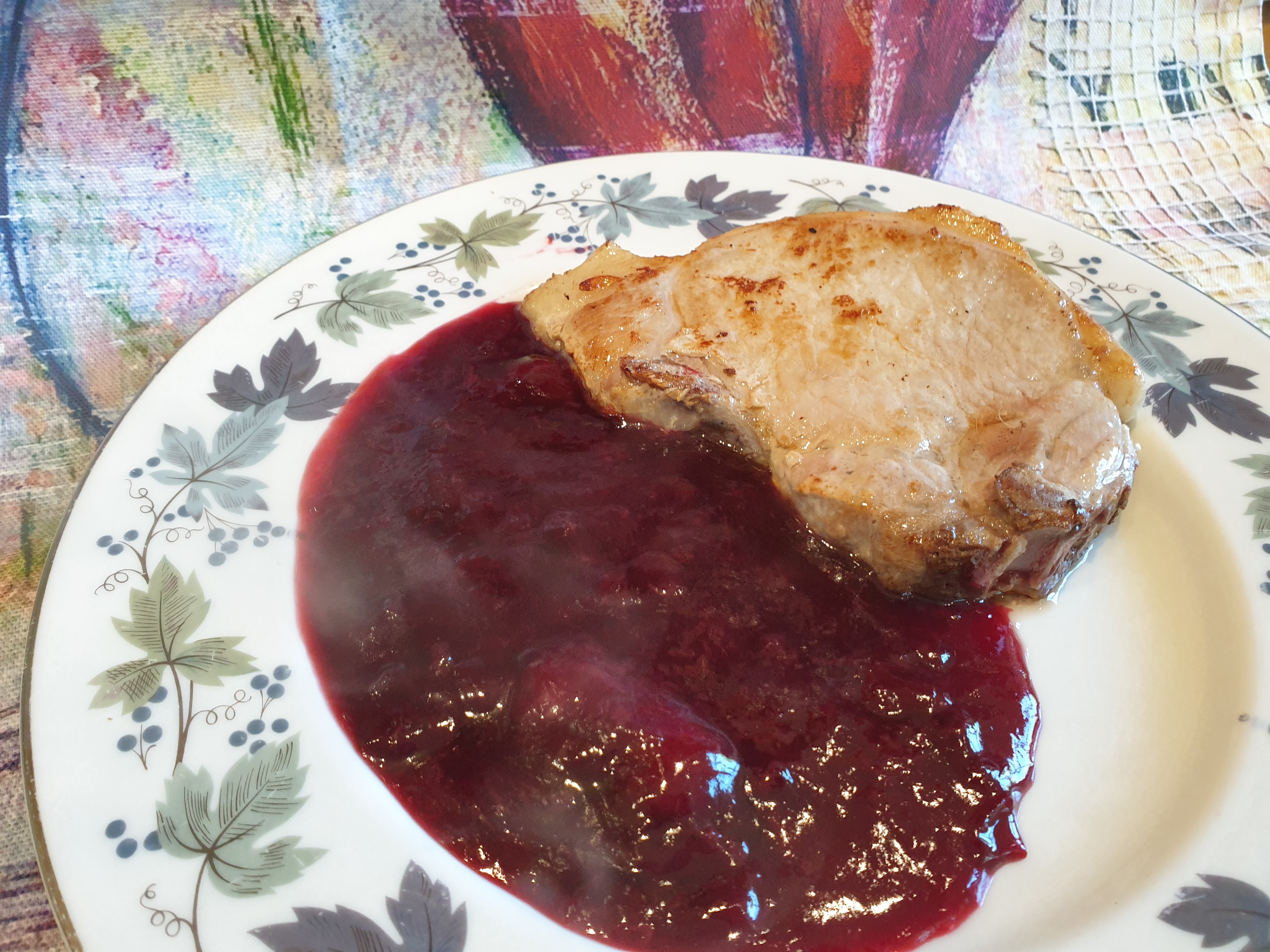
Pork with Honeyed Plums

  • I previously wrote about pork with soured plums.
  • This time the recipe uses honey to sweeten the plums.
  • I have previously posted the recipe for honeyed plum sauce.
  • The pork is cooked separately from the plums.
  • Grilled pork chops or roast loin of pork works well. 

Ingredients

  • 10 plums
  • 250ml water (maybe a little extra)
  • 4-6 tablespoons of runny honey

Method

  • Simmer the plums gently in the water.
  • Stir until the plums fall apart.
  • Add extra water if needed.
  • Add as much honey as required to taste.
  • Remove the stones – optional.
  • Serve hot with the cooked pork.

  • Served on a Royal Doulton – Burgundy plate

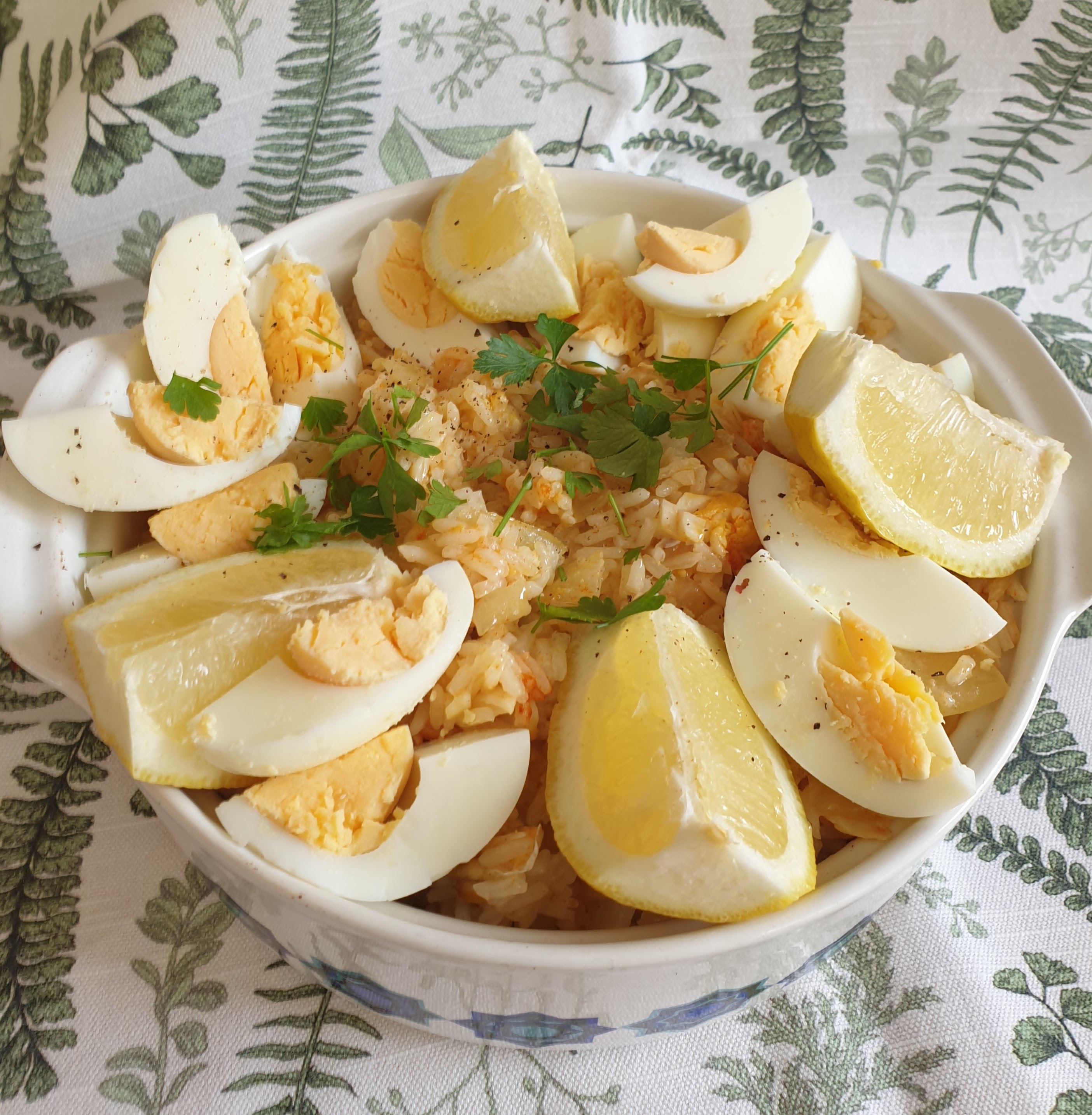
Kedgeree

  • This dish was very popular in Victorian times in Britain.
  • It originated in India and was often served for breakfast.
  • It originated in India and was called – ‘khichari’.
  • It was started as a dish with rice, fried onion, lentils and eggs.
  • Over time, the lentils were left out and fish was added.
  • There are many different recipes  but they all include: boiled rice, fish (often smoked) and hard boiled eggs. Paprika, cayenne pepper or curry powder is added.
  • I made this whilst doing some research into old English recipes.
  • Everyone loved it and I thought that it would be a “hit” in Poland too.

INGREDIENTS

  • 2 onions – finely chopped
  • 75g butter (do not stint on this)
  • 300ml of vegetable stock
  • 200g-250g long grained rice – boiled
  • 250g-300g smoked haddock
  • 3 – 4 hard boiled eggs – cut into quarters
  • 1 lemon – cut into quarters
  • 1 teaspoon ground paprika or cayenne pepper
  • Salt and pepper to taste
  • *
  • Flat leaved parsley to garnish

METHOD

  • Poach the fish in the vegetable stock for 6 – 8 minutes.
  • Remove the skin and flake the fish.
  • Meantime melt the butter in a large frying pan.
  • Gently fry the onions till golden.
  • Add rice and a few tablespoons of the stock.
  • Add the paprika, stir and continue cooking.
  • Add the flaked fish and more stock if too dry.
  • Cook through for a few minutes.
  • Season to taste.
  • Serve in a large dish with hard boiled eggs and lemons around the side.
  • Garnish with flat leaved parsley.
  • Diners should squeeze lemon juice over their portion.


Poached Pears

  • I recently went on a trip to The Netherlands to visit my old school friend.
  • We were invited out for a meal and this gave me a few ideas for recipes.
  • The main course was a venison gulasz with gingerbread, which was very reminiscent  of  my recipe for beef gulasz with piernik, which did originate in Belgium.
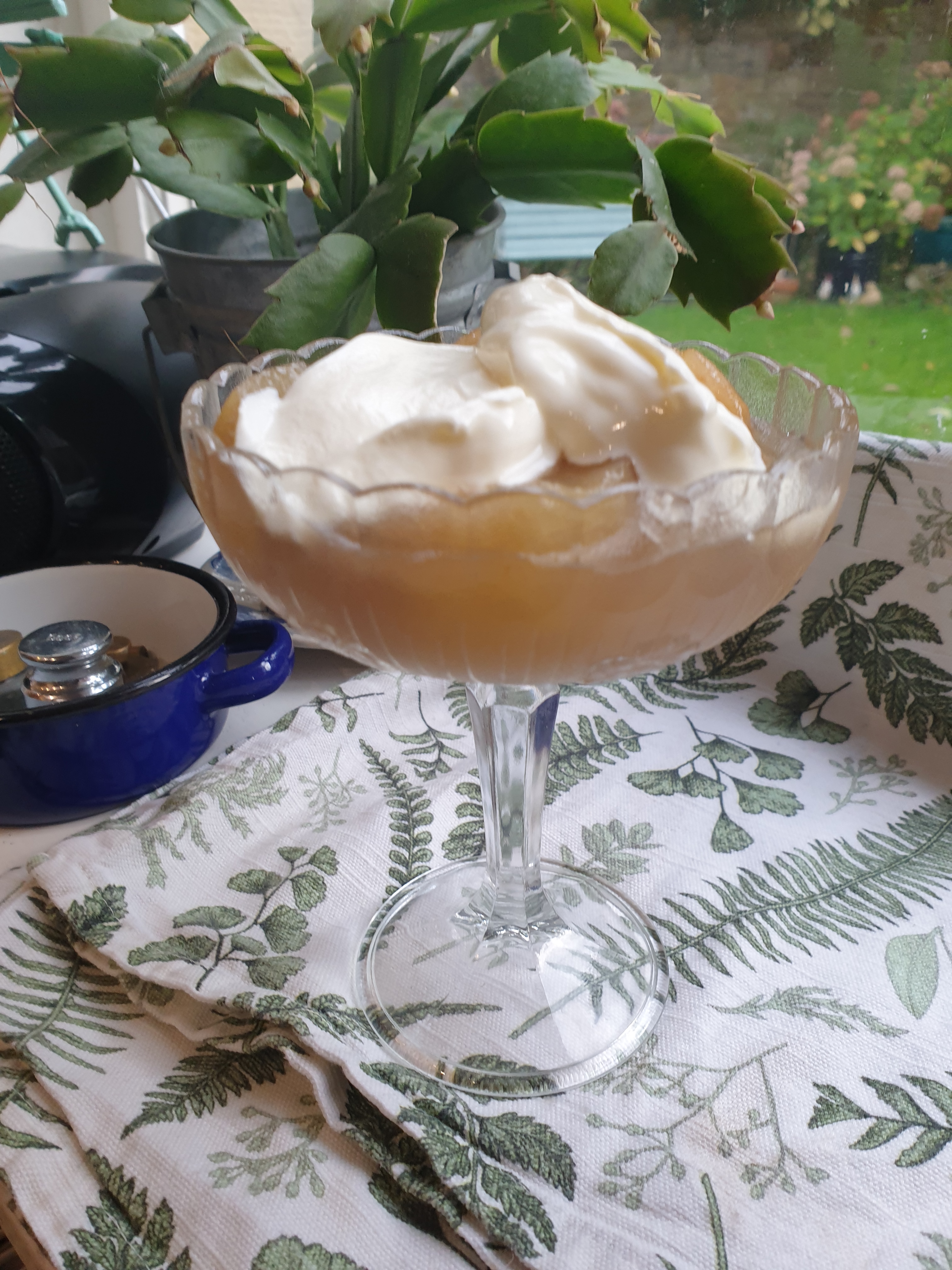
  • This was served with warm poached pears, which went really well together.
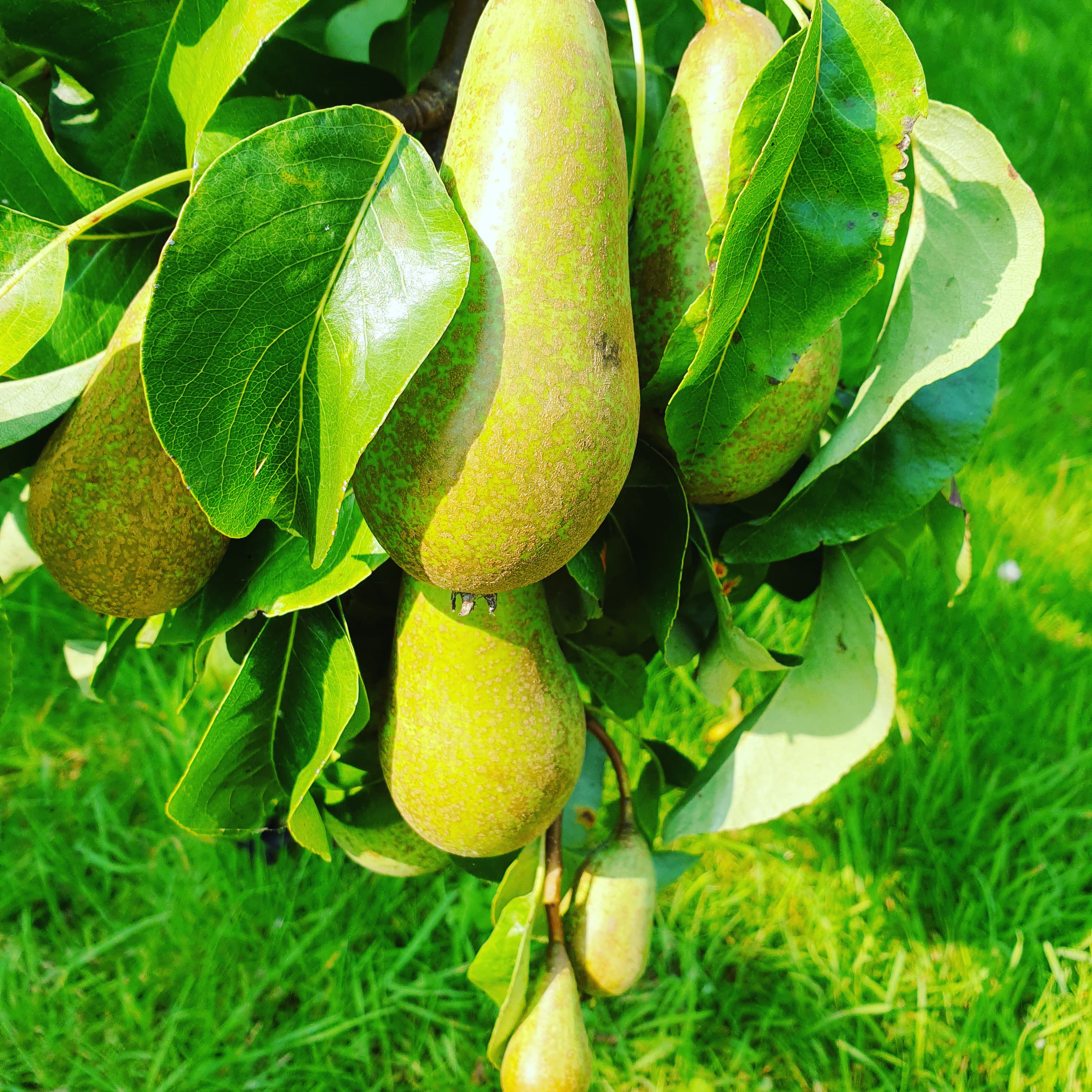
  • This year my small pear tree had a good crop of pears so I tried out a recipe.
  • Hard pears such as my Conference pears are best for this recipe.
  • The pears can be poached in a solution of red or white wine and sugar or just a sugar solution.
  • Sherry or port can be added afterwards when the liquor is thickened.
  • Various whole spices are added to the poaching solution.
  • *
  • You can also serve these poached pears chilled with thick Greek style yoghurt or budyń (Polish custard) or vanilla ice cream.
  • *
  • Below is the version I made.

Ingredients

  • 9-12 hard pears
  • 500ml water
  • 120 – 150g granulated sugar
  • Small piece of cinnamon bark
  • 4-6 whole cloves 
  • 4-6 allspice grains
  • *
  • 1 tablespoon potato or cornflour
  • 1 tablespoon of water
  • 2 tablespoons sherry

Method

  • Peel the whole pears and if possible leave the stalk attached.
  • Put the pears into an oven proof dish – one with a lid.
  • Pre-heat the oven to GM3 – 160°C
  • *
  • Make a solution of water, sugar and the spices.
  • Bring to the boil and simmer for a few minutes.
  • Pour the solution over the pears.
  • Put the lid on the dish.
  • Place the dish in the oven and cook for around 40 minutes.
  • *
  • Strain the liquor from the pears into a small saucepan
  • Mix the water with the potato or corn flour and add this to the liquor.
  • Heat with stirring to thicken.
  • Add the sherry and stir.
  • Pour this over the pears and serve.
  • Goes well with any gulasz or roast chicken, duck or pork.
  • *
  • Or leave to cool and then chill.

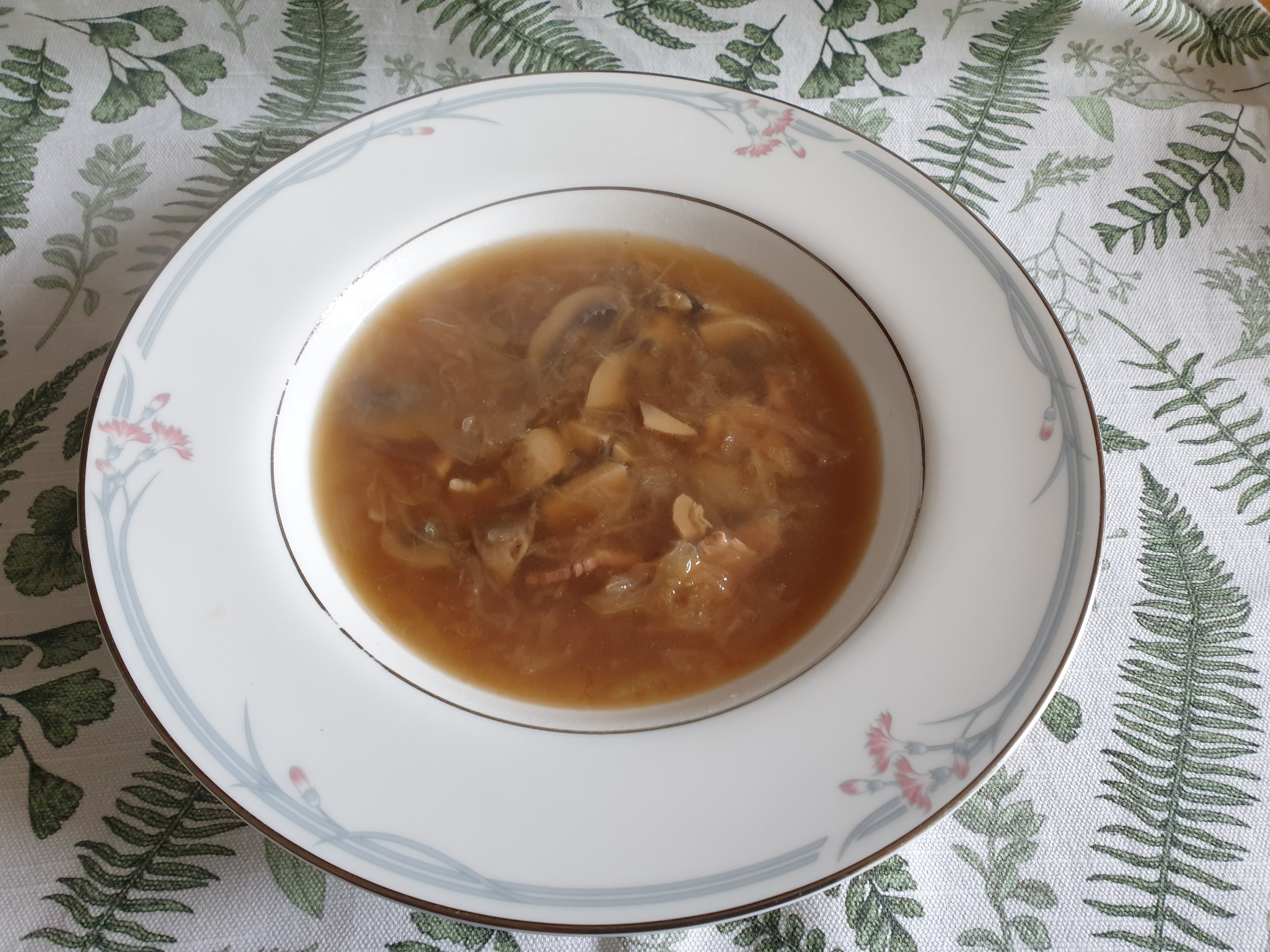
Dark Mushroom Soup

  • I have recently returned from a trip to the Netherlands to visit my old school friend.
  • We were invited out to dinner and had a lovely meal, which gave me several ideas for new recipes.
  • Our host had cooked venison and had used venison stock to make a soup.
  • Now I am unlikely to get any venison in the near future so I decided to used beef stock (from a cube) to make this soup.
  • Whilst eating this soup I thought it had ingredients, which could easily be a soup that would be very popular in Poland.
  • These were: fresh mushrooms, sauerkraut and smoked bacon. 
  • I did not have any flat leaved parsley on the day I made this or I would have used it to garnish the soup.

Ingredients

  • 200g mushrooms – white or brown caps.
  • 1 large onion 
  • 3-4 rashers of smoked bacon
  • 100 – 150g sauerkraut 
  • 1½ litres of beef stock (can be from cubes or concentrate)
  • Sauerkraut liquor – to taste 
  • Salt & pepper to taste.
  • *
  • Flat leaved parsley to serve

    Method

  • Chop the onion into small chunks.
  • Slice the mushroom caps into thin slices.
  • Add the onion and mushrooms to the stock.
  • Bring to the boil and then let it simmer with a lid on the pan.
  • Simmer for around 30 minutes.
  • Cut the bacon into thin long pieces.
  • Drain sauerkraut and chop it into smaller strands.
  • Add the bacon and sauerkraut and let these simmer for another 30 minutes.
  • *
  • Adjust the sourness with sauerkraut liquor to taste.
  • Season to taste.
  • *
  • Serve with flat leaved parsley if available.
Soup Plate by Royal Doulton – Carnation

Chałka

  • This a very popular “bread” in Polish and is of Jewish origin.
  • In olden days this would not be called bread as it does not contain any rye flour.
  • This is made from wheat flour and is a slightly sweet loaf and is more a ‘bulka’- more a yeast cake than a bread.
  • In English books it is often called – Challah.
  • I have found several recipes and combined them.
  • The dough is enriched with eggs, milk and butter.
  • I have used honey as the sweetener as this is more traditional than sugar.
  • The dough is plaited using at least three strands.
  • A glaze of egg yolk and milk is used – but this tends to burn easily – I might try egg white next time, which I have found to be better  
  • Poppy seeds, sesame seeds or  kruszonka – (crumble mixture) is scattered over the egg glaze.

Ingredients

  • 550g strong or plain flour
  • 125ml milk
  • 20g dried yeast
  • 2 eggs – beaten.
  • 2 tablespoons butter – melted
  •  5- 6 tablespoons water
  • 3 tablespoons of runny honey
  • *
  • Egg yolk & 1 tablespoon of water – (I will try just an egg white next time)
  • Poppy seeds, sesame seeds or crumble mixture for topping

Method

  • Make a starter using 3 tablespoons of the flour, the yeast, the milk and 1 tablespoon of the honey.
  • *
  • Leave until frothy and rising.
  • *
  • But the rest of the flour in a large bowl.
  • Make a well in the centre.
  • Pour in the starter.
  • Pour in the beaten egg.
  • Pour in the melted butter.
  • Pour in some of the water and start to draw the flour and other ingredients together to make a soft dough,
  • Add any more water as required.
  • Once you have a ball of soft dough move the ball onto a wooden board.
  • Knead the dough for 10 minutes.
  • Place the dough back into the bowl.
  • Cover and leave until the dough has risen and doubled in size.
  • *
  • Grease a large baking tray.
  • Divide the dough into three equal parts.
  • Roll out each piece into three strands.
  • Plait the three strands together.
  • Tuck each end under.
  • Place the loaf onto the baking tray.
  • *
  • Leave for 20-30 minutes.
  • *
  • Pre-heat the oven to GM6 – 200 C.
  • *
  • Brush the loaf with the egg yolk mixture.
  • Sprinkle with poppy or sesame seeds.
  • Bake for  25 – 30  minutes.
  • Check after 20 minutes and cover with baking paper if it starts to burn.

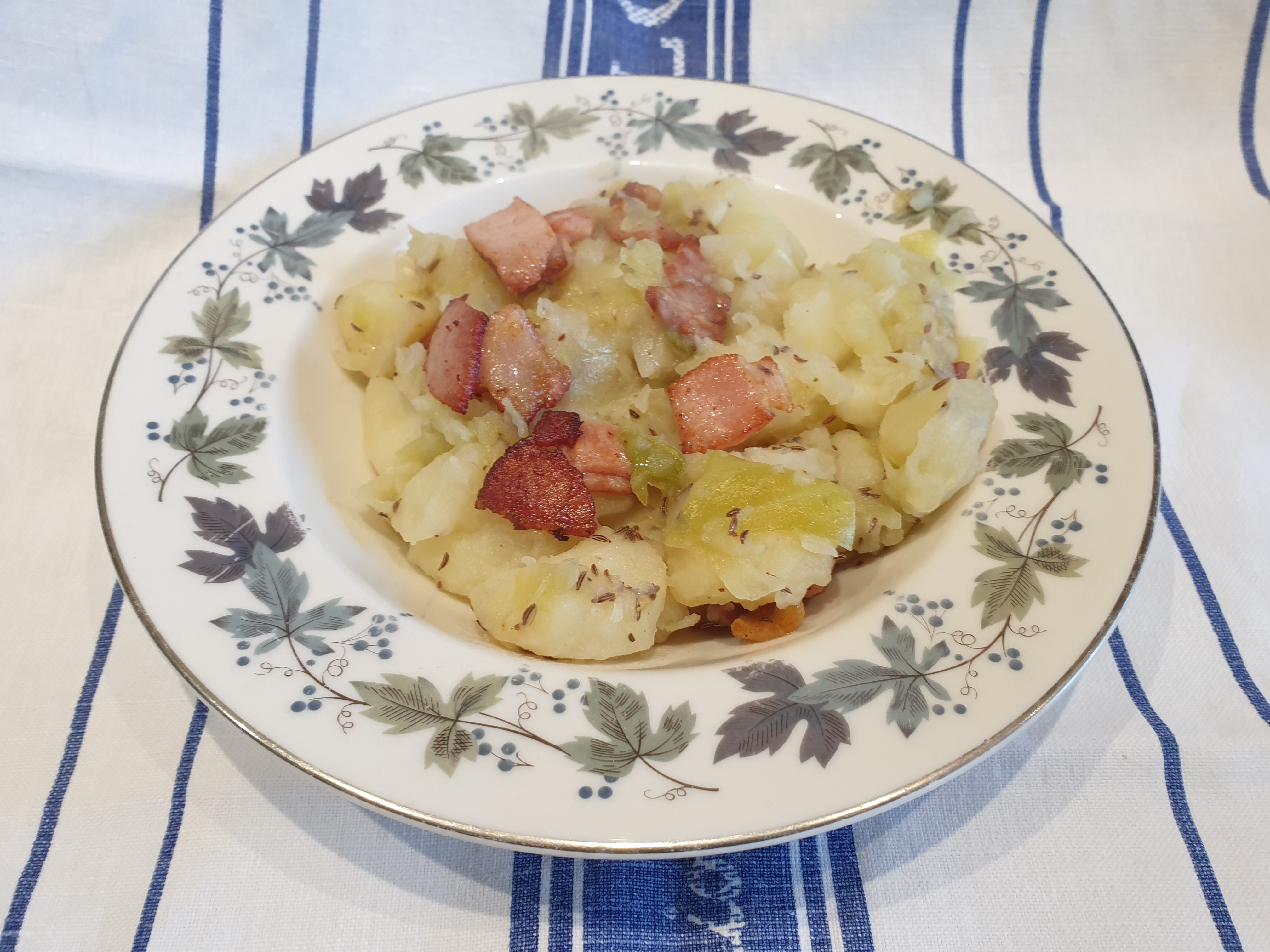
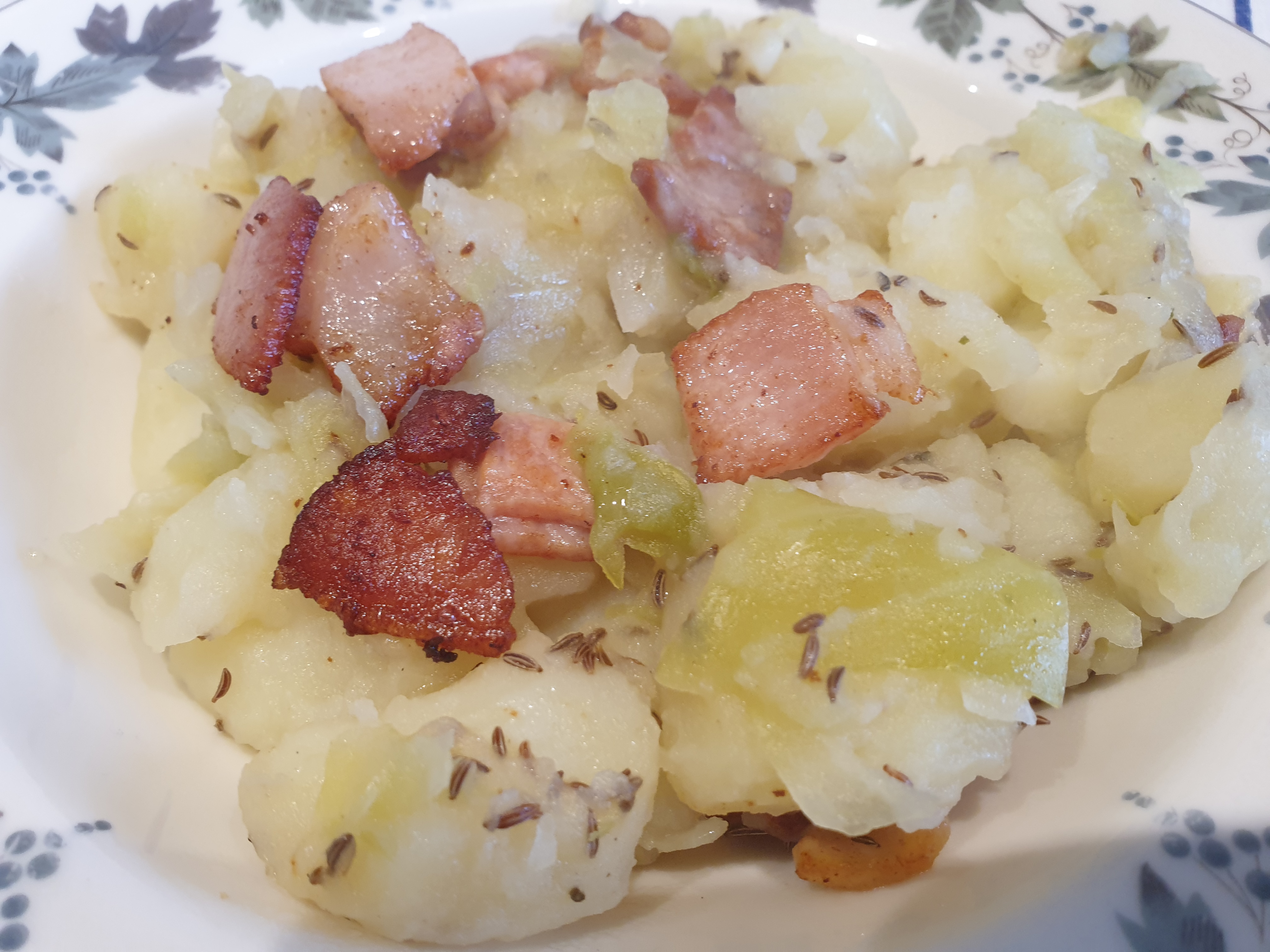
Kapusta “Parzybroda”

  • The name for this cabbage dish translates as ‘scalds your chin’ or ‘burns your beard’ .
  • I am not sure why  – but if you serve it straight from the pan it is very hot.
  • In some parts of Poland this is more like kapuśniak – cabbage soup – one that is made with fresh cabbage.
  • Here it is dish that can be eaten on its own or as a side dish.

Ingredients

  • 1 sweetheart or white cabbage
  • 500g starchy potatoes
  • 200g smoked streaky bacon
  • 1 litre vegetable stock
  • 1 tablespoon caraway seeds
  • Salt and pepper to taste

Method

  • Cut the cabbage into largish squares.
  • Peel and chop the potatoes into medium sized chunks.
  • Mix the two together in a large saucepan with the stock.
  • Bring to the boil and then simmer gently until the stock is all absorbed and the cabbage and potatoes are cooked.
  • In the meantime – chop the bacon into small squares and fry till all fat is cooked out and the bacon crisp.
  • These are called skwarki.
  • Add the caraway seeds to the cooked cabbage and potatoes – mix gently.
  • Gently mix in the fried bacon and the fat.
  • Season if necessary to taste.
  • Serve straight away.
  • Here served in a Royal Doulton – Burgundy dish

Belgian Buns

  • These would be called ciasteczka belgijskie in Polish
  • This is a  recipe that was popular in the 19th century in Belgium.
  •  The mixture of spices is slightly different than in many Polish or English recipes.

INGREDIENTS

  • 80g blanched almonds
  • 85g butter
  • 225g plain flour
  • 1 teaspoon baking powder
  • 125g icing sugar
  • ¼ teaspoon ground cloves
  • ¼ teaspoon ground ginger
  • ½ teaspoon freshly ground nutmeg
  • 2 eggs
  • 75g currants
  • 40g mixed peel
  • Zest of 1 lemon
  • (a little milk maybe needed)
  • *
  • 1egg yolk & 1 tablespoon of milk for egg wash

METHOD

  • Pre-heat oven to GM3 – 160°C.
  • Line a large baking tray with baking paper.
  • Chop the almonds into 4 and keep around 36 pieces back for the tops.
  • Mix the flour and baking powder together.
  • Rub in the butter until you have breadcrumbs.
  • Mix the icing sugar and the spices together.
  • Mix the sugar mixture into the flour mixture.
  • Mix the currants, almonds, peel and lemon zest together.
  • Mix the fruits with the other ingredients.
  • Add the eggs, mixing until you have a soft dough.
  • (You might have to add a dash of milk – depending on the size of the eggs.)
  • With floured hands divide the dough into 12 equal parts.
  • Form these into balls.
  • Space these out on the baking tray and flatten them slightly.
  • Brush the tops with the egg wash.
  • Put 3 pieces of almonds on the top of each.
  • Bake for 40-45 minutes until golden.
  • Leave to cool for a while on the tray before putting them on a wire rack.

Vintage cake plate on a chrome foot.
Fresh Cabbage & Apples

  • I came across a Polish idea to cook white cabbage with apples.
  • The writer did not give a method nor did they say whether they made it sweet or tart.
  • I went for a slightly sweet version and I thought the result was delicious.

Ingredients

  • 1 sweetheart cabbage or a small white cabbage
  • 2 large Bramley apples
  • 500ml water
  • 2-3 tablespoons of granulated sugar

Method

  • Preheat the oven to GM 3 – 160°C.
  • Use a large oven proof dish with a lid.
  • Chop the cabbage into rough squares.
  • Peel and core the apples and chop these into chunks.
  • Mix the cabbage, apples and sugar together and put in the dish.
  • Add the water.
  • Cook for around 1 hour.
  • Keep an eye on this about half way through as the apples can fluff up and escape from the dish.
  • *
  • Serve with roast chicken, duck or pork.
  • *
  • You can add part of the sugar and add the rest to taste at the end.

  • Served in Bavarian china with a forget me knots pattern

Sponge Cake with Peaches

  • This cake is loosely based on one I made with pears.
  • However rather than use fresh peaches – I used tinned peaches.
  • My peaches were in syrup – but one in juice should also be fine (but not tested).
  • This sponge is made with sunflower oil and is very easy to make.

Ingredients

  • Tin of peaches – drained
  • *
  • 230g of plain flour
  • ½ tablespoon of baking powder
  • ½ teaspoon of salt
  • 125ml of sunflower oil
  • 200g granulated sugar
  • ¼ – ½ teaspoon vanilla extract
  • 3 eggs
  • *
  • Icing Sugar to dredge – optional

Method

  • Pre-heat oven to GM4 – 180°C.
  • Use a 22cm loose bottom tin with a cake liner – (like a huge bun case).
  • Chop the peaches into small chunks.
  • Leave whilst you prepare the cake mixture.
    *
  • In a large bowl mix the flour, baking powder and salt.
  • In another bowl whisk the oil, sugar, vanilla extract and the eggs until they are thoroughly mixed.
  • Add the flour mixture to the oil mixture and mix thoroughly.
  • Place half the cake batter into the cooking tin.
  • Place half the peaches on top of the cake batter.
  • Cover with the rest of the cake batter.
  • Place the rest of the peaches evenly over the surface of the cake.
  • Bake for 60 – 65 minutes – cover and maybe another another 10 minutes if not done.
  • Leave to cool in the tin before turning it out.
  • *
  • Dredge with icing sugar when serving – optional.
  • Served on Royal Doulton – Sonnet  and Duchess – Bramble Rose tea plates
  • *
  • I tried this out also in a rectangular tin – 26 x 21cms.
  • The batter was poured into the tin and the peaches all put on the top.
  • This took 40 – 45 minutes to cook – check after 35 minutes and cover with baking paper if necessary.

Pierogi with Chicken & Spinach

    • I have been trying out new fillings for pierogi – all with chicken – here is the third and last for now – will be trying out different ones  later.
    • The filling is  made with cooked chicken as usual but I have found that chicken thighs make a tastier dish than chicken breast.
    • I cooked the chicken as for  rosȯł – chicken soup.
    • Spinach is often added to twaróg or yoghurt cheese but I wanted a more meaty mixture.
    • Lots of spinach cooks down to quite a small amount so the amount can be whatever you have.
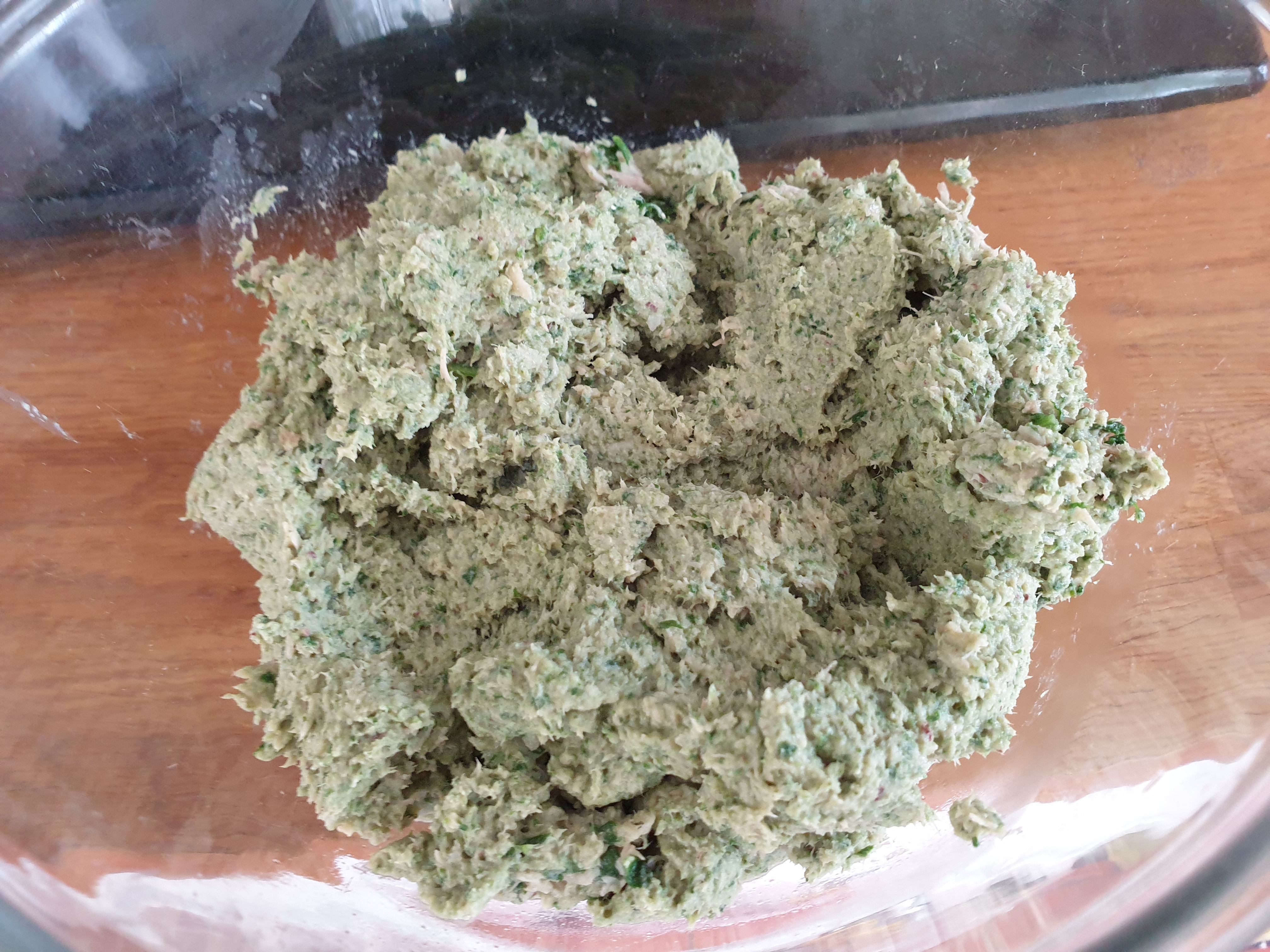
    • You can mince the chicken and spinach but I used a mini-chopper, which gave a great smooth filling.

Ingredients – Filling 

  • 150 – 200g cooked chicken thighs
  • 150 -200g fresh spinach
  • 1-2 tablespoons melted butter
  • Salt and pepper to taste
  • *
  • Melted butter to serve

Method – Filling

  • Blanch the spinach in  rosȯł,  chicken stock or boiling water for several minutes.
  • Let it cool and drain it.
  • Whisk the spinach in a mini chopper.
  • Minch the chicken or use a mini chopper.
  • Mix the spinach with the chicken until well mixed.
  • Mix well in the cooled, melted butter.
  • Season to taste.
  • *
  • Serve with melted butter.
  • *
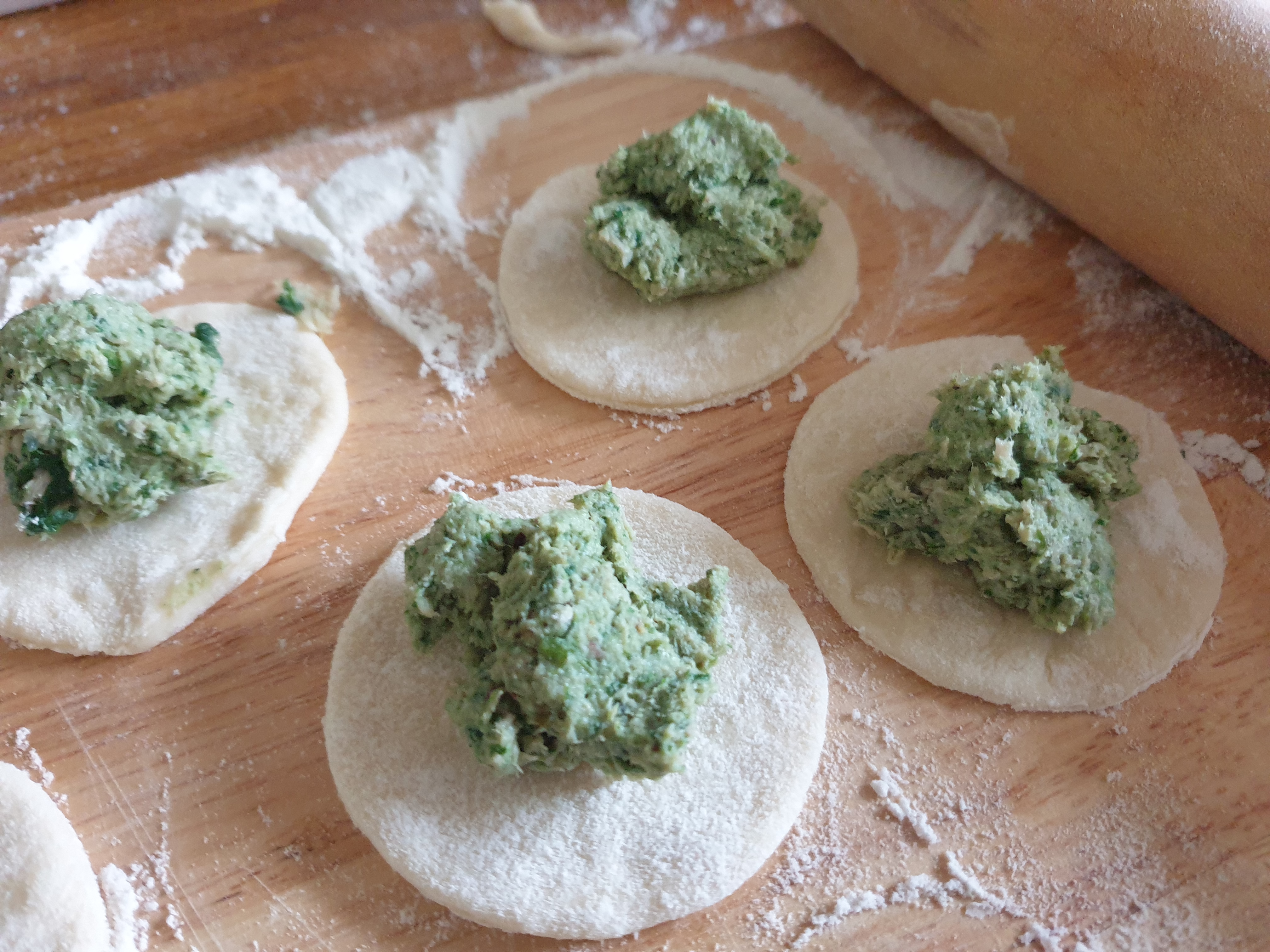
  • Instructions for putting the pierogi together are below the photographs.

How to make pierogi

Ingredients – Dough

  • 250g pasta flour or plain flour & 2 tablespoons of fine semolina
  • 150ml water
  • 1   tablespoon oil – sunflower or light olive
  • ½ teaspoon salt
  • 1 egg yolk.

Method – Dough

  • In a jug or bowl mix together the water, oil and the yolk.
  • Put the flour and salt into a large bowl and make a well in the centre.
  • Pour in the liquid from the jug and initially use a knife to mix this into the flour and then use your hands to mix the liquid and flour to get a ball of dough.
  • Turn this out onto a floured board and knead the dough for a few minutes until you have a smooth ball.
  • Cover and leave to rest for about ½ an hour.
  • *
  • Cut the dough into half.
  • Prepare a large tray and cover it with a clean cotton or linen tea towel and sprinkle this with flour.
  • On a floured board roll out the dough a half at a time until you have a sheet of thinly rolled dough.
  • Cut out circles using a 7 cm diameter cutter.
  • The excess dough can be re-mixed and rolled out again.
  • Around a half tablespoon of filling is put on  each circle and then they are folded over and the edges pinched together to make a good seal.
  • You learn from experience how much filling to put in as too much will make it hard to seal them and if not properly sealed they will burst on boiling.  Do not worry if you have a few mishaps – it still happens – even with experience – it is hard to salvage one that has gone wrong – just accept that there will be a few that you do not cook.
  • Place the sealed pierogi on prepared tray until they are all made, do not let then touch each other.
  • *
  • To cook the pierogi
  • Use a large pan of boiling water to which you have added some salt and a drizzle of oil.
  • Drop the pierogi in one by one and allow them to boil.  I usually do about 5 to 6 at a time.
  • As they cook they will float to the surface, let them boil for 2 minutes and then remove them with a slotted or perforated spoon and put into a colander above a pan for a few seconds to drain and serve with melted butter.
  • Continue boiling batches in the same water.
  • If you want to make all the pierogi to serve together then you need to get a large oven proof dish.
  • Melt lots of butter in the dish.
  • Keep the dish warm in a low oven.
  • As you take out the cooked pierogi add them to the dish and coat them with the melted butter.
  • Keep on adding more as they cook.