Early Summer Soup

In the original recipe this was called spring soup.  I thought it a bit strange as not all the ingredients are out in spring – so I have re-named it to early summer soup.

Otherwise you could call it green leaves soup!

It is a really super soup – very tangy  with the sourness loved by Poles.

If you have the vegetable stock and some hard boiled eggs ready – then this is a very quick soup to make.

Some of the ingredients – growing in pots in my garden

It is hard to give exact amounts needed – around 500ml in volume of different leaves.

Ingredients

  • Large handfuls of sorrel
  • Large handfuls of spinach – or use frozen leaf spinach
  • Several sprigs of flat-leaved parsley
  • A stem of lovage or some celery leaves
  • 1 litre of vegetable stock – can be from a cube or concentrate.
  • 1 tablespoon of plain flour
  • 2 tablespoon of milk
  • 250ml soured cream
  • *
  • Hard boiled eggs – 1 per serving

Method

  • Have the vegetable stock ready and hot in a saucepan.
  • Remove all the leaves from the stalks.
  • Chop the leaves.
  • Add the leaves to the stock.
  • Mix the flour with the milk.
  • Add the flour mixture to the soup.
  • Mix well and simmer for 3 minutes.
  • Take the pan off the boil and stir in the soured cream.
  • Serve with a hard boiled egg chopped in half per serving.

Served in Royal Doulton – Carnation  1982- 1998

Poolish Bread

A Poolish is a pre-ferment usually combing equal parts of flour and water (by weight) with some yeast.

The origin of the term Poolish is that it is named after a method used by Polish bakers around 1840 when it was brought to France.

However – Poolish is an old English version of Polish and this term seems to be most used in France where polonais is the word for Polish – strange!

Fermentation is carried out at room temperature for some time – long enough for the Poolish to bubble up and increase its volume. This can take anywhere from 3 to 24 hours.

Using  Poolish is said to give a light texture to the dough, develop a sweetness of flavour and also give a good colour in the crust.

This recipe is adapted from Bake it Better  – Bread – edited by Linda Collister, Hodder & Stoughton, 2015.

The original amounts made two very big loaves so I the second time I made this,  I cut it down, to make two small loaves – these are the instructions below.

Ingredients – Day One

  • 25g wholemeal flour
  • 150g strong flour
  • 10g fresh yeast (5g dried)
  • 175ml water
  • 1/4 teaspoon of sugar

Method – Day One

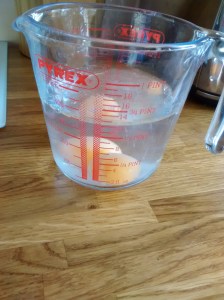
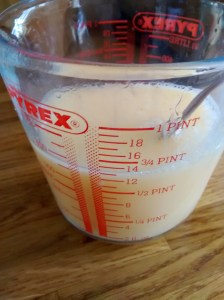
  • Mix the yeast, water and sugar in a jug
  • Leave for about 5 -10 minutes.
  • Mix the two flours together in a bowl.
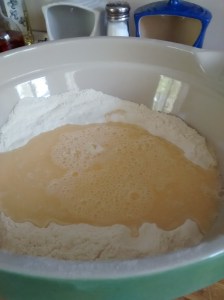
  • Make a well and pour in the yeast mixture.
  • Bring it all together to make a thick lump free mixture.
  • Cover the bowl (a shower cap is good)
  • Leave a room temperature for 20 – 24 hours.

Ingredients – Day Two

  • Poolish from day one
  • 125ml water
  • 250g strong flour (maybe a little more)
  • ½ tablespoon of salt

Method – Day Two

  • To the Poolish add the water and mix to make a smooth batter.
  • Add 125g of the flour and mix it in by hand.
  • Add the salt.
  • Gradually add the rest of the flour until you have a soft but not sticky dough.
  • Add more flour if necessary.
  • Knead the dough for 10 minutes (set a timer).
  • Put back into a large bowl and cover (a shower cap is good).
  • Leave to rise till double in size – around 3 hours.
  • When it looks nearly ready – line a baking sheet with grease-proof paper.
  • Knock back the dough with your knuckles to deflate it.
  • Cut the dough into two pieces.
  • Leave them to rest for 5 minutes.
  • Knead each piece for 1 minute.
  • Shape each piece and put it on the baking sheet.
  • Dust them lightly with some flour.
  • Cover loosely and leave to prove for 1 to 1½ hours.
  • Pre-heat the oven to GM7 220°C
  • Put a roasting tin at the bottom of the oven to heat up.
  • Cut 3 slashes in the top of each loaf (oops I forget the 2nd time!).
  • Put the loaves in the oven.
  • Quickly pour a glass of water into the roasting tin (the steam helps to give a good crust).
  • Close the door and bake for around 30 minutes.
  • Leave to cool on a wire cake rack.

Celeriac & Carrot Soup

A variation on a simple celeriac soup with two options on how to serve.

Ingredients

  • 1 Celeriac
  • 3 Large carrots
  • 1 Onion – chopped
  • 1.5 litres of chicken stock (can be from cube or concentrate)
  • 2-3 Allspice grains
  • Butter to fry the onion
  • 5 tablespoons of tomato ketchup
  • Salt and pepper to taste
  • *
  • To serve
  • *
  • Soured cream or
  • *
  • Fried potatoes & charred onions

Method

  • Peel the celeriac and chop into large chunks.
  • Peel the carrots and cut into large chunks
  • Lightly fry the onion in butter till golden.
  • Put the celeriac, carrots, fried onion and allspice into a pan of chicken stock.
  • Bring to the boil and then simmer with a lid on the pan until the celeriac and carrots are soft.
  • Leave to cool slightly.
  • Purée the soup – a stick blender is good for this.
  • Add the tomato ketchup.
  • Season to taste.
  • Bring the soup back to the boil for a couple of minutes.

To serve – 1

  • Add 1 or 2 tablespoons of soured cream and stir.

To serve – 2

  • Serve with fried potatoes and charred onions.

Served in Royal Doulton – Tapestry – 1966 – 1998


Mincemeat Yeast Buns

I have been doing a lot of yeast baking recently and  posted recipes for cinnamon buns and for poppy seed yeast buns, which were very soft and fluffy.

I still had a little mincemeat left over from Christmas and thought why not use some of this. The resulting buns are reminiscent of English Chelsea Buns.

This English fruit mix would be recognised in Poland as bakalie -Balkan mix.

The dough is soft and rather hard to handle. After the first rising the dough is NOT knocked back but just used as it is to make a rectangular shape. Putting the buns into a deep foil lined roasting tin helps to let them rise into shape.

Ingredients

  • 250g strong flour
  • 250g plain flour
  • Half a tablespoon of dried yeast
  • 50g butter
  • 50g granulated sugar
  • 1 egg
  • Around 330ml milk
  • *
  • Several tablespoons of mincemeat

Method

  • Line a roasting tin with foil taking it all up the sides.
  • Warm a little of the milk and add the yeast.
  • Leave for around 10 minutes.
  • Mix the flours together.
  • Rub the butter into the flour – like breadcrumbs.
  • Add the sugar.
  • Make a well in the centre and pour in the yeast mixture.
  • Add the beaten egg
  • Slowly add the milk – you might not need all of it.
  • Use a knife first to start to bring everything together
  • Then use your hands and form a soft dough ball.
  • Knead the dough on a lightly floured surface for at least 5 minutes – even up to 10 minutes.
  • Place the dough into a bowl, cover (a disposable shower cap is good) and leave to rise until the dough has doubled in size.
  • Turn the dough out onto a lightly floured board.
  • DO NOT KNOCK BACK THE DOUGH.
  • Using you fingers gently flatten and shape the dough into a rectangle.
  • Cover the dough with the mincemeat.
  • Roll into a log.
  • Slice into thick pieces.
  • Place the pieces into the tin.
  • Cover and leave to rise.
  • Pre-heat the oven to GM6 – 200°C
  • Once all the pieces are touching put in the hot oven.
  • Bake for around 20 mins – check and maybe cover after 15mins.
  • Drizzle with icing made with lemon juice and icing sugar or just dust with icing sugar
  • Leave to cool in the tin on a cake grid.


Celeriac Soup

Having seen lots of celeriac in the shops this week, I decided to make some of this lovely soup.

Ingredients

  • 1 Celeriac
  • 1 Onion – chopped
  • 1 litre of chicken stock (can be from cube or concentrate)
  • 2-3 allspice grains
  • Butter to fry the onion
  • Soured cream
  • Salt and pepper to taste
  • Chopped flat-leaved parsley to serve

Method

  • Peel the celeriac and chop into large chunks.
  • Lightly fry the onion in butter till golden.
  • Put the celeriac, fried onion and allspice into a pan of chicken stock.
  • Bring to the boil and then simmer with a lid on the pan until the celeriac is soft.
  • Leave to cool slightly.
  • Purée the soup – a stick blender is good for this.
  • Bring the soup back to the boil.
  • Add 1 or 2 tablespoons of soured cream and stir.
  • Season to taste.
  • Serve with a dollop of soured cream and chopped flat-leaved parsley.

Served here in Royal Stafford – Blossom Time from the 1950s.

Pepper & Apple Salad

Here is a refreshing salad with a honey and yoghurt dressing for a sunny day.

Ingredients

  • 1 red pepper
  • 1 yellow or orange pepper
  • 2 onions
  • 2 eating apples such as Braeburn
  • Juice of 1 lemon
  • *
  • 2 tablespoons of runny honey
  • 3 tablespoons of Greek style yoghurt
  • *
  • Flat-leaved parsley to garnish

Method

  • Cut the peppers and remove the stalk and seeds.
  • Cut the peppers into very thin strips.
  • Slice the onions finely.
  • Put the lemon juice into a bowl.
  • Core the apples and cut into small chunks.
  • Place the apples into the lemon juice.
  • Mix the peppers, onions and apples together.
  • Put the salad into a serving dish.
  • *
  • Mix the honey and yoghurt together.
  • Put this mixture on top of the salad.
  • Garnish with chopped flat-leaved parsley.

No Knead Sourdough Rye Bread

This recipe is taken from Tomek Lach.  He has many extremely good videos on YouTube – they are however in Polish.  His videos include ones on yeast, sourdough, bread and pizzas.

I have tried out several recipes and tips.

This recipe is so easy as there is no need to knead – you just need time and patience. It can take up to three days.

You need to have some – zakwas – sourdough starter.

To make this you put 50g of rye flour and 50ml of water into a large glass preserving jar on day 1 and stir, cover and leave for 24 hours. On days 2, 3, and 4 you repeat this. On Day 5 it is ready to use or you can keep it in the fridge – topping up once a week with a couple of spoons of flour and water.

Ingredients – Day One

  • 2-3 tablespoons of zakwas – sourdough starter.
  • 150g of rye flour
  • 150ml of water

Method – Day One

  • Mix all the ingredients together in a large bowl.
  • Cover with a shower cap.
  • Leave for 12 hours minimum (overnight is good)

Ingredients – Day Two

  • The mixture from day one
  • 200g of rye flour
  • 200g of strong white flour
  • 200ml of water
  • 1 + 1/2 teaspoons of salt

Method – Day Two

  • Mix all the ingredients into a thick paste.
  • Get a large loaf tin (often called a 2lb tin).
  • Use one rectangle of grease-proof paper to line the tin.
  • Spoon all the mixture into the tin and smooth the top.
  • Cover again with the shower cap and leave for at least 5 hours – I have found that overnight is good here again.
  • Put the tin into the cold oven.
  • Put the oven on to GM7 –  220°C.
  • Bake for 50 minutes.
  • Take out and leave for at least 30 minutes before cutting into the loaf as it is still baking.

Variations

  • Adjust the types of flour – maybe use a light rye if you used a dark one before.
  • Add 2 tablespoons of seeds into the dough mixture – such as caraway, pumpkin or sunflower.
  • Add seeds to the top of the loaf.

Note

The bread keeps for several days and is good toasted or you can slice it up and freeze it.

Poppy Seed Yeast Buns

I recently posted a recipe for cinnamon buns, which were very soft and fluffy.

I thought – Why not use the traditional sweet Polish poppy seed mixture instead of the cinnamon mixture? – and so I did.

A mixture of strong and plain flours is used making the dough softer and a little harder to handle. After the first rising the dough is NOT knocked back, just used as it is to make a rectangular shape. Putting the buns into a deep foil lined roasting tin helps to let them rise into shape.

Ingredients – Dough

  • 250g strong flour
  • 250g plain flour
  • Half a tablespoon of dried yeast
  • 50g butter
  • 50g granulated sugar
  • 1 egg
  • Around 330ml milk

Method

  • Line a roasting tin with foil taking it all up the sides.
  • Warm a little of the milk and add the yeast.
  • Leave for around 10 minutes.
  • Mix the flours together.
  • Rub the butter into the flour – like breadcrumbs.
  • Add the sugar.
  • Make a well in the centre and pour in the yeast mixture.
  • Add the beaten egg.
  • Slowly add the milk – you might not need all of it.
  • Use a knife first to start to bring everything together
  • Then use your hands and form a soft dough ball.
  • Knead the dough on a lightly floured surface for at least 5 minutes – even up to 10 minutes.
  • Place the dough into a bowl, cover (a disposable shower cap is good) and leave to rise until the dough has doubled in size.
  • Turn the dough out onto a lightly floured board.
  • DO NOT KNOCK BACK THE DOUGH.
  • Using you fingers gently flatten and shape the dough into a rectangle.
  • Cover the dough with the poppy seed mixture.
  • Roll into a log.
  • Slice into thick pieces.
  • Place the pieces into the tin.
  • Cover and leave to rise.
  • Pre-heat the oven to GM6 – 200°C
  • Once all the pieces are touching put in the hot oven.
  • Bake for around 20 mins – check and maybe cover after 15mins.
  • Drizzle some icing made from lemon juice and icing sugar over these or just dust with icing sugar.
  • Leave to cool in the tin on a cake grid.

Ingredients – Poppy seed mix

  • 180ml of milk (full fat or semi)
  • Around 100ml of runny honey (extra may be needed)
  • 120g of poppy seeds *
  • 50g of raisins
  • Strong Earl Grey tea
  • Grated zest of 1 lemon
  • *
  • * You can grind the poppy seeds – I used a little electric grinder.

Method

  • Make some strong Earl Grey tea.
  • Put the raisins in a small bowl and cover them with the hot tea and leave till they go cold.
  • Into a small saucepan put the poppy seeds and the milk.
  • Bring to the boil then lower the heat.
  • Simmer gently for around 20 minutes, stirring constantly.
  • Take care not to let the mixture burn.
  • Add the honey and continue heating and stirring.
  • Drain the raisins and add them to the mixture and mix them in.
  • Keep stirring and try and drive off any liquid left.
  • Taste for sweetness – you may want to add more honey.
  • Leave to go completely cold before using.
  • Add the grated lemon rind.
  • *
  • If this is too much filling – you can always freeze some.


Caraway Seed Cake 2

I wrote a post on Caraway Seed Cake in March 2018 and in doing so found that although caraway is such a popular herb/spice in Poland and used in breads, meat & vegetable dishes, it is quite surprising that it is not used  in cakes.

I looked in all my recipe books and did not find any use of caraway in Polish cakes.

Caraway – Image from Wikapedia


Caraway seed cake seem to be a quintessential British cake and recently whilst  doing some research into Victorian cooking in the north of England I came across this delicious version.

As I live a short walk away from a house that Charlotte Brontë used to visit, I was very interested to find that seed cake is mentioned in her novel Jane Eyre (1847)

“And then Miss Temple invited Jane and her new friend Helen into her parlour for tea and I began to warm up. The kindly teacher unwrapped before their eager eyes a parcel containing ‘a good-sized seed-cake’.

‘I meant to give each of you some of this to take with you,’ said she, ‘but as there is so little toast, you must have it now,’ and she proceeded to cut slices with a generous hand.

We feasted that evening as on nectar and ambrosia; and not the least delight of the entertainment was the smile of gratification with which our hostess regarded us, as we satisfied our famished appetites on the delicate fare she liberally supplied.”

This recipe has been adapted from –

Mrs Somerville’s Cookery and Domestic Economy, published in 1862 and found in  – The Victorian Kitchen by Jennifer Davies BBC 1989 TV Series.

The original recipe used 10 eggs! – here the ingredients have been adjusted to 5 eggs.

How large the bowl must have been & how hard the whisking of the whites without an electric whisk.

Ingredients

  • 225g butter
  • 225g caster sugar
  • 200g plain flour
  • 2 teaspoons of baking powder
  • 2 tablespoons of cornflour
  • 2 tablespoons of caraway seeds
  • 50g ground almonds
  • 5 eggs separated

Method

Pre-heat the oven to GM4 180°C.

  • Use a loose bottomed cake tin – 24cm in diameter.
  • Grease the tin and line the base with a circle of greaseproof paper.
  • Mix together the flour, baking powder, cornflour, ground almonds & caraway seeds.
  • Cream together the butter and sugar.
  • Add the yolks, one at a time creaming the mixture on each addition.
  • Fold the flour mixture into the creamed mixture.
  • Whisk the egg whites till firm and stiff.
  • Fold the egg whites into the cake mixture.
  • Spoon the mixture into the tin and smooth over the top.
  • Bake for 60 minutes, check after 50 minutes and cover with grease-proof paper if necessary – to prevent burning.
  • Leave to cool in the tin.


Caraway Seeds are thought to aid digestion – so this is a good cake to have at the end of a meal.

Royal Albert – Primulette tea set from the 1950s.

Lead Crystal cake stand  – Tortenplatte – Venus  by Nachtmann(Germany).

Flat Bread

I was given this really easy flat bread recipe from my friend in Leeds.  She had seen it on a recent TV programme.  The same weight of self raising flour to Greek style thick yoghurt is used.  The amounts below make four flat breads which are then baked on a griddle or cast iron frying pan.

It is very versatile and can be used as a sort of “cheat’s” naan bread with Indian meals.

Ingredients

  • 225g Self Raising flour*
  • 225g Greek style yoghurt
  • 1/2 teaspoon of baking powder*
  • Large pinch of salt
  • *
  • * if you only have plain flour just use more baking powder than normal to the amount of flour.

Method

  • Mix flour, baking powder and salt together.
  • Mix the flour and yoghurt together to give a smooth dough.
  • Wrap the dough in plastic and place in the fridge for 20 minutes.
  • Cut the dough into four equal pieces.**
  • Flatten each piece and press out or roll on a floured board to a form a thin circle.
  • Heat the griddle or frying pan until it is hot.
  • Cook each flat bread on both sides.
  • Serve immediately.
  • Lovely with lots of butter.

Variation

Add some seeds such as black onion seeds to the dough when rolling out.

** you can freeze these portions – wrap them individually in thin plastic and place in a box.