Traditional Polish Recipes Made Easy & New Variations
Author: jadwiga49hjk
I love cooking and baking. I love trying out new recipes and currently am trying out many old favourites from my Polish cookbooks and family recipes. I am trying out many variations, often to make them easier but still delicious.
I collect glass cake stands and china tableware, mainly tea plates, jugs and serving dishes, many of which I use on a daily basis. They are an eclectic mixture from the 20th & 21st century.
Spelt – Triticum spelta – is an older type of wheat known to have been used from around 5,000BC.
Modern wheat is Triticum sativum.
I use ayoghurt & wheymix, as I nearly always have these in when I make yoghurt cheese, but you can adapt by using a milk & water mix or buttermilk instead.
Ingredients
250g spelt flour
150g plain flour
1 teaspoon of salt
1 teaspoon of baking powder
200ml of yoghurt
150ml of whey
Spelt flour
Method
Pre-heat the oven to GM 6 – 200°C
Flour a baking tray.
Mix all the dry ingredients in a big bowl.
Mix the yoghurt and whey together in jug or bowl.
Add the yoghurt mixture to the dry ingredients, bit by bit, using a wooden spoon to mix it all together .
Use your floured hands to bring it all into a soft dough ball, trying to handle the dough as little as possible.
Place the ball onto the floured baking tray and flatten it slightly.
Using a sharp large knife cut a cross or star through most of the thickness
Bake for 30 – 35 minutes.
The base should sound hollow when the bread is cooked .
Leave to cool on a cooling rack.
Fruit Version
To the flours add a 100g of dried fruits – raisons, sultanas, dried apricots etc.
I love the taste of the apricots!
Note
As with all soda breads, they do tend to become stale very quickly, however they are delicious toasted.
I have been concentrating on a variety of rye breads and had gone to my local Polish shop to buy some more rye flour when I saw some mąka orkiszkowa which is speltflour.
Spelt – Triticum spelta – is an older type of wheat known to have been used from around 5,000BC
Modern wheat is Triticum sativum.
Ingredients
250g spelt flour
250g strong wheat flour
150g oat flakes
50g sesame seeds
1 1/2 teaspoons of salt
20ml of sunflower oil
250ml milk
150ml water
1 tablespoon of fresh yeast
1 teaspoon of sugar
Method
Mix the milk and water and heat them slightly to hand heat.
Add the sugar and the yeast and wait for the yeast to froth up.
Mix all the other ingredients in a large bowl.
Make a well in the dry ingredients and pour in the yeast mixture.
Use a large wooden spoon to mix everything together and then use your hand to bring the dough into a soft ball, kneading it lightly for around 3 minutes.
Spelt flour
Leave to rise for at least 1 to 2 hours.
Grease a long Continental loaf tin (or a 2lb loaf tin).
Lightly press the dough into the tin.
Leave to rise – I found this took around 5 hours.
Pre-heat the oven to GM6 – 200°C.
Bake for 35-40 minutes , checking after 25 minutes and cover with foil or greaseproof paper if it has browned too quickly on the top.
The base of the loaf will sound hollow when it is cooked – put back for a few more minutes if not.
Once cool, I wrap the bread in a cloth.
I have found that the sliced bread, packed in a plastic box with a lid freezes very well.
Soup plays such huge part in Polish meals and I will be writing much on the subject soon (I could write a huge book on Polish soups alone).
Soups are usually served with some sort of accompaniments or garnish.
Some soups have traditional accompaniments but every cook will improvise with what they have.
These accompaniments include a wide variety of pasta and noodles, dumplings, rice, potatoes, croutons, hard-boiled eggs, pulpety (little meatballs) chopped, cooked sausage and crispy fried bacon and so on …. the list is endless.
Many of the soups to which these are added are of the clear consommé type.
Pasta, Noodles & Rice
Very small pasta shapes are used or larger pasta is cut into small pieces.
The pasta, noodles or rice are all cooked beforehand and a small amount is placed in the soup dish and hot soup poured over them to serve.
Often a small amount of pasta, noodles or rice is kept back from when they are being cooked for another dish – these are best kept in the fridge.
The chopped eggs are sprinkled on top of the soup or several pieces ‘floated’ on top of the soup when serving.
Krokiety
These are made using pancakes which are filled with sauerkraut & mushrooms, meat or cheese then folded and rolled, then dipped in bread crumbs and fried.
I have found a firm that has these ready made for frying and I think they are good.
I fry them in quite a lot of oil on both sides and then put them in the oven at GM4 – 180°C for around 20 minutes.
I have not made them from scratch myself – I must do this soon .
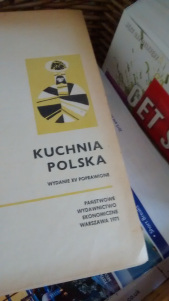
Photo below from my Kuchnia Polska book,1971
Kuchnia Polska, 1971 – Polish Kitchen or Polish Cookery
Pasztecik
This is similar to an English sausage roll, often made with a yeast dough pastry, and filled with pasztet (paté), meat, sauerkraut & mushrooms or cheese.
Photos below from my Kuchnia Polska book, 1971
I have eaten these in Poland in cafes and restaurants but not made these myself – something else to try out soon.
Bread
Bread can be served with soup – it is usually not buttered.
These are two variations of a classic wheat flour soda bread recipe.
I think the slow rise breads you get with sourdough or bakers’ yeast are better but they take time to make.
These are a quick bake if you want some bread for lunch or supper.
I use a yoghurt & whey mix as I nearly always have these in when I make yoghurt cheese, but you can adapt by using a milk & water mix or buttermilk if you have it instead of the whey.
I add caraway as I love the taste but you can experiment with other flavours using fresh or dried chopped herbs.
Version 1
Ingredients
150g rye flour
250g plain flour
1teaspoon salt
1teaspoon baking powder
1 tablespoon caraway seeds
150ml yoghurt
200ml whey
Method
Pre-heat the oven to GM 7 – 220°C
Flour a baking tray.
Mix all the dry ingredients in a big bowl.
Mix the yoghurt and whey together in jug or bowl.
Add the yoghurt mixture to the dry ingredients and use a wooden spoon to mix it all together.
Use your floured hands to bring it all into a soft dough ball.
Place the ball onto the floured baking tray.
Using a sharp large knife cut a cross or star on the surface.
Bake for 5mins then turn the heat down to GM 6 – 200°C and bake for 30 – 35 minutes.
The base should sound hollow when the bread is cooked .
Leave to cool on a cooling rack.
Version 2
Ingredients
100g rye flour
250g wheat flour
50g rolled oats
1teaspoon salt
1teaspoon baking powder
1 tablespoon caraway seeds
150ml yoghurt
200ml whey
Method
Pre-heat the oven to GM 7 – 220°C
Flour a baking tray.
Mix all the dry ingredients in a big bowl.
Mix the yoghurt and whey together in jug or bowl.
Add the yoghurt mixture to the dry ingredients and use a wooden spoon to mix it all together.
Use your floured hands to bring it all into a soft dough ball.
Place the ball onto the floured baking tray.
Using a sharp large knife cut a cross or star on the surface.
Bake for 5mins then turn the heat down to GM 6 – 200°C and bake for 30 – 35 minutes.
The base should sound hollow when the bread is cooked .
Leave to cool on a cooling rack.
Note
Soda bread does tend to go stale quickly but is is still delicious toasted and served with butter.
Tea plates are Las Palmas by Aynsley from the 1960s.
The lentil is Lens culinaris, an edible legume – which means its seeds grow in pods.
The seeds are lens-shaped from whence it gets its name – meaning little lens.
The Polish is soczewica and is also from a word meaning a small lens.
It belongs to the bean family and these seeds are classed as pulses – dry seeds for consumption.
Lentils originated in the Near East and Central Asia and are the oldest pulses and among the earliest crops domesticated in the Old World.
The first evidence of pulses comes from 11,000 years ago in the Fertile Crescent, a region in the Middle East which was home to some of the earliest human civilizations.
They are mentioned in the Bible – Genesis 25:29-34 – when Esau gives up his birthright to Jacob for a mess of pottage.
” …let me eat the red soup … then Jacob gave him bread and lentil soup …“
Figures for 2016 show the top four countries for lentil production as:
Canada
India
Turkey
United States of America
I bought a packet of whole allspice (ziele angielskie) and this recipe was on the back.
I think it is related to Breton beans – a popular Polish recipe.
Ingredients
200g – 250g dried lentils
100g smoked bacon – chopped into small squares.
200g Polish sausage (I used Toruńska) – sliced
2 onions – chopped
3 cloves of garlic – sliced
1 tin of chopped tomatoes
200 ml of chicken stock (can be from a cube or concentrate)
5 grains of allspice
2 bay leaves
1 teaspoon of sweet paprika (not smoked)
1 teaspoon of Italian herbs
Sunflower oil for frying
Ground black pepper
(salt might not be needed because of the bacon and sausage)
Yoghurt and chopped flat-leaved parsley to serve
Method
Pre-heat the oven to GM3 – 160°C
Cook the lentils in water until they are soft.
Use a sieve to remove some of the excess water – if any.
Fry up the bacon and the onions and garlic.
In a jug or bowl mix the stock, paprika, herbs and pepper.
Get an oven proof dish with a lid and add the lentils, fried bacon, onions and garlic.
Add the tomatoes and the stock mixture.
Add the sliced sausage, the bay leaves and allspice and mix all together thouroughly.
Put the lid on the dish and place into the oven.
Cook for 45 -60 minutes.
Serve garnished with flat – leafed parsley or this and a dollop of plain yoghurt or soured cream as well.
Here served in Royal Doulton – Carnation (1982 – 1998) dishes.
There was a heat wave this summer (2018) in England and Europe and during my recent trip to The Netherlands, I had lunch in the sunny garden of my friend’s older sister.
One of the dishes was a pasta salad and included an ingredient which you would find as a garnish in many Polish dishes – skwarki – small, crispy, fried, bacon pieces.
This was a wonderful addition and I think would go well in other salads too.
I recreated this dish when I got home – the exact amounts are not so important.
Ingredients
400g of cooked Penne or Macaroni
1 small tin of sweetcorn – drained
3 celery stalks
125g of smoked bacon
3 tablespoons of mayonnaise (I used full fat – which I prefer for cooked salads)
Ground black pepper
Method
Chop the bacon into small squares and place on a heavy frying pan on a medium heat until all the fat comes out and you are left with small, crispy squares.
Drain the bacon pieces from the fat and place them on some kitchen roll and leave them until they are cold.
Chop the celery into fine pieces.
You can cut the pasta into smaller pieces if you wish.
In a large bowl, mix the pasta, sweetcorn, celery and the skwarki together.
Add the mayonnaise and the ground black pepper and mix well together.
Note
You are unlikely to need to add any salt as this is provided by the bacon.
This salad will go well with cold meats and barbecued meats.
I believe this recipe is very popular in America and I think it is a sort of second generation recipe which is made up from memories of dishes from Poland and some adaptations using local ingredients.
I feel this is a blend of two previous bean recipes Beans – po Staropolsku (in an oldPolish style) which has a lot of sweetness using prunes and honey and Breton beans with tomato sauce. Here the sweetness is from maple syrup (I still had some from my friend who now lives in Canada – so thought of her as when making this).
Ingredients
Note – these quantities do not have to be exact.
200 -300g kielbasa – Polish sausage
200 – 300g smoked bacon
400 – 500g minced beef
2 small onions
4 large tins of different beans (butter beans, canellini, haricot, red kidney etc) – some recipes say that using some butter beans is a must!
3 tablespoons of tomato puree
1 tablespoon of made-up mustard
1 tablespoon of wine or cider vinegar
250ml maple syrup
Ground black pepper
Sunflower oil for frying
Method
Pre-heat the oven to GM3 160°C
Drain the beans and place then into an ovenproof dish with a lid.
Chop the onions into small pieces and fry them up in a little oil.
Chop the bacon into small pieces and add these to the onions and fry them together.
Slice and chop the sausage and add this to the onions and bacon.
Add the minced meat to the mixture and fry this up for a few minutes.
Add this mixture to the beans in the dish.
Mix in the tomato puree, mustard, vinegar, maple syrup and black pepper.
Put the lid on the dish.
Cook for around 3 hours in the oven until the beans are soft.
Note
This is suitable for making in a slow cooker.
This can be eaten as a dish on its own or served with bread.
Having made a super sour dough rye bread , I now thought I would have a go at one using baker’s yeast as this is a quicker option.
Only rye flour is used which does make it a harder to handle dough.
Ingredients
500ml yoghurt & water ( around 1:1 ) at hand heat
1.5 tablespoons of dried yeast
1 teaspoon sugar
100g rye flour
**********
650g rye flour
2 teaspoons of salt
2 tablespoons of caraway seeds – plus extra for sprinkling on top
Method
Day 1
In a bowl mix the yoghurt and water , yeast , sugar and flour.
Leave for a while until it starts to bubble.
Mix the rest of the flour, salt and caraway seeds in a large bowl.
Add the yeast mixture to the flour mixture and mix with a wooden spoon.
Aim for a “wet” mixture, adjusting with water or flour as necessary.
Cover this with a cling film or a cloth and leave overnight.
Day 2
This will make 2 loaves – either two round or oval loaves which you can place on greased baking sheets or you can use small baking tins – shallow ones rather than loaf tins work out best I think – I used a 16 x 27cm mermaid tin.
This dough is very hard to work with – I cut it into two and shape each piece without much kneading and try not to add much extra flour.
Cover and leave to rise – this may take several hours – you do not get much of a rise.
Pre-heat the oven to GM 4 – 180°C.
Brush the top of the loaf with hot water and sprinkle with caraway seeds. You can make 1 or 2 cuts on the top of the loaf.
Whilst experimenting with this recipe I found that if you make the loaf too thick then it can burn on the outside and still be uncooked in the centre.
I found that a flatter loaf and the one in the rectangular tray came out consistently better.
Bake for 50 – 55 minutes – I swap the trays around after 20 -25 minutes.