Spelt Scones – Updated

The updating of this recipe has been the use of different dried fruits.

Instead of sultanas or raisins – option 1 was to use chopped dried apricots and option 2 was to use dried cranberries.

All versions are lovely.

This recipe is a cross between an English scone and soda bread.

In Poland you might call these babeczki – little buns or bułeczki – little bread buns or even ciasteczka.

Spelt flour gives these a lovely taste.
Ingredients

  • 250g spelt flour
  • 1 tablespoon of baking powder
  • 1/4 teaspoon of salt
  • 30g of demerara or granulated sugar  & 1/2 tablespoon
  • 80g of sultanas or raisins *
  • 65g butter – chilled and diced
  • 2 tablespoons of yoghurt & milk to make 125ml of liquid
  • 1 egg

Method

  • Line a baking sheet with grease-proof paper.
  • Preheat the oven to GM7 – 220°C.
  • Mix the flour, baking powder and salt together.
  • Add the butter and mix in with the flour to make breadcrumbs.
  • Add the 30g of sugar.
  • Add the sultanas or raisins.
  • Lightly mix the egg into the yoghurt/milk mixture.
  • Make a well in the flour mixture and pour in the egg mixture.
  • With a knife work the mixture together to make a damp rough ball.
  • Turn the ball of dough on the the baking sheet.
  • Form into a flattened disc around 20cm in diameter.
  • Sprinkle with the 1/2 tablespoon of the demerara sugar.
  • Deeply score the disc into eight sections.
  • Bake for 15 – 20 minutes until golden and firm.

They tastes delicious freshly baked with butter & the next day slightly warmed or toasted.

Served here on  Ansley – Las Palmas tea plates from the 1960s and on Queen Anne tea plates.

*Option 1 instead of sultanas or raisins use dried apricots cut into small pieces

Spelt&apricot

*Option 2 instead of sultanas or raisins use dried cranberries

Lemon Soup

  • Once again this is a soup my mother never made.
  • It does fit in with the Polish love of ‘sour’.
  • It is very refreshing and would be good on  hot summer’s day.

INGREDIENTS

  • 150g of cooked rice – pudding or risotto works well. (around 50g per person).
  • 1½ litres of stock – I used 2 chicken stock cubes & 1 teaspoon of vegetable stock powder
  • 4-5 lemons
  • 2 tablespoons of potato flour (or cornflour)
  • 125ml of soured cream
  • Salt & Pepper to taste

METHOD

  • Cook the rice and leave to cool.
  • Bring the stock to the boil and leave at a gentle simmer.
  • Mix the potato flour with a little water and add this to the stock,
  • Stir well until the soup thickens.
  • Add the juice of 2 lemons.
  • Season to taste.
  • You can add more lemon juice if you wish.
  • Remove the skin from the other lemons and cut them into thin slices.
  • Add the lemon slices to the hot soup.
  • Put some rice into a soup dish for serving.
  • Pour the hot soup over this including some lemon slices.
  • Serve straight away.
  • *
  • Squeeze the juice out of the lemon slices when you are eating the soup.

Keks – With Yorkshire Connections

updated February 2026

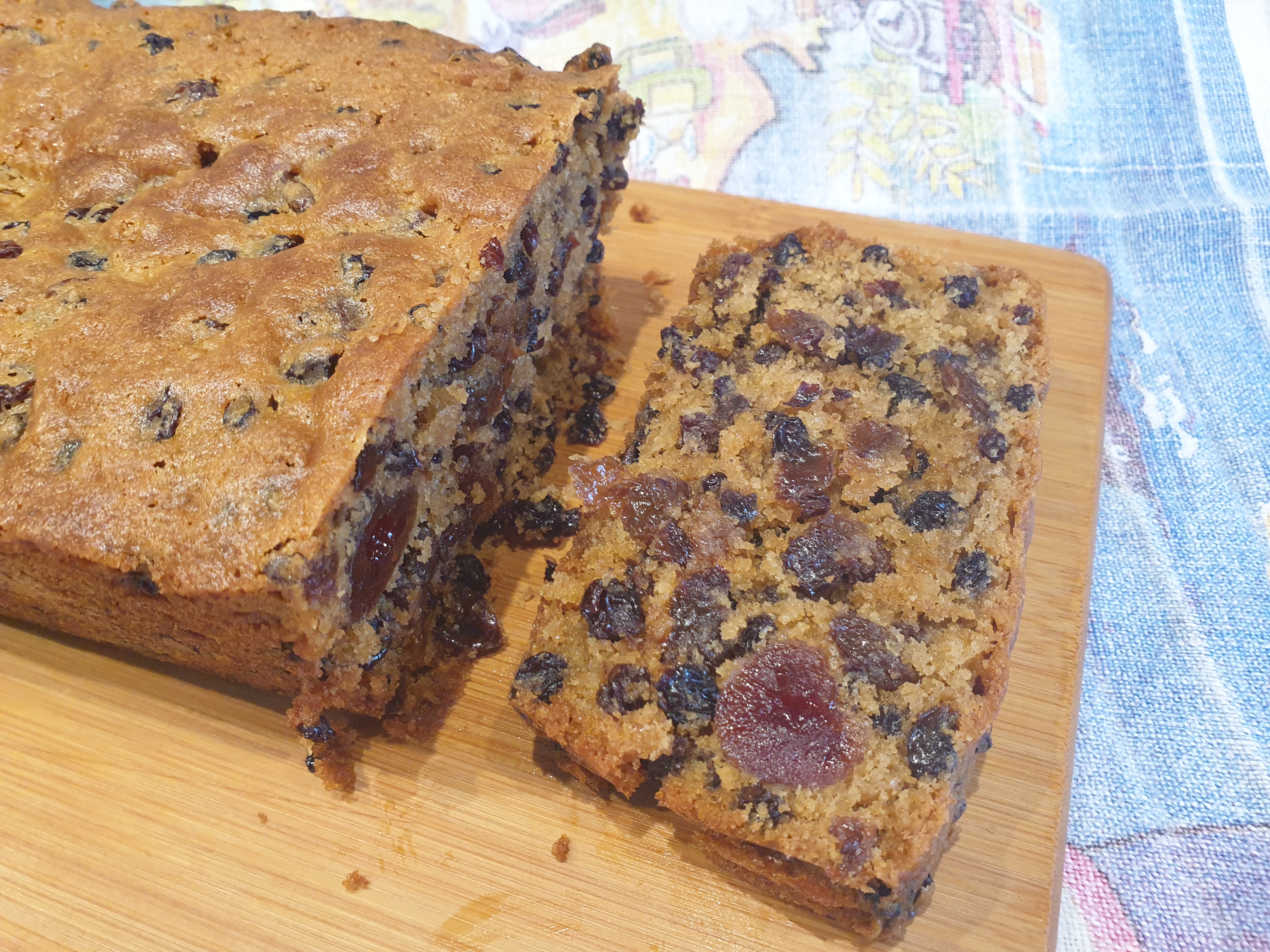
  • Keks is the word for a light fruit cake which is baked in a loaf tin or even more so a long narrow rectangular tin.
  • This recipe is adapted from an old Yorkshire recipe but would equally be liked in Poland.
  • The fruit in this recipe is may be bit higher than in some keks recipes,
  • In England this cake could be made at Christmas time.
  • The soft brown sugar could be replaced by granulated sugar (not tested)
  • The cake has to be started the night before.

INGREDIENTS

155g butter

140g soft brown sugar

3 eggs

*

225 raisins

225 currants

80g glacé cherries

60ml of brandy

*

155g plain flour

1½ teaspoons of baking powder

55g ground almonds

½ teaspoon of freshly ground nutmeg

1 teaspoon of mixed spice

METHOD

Soak the fruit with the brandy overnight.

Use a cake liner to line a 2lb loaf tin.

Pre-heat the oven to GM2.

Mix the dry ingredients together.

Cream the butter with the sugar.

Add the dry ingredients with an egg one at a time.

Stir in the fruit mixture.

Place the cake mixture into the cake tin and cook for around 2 hours – check after 1 30 minutes – should be golden and fully baked.

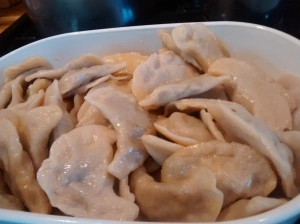
Pierogi – Cheese Savoury

  • Mama made these very often – I loved them.

  • She often made them for Friday, when this was a meatless day.
  • In Poland you may see these savoury cheese ones on a menu  as Pierogi ruskie   – that is  Ruthanian pierogifrom the old word for the Ukraine.
  • My mother would  boil extra potatoes on one day and save some to make these fillings the next.
  • They are super fried up later.

Ingredients – Cheese 1

Method

  • Peel and boil the potatoes in salted water, strain and mash, then leave to cool.
  • Chop the onion finely and fry it till it is soft and golden, allow it to cool.
  • Mix together thoroughly, the potatoes, onions, cheese and egg yolk.
  • Add salt and pepper to taste.

Ingredients – Cheese 2

  • When my mother did not have any curd cheese, she used Lancashire cheese, as that was the cheese most readily available to her.
  • Both versions taste good, the secret with this one is to grate the cheese as finely as possible and mix it in well.
  • *
  • 400g floury potatoes
  • 1 onion
  • 200g white crumbly cheese such as Lancashire
  • 1 egg yolk
  • Butter & oil to fry the onion
  • Salt & ground black pepper to taste

Method

  • Peel and boil the potatoes in salted water, strain and mash, then leave to cool.
  • Chop the onion finely and fry it till it is soft and golden, allow it to cool.
  • Grate the cheese as finely as possible.
  • Mix together thoroughly, the potatoes, onions, cheese and egg yolk.
  • Add salt and pepper to taste.

Make the pierogi in the usual way – instructions are given below.

  • Ingredients – Dough

  • 500g pasta flour or strong flour or plain flour & 2 tablespoons of fine semolina
  • 300ml water
  • 1 – 2 tablespoons oil – sunflower or light olive
  • ½ teaspoon salt
  • 2 egg yolks
  • *
  • Melted butter for serving or chopped onions cooked in butter.

Method – Dough

  • In a jug or bowl mix together the water, oil and the yolks.
  • Put the flour and salt into a large bowl and make a well in the centre.
  • Pour in the liquid from the jug and initially use a knife to mix this into the flour and then use your hands to mix the liquid and flour to get a ball of dough.
  • Turn this out onto a floured board and knead the dough for a few minutes until you have a smooth ball.
  • Cut the dough into quarters.
  • On a floured board roll out a quarter at a time until you have a sheet of thinly rolled dough.
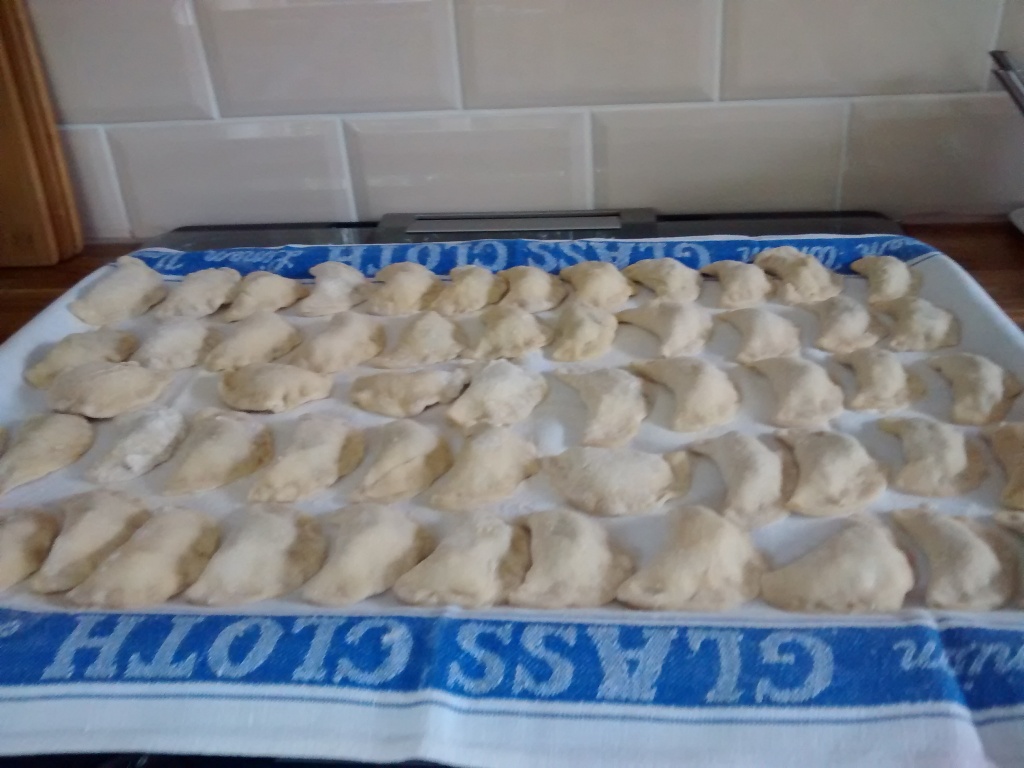
  • Now prepare a large tray and cover it with a clean tea towel and sprinkle this with flour.
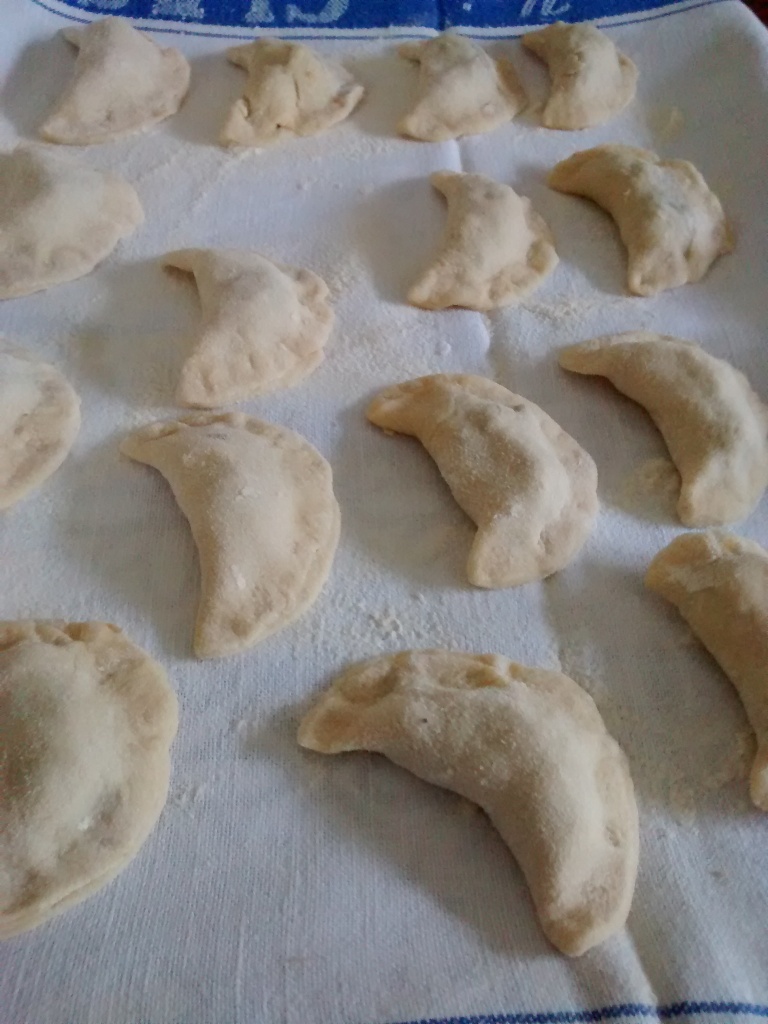
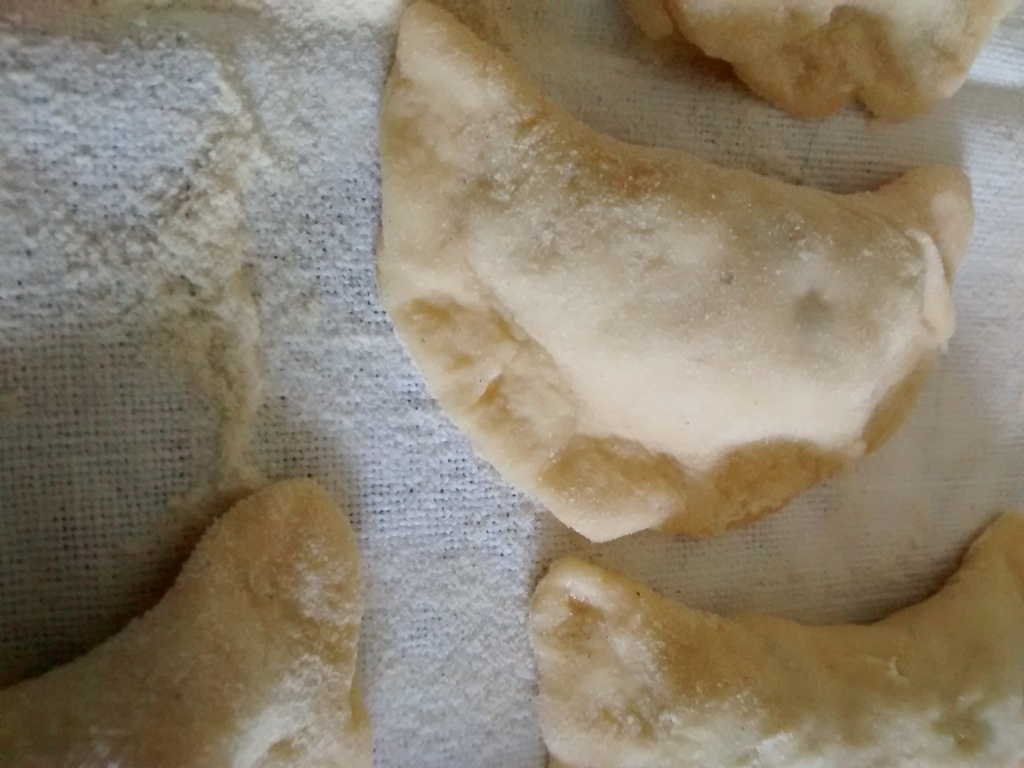
  • Have a large surface such as a tray covered with a cotton or linen cloth which has been lightly floured ready  and place the sealed pierogi on this until they are all made, do not let then touch each other.
  • I cut them out using a 7 cm diameter cutter.
  • I have noticed some people make them larger – I will try this out soon.
  • The excess dough can be re-mixed and rolled out again.
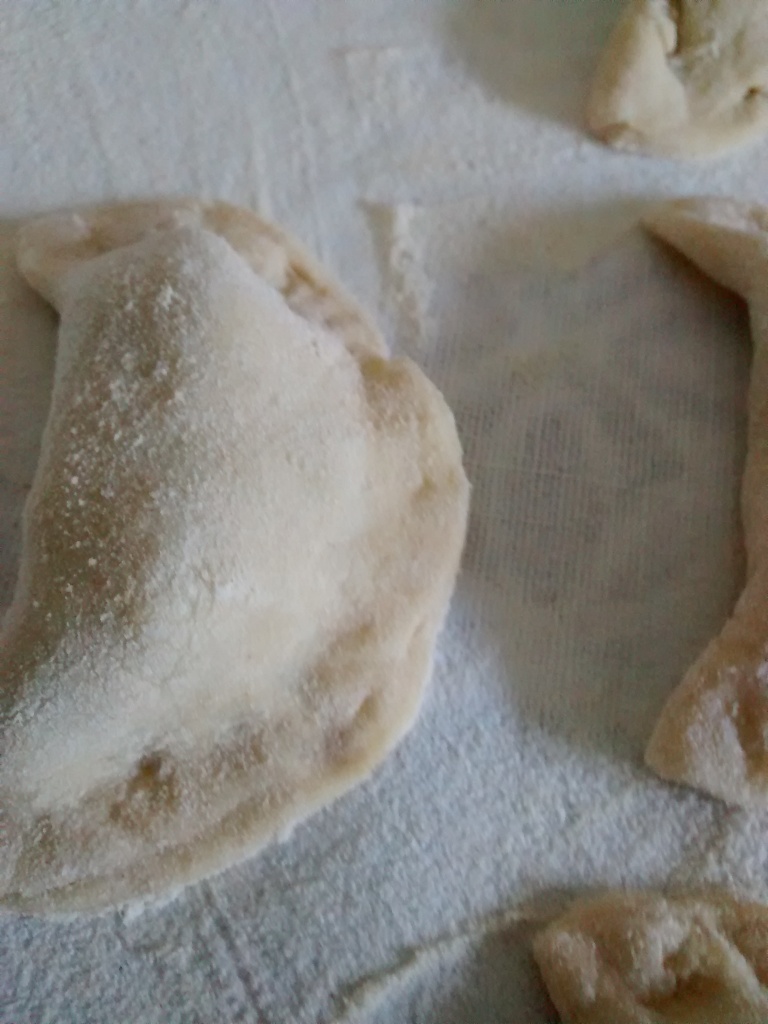
  • Around a half tablespoon of filling is put on  each circle and then they are folded over and the edges pinched together to make a good seal.
  • You learn from experience how much filling to put in as too much will make it hard to seal them and if not properly sealed they will burst on boiling. 
  • Do not worry if you have a few mishaps – it still happens to me even with experience – it is hard to salvage one that has gone wrong – just accept that there will be a few that you do not cook.
  • *
  • To cook the pierogi, use a large pan of boiling water to which you have added some salt and a drizzle of oil.
  • Drop the pierogi in one by one and allow them to boil.  I usually do about 6 to 8 at a time (I only do 6 at a time if using frozen ones).
  • As they cook they will float to the surface, let them boil for 2 to 3 minutes, (a bit more if they were frozen*), and
  • Then remove them with a slotted or perforated spoon and put into a colander above a pan for a few seconds to drain and serve.
  • Continue boiling batches in the same water.
  • If you want to make all the pierogi to serve together then you need to get a large shallow dish.*
  • Put in the pierogi and add melted butter.
  • Keep the dish warm in a low oven.
    • *I often open freeze them for later.

Cherry Buns

  • These ciasteczka – small cakes are made with glacé cherries.
  • Did you know that the centre for glacé cherries production is in Provence in France?
  • To keep their shape these are baked in greased bun tins whilst here bun cases were used as well.

INGREDIENTS

  • 220g plain flour
  • 2½ teaspoons of baking powder
  • 110g butter
  • 110g granulated sugar
  • 110g of glacé cherries – chopped into quarters
  • 1 egg – beaten
  • Grated rind of ½ a lemon
  • 2 – 3 tablespoons of milk

METHOD

  • Pre-heat the oven to GM5 – 190°C.
  • Mix the flour and the baking powder together.
  • Rub in the butter.
  • Add the sugar and chopped cherries.
  • Stir in the grated lemon rind.
  • Add the beaten egg and milk and lightly mix to a stiff consistency.
  • Spoon around 1½ tablespoons into each bun case, keeping them look ‘rough’.
  • Bake for 14 -15 minutes until lightly browned.

The plate stand is by Heathcote and was Made in England.

OPTIONS

Not tested but other glacé fruits could be used or dried fruits.

Pierogi – Meat Filling

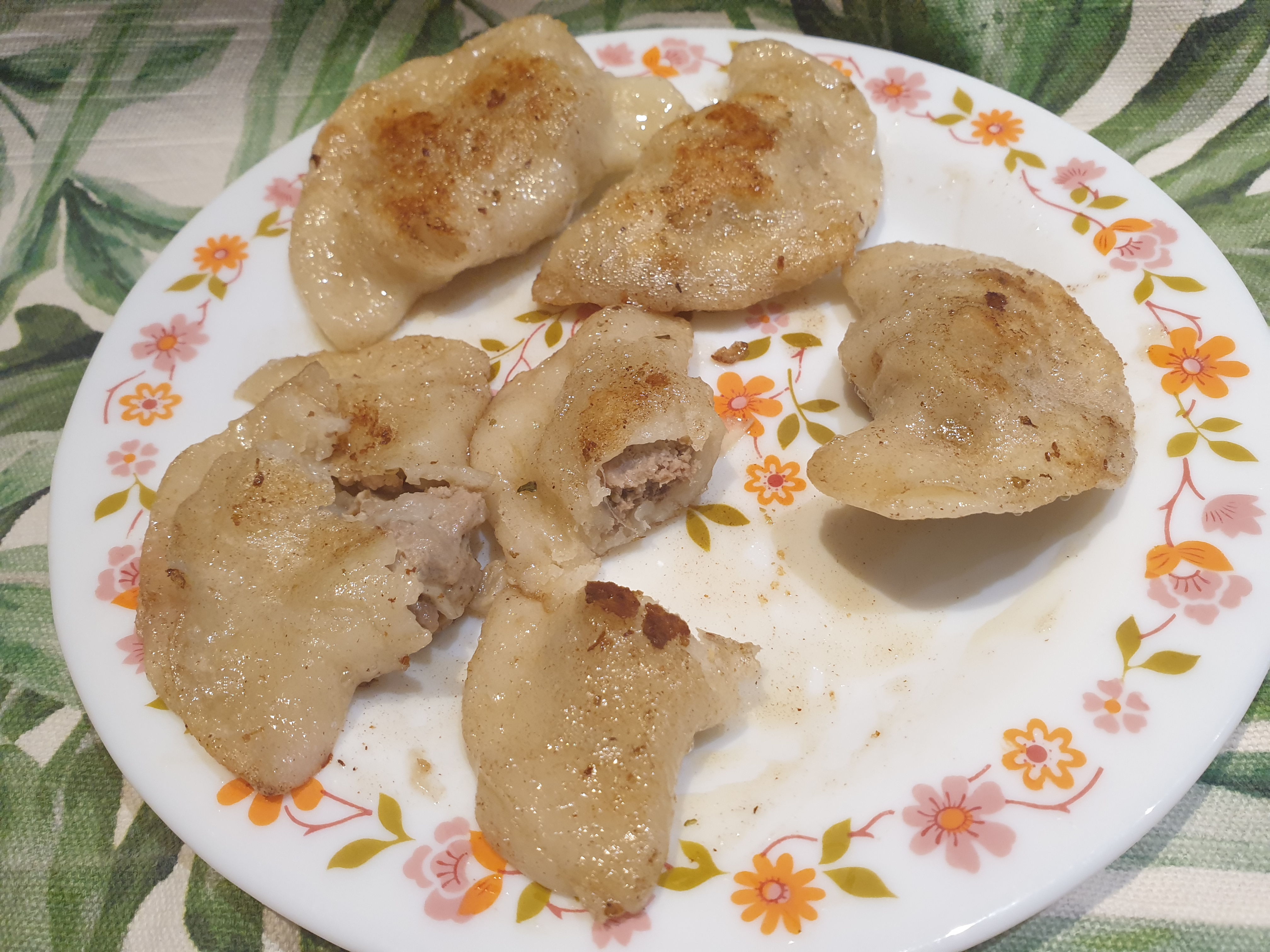
  • Pierogi with meat filling is one of the most usual ways my Mama made pierogi.
  • The meat was usually cooked pork, which had been left from a roast or gulasz the day before.
  • Below are instructions for cooking the pork from scratch in case you do not have any cooked pork.
  • At Christmas time the meat could have been chicken, should any have been left.

Ingredients

  • 300g shoulder or spare rib pork
  • 1 onion
  • 1 egg yolk
  • 1 tablespoon of dried breadcrumbs
  • Approx 250 ml of chicken stock – can be from stock cubes
  • Butter & oil to fry the onion
  • Salt & ground black pepper to taste

Method

  • Pre heat the oven to GM 3 – 1600C
  • Put the pork into a small casserole dish and cover it with the stock and put on the lid.
  • Put the dish in the oven for at least 1 hour, depending on the meat you might need longer.
  • Cook the meat until it is tender and can be broken up with a fork and most of the liquid has been absorbed.
  • Allow the meat to cool.
  • You can mince the meat but I find that if you cook it long enough you do not need to, you can just chop it with a sharp knife .
  • Chop the onion finely and fry it till it is soft and golden, allow it to cool.
  • Mix thoroughly together: the meat, onion, yolk and breadcrumbs and then add salt and pepper to taste.
  • *
  • Serve with melted butter or
  • Onions fried in butter or
  • Fried bacon bits – skwarki.
  • Make the pierogi in the usual way – instructions are given below.

    • Ingredients – Dough

    • 500g pasta flour or strong flour or plain flour & 2 tablespoons of fine semolina
    • 300ml water
    • 1 – 2 tablespoons oil – sunflower or light olive
    • ½ teaspoon salt
    • 2 egg yolks
    • *
    • Melted butter for serving or chopped onions cooked in butter.

    Method – Dough

    • In a jug or bowl mix together the water, oil and the yolks.
    • Put the flour and salt into a large bowl and make a well in the centre.
    • Pour in the liquid from the jug and initially use a knife to mix this into the flour and then use your hands to mix the liquid and flour to get a ball of dough.
    • Turn this out onto a floured board and knead the dough for a few minutes until you have a smooth ball.
    • Cut the dough into quarters.
    • On a floured board roll out a quarter at a time until you have a sheet of thinly rolled dough.
    • Now prepare a large tray and cover it with a clean tea towel and sprinkle this with flour.
    • Have a large surface such as a tray covered with a cotton or linen cloth which has been lightly floured ready  and place the sealed pierogi on this until they are all made, do not let then touch each other.
    • I cut them out using a 7 cm diameter cutter.
    • I have noticed some people make them larger – I will try this out soon.
    • The excess dough can be re-mixed and rolled out again.
    • Around a half tablespoon of filling is put on  each circle and then they are folded over and the edges pinched together to make a good seal.
    • You learn from experience how much filling to put in as too much will make it hard to seal them and if not properly sealed they will burst on boiling. 
    • Do not worry if you have a few mishaps – it still happens to me even with experience – it is hard to salvage one that has gone wrong – just accept that there will be a few that you do not cook.
    • *
    • To cook the pierogi, use a large pan of boiling water to which you have added some salt and a drizzle of oil.
    • Drop the pierogi in one by one and allow them to boil.  I usually do about 6 to 8 at a time (I only do 6 at a time if using frozen ones).
    • As they cook they will float to the surface, let them boil for 2 to 3 minutes, (a bit more if they were frozen*), and
    • Then remove them with a slotted or perforated spoon and put into a colander above a pan for a few seconds to drain and serve.
    • Continue boiling batches in the same water.
    • If you want to make all the pierogi to serve together then you need to get a large shallow dish.*
    • Put in the pierogi and add melted butter.
    • Keep the dish warm in a low oven.
    •  
      • *I often open freeze them for later.

Fig Placek

  • Did you know that figs were one of the first cultivated plants?
  • They were grown over 11,000 years ago in what was then called Mesopotamia.

INGREDIENTS

150g butter

140g granulated sugar

2 tablespoons of runny honey

2 eggs

230g dried figs (soft version used)

225g plain flour

1 teaspoons of baking powder

1 teaspoon of mixed spice

Pinch of salt

Large pinch of bicarbonate of soda

3-4 tablespoons of milk to mix

METHOD

Pre-heat the oven to GM3 – 160°C.

Grease and line – 3 sides of a 26 x 20cm baking tin.

*

Chop the figs into small pieces.

*

Mix the flour, spices, salt, baking powder and bicarbonate of soda together,

*

Cream the butter and sugar

Add the honey and cream some more

Add the eggs and mix together.

*

Stir in the flour mixture.

Stir in the chopped figs.

Stir in the milk to make a soft mixture.

Spoon the cake mixture into the tin and smooth the top.

Bake for 35 – 40 minutes

Check earlier and cover if necessary to prevent burning the top.

Royal Worchester Evesham Vale tea plates.

Pierogi – Sauerkraut & Carrot

  • I tried some pierogi recently which had a variation on the sauerkraut filling.
  • The mixture contained grated carrot.
  • I discovered that the sauerkraut and carrot mix can be bought in a jar and this is what I used.

Ingredients – Filling

  • 1 jar of sauerkraut and carrots
  • 1 large onion – chopped fine
  • 25 -30g dried mushrooms – soaked overnight
  • Butter to fry the onion
  • Salt & Pepper to taste
  • OPTION 
  • Add fresh mushrooms fried in butter and chopped fine to the filling.

Method – Filling

  • Soak the mushrooms overnight.
  • Strain the mushrooms – keep the liquor.
  • Chop the mushrooms into small pieces.
  • Strain the sauerkraut and carrot mixture – keep the liquid – there may not be very much.
  • Chop the sauerkraut and carrots into small pieces.
  • Put the sauerkraut and carrot mixture and liquid into a pan.
  • Add the chopped mushrooms and the liquor.
  • Add boiling water to cover.
  • Put a lid on the pan
  • Cook the gently for around 30 minutes.
  • Check occasionally.
  • Leave to cool.
  • Strain the mixture in a large sieve
  • You can put this into a clean dry cotton or linen cloth and twist the ends together –
  • Squeeze to get it really dry.
  • *
  • Chop the onions finely and fry them till they are soft and golden.
  • Mix the sauerkraut, carrots, mushrooms and onions together.
  • Add some ground black pepper to taste; salt should not be necessary.
  •  
  • (Add the fried chopped mushrooms if using.)
  •  
  • I have written much previously about pierogi  – but have again included the instructions for the dough below.

Ingredients – Dough

  • 500g pasta flour or strong flour or plain flour & 2 tablespoons of fine semolina
  • 300ml water
  • 1 tablespoon oil – sunflower or light olive
  • ½ teaspoon salt
  • 2 egg yolks
  • *
  • Melted butter to serve

Method

  • In a jug or bowl mix together the water, oil and the yolks
  • Put the flour and salt into a large bowl and make a well in the centre.
  • Pour in the liquid from the jug and initially use a knife to mix this into the flour and then use your hands to mix the liquid and flour to get a ball of dough.
  • Leave for around 20 -30 minutes in a cool place.
  • Turn this out onto a floured board and knead the dough for a few minutes until you have a smooth ball.
  • Cut the dough into quarters.
  • On a floured board roll out a quarter at a time until you have a sheet of thinly rolled dough.
  • Now prepare a large trays and cover them with clean tea towel sprinkle with flour.
  •  Place the sealed pierogi on this until they are all made, do not let then touch each other.
  • I cut them out using a 7 cm diameter cutter.
  • The excess dough can be re-mixed and rolled out again.
  • Around a half tablespoon of filling is put on  each circle and then they are folded over and the edges pinched together to make a good seal.
  • You learn from experience how much filling to put in as too much will make it hard to seal them and if not properly sealed they will burst on boiling. 
  • Do not worry if you have a few mishaps – it still happens to me even with experience – it is hard to salvage one that has gone wrong – just accept that there will be a few that you do not cook.
  • *
  • To cook the pierogi, use a large pan of boiling water to which you have added some salt and a drizzle of oil.
  • Drop the pierogi in one by one and allow them to boil.  I usually do about 6 to 8 at a time (I only do 6 at a time if using frozen ones). ( I often open free some of them.)
  • As they cook they will float to the surface, let them boil for 2 to 3 minutes, a bit more if they were frozen, and then remove them with a slotted spoon and put into a colander above a pan for a few seconds to drain.
  • Continue boiling batches in the same water.
  • If you want to make all the pierogi to serve together then you need to get a large shallow dish and put in the pierogi and add melted butter.
  • As you take out the cooked pierogi add them in the dish.
  • Keep the dish in a  warm oven.
  • Keep on adding more as they cook
  • Do not let them stick together – keep mixing them in the butter.
  • OPTIONS
  • Serve with melted butter or
  • Melted butter and breadcrumbs or
  • Onions fried in butter or
  • With fried bacon bits – skwarki.

“Our Food is Our Identity”

  • Claudia Roden was born in Cairo, Egypt in 1936.
  • She moved to Paris in 1951.
  • Then to London in 1954.
  • Her family was Jewish.
  • She collected recipes from family, friends and anyone else who would contribute.
  • She has written many cookery books.
  •  I recently bought a second hand copy of ‘Jewish Cookery from Samarkand to Vilna’- mainly because of the Polish connections, especially Vilna (Wilno), the nearest large town my father identified with.
  • A few years ago I heard a programme on the radio in which Claudia said
  • “Our Food is Our Identity”.
  • I so agree with this statement.
  • *
  • Polish Cookery is influenced by food from other countries  – in the past from France, Italy & Germany as well as – Lithuania, Finland & Sweden.
  • Jewish cookery has also influenced some of the dishes served in Poland.
  • Many people say  that when they made a recipe they always remember the person that gave then this recipe.
  • Do you have such recipes?
  • Here are just a few of my Mama’s recipes, which will always remind me of her.
  • *
  • Bigos
  • Pierogi
  • Polish Apple Cake
  • Polish Potato Pancakes

Fish Pie

  • This is a popular dish in the North of England.
  • Although it is called a ‘pie’ it is not topped with pastry but with mashed potatoes.
  • This is a simple, more traditional version using just white fish.
  • Haddock would have been the most common fish used in the past, here Basa was used.
  • This could easily be made in Poland.
  • Everyone loved this so I have included it in my recipes.

INGREDIENTS

300-400g of white fish

400ml of milk

2 tablespoons of plain flour

2 tablespoons of butter

50g of cheddar cheese – grated

2 hard boiled eggs

Flat leafed parsley – chopped.

Salt & pepper

*

400 – 600g of starchy potatoes – depends on the size of the top of the dish being used

Butter & milk to make mashed potatoes

METHOD

Pre-heat the over to GM4 – 180°C.

Have ready a rectangular or round deep oven proof dish.

Peel and boil the potatoes.

Drain and mash the potatoes with butter and milk.

*

Poach the fish in the milk.

Drain the poached fish, break into small pieces and place them in the dish.

Cut the eggs into halves or quarters.

Place the cut eggs on top of the fish.

Sprinkle with salt and pepper.

Sprinkle with the chopped parsley.

Use the milk for the poaching and the flour and butter to make a sauce.

Add the grated cheese and mix well.

Pour the sauce over the fish and eggs and mix slightly.

*

Cover with a thick layer of mashed potatoes.

Use a fork to make patterns in the top.

Bake for around 44 – 55 minutes.

*

Serve with green vegetables such as peas, green beans or cabbage.