Herring Salads

Salted herrings are very, very popular in Poland, they have been a staple in Northern Europe since Medieval times as this was the way to preserve and transport fish – usually in barrels.

Śledź is the Polish word for herring.

Matjes herrings (matjasy in Polish) are young herrings which are caught throughout May and June before they start spawning in July.

The way that they are prepared originated in The Netherlands and the name comes from the Dutch word maagd which means maiden(because they are young fish).

Often you will see the phrase à la matjas – this means that they are in the style of the matjes herring but they will be a slighty older fish and not as expensive .

Salted herrings need to be soaked, often for up to 24 hours, in water to remove some of the salt.

I have used already prepared à la matjas herrings and I think they are still too salty – so I take the fillets out of the oil they are packed in and put them in milk for 10 to 15 minutes (you can do longer) and then pat them dry and slice them.


These herring salads are often served as an hors d’oeuvre (zakąska in Polish – something to bite after), appetizer, entrée or starter.

They are usually one of the dishes served at Wigilia (Christmas Eve).

Thinly sliced onions are a must to serve with the herrings!

Simple Herrings 1

Ingredients

  • Thinly sliced herrings
  • Thinly sliced onion
  • A little lemon juice

Simple Herrings 2

Ingredients

  • Thinly sliced herrings,
  • Thinly sliced onion
  • Chopped gherkins (ogórki).
  • A little liquor from the gherkin jar

Simple Herrings 3

Ingredients

  • Thinly sliced herrings,
  • Thinly sliced onion and
  • Sliced (red skinned) apple
  • A little lemon juice

Herring Salads

The dressings used are: lemon juice, mayonnaise (full fat is best here), soured cream and horseradish – on their own or as a mixture.


I have not given quantities – exact amounts are not critical.

Herring & Apple Salad

Ingredients

  • Thinly sliced herring
  • Thinly sliced onions,
  • Chopped (red skinned) apples
  • Dressing

Herring & Potato Salads

The following salads are variations on  classic Polish potato salads.

Herring, Potato & Gherkin

Ingredients

  • Thinly sliced herring
  • Thinly sliced onions
  • Cold boiled or steamed,chopped potato,
  • Chopped gherkins
  • Dressing


Herring, Potato, Gherkin & Hard-boiled Eggs

Ingredients

  • Thinly sliced herring
  • Thinly sliced onions
  • Cold boiled or steamed,chopped potato,
  • Chopped gherkins
  • Chopped hard-boiled eggs
  • Dressing


Herring, Potato & Peas

Ingredients

  • Thinly sliced herring
  • Thinly sliced onions
  • Cold boiled or steamed, chopped potato,
  • Cooked peas
  • Chopped hard-boiled eggs
  • Dressing

Herring, Potato, Peas & Hard-boiled Eggs

Ingredients

  • Thinly sliced herring
  • Thinly sliced onions
  • Cold boiled or steamed, chopped potato,
  • Cooked peas and dressing
  • Chopped hard-boiled eggs
  • Dressing

Herring, Apple, Bean & Hard-boiled Eggs

When I first saw this recipe I was not sure how the beans would go with the rest of the ingredients.  Having tried it,  I think the taste combination is wonderful!

Ingredients

  • Thinly sliced herring
  • Thinly sliced onions
  • Chopped (red skinned) apples
  • Haricot beans  – tinned beans  with the tomato sauce washed off , rinsed and patted dry
  • Chopped hard-boiled eggs
  • Dressing

Chopped parsley & chives

All of the salads can have chopped flat-leafed parsley and/or chives sprinkled on top.


Updated April 2020

Sauerkraut & Mushrooms

Sauerkraut & Mushrooms  is often one of the dishes  for Wigilia (Christmas Eve) when meat is not eaten.

Ingredients

  • 1 large jar  of sauerkraut – around 800 – 900g.
  • 20 – 30g of dried mushrooms
  • 1 tablespoon granulated sugar
  • 1 onion – finely chopped
  • 2-3 tablespoons of plain flour
  • Butter or oil for frying the onion
  • Ground black pepper
  • *
  • The acidity of sauerkraut varies very much and homemade is often not as acid.
  • Rinsing bottled sauerkraut before use will lower the acidity.
  • *
  • The amount of  sugar  you add to the dish is a personal preference – if rinsed 1 tablespoon should be enough – if not rinsed you might need around 3 tablespoons.

Method

The evening before you want to make this dish place the dried mushrooms in a small bowl and cover them with boiling water and leave them overnight.

  • Cut the reconstituted mushrooms into strips.
  • Put the strips and the liquor into a saucepan and simmer them for around 5 minutes.
  • Drain the sauerkraut and keep the liquid (you might want to use it to adjust the acidity of the dish).
  • Rinse the sauerkraut with cold water.
  • Place the sauerkraut in a large saucepan and pour boiling water over it until it just covers it.
  • Add the sugar.
  • Bring to the boil and then cover the saucepan with a lid and let it gently simmer for around 10  minutes.
  • Add the mushrooms to the sauerkraut and mix together.
  • Continue heating either gently on top of the stove or put the pan with the lid into a low to medium oven.
  • Cook until the sauerkraut is soft.
  • Fry the onions until they are golden.
  • Sprinkle the flour over the onions and heat gently to brown the flour.
  • Add spoonfuls of liquid from the sauerkraut mixture to the onion mix.
  • Stir and heat to form a thickening roux/paste.
  • Add this to the sauerkraut mixture and mix throughly .
  • You can then serve this straight away or put it back in the oven for around 5 minutes.
  • Sprinkle ground black pepper on the top before serving.
  • Served here in Carnation by Royal Doulton, 1982 – 1998.
  • Serve with rye bread or boiled potatoes and hot roast pork or cooked Polish sausages.
  • For Wigilia (Christmas Eve ) this  would just be served as a separate dish.


Caraway Seed Cake

Caraway is such a popular herb/spice in Poland and is used in breads, meat & vegetable dishes.  So it is quite surprising that it is not used  in cake.

Caraway – Image from Wikapedia


I have looked in all my recipe books and I have not found any use of caraway in Polish cake.

So I have gone to what by many is seen as an old-fashioned  quintessential British cake – Seed Cake – which is  Caraway Seed Cake.

This cake has been popular since the 17th century and especially  in Victorian times  and the 1920s and 1930s.

Caraway Seeds are thought to aid digestion – so this is a good cake to have at the end of a meal.

I have found several variations – this is one that has worked for me & I am sure it would be well received in Poland!

I have tried this out in 2 different shapes of tins.

Ingredients

110g butter

110g caster sugar

2 eggs – beaten

150g self-raising flour – sifted

25g ground almonds

3 tablespoons of milk

3 rounded teaspoons of caraway seeds

Several crushed sugar cubes or 1 level tablespoon of Demerara sugar for the round cake and 1/2 a tablespoon for the loaf.


Version 1

Method

Pre-heat the oven to GM 4 – 180°C.

Grease a 19cm round cake tin and line the bottom with greaseproof paper.

Mix the flour, ground almonds and caraway together in a little bowl.


In a larger bowl, cream the butter and sugar together until they are pale and fluffy.

Beat in the eggs a little at a time.

Using a metal spoon fold in the flour mixture.

Add the milk to give a good dropping consistency.

Spoon the cake mixture into the prepared tin and level off the top.

Sprinkle the top with the sugar.


Bake for between 35 – 40 minutes.

Cool in the tin for 15 minutes.


Version 2

Method

Pre-heat the oven to GM 4 – 180°C.

Line a “1lb” loaf tin with a tin liner or grease and line the tin with greasproof paper.

Make the mixture as in version 1.

Sprinkle the top with the 1/2 tablespoon of Demerara sugar.

Bake for between 45 to 50 minutes.

Cool in the tin for 15 minutes.

Once cold, wrap in foil and keep in an air tight container.


Caraway & Dill & Parsley

When I think of Polish cooking three popular herbs which always spring to mind are caraway, dill and parsley.

They all  belong to the Apiaceae family which includes  carrot and celery. 

This family is also called  Umbelliferae (from the Latin – umbella  – for parasol or sunshade) – the flower heads consists of umbels  which have equal length flower stalks coming from a central point which forms a flattened head – rather like an umberella.

Carum carvi is caraway –  kminek – in Polish.

It  is native to  Europe,  North Africa & Western Asia.

Caraway – Drawing taken from Wikapedia


Caraway  fruits are often called seeds.

Caraway is thought to be an aid to digestion.

In 2011 Finland supplied over 25% of the world’s caraway.


Caraway is often added to rye bread, to dishes with sauerkraut and also many meat dishes,  especially pork, such as Sauerkraut & BaconPork & Prunes  and  Pork & Sauerkraut Gulasz.

Caraway  is often  added to twaròg (Polish soft curd cheese)


Anethum graveolens is dill – koperek  – in Polish.

Dill is grown for its leaves, which are fern like, and its seeds.

Dill leaves are  best when used fresh  (I never bother with dried dill).


Dill  leaves are used as a topping for many salads and for boiled new potatoes.


Dill leaves are added to twaròg (Polish soft curd cheese) and smetana (soured cream).

Dill leaves are used in sauces including ones served with fish.


Dill seeds are similar in flavour to caraway seeds.

Dill seeds are used in dill pickles –    – which are cucumbers preserved in brine – Ogórki – Gherkins


The name of the Polish astronomer  – Copernicus  in Polish is  Kopernik (so in Polish he is Mr Dill!)

Petroselinum crispum is flat leaf parsley – pietruszka –  in Polish

Flat Leaved Parsley


Chopped flat leafed parsley  leaves are added as a garnish or topping for many salads and savoury dishes.


Petroselinum crispum tubersum

This is Parsley root or Hamburg parsley.

Flat leafed parsley is also grown for its white tap root which looks a lot like parsnip and is also used in  Polish cookery, often added to casseroles.

I have seen this for sale in Polish markets, you might find it in the larger Polish shops that have fresh produce.

20180314_172735


Parsley root grated with apple or pear and with added lemon juice is one suggestion for a fresh salad.


Drożdżówka – Yeast Cake

  • The Polish word for yeast is drożdże and drożdżówka is any sweet cake or bun made using yeast.
  • Often the cake is a large flat cake ( placek) made in a large roasting tin.
  • This yeast cake is made with plain flour not strong flour and the mixture is mixed with a wooden spoon to form a soft mixture and is not kneaded.
  • My late father has two cousins living in Białystok, North East Poland, they are both wonderful cooks.
  • This yeast cake is based on a recipe given to me by one of these aunties.
  • As with any recipe made with yeast, timings are so unpredictable depending on many variables including the room temperature.
  • I always bake with yeast when I am at home for most of the day with other activities to do whilst waiting for the dough to rise etc.

Ingredients

Yeast Cake

  • 400g plain flour
  • 250ml of tepid milk
  • 1 egg
  • 2 tablespoons of granulated sugar
  • 1 tablespoon of sunflower oil
  • 150g of raisins or sultanas
  • 10g of fresh yeast or 5g of dried yeast

Crumble Topping

  • 2 tablespoons of plain flour
  • 1 tablespoon of butter
  • 1 tablespoon of granulated sugar

Method

  • Mix the yeast with 2 tablespoons of the milk and 1 tablespoon of the sugar and leave this till it starts bubbling.
  • In a bowl whisk together the egg  and 1 tablespoon of the sugar.
  • Add the oil and whisk again.
  • Add the milk and the raisins or sultanas and mix well.
  • Add the flour and mix this all together with a wooden spoon to form a very loose, soft dough.
  • Cover the bowl with clingfilm or a cloth and leave in a warm place to rise.
  • Make the crumble topping by rubbing the butter into the flour until the mixture resembles bread crumbs and then stir in the sugar.
  • Grease and line a large roasting tin.
  • 25cm x 34 cm or 22cm x 32cm.
  • Put the risen dough into the tin – use a spatula to spread it out.
  • Sprinkle the crumble mixture over the top and leave to rise again.


  • Pre-heat the oven to  GM6 – 200°C.
  • Place the risen cake into the oven and bake for 15 minutes.
  • Then lower the temperature to GM5 – 190°C and bake for another 10 minutes – keeping an eye on this and cover with foil if it looks like it is burning.
  • You might want also want to move it down a shelf for the last 5  minutes.
  • Leave to cool in the tin for about 5 minutes then take it out and remove from the greaseproof paper – so it does not go soggy on the base.


Served on Sonnet by Royal Doulton, 1971 – 1998.

As with most yeast cakes this is best eaten as soon as possible as it will soon go stale – you might need to invite round lots of friends and family!

If all is not eaten on the day of baking, I cut the cake into slices and pack into a plastic container and freeze – these are then toasted and served with butter at a later date.


Toasted and buttered yeast cake served on Las Palmas by Aynsley from the 1960s.

Variations

The dried fruits added can be varied  and I have made this with raisins, mixed peel and 1 teaspoon of mixed spice.


Served on Counterpoint by Royal Doulton, 1973 – 1987.

Other dried fruit options can be used, such as apricots, cranberries, pears or prunes and so on,  chopping larger fruits into small pieces.

I made this with apricots, sultanas and a 1/4 teaspoon of vanilla essence.


The dried fruits add sweetness to the cake and I think the small amount of sugar works well – you can if you like add a few extra tablespoons of sugar.


Karpatka – Carpathian Mountain Cake

Karpatka – Carpathian Mountain Cake  – gets its name as the top looks like the rugged mountains and the icing sugar dusting looks like a fine covering of snow.

The Carpathian Mountains – Karpaty in Polish –  are a mountain range in an arc roughly 1,500 kilometres in central and eastern Europe; part of the range is in Southern Poland  and can be described as Alpine.


It is made with 2 layers of  choux pastry with vanilla pastry cream in between the layers and the top dusted with icing sugar.

Choux Pastry

This was invented by an Italian chef in the mid 16th century and soon became popular in France.  It gets its name from the French for cabbage as the little buns made from this pastry  looked like little cabbages.

It is made without any raising agent. It is the large water content in the dough which turns to steam in the high oven temperature which causes the pastry to rise.

  • I read loads of conflicting advice on how to make choux pastry. 
  • My first attempt came out more like a Yorkshire pudding.
  • After several attempts I  now have a recipe that works.

Ingredients

  • 6 eggs
  • 300ml of water
  • 2 teaspoon of granulated sugar
  • 200 g of plain flour or strong plain flour *
  • 100g butter
  • pinch of salt
  • *Using strong flour gives a drier pastry whilst using plain flour gives a softer pastry.

Method

  • Pre-heat the oven to GM6 200°C
  • Grease 2 equal sized rectangular baking trays with sides or a large rectangular tin.
  • Put the water, pinch of salt, sugar  and the butter into a saucepan.
  • Heat gently so the butter melts and then slowly bring this to the boil.


  • Sift the flour.
  • Taking the pan off the heat add the flour, all in one go.
  • Return the pan to a gentle heat.
  • Using a wooden spoon blend this all  together until the dough forms a ball in the middle of the pan.


  • Take the pan off the heat and put the dough into a bowl and leave till it is completely cold.
  • Add the eggs one by one, continually blending the mixture. You can use a wooden spoon to do this – I have found it easier to start with an electric whisk to begin with and then change to a wooden spoon at the end.  You get a thick paste type mixture.


Divide the mixture between the two trays and spread it out to fill the tray – do not smooth down the top – you want to have rough peaks.

  • Bake for  10 minutes.
  • Increase the heat up GM7 – 220°C and bake for another 10 minutes
  • Using a cake tester make holes in the top of the pastry to remove some of the steam.
  • Bake for another 5 – 10 minutes.
  • The pastry should be ready now, test to see if it feels dry – if not return for a few more minutes.

Vanilla Pastry Cream

Ingredients

Budyń made with 500ml of milk.

  • 3 tablespoons  of granulated sugar
  • 2-3 drops of vanilla essence
  • 1 egg yolk
  • 125g butter

Method

  • Cream together the butter, sugar and egg yolk till pale and fluffy.
  • Add the vanilla essence and mix this in well.
  • Add the budyń, spoonful by spoonful, mixing it well in.

Assembling the Cake

Note

Whilst testing this recipe, I used half quantities of the choux pastry – ie just 1 tray – and cut this in half – the photographs – reflect this.

Great Cake Lifter


  • Place one piece of the baked pastry onto a serving board.
  • Cover the pastry with all the  pastry cream spreading it evenly  to the edges.
  • Place the second piece of pastry on top.
  • Dust the top lightly with icing sugar.
  • Cut into squares to serve.


Served on Las Palmas by Aynsley  from the 1960s.

Easier Option

Though not as authentic but easier you can just use the chilled budyń on its own as the filling.

Served here on  Greenaway by John Russell from the 1960s.


Budyń – Polish Custard

Budyń is similar to the thick English custard that is used on trifles, rather than the pouring type.

The word comes from the French  –  boudin, as does the English word pudding.
It is made from milk, egg yolks, sugar  and potato flour & flavoured most often with vanilla.

I have found numerous recipes – this one is my favourite.

I think this is best eaten after it has been very well chilled.

Ingredients

  • 500ml of milk (full or semi-skimmed)
  • 1 tablespoonful of butter
  • 3 tablespoons of granulated sugar
  • 3 drops of vanilla  essence
  • 2- 3 tablespoonfuls of potato starch (you can use cornflour – if potato flour is not available)
  • 3 egg yolks

Method

  • Put 300ml of the milk, the butter, sugar and the vanilla essence into a saucepan.
  • Heat gently till the butter has melted and the sugar dissolved, stirring all the time.
  • Bring this to the boil for a few seconds and then take of the heat.
  • Blend together the rest of the milk (200ml) with the egg yolks and potato flour.
  • Add some of the boiled mixture to this and stir well.
  • Add this to the rest of  the boiled mixture and stir well.
  • Put the pan back on the heat and bring back to boiling point, stirring gently.
  • Keep at boiling for 1 minute, stirring all the time.
  • Pour into a glass dish (or several small dishes) – leave to cool.
  • You can cover the budyń with greaseproof paper to stop a skin forming.


  • Refrigerate for at least 2 hours before serving.
  • Serve with grated chocolate, fruit or fruit syrup.


Served  here in Art Deco sundae/trifle glass dishes from the 1930s.

Packet Budyń

Budyń can be made from packet ingredients with fresh milk.

The ingredients are cornflour & potato flour with flavouring.


This is similar to  British Birds custard which is made from cornflour and flavouring and added to fresh milk.

The budyń comes out thicker – not a pouring sauce,

Using Budyń

Budyń is used in cakes and pastries as a filling and to make  vanilla pastry cream used in several recipes including Karpatka (recipes to follow in future posts) Carpathian Mountain Cake.

Vla

When I visit my friend in The Netherlands we often have vla for dessert – this is very similar to budyń.

Vla used to be sold in bottles but more often now comes in cartons.  Originally it was also made from milk, sugar and eggs  but now the thickening is more usually cornflour.

With yoghurt

In the Netherlands,  vla is often mixed with yoghurt.

I mix roughly equal parts of budyń with chilled Greek yoghurt and whisk it together to get a well combined mixture.

This can be served with grated chocolate, fruit or fruit syrup.


1930s Art Deco glass dish


Ribs with Sauerkraut

For this dish use the best pork you can buy – I used some locally reared Yorkshire pork.

Ingredients

1 -2  racks of pork ribs

900ml – large jar of sauerkraut

2 onions – thinly sliced – fried.

1 teaspoon caraway seeds

2 cloves of garlic – chopped

1 tablespoon of sugar (more or less depends on the sourness of the sauerkraut)

4-5 peppercorns

350ml- of chicken stock (can be from a cube or concentrate) – extra might be needed for topping up.

Caraway Seeds

Method

Take the sauerkraut out of the jar and put into a saucepan with any liquid from the jar.

Cover the sauerkraut with water and simmer gently for 20 minutes.

Pre-heat the oven to GM3- 160°C

You need a large oven proof dish with a lid  – I use an enameled dish.

Put the sauerkraut, and any liquid, and onions in the dish and mix well.

Add, caraway, garlic, sugar & peppercorns.

Pour most of the stock over the sauerkraut mixture.

Place the ribs on top of the sauerkraut and pour the rest of the stock over them.


Put the lid on the dish and place in the oven.

Check on the liquid level during the cooking time and add any extra needed so it does not dry out.

Move some of the sauerkraut  mixture over the ribs.

Cook for 3-4 hours.

This would usually be served with either rye bread or boiled potatoes.

Sauerkraut – Traditional with Bacon

This is  a very popular dish to make in the winter time with produce from the stores.

Ingredients

1 large jar sauerkraut – 800-900g

100g smoked streaky bacon

1 onion

1 teaspoon caraway.

2-3  tablespoons of plain flour

Oil or bacon fat for frying

1 tablespoon granulated sugar*


*The acidity of sauerkraut varies very much and homemade is often not as acid.

*Rinsing bottled sauerkraut before use will lower the acidity.

*The amount of  sugar  you add to the dish is a personal preference – if rinsed 1 tablespoon should be enough – if not rinsed you might need 1 -2 tablespoons more.


Method

Drain the sauerkraut and keep the liquid ( you may want to use it to adjuct the acidity of the dish later ).

Rinse the sauerkraut with cold water.

Place the sauerkraut in a large saucepan and pour boiling water over it until it just covers it.

Add the sugar.

Bring to the boil and then cover the saucepan with a lid and let it gently simmer for around 10  minutes.

Continue heating either gently on top of the stove or put the pan with the lid into a low to medium oven.

Cook for  around another 30 minutes until the sauerkraut is soft.

Remove the pan from the heat and add the caraway seeds – put the dish  back into oven or keep on the stove with the lid on.

Chop the bacon into small squares and heat gently in a frying pan to release the fat.

Chop the onions into small pieces and add them to the pan and fry the onions until they are golden.

Sprinkle the flour over the onions and heat gently to brown the flour.

Add spoonfuls of liquid from the sauerkraut mixture to the onion mix.

Stir and heat to form a thickening roux/paste.

Add this to the sauerkraut mixture and mix throughly.

Put the pan back in the oven for around 10 minutes – or heat gently on the stove.

Sprinkle ground black pepper on the top before serving.

Serve with rye bread or boiled potatoes and hot roast pork or cooked Polish sausages.


Here served with Kolos rye bread,  from the Bradford Ukranian Bakery,  founded in 1961 and grilled Polish sausage from Torun (kiełbasa Toruńska) – the birthplace of the astronomer Copernicus (Kopernik ) – also famous for its spiced honey cake (piernik)

Served on Carnation by Royal Doulton, 1982 – 1998.


Kotlety with Cabbage

  • On my last trip to Poland my  cousin in Białystok suggested this variation on kotlety mielone – minced meat burgers.
  • The idea is to add shredded white cabbage to the minced meat mix.
  • I used the following  amounts by weight:
  • 2 parts minced meat : 1 part cabbage – you can go up to equal weights of each.

Ingredients

  • 500g beef mince
  • 250g white cabbage
  • 1 onion – chopped fine
  • 3  tablespoons semolina*
  • 2 eggs
  • Dried breadcrumbs
  • Salt  and pepper
  • * I used semolina instead of my usual white bread soaked in milk – I was pleased with this as an alternative.
  • Sunflower oil  for frying

Method

  • Chop the onion fine and fry in a little hot oil till lightly browned then leave till cold.
  • Cut the cabbage into fine shreds and then across so you have small squarish pieces.
  • In a large bowl mix the minced meat and cabbage till they are evenly mix.
  • Add the fried onions and mix again.
  • Add the eggs and mix.
  • Add the semolina, salt and pepper and mix until you get a uniform mixture.

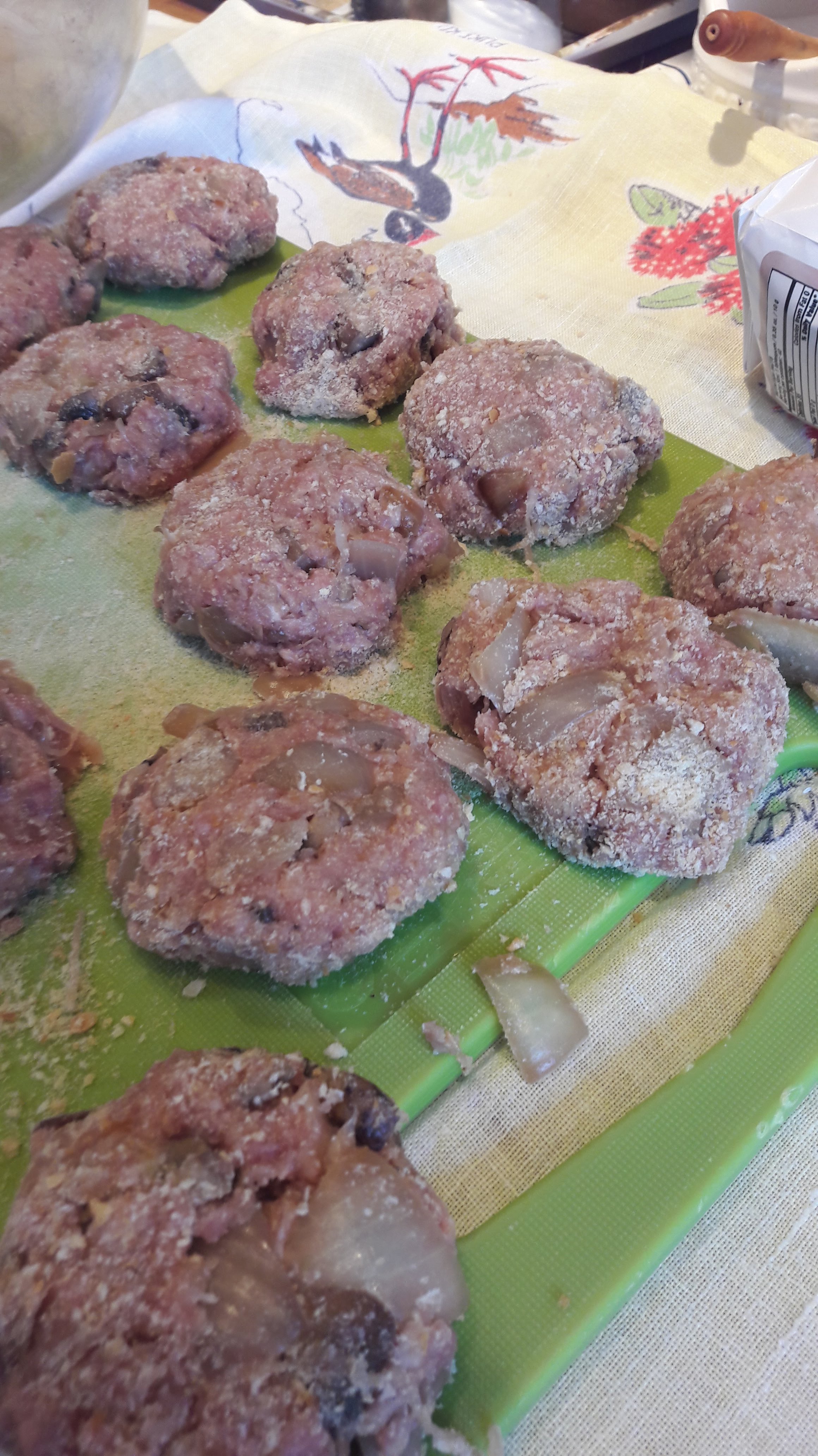
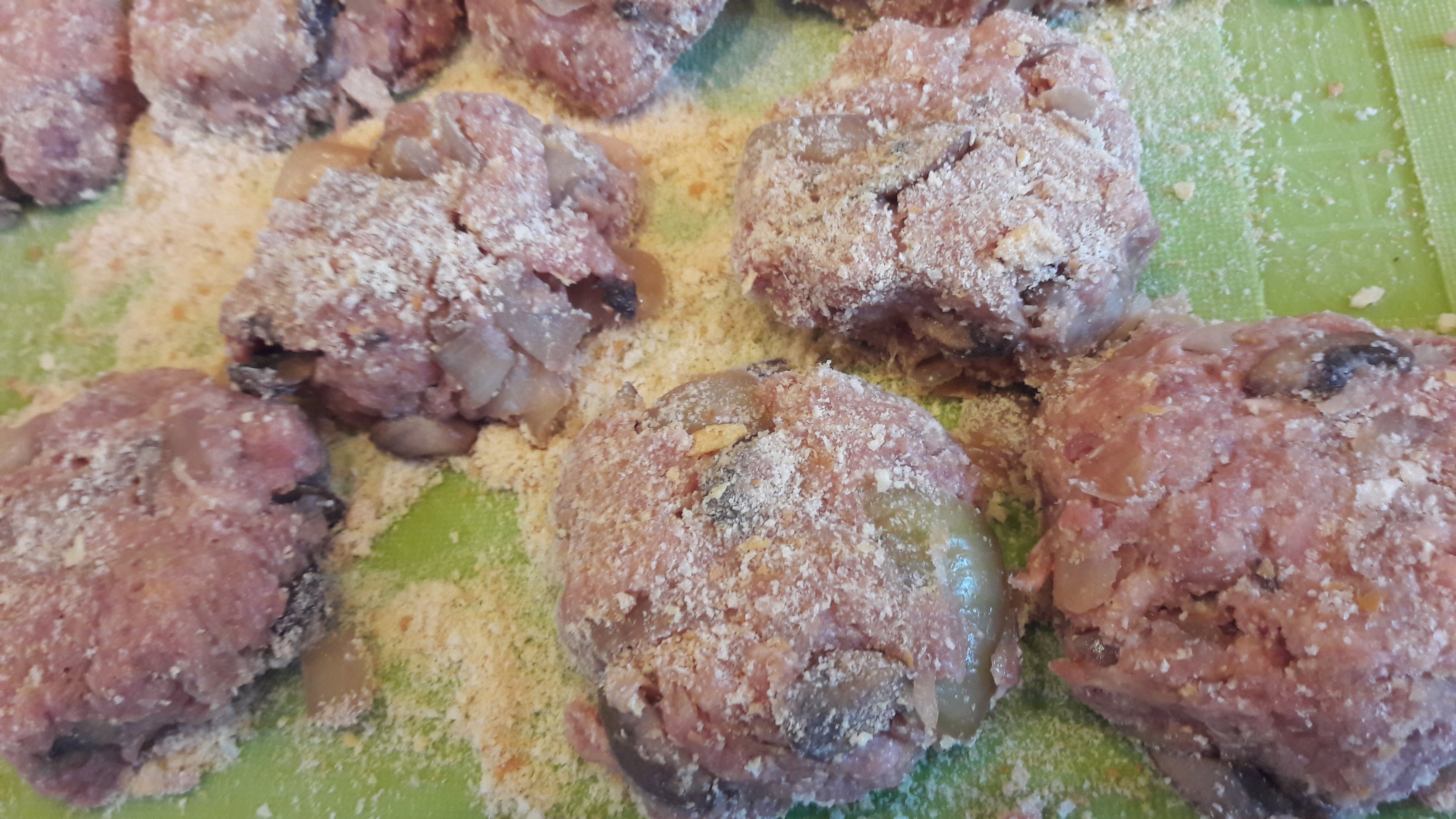
Try to make each one the same size, take a handful of the mixture and press it between your hands to make a flattened circle and then place this in the dried breadcrumbs and turn it over to cover both sides and edges.

  • Once coated place them on a tray dusted with breadcrumbs until you have used all the mixture up.
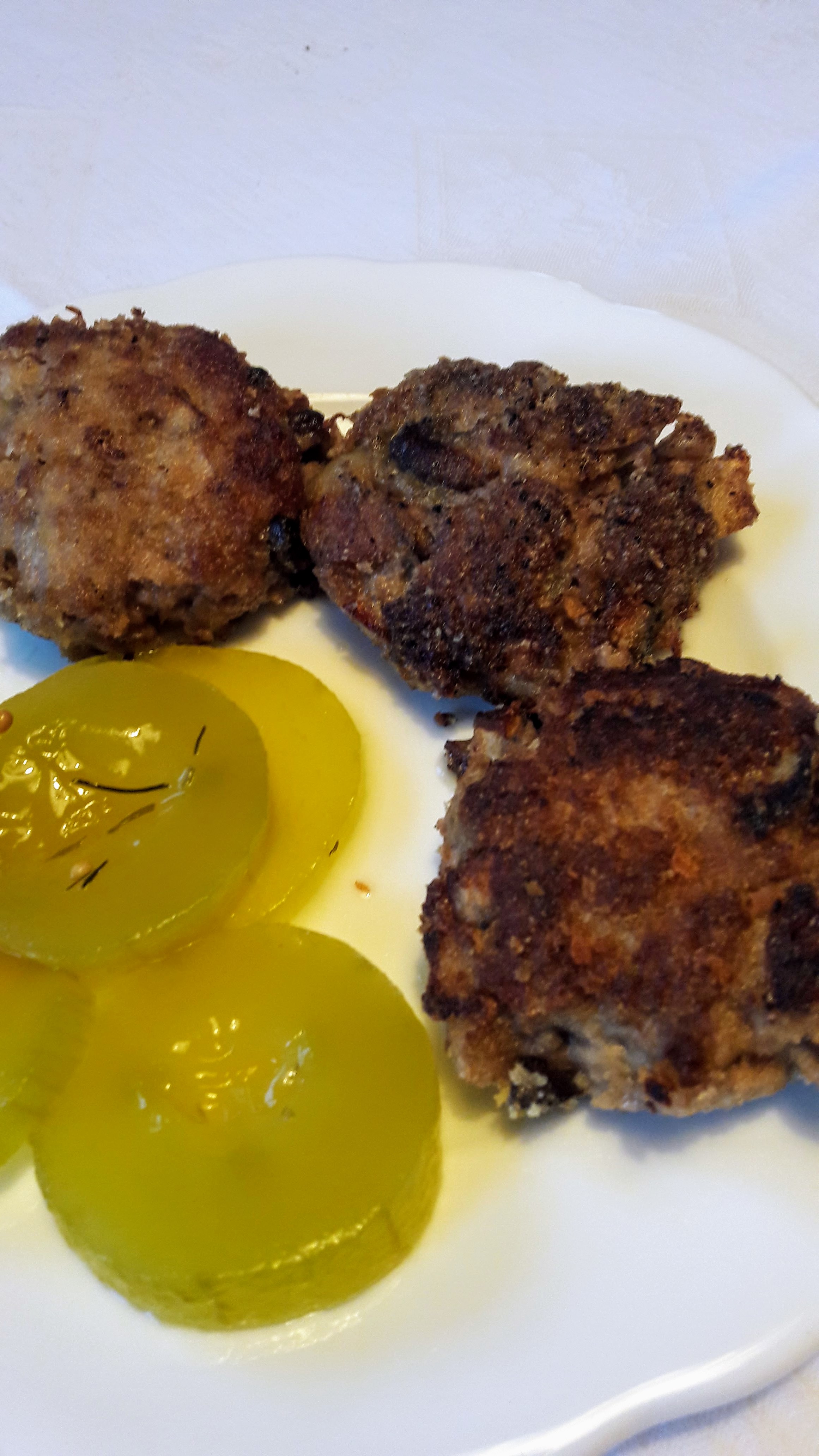
  • Shallow fry the kotlety in hot oil, depending on the frying pan size,  you can do 3 to 4 at a time, turning them over so that both sides are done. Place them on kitchen roll on a plate or metal tray till they are all cooked –  you can keep them warm in a low oven.
  • I had found I like these more when they have been in the oven for a while after frying – evenly cooked through.
  • These can be served in many ways, with boiled or mashed potatoes or rice and a variety of salads.

20180127_185749

Served  here with steamed & buttered new potatoes and carrot & apple salad – on

Royal Doulton – Carnation – 1982 – 1998.

Version 2 – using Cooked Cabbage

Whilst doing some research on this recipe,  I found that some cooks used cooked cabbage rather than raw.

Ingredients

As above but this time with 400g – 500g of uncooked white cabbage  (around the same weight as the minced meat).

Method

  • Chop the cabbage into large pieces and steam it till cooked.
  • Dry the cabbage with a clean tea towel to get rid of as much water as possible.
  • Chop the cabbage into very fine pieces.
  • Proceed as in the method above.

Note

For both versions, should you have any left,  you can reheat them in sauce made with chicken or vegetable stock.