Green Bean Soup

Phaseolus vulgaris is the Common bean or French bean. In Polish it is fasola szparagowa, which  translates as asparagus bean.

This was once just a late summer soup when there were lots of beans ready for cooking.

Nowadays it is one that can be made all year round using frozen whole green beans.

Ingredients

  • 400 – 500g of whole green beans
  • 1½ litres of chicken stock (can be from a cube or concentrate)
  • 50g butter
  • 1 onion
  • Leaves from around 6 sprigs of marjoram & extra for serving.
  • 125ml of milk
  • 1½ tablespoons of  cornflour
  • 125ml of soured cream
  • Salt & Pepper to taste
  • *
  • Rye Bread croutons to serve

Method

  • Chop the onion into small pieces.
  • Fry the onion gently in the butter till golden – do not brown.
  • Chop the beans into small pieces.
  • Put the onions, beans and stock into a large saucepan.
  • Add the marjoram leaves.
  • Bring to the boil.
  • Turn down the heat and simmer gently with the lid on until the beans are soft.
  • Mix the cornflour with the milk.
  • Stir this into the soup – increase the heat and continue stirring until the soup is thickened.
  • Add some more marjoram leaves.
  • Adjust the seasonings to taste.
  • Stir in the soured cream and serve.


Served in Royal Doulton – Burgundy – 1959 – 1981

Tort – Jadwiga

I remember my mother making this as a no-bake tort using sponge fingers.

She called it tort Jadwiga.

I have not been able to find a recipe for this other than in my notes and now I wonder whether she called it after me!

Partly because I did not have any sponge fingers and partly because I wanted to make a round cake – I decided to make this by baking two round fat free sponges.

Three are 4 parts to the ingredients list:

  • Fat free sponges – I used a quick English style version
  • Juice of a large orange
  • Rum & Almond butter icing
  • Toasted flaked almonds to decorate.

Ingredients -Fat Free sponge

  • 4 eggs
  • 150g caster sugar
  • 150g self raising flour

Method – Fat Free sponge

  • Pre-heat the oven to GM4 – 180°C
  • Grease and line the base of  two 18cm diameter baking tins.
  • In a bowl whisk the eggs and caster sugar until they are pale and creamy.
  • Gently fold in the flour.
  • Pour the mixture into the tins and bake for 25-30 minutes until golden.

Ingredients – Butter Cream

  • 110g unsalted butter
  • 50g ground almonds
  • 2 egg yolks
  • 2 tablespoons of rum
  • 300g icing sugar (approx)

Method – Butter Cream

  • Cream the butter with around half of the icing sugar.
  • Add the egg yolks and cream again till fluffy.
  • Add the ground almonds and the rum and whisk again.
  • Start adding the rest of the icing sugar until you have a thick butter cream.

Assembling the tort

  • Prick the top of each sponge with a skewer.
  • Place one of the sponges on the cake stand or plate you are going to use.
  • Using a spoon pour half the orange juice over the base of the tort.
  • Put a layer of the butter cream over the base.
  • Put the second cake on top and gently pour the rest of the orange juice over it.
  • Using a small spatula cover the top and sides with the rest of the butter cream.
  • Scatter the almond flakes over the edge of the top and around the sides of the tort.


Tea set by Royal Standard – Lyndale from the 1950s

Liver Pulpety Served in Green Soup

I wrote about pulpety over three years ago. They are small meatballs which are simmered, often in stock, not fried.

They are often used as an accompaniment for soup,

In this recipe the liver pulpety are cooked directly in the soup and served with it.

Ingredients – Pulpety

  • 150g of pork liver or chicken liver
  • 1 beaten egg
  • 1 tablespoon of chopped flat-leaved parsley.
  • 60g-80g of dried breadcrumbs – see Breadcrumbs – Bułka tarta
  • Salt & pepper
  • *
  • Some plain flour for your hands for shaping.

Method -Pulpety

  • Mince the liver or wizz in a mini-chopper.
  • In a large bowl mix all the liver, egg and parsley together.
  • Add salt & pepper.
  • Add enough dried breadcrumbs so that it is a firm mixture – best to do this using both hands, making sure that all the ingredients are thoroughly combined.
  • Put some flour in a dish for your hands to make it easier to shape the pulpety.
  • Pinch off small bits of the mixture and roll the piece between your hands to make small round balls and place these onto a floured board or tray whilst you make them all.
  • *
  • Leave these to chill in a cool place or in the fridge.

Ingredients – Soup

  • 1 litre of vegetable stock – can be from a cube or powder
  • 100g frozen peas
  • 100g frozen whole green peas
  • Bunch of spring onions
  • 2-3 tablespoons of butter
  • Salt and pepper to taste

Method – Soup

  • Chop the green beans  into small pieces similar in size to the peas.
  • Chop the green and white parts of the spring onions in to small pieces.
  • In a large pan melt the butter.
  • Add the chopped spring onions and fry gently till golden.
  • Add the peas and beans.
  • Add the vegetable stock and bring to the boil.
  • Reduce the heat and simmer gently until the peas and peas are cooked.
  • Season to taste.
  • Bring the soup up to the boil.
  • Drop the pulpety into the boiling liquid and then let them simmer for around 5 -7 minutes.

To serve

Polish style would be to have 3-5 pulpety in a bowl of soup –  but for a light lunch  have a large bowl of soup with lots of pulpety per serving.


Biszkopciki – Little Sponge Cakes

Biszcopciki, Sponge drops or fingers, Lady Fingers and Savoiardi (Italian) are names given to little light sponge cakes often with a light sugar crust.

In many older recipes eggs are separated and then the white and yolks beaten separately with sugar and these two mixtures brought together and plain flour added.

I have gone for a slightly easier version, using a more English sponge mixture with whole eggs and self raising flour but have used an icing sugar topping which is simple but wonderful!

You can use a piping bag to make these into fingers but I have made them into little tablespoon sized drops.

Ingredients

  • 2 eggs
  • 75g caster sugar
  • 75g self raising flour
  • *
  • 2-3 tablespoons of icing sugar

Method

  • Pre-heat the oven to GM 5 – 190°C.
  • Line two baking sheets with baking paper.
  • Whisk the eggs with the sugar until they are pale and thick.
  • Sift the flour.
  • Gently fold the flour into the whisked mixture.
  • Place tablespoonfuls of sponge mixture onto the trays, leaving them some distance apart.
  • Sift around 1 tablespoon of icing sugar over the drops.
  • Leave for 5 minutes (set a timer).
  • Sift another tablespoon of icing sugar over the drops.
  • Bake for 5 minutes and change the trays around.
  • Bake for another 3 to 5  minutes.
  • Allow to cool for 5 minutes then remove with a metal spatula to cool on a wire rack.

Cake plate – Dubarry by Crown Devon from the 1930s


Served with Strawberry soup

Royal Doulton – Carnation 1982 – 1998


Leek & Potato Soup

Caraway seeds give this soup a wonderful taste and make it very different from an English style leek & potato soup.

Ingredients

    • 3-4 leeks
    • 3 medium sized potatoes
    • 1.5 litres of vegetable stock (I use Marigold powder)
    • 2 teaspoons of caraway seeds.
    • Butter to fry leeks
    • Salt and pepper to taste
    • *
    • Garnishes to serve – chopped chives or flat-leaved parsley.

Method

  • Put the stock into a large pan and bring to the  boil.
  • Peel the potatoes and chop into small rough cubes.
  • Add the potatoes to the stock.
  • Add the caraway seeds.
  • Leave to simmer.
  • Chop the leeks into circles and then quarter these.
  • Gently fry these in butter to soften but not to brown them.
  • Add the leeks to the stock and potatoes.
  • Put a lid on the pan.
  • Leave to cook on a medium simmer until the potatoes are soft.
  • *
  • Serve garnished with chopped chives or flat-leaved parsley.


Served in  Royal Doulton – Carnation – 1982 – 1998

Almond Meringue Cake

My mother used to buy little cakes called Japs from the English bakers where we lived in Lancashire.

We both loved them.

I now know that the name is shortened from Japonais  – which is French for Japanese style.  How they came by this name seems to be a mystery.

Traditionally they were two circles of almond meringue sandwiched together with a butter cream (often coffee flavour), covered with more butter cream and nibbled nuts.

When I came across this recipe for an almond meringue cake, lots of memories came flooding back.

The proportions for the meringue are:

50g of caster sugar & 25g of ground almonds per egg white.

I used 4 egg whites in this version.

Ingredients

  • 4 egg whites
  • 200g caster sugar
  • 100g ground almonds

Method

  • Use the loose bases of two baking tin – 20cm in diameter.
  • Lightly grease the circles.
  • Cut a 2 x 20cm circles of grease-proof paper and stick them onto the metal circles.
  • Place each circle on a large baking tray.
  • Pre-heat the oven to GM1 – 140°C.
  • Whisk the egg whites until stiff.
  • Add the sugar and whisk again till stiff.
  • Fold in the ground almonds.
  • Spoon and smooth half the mixture onto each circle.
  • Bake for 50 minutes (swap shelves half way through).
  • Turn off the oven and leave the meringues inside for 20 minutes.
  • Take out and leave to cool completely before using.
  • *
  • Place one circle onto your cake stand.
  • Cover this with coffee or rum butter cream**.
  • Place the second circle on top.
  • Optional – add a few blobs of butter cream on top to decorate.
  • *
  • ** You can use a lighter cream filling of your choice.


Coffee set by Royal Doulton  – Pastorale – 1970 – 1990

Jug by Buchan Pottery, Portobello near Edinburgh –  from the early 1960s.


Fruit Soups

Fruit soups are very popular in Poland especially in summer.

Many may think they seem rather strange, however once tasted, I hope, like me you will think that they are “nectar from the gods!”

Just like other soups they are served as a first course.

They are eaten – hot or warm, at room temperature or chilled. – This can vary with the time of the year and people’s preferences.

  • Many are served with a variety of soup accompaniments such as cooked pasta or croutons – either from white rolls or rye bread.  Sponge fingers or little biscuits are also often served with them.
  • They can be made from fresh (or frozen) fruit or bottled fruit and also from dried fruit.
  • Most recipes are for single single fruit versions but you can use mixed fruits depending on what is available but try to keep to just 2 or 3 fruits.
  • These soups should not be over sweet.
  • Potato flour is usually used as a thickening agent but you could substitute cornflour for this.
  • Some recipes had soured cream added, sometimes before serving.

I am going to look at 3 different summer fruit flavours in this post:

  • Rhubarb
  • Sour cherry
  • Strawberry

Later I will look at others including using dried fruits, which are more for the winter time and would usually be served warm or hot.

Rhubarb Soup

Ingredients

  • 500g rhubarb
  • 100g granulated sugar
  • 2 tablespoons of potato flour
  • Small cinnamon stick
  • 4 cloves
  • 1.5 litres of water
  • 125 ml of soured cream

Method

  • Cut the rhubarb into small chunks.
  • Put the rhubarb and spices into a large saucepan.
  • Add the water, bring to the boil then simmer till the rhubarb is falling apart.
  • Sieve to remove the pulp.
  • Add the sugar to the liquid.
  • Mix the potato flour with the soured cream.
  • Add this to the soup.
  • Bring to the boil, stirring gently.
  • Serve hot or warm with rye bread croutons or cold cooked pasta.
  • or add a few fresh strawberries or alpine strawberries to each portion.

Sour Cherry Soup

I have never seen fresh soured cherries for sale in England, so my recipe is based on using bottled soured cherries, which works very well and can be made all year round.

Ingredients

  • 500 -600g of bottled cherries
  • Small cinnamon stick
  • 4- 6 cloves
  • Strips of peel from 1 lemon
  • Water to make the juice amount  up to 1.5 litres
  • 1½ tablespoons of potato flour
  • *
  • I did not add any extra sugar to the bottled cherries

Method

  • Depending on the jar of cherries – you may have to stone them.
  • Put the cherries, cinnamon stick, cloves and lemon peel into a saucepan.
  • Bring to the boil and then simmer gently, with a lid on, until the cherries are very soft.
  • Leave to go cold.
  • Remove the spices and lemon peel.
  • Blend the cherries to a pulp.
  • Mix the potato flour and a little of the liquid in a small dish.
  • Add the potato flour mixture to the blended cherries.
  • Bring up to the boil gently, stirring often.
  • Simmer and stir until the soup thickens.
  • *
  • Serve hot or chilled with cold pasta.
  • *
  • I like this best hot – even on a warm day.


Strawberry Soup

  • This is best eaten chilled – the strawberries are not cooked.
  • If you prefer a tangier taste add the juice of a lemon at the end.

Ingredients

  • 450-500g  strawberries
  • 100g granulated sugar
  • 1 tablespoon of potato flour
  • 1 litre of water
  • 250ml of soured cream

Method

  • Add the sugar to the water and bring this to the boil.
  • Mix the potato flour with a small amount of water.
  • Add this to the sugar water.
  • Heat and stir till it thickens.
  • Leave to chill.
  • Add the soured cream and mix together.
  • Remove any leaves and stalks from the strawberries.
  • Gently wash the strawberries.
  • Blend the strawberries to a pulp.
  • Stir the strawberry pulp into the chilled thickened sugar – cream mixture.
  • Chill for 30 minutes.
  • Serve with sponge fingers or sponge drops.


Served in –

  • Royal Doulton – Carnation – 1982 – 1998
  • Midwinter – Spanish Garden – 1966 – 1982

Cabbage & Gherkin Salad

I had half a sweetheart cabbage left after a meal and not much else in the fridge.

I put together the ingredients I had and got a delicious new salad.

Use red onions if you can as these give a good colour contrast.

Ingredients

  • ½ a sweetheart cabbage
  • 4-5 medium sized gherkins
  • 2 small red onions
  • 3 tablespoons of gherkins liquid from the jar
  • 2-3 tablespoons of full-fat mayonnaise
  • Salt & pepper

Method

  • Cut the cabbage into fine shreds.
  • Cut the gherkins into round slices.
  • Chop the onions into small pieces.
  • Mix the chopped ingredients with the gherkin liquid and the mayonnaise.
  • Season with salt and pepper.


Ogórkowa – Gherkin Soup -2

I posted the recipe for ogórkowa – gherkin soup, which is a classic Polish soup, over a year ago.

It is sour, a taste much loved by the Poles!

It is traditionally made from brine fermented gherkins but you can also use pickled gherkins.

I was sorting out my cutting and notes the other day and came across this recipe from my aunt in Białystok and decided it was time I made this version.

Ingredients

  • 250g gherkins
  • 125ml gherkin liquid
  • 1.5 litres of vegetable stock (can be from cubes or powder)
  • 4 medium potatoes, peeled – boiled or steamed
  • 3-4 carrots whole – peeled – boiled
  • 125ml of soured cream
  • Chopped dill – some to add and some  to serve

Method

This is easiest to make if you have some potatoes and carrots boiled already.

  • Add the gherkin liquid to the vegetable stock and bring to the boil.
  • Rough chop the gherkins.
  • Drop the gherkins into the liquid and simmer for around 20 -25 minutes.
  • Chop the boiled potatoes into rough cubes.
  • Chop the boiled carrots into circles or half circles (depending on the size)
  • Add the potatoes and carrots, stir and simmer for around 5 minutes.
  • Stir in some chopped dill.
  • Stir in the soured cream.
  • Serve with extra dill sprinkled on top.


Served in Royal Doulton – Tapestry – 1966 – 1988.


Pierogi with Red Fruits

  • Pierogi  are  little semicircular parcels of pasta which are made with a multitude of fillings.
  • I wrote a very large post about them over 4 years ago.
  • Pierogi with sweet fillings are made in just the same way as savoury ones.
  • Circles of dough have a filling placed on them.  The dough is folded over and pinched to make a semi circle and these are boiled in slightly salted water.
  • Once boiled, sweet pierogi are dredged with icing, granulated or caster sugar and are often served with soured cream.  They are best eaten straight away.
  • I must admit that when I was younger I did not really like sweet pierogi but now I think they are utterly delicious especially when served with soured cream.

Red Fruits

In the summer and early autumn in Poland, when all the fruits of the forests and the garden  are ripe, that is when these pierogi are at their best.  However bottled fruit is available all year round and I often make my sweet pierogi with these.

You can also use defrosted frozen fruit.

My favourite are:

  • Morello(sour) Cherries  – fresh ones are not usually available in England – I use bottled ones.
  • Whinberries (bilberries) –  these grew in Lancashire near my home and also could be bought in baskets imported from Poland.  (I think the larger American Blueberry is nowhere near as tasty.)
  • When we went to pick these I know this always made my mother think of her childhood in Poland.

Some of the other options are:

  • Blackberries
  • Blackcurrants
  • Raspberries
  • Strawberries
  • *
  • Depending on the size of the fruit, you need about 3 or 4 per circle.
  • Do not add sugar to fresh fruit as this will make too much liquid and the pierogi will not seal.
  • If using bottled fruit you need to strain as much juice away as possible.
  • If using defrosted frozen fruit dab away any excess water.
  • Drench the cooked pierogi in icing sugar and serve with sour cream. The sugar contrasts with tartness of the fruit.

Ingredients – Dough

  • 250g pasta flour or plain flour & 2 tablespoons of fine semolina
  • 150ml water
  • 1 tablespoon oil – sunflower or light olive
  • ½ teaspoon salt
  • 1 egg yolk

Method – Dough

  • In a jug or bowl mix together the water, oil and the yolk.
  • Put the flour and salt into a large bowl and make a well in the centre.
  • Pour in the liquid from the jug and initially use a knife to mix this into the flour and then use your hands to mix the liquid and flour to get a ball of dough.
  • Turn this out onto a floured board and knead the dough for a few minutes until you have a smooth ball.
  • Cover and leave to rest for about ½ an hour.
  • *
  • Cut the dough into half.
  • Prepare a large tray and cover it with a clean cotton or linen tea towel and sprinkle this with flour.
  • On a floured board roll out the dough a half at a time until you have a sheet of thinly rolled dough.
  • Cut out circles using a 7 cm diameter cutter.
  • The excess dough can be re-mixed and rolled out again.
  • Depending on the fruit and size place 3 to 4 on each circle.
  • Folded them over and pinch the edges together to make a good seal.
  • You learn from experience how much filling to put in as too much will make it hard to seal them and if not properly sealed they will burst on boiling.  Do not worry if you have a few mishaps – it still happens – even with experience – it is hard to salvage one that has gone wrong – just accept that there will be a few that you do not cook.
  • Place the sealed pierogi on the prepared tray until they are all made, do not let then touch each other.
  • *
  • To cook the pierogi, use a large pan of boiling water to which you have added some salt and a drizzle of oil.
  • Drop the pierogi in one by one and allow them to boil.  I usually do about 6 to 7 at a time.
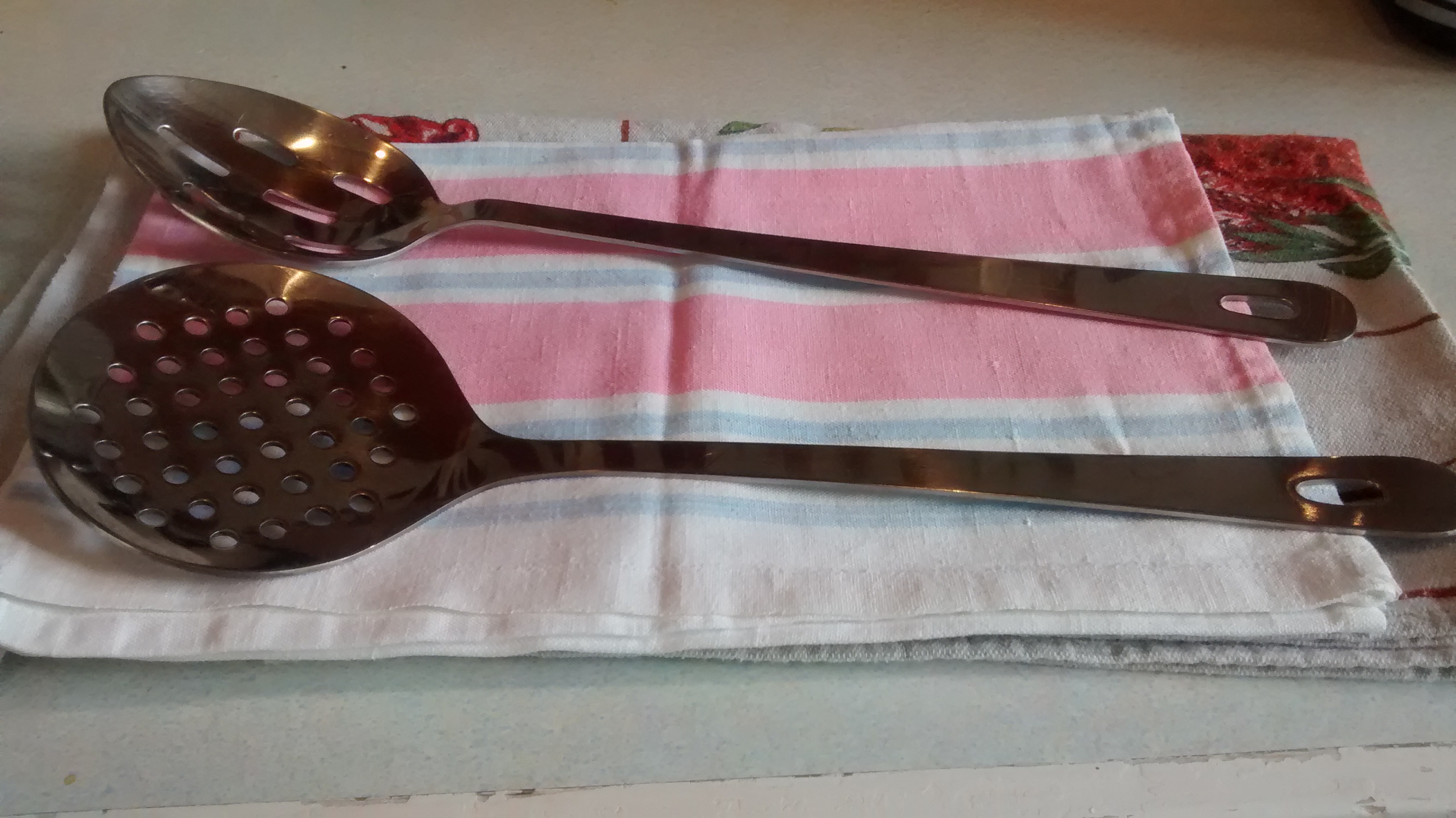
  • As they cook they will float to the surface, let them boil for 2 minutes and then remove them with a slotted or perforated spoon and put into a colander above a pan for a few seconds to drain and serve.
  • Continue boiling batches in the same water.
  • If you want to make all the pierogi to serve together then you need to get some oven proof plates.
  • Keep the plates warm in a low oven.
  • As you take out the cooked pierogi add them to the plates, trying not to make them touch.
  • Keep on adding more as they cook.

To Serve

Sprinkle with icing, granulated or caster sugar and some soured cream.

Pierogi with Sour Cherries

Served here on La prune by Jet for Ter Steege

Pierogi with Whinberries

Served on Royal Doulton – Carnation  1982 – 1998