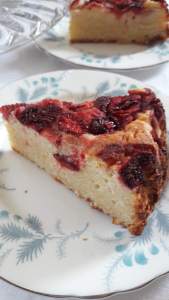
Placek – Derbyshire Inspired

A few months ago I went on a craft week in Derbyshire (home of the Bakewell Tart) and as always I was looking out for new recipes and ideas.

I came across a recipe for a cake using yoghurt.  Now in the past, every cake I have made with yoghurt in the ingredients was not a success with it either being straight to bird table or straight to bin!

Anyway, I tried this one out and was really pleased with the results.

I used Greek style full fat yoghurt and I am sure low or no fat yoghurt would not do! – If using my own yoghurt I would strain it a little so it becomes thicker.

I have made a few alterations to the original recipe.

It is similar to a Polish placek (flat cake) and baked in a rectangular tray.

Ingredients

250g butter or block margarine

225g caster sugar

150ml of Greek style yoghurt (full fat)

4 eggs

1 teaspoon of vanilla essence or the fine grated rind of 1 lemon

280g self raising flour

1/2 teaspoon of baking powder

Blackcurrant jam or sour cherry jam or other slightly tart jam

50g of dessicated coconut

Method

Grease and line 22 x 32 baking tin – use 1 piece of greaseproof to do the 2 long sides and base.

Pre-heat the oven to GM4 – 180 C

Mix together the yoghurt, eggs and vanilla essence or lemon rind.

Mix together the flour and the baking powder.

Beat together the butter and sugar .

Add the yoghurt and egg mixture and beat well.

Add the flour mixture and beat till you have a unified smooth mixture.

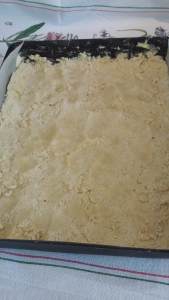
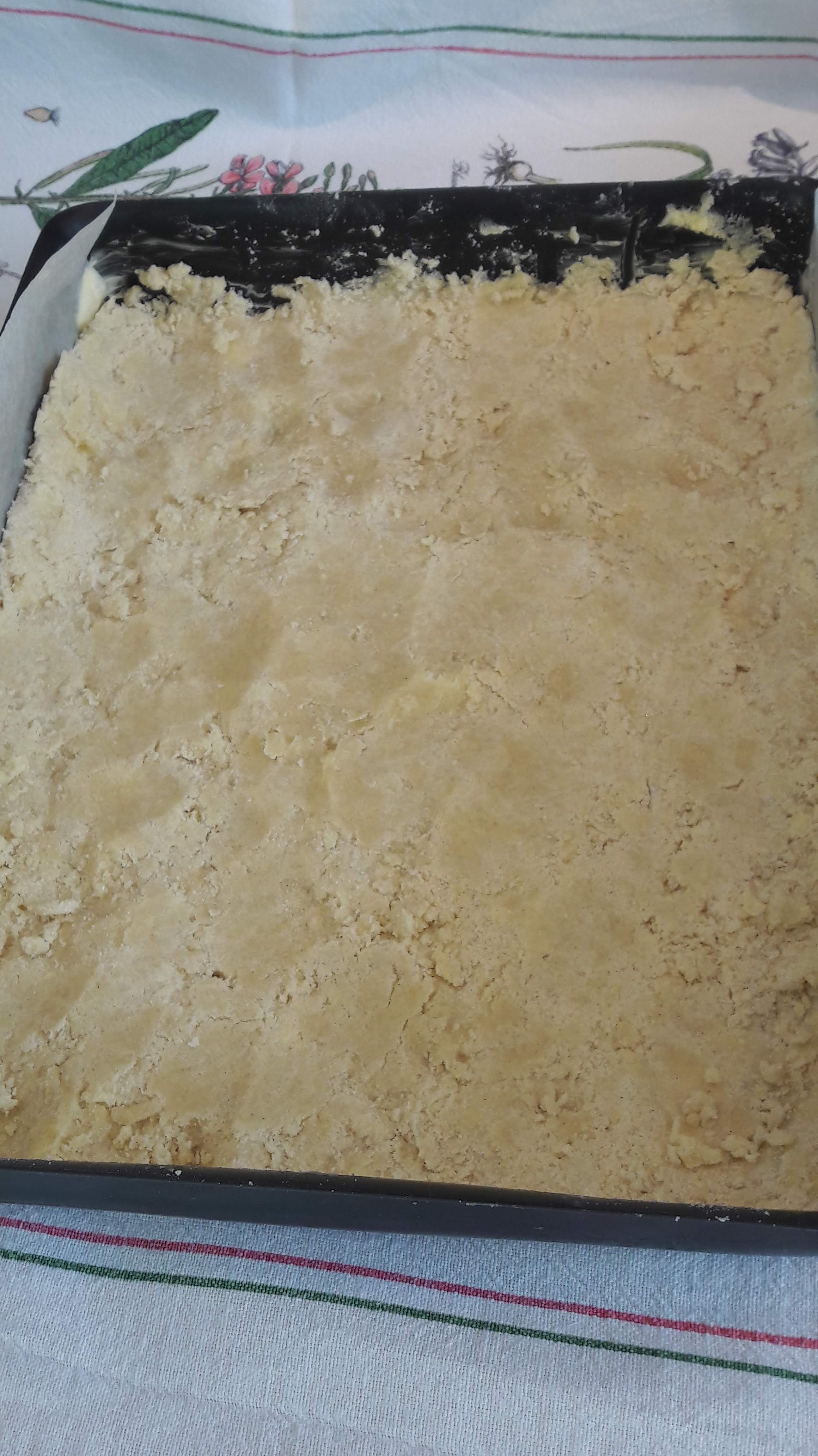
Using a big spoon and spatula put the mixture into the prepared tin.

Bake in the oven for 10 minutes.

Carefully take the cake out of the oven and place large teaspoon ‘blobs’ of jam on the top – I did 12 teaspoons at even intervals.

Drench the top with the coconut and quickly put it back in the oven.

Bake for around another 25 minutes.


Place on a cooking rack and leave until it is cold to take out of the tin.

Cut into squares or rectangles to serve.


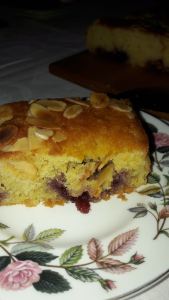
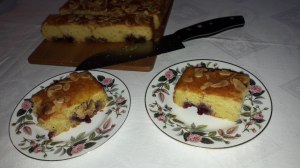
As a nod to Derbyshire, I used my Royal Crown Derby – Derby Posies – teaplates to serve.

They are marked  XXV which indicates 1972.

Variations

I think that the basic batter of this cake lends itself to quite a few variations – I intend to try some of these out in the coming months.

Szarlotka

  • Szarlotka is the word my mother used for (apple) crumble.
  • In some parts of Poland szarlotka is the word used for an apple cake.
  • I wanted to create a cake that was cross between a cake and a crumble.
  • I have used half the quantity from my apple cake (jabłecznik) recipe as the base and then used a drier crumble type mixture – called kruszonka in Polish – for the top.
  • I have already done this  for a rhubarb cake, so I have revisted this recipe.
  • I have adjusted the recipe to use just one type of flour (plain) and one type of sugar (granulated) to make it  easier.

Apple Filling

  • You can use an apple filling with just apples and sugar with the addition of cinnamon.
  • Sometimes in Poland raisins or sultanas are added to the apples.
  • As I had some homemade, fruit mincemeat left from last year to use up (made from Delia Smith’s recipe but without nuts) before I made this year’s batch,  I added some of this to the apples.

Ingredients

  • 4 to 6 Bramley Apples
  • Granulated Sugar to taste – keep it slightly tart
  • A little water
  • 4 tablespoons of mincemeat

Method

  • Make the apple filling first, even the day beforehand as it needs to be cold before you use it.
  • Peel and core the apples and cut them into thick slices.
  • Stew the apples gently with some sugar and very little water. You can make this in a saucepan on the stove or place the apples and sugar in a dish in the oven.
  • Do not add a lot of sugar at the beginning as it does not want to be too sweet, you can adjust the sweetness at the end.
  • Do not make it too much of a purée, cook it so that you have some soft apples but with some harder less cooked chunks as well.
  • Leave this to be completely cool.
  • Mix in the mincemeat.

Note

When I have lots of apples, I cook a large amount and portion this up and keep them in the freezer –  add the mincemeat when making the cake.

Base

  • 150g  plain flour
  • 2 teaspoons of baking powder
  • 100g butter
  • 40g granulated sugar
  • 1 egg yolk
  • 1 or 2 tablespoons of lemon juice or water.

Topping (kruszonka)

  • 120g plain flour
  • 60g butter
  • 60g granulated sugar

Method – Base

  • You have to use a loose bottom or spring-form tin or you will not be able to get the cake out.
  • I use a loose bottomed anodised aluminium cake tin which is 22cm in diameter and 8cm deep.
  • Grease the tin well.
  • First make the cake base by rubbing the butter into the flour to make crumbs, then stir in the sugar.
  • Add the yolk and lemon juice and bring the ingredients together to form a soft dough – do not handle the dough too much.
  • Pre heat the oven to GM 4 – 180ºC.
  • Make the dough into a rough flat circle and press it into the base of the tin.

Method – Topping

  • Make the topping by rubbing the butter into the flour to make crumbs and then stir in the sugar.
  • Put the  apple mixture on top of the base – it wants to be quite a thick layer.
  • Sprinkle the topping crumbs over the apple mixture.
  • Bake in the oven for around 1 hour.
  • Leave to cool in the tin.
  • Use a long metal spatula to ease the cake from the side of the tin, then place the cake on to the top of a tin can and slide the side down.

Tea set here is  Woodside by Royal Grafton, 1940 – 1959

Piernik with Chocolate

I came across this recipe in the book my Polish friend, who lives in Leeds, bought for me in Poland this summer.

20180916_153212


I thought it sounded interesting and I have adapted it slightly.

Piernik is a honey spice cake which has its origins in the 12th Century.

The spices used will have originaly been brought back by the Crusadors.  I make up a mixture of equal parts of cinnamon, cloves and cardamon.

Piernik in Poland is associated with the Christmas season and would be made for Christmas Eve and for Christmas Day, it would also be made for Święty MikołajDecember 6thSt Nicholas Day. This a day for present giving in Poland to children and I would always get a piernik shaped and decorated to look like the bishop that was St Nicholas.

As it is Święty Mikołaj next week on  December 6thSt Nicholas Day – I  thought this was a good day to post this recipe.

The addition of chocolate to coat the piernik is more recent. Chocolate made by Wedel in Poland started in 1851.

Here the chocolate is grated or chopped finely and added to the cake mixture.

The result is delicious and I will certainly be adding this to my Wigilia (Christmas Eve) menu.

I found grating the chocolate hard work – it was easier for me to chop this amount into very small pieces, using a cleaver type knife.

Ingredients

250ml runny honey

230g granulated sugar

2 large eggs (or 3 medium)

1.5 teaspoons of piernik spices (cinnamon: cloves: cardamon in equal amounts  so a half  teaspoon of each).

350g plain flour

2 teaspoons of baking powder

100g dark chocolate – grated or finely chopped

100g chopped mixed peel


Icing Sugar to serve

Method

Pre-heat the oven to GM3 – 160°C

Grease and line a 32cm x 22cm shallow Mermaid tin (use one sheet for the two long sides and the base).

Put the honey, eggs, sugar and the spices into a large bowl and whisk well together.

In another bowl mix the flour, baking powder, chopped/grated chocolate and the mixed peel.

Gently fold the flour mixture into the honey mixture and then mix it all together.

Pour the mixture into the tin and bake for around 1 hour 10 minutes, check it after 40 minutes and cover if it is starting to catch.

Test with a cake tester to check it is done and then leave it  in the oven for 10 minutes with the door slightly open.

Then put on a cake rack to cool.


Dust with icing sugar before serving.


Plates, cups & saucers are Lyndale by Royal Standard from the 1950s

Teapot is Café Culture by Maxwell Williams

Courgette Cake

I have just returned from a trip to The Netherlands where I stay with my  Dutch friend who I have known for nearly all my life!  We were both born in the same year  – lived just a few doors apart in Lancashire and  went to the same school together. Now we live in differerent countries but we visit each other often.

I am always on the look out for recipes as well as old glass & china. We went to a second-hand street market in Roermond and there was a book sale in one of the churches and strangely enough the books were sold by weight!  I  bought a nearly new copy of a cookery book by Yvette van Boven (I now know she appears on television).

This cake is  based on one of her recipes and reminds me of the light fruit cakes called keks in Polish – though the use of the courgette is novel  –  you would never guess it is in the cake!

Ingredients – Cake

  • 150g self-raising flour
  • pinch of salt
  • 1 tablespoon of vanilla sugar
  • 150g of light brown sugar
  • 1 teaspoon of cinnamon
  • 150g of raisins
  • 150g of currants
  • 100g of roasted and roughly chopped hazelnuts
  • 1 medium size courgette coarse grated
  • 2 eggs
  • 125ml of sunflower oil

Ingredients – Lemon Icing

  • Fine grated rind of 1 lemon
  • 2 tablespoons of lemon juice
  • 150g of icing sugar

Method – Cake

  • Pre-heat the oven to GM4 180°C
  • I used a continental style long loaf tin, greased it  and used a single sheet of grease proof paper  to line the long sides and the base.
  • Mix together the flour, salt, sugars and cinnamon, making sure that any lumps in the brown sugar are all pressed out.
  • Mix together the raisin, currants, nuts and the courgette.
  • Lightly whisk the eggs and oil together.
  • Add the flour mixture to the egg mixture and mix thoroughly together with a wooden spoon.
  • Add the courgette mixture and mix well in.
  • Place the cake mixture into the tin and smooth the top.
  • Bake for 50 – 55 minutes – check after 40 minutes and cover the top with greaseproof or foil if browning too much before it is baked through.
  • Leave to cool before icing.

Method – Icing

  • Place the icing sugar in a bowl and add the grated lemon zest.
  • Mix in the lemon juice until you have a thick icing.
  • You might have to adjust the thickness with  more lemon juice (or water) or with icing sugar.
  • Put the icing on the top of the cake and let it drip down the sides.

Served on Woodside by Royal Grafton from 1940 to 1959.

Carrot Variation

  • I  thought that this might be good using grated carrot instead of courgette – I used a medium sized carrot.
  • I used chopped walnuts, which I had, as when I had gone to get the hazelnuts, I got the last packet from my local shop and did not have time to go to anywhere else!

Nuts for sale in the Food Market in Rotterdam

Served on Stardust by Colclough from the 1960s.

Both versions were delicious and enjoyed by many!

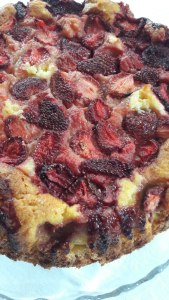
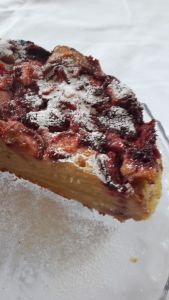
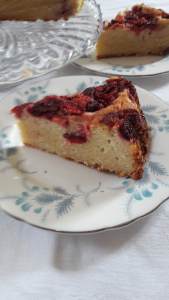
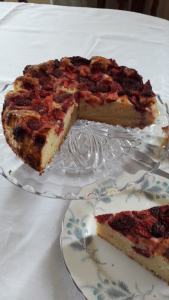
Not Quite a Cheesecake

For this recipe you can  use twaróg, curd cheese, cream cheese or yoghurt cheese but it is quite a bit different from my usual Polish baked cheesecake.

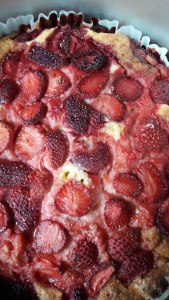
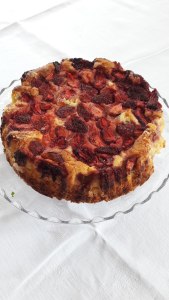
It is a more a ground almond cake with strawberries on top.

I used the last pickings of strawberries from my garden this summer.

I used my own yoghurt cheese and squeezed it out in a cloth to get rid of as much excess liquid (whey) as possible.

Ingredients

  • 115g Butter
  • 115g Caster sugar
  • 3 eggs separated
  • 2 tablespoons of cornflour or potato flour
  • 175g Ground almonds
  • 200g Twaróg , Curd cheese or Yoghurt Cheese
  • 1/2 teaspoon of vanilla essence
  • Pinch of salt
  • Topping
  • Strawberries & 1/2 tablespoon of caster sugar
  • Optional – Icing sugar to dust

Method

  • Line a 20cm in diameter loose bottomed cake tin with a bought paper cake liner.

  • Pre-heat the oven to GM5 190°C
  • Cream the butter and sugar until they are soft and fluffy.
  • Add the egg yolks one by one until you have a smooth mixture.
  • Add the vanilla essence and the salt and mix in.
  • Add the cornflour, ground almonds and the yoghurt cheese and mix together thoroughly.
  • Whisk the egg whites until they are stiff.
  • Fold in the egg whites into the cake mixture.
  • Put the cake mixture into the lined tin.
  • Slice the strawberries and place these on the top and sprinkle them with the sugar.
  • Bake in the oven for 35 minutes.
  • Turn the oven down to GM2 – 150°C and bake for around another 30 minutes.
  • Switch off the oven but leave the cake in there until it is cool.
  • Keep the cake in the refrigerator but bring to room temperature for serving.
  • Served here on tea plates – Las Palmas by Aynsley from the 1960s.

Variations

  • More strawberries on to top would have been okay.
  • Other red summer fruits such as raspberries, blackberries or whinberries (bilberries) would also work well.

Mincemeat Placek

This is a variation on Prune placek (flat cake) which I posted recently, this time using fruit mincemeat (a very British ingredient) instead of prunes.

I make my own mincemeat using the recipe from Delia Smith but without the chopped almonds.

I only make mince pies around Christmas time – so that they are seen as special and usually  I have a jar left.

I am always looking out for recipes that use mincemeat and my old standby is a variation on a Polish style fruit cake – keks.

So I was glad to try another recipe using the mincemeat and I am very pleased with how this placek has turned out.

There is a base of short crust type pastry, a layer of  mincemeat and a cake topping which contains oats and sesame seeds.

Ingredients

Base

175g plain flour

125g butter or margarine

50g caster sugar

Filling

Around half a jar of fruit mincemeat

Topping

125g butter or margarine

75g caster sugar

1 tablespoon of honey

125g chopped sultanas & mixed peel

125g self-raising flour

1/2 teaspoon of bicarbonate of soda

125g rolled oats

50g sesame seeds.

Method

Base

Grease and line a rectangular 20 x 27cm tin.

Pre-heat the oven to GM 4 – 180°C

Rub the butter into the flour to made breadcrumbs.

Mix in the caster sugar.

Bring the mixture together to make a dough.

Press the dough into the tin.

Bake the base for around 25 minutes until it is golden on top.

Leave till it is cold.

20180614_120851

Filling

Spread the mincemeat over the base.

20180617_073801

Topping

In a pan gently melt the butter, sugar and honey.

Leave to cool slightly.

Add the chopped sultanas & mixed peel  to the butter mixture and mix .

In a bowl mix the flour, bi-carbonate of soda, oats and sesame seeds.

Add the butter mixture to the dry ingredients and mix well in.

Spread this mixture over the mincemeat.

Sprinkle the reserved sesame seeds over the top.

Bake for 25 – 30 minutes until the top is golden.

Cut into squares or rectangles to serve.

Green teapot is Café Culture by Maxwell Williams.

Cake Stand – made in England.

Tea cups & saucers and tea plates  – Queen Anne – pattern name unknown.

Apricot Placek

This is a variation on Prune placek (flat cake) which I posted recently, this time using dried apricots instead of prunes.

There is a base of short crust type pastry, a layer of softened apricots and a cake topping which contains oats and sesame seeds.

Ingredients

Base

  • 175g plain flour
  • 125g butter
  • 50g caster sugar

Filling

  • 225g soft dried apricots
  • 1 tablespoon granulated sugar
  • 1 tablespoon of cornflour

Topping

  • 125g butter
  • 75g caster sugar
  • 1 tablespoon of honey
  • 125g soft dried apricots
  • 125g self-raising flour
  • ½ teaspoon of bicarbonate of soda
  • 125g rolled oats
  • 50g sesame seeds

Method – Base

  • Grease and line a rectangular 20 x 27cm tin.
  • Pre-heat the oven to GM 4 – 180°C
  • Rub the butter into the flour to made breadcrumbs.
  • Mix in the caster sugar.
  • Bring the mixture together to make a dough.
  • Press the dough into the tin.

  • Bake the base for around 25 minutes until it is golden on top.
  • Leave till it is cold.

Filling

  • Chop the apricots into small pieces.
  • Put the apricot and sugar into a small pan and cover them with water
  • Simmer the apricots, sugar and water  for 10 minutes until you have a soft pulp – take care not to boil the mixture dry – add more water if needed.
  • Mix the cornflour with some water to form a paste and add this to the mixture and stir until it thickens.
  • Remove from the heat and leave it till it is cooled completely.

Spread the filling on top of the pastry base.

Topping

  • In a pan gently melt the butter, sugar and honey.
  • Leave to cool slightly.
  • Chop the 125g of apricots into small pieces.
  • Add the apricots to the butter mixture and mix .
  • In a bowl mix the flour, bi-carbonate of soda, oats and sesame seeds.
  • Add the butter mixture to the dry ingredients and mix well in.
  • Spread this mixture over the apricot filling.
  • Sprinkle the reserved sesame seeds over the top.
  • Bake for 25 – 30 minutes until the top is golden.
  • Cut into squares or rectangles to serve.

Tea plates are Bramble Rose by Duchess from the 1960s.

Prune Placek

This recipe was given to me by one of my cousins (British born like me) who lives in Wembley.

Although this is not a traditional Polish recipe it does reminds me of a Polish placek (flat cake) and contains prunes which are very popular and used in many recipes in Poland.

There is a base of  easy to make shortcrust type pastry, a layer of softened prunes and a cake topping which contains oats and sesame seeds.

Muscovado sugar is used – this is definitely not a Polish sugar as it is produced in the process of refining sugar cane whilst in Poland sugar is made from sugar beet.

Note

You can make the filling ahead of when  you need it as it has to be cold.  I often make the base and the filling in the evening and then finish the placek the next day.

Ingredients

Base

175g plain flour

125g butter or margarine

50g caster sugar

Filling

225g no-need-to-soak prunes

1 tablespoon dark muscovado sugar

1 tablespoon of cornflour

Water

Topping

120g butter or margarine

60g caster sugar

1 tabelspoon of honey

125g no-need-to-soak prunes

100g self-raising flour

1/2 teaspoon of bicarbonate of soda

100g rolled oats

50g sesame seeds (keeping  back 2 tablespoons to sprinkle on the top)

Method

Base

Pre-heat the oven to GM 4 – 180°C

Grease and line a rectangular 20 x 27cm tin.

Rub the butter into the flour to made breadcrumbs.

Mix in the caster sugar.

Bring the mixture together to make a dough.

Press the dough into the tin.


Bake the base for around 25 minutes until it is golden on top.

Leave till it is cold.

Filling

Cover the prunes with water in a small pan and add the sugar.

Simmer the prunes, sugar and water  for 10 minutes until you have a soft pulp – take care not to boil the mixture dry – add more water if needed.

Mix the cornflour with some water to form a paste and add this to the mixture and stir until it thickens.

Remove from the heat and leave it till it is cooled completely.

Spread the filling on top of the pastry base.

Topping

In a pan gently melt the butter, sugar and honey.

Leave to cool slighty.

Chop the prunes into small pieces.

Add the prunes to the butter mixture and mix .

In a bowl mix the flour, bi-carbonate of soda, oats and sesame seeds.

Add the butter mixture to the dry ingredients and mix well in.

Spread this mixture over the prune filling.

Sprinkle the reserved sesame seeds over the top.

Bake for 25 – 30 minutes until the top is golden.

Cut into squares or rectangles to serve.

Variations

Other dried fruits can be used for the filling  – such as apricots, dates or figs.


The serving cake plate is a recent purchase from Leeds second hand market.

The design is Field Fare by James Cooper for Washington Pottery, Hanley, Staffordshire from around the 1950s.

The cups and saucers are another very recent purchase from a local car boot sale.

They are bone china by Colclough, pattern number 8266, from I think the 1970s.

The stoneware tea plate is Blue Mist, Burleigh Ware by Burges and Leigh Ltd  from the 1930s.


Caraway Seed Cake

Caraway is such a popular herb/spice in Poland and is used in breads, meat & vegetable dishes.  So it is quite surprising that it is not used  in cake.

Caraway – Image from Wikapedia


I have looked in all my recipe books and I have not found any use of caraway in Polish cake.

So I have gone to what by many is seen as an old-fashioned  quintessential British cake – Seed Cake – which is  Caraway Seed Cake.

This cake has been popular since the 17th century and especially  in Victorian times  and the 1920s and 1930s.

Caraway Seeds are thought to aid digestion – so this is a good cake to have at the end of a meal.

I have found several variations – this is one that has worked for me & I am sure it would be well received in Poland!

I have tried this out in 2 different shapes of tins.

Ingredients

110g butter

110g caster sugar

2 eggs – beaten

150g self-raising flour – sifted

25g ground almonds

3 tablespoons of milk

3 rounded teaspoons of caraway seeds

Several crushed sugar cubes or 1 level tablespoon of Demerara sugar for the round cake and 1/2 a tablespoon for the loaf.


Version 1

Method

Pre-heat the oven to GM 4 – 180°C.

Grease a 19cm round cake tin and line the bottom with greaseproof paper.

Mix the flour, ground almonds and caraway together in a little bowl.


In a larger bowl, cream the butter and sugar together until they are pale and fluffy.

Beat in the eggs a little at a time.

Using a metal spoon fold in the flour mixture.

Add the milk to give a good dropping consistency.

Spoon the cake mixture into the prepared tin and level off the top.

Sprinkle the top with the sugar.


Bake for between 35 – 40 minutes.

Cool in the tin for 15 minutes.


Version 2

Method

Pre-heat the oven to GM 4 – 180°C.

Line a “1lb” loaf tin with a tin liner or grease and line the tin with greasproof paper.

Make the mixture as in version 1.

Sprinkle the top with the 1/2 tablespoon of Demerara sugar.

Bake for between 45 to 50 minutes.

Cool in the tin for 15 minutes.

Once cold, wrap in foil and keep in an air tight container.


Drożdżówka – Yeast Cake

  • The Polish word for yeast is drożdże and drożdżówka is any sweet cake or bun made using yeast.
  • Often the cake is a large flat cake ( placek) made in a large roasting tin.
  • This yeast cake is made with plain flour not strong flour and the mixture is mixed with a wooden spoon to form a soft mixture and is not kneaded.
  • My late father has two cousins living in Białystok, North East Poland, they are both wonderful cooks.
  • This yeast cake is based on a recipe given to me by one of these aunties.
  • As with any recipe made with yeast, timings are so unpredictable depending on many variables including the room temperature.
  • I always bake with yeast when I am at home for most of the day with other activities to do whilst waiting for the dough to rise etc.

Ingredients

Yeast Cake

  • 400g plain flour
  • 250ml of tepid milk
  • 1 egg
  • 2 tablespoons of granulated sugar
  • 1 tablespoon of sunflower oil
  • 150g of raisins or sultanas
  • 10g of fresh yeast or 5g of dried yeast

Crumble Topping

  • 2 tablespoons of plain flour
  • 1 tablespoon of butter
  • 1 tablespoon of granulated sugar

Method

  • Mix the yeast with 2 tablespoons of the milk and 1 tablespoon of the sugar and leave this till it starts bubbling.
  • In a bowl whisk together the egg  and 1 tablespoon of the sugar.
  • Add the oil and whisk again.
  • Add the milk and the raisins or sultanas and mix well.
  • Add the flour and mix this all together with a wooden spoon to form a very loose, soft dough.
  • Cover the bowl with clingfilm or a cloth and leave in a warm place to rise.
  • Make the crumble topping by rubbing the butter into the flour until the mixture resembles bread crumbs and then stir in the sugar.
  • Grease and line a large roasting tin.
  • 25cm x 34 cm or 22cm x 32cm.
  • Put the risen dough into the tin – use a spatula to spread it out.
  • Sprinkle the crumble mixture over the top and leave to rise again.


  • Pre-heat the oven to  GM6 – 200°C.
  • Place the risen cake into the oven and bake for 15 minutes.
  • Then lower the temperature to GM5 – 190°C and bake for another 10 minutes – keeping an eye on this and cover with foil if it looks like it is burning.
  • You might want also want to move it down a shelf for the last 5  minutes.
  • Leave to cool in the tin for about 5 minutes then take it out and remove from the greaseproof paper – so it does not go soggy on the base.


Served on Sonnet by Royal Doulton, 1971 – 1998.

As with most yeast cakes this is best eaten as soon as possible as it will soon go stale – you might need to invite round lots of friends and family!

If all is not eaten on the day of baking, I cut the cake into slices and pack into a plastic container and freeze – these are then toasted and served with butter at a later date.


Toasted and buttered yeast cake served on Las Palmas by Aynsley from the 1960s.

Variations

The dried fruits added can be varied  and I have made this with raisins, mixed peel and 1 teaspoon of mixed spice.


Served on Counterpoint by Royal Doulton, 1973 – 1987.

Other dried fruit options can be used, such as apricots, cranberries, pears or prunes and so on,  chopping larger fruits into small pieces.

I made this with apricots, sultanas and a 1/4 teaspoon of vanilla essence.


The dried fruits add sweetness to the cake and I think the small amount of sugar works well – you can if you like add a few extra tablespoons of sugar.