Piernik – Honey Spice Cake-2

Two months to Christmas and I am posting this recipe so you have time to prepare for then.

I have tried out several piernik – honey spice cake  recipes  & many of them have been dreadful!

But at last I have found one that I am happy to share – I would describe it as a sort of soft biscuit.

This is piernik staropolski (in the old Polish style) and is a recipe which takes time to make, as the mixture is left for several weeks before it is baked – (10 days is the absolute minimum). This maturing enhances the flavour of the spices.

I have been reading that some people make their dough even earlier say in September before they bake it

This piernik is baked for Święty Mikołaj – St Nicholas Day – December 6th and for  Wigilia – Christmas Eve – December 24th.

The science for this will be really interesting – I presume it is a slow fermentation that is taking place & the high honey/sugar content, low temperature & access to air prevents the dough from spoiling.

Ingredients

  • 250ml runny honey
  • 125g Trex™ **
  • 230g granulated sugar
  • 2 eggs – lightly beaten
  • 550g plain flour (may need more)
  • 2 teaspoons of mixed spices or piernik mix (ground cinnamon, cloves, cardamom in equal parts)
  • large pinch of salt
  • 1 & 1/2 teaspoons of baking soda
  • 70 ml of warm milk
  • 250g mixed dried fruit (raisins, peel, chopped dates and figs)

** The original recipe uses lard (pork fat) – I used Trex™ – a white solid vegetable fat.

Method

  • Put the honey, sugar and Trex in a saucepan and heat gently, stirring the mixture till all the Trex is melted and the sugar dissolved.
  • Remove the pan from the heat and allow to cool.
  • Mix the flour, salt & spices together.
  • Add this to the honey mixture and mix together first with a wooden spoon.
  • Add the beaten eggs to the mixture.
  • Dissolve the baking soda in the milk and add this to the dough and mix till you have a thick dough.
  • Knead this dough lightly for around 5 minutes (add more flour if the mixture is too wet).
  • Add in the dried fruits and knead them in lightly.
  • Form the dough into a ball.
  • Place the dough in a glass or ceramic bowl – not a metal one.
  • Cover with a linen or cotton cloth – tie the string around it to keep it covered.
  • Do not use cling film – as air needs to circulate.
  • You could use foil but you would need to prick in some air holes.
  • Place in a cool place (mine was put into my cool cellar) for a minimum of 10 days and up to 4 weeks.
  • I left mine for 2 weeks.
  • Ensure that the dough will not pick up any unwanted flavours such as onions or garlic by carefully choosing the place you store it.

After resting

  • Pre-heat the oven to GM2 – 150°C
  • Grease and line a 2 baking tins – 22 x 33 cm.
  • Take the ball of dough out of the bowl and cut it into two.
  • Flatten each piece lightly and make into a rough rectangular shape – can use a rolling pin.
  • Place this into the tim and with fingers push and press it into all the sides of the tin.
  • You can use the blunt end of a rolling pin.
  • Repeat for the other
  • Bake for around  55 -65 minutes – checking after 40 minutes and covering with greaseproof paper if it is starting to burn.
  • Leave the piernik to cool in the tin.
  • When it is cold, wrap it loosely in greaseproof paper and then a clean linen tea towel and leave in a cool place for 2 -3 days.

To serve

  • Cut each cake into two or three rectangles.
  • Remove the crusts – optional.
  • Dust with icing sugar or coat in chocolate melted with butter (40g butter : 100g dark chocolate).
  • You can use a thin white icing semi glaze instead of the chocolate.
  • You can store the piernik in an airtight tin – I think the chocolate coating helps to keep it longer.

Slices served on Queen Anne china tea plates.


CoverSave

Save

Save

Save

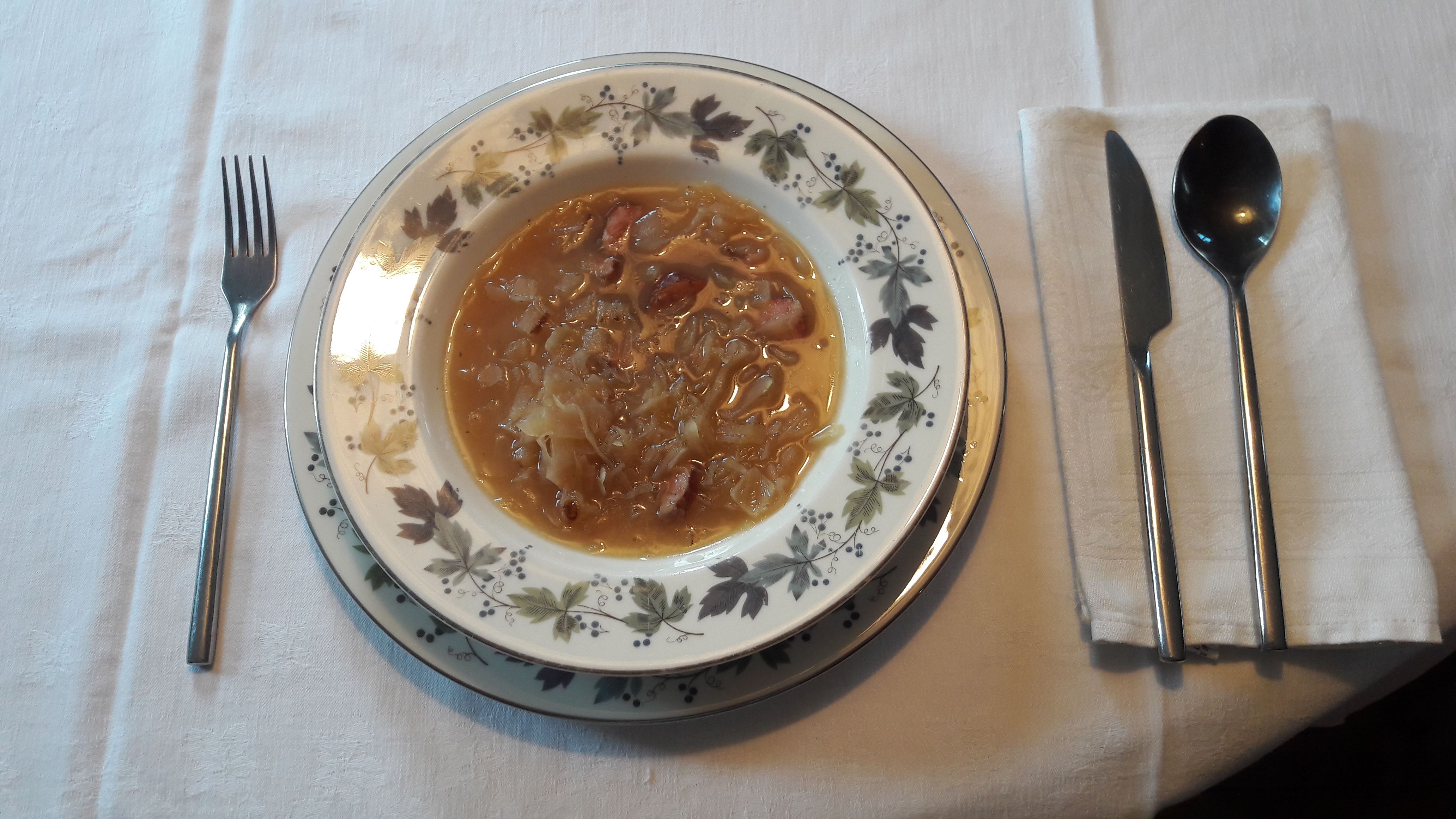
Gypsy Soup

Zupa cygańska is Gypsy soup and is so called  because it contains red peppers.  I think the smoky meats may also evoke the idea of camp fires.

Ingredients

  • 4 large tomatoes
  • 2 red or orange peppers
  • 1 large onion
  • 4 medium potatoes
  • 100g smoked bacon – chopped into small pieces
  • 200g of Polish sausage – sliced and chopped
  • 2 bay leaves
  • 2-3 grains of allspice
  • 3-4 peppercorns
  • a little sunflower oil for frying
  • Chopped flat-leaved parsley to serve

Method

  • Use boiling water to skin the tomatoes and leave to cool.
  • Chop the tomatoes into quarters.
  • De-seed the peppers.
  • Chop the peppers into small pieces.
  • Chop the onion into small pieces.
  • Fry the onion gently for a few minutes in a large frying pan.
  • Add the chopped tomatoes & peppers.
  • Fry gently for a couple of minutes.
  • Add the bacon & sausage and mix.
  • Cover the mixture with water and cover with a lid.
  • Cook gently for around 10 minutes.
  • Transfer the ingredients to a large saucepan.
  • Add the bay leaves, all-spice and peppercorns.
  • Add around 1.5 litres of water and bring to the boil.
  • Cover with a lid and simmer gently for around 30 minutes.
  • Peel the potatoes and cut them into large “cubes”.
  • Add the potatoes to the soup and cook gently until the potatoes are cooked.
  • Serve with chopped flat-leaved parsley.

Note

Do not let the potatoes disintegrate into a pulp.


Served in Royal Stafford – Blossom Time from the 1950s.

Note

If you do not have the fresh ingredients  you could use tinned tomatoes and bottled peppers.

Placek-with sour cherries & meringue

The base of this placek  (flat cake) is made with  a recipe similar to  Ciasto kruche 2 – with cooked egg yolks found in a previous post  – Pastry – ciasto kruche & półkruche.

The base is baked, apricot jam and bottled sour cherries are placed on top, this is topped with meringue and cooked again.

A few stages but well worth the effort. It is delicious with a lovely balance of  sweetness against the sour cherries.

Ingredients

  • 300g plain flour
  • 200g butter – chilled
  • 100g  & 150g icing sugar
  • 3 eggs separated
  • pinch or two of salt
  • Fine grated rind of 1 lemon – optional
  • 250ml of apricot jam – approx
  • 1/2 – 3/4 of a jar of morello/sour cherries

Method

Cook the egg yolks

  • Separate the raw yolks from the whites.
  • Place the yolks  in a colander and cook over hot water.
  • Use a fork to break up the yolks into very small pieces.
  • Leave to go cold.

Make the base

  • Add a pinch of salt to the flour.
  • Use a knife to cut the chilled butter into small pieces into the flour and then use your fingers to make the mixture like breadcrumbs.
  • Add the 100g of icing sugar and mix this together.
  • Add the broken up yolks and gently mix this in then and bring it all together into a dough – try and handle the pastry as little as possible.
  • Form the dough into a rough rectangle.
  • Wrap the dough in greaseproof paper and chill it in the fridge for about 30 minutes.
  • Pre-heat the oven to GM 7 – 220°C.
  • Grease and line a 33 x 23 cm baking tin.
  • Use a rolling pin to flatten the dough a little
  • Press the dough into the tin – filling it up the all the sides.
  • Prick the surface with a fork.
  • Bake for 20 – 25 minutes till golden.
  • Leave to cool.

Toppings and meringue

  • Lower the oven to GM 1 -140°C
  • Place the whites into a grease free bowl.
  • Whisk till stiff.
  • Add the 150g of icing sugar and whisk again till stiff.
  • Spread the jam thickly over the base
  • Drain the sour cherries and pat them dry.
  • Arrange the cherries over the jam.
  • Spread the meringue over the cherries taking it up to the edges.
  • Put back into the low heat oven for 45 to 60 minutes.


Cut the cake into squares when cool to serve.


Served here on Duchess  – Bramble Rose tea plates from the 1960s.

Karoflanka – Potato Soup

When I was young and I told my friends that my mother made potato soup, they all thought this sounded rather weird & tasteless.

Whereas, it was one of my favourite soups and like most Polish soups, it is not a purée, it has chucks of potato in it.

This following is based on my memory of my mother’s recipe.

For the best results, I use rosół (chicken bouillon) or homemade chicken stock when I have it.

Ingredients

  • 750g – 1 kilo of potatoes
  • 2 large onions
  • 200g smoked bacon
  • 2 litres of chicken stock or rosół
  • Large bunch of flat leaved parsley
  • 1 bay leaf
  • 2-3 grains of allspice
  • 4-5 peppercorns
  • A little oil for frying
  • Chopped flat leaved parsley to garnish
  • Extra seasoning may not be necessary because of the bacon and rosół/stock.

Method

  • Chop the smoked bacon into small squares.
  • Slowly heat the bacon in a heavy bottomed pan or good Teflon red spot non stick pan without oil.
  • Let all the fat cook out.
  • Chop the onions into small pieces and fry them with the onions.
  • You want the onions well browned, even some slightly charred.


  • Peel and chop the potatoes into chunks.
  • Fry them lightly in oil so all sides are done.
  • Mix the potatoes with the smoked bacon and onions in a large pan.
  • Add the chicken stock or rosół.
  • Chop the parsley leaves and add them with the allspice, bay leaf and peppercorns.
  • Add 1.5 to 2 litres of water and bring this to the boil.
  • Reduce the heat, put a lid on the pan and simmer gently for around 15 minutes.
  • You are aiming for cooked pieces of potatoes – do not let it disintegrate to a pulp! 
  • Garnish with chopped flat leaved parsley when serving.


Served here in Royal Stafford – Blossom Time from the 1950s

Creamier Version

Looking through other recipes for this soup, I found that often some soured cream was added at the end just before serving.

So add 3 to 4 tablespoons of soured cream to some slightly cooled soup in a little dish and then mix this into the pan and serve.


Served here in Royal Doulton –  Burgundy – 1959 to 1981.

Note

Both are super –  but my vote is for my mother’s version!

Egg Cookies

Eierkoeken – Egg Cookies  – are very popular in The Netherlands  – their  recent revival  was caused  I heard by Sonja Bakker  – a celebrity cook.

Koekje  is a small cake and the origin of the word cookie.

They are sold in bakers and supermarkets in packets of  five or six and even up to ten.

They are soft little cakes rather like English sponge drops.

The mixture is a fat free sponge similar to  Polish biszkopt.

They are so easy to make, especially if you have an electric hand whisk.

This two egg recipe makes six.

Ingredients

  • 2 eggs
  • 90g caster sugar
  • 120g plain flour
  • 2 teaspoons of baking powder

Method

  • Pre-heat the oven to GM 5 190°C.
  • Line a baking tray with grease-proof paper.
  • Mix the flour and baking powder together.
  • Whisk the eggs and sugar till they are white and fluffy.
  • Fold in the flour.
  • Place 6 circles of mixture on the baking tray.
  • Bake for around 15 minutes till golden – not much longer as they will be harder –  they need to be soft.


Served on Lavender plates by Jet for Ter Steege in The Netherlands

Variation

Add the grated rind of a lemon to the egg and sugar mixture  – a subtle addition to the flavour.

Nearly a Dandelion!

Mlecz was the name my mother used for dandelion (Taraxacum officinale) – this name refers to the milky fluid found in its stems. (mleko is Polish for milk)

Looking through one of my Polish recipe books I came across a salad using  the leaves of  mniszek lekarski – (lekarski means medicinal).  On looking this up I found this was another name for dandelion!

The photo below is  from a website called  me.me and on a leaflet from the East Village Farm in New York.


The likelihood of having me having young dandelion leaves for this salad is low so I decided to use rocket (arugula) leaves – rukola in Polish –  Eruca vesicaria or sativa which are more readily available and have a similar bitter/peppery taste from what I can gather.

Rocket has been grown in the Mediterranean area since Roman times.

Ingredients

  • Bunch of radishes
  • Around 70g of rocket
  • 60ml of soured cream
  •  Around a tablespoon of either fresh thyme, lemon balm, flat-leaved parsley or dill
  • Extra parsley to garnish

Method

  • Chop the rocket into small pieces
  • Top & tail the radishes and the finely slice them
  • Mix the two together
  • Finely chop the herb you are using
  • Mix the herb with the soured cream
  • Mix the salad with the soured cream mixture
  • Season to taste
  • Garnish with flat-leaved parsley to serve


Tomato Soup

There are many versions of tomato soup – some people just add tomato puree or a tin of tomatoes to rosół, (chicken bullion). For many this was standard practice on Monday with any that was left over from Sunday lunch and also in winter months in the past when fresh tomatoes were not so readily available.

I prefer to make a more refreshing fresh tomato soup.

Ripe tomatoes make the best soup – if you are lucky enough to have your own from the garden or allotment then these will be great or look out for ripe tomatoes on a market rather than the hard bullet ones often sold for salads.

Little note from the Metro newspaper

My mother always served boiled rice as the soup accompaniment.

Many years ago, well before Poland joined the European Union, when there were not as many Poles living in England, one of my English friends went for dinner at at a Polish lady’s house.  On telling me about the lovely food she said ” …. we had tomato soup with rice in it!” My instant reply without thinking was “but tomato soup always has rice in it”.   

Ingredients

  • 700g – 800g of ripe fresh tomatoes
  • 1 large or 2 medium onions
  • 1.5 litres of vegetable stock – came be from a cube or powder
  • Salt & ground pepper to taste
  • A little granulated sugar – optional – might not be needed.
  • Boiled rice to serve

Method


  • Pour boiling water over the tomatoes in a bowl and leave to cool.
  • Skin the tomatoes.
  • Chop the tomatoes into quarter.
  • Chop the onion into fine pieces.
  • Place the tomatoes, onion and vegetable stock into a large saucepan.
  • Bring to the boil and then put on the lid and simmer for at least 30 minutes.
  • You want the tomatoes and onions to have cooked away into the liquid -no large pieces left.
  • Season to taste.

Although sour soups are popular in Poland – tomato soup does not want to be sour.  Depending on the tomatoes used, I sometimes add a little granulated sugar.

  • To serve place a handful of cooked boiled rice into each soup plate.

Served here in my mother’s Crown Devon – Fieldings – Glenwood soup plates – made in England – 1939.

Dutch Cold Dish & Other Salads

I recently returned from a trip to The Netherlands to visit my friend again.

I always have a great time visiting different parts of the country and enjoying the wonderful hospitality.

One dish I have had many times is Koudeschotel – this translates as Cold Dish.

I think it is a sort of  “posh cousin” to  several Polish cooked salads such as Potato Salad and Mixed Vegetable Salad.

It is often made in large quantities as the centrepiece in a buffet meal.

There is a central mound made with boiled potatoes mashed with mayonnaise, onions, peas, carrots and cooked meat like chicken, pork or beef.

This is then decorated with items such as hard boiled eggs, gherkins, silver-skin onions, prawns or shrimps, asparagus, tomatoes, cooked or smoked meats and dusted with a little sweet paprika.


The koudeschotel on my arrival from England this year.

If the central mound is made without meat it is sometimes called Huzarensalade – Huzar’s Salad.

Ingredients – for the central mound

The original recipe  was for a large amount suitable for a big party – I have scaled it down.

  • 1 Kg of cold boiled potatoes
  • Around 200ml of mayonnaise – real full fat is best
  • 100g of cooked peas
  • 1 large onion chopped fine
  • 2 boiled carrots – diced
  • 200g of cooked chicken, pork or beef – shredded (meat used to make soup or stock is good)
  • Salt & pepper to taste

Notes

Many supermarkets and delicatessens in The Netherlands sell this mixture ready made.

Method

  • Mash the potatoes with the mayonnaise.
  • Add the peas, carrots, onion and meat and mix well.
  • Season to taste.
  • Arrange the mixture in the centre of a serving plate.

Decorate with a selection of the following:

  • Hard boiled eggs – sliced or quartered
  • Gherkins – small or large ones sliced
  • Silver-skin onions
  • Cooked prawns or shrimps,
  • Cooked asparagus spears or slices
  • Tomatoes – quartered
  • Cooked or smoked meats – chopped or in little slices
  • Dusted with a little sweet paprika.

Now is the time to be a little creative with the decoration – I tend to do rows of the different ingredients and dust with sweet paprika at the end.

(For smaller gatherings sometimes the mixture is placed in a bowl and the eggs and gherkins etc are just placed on top)

Other Salads

One day we went to a neighbour’s house for a BBQ and koudeschotel was one of the dishes served with the grilled meats.

We were also served the following two lovely salads –

Cabbage & Pineapple Salad

Ingredients

  • Small white cabbage
  • 8 rings of fresh or tinned in juice pineapple
  • 50 – 80g of raisins

Method

  • Soak the raisins in pineapple juice for at least 30 minutes
  • Shred and chop the cabbage
  • Chop the pineapple rings into small pieces
  • Mix the cabbage, pineapple and the raisins in juice together

Salad with Smoked Salmon & Capers

Ingredients

  • Crunchy lettuce such as Cos or  Little Gem – I used a Red Little Gem
  • 100g Smoked Salmon
  • 2 or 3 sticks of celery – finely sliced
  • 1 tablespoon of capers
  • 100g of cooked small sized pasta
  • Juice of half a lemon
  • Ground black pepper

Method

  • Hand tear the lettuce into medium sized pieces.
  • Chop the smoked salmon into small pieces.
  • Mix the smoked salmon, capers and pasta together and
  • Mix this with the lettuce.
  • Pour the lemon juice over this and mix.
  • Season with black pepper.
  • Extra salt should not be needed because of the capers & smoked salmon.


You could serve this as a starter using a few lettuce leaves as a bed on each plate with the smoked salmon mixture in the centre.

Barszcz – Beetroot Soup

 Barszcz  is the classic Polish beetroot soup.

Now this may just my imagination but beetroots in Poland just taste so much better and sweeter than the ones I have had in England, maybe it is the variety that is grown there or the soil.   I think you have to use home-grown or organic beetroot to get as good a taste.

I like the clear, meat-free, Lenten barszcz made for Wigilia – Christmas Eve and have tried over the years many recipes using fresh beetroots, which I have boiled or roasted and also used ready cooked vacuum packed beetroot and adjusted the taste with lemon juice or a little sugar.


I have never been truly happy with the results which did not seem to have the sweetness and flavour or the soups I have had made for me.

Nowadays the way I make  barszcz is my biggest cheat!

Many years ago I started to make my barszcz with beetroot concentrate as the base, with the addition of  vegetable stock and some grated beetroot to make it look authentic and this proved very popular.


A few years ago I was recommended to try barszcz from a carton – and would you believe it – everyone said this was the best barszcz they had ever had!

I have used this ever since.

Served in Carnation by Royal Doulton 1982 – 1998

Uszka (mushroom filled Polish pasta) are often served in barszcz or a dollop of soured cream is added on serving.


Orange Cake

This cake using sunflower oil and  yoghurt has a really good texture and reminds me of English Madeira cake, which was invented in the mid 19th Century taking its name from the Portuguese Madeira wine with which this cake was often served.

It started out in my hunt to make a cake using lemon balm – (melisa in Polish) which grows abundantly in my garden. Sadly none of the cakes I made captured its taste at all!

However I  adapted this recipe to make an orange cake and the result is delicious.

Short History of Oranges

Oranges originated in Ancient China and sweet oranges are recorded in Chinese literature in very early times.

They are thought to have been brought by Italian and Portuguese traders to the Mediterranean area in the 15th century.

The name is of  Middle Eastern origin:

  • Arabic – nāranj
  • Persian – narang
  • French – l’orange
  • Italian – arancia
  • Portuguese –  laranja
  • Spanish – naranja
  • Polish – pomarańcz
  • Whilst in Dutch it is – sinaasappel – meaning  Chinese apple.

Oranges in Poland were very expensive before World War 2 and my mother would tell me that at St Nicholas and Christmas time an orange or a tangerine would be a common gift.

Christopher Columbus took oranges to the Caribbean on his second voyage in 1493.

Later,  Spanish settlers introduced orange plants to North America,  first to Florida and then to California.

Figures from 2017 show Brazil as being the largest orange producer in the world with the United States of America coming second and  Florida produces 70% of that country’s oranges.

Ingredients

  • 85- 90ml of Greek yoghurt (full fat is best)
  • 2 large oranges – finely grated rind & juice (not all will be needed)
  • 125ml of orange juice
  • 180g of caster sugar
  • 320g of plain flour
  • 2 teaspoons of baking powder
  • 1/4 teaspoon of salt
  • 170ml of sunflower oil
  • 2 eggs
  • 1 tablespoon of lemon juice

Method

  • Pre-heat the oven to GM 5 – 190°C.
  • Finely grate the rind of the oranges.
  • Squeeze the juice from the oranges (you will not need all of it).
  • Mix the yoghurt with 125ml of the  orange juice.
  • Prepare a 23cm loose bottom or spring  form tin with a cake liner.
  • In a bowl mix the flour, baking powder and salt.
  • In a large bowl whisk together the sugar, oil and orange rind.
  • Add the eggs and whisk again.
  • Lightly mix in the flour.
  • Mix in the lemon juice.
  • Mix in the yoghurt and orange juice mixture to give a thick batter.
  • Pour into the cake tin.
  • Bake for 30 – 35 minutes (check after 25 minutes and cover the top lightly if necessary).

Served on Duchess – Bramble Rose – tea-plates from the 1960s.