Podkarpackie Hreczanyki

I saw a picture on an Instagram site of  Podkarpackie hreczanyki – I had not heard of them before so did some research and decided to make them.

They are buckwheat and minced meat kotlety (burgers or meatball).

Podkarpackie is a mountainous province in the south-eastern corner of Poland.

Its name translates into  English as Subcarpathian – these are the the foot hills of the Carpathian Mountains.

The usual Polish word for buckwheat is  gryka  but here a regional word  hreczka is used.

Buckwheat (Fagopyrum tataricum) is used very much in Polish cookery and was eaten in Poland long before the introduction of the potato in the 18th century.

I have written already about the use of its flour to make bliny & pancakes.

The buckwheat has a strong, slightly perfumed taste and I think beef is a good meat to mix with it.

These are often serve with mushroom sauce. I heated some up in the sauce itself and I thought they were even better this way. They soak up the sauce and are delicious.

Ingredients

  • 100g buckwheat
  • 500g of minced beef
  • 1 onion
  • 4 cloves of garlic
  • 2 eggs
  • Salt & pepper
  • *
  • Dried breadcrumbs or flour to shape
  • Sunflower oil for frying
  • *
  • Mushroom sauce for serving

Method

  • Cook the buckwheat according to instructions.
  • I use the boil in the bag method with a 100g packet.
  • Drain and leave to go cold.


  • Chop the onion and garlic very fine or use a mini chopper.
  • Mix the beef and buckwheat together.
  • Add the onion and garlic and the 2 eggs.
  • Add some salt and pepper.
  • Mix the ingredients together with your hands.
  • Shape the mixture into large balls and coat them with dried bread crumbs or flour.
  • Fry them on both sides so they are cooked through.
  • Keep the cooked ones in a low oven whilst cooking the rest.
  • *
  • Serve with a strong mushroom sauce or
  • *
  • Put them into an oven proof dish and cover them with mushroom sauce.
  • Cook for at least an hour at GM4 – 180°C.


Royal Doulton – Tapestry – 1966-1988

Pierogi leniwe

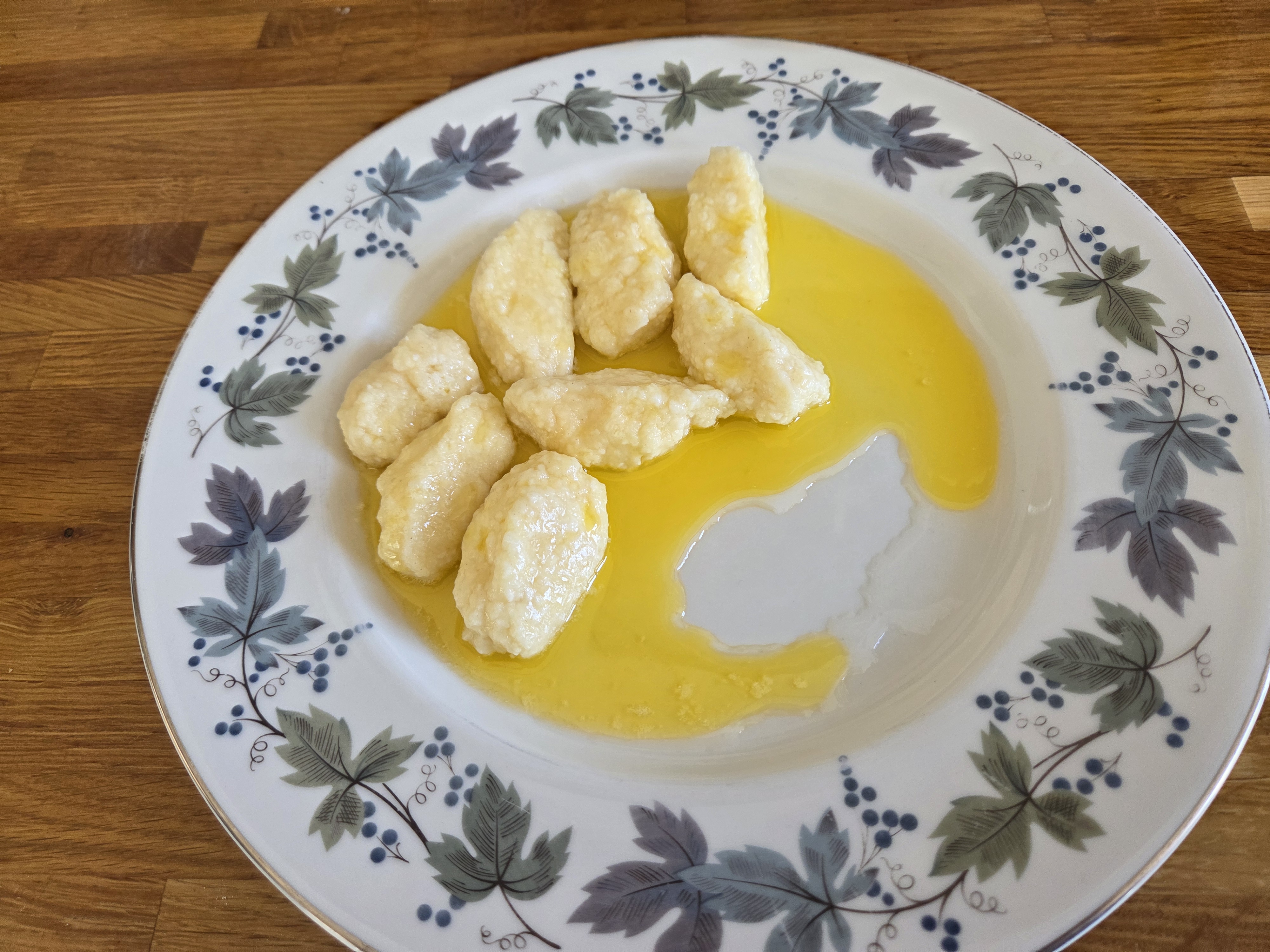
Pierogi leniwe – means lazy pierogi or  lazy dumplings.

I wrote about kopytka – Polish potato dumplings a good while back and these have the same shape.

Traditional recipes use twaróg – Polish curd cheese – I use my own yoghurt cheese.  I have found that you can use crumbly, white, mild, English cheeses such as: Cheshire, Lancashire or Wensleydale.

They can be served savoury or sweet – with melted butter, à la Polonaise (buttered breadcrumbs) or skwarki (crisp, fried, small squares of bacon) or sweet with a cinnamon sugar mixture.

Ingredients

  • 400g of twaróg (curd cheese), yoghurt cheese or  a white, crumbly cheese.
  • 3 egg yolks
  • 160 – 200g of plain flour
  • ½ teaspoon of salt

Method

  • Mix the yolks with the cheese.
  • Add the salt
  • Weigh out the flour to give an idea of how much is needed – this will depend on the cheese and the size of the eggs.
  • Add the flour and mix first with a wooden spoon and then by hand, you might not need all the flour or you may need more.
  • Mix until you have a soft dough.
  • Divide the dough into quarters and using a floured board shape the dough and roll it with you hands until you have a long sausage about 3cm in diameter.  If the dough sticks to the board then you need to add more flour.
  • Use a sharp knife to cut the dough into pieces, make the first cut at a diagonal and make the thickness about 1 to 1.5cm. You will get a sort of oval shape.
  • Repeat this with the rest of the dough.
  • Fill a large pan with water, add some salt and bring this to the boil.
  • When the water is boiling, add the dumplings one by one, do not over fill the pan or they will stick together. I tend to do around 8 at a time.
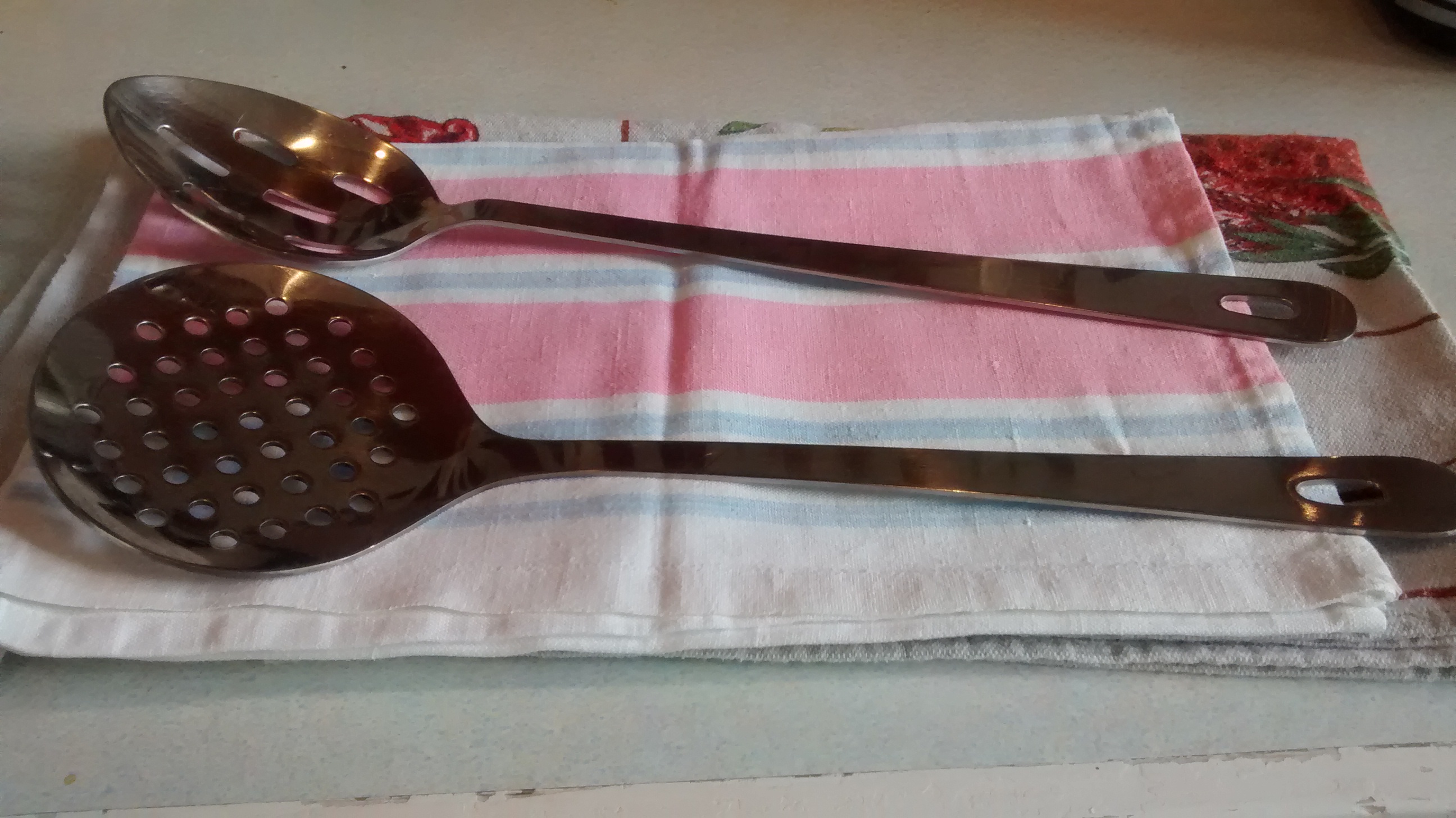
  • As they cook they will float to the surface, give them about another minute and then remove them with a slotted  or a perforated spoon and put them in a colander.
  • I have a colander sitting in an empty pan by the side of the large pan in which I am boiling the dumplings.

IMG_20151020_094418143


  • I find that the maximum from putting  them into the water to taking them out will be 3 minutes, if you cook these too long they will start to fall apart.

Here served as suggested above with  melted butter and with skwarki (crisp, fried, small squares of bacon).

Served on –

  • J & G Meakin – Topic – around 1967
  • Wedgwood – Chelsea garden – early 21st century.

Here served  à la Polonaise (buttered breadcrumbs)  in a handled dish by

Rörstrand Sweden Granada Ovenware  from the 1960s


They can be also be served  sweet with a cinnamon sugar mixture.

Ogórkowa – Gherkin Soup -2

I posted the recipe for ogórkowa – gherkin soup, which is a classic Polish soup, over a year ago.

It is sour, a taste much loved by the Poles!

It is traditionally made from brine fermented gherkins but you can also use pickled gherkins.

I was sorting out my cutting and notes the other day and came across this recipe from my aunt in Białystok and decided it was time I made this version.

Ingredients

  • 250g gherkins
  • 125ml gherkin liquid
  • 1.5 litres of vegetable stock (can be from cubes or powder)
  • 4 medium potatoes, peeled – boiled or steamed
  • 3-4 carrots whole – peeled – boiled
  • 125ml of soured cream
  • Chopped dill – some to add and some  to serve

Method

This is easiest to make if you have some potatoes and carrots boiled already.

  • Add the gherkin liquid to the vegetable stock and bring to the boil.
  • Rough chop the gherkins.
  • Drop the gherkins into the liquid and simmer for around 20 -25 minutes.
  • Chop the boiled potatoes into rough cubes.
  • Chop the boiled carrots into circles or half circles (depending on the size)
  • Add the potatoes and carrots, stir and simmer for around 5 minutes.
  • Stir in some chopped dill.
  • Stir in the soured cream.
  • Serve with extra dill sprinkled on top.


Served in Royal Doulton – Tapestry – 1966 – 1988.


Green Early Summer Soup

In olden days, and even in Communist times in Poland, the only vegetables available in winter were root vegetables or preserved or bottled ones.

When sorrel leaves started to grow this marked the end of winter – a herald of spring and the start of fresh greens.

I grow sorrel in pots in my garden.

I posted a recipe for Polish sorrel soup nearly a year ago.  The following recipe does not require as much sorrel, though should you not have any sorrel at all, then use more spinach and another lemon.

Ingredients

  • 100g sorrel leaves
  • 100g of fresh spinach leaves (or use frozen)
  • ½ a head of a large lettuce
  • Juice of 1 lemon
  • 125ml soured cream
  • 2 egg yolks
  • Salt & Pepper if needed
  • *
  • Chopped hard boiled eggs – around 1 egg  per serving.

Method

  • Have the vegetable stock ready and hot in a saucepan.
  • Remove any thick stalks from the sorrel and spinach.
  • Chop the lettuce, sorrel and spinach.
  • Add them to the stock.
  • Bring to the boil and then simmer gently for around 5 minutes.
  • Take off the heat and leave to cool a little (for safety).
  • Blend the soup until you have a thick purée.
  • Adjust the seasoning if necessary.
  • Bring back to the boil.
  • In a small dish mix the soured cream with the egg yolks.
  • Take the pan off the boil and add the lemon juice
  • Stir in the soured cream mixture and then use a balloon whisk to mix it in.
  • Adjust the seasoning if needed.
  • *
  • Serve with chopped hard boiled eggs.


Soup plate – Royal Doulton – Burgundy – 1959-1981

Knedle – Polish Potato Dumplings

The word knedle comes from a German word knödel which means dumpling.

Knedle are similar to kopytka, both can be called potato dumplings. They are different in shape but both are made with boiled potatoes, which have been left to go cold.

I  often boil potatoes the day before – the exact amounts are not critical but you must use starchy potatoes. When you have made these once you will have a good idea of the amounts involved.

Traditionally they are served with either melted butter or skwarki (crisp, fried, small squares of bacon) or charred fried onions.

Ingredients

  • 650 -750g boiled starchy potatoes – such as King Edward or Maris Piper
  • 1 egg & 1 yolk
  • 200g potato flour or plain flour or a mixture of the two.(I prefer a mixture or just plain flour)
  • salt

Method

  • Peel the potatoes, cut them up into pieces and boil them in salted water.
  • Drain the potatoes.
  • Leave the potatoes to cool.
  • Mash them so that there are no lumps – I have a ricer which is very good for this.
  • Use a large bowl and put the mashed potatoes into the bowl.
  • Lightly beat the egg and the yolk together and add this to the potatoes.
  • Add a little salt.
  • Weigh out the flour to give an idea of how much is needed – this will depend on the type of potato and the size of the eggs.
  • Add the flour and mix first with a wooden spoon and then by hand.
  • You might not need all the flour or you may need more.
  • Mix until you have a soft dough.
  • Have ready a large floured board to put the knedle on.
  • With your hands take small amount of the dough and roll into walnut sized balls.
  • On the board flatten the ball to a thick disc.
  • Made a thumb print in the centre of the disc (this allows them to hold more sauce when served).
  • Repeat this with the rest of the dough.
  • Fill a large pan with water, add some salt and bring this to the boil.
  • When the water is boiling, add the dumplings one by one, do not over fill the pan or they will stick together, around 5 at a time.
  • As they cook they will float to the surface then let them cook for another 2 minutes.
  • Then remove them with a slotted  or a perforated spoon and put them in a colander.
  • I have a colander sitting in an empty pan by the side of the large pan in which I am boiling the knedle.
  • Served here with melted butter, charred fried onions and mushroom sauce.

Served  in soup dishes by Royal Doulton – Tapestry – 1966 -1988.

Pierogi with Chicken & Raisins & Walnuts

This is my 250th post!

So I have decided on this Polish classic with a new twist – one I will certainly be making again.

Last Easter time I was in Gdańsk and I got to eat many old favourites and several new dishes.

I tried pierogi in several restaurants, choosing some unusual fillings and have written about some of these already such as pierogi with duck. 

I did find that some of the meaty ones were too big – I use a 7cm diameter cutter, which for me gives a better filling to pasta ratio.

On one menu I noticed a filling of chicken, raisins and walnuts.  I did not get the chance to eat these but decided that this was a must to try out.

Ingredients

  • 150 -200g of cooked chicken or thighs – roasted or poached  – amounts are not critical.
  • 50g of raisins
  • 30-50g of walnuts
  • Pepper to taste

Method

  • Place the raisins in a small bowl and cover them with boiling water.
  • Leave for an hour till they swell up.
  • Place them into a small saucepan heat them slowly and simmer stirring with a wooden spoon.
  • Once you have a pulp of the raisins leave them to go cold.
  • Chop the walnuts into small pieces.
  • Chop or mince the chicken.
  • Mix the ingredients together.
  • Season with pepper.
  • *
  • Use this filling for the pierogi – instructions for the dough are given below.
  • *
  • Serve with melted butter.

I have written much previously about pierogi  – but have included the instructions for the dough again below to save you looking it up.

Ingredients – Dough

  • 250g pasta flour or strong flour or plain flour & 2 tablespoons of fine semolina
  • 150ml water
  • 1 tablespoon oil – sunflower or light olive
  • ½ teaspoon salt
  • 1 egg yolk

Method

  • In a jug or bowl mix together the water, oil and the yolk.
  • Put the flour and salt into a large bowl and make a well in the centre.
  • Pour in the liquid from the jug and initially use a knife to mix this into the flour and then use your hands to mix the liquid and flour to get a ball of dough.


  • Turn this out onto a floured board and knead the dough for a few minutes until you have a smooth ball.
  • Cut the dough into quarters.
  • On a floured board roll out a quarter at a time until you have a sheet of thinly rolled dough.
  • Now prepare a large tray and cover it with a clean tea towel and sprinkle this with flour.
  • Have a large surface such as a tray covered with a cotton or linen cloth which has been lightly floured ready  and place the sealed pierogi on this until they are all made, do not let then touch each other.
  • I cut them out using a 7 cm diameter cutter.
  • The excess dough can be re-mixed and rolled out again.
  • Around a half tablespoon of filling is put on  each circle and then they are folded over and the edges pinched together to make a good seal.
  • You learn from experience how much filling to put in as too much will make it hard to seal them and if not properly sealed they will burst on boiling.  Do not worry if you have a few mishaps – it still happens to me even with experience – it is hard to salvage one that has gone wrong – just accept that there will be a few that you do not cook.
  • To cook the pierogi, use a large pan of boiling water to which you have added some salt and a drizzle of oil.
  • Drop the pierogi in one by one and allow them to boil.  I usually do about 6 to 8 at a time.
  • As they cook they will float to the surface, let them boil for 2 to 3 minutes and then remove them with a slotted or perforated spoon and put them into a colander above a pan for a few seconds to drain.
  • Continue boiling batches in the same water.
  • If you want to make all the pierogi to serve together then you need to get a large shallow dish and put melted butter into the dish.
  • Keep the dish warm in a low oven.
  • As you take out the cooked pierogi add them to the dish, mix them with the butter to prevent them sticking.
  • Keep on adding more as they cook and keep shaking the dish to coat and mix them.
  • Fried pierogi

  • All the butter coated pierogi that are not eaten can be fried up later – equally delicious!
  • Any that are not eaten should be spread out so that they cool with the melted butter around them.
  • Later, you can then fry them up gently so they are golden in parts.


Breaded Celeriac

Celeriac is used more often than celery stalks in Polish cooking.

I first  wrote about  celeriac in July 2016 Seler – Celeriac – Celery  and have written other posts after that.

Celeriac is become more and more popular in the shops in England  nowadays.

I came across this recipes recently and it reminded me of à la Polonaise.

Ingredients

  • 1 celeriac
  • 1 egg
  • Dried breadcrumbs – Bułka tarta
  • Salt & ground black pepper
  • Sunflower oil – for frying

Method

  • Peel the outer part of the celeriac away.
  • Steam the celeriac till it is soft throughout (20 – 30 minutes).
  • Allow to cool.
  • With a clean tea towel mop the celeriac till it is dry.
  • Cut  it into “sticks”.
  • Sprinkle them with salt & pepper.
  • Beat the egg and put it into a shallow dish.
  • Dip the sticks in the beaten egg mixture.
  • Put the dried breadcrumbs into a shallow dish.
  • Dip the sticks into the dried breadcrumbs making sure all the sides are covered.


  • Shallow fry the coated sticks in hot sunflower oil – turning them over.
  • Place onto kitchen roll to remove any excess oil.
  • Keep them warm in an oven whilst you fry other batches.

Here served with a beetroot salad.

Goes well with roast chicken or pork.


Pyzy

Pyzy are potato dumplings, usually stuffed with meat and then boiled.

Traditionally they are served with some skwarki – crispy smoked bacon bits or slightly charred onions, a mixture of the two or just melted butter poured over them.

  • There are many recipes, some made with raw potato, others with boiled or steamed potatoes and some using a mixture of the two.
  • I have found that using a 50:50 mixture of  fine grated raw potatoes and boiled potatoes gives the best results.
  • You will need some flour, which can be wheat flour, potato flour or a mixture of the two (I prefer just wheat).
  • You also need eggs or egg yolks – around 1 egg to 1 kilo of potatoes.
  • For the filling you needs some cooked meat such as from a klops – meat loaf, cooked kotlety (meat balls/burgers) or meat filling for pierogi.

My mother never made pyzy and I must admit the first time I had them in Poland, I thought they were much too big & heavy! Since them I have tried out many different version and have liked them very much.

In Gvara, a restaurant in Gdańsk, I tried a soup with some pyzy in it.  It was utterly delicious.

Dried mushroom consommé with thin sliced mushroom carpaccio* and pyzy filled with pork & shrimp.

* Usually thinly sliced raw meat or fish -named by Giuseppe Cipriani (1900 – 1980) bar owner in Venice, because of the colours used by the Venetian Painter Vittore Carpaccio.

Ingredients

  • 750g of raw potatoes
  • 750g of cold boiled potatoes
  • 1 egg and 1 yolk
  • 1-2 tablespoons of plain flour  & extra for dusting
  • Salt

Method

  • Grate the raw potatoes using a fine grater.
  • Place the potatoes on a clean tea cloth.
  • Squeeze out as much liquid as possible.
  • Mash or use a ricer to get the boiled potatoes smooth and lump free.
  • Mix the two sorts of potato together in a large bowl.
  • Add the egg and the yolk and mix together.
  • Add enough flour to make a stiff dough.
  • Add some salt.


Ingredients – Filling

  • 250g of cooked and then minced or finely chopped meat(usually pork)
    such as from:

    • Klops – meat loaf
    • Cooked minced kotlety (meat balls/burgers)
    • Meat filling for pierogi.
  • Half a grated onion
  • 25g of melted butter
  • 1-2 tablespoons of dried breadcrumbs – bułka tarta
  • Salt & pepper

Method – Filling

  • Mix all the ingredients together to make a stiff filling.
  • Season to taste.

Making the pyzy

  • You are aiming for balls around the size of a large walnut.
  • Take a small handful of the mixture and shape it into a flat disc.
  • Place this onto a floured board.
  • Add a teaspoon amount of the meat filling.
  • Bring the potato mixture around the filling and with floured hands shape into a ball.
  • Repeat this with the rest of the potato mixture and meat filling mixture.
  • Have ready a large pan of boiling water to which you have added some salt.
  • Place around 5 pyzy at a time into the hot water.
  • Let them rise to the top then simmer for 4 – 6  minutes, depends on the size –  not too long as they will start to disintegrate.
  • Remove with a slotted spoon and place in a colander over a pan.


  • Place into a warm serving dish and top with skwarki – crispy smoked bacon bits, slightly charred onions, a mixture of the two or just melted butter.
  • Keep the dish warm and continue adding to the pyzy in the dish as they cook.
  • The fat in the topping stops them sticking together.

Serving tureen – Gaywood by Ridgeway – Made in England.


Dumplings … just one word!

In Polish cookery there are many items, made with flour or potatoes, which when you look up English words to describe them, you find just one word … dumplings!

Some are similar – some quite different – Most I have already written about – there may be some in the future.

Below is a list – with links to those already written about – updated in 2024.

See also:

February 2024 – This has been updated to include – Kołduny 2

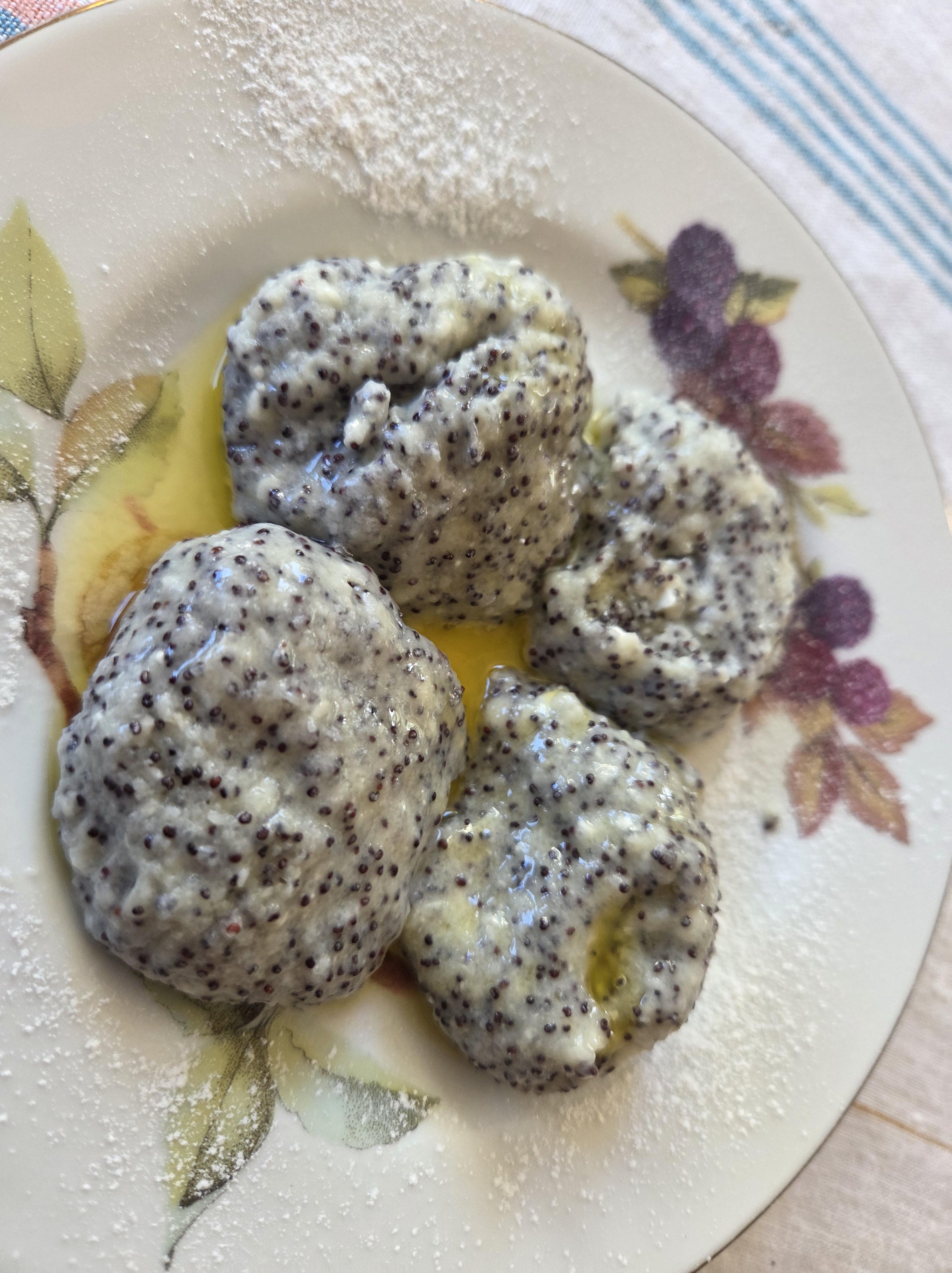
September 2026 – This has ben updated to include Knedle with Curd cheesse and

Knedle with Cheese and Poppy seeds.


Paszteciki – little savoury pastries

Paszteciki are little savoury pastries often served as a soup accompaniment. They are made with with a pre-cooked filling which sometimes contains meat but vegetable versions are very popular and mushroom or sauerkraut & mushroom ones are very often made for Wigilia – Christmas Eve.

They are shaped like little sausage rolls or diagonal slices cut from a large roll.

I think they are best served warm.

You can make these using many sorts of pastry doughs – the following yeast dough is one that is often used.

Yeast Dough

Ingredients

  • 250g plain flour or a mixture of spelt & plain flour
  • 1 tablespoon of dried yeast
  • 1 teaspoon of granulated sugar
  • 125-150ml of milk
  • 1 egg & 1 yolk
  • 40g butter – melted
  • 1/2 teaspoon of salt
  • 1 egg white used for glaze

Method

  • Put 50g of the flour into a bowl.
  • Add the yeast and sugar.
  • Add enough of the milk to make the mixture like double cream.
  • Leave in a warm place to bubble and froth up.
  • Place the rest of the flour into a bowl.
  • Add the salt and mix.
  • Lightly beat the whole egg  and the yolk together.
  • Add the egg mixture to the flour.
  • Add the yeast mixture to the flour.
  • Start to mix together using a wooden spoon.
  • Slowly add as much milk as needed.
  • Bring the dough together using your hands until it leaves the side of the bowl.
  • Knead the dough lightly until it is smooth.
  • Flatten the dough into a rectangle.
  • Slowly pour on the butter and fold over the dough.
  • Keep kneading the buttery dough until it is all incorporated.
  • Knead a little longer until you have a nice glossy ball.
  • Put the dough back into a bowl.
  • Cover with a cloth or cling film and leave to rise in a warm place.
  • ***********************
  • Pre-heat the oven to GM7 220 °C.
  • Grease several baking trays.
  • Take the pastry and shape into a rough rectangle.
  • Roll out thinly into a large rectangle.
  • Cut the rectangle into two lengthwise so you have two long thin rectangles.
  • Place the cold filling in the centre lengthwise.
  • Fold the two long sides over the filling so the pastry just meets and is not too thick.
  • Turn the roll over so the seam is underneath.
  • Cut the roll into diagonal slices about 5cm thick.

  • Place the pieces on the baking trays.
  • Glaze the pieces with beaten egg white.
  • Leave for around 30 minutes.
  • Bake for 14-15 minutes.
  • Allow to cool a little and then remove from the tray and place on a cooling rack.

Served on Royal Worcester  – Evesham – tea plates –  a design from 1961

Fillings

A variety of  fillings can be used such as ones that you would use for pierogi – Polish filled pasta, for example mushroom or sauerkraut & mushroom or you can  use pre-cooked vegetables, meats and also include hard boiled eggs.

All fillings should be cold when used.

Below are two fillings that I made for my paszteciki.

Fresh Cabbage & Mushroom Filling

Ingredients

  • Small head of white cabbage or sweetheart cabbage.
  • 150-200g of mushrooms (I used the chestnut ones)
  • 1 large onion
  • 100g of butter
  • 2 or more hard boiled eggs
  • Salt & pepper to taste


Method

  • Shred and then chop the cabbage into small pieces.
  • Chop the onion into small pieces.
  • Chop the mushrooms into small pieces.
  • Melt the half the butter in a large deep frying pan.
  • Slowly cook the onions and the cabbage but do not brown.
  • Cover with a lid and let them simmer till they are both soft.
  • Stir occasionally – you might need to add a little hot water.
  • In another pan melt the rest of the butter and fry the mushrooms.
  • Add the mushrooms to the cabbage and onion mixture and mix well.
  • Heat gently together to remove all the excess liquid.
  • Leave to go cold.
  • Rough chop the hard boiled eggs and add them to the mixture.
  • Season to taste.

Note – this might be more filling than you need – you can always freeze what is left.

Mushroom Filling

This is a new filling for me using just fresh mushrooms.

Ingredients

  • 250 -300g mushrooms(I used chestnut)
  • 1 onion
  • Around 50g  of butter
  • 3-4 tablespoons of soured cream
  • Salt & pepper to taste.

Method

  • Slice and chop the mushrooms into small pieces.
  • Chop the onion into small pieces.
  • Fry the onion in butter till they are soft – do not brown.
  • Add the mushrooms and fry together.
  • Keep stirring and cook gently till the mushrooms are soft.
  • Add the soured cream and stir together.
  • Heat for a little while to remove excess liquid.
  • Leave to go cold.
  • Season to taste.

Note – this might be more filling than you need – you can always freeze what is left.