Currant Tea Cakes

  • This recipe is a variation of Yorkshire Tea Cakes –  bułeczki.
  • These are soft bread buns with the addition of currants.
  • In Polish the word – rodzynki – is used for raisins and sultanas – ie dried grapes.
  • I do not know what word is used for currants – the dictionary gives the word   porzeczki  –  but that is used for berries such as black  or red currants.

Ingredients

  • 340g plain flour
  • ½ tablespoon of dried yeast
  • ¼ teaspoon of salt
  • 30g granulated sugar
  • 30g of butter
  • 220ml of milk & water mixed – lukewarm
  • 60g currants

Method

  • Mix the yeast, sugar and milk and water mixture and leave to froth up.
  • In a large bowl rub the butter into the flour.
  • Add the salt.
  • Stir in the currants.
  • Pour the yeast mixture into the flour mixture and mix well.
  • Cover the bowl and leave in a warm place for an hour.
  • Grease a baking tray.
  • Divide into 6 pieces and shape into flattened circles.
  • Place the circles, evenly spaced onto the greased baking tray.
  • Cover and leave for 40 – 60 minutes
  • Pre-heat the oven to GM6 – 200°C
  • Bake for 10- 12 minutes.
  • Leave on the tray for a few minutes then put them on a wire rack to cool.

They are delicious, split, toasted and buttered.

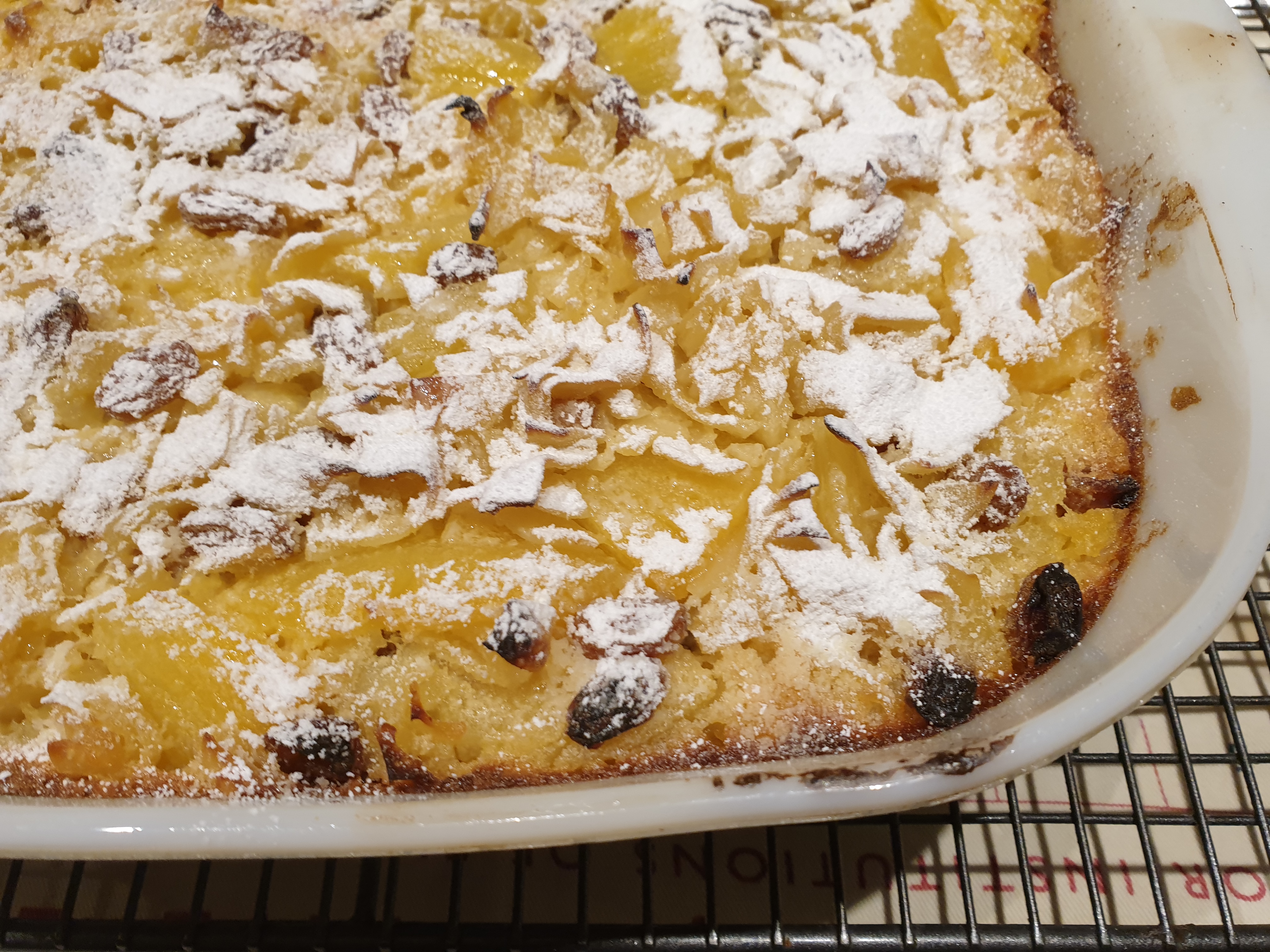
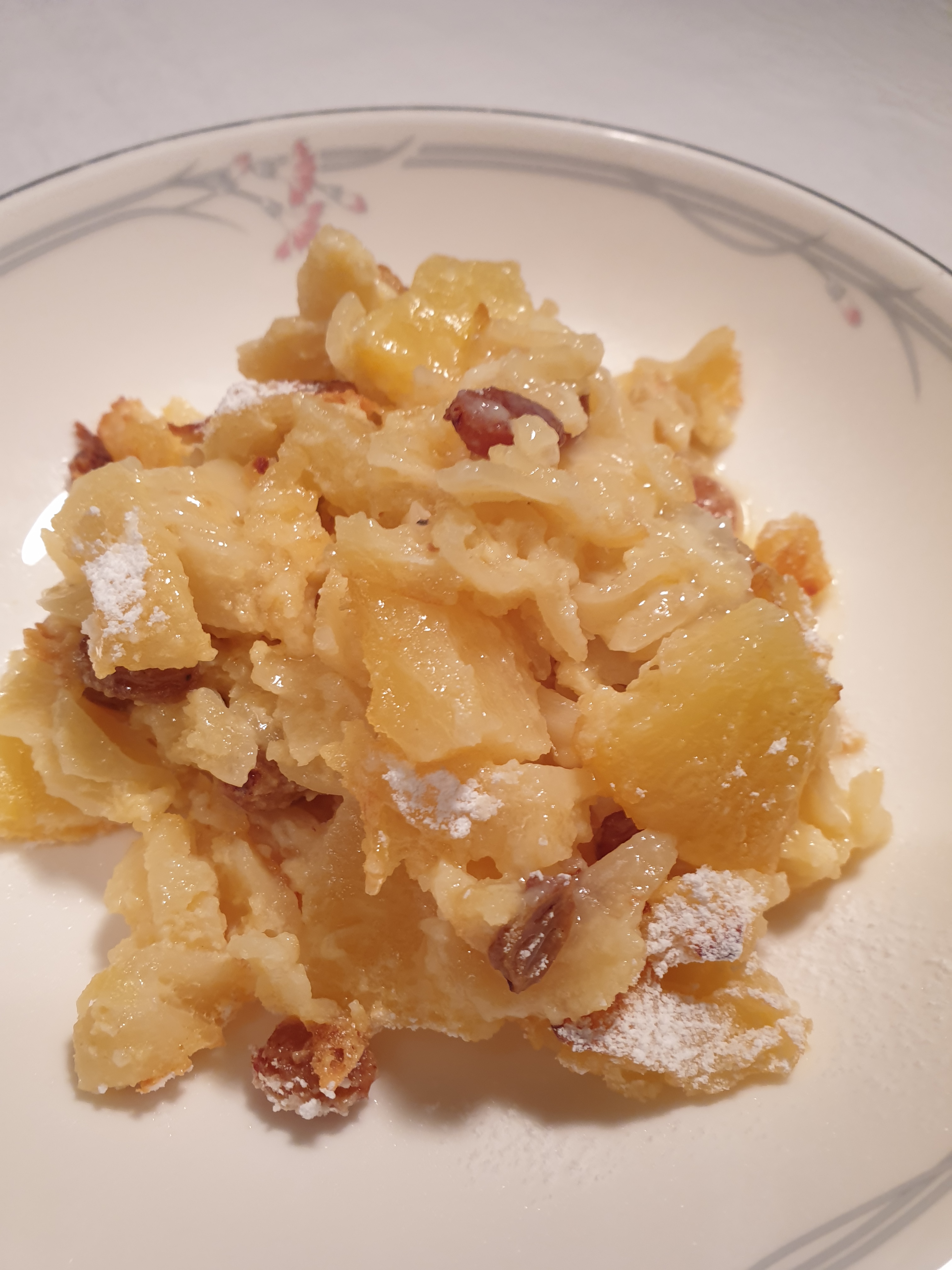
Makaron with Pineapples

Ingredients

  • 250g cooked small sized pasta
  • 1 tin of pineapples (425g)
  • 100g of sultanas
  • 70g granulated sugar
  • 3 eggs separated
  • 50g butter

Method

  • Soak the sultanas in the juice from the pineapples for several hours.
  • Chop the pineapples into small pieces.
  • Melt the butter.
  • Grease an oven proof dish with some of the butter.
  • Pre-heat the oven to GM4 – 180°C.
  • Mix the pasta with the rest of the butter.
  • Mix the sultanas and liquor with the pasta.
  • Mix in the chopped pineapples.
  • Whisk the egg yolks with the sugar till pale and frothy.
  • Lightly whisk the egg whites.
  • Mix the whites with the yolk mixture and whisk again.
  • Mix the pasta mixture with the egg and sugar mixture.
  • Put the mixture into the buttered oven proof dish dish.
  • Cook for 40 -50 minutes.
  • Dust with icing sugar and serve.

Served in Royal Doulton – Carnation 1982 – 1998

Ciasteczka with currants & peel

Ciasteczka is the nearest Polish word for biscuits. It can describe small soft cakes or crisper style biscuits or cookies.

At home we always spoke about biskwity and it was only when I first went to Poland that I realised this was NOT A POLISH WORD!

The word nearest to descripting English biscuits is herbatniki – these are biscuits to have with a cup of tea (herbata).

These are often petit beurre, morning coffee or rich tea type biscuits – plain thin biscuits.

These ciasteczka are quite a bit richer – variations of these I would have enjoyed cutting out with my mother.

Ingredients

  • 240g plain flour
  • 120 butter
  • 120g granulated sugar
  • ½ teaspoon of baking powder
  • ¼ teaspoon of ground cinnamon
  • Pinch of salt
  • 50g currants
  • 30g mixed peel
  • 1 egg – beaten
  • 1 tablespoon of milk – optional

Method

  • Pre-heat the oven to GM4 – 180°C.
  • Grease 2 to 3 baking trays.
  • Rub the butter into the flour till it resembles breadcrumbs.
  • Stir in the rest of the dry ingredients.
  • Add enough of the egg to make a soft dough.
  • You might need some of the milk.
  • Roll out the dough to 1cm thickness.
  • Cut out circles using a 7cm circular cutter.
  • Place on the baking trays.
  • Bake for 15 to 20 minutes till lightly golden.
  • Leave to cool on a wire baking rack.

Yorkshire Tea Cakes

I have been looking at some old Yorkshire recipes and tried out this recipe for soft bread buns – tea cakes in Yorkshire  – bułeczki in Polish.

This recipe is so easy and the tea cakes are delicious – I think I will be using this recipe often.

Ingredients

  • 340g plain flour
  • ½ tablespoon of dried yeast
  • ¼ teaspoon of salt
  • 30g granulated sugar
  • 30g of butter
  • 220ml of milk & water mixed – lukewarm

Method

  • Mix the yeast, sugar and milk and water mixture and leave to froth up.
  • In a large bowl rub the butter into the flour.
  • Add the salt.
  • Pour the yeast mixture into the flour mixture and mix well.
  • Cover the bowl and leave in a warm place for an hour.
  • Grease a baking tray.
  • Divide into 6 pieces and shape into flattened circles.
  • Place the circles, evenly spaced onto the greased baking tray.
  • Cover and leave for 30-40 minutes
  • Pre-heat the oven to GM7 – 220°C
  • Bake for 10- 11 minutes.
  • Leave on the tray for a few minutes then put them on a wire rack to cool.

Mama’s Pouring Potato Pancakes

  • My mother once said that she had made some potato pancakes from boiled potatoes with the batter being of a pouring consistency.
  • She said the mixture was a similar to  krokiety kartoflane – potato croquettes.
  • Now I never actually tried these nor attempted to make them before.
  • This recipe is the result of a several tests with different quantities.

Ingredients

  • 200g cold boiled starchy potatoes
  • 3 tablespoons of plain flour
  • Pinch of salt
  • 3 eggs
  • 200ml of milk
  • *
  • Sunflower oil and butter for frying

Method

  • Mash the potatoes so they are lump free.
  • Add the flour and salt.
  • Add the eggs and mix well.
  • Slowly add the milk , you might not need it all.
  • Mix until the batter is like double cream.
  • A Danish whisk is good for this.
  • Melt a small amount of butter and add a little oil to your pancake pan.
  • Use a ladle to measure out the batter and tip the pan to spread.
  • Turn and cook on both sides.

Served here with maple syrup – but will be good with savoury options too.

Makaron with Apples

  • This is a sweet dessert made with cooked pasta.
  • Mama would often make this dish when I was young.
  • The general word for pasta in Polish is makaron .. from the Italian macaroni or maccheroni which is thought to originate from the Greek makariafood made from barley!
  • If you use home-made noodles or chopped tagliatelle – you could call this łazanki  with fruit.
  • Amounts of pasta and apples are not that critical.

Ingredients

  • 250g cooked small sized pasta
  • 500g cooking apples
  • 100g & 100g granulated sugar
  • ¾ teaspoon of ground cinnamon
  • 3 eggs separated
  • 50g butter

Method

  • Peel and chop the apples.
  • Partly cook them with 100g of sugar.
  • Leave then slightly chunky.
  • Add cinnamon and stir.
  • Leave to cool.
  • *
  • Melt the butter.
  • Grease an oven proof dish with some of the butter.
  • Pre-heat the oven to GM4 180°C.
  • Mix the pasta with the rest of the butter.
  • Whisk the egg yolks with 100g of sugar till pale and frothy.
  • Lightly whisk the egg whites.
  • Mix the whites with the yolk mixture and whisk again.
  • Mix the buttered pasta with the egg and sugar mixture.
  • Spread out half the pasta as a layer at the bottom of the dish.
  • Put the cooked apples on top of the pasta.
  • Spread the rest of the pasta on top of the apples.
  • Cook for 40 -50 minutes.
  • Dust with icing sugar and serve.
  • *
  • Can be served hot, warm and even cold.

Plate by Johnson Brothers – Snowflake -1960-1979


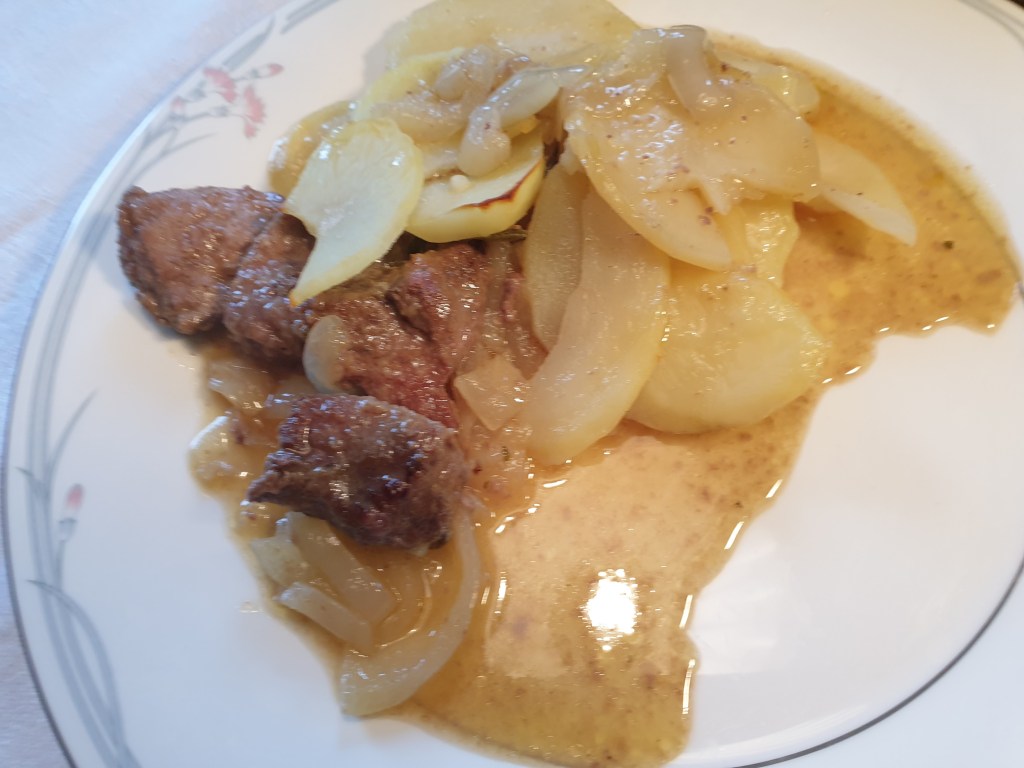
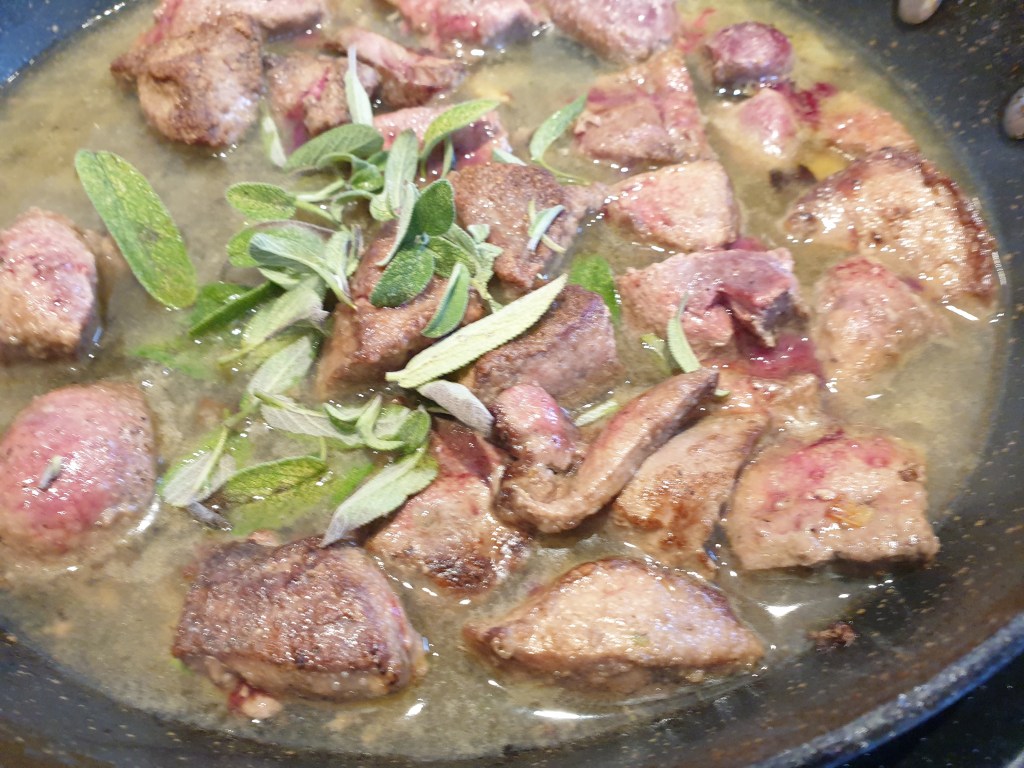
Liver & Pineapple

  • I saw a recipe for liver with pineapples and thought that it should be good.
  • It is a variation on my simple recipe in lovely liver.
  • Use lamb, ox or pig’s liver – whichever you like best.

Ingredients

  • Around 100g of liver per person.
  • 1 or 2 onions (I like lots of onions with the liver).
  • Tinned pineapples – 1 or 2 rings per person – and the juice.
  • Italian herbs
  • 1 -2 tablespoons of plain flour
  • Butter & sunflower oil to fry
  • Salt & pepper

Method

  • It is easiest to make this using 3 pans or 2 pans and a grill.
  • Fry the onions in butter & sunflower oil till golden.
  • Thinly slice the liver.
  • Coat the liver in a mixture of flour and pepper.
  • Lightly pan fry the liver slices in a mixture of butter & sunflower oil on both sides.
  • Sprinkle on some Italian herbs.
  • Add around 150 ml of  vegetable stock (can be from a cube, concentrate or powder) … depends on the size of your pan & the juice.
  • Put the lid on the pan (a glass lid is good for this) and simmer gently for 2 -3  minutes.  (The time will depend on the thickness of the slices)
  • Heat the pineapple rings on both sides on a grill or in a frying pan.
  • Add the onions to the fried liver and mix together.
  • Season to taste.
  • Put the onions and liver into a warm shallow serving dish.
  • Place the pineapple rings on top and serve.


Serve with boiled potatoes, rice or noodles.


Fruity Yeast Cake

  • This started as a recipe for buns but the dough was much too soft.
  • I decided to make it as a large flat cake ( placek) instead.
  • It has turned out similar to my aunt’s recipe for  drożdżówka  a sweet cake made using yeast.
  • This yeast cake is made with spelt flour (not strong flour) and the mixture is mixed with a wooden spoon or a Danish whisk to form a soft mixture and is not kneaded.
  • As with any recipe made with yeast, timings are so unpredictable depending on many variables including the room temperature.
  • I try to bake with yeast when I am at home for most of the day with other activities to do whilst waiting for the dough to rise.

Ingredients

  • 450g spelt flour
  • 100g granulated sugar
  • 100g butter
  • 180g currants
  • 40g mixed peel
  • 25g fresh yeast
  • Around 280ml of milk – warmed
  • ¼ teaspoon salt
  • 1 teaspoon mixed spice

Method

  • In a bowl mix the flour and salt.
  • Rub in the butter till you have breadcrumbs.
  • Stir in the sugar, mixed spice, currants and mixed peel.
  • Make a well in the centre, add the yeast and enough of the warmed milk to make a soft dough.
  • Cover the bowl and leave it in a warm place to rise.
  • The rise will not be very large.
  • Line a large baking tray with a rim.
  • Tip out the dough and spread it out to the edge of the tray with a spatula.
  • Cover and leave to rise for 30 to 60 minutes.
  • Pre-heat the oven to GM6 – 200°C.
  • Bake for 20 – 25  minutes.
  • Cool on a baking rack for 5 minutes.
  • Remove from the baking paper and put back on the rack to avoid it going soggy at the base.

Royal Doulton – Sonnet  tea plates – 1971 – 1998

As with most yeast cakes this is best eaten as soon as possible as it will soon go stale.

If all is not eaten on the day of baking, I cut the cake into slices and pack into a plastic container and freeze – these are then toasted and served with butter at a later date.

Sweetcorn Fritters

  • I have been making these for years but cannot remember where I got the recipe from.
  • Originally I used one small carton of natural yoghurt.
  • I now buy large pots of yoghurt and I use my 125ml measure instead.
  • I always use tinned sweetcorn but you can use frozen sweetcorn, cooked and cooled.
  • There are lots of ways to eat these – I often have then with grilled bacon and fried eggs.

Ingredients

  • 250g plain flour
  • Pinch of salt
  • 2 eggs
  • 125ml of yoghurt
  • 125ml of milk – some extra might be needed.
  • 1 tin of sweetcorn (340g) – drained
  • ½ teaspoon of turmeric – optional
  • Sunflower oil to fry

Method

  • Put the flour and salt into a large bowl.
  • Make a well in the centre.
  • Add the eggs, yoghurt and milk.
  • Mix together – a Danish whisk is good for this.

  • Aim for a thick batter – add a little more milk if necessary
  • Add the sweetcorn and mix again.
  • Heat a little oil in a frying pan.
  • Drop large tablespoonfuls of the batter into the pan.
  • Cook on both sides.
  • Keep warm on a plate in the oven whilst making the rest.

Variations

Add some chopped spring onions or chives to the batter or chilli flakes or chopped chilies.

Kulebiak with Cabbage & Mushrooms
  • Kulebiak is the nearest there is in Polish Cookery to a pie or a pasty.
  • It can be made with a yeast dough, a short crust type of pastry or puff pastry.
  • It is very much a large version of   paszteciki – the small savoury pastries,  which I posted in November 2019.
  • Popular fillings include cabbage & mushrooms of various sorts, hard boiled eggs and fish.
  • Many people serve this for Wigilia –  the Christmas Eve meal.
  • Sometimes the several fillings are put in as layers.
  • Here I have made it with a yeast dough with a fresh cabbage and fresh mushroom filling.
  • It is best served hot.
  • *
  • In the early part of the 20th century Auguste Escoffier, the French chef, wrote about this dish and called it Coulibiac.
  • Was this the start of dishes such as Salmon en croute?

Ingredients – Yeast Dough

  • 250g plain flour or a mixture of spelt & plain flour
  • 1 tablespoon of dried yeast
  • 1 teaspoon of granulated sugar
  • 125-150ml of milk
  • 1 egg & 1 yolk
  • 40g butter – melted
  • 1/2 teaspoon of salt
  • 1 egg white & water for a glaze

Method – Yeast Dough

  • Put 50g of the flour into a bowl.
  • Add the yeast and sugar.
  • Add enough of the milk to make the mixture as thick as double cream.
  • Leave in a warm place to bubble and froth up.
  • *
  • Place the rest of the flour into a bowl.
  • Add the salt and mix.
  • Lightly beat the whole egg  and the yolk together.
  • Add the egg mixture to the flour.
  • Add the yeast mixture to the flour.
  • Start to mix together using a wooden spoon.
  • Slowly add as much milk as needed.
  • Bring the dough together using your hands until it leaves the side of the bowl.
  • Knead the dough lightly until it is smooth.
  • *
  • Flatten the dough into a rectangle.
  • Slowly pour on the butter and fold over the dough.
  • Keep kneading the buttery dough until it is all incorporated.
  • Knead a little longer until you have a nice glossy ball.
  • Put the dough back into a bowl.
  • Cover with a cloth or a shower cap and leave to rise in a warm place.
  • *
  • Grease a baking tray.
  • Take the pastry and shape into a rough rectangle.
  • Roll out into a large rectangle around a finger width in thickness.
  • Place the cold filling in the centre lengthwise.
  • Fold the two long sides over the filling so the pastry just meets and is not too thick.
  • Fold over the short sides.
  • Turn the roll over so the “seams” are underneath.
  • Place on the baking tray, cover and leave to rise.
  • *
  • Pre-heat the oven to GM4 180 °C.
  • *
  • Lightly beat the egg white with a little water and brush this on the top.
  • Bake in the oven for around 1 hour.
  • *
  • Best served hot – but still good cold
  • Cut into thick slices to serve.

Ingredients – Filling

  • Small head of white cabbage or sweetheart cabbage.
  • 250g of mushrooms
  • 1 large onion
  • 100g of butter
  • 2 or more hard boiled eggs
  • Salt & pepper to taste


Method

  • Shred and then chop the cabbage into small pieces.
  • Chop the onion into small pieces.
  • Chop the mushrooms into small pieces.
  • Melt the half the butter in a large deep frying pan.
  • Slowly cook the onions and the cabbage but do not brown.
  • Cover with a lid and let them simmer till they are both soft.
  • Stir occasionally – you might need to add a little hot water.
  • In another pan melt the rest of the butter and fry the mushrooms.
  • Add the mushrooms to the cabbage and onion mixture and mix well.
  • Heat gently together to remove all the excess liquid.
  • Leave to go cold.
  • Rough chop the hard boiled eggs and add them to the mixture.
  • Season to taste.

Notethis might be more filling than you need – you can always freeze what is left 

Served on a vintage Pyrex platter and Royal Doulton – Carnation plates – 1982-98