Placek – Derbyshire Inspired

A few months ago I went on a craft week in Derbyshire (home of the Bakewell Tart) and as always I was looking out for new recipes and ideas.

I came across a recipe for a cake using yoghurt.  Now in the past, every cake I have made with yoghurt in the ingredients was not a success with it either being straight to bird table or straight to bin!

Anyway, I tried this one out and was really pleased with the results.

I used Greek style full fat yoghurt and I am sure low or no fat yoghurt would not do! – If using my own yoghurt I would strain it a little so it becomes thicker.

I have made a few alterations to the original recipe.

It is similar to a Polish placek (flat cake) and baked in a rectangular tray.

Ingredients

250g butter or block margarine

225g caster sugar

150ml of Greek style yoghurt (full fat)

4 eggs

1 teaspoon of vanilla essence or the fine grated rind of 1 lemon

280g self raising flour

1/2 teaspoon of baking powder

Blackcurrant jam or sour cherry jam or other slightly tart jam

50g of dessicated coconut

Method

Grease and line 22 x 32 baking tin – use 1 piece of greaseproof to do the 2 long sides and base.

Pre-heat the oven to GM4 – 180 C

Mix together the yoghurt, eggs and vanilla essence or lemon rind.

Mix together the flour and the baking powder.

Beat together the butter and sugar .

Add the yoghurt and egg mixture and beat well.

Add the flour mixture and beat till you have a unified smooth mixture.

Using a big spoon and spatula put the mixture into the prepared tin.

Bake in the oven for 10 minutes.

Carefully take the cake out of the oven and place large teaspoon ‘blobs’ of jam on the top – I did 12 teaspoons at even intervals.

Drench the top with the coconut and quickly put it back in the oven.

Bake for around another 25 minutes.


Place on a cooking rack and leave until it is cold to take out of the tin.

Cut into squares or rectangles to serve.


As a nod to Derbyshire, I used my Royal Crown Derby – Derby Posies – teaplates to serve.

They are marked  XXV which indicates 1972.

Variations

I think that the basic batter of this cake lends itself to quite a few variations – I intend to try some of these out in the coming months.

Zupa – Soup

Zupa is soup in Polish – it is a huge topic and I could easily write a book on soups alone.

The words zupa and soup originate from either the French soupe which is a broth or the German sop which is bread used to soak up soup or the Italian zuppa which is a country vegetable soup.

I intend to cook and write about soups in 2019.

Soup is traditionally the first course of the main meal of the day – served usually sometime between 12.30pm to 5pm.

For a larger occasion, the first course can be a cold starter,  followed by the soup and then the main course.

My cousins in Poland found it hard to imagine a meal without a soup to start with!


Robert Makłowicz, a Polish TV chef and cookery writer, writes  in one of his books

Polak bez zupy robi się smutny –  A Pole without soup becomes sad.

Nina Froud is a cookery book writer & editor of the 1961 & 1977,  English translations of the 1938 Larousse Gastronomique.


In an introduction to Polish food in Country Cooking, published in 1978, she wrote:

“Poles are hearty but discriminating eaters … they like food unashamedly and are clever at producing delicious dishes from simple and inexpensive ingredients.”

This I think is very true and especially so in the making of soup.


There are so many, many soups – where do I begin?

  • hot soups
  • chilled (cooling) soups
  • fruit soups
  • milk soups

12 Well-Known Polish Soups in Alphabetical Order

  • Barszcz ………….. Beetroot
  • Fasolowa ……….. Bean
  • Grochówka …… Pea
  • Grzybowa ……… Mushroom
  • Kapuśniak …….. Cabbage
  • Kartoflanka …… Potato
  • Krupnik …………. Barley
  • Ogórkowa ……… Gherkin
  • Pomidorowa ….. Tomato
  • Rosół ………………..Chicken
  • Szczawiowa …… Sorrell
  • Żurek ……………… Sour Rye

    These are just a start!


Soups are served with  Garnishes & Accompaniments


Polish Fairy Tale about Soup

My mother used to tell this story to me when I was young – I loved it then and since I have cooked myself I love it even more.

My mother would vary the ingredients so that each time she told it, it could be a different recipe!

Here is a shortened version of the story –

Once upon a time a stranger, with a knapsack on his back,  comes to a village and sits down on a path.

He gets out a little cooking pot and pours in some water from a container and lights a little fire underneath and sits waiting for the water to boil.

Whilst waiting he unwraps a shiny stone which was covered in a linen cloth and pops this into the water.

Slowly the villagers come out, curious to see what he is doing.

They ask him what he is doing – “making Magic Stone Soup – the best soup in the world” he replies.

As the water starts boiling the stranger takes out a ladle and takes a sip.

The villagers ask him how it tastes.

“Good”says the stranger “but would taste even better with some potatoes”

“I can get some potatoes” said an old man, who then went off to get them.

The stranger peeled and chopped the potatoes and added them to the pot.

After a few minutes the stranger again takes a sip of the soup, saying it tastes good but that it would taste even better with some onions.

“I can get some onions” said an old woman, who then went off to get them.

The stranger peeled and chopped the onions and added them to the pot.

….here my mother would go on adding ingredient after ingredient, varying them every time she told the story ….

The stranger again takes a sip of the soup, saying it tastes good but that it would taste even better with some salt & pepper.

“I can get that” says a young boy who then went off to get some.

When he comes back the stranger seasons the soup and declares it nearly ready.

“It just needs some flat leaved parsley to garnish it”.

“I can get some” says a young girl.

When she returns the stranger chops the leaves and sprinkles them on the soup.  

The stranger then ladles generous servings of it into bowls and handed them around to all the villagers and also has a bowl himself.

He then takes out the stone, wipes it dry and puts it away into his knapsack.


Celeriac with Prune Sauce

I have just tried another recipe  from my new Polish cookbook. It is for cooked celeriac – I adapted it slightly to make it – it is truly delicious.

Ingredients

1 large (or 2 small ) celeriac

150g pitted prunes

75g raisins or sultanas

125ml soured cream

2 -3 tablespoons of prepared horseradish sauce

Juice of 1 or 2 lemons

Salt & pepper to taste

Method

Cook the celeriac – I find steaming the best option – leave it to cool and then peel away the outer layer and cut the flesh into cubes. ( You can do this some time beforehand.)

Pre-heat the oven to GM 4 – 180°C.

Cover the raisins with boiling water and leave to soak.

Cover the prunes with boiling water and simmer them gently for around 10 minutes.


Add the soured cream, horseradish sauce, raisins and lemon juice to the prunes and mix together.


Add salt & pepper to taste.


Mix the cubed celeriac with the prune sauce place the mixture in an oven proof dish and cook for at least 30 minutes.


This goes well with hot roast meats such as chicken and especially pork.  (I have used the prune & pork combination in other recipes.)

Variations

I think this sauce would go well with other vegetables such as kohlrabi or white turnip.

Szarlotka

  • Szarlotka is the word my mother used for (apple) crumble.
  • In some parts of Poland szarlotka is the word used for an apple cake.
  • I wanted to create a cake that was cross between a cake and a crumble.
  • I have used half the quantity from my apple cake (jabłecznik) recipe as the base and then used a drier crumble type mixture – called kruszonka in Polish – for the top.
  • I have already done this  for a rhubarb cake, so I have revisted this recipe.
  • I have adjusted the recipe to use just one type of flour (plain) and one type of sugar (granulated) to make it  easier.

Apple Filling

  • You can use an apple filling with just apples and sugar with the addition of cinnamon.
  • Sometimes in Poland raisins or sultanas are added to the apples.
  • As I had some homemade, fruit mincemeat left from last year to use up (made from Delia Smith’s recipe but without nuts) before I made this year’s batch,  I added some of this to the apples.

Ingredients

  • 4 to 6 Bramley Apples
  • Granulated Sugar to taste – keep it slightly tart
  • A little water
  • 4 tablespoons of mincemeat

Method

  • Make the apple filling first, even the day beforehand as it needs to be cold before you use it.
  • Peel and core the apples and cut them into thick slices.
  • Stew the apples gently with some sugar and very little water. You can make this in a saucepan on the stove or place the apples and sugar in a dish in the oven.
  • Do not add a lot of sugar at the beginning as it does not want to be too sweet, you can adjust the sweetness at the end.
  • Do not make it too much of a purée, cook it so that you have some soft apples but with some harder less cooked chunks as well.
  • Leave this to be completely cool.
  • Mix in the mincemeat.

Note

When I have lots of apples, I cook a large amount and portion this up and keep them in the freezer –  add the mincemeat when making the cake.

Base

  • 150g  plain flour
  • 2 teaspoons of baking powder
  • 100g butter
  • 40g granulated sugar
  • 1 egg yolk
  • 1 or 2 tablespoons of lemon juice or water.

Topping (kruszonka)

  • 120g plain flour
  • 60g butter
  • 60g granulated sugar

Method – Base

  • You have to use a loose bottom or spring-form tin or you will not be able to get the cake out.
  • I use a loose bottomed anodised aluminium cake tin which is 22cm in diameter and 8cm deep.
  • Grease the tin well.
  • First make the cake base by rubbing the butter into the flour to make crumbs, then stir in the sugar.
  • Add the yolk and lemon juice and bring the ingredients together to form a soft dough – do not handle the dough too much.
  • Pre heat the oven to GM 4 – 180ºC.
  • Make the dough into a rough flat circle and press it into the base of the tin.

Method – Topping

  • Make the topping by rubbing the butter into the flour to make crumbs and then stir in the sugar.
  • Put the  apple mixture on top of the base – it wants to be quite a thick layer.
  • Sprinkle the topping crumbs over the apple mixture.
  • Bake in the oven for around 1 hour.
  • Leave to cool in the tin.
  • Use a long metal spatula to ease the cake from the side of the tin, then place the cake on to the top of a tin can and slide the side down.

Tea set here is  Woodside by Royal Grafton, 1940 – 1959

Cranberry & Pear Sauce

This is very popular in Poland, especially in the wintertime, and is served with hot roasts or cold meats and smoked sausages.

  • I cannot find any reference to when and why these two fruits were put together but they do make a good combination.
  • It is more like a conserve or a salsa  –  it is not a pouring sauce.
  • Many years ago I got a recipe from my aunty in Białystok. However I did not get around to to making this until recently, mainly because the pears in my garden are ripe in September but fresh cranberries are not  in the shops in England until around December.
  • As I could not use my own pears and I  decided to make this with bought produce.
  • The following proportions are used,  2 parts cranberries to 1 part pears (once they are peeled & cored).
  • Hard pears, such as Conference pears are best and it is better if they are ripe as they provide sweetness.
  • I find that “bought” cranberry sauce is often much too sweet and sickly.
  • It is difficult to judge how much sugar to add, I have given the quantities I used, it is easier to add some later, hard to take any away!

Version 1

This will keep for at least a week in a fridge – I pack the sauce into oven sterilised jars.

Ingredients – 1

  • 600g Cranberries
  • 300g Pears (once peeled and cored)
  • 300g Granulated sugar
  • 300ml of water

Method

  • Rinse the cranberries and drain and put them into a plastic bag, flatten the bag and place it into a freezer for 24 hours.
  • The next day, take the cranberries out of the bag and put them into a bowl and cover them with boiling water then leave them for 30 minutes and then strain them.
  • Peel and core the pears and then cut them into rough cubes.
  • Place the cranberries in a thick bottomed pan and add the pears, sugar and the water.
  • Bring to the boil, mixing often then simmer gently for around 30 minutes, still stirring often.
  • Pour the sauce into hot sterilised jars – leave them to cool thoroughly  before putting on the lids.

Version 2

This will also keep for at least a week in a fridge – I pack the sauce into oven sterilised jars – it has a “fresher ” taste than version 1.

Ingredients -2

  • 600g Cranberries
  • 300g Pears (once peeled and cored)
  • 70 -100g Granulated sugar

Method

  • Peel and core the pears and then cut them into rough cubes.
  • Place the cranberries in a thick bottomed pan and add the pears and 70g of the sugar and stir well.
  • Cover with a lid and heat gently for around 5 minutes.
  • Remove the lid and give the mixture a stir, continue doing this for around 15 minutes, when you check and stir you can test for sweetness and add up to another 30g of sugar.
  • Pour the sauce into hot sterilised jars – leave them to cool thoroughly  before putting on the lids.

Piernik with Chocolate

I came across this recipe in the book my Polish friend, who lives in Leeds, bought for me in Poland this summer.

20180916_153212


I thought it sounded interesting and I have adapted it slightly.

Piernik is a honey spice cake which has its origins in the 12th Century.

The spices used will have originaly been brought back by the Crusadors.  I make up a mixture of equal parts of cinnamon, cloves and cardamon.

Piernik in Poland is associated with the Christmas season and would be made for Christmas Eve and for Christmas Day, it would also be made for Święty MikołajDecember 6thSt Nicholas Day. This a day for present giving in Poland to children and I would always get a piernik shaped and decorated to look like the bishop that was St Nicholas.

As it is Święty Mikołaj next week on  December 6thSt Nicholas Day – I  thought this was a good day to post this recipe.

The addition of chocolate to coat the piernik is more recent. Chocolate made by Wedel in Poland started in 1851.

Here the chocolate is grated or chopped finely and added to the cake mixture.

The result is delicious and I will certainly be adding this to my Wigilia (Christmas Eve) menu.

I found grating the chocolate hard work – it was easier for me to chop this amount into very small pieces, using a cleaver type knife.

Ingredients

250ml runny honey

230g granulated sugar

2 large eggs (or 3 medium)

1.5 teaspoons of piernik spices (cinnamon: cloves: cardamon in equal amounts  so a half  teaspoon of each).

350g plain flour

2 teaspoons of baking powder

100g dark chocolate – grated or finely chopped

100g chopped mixed peel


Icing Sugar to serve

Method

Pre-heat the oven to GM3 – 160°C

Grease and line a 32cm x 22cm shallow Mermaid tin (use one sheet for the two long sides and the base).

Put the honey, eggs, sugar and the spices into a large bowl and whisk well together.

In another bowl mix the flour, baking powder, chopped/grated chocolate and the mixed peel.

Gently fold the flour mixture into the honey mixture and then mix it all together.

Pour the mixture into the tin and bake for around 1 hour 10 minutes, check it after 40 minutes and cover if it is starting to catch.

Test with a cake tester to check it is done and then leave it  in the oven for 10 minutes with the door slightly open.

Then put on a cake rack to cool.


Dust with icing sugar before serving.


Plates, cups & saucers are Lyndale by Royal Standard from the 1950s

Teapot is Café Culture by Maxwell Williams

Easy Rye Bread

I have been spending many days in the last few months trying to make a good easy rye bread.

Many of my attempts were just awful – not even good enough for the birds – more straight to the bin!

At last, I have found a recipe that is easy & it just uses rye flour and baker’s yeast & there is no kneading whatsoever!

In fact, I got some fresh yeast from my local Polish shop and this was just so lovely to use.

I made this twice, once with rye flour from the Polish shop and once with dark rye from Aldi. They both turned out well.

You just mix the ingredients together with a wooden spoon to give a wet mixture a bit like porridge.

The less you handle the mixture the better.

Ingredients

300g rye flour

10g fresh yeast (or the equivalent in dried yeast)

250ml hand hot water

1 teaspoon of granulated sugar

1.5 teaspoons of salt

1 tablespoon of caraway seeds

Method

Add the sugar and yeast to the water, mix well and leave it to start to froth.

Put the flour, salt and caraway in a large bowl and mix together.

Grease a 2lb loaf tin.

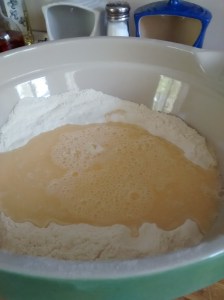
Add the water and yeast mix to the flour mix and with a wooden spoon mix well to form a unified mass.  You are aiming for a wet mixture rather like porridge.

Using a large spoon or spatula put the mixture into the prepared loaf tin.

Loosely cover the tin with cling film or similar  – a recent tip I have got is to use a clear shower cap – this allows the dough to rise without touching the plastic.

Leave the dough to rise in a warm place until dough has doubled in size (I found this took around 2 hours).

Pre-heat the oven to GM 6 – 200°C

Bake for around 30 -40 minutes – check after 15 minutes and cover with a piece of greaseproof paper if it is starting to catch on the top.

To slice the loaf, I have found that a cleaver type knife is actually easier than using a bread knife.

You can place the slices in a plastic box and they freeze very well.

Spiced Pears

I have two pear trees in the garden and this year I have had the best crop of pears ever,  both in number and size of pear.

As I do not have a place to store the fruit that is cool and dry enough,  I was looking for recipes to use the pears.

I tried this popular recipe from my great Polish standby recipe book but I found it too acidic.  I adjusted the recipe and used less vinegar and more sugar and this I find to be much better.

Ingredients

  • 1.5 kg of hard pears such as Conference
  • 300ml of water
  • 300ml of cider or white wine vinegar
  • 500g of granulated sugar
  • 8 cloves
  • 8 grains of allspice
  • Piece of cinnamon bark

Method

Clean and sterilise 2 large glass jars.

Peel and core the pears and cut into large pieces.

Put the water, sugar and spices into a large pan and gently bring to the boil making sure the sugar is all dissolved.

Add the pears and bring back to the boil,  then gently simmer until the pears are soft and translucent.

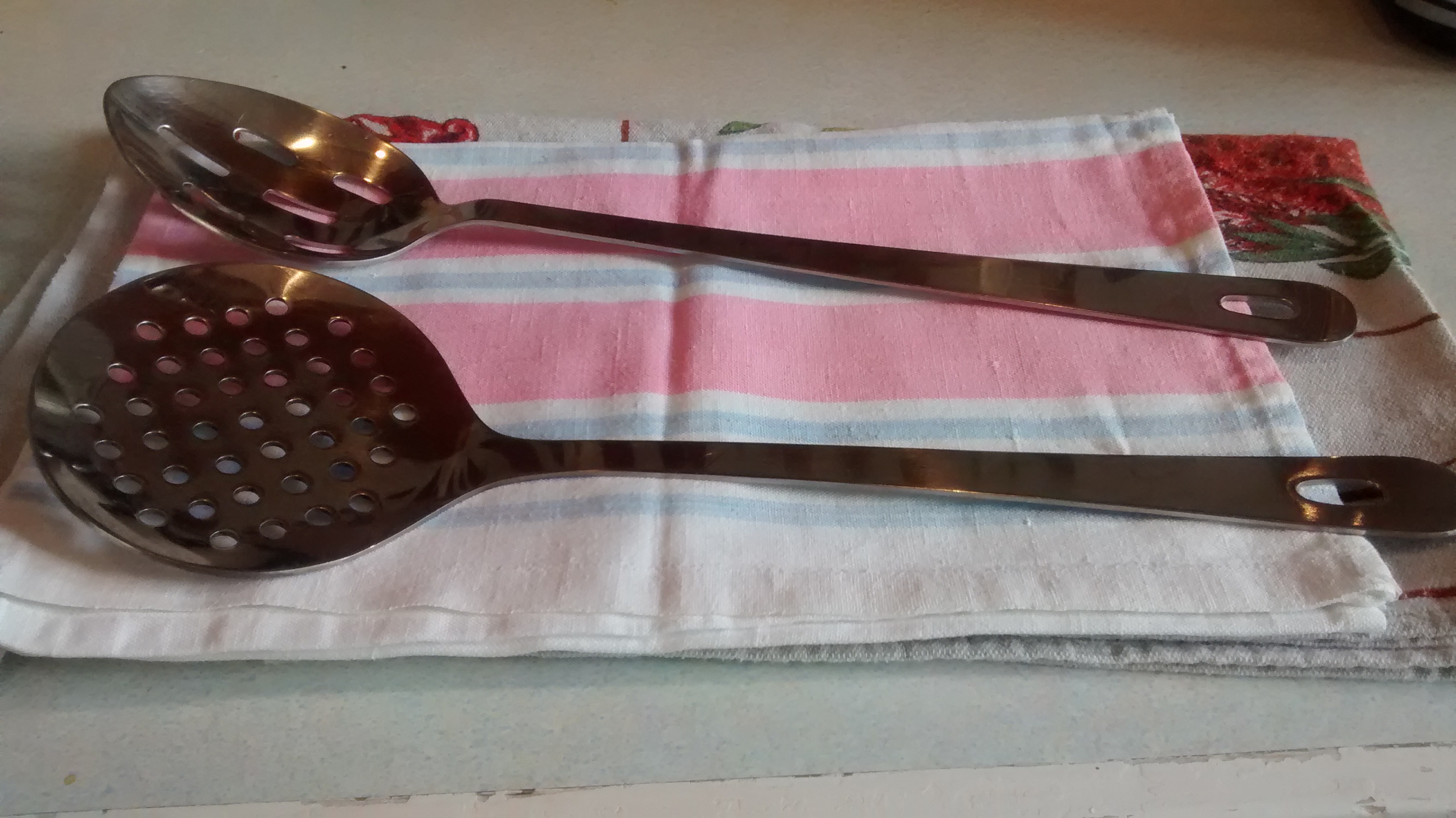
Using a slotted spoon remove the pears and divide them between the jars.

To the liquid remaining in the pan add the vinegar and bring to the boil.

Leave this on a gently boil for around 5 minutes and then leave to cool.

Use a funnel to pour the liquid over the pears.

When the jars are cold put on the lids.

Store in a cool dry place or in a fridge.

Serve with hot roasts or cold meats, smoked sausages and cheeses.

The pears can be chopped into small pieces and used in various salads.

The spiced liquid can be used in salad dressings or in marinades for meat.

Fruity Ribs

My Polish friend who lives in Leeds often goes back to Poland to visit relatives and to have a holiday.

This summer she brought me back a recipe book which covers  a year of meals (365 meals) divided into 4 sections – namely the 4 seasons.

20180916_153212


There are lots of lovely recipes in the book and I am sure I will be trying many of them.

Here are two I have tried already – adapted slightly to make life easier!

Recipe 1 (autumn)

1 or 2 racks of pork ribs

2 tablespoons of raisins or sultanas

120g of ready to eat prunes

120g of ready to eat apricots

3-4 tablespoons of plain flour

3 large onions – chopped

500ml dry red wine ( more might be needed or some extra water)

4 peppercorns

4 grains of allspice

4 cloves

1 teaspoon of  dried marjoram or Italian herbs

1/2 teaspoon of salt

3 – 4  eating apples (best if quite tart – such as Granny Smiths)

Sunflower oil for frying

Method

Place the apricots & raisins in a bowl and cover them with hot water and leave for around 30 minutes.

Pre-heat the oven to GM3 160°C.

Chop the ribs into 2 rib portions.

Put the flour onto a plate and then flour the ribs on both sides.

Fry the ribs lightly in hot oil on both sides.

Place the ribs in the bottom of a oven proof dish which has a lid.

Fry the onions until golden.

Slowly add some of the liquid from the soaked fruit and cook together mixing it well.

Add this to the ribs in the dish.

Add the peppercorns, allspice, cloves, marjoram and salt.

Pour the red wine over the rib mixture.

Place in the oven for around 45 minutes.

Cut the soaked apricots into strips and add these, the prunes and the raisins to the dish and give the mixture a stir.

Place back in the oven and cook for around 90 minutes to 2 hours until the meat is tender.

Check on the liquid level during this time and add wine or water if needed.

Remove the core from the apples and cut them into quarters (leave the skin on).

Place the apples, skin side down, on top of the ribs and place the lid back on.

Put the dish back in the oven for around 20 minutes.

When serving, place the cooked apples on top of the ribs and sauce.

Serve with boiled potatoes or rice.


Recipe 2 (spring)

Start this the evening before

Ingredients

1 or 2 racks of pork ribs

4 -5 tablespoons of runny honey

750 ml of apple juice (more might be needed)

Juice & finely grated rind of 1 lemon

100g of ready to eat prunes

3 -4  large tart apples (I used Bramleys)

3 cloves

Piece of cinnamon bark – around 10cm long

Method

Chop the ribs into 2 rib portions.

Coat both sides of the ribs with the honey and place them in a non-metal dish and sprinkle the lemon rind on the top.

Cover the dish and place it in a fridge overnight.

Next Day

Pre-heat the oven to GM3 160°C

Place the ribs into an oven proof dish which has a lid.

Add the cloves and cinnamon bark to the dish.

Peel, core and thickly slice the apples & sprinkle lemon juice on them.

Arrange the apples and prunes over the ribs.

Pour the apple juice over the contents.

Place the lid on top of the dish and put in the oven.

Cook for around 2 – 3 hours until the meat is tender.

You might have to add more apple juice when you check on the progress


Variation

Instead of ribs you might want to use slices of shoulder pork (750g  – 1kg) the method is just the same.

I tried this with recipe 2 – the one with the apple juice.


Served here with boiled new potatoes and brussel sprouts à la Polonaise.

Serving dishes  are Carnation by Royal Doulton, 1982 – 1998


More Celeriac Salads

My Polish friend who lives in Leeds, just came back from a visit to Poland and mentioned a celeriac salad with carrots and apples that she had enjoyed.

This started me thinking and I made this one and then I tried out a couple of other ones as well.

Ingredients -1

Half a celeriac – peeled

2 -3 carrots

3 apples

Lemon juice

2- 3 tablespoons of soured cream

salt & pepper

Optional

A little bit of sugar

Method – 1

Coarse grate the celeriac.

Peel and then coarse grate the carrots.

Coarse grate 2 of the apples.

Leave the skin on the other apples, remove the core  and chop it into small pieces.

In a bowl mix the celeriac, carrots and apple together.

Add the juice of a lemon and the soured cream and mix well.

Add salt, pepper and sugar to taste.


Note

I think this tastes best when made a few hours before serving.

Ingredients -2

Half a celeriac – peeled

2-3 hard pears (Conference are good)

3-4 tomatoes

1-2  tablespoons of olive oil

Juice of 1 lemon

Salt & pepper

A little bit of sugar

Method – 2

Coarse grate the celeriac.

Peel the pears and remove the core and chop them into small chunks.

Chop the tomatoes into small chunks.

Add the olive oil and lemon juice and mix.

Add salt, pepper and sugar to taste.


Ingredients -3

Half a celeriac – peeled

2-3 apples (Braeburn) are good

2-3  red peppers

1-2  tablespoons of olive oil

Juice of 1 lemon

Salt & pepper

A little bit of sugar

Method – 3

Coarse grate the celeriac.

Chop the red peppers into small squares.

Blanch them with boiling water and leave to cool.

Strain and the dry the peppers – with a clean tea towel or kitchen paper.

Leave the skin on the apples, remove the core and chop them into small pieces.

Add the olive oil and lemon juice and mix.

Add salt, pepper and sugar to taste.


Three Celeriac Salads


20180913_161228


Served in Carnation by Royal Doulton dishes from 1982 – 1998.